October 2018
Tocra
I had planned to be in Libya in the early part of October to assist with the University of Benghazi training excavation at Tocra, directed by Dr Ahmad Emrage. Unfortunately, very late in the day the University decided to cancel the season through lack of funds. Ahmad is hopeful that the Tocra training excavation for students at Benghazi and affiliated universities can be reprogrammed for the spring of 2019 at the beginning of a new financial year. I have again been invited and accepted.
Friends in Libya
Mustafa Turjman, Head of Research at the Department of Antiquities, Tripoli, is making a strong recovery following his bad road traffic accident. He acknowledges the best wishes we sent him soon after the accident and sends his best wishes to the Society.
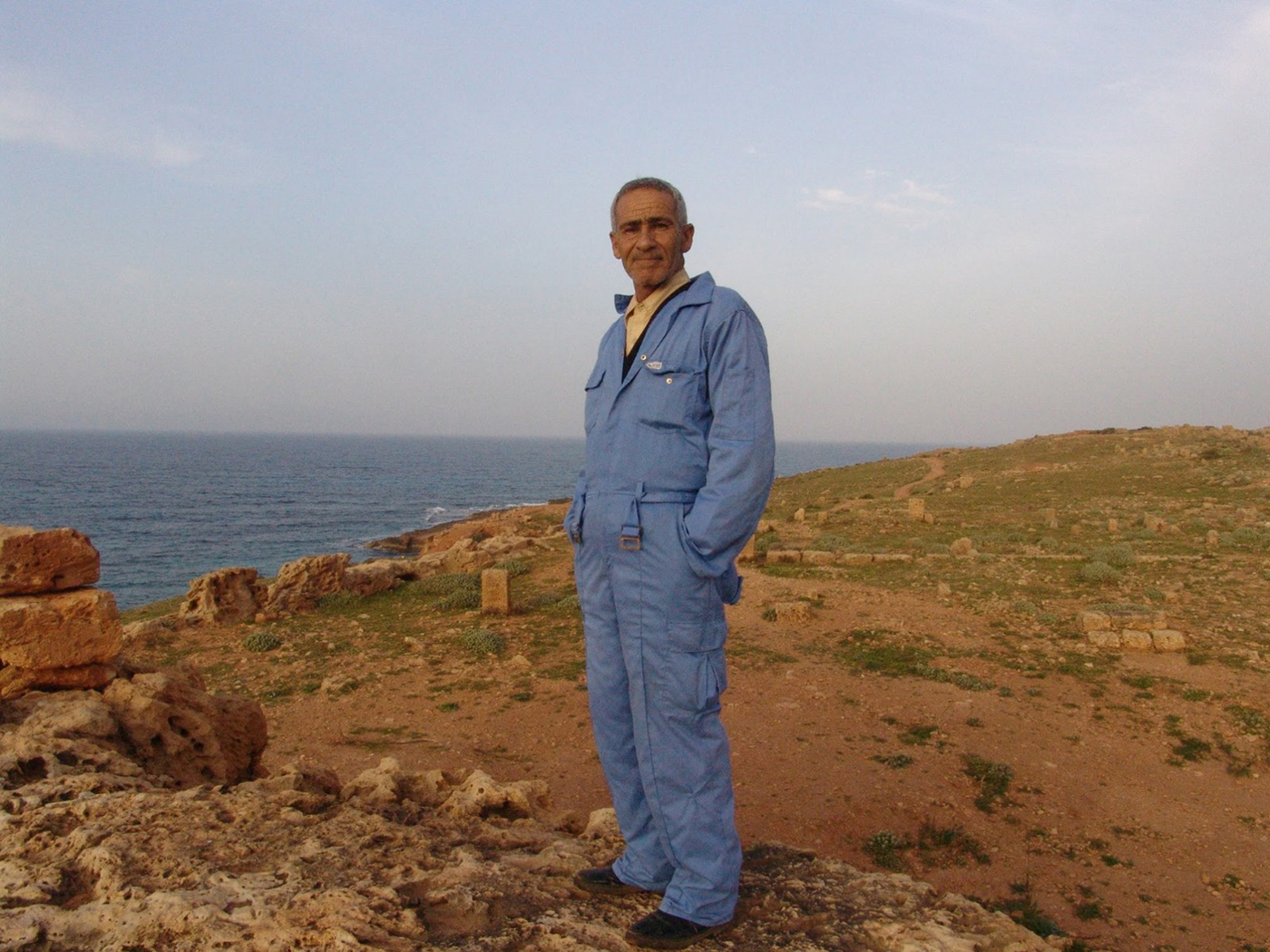
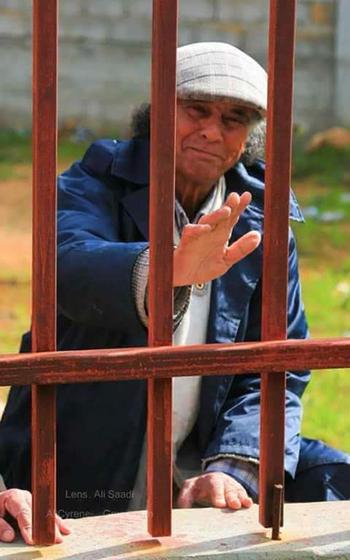
In the past months two special friends have died: Al-Mabrook Ikweineen, Controller of Susa (Apollonia) and Daoud Hallag of Cyrene. (Figures 1 and 2). Al-Mabrook (known as Ibreik to many of us) has been a long-term friend of the Society, assisting us and the French Mission over many years. He was particularly helpful to the team excavating at the Haua Fteah and with his son and colleagues has always shown us great kindness and consideration. He is a significant loss to the Department and to the community of Susa. The Society has lost a good friend. Daoud, a local historian, archaeologist, poet and philosopher, was an outspoken eccentric (particularly in dress) and always fun to be with. He had a bottomless well of stories and anecdotes and a wonderful turn of phrase. He was also a serious archaeological fieldworker, with a number of significant discoveries to his credit. The most notable being a set of chambers, partly natural but some cut into the rock, set high-up in the west cliff face of wadi Morgus, located half way between Ras el Hilal and el Atrun and approximately 27 km east of Apollonia. Here Daoud found a crude cross carved into the rock face and a worked stone representing a lion. A much lower cave contained a spring and traces of an inscription. Daoud interpreted the complex as part of a remote monastery named for St Mark. This and other discoveries were published by Daoud in Houses of our Ancestors in Arabic in 1989.
Al-Mabrook Ikweineen, Controller of Susa (photo: Hafed Walda).

Daoud Halag of Cyrene, Historian and Poet (photo: Hafed Walda).

Ghadames
I have been helping with an application by Dr Lamees BenSaad of Tripoli University for a British Council grant to undertake building assessment and restoration work at Ghadames. Warfare, neglect and recent very bad weather have had a marked effect on parts of the city. A number of co-dependent buildings have collapsed, jeopardizing the stability of adjacent properties. The project seeks to assess the present condition of the city and produce a report setting out the condition of the entire site and surrounding ‘gardens’. More detailed reports will be prepared for four properties, one in each of the four quarters of the city, which will then lead on to a programme of repair, consolidation and restoration work for those buildings. Five workshops are planned to accompany the restoration work: to train local people in traditional building techniques and to encourage local people to care for the city and its buildings, now and into the future. I informed Dr Lamees of the very successful and informative BP-funded campaigns of work at Ghadames run by Professor David Mattingly and colleagues and suggested that she should contact him. The application was unfortunately very basic and not in the correct BC format, and may thus be rejected, but I hope that the BC assessor will ask for further information and clarification that may eventually lead to a successful outcome.
Libyan publications and publicity
I have been in touch with Ahmad Emrage and Mohammed Touati, encouraging both of them to produce reports for Libyan Studies on their recent emergency excavations at Apollonia and Al Baida. Abdusalam Kawash, a lecturer in archaeology at the University of Benghazi, has offered a paper on the Ptolemais aqueduct following survey work undertaken by him in 2011 and I hope this may be accepted for a future issue.
I was asked at our last meeting whether it would be possible to get Libyan speakers for a future meeting of the Society to talk about the work of the Boy Scout movement and on the work that is taking place in Benghazi with children traumatized by warfare. Unfortunately, although it is possible to find speakers, it is next to impossible to obtain visas for them in a timescale or at a cost they or we could afford.
I now have a huge pile of Society books that can go to Libya. I have not progressed the dispatch as yet, simply because there are now so few university libraries or museums that are open to the public. In the past such locations were key distribution centres and until they are functioning again or an alternative distribution strategy has been devised, the books will remain in storage.
Civil war
The present situation in Benghazi is calm. The old city has been devastated but there appears to be no fighting and city life is slowly recovering. Plans for rebuilding the city are being discussed and Haliburton, one of the companies responsible for the Great Man-Made River Project, is one of a number of organizations discussing reconstruction with the Government.
Recent fighting between militia groups in Tripoli has ceased. Many were worried that the situation was going from bad to worse but an uneasy truce between the competing groups has been brokered mainly by local people rather than outside agencies.
Derna is under siege and intermittent bombardment by the Libyan Army and I fear that it will soon resemble the worst parts of central Benghazi. Most of the population has left the city or is on the move. So many Libyans are now refugees in their own country.
Although occasional fighting between tribal groups is reported in the south, this immense region is reasonably quiet. Worrying still however are the humanitarian problems connected with migration and continuing reports of murder, kidnap, arms trafficking and slavery.
December 2018
Ghadames
I am continuing to assist with an application by Lamees BenSaad of the University of Tripoli to the British Council for project funding to assess the present status of buildings at Ghadames, to restore and stabilize four structures and to run five workshops for local people on the restoration of mudbrick buildings and the importance of their heritage buildings. Additional information has been sent to the BC and Lamees is awaiting their adjudication of her bid. The American Ambassador's fund is also being approached for help.
Benghazi
There is no change in the status of the Medina Gadima or the University campus. Both areas are in ruins and no plans have been published to clear and rebuild the old city or the University.
However, I was contacted recently by a number of concerned Libyan friends who informed me that the Benghazi Football Club, or those running the club, are seeking to develop an area formerly part of the Harbour and the Lower City of Euesperides. The Club has sought permission for the development of 140 shops from Dr Ahmed Hussein, the Chairman of the Eastern Department of Antiquities and from his consultant Dr Saleh Aghab. Information received from Benghazi suggests that the Department is under a great deal of pressure to agree to the proposal.
I have written to Ahmed Hussein and to Saleh reminding them that the Sebkha es Selmani is of considerable archaeological importance to Benghazi and to Libya and that the area under threat contains the possible site of the Agora, the western and southern defenses of the city and the site of the ancient harbour. I went on to say that the open ground north of existing high-rise flats and south-east of the Football club, despite extensive piles of domestic and industrial rubbish dumped after 2000, even today retains visible traces of a complex pattern of streets dating back before the mid-third century BC. A more complete pattern of streets, defenses and buildings were visible in 1946 when an RAF photograph of the site was first published by Richard Goodchild.
I reminded them that much of the city has already been lost to development with only two areas left; the walled cemetery of Sidi Abeid and the eastern end of the Sebkha es Selmani. Both zones contain substantial remains of the Greek city. If these sites are developed, Euesperides, the first Benghazi, will be lost forever.
This is not the first time development of one or both sites has been attempted. To counter future attempts, the Department of Antiquities and the Society promoted the idea of creating a Public Park at Euesperides, to celebrate the surviving below-ground remains of the Greek City and in so doing, create an amenity for local people in the heart of the modern city, and a means of protecting the archaeology of the site in the long-term.
Although I would rather see the whole area laid out as a Public Park, if Ahmed and Saleh believe some form of development on the site is considered inevitable in such difficult times, then I suggested it should be possible, with careful surveying and physical evaluation, to develop a triangular block of land W of the Greek defenses, in what would have been the ancient harbour.
If establishing a park for Euesperides is totally out of the question and development pressures from the Football Club are overwhelming, I suggested that the Department restrict development to land over the ancient harbour, without impacting on the below-ground remains of the city (the line of the city wall with internal streets) and that in allowing permission for restricted development, they would be in a very strong position to establish the following set of development conditions:
• That evaluation trenching or geophysics be used to test for the presence or absence of archaeological remains in advance of the development;
• That all evaluation works be funded by the developer;
• That further evaluation trenching should be undertaken to establish that the eastern boundary of the proposed development does not impact on the footprint of the Greek city;
• That a buffer zone at least 30–50 m wide be established between the development boundary and the predicted line of the Greek city defenses;
• That on the strength of the results of the evaluation, the developer pays for a new, strong, fenced boundary to protect what remains of Euesperides up to the line of the modern main north-south road or even all that is posited to remain of the Lower City to the east of that road. Priority should be given to the land west of the road;
• To produce notice boards (at the developer's expense), explaining the importance of the site and the need to protect it.
I have offered further help, including visiting the site to advise on the ‘buffer’ zone and the fencing-off of the most important parts of the site.
Andrew Wilson and Will Wootton of the Society have written to Ahmed Hussein and I have asked others to write, including Kristian Göransson from the Swedish School in Rome.
Cyrene
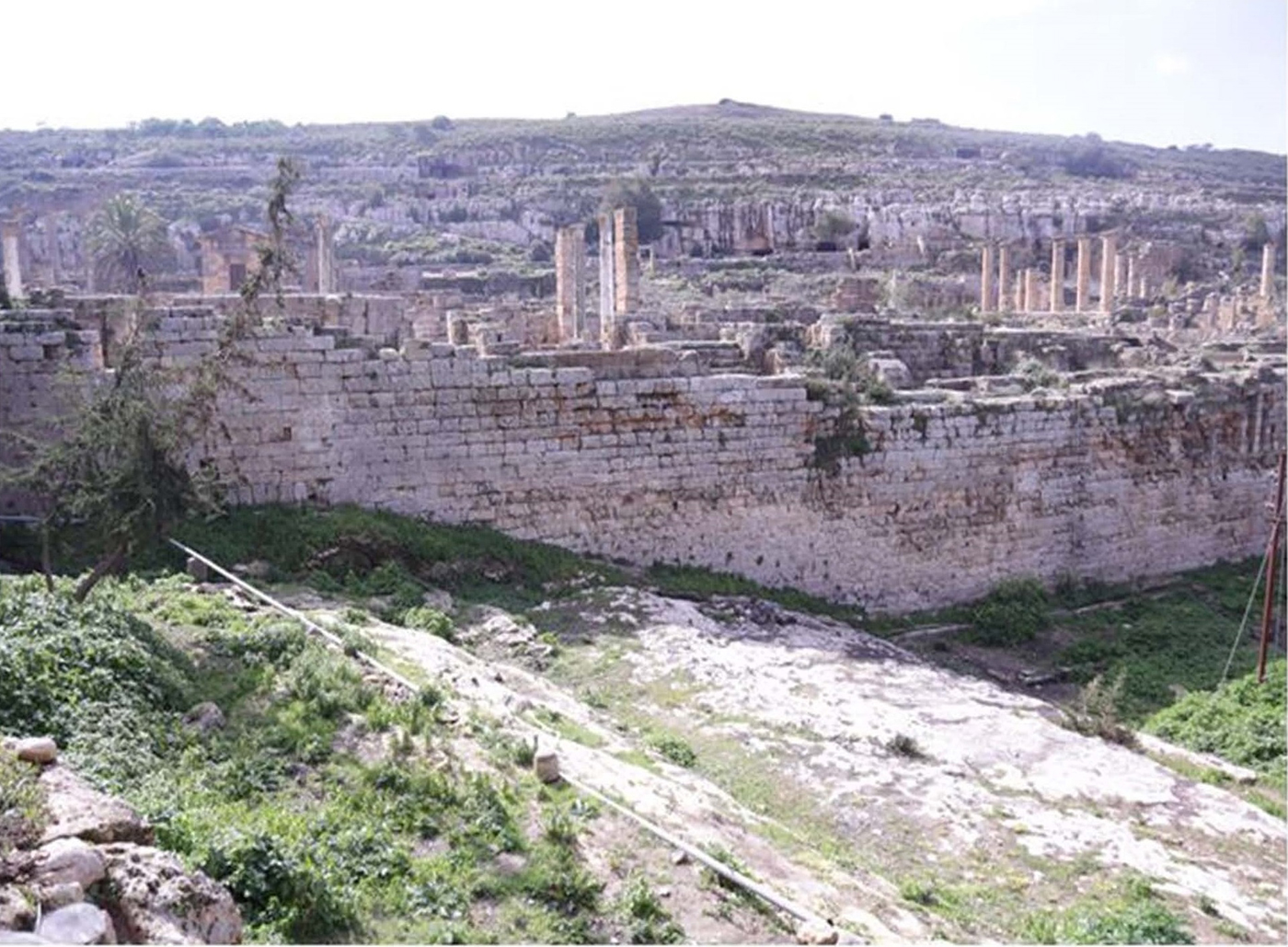
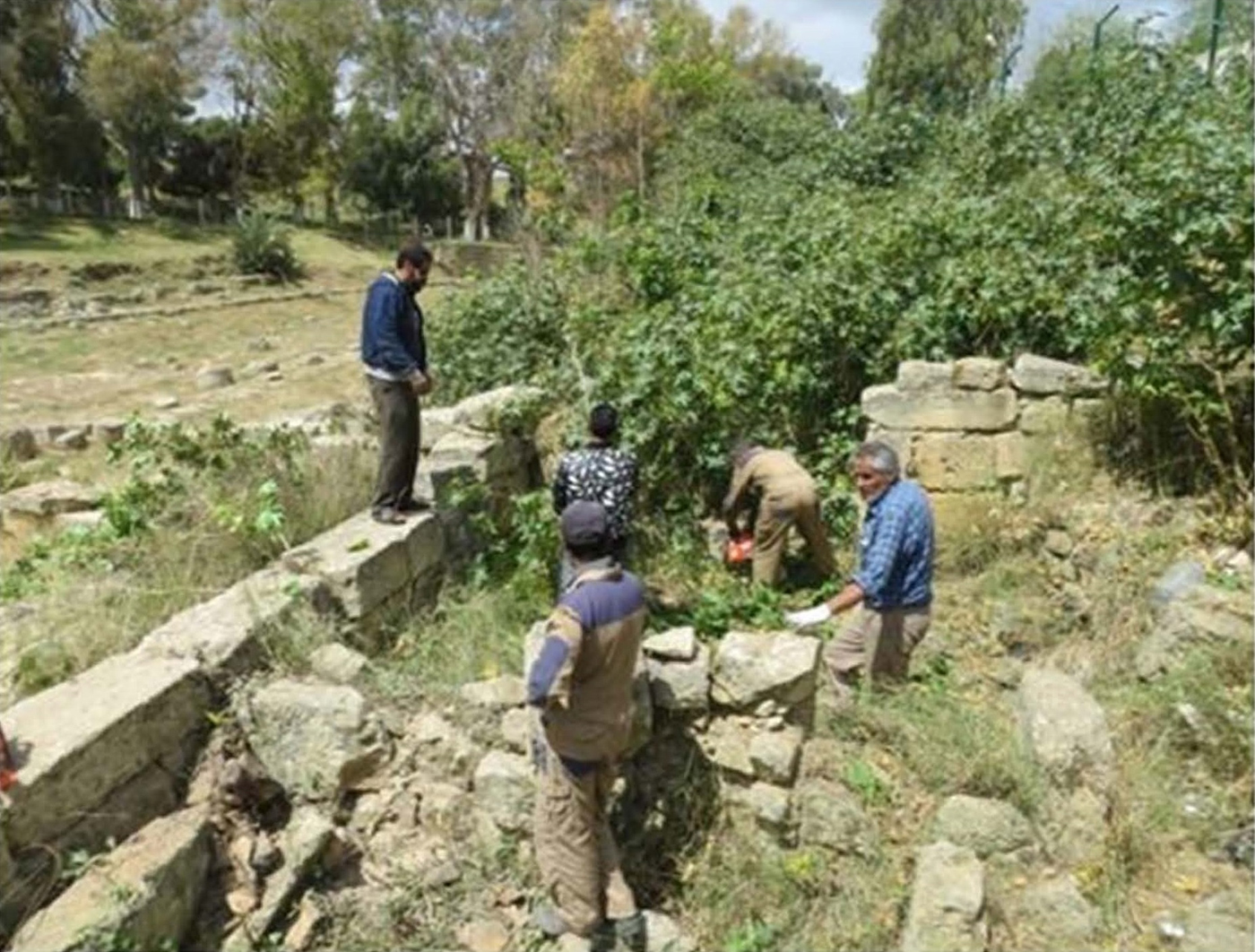
Despite the many illegal developments that beset the suburbs of Cyrene and the heritage site, the new Controller Fadl Abdulaziz continues to do encouraging work. Recently he enlisted the support of local Boy Scouts and schoolchildren to systematically litter-pick large tracts of the site. For the first time in many years the woodland plantation near the entrance to the Caravanserai and Forum, where families picnic most Fridays, is clear of rubbish. With very little in the way of resources, the Sanctuary of Apollo has been cleared of damaging vegetation and rubbish and other parts of the site are also being cleaned (Figures 3 and 4). This may not be viewed as headline news, but for those of us who know the site, it represents a tremendous achievement in local engagement and an outward sign that all the hard work that has been undertaken by Fadel and others in local schools, explaining the importance of Cyrene to the young and why it is a World Heritage Site, is beginning to pay off. Fadel is encouraging greater numbers of Libyan families to enjoy the site and learn more about it, without littering the countryside. Congratulations to him. I wish we could do more to assist.
The retaining wall at the Sanctuary of Apollo, Cyrene cleared of vegetation (photo: Fadel Abdulaziz).

Clearing of vegetation from buildings in Valley Street (photo: Fadel Abdulaziz).

Tocra
Following a renewed invitation from Dr Ahmad Emrage, I am intending to assist with the University of Benghazi training excavation at Tocra, due to take place in March 2019.
February 2019
Ghadames
I am sorry to report that an application to the British Council by Lamees BenSaad of the University of Tripoli for funding to assess the present status of buildings at Ghadames has failed. Lamees is now applying to the American Ambassador's fund.
Benghazi
A proposal by a Benghazi football club to develop a significant parcel of land adjacent to their stadium, threatening the survival of part of the Lower City of Euesperides, has been modified to protect the ancient site.
Considerable pressures had been placed on the Department of Antiquities to allow the development, but concerted efforts on the part of Dr Ahmed Hussein, Chairman of the Eastern Department of Antiquities and others, including Dr Farraj Najem a former member of SLS Council and Dr Salah Suhbi, Member of the House of Representatives of Libya have won the day.
The site was evaluated by the Controller of the Fazzan, Lamin Al-Huni about four months ago and it was found that a large part of the threatened site was, as predicted, an ancient harbour; what was open water is now sand. After a period of negotiation permission has been given for 140 shops to be built close to the football stadium, away from the ancient site. In return the football club will clear the entire area of the sebkha Es-Selmani of rubbish with archaeological supervision and build a fence around that part of the ancient site to protect it in the longer term. We are presently discussing the design specifications for the fence, including the boundary line. One of the shops will be given over to the Department for use by a site guardian. Heartfelt congratulations are extended to Dr Hussain for resolving this challenging situation. I know it is his hope that this success might eventually lead to a more ambitious scheme to protect the rest of Eusperides, preferably establishing the site as a public park.
Cyrene
A potentially difficult and divisive situation has been avoided in Cyrene. In response to requests from UNESCO for a status report on the World Heritage Site, which together with the other Libyan World Heritage sites is considered to be ‘at risk’, the Controller of Cyrene, Fadel Abdulaziz, prepared an illustrated report setting out everything his staff have achieved in the recent past working with the local community and schools to clear the site of vegetation, rubbish and graffiti. At the same time the department in Tripoli provided their own report on Cyrene, including a new plan setting out what they believe to be the core site boundaries and a proposed ‘buffer zone’. UNESCO only recognizes the Department of Antiquities in Tripoli, so there was a danger that the great work carried out by Fadel and colleagues to improve conditions in Cyrene would remain unacknowledged. I am pleased to report that with help and advice from Dr Hafed Walda the Tripoli report to UNESCO was changed to include a summary of Fadel's paper and his entire document is in the hands of UNESCO assessors as an appendix.
One late piece of news is that Fadl Abdulaziz, Controller of Cyrene, has been replaced. Fadl achieved much in the short time he was in post and will be very hard to replace. We wish the new Controller every success. Fadl has gone back to University to study for an MA in cultural resource management and we wish him well.
Benghazi
I still hope to attend the Benghazi university training excavation in Tocra in the spring and perhaps join Mohamed Touati in Balagrae for the Al Baida University training excavation a little later in the year.
Conferences and publications
I attended a conference in Verona on ancient city walls in February, and with Hafed Walda discussed the present situation in Libya with colleagues from Rome, Chieti, Urbino and Naples. Hafed and I will also attend a conference in Chieti in May. The theme of the conference is ‘buffer zones’ and I will provide a paper on the work I did some years ago to define protected zones for the Cities of the Pentapolis, Cyrene, Apollonia, Ptolemais, Tocra and Benghazi.
John Wright has given consent for the publication of an Arabic translation of his book Travellers in Libya, by Professor Suhbi. I am grateful to John for giving permission and congratulate Professor Subhi on completing the translation and arranging the publication.
Apollonia
Governments of east and west have found rare accord over a proposed development at Apollonia to build a new port next to the ancient port of Soussa. The scheme appears to have American money behind it. Plans will have to be looked at closely to determine what impact this might have on the archaeological site.
May 2019
New conflict
At the beginning of the year I had an unusual request from three retired businessmen to organize a trip for them to visit Lepcis Magna and Sabratha. I agreed to lead a short tour and with the assistance of Mustafa Turjman of the Department of Antiquities in Tripoli, and Ahmad Emrage of the University of Benghazi made all the arrangements. It is not easy getting to Libya, but all was made ready for a departure on 4 April. A week before we were due to leave, first one and then the remaining two of my party backed out of the trip. Annoying as this late decision not to proceed was, in the event my tourists proved to be far wiser than me. On the day after we were due to arrive in Tripoli, Field Marshall Khalifa Haftar and units of the ‘Libyan Army’ unexpectedly arrived in the outskirts of Tripoli. His arrival led to an immediate closure of the airport a locking-down of the city and the mobilization of local militias to oppose what was perceived as an attack by the east on the west.
The on-going and developing rivalry between eastern and western Libya is well known to all of us, but few could have predicted Haftar's move on Tripoli. I was convinced that the political situation was improving – but I was not the only one. A number of visits of European diplomats to Tripoli have been reported in the press recently to discuss improving relations and even the possible re-opening of Embassies; Vincent Michel of the French Archaeological Mission to Libya had for the first time in a long time organized a workshop in Tripoli rather that Tunisia, in this case to discuss the conservation of archives and even the resumption of tourism. Similarly, Osca Mei of the University of Urbino (for the Italian Mission) had been in Cyrene for meetings with the Department of Archaeology of the east to discuss in-country training, and Oliva Menozzi of the University of Chieti was travelling out to eastern Libya for the same purpose, at just about the same time I was due to take my party of tourists to Lepcis Magna. More significantly, the UN Secretary General was in Tripoli at that time, making preparations for a peace summit ahead of elections due to take place later this year. Part of the reason for the conference was to establish a constitutional framework for elections, with many believing that Haftar had been persuaded by France, Egypt and others to bide his time and capture the country through the ballot box. How wrong could we have been? While we were convinced that the promise of a summit and elections gave grounds for optimism; the Field Marshall opted for a military solution.
Haftar clearly thought he could expect some support from militias in and around Tripoli and that with local help and his own armed forces he could win the city quickly – and with Tripoli the country. In the aftermath of a long-term war on dissidents in Benghazi and Derna that has left both cities devastated, there has been a period of peace. Most of the east appears to support Haftar and ‘the Army,’ and there is a growing personality cult evidenced by posters on most street corners and public places in Benghazi celebrating Haftar's achievements. Recent contact with friends in the east indicates that they are ebullient, to the point that you would not know it is the same country. Facebook pages are either filled with pictures of friends coping with difficulties but enjoying life, or making statements supporting the Libyan Army and urging them on to victory.
The reality is very different. Rather than being welcomed by Tripoli's population, feuding militia have stopped fighting each other and have united to oppose Haftar's army. There are reports of heavy losses of life, air strikes on built-up areas, attacks on migrant camps and a wave of Tripoli citizens moving away from danger zones. Whether one believes all these stories or not, Haftar's army has been held and in places pushed back. Now we appear to see the beginnings of a drawn-out siege and possibly an immensely destructive war of attrition.
In the build-up to this move, Haftar has subtly taken over most of the oil installations. Another section of the Libyan Army led by his son has been active in the south, waging war on dissidents and controlling oil and water assets. So difficult has the situation become that the head of the National Oil Corporation (the corporation is an NGO, separate from either government) has warned that if Haftar attempts to control the flow of oil leaving Libya's terminals and worse, the revenue stream channelled through the NOC to east and west governments, he will destroy the economy and the country.
The situation is as serious as it could possibly be. Haftar has the best-equipped fighting force in the country with weapons supplied by Egypt, Russia and others. France has been friendly towards him and more recently, so has President Trump. There are also rumors of military advisers from a number of nations on both sides. Libya has Africa's largest proven oil reserves and is a major exporter of natural gas, so there can be no doubt that third parties are involved in this conflict, and a significant number of those covert powers believe that support for Haftar will bring stability, peace and order to troubled Libya. On the other side is the official government supported by the United Nations and increasing numbers of militia opposing Haftar. This stout resistance is potentially his undoing. He was hoping for a quick victory; it is now looking like a drawn-out siege.
Haftar used to be a supporter of Gadaffi, but fell out with him in the 1980s and fled to the USA. He lived in Virginia for nearly twenty years, spending some of that time in the employ of the CIA, before returning to Libya just before Gadaffi was overthrown. Haftar has repeatedly stated in public that Libya is not ready for democracy and this has been taken by those opposing him to mean that Haftar is simply another Gadaffi in the making. There are those who believe that this is precisely what Libya needs.
So Tripoli is under siege with a growing death rate and population movement not seen since the fall of Gadaffi. The situation is volatile and it is difficult to predict what is going to happen. Haftar's foreign backers are hardly likely to be pleased with the dramatic deterioration, but it would seem that they have no alternative but to continue to support him. The recognized Government with UN and militia backing continue to resist, with the prospect that even if Haftar does succeed, a guerrilla war will ensue thereafter. Caught up in the middle of all this conflict are significant numbers of non-combatants and the Medina Gadima (the old City of Tripoli), with an extraordinary history and wealth of buried and standing archaeology. A jewel of the Mediterranean, Tripoli is potentially another Libyan World Heritage site and we must do all we can to ensure that this conflict is ended as soon as possible.
Other Libyan projects and publications
I would like to share the achievements of a remarkable Libyan family. Ahmed Buzaian, Muna Abdulhamid and their three sons moved to Britain on a Libyan Government scholarship for Muna to study for a PhD at Leicester University in 2012. Ahmed and Muna are lecturers at the University of Benghazi and have been long-term supporters of the Society. Ahmed, who lectures in Archaeology, specializing in field techniques, was the joint Director of the Euesperides project with Professor Andrew Wilson and myself (2000–2008). Ahmed was not just ‘our friend’ in Benghazi; he provided immeasurable help and assistance to all Missions working in Libya. Muna lectures in Classics and her PhD study focused on Cyrenaican inscriptions and what they can tell us of the economy of the Province in the Hellenistic and early Roman periods. Ahmed came to Britain principally to look after the boys, but decided to study for a PhD in olive oil and wine production in Cyrenaica in the Roman period. I am pleased to inform Council that Muna Adulhamid, was awarded with her PhD by Leicester University in February and Ahmed in May of this year. An incredible achievement for both of them, with all the worries at home in Libya, and an even greater achievement given that their eldest son Mustafa, graduated with a degree in Engineering from DeMonfort University Leicester this year, and his two younger siblings are doing exceptionally well in their respective schools. They are, all of them, a truly exceptional Libyan family. The foundation of Ahmed's thesis is dedicated fieldwork undertaken over many years, involving detailed study of well over one hundred individual sites, including a significant number of hitherto unrecorded settlements. Muna's thesis is of equal importance for highlighting the number and significance of Cyrenaican inscriptions and the insights that these sources can give us into so many aspects of ancient society, not just economics. Both pieces of work are ground-breaking for Eastern Libya and I dearly hope they will be published in English and in Arabic. In these very difficult times for all Libyans, what better examples of success could the next generation of Libyan academics have to follow?
Ahmed Emrage has undertaken another successful training excavation at Tocra for the University of Benghazi and the University of Tocra. I had hoped to join them, but all of the above prevented me from travelling. I hope Ahmed will provide an article on the results of the training excavation for Libyan Studies. (Figure 5).
Mohammed Touati at the Balagrae training excavation (photo: Paul Bennett)

I have also recently learned that Ahmed has been awarded a Fulbright Scholarship to teach in the USA for a year, 2019–20. This is really well-deserved. Ahmed features regularly in my reports to Council and it is marvellous to see that his hard work and professionalism has been rewarded. I congratulate Ahmed and his family (who will accompany him to the States), and I thank Professor Susan Kane of Oberlin University and the Head of the American Mission to Libya, for making this possible.
Ahmed has been continuing to assist with the Training in Action programme led by Professor Anna Leonie of University of Durham with funding from the British Council. This is a huge success story, with long-term impact for the professional development of the Department of Antiquities and other heritage-based institutions in Libya, and better cultural resource management of Libya's world class heritage assets. I congratulate Anna and her colleagues for their continuing application and enthusiasm.
Ahmed Buzaian is translating Philip Kenrick's magnificent archaeological guide to Cyrene into Arabic. The English language version was published by the Society in 2013. Packed with summaries of the most important archaeological sites in Cyrenaica, with superb plans and illustrations, the book will have an undoubted impact in Libya when it is published in Arabic. We are all indebted to Ahmed and to the generous sponsors, Marigold Norbye and Olwen McNay who are supporting the translation and publication.
There are still a few bright lights in all this ‘gloom’.