Introduction
This is the third article dealing with Pashto preverbs. The first two articles focused on all simple verbs containing a preverb of Iranian origin.Footnote 1 Generally, these preverbs are fully assimilated and have left just slight traces of their presence. A simple verb is a verb that, in its perfective forms, prefixes wə́- which always bears the stress.
The list of preverbs treated here begins with XIV: indeed, this article is intended as a continuation of the previous two. The first of this series dealt solely with verbs formed with the preverb *ā-, while the second dealt with all verbs formed with the other 12 preverbs, from II to XIII.
In this article I will treat all members of the “compound verbs with preverb” class. Compound verbs with preverbs are a closed set, defined in De Chiara and Septfonds (Reference De Chiara and Septfonds2019: 166) as “Verbe Composé formé sur un préverbe (directionnel ou relateur) + un autre Verbe Simple”. Compound verbs are verbs whose perfective forms never prefix wə́-, but rather move the stress onto the nominal base or, in our case, onto the preverb.Footnote 2
Only seven preverbs, plus the three directional pronouns, are used to form the compound verbs with preverb: XIV. byā-; XV. cə-; XVI. kxě-; XVII. nəna-; XVIII. prā-; XIX. pre-; XX. pore-; XXI. directional pronouns: rā-, dar-, war-.Footnote 3
For the most part, these preverbs are still in use in contemporary Pashto as adverbs and preverbs, in particular: byā “again”, kxě “in”, (də)nəna “inside”, pore “till” and pre “on”.
The etymologies proposed in this article (a in the preceding two) are sometimes uncertain, such as that of prānistə́l: this does not invalidate the thesis contained in this research.Footnote 4
XIV. PIr. *apy-ā- > Pšt. byā-
= Skt. apy-ā- (see De Chiara Reference De Chiara2022a [2023] and Reference De Chiara2022b [2023]). In Pšt. there is a byā “again, anew; after that, then; back”, which is also considered to be a preverb “re-”, “indicating renewal or repetition of an action” by Aslanov (Reference Aslanov1966) (see Pashtoon Reference Pashtoon2009), also quoting two verbs: بياموندل “a. to find again; b. to acquire, gain; c. to return; d. to restore” and بياتنظيمول “to reorganize”.
Apparently, Morgenstierne changed his mind on the etymology of byā. Indeed, while in EVP (p. 16) he derives it from Av. apaya “again, later on”, in NEVP (p. 16) he considers it a loanword from IA, and compares Panj. Lhd. biā “again” (cf. T6680 dvitīya “second”: Tor. bī “again”; Lhd. bī, biā “second, another”, adv. “again”).
The etymology originally proposed by EVP seems to me more fitting: however, this does not change the point of the question. Indeed, in the usage of byā- as a perfective preverb, which occurs only with the verb mindəl/mundəl, there is no difference at all in the semantics between the imperfective and the perfective forms.
Aslanov (Reference Aslanov1966) (in Pashtoon's English translation) translates the simple verb mində́l/mundə́l “to find, reveal, discover; to obtain; acquire, gain, win; to procure, get; attain”. He also mentions a verb byāmində́l/byāmundə́l, translated “to find again; 2 to return; 3 to acquire, obtain; 4 to restore (e.g. independence)”.
The notion of “re-, again” added to the verb byāmundə́l is obvious, but this verb does not exist: indeed, the notion of “again” is here implied by the adverb and not by the preverb. Aslanov (Reference Aslanov1966) also adds an example: ورپسې ډېر وگر  لاکن بيا مي نه موند [wərpse ḍer wə́gərjedəm, lākin byā́=me=nə-mund] “I looked for him a long time, but again I didn't find him.” The translation “again” in this example is certainly wrong: byā- here is simply a preverb without any semantic value and not the adverb byā “again”, which can be used with every verb.
This preverb byā́-, not to be confused with the adverb byā, could simply be the result of the fusion of the two preverbs *api and *ā. As we saw in “Pashto preverbs, I and II” (see De Chiara Reference De Chiara2022a [2023] and Reference De Chiara2022b [2023]), *ā- is always stressed. This combination is already attested in Skt.: cf. apyāhṛ- (Potential ápy ā́ haret) “to take or assume in addition”, where the meaning of the preverb is “in addition”.Footnote 5
mində́l/mundə́l: mími/múmi میندل \ موندل tr. “to find, reveal, discover; to obtain; acquire, gain, win; to procure, get; attain” (Pashtoon Reference Pashtoon2009)
1. “trouver” (Akbar Reference Akbar2015)
“to find, find out, get, meet with, fall upon, trace, get at, stumble upon, detect” (Raverty Reference Raverty1860)
“
 ، موندل، پيدا کول، ترلاسه کول ” (PP)
2. This verb, irr., is used in all Pšt. dialects. In De Chiara and Septfonds (Reference De Chiara and Septfonds2019: 66–7) it is classified as a “mixed verb” (“6 verbes qui partagent des traits avec les verbes simples à l'imperfectif et des traits avec les verbes composés au perfectif. On distingue deux catégories de VM : 3 Verbes Mixtes Dénominatifs et 3 Verbes Mixtes à Préverbe”: De Chiara and Septfonds Reference De Chiara and Septfonds2019: 166), as the perfective forms of this simple verb (in the imperfective forms) were formed with the preverb byā́-, instead of with wə́-, with the resulting paradigm seen in Table 1.
The verb behaves normally, with the usual separability between the preverb and the rest of the verb (byā́=ye-mund) under certain conditions. However, nowadays, in the majority of dialects, the verb has been regularized and the perfective forms are regularly formed with the preverb wə́-, with the resulting paradigm seen in Table 2.
The semantics of the perfective forms formed with byā́- do not change the meaning of the verb. The alternation between -nd-: -m- in the past/present stem is isolated.
3. Etymology: < *ham-wán-ta-: *ham-áf-nau-? This hypothesis is quite uncertain. Four roots, all prefixed by the preverb *ham-́, seem to fit here: a) **am- “to take”; b) *waid- “to find”; c) *wan- “to win”; d) *ap- “to reach, attain”.
a) **am- “to take”: according to Morgenstierne's proposal (EVP 44–5), we could imagine a **ham-am-ta-: **ham-am-. But this root is attested only in Skt. sam-am- (Ā. -amate) “to ask eagerly, solicit, win over; fix or settle firmly; ally or connect one's self with” (Monier-Williams Reference Monier-Williams1899: 1156): even if the meaning and form seem to fit well, the root is apparently not attested elsewhere (with the possible exception of Lat. emō: cf. infra) and in Skt. itself a root *AM- does not exist (indeed *am- and sam-am- are absent in KEWA and EWAia). No attestations exist in other Iranian languages.
Another point of incongruity is the vocalism in Pšt. with -u- (the vocalism with -i- can be considered a dialectal peculiarity of the Middle zone), which remains unexplained by this root. Indeed, Pšt. -u- can only be derived from *-u- (cf. lur لور “daughter” < PIr. *duxθr-; sur سور “red” < PIr. *suxra-; gúta گوته “finger” < PIr. *anguštā-), *-ū- (γul غل“excrement” < PIr. *gūta-; lu لو, lugáy لوگی “smoke” < PIr. *dūta-) and *-aw-N- (γúna غونه “hair (of the body), pore, colour (of the skin)” < PIr. *gauna-; γúnde غندی “alike, similar” < PIr. *gauna-tā- “like-ness”).Footnote 6
The comparison with Lat. emō “to take, buy” proposed by EVP does not appear very convincing. According to de Vaan (Reference de Vaan2008: 188), it would derive from IE. *h 1em-e/o- “to take”, pf. *h 1e-*h 1m-, with the following cognates: Umbrian emantur, emantu; Oscan emmens “to buy, take”; Old Irish ar⋅foim “to receive, allow” < *ari-wo-em; Old Prussian īmt, Lith. im̃ti; Latvian jem̃t “to take”; OCS jęti; Russian jat' (dialectal) “to take, begin”.
b) *waid- “to find”. This root, which is the most fitting in terms of meaning, is found in many IIr. languages (cf. Cheung Reference Cheung2007: 409–10 waid- 2 “to find”): Av. vaēd- “to find”, pres. 3pl. viṇdəṇti, perf. pass. vista-; MPrs. w(y)nd- “to find, obtain, gain”, pres. nwny(y)d, part. perf. pass. w(y)nd'd, Prth. w(y)nd- “to find” (Ghilain Reference Ghilain1939: 83); Par. γun-: γunt- “to find”; Skt. ved- “to find, discover”; Skt. vid- “to find, discover, obtain, get, acquire”, pres. vindáti, Skt. saṃ-vid- “to find, obtain, acquire” (Monier-Williams Reference Monier-Williams1899; KEWA III 214; EWAia II 579–81). Cf. also Darmesteter (Reference Darmesteter1888–90: XLVI n. 2) < *nvūndǝl < Av. vid-, vindaiti (cf. also EP 153).
However, this etymology should be rejected, as the paradigm would be **ham-wista-: **ham-vid- > Pšt. **mu/istǝl: **mu/il-: neither of the two proposed stems would fit Pšt. mundǝl: mum-.
c) *wan- “to win”. This root is widely attested in all IE. languages: among the IIr. languages (cf. Cheung Reference Cheung2007: 417–18), cf. in particular Oss. I. awwandyn, D. awwandun “to (en)trust, believe” (+ *ham-). Cf. also Skt. van- “to win, conquer”. From the formal point of view, this root can easily explain the past stem (*ham-wan-ta- > Pšt. mundǝl), but not the present stem.
d) *ap- “to reach, attain”, according to the new proposal of Morgenstierne (NEVP 50). The root *Hap/f- (cf. Cheung Reference Cheung2007: 161–3) has many IE. cognates and, among the Ir. comparisons, we find Orm. waw-/wōk “to obtain, find” = wa-wók “to find”. Cheung (Reference Cheung2007: 163) adds that “The long vowel in many Ir. forms points to an old perf. Formation.” Cf. also Skt. sam-āp- (pres. āpnoti Footnote 7) “to acquire or obtain completely, gain; accomplish, fulfil; reach; etc.”.
The starting point for the present in Pšt. would be *ham-af-nau-. The problem here derives from the last -m-: *-fn- > Pšt. -m-? This would be confirmed by the derivation of Pšt. šúma شومه “the watch between midnight and daylight, food taken at that hour” from PIr. *xšafna-. On this matter, cf. EVP 74:
šūma “the watch between midnight and daylight, food taken at that hour”, Waz. šīma, Khl. šūma – Horn (768) considers šūma to be borr. from Prs. šām < Av. xšā̆fnya- “supper”. If dūna < *hantafnā- (…), šūma must be borr., but this derivation of dūna is not certain. fn becomes m in Minj. xšḗma “supper”. Psht. -ūm- might be derived from *-afn-, but scarcely from *-afny-. If borr., ū proves it to be an ancient lw. In most lw.s š is represented through ṣ̌, in recent ones through š. šūma must eventually have been borr. from an early Phl. form *xšām, cf. Turk. axšam, Georg. vaxšami – Shgh. ṣ̌ūm “evening” also is prob. borr., in spite of its vowel (in more recent lw.s å̄n, å̄m), on account of the m, as *fn becomes *vn > δm in xūδm “sleep”.
And NEVP 79:
šúma f. ARS, Bellew “the watch between midnight and daybreak; food taken at that time, supper” – Most likely an early LW < Prs šām rather than direct from Av. xšāfniia- “supper” with Horn no. 768. Thus also Sh. x̌ům “evening” (EVShG 102, s.v. x̌ēm), but Turki axšam, Georgian vaxšami are LWs < earlier Ir forms with xš-.
Obviously, Morgenstierne's statement that “ū proves it to be an ancient lw” is inconsistent, ū being a simple transliteration just indicating the presence of و in the Pashto script and has nothing to do with a presumed opposition of length between u and ū. A contrary case to šuma, however, is possibly represented by dúna دونه “bonfire”, according to EVP 80 derived < PIr. *hantafnā-, while according to NEVP 22, it is a loanword from IA.
4. NEVP 50: < *ham-af-nau- (with secondary past), cf. Skt. sam-āpnoti “acquires”. EVP 44–5 < *ham-am-, cf. Skt. sam-am- “to ask eagerly, to win over”, Lat. emo. Darmesteter: “? < *nwūndəl < Av. vaēd-, vindaiti”. EP 153 has only “?”. This verb is absent in Cheung (Reference Cheung2007).
 ، موندل، پيدا کول، ترلاسه کول ” (PP)
Former paradigm of mindəl/mundəl.

Regularized paradigm of mindəl/mundəl.

XV. PIr. *hačā-? > Pšt. cə-
= Skt. sacā “near, at hand, along, together, in presence of, before, in, at, by”; = Av. hačā. In Pšt., we have only one instance of this preverb: camlāstəl. As expected, *ha- was lost in Pšt., while *-č- regularly > c-. = Mnj. žə, Yd. že, žo, žə, Yzg. ž(ə)-/s(ə)-, Sogd. “č, č”.
In Pšt. this preverb appears in the verb cə·mlāstəl : cə·mli “to lie down”, intr irr, and its corresponding transitive cə·mlawəl : cə·mlawi.
camlāstə́l: cám(ə́)li  intr. “to lie down for a bit, have a nap” (Pashtoon Reference Pashtoon2009)
1. “se coucher” (Akbar Reference Akbar2015), cf. also mlāst “couché, allongé” (Pashtoon Reference Pashtoon2009)
“to lie down, recline, repose, be recumbent” (Raverty Reference Raverty1860)
-ويده کېدل، بيده کېدل، ۲ اوده کېدل ۱” (PP); “پرېوتل، غزېدل، خورېدل، (٢) مغلوبېدل، ماتې خوړل، (٣) لټ کېدل، ناړامه کېدل،
” “غزېدل، ۳ مغلوبېدل (Daryāb Reference Momand1994)2. This verb, irr, is used in all Pšt. dialects. In De Chiara and Septfonds (Reference De Chiara and Septfonds2019: 66–7) it is classified as a “compound verb with prefix” (“Verbe Composé formé sur un préverbe [directionnel ou relateur] + un autre Verbe Simple”: De Chiara and Septfonds Reference De Chiara and Septfonds2019: 166). Its verbal element, *ml(āst)əl, does not exist elsewhere (but cf. also pre·mištəl).Footnote 8 However, according to Aslanov (Reference Aslanov1966) there exists a VSS mledəl (not attested elsewhere), which would be regularized as cǝ·mledəl : cǝ·mli. The place of stress in the present stem is established by Dybo (Reference Dybo1989: 116).Footnote 9
The transitive cə·mlawəl : cə·mlawi, “1 to lie down in bed, lie down and go to sleep 2 to throw down; to roll on the ground (in a fight)”, is a regular secondary formation on the irr cə·mlāstəl: according to Aslanov (Reference Aslanov1966), the perfective past of this secondary formation would be wə́=ye-camlāwə, with the perfectivizing preverb wə́- as for the simple verbs.
Conversely, in camlāstəl the perfectivizing sf. wə́- is not used: according to PP the future (= +2e) is
به ملي , with cə́- in the perfective, while in Aslanov (Reference Aslanov1966) no information on the perfective is provided.The dictionary of Akbar Reference Akbar2015 also quotes a verb nmāstəl, with the meaning “se coucher” (in Daryāb it is considered identical to لماستل , with the same meaning): it is obviously analysed as a secondary derivation from camlāstəl.
3. Etymology: < *hačā́-ni-pásta-: *hačā́-ni-pad-?, according to Morgenstierne's hypothesis of an evolution *nipáδati > *nvaδti > *mla (Morgenstierne Reference Morgenstierne1923a: 274–5, Reference Morgenstierne1923b: 206–7, EVP 17, NEVP 49). Morgenstierne (Reference Morgenstierne1923a: 274–5) also acknowledged the presence of the preverb *hačā- in this verb: “Though we do not meet with other cases in Psh. where derivatives of hača are used as preverbs,Footnote 10 I think this is the most satisfactory explanation. […] In camlāstəl ca- would be used in a weakened, general sense ‘away, down’”.Footnote 11
After careful analysis, this proposalFootnote 12 proves to be the most plausible, if unsatisfying. Many points remain unexplained, in particular the presence of -l- in the past stem and the hypothetical outcome *-n(V)p- > -m-: according to Morgenstierne's proposal, *-n(V)p- weakens to *-nv- and finally becomes Pšt. -m-, but no other instances of this outcome are found in Pashto.
The main argument in favour of this etymology is the comparison with Ormuṛi. Morgenstierne quotes this comparison with Orm. K nwastak “to lie down” (Kan. nwastak “to lie down, go to sleep” < *ni-pad-, IIFL I 403), and we can add Munj. nǝliv-/nuvōst- “to lie down” and Yi. nuwṓstiy “lying down” (cf. Cheung Reference Cheung2007: 287). Cf. Efimov (Reference Efimov and Baart2011: 293): Kan. nw- “to lie down (to sleep)” (4th conj.) < PIr. *ni-padyá- or *ni-paθyá- (class IV) from *pad-, paθ- “to fall”, *ni- (movement downwards), cf. Av. pad-, paθ- id.; Kan. nwástak “to lie down (to sleep)” < PIr. *nī̆-pastá- + *-ka from PIr. *pad- < IE *pē̆d-, *pō̆d- (Pokorny Reference Pokorny1959: 790–1), cf. Av. pad- “to fall”, with preverb nī- “to lie down”, Parth. ’mbd /am-baδ-/ “to fall down” (Ghilain Reference Ghilain1939: 53) and Khot. nuvad- “to lie down” < *ni-pada- < *ni-pad- (SGS 58).
Concerning the root *pad- “to fall, be stuck in” (Cheung Reference Cheung2007: 287–8Footnote 13), we can quote Av. paδ/θ- “to fall, be stuck in”, and in particular the same root + *ni- “to lie, lay down (esp. to have sexual intercourse)”, exactly corresponding to Skt. ni-pad “id.” (Cheung Reference Cheung2007: 287).
The strongest argument for this hypothesis is its explanation of Pšt. -st-, which remains unclear under other proposals. Indeed, a “suffix” -(ā)st- is attested only in two CVP, camlāstǝl and kxěnāstǝl (and we could add also prānistǝl), while the other simple verbs in which this-st- is present have a different origin.Footnote 14
However, this same ending -āst-, found only in the past stem of camlāstəl and kxěnāstəl, is very interesting: might it be the remnant of an ancient suffix? It should be noted that the two verbs have similar meanings and formal structure: the former means “to lie down for a bit, have a nap”, the latter “to sit down, take a seat”, both displaying the “suffixes” -āst- exclusively in the past stem. The meaning “down” would be provided by the preverb *ni-. In Table 3, I tentatively place the two verbs in parallel.
I put in bold and underlined the elements without explanation. In both cases, the comparison with Orm. seems enlightening: indeed, we find there:
Orm. nwástak: nw- “to lay down (to sleep)” Orm. nastak: n(ay)- “to sit down”
We could imagine a secondary past, on the basis of the present stem in camlāstəl (< *camastəl), with a simplification of the present stem in kxěnāstəl (*kxěnəli > kxěni): the second point would be proved by the pres. stem in Orm.: n-/nay-, where the form nay- is regularly derived from *n(i)-(h)ad-, but with a tendency to further simplification. In Orm. this phenomenon is also regular in the first case: we could imagine that the present stem could have been nw-/nway-, with the same derivation of the second form from *n(i)-pad-, with a further development to nw-. In Pashto, however, not only do we find an intrusive -l- in the past stem of camlāstəl, but in the past stem of both verbs we find an unexpected lengthening of the radical vowel: -ā- instead of the expected -a-.
Even more tentatively, we could compare the verbs with sf. -ed- (= Prs. -id-), as rasedəl, garjedəl, osedəl and so on: in these verbs, the sf. -ed- is used, as in Persian, only in the past stem, while in the present stem it is absent. Indeed, we find rasedəl: ras-, garjedəl: garj-, osedəl: os- etc.Footnote 15 Could we compare, at least typologically, also kxěnāstəl: kxěn- and camlāstəl: caml-? On this basis we could imagine an initial influence from rasedəl: ras-, followed by a reciprocal influence between the two verbs, motivated by a certain similarity of meaning, with the resulting two phases shown in Table 4.
The model rasedəl: ras- influenced *kxěnāstəl: *kxěnəl- in the direction of the suppression of the presumed sf. in the present stem. Even if -l- is regularly derived from *-d- (if the derivation from root *hasta-: *had- is correct), *-āst- could have been analysed successively as a sf. and not simply as the regular evolution of root *ni-had- in the past stem, also on the basis of comparison with the semantically quite close camlāstəl. Phonetic reasons may also have played a role: while -ml- in camlāstəl is quite easy to pronounce, unlike *-nl-, this may have contributed to the suppression of *-l-. The parallel with ras- could have encouraged this change (cf. once again Orm. n-). Finally, if the verb kxěnāstəl: kxěn- was perceived as a regular verb with a sf. -āst- in the past stem, on the model of rasedəl: ras-, where in the past stem we find the sf. -ed-, should *camāstəl, also similar in meaning, not show a similar process? Thus, we propose the subsequent reanalysis of the present stem caml- as a regular present without the past sf. -āst- and the substitution of *camāstəl with the “regular” camlāstəl. Indirect support for this reconstruction could come from the variant of camlāstəl provided by Aslanov (Reference Aslanov1966) and quoted above: camledəl can be considered either a secondary formation on the transitive camlawəl or, even better, a proof of the equivalence between this “suffix” -āst- and the real sf. -ed-.
As a final remark, we can note that both verbs, kxěnāstəl and camlāstəl, are perceived to include the preverbs kxě- and ca-, but the other preverb *ni- has been obscured and merged totally with the radical.
4. Morgenstierne (Reference Morgenstierne1942b: 264) derives the verb mledǝl < *miθa(ya)-; Cheung (Reference Cheung2007: 260 s.v. *maiθH- 1 “to dwell”) quotes a Pšt. verb mǝl- “to stay, dwell” and Pšt. mēšt “settled, residing”, and in the same entry he quotes Av. miθ- “to rest, dwell” and the form (with “?”) and YAv. mitaiiatu (“The inclusion of YAv. mitaiiatu is uncertain, it may go back to (pre)IIr. *mitṇHi̯a ° > Ir. *mitāi̯a ° >Av. mitaiia° (shortening of ā in front of *i̯)”, Cheung (Reference Cheung2007: 259): cf. Kellens (Reference Kellens1995: 45) mit- “demeurer”, pres. mitaiia-, 2nd pres. miθnā-. The verb məl-, cited by Cheung above, is the Suffixed Verb (nowadays no longer used) mledə́l: mli “to live, settle, sojourn” (Pashtoon Reference Pashtoon2009).
Cheung (Reference Cheung2007) also provides a comparison with OCS mě̀sto “place”, Ru. mesto, etc. Derksen (Reference Derksen2008: 313) states that “As observed by Fraenkel (I: 460), the problem with the connection with Lith. mìsti ‘feed, live, stay’ is that the acute tone of the root of *mě̀što is left unexplained. The same holds for the etymology advocating a t-enlargement of Skt. may- ‘fix, build’, mitá- ‘built, established’. To my knowledge, there are no satisfactory alternatives.”
Most probably, the two verbs camlāstǝl and mledǝl should be kept separate and attributed to different origins, while the substantive mlāst “prone, lying down” would be a secondary derivative from camlāstǝl on the model of nāst, in any case with awareness of the different nature of the preverb ca-, which indeed behaves as a preverb in the perfective forms, with consequent separability and stress. The main weakness of this proposal is the unexplained origin of -st- and the simultaneous presence of -l- and -st- in the past stem.Footnote 16
 ” “غزېدل، ۳ مغلوبېدل (Daryāb
 به ملي , with cə́- in the perfective, while in Aslanov (
Paradigms of camlāstəl and kxěnāstəl.

Evolution of camlāstəl and kxěnāstəl on the basis of the model of rasedəl.

XVI. PIr. *kašai- > Pšt. kxě-
The preverb kxě-, is, according to Morgenstierne (NEVP 41) “1. adv. (pa kxě ‘inside’); 2. postp. (usually with prep. pa) ‘in’; 3. preverb”.
In the Pšt. dialects kxě- is very often pronounced ke-: “In most dialects, even in the ‘soft’ ones, pronounced kē, e. g. ordinary Waz. kē, but Ms. kšē” (EVP 34); “in most dialects ke, Kak ke, kī, Ban še, Wan če” (NEVP 41). Morgenstierne (NEVP 41) also adds that “Waz. gžē (pa gžē mi wēlē kasē? ‘why do you look askance at me?’) may be the same word, *kẓ̌ē (< *kaẓ̌ē < *kašē) becoming either kṣ̌ē or gẓ̌ē. Cf. Waz. gžē ‘that can be used in plough (of bullock)’, Orm. K. lw., gaẓ̌ōī, < *kṛšya-”.
Geiger (EP 72) proposed a derivation < *kašē, and compared Skt. kakṣa- “armpit” and Av. kaša- “shoulder”, citing Si. khē, according to Morgenstierne (EVP 34) “used in a similar sense”. NEVP 41 specifies the etymology as “< *kašai (locative)”, while quoting the same comparisons found in EP and EVP. On Si. khē cf. Parmanand Mewaram (Reference Mewaram1910: 404).
This etymology seems to be reliable, on the basis of comparison with the IA languages. Cf. in particular Chatterji (Reference Chatterji1926: 760): “‘-k-ē’ is an inflected form, the final ‘-ē’ being really the locative affix […]” and may be “the OIA. ‘kakṣa’ which has been suggested by Beames [Reference Beames1872–79: 252–9] and Hoernle [Reference Hoernle1880: 224], and accepted by Kellogg [Reference Kellogg1893: 130]”. “[I]n favour of a derivation from ‘kakṣa’, are the forms ‘kakhu’ in OB. […], ‘kāhū, kāhu’ with ‘-ā-’ in Eastern Hindī, and ‘kahū’ as in Western Hindī”, where “Skt. ‘kakṣa’ seems to have been adopted in Late MIA. as a post-positional, and from ‘kakkha’ a weak form ‘*kakha’ can very well be assumed. This in the transitional stage between Late MIA. and NIA. seems to have become ‘kaha, kāha’. […] The normal NIA. form of ‘kakṣa’, with ‘-kh-’, is certainly preserved in the Sindhī ‘khē’ for the dative […]” (Chatterji Reference Chatterji1926: 760). Cf. also Strand (Reference Strnad2012: 61–2), dealing with “The postposition of the locative -kai (the so-called inflected genitive of possession)”.
According to EWAia I 288, there exists also a variant kacchā- of Skt. kakṣa- and this latter can be compared with Av. kaša- “armpit”, Prs. kaš, Sogd. Buddh. ’p-kš- “side”: cf. DKS 56 and KEWA III 659, quoting api-kakṣá- m., “die Seite des Brustkastens unter (bzw. an) der Achselhöhle”. Mehendale (Reference Mehendale1959: 143) arrives at the same conclusion as Benveniste (Reference Benveniste1959: 125) that the origin of Sogd. ’pkš- “side” should be an OIr. *api-kaša- (= Skt. api-kakṣá- “region of the arm-pits”) instead of *upa-kaša-.
This last Sogdian form is particularly interesting from a comparative point of view as Pšt. kxě is, as said above, principally used as postposition, in connection with the preposition pə, and in the adverbial locution pəkxě. pə is rightly derived by Morgenstierne (EVP 55 and NEVP 61) < Av. paiti (while the preposition pər is derived < Av. pairi), rather than Av. upa (cf. EP 155) or Av. api (see also De Chiara Reference De Chiara2022b [2023]).
Doubtful, according to NEVP (61), is the connection proposed by EVP (55) with kṣ̌ata, ṣ̌kata “below”, derived by the first Morgenstierne from *kaša-šta.
This preverb is used to form different verbs, in particular three CVP (kxěistǝl, kxěnāstǝl, kxěwatǝl) and one mixed verb, ix̌odǝl, as perfectivizing prefix.Footnote 17 The use of kxěnāstǝl is different from that of kxěwatǝl and kxěistǝl, as will be shown by the analysis below.
ix̌o(d)ə́l: ǧdəm, iǧdə́m, 1“  ودل to put, place; stand, install; locate; 2 to put in; 3 to plant (i.e. trees); 4 to put aside (for a reserve); 5 to create, develop; 6 to lay or place upon someone (i.e. responsibility); 7 to invest (capital); 8 to pay in (money); 9 to lay, build (i.e. a road)” (Pashtoon Reference Pashtoon2009)
1. “mettre, poser, placer, planter” (Akbar Reference Akbar2015)
“to place, put, set, lay, arrange, dispose, settle” (Raverty Reference Raverty1860)
(Daryāb Reference Momand1994)2. This verb belongs to the category of the so-called “mixed verbs”; see above s.v. XIV. PIr. *apy-ā- > Pšt. byā-. Table 5 shows the paradigm of verb ix̌o(d)ə́l (cf. De Chiara and Septfonds Reference De Chiara and Septfonds2019: 76).
Accordingly, the preverb kx̌é- appears only in the perfective forms and always bears the stress.
3. Etymology: < *haršt-: *harz-, according to Morgenstierne's proposal (EVP 77, Morgenstierne Reference Morgenstierne1942a: 114, NEVP 29Footnote 18). The root *harz-, meaning “to let go, release”, has many uses and is often found in connection with a preverb: cf., for instance, Av. harəz- “to release (esp. water, liquid)”, found in connection with the preverbs *awa-: “to decline, reject”, *upa-: “to drop on, let (it) lie”, *pari-: “to filter” and *fra-: “to ejaculate” (see Cheung Reference Cheung2007: 132–3).
4. Cf. also MMP hyl- “to leave, abandon; remit (of sins); establish, appoint; let, allow” (Durkin-Meisterernst Reference Durkin-Meisterernst2004: 196), Prth. hyrz- (Ghilain Reference Ghilain1939: 49), Bactr. υιρζ- (Sims-Williams Reference Sims-Williams2000: 228), Prs. hištan/hil-, etc. (see Cheung Reference Cheung2007: 132–3).
 (Daryāb
Paradigm of ix̌o(d)əl.

k(x̌)e·istə́l: k(x̌)e·bā́si  tr. “1 to insert; put in; put into (operation, service), introduce 2 to pull in, drag in 3 to subject to something” (Pashtoon Reference Pashtoon2009)
1. “impliquer, engager” (Akbar Reference Akbar2015)
“to insert, introduce, implant, thrust in, stick in, deposit, locate, wedge in, fix in, make enter, etc.” (Raverty Reference Raverty1860)
۱
۲ اخته کول، مبتلا کول، ګيرول ۳ په غم او جنجال اړول ۴ ننه ايستل، داخلول (PP) ۵ ر کول، ر کول “ ”(۱) اخته کول، ؛ېرول، (٢) پۀ غم اړول، (٢) ننه اېستل، (٤) ر کول، راغُر ل “ (Daryāb Reference Momand1994)2. A CVP not prefixing wə́- in the perfective forms. The basic meaning is the result of those of the two components, k(x̌)e and istə́l. The verb istə́l can be also prefixed by nəna-, pre- and pore-: see below.
3. Etymology: kxě- + istə́l. For the latter (< *yásta-: *apá-ás-sa-?), see De Chiara (Reference De Chiara2022b [2023]).
 ۲ اخته کول، مبتلا کول، ګيرول ۳ په غم او جنجال اړول ۴ ننه ايستل، داخلول (PP) ۵ ر
 کول، ر
 کول “ ”(۱) اخته کول، ؛ېرول، (٢) پۀ غم اړول، (٢) ننه اېستل، (٤) ر
 کول، راغُر
 ل “ (Daryāb
k(x̌)e·nāstə́l: k(x̌)é·ni  intr. “1 to sit down, take a seat; sit 2 to live, dwell, inhabit 3 to make a landing, land” (Pashtoon Reference Pashtoon2009)
1. “s'asseoir, se tasser, s'affaisser” (Akbar Reference Akbar2015), cf. aussi nāst “assis, affaissé” (Akbar Reference Akbar2015) “to sit, sit down, loll, recline” (Raverty Reference Raverty1860)
۱
کېناستل ۲ د زنګنو نه بشپړ کتول او سره تماس ورکول ۳ کېدل، ښکتهکېدل ۴ تل ته “ رسېدل، پھ مایع کې بېخ تھ
( د کوم دروند شي )؛ ۵ لھ خوبھ یا (بستر) ر کېدل؛ د ماشوم پر کونھ کېناستل ۷ رفع حاجت کول ” (PP); پۀ زمکھ دَ پۀ سر “ ۶ د ناروغھ یا کوچني کوناستی( دکوچني ) ، دروند رګ وھل ( د کوچني ) ”
لګول (Daryāb Reference Momand1994)2. As in all the CVP, in the perfective forms this verb does not prefix wə́-, but simply shifts the stress onto the initial syllable, in this case kx̌é-. The verb k(x̌)e·nawəl: k(x̌)e·nawi “1 to seat 2 to settle (in a new place) 3 to plant (plants) 4 to place, locate, put 5 to set up, assemble (equipment) 6 to put (in, into), install, insert (e.g., window panes, etc.) 7 to set down, land 8 to arrest”, the transitive counterpart of kxěnāstǝl, is regularly formed on the radical of the present of kxěnāstǝl, i.e. kxěni.
3. Etymology: < *°ni-hast-: *°ni-had-, according to Morgenstierne (EVP 53,Footnote 19 NEVP 59Footnote 20),Footnote 21 from the root *had- “to sit, be seated” (Cheung Reference Cheung2007: 125–6), cf. Skt. sad- “to sit” (KEWA III 472–4, EWAia II 692–3). The past stem fits well, but the present stem does not: indeed, we would expect Pšt. *°nāl- (cf. axistǝl, etc.). Once again (as for camlāstəl), the correct evolution is provided by Orm.: Log. nustuk: n-, Kan. nastak: n- “to sit down” < *ni-had- (IIFL I 401), Log. ney-, Kan. nay- pres. stem “to sit down” (Efimov Reference Efimov and Baart2011: 292). For the discussion, see above camlāstəl, s.v. XV. PIr. *hačā-? > Pšt. cə-.
4. For other comparisons with Ir. languages of this root + preverb *ni- cf. Cheung (Reference Cheung2007): Av. had- “to be seated, to sit down” (Kellens Reference Kellens1995: 71), OPrs. ni-šād- “to establish” < *ni- (Kent Reference Kent19532: 212), Parth. nšyd (nišiδ-), Khot. näd- “to sit down” (SGS 53–4). Comparison with Av. was already proposed by Geiger (EP 141), cf. also Darmesteter (Reference Darmesteter1888–90: XCVI). Khwar. nyθ- “to sit; to be, become” (Samadi Reference Samadi1986: 127), MMP nšyy- “to sit down, settle oneself” (Durkin-Meisterernst Reference Durkin-Meisterernst2004: 245), nšyd- “to sit (down), settle oneself” (Ghilain Reference Ghilain1939: 50), BSogd. nyδ, CSogd. nyd, MSogd. nyδ “to sit down”; Bactr. νιϸαλμο “seat (of the gods), throne, dwelling” (Sims-Williams Reference Sims-Williams2000: 208); Sh. niθ-/nūst, Rosh. niθ-/nōst, Bart. niθ-/nost, Yzgh. niθ-/nəyůst, Sangl. nīδ-, Yi. nix̌-/niāst-, M. nix̌-/niōst-, Yghn. nīd-, Wa. nыzd-, nəzd-/nəyn- “to sit down” (IIFL II 234; EVShG 47, 50, 106; Steblin-Kamenskij Reference Steblin-Kamenskij1999: 244). The variation between the past and present radicals, kxěnāstəl: kxěni is also present in many other modern Western Ir. languages: cf. Prs. nišastan: nišīn-, Bal. ništ: nind-, Zaz. ro-ništiš: ro-šen-, Tt. (Esh.) anšešt: anšin, Gil. (Rsht.) ništoen: nišin-, Gur. (Kand.) nīšt-/-nīšān- (Cheung Reference Cheung2007: 126).
On the nasal in the present stem, Horn (Reference Horn1893: 231) observes that “Der Nasal der Wurzelsilbe in np. nišīn-em ist auffällig (er findet sich auch in bel. nindag, ksl. sędą (sěsti), apr. sindāts, ist also wohl alt), ebenso das lange ī. Vergl. Bartholomae, Studien II, 97, 98, der eine Erklärung für die iranischen Formen allein versucht”. Cf. also Bartholomae (Reference Bartholomae1891, II: 97–8): “das neup. nišīnad ‚sitzt‘ [geht] auf ein ar. nisindn° zurück, wogegen das avesta nišhiδaiti aus idg. *ni-sədeti bietet […] Den auffälligen nasal in der wurzelsilbe – s. aber das ksl. sędą – zeigt auch das bal. nindag, welches aus *nišnd°, *nišind° hervorgegangen sein wird; š vor n, m schwindet allgemein”. Mayrhofer also comments on the -n-: “Ein -n-haltiges *se-n-d- wird in aksl. sędǫ ‚setze mich‘ und in mehreren arischen Formen (…), darunter āsandī́, gesucht” (KEWA III 474), “Ablehnend zu idg. *se-n-d° in ved. āsandī́ s.o. I 183” (EWAia II 693).
 کېناستل ۲ د زنګنو نه بشپړ کتول او

 سره تماس ورکول ۳
 کېدل، ښکته
 ( د کوم دروند شي )؛ ۵ لھ خوبھ یا
 (بستر) ر
 کېدل؛ د ماشوم پر کونھ کېناستل ۷ رفع حاجت کول ” (PP); پۀ زمکھ دَ
 پۀ سر “ ۶ د ناروغھ یا کوچني کوناستی
 لګول (Daryāb
k(x̌)e·watə́l: k(x̌)e·wuzí تل  intr. “1 to get (somewhere), be found, find oneself, come to be 2 to be lowered, descend, come down 3 to burst into, penetrate” (Pashtoon Reference Pashtoon2009)
1. “1. s'engager, être impliqué, 2. descendre” (Akbar Reference Akbar2015)
“to fall into, drop into (as birds in a net), slip or slide into, go down into, plump into, sprawl into, etc.” (Raverty Reference Raverty1860)
۱ اختھ کېدل،
ٻدل، مبتلا کېدل ۲ پھ غم او جنجال اختھ کېدل ۳ کوزٻدل، ” (PP); “ اختھ ر کېدل ۴ بوختېدل، کېدل “ ”کېدل، لاندې وتل، بوخت کېدل (Daryāb Reference Momand1994)2. A CVP not prefixing wə́- in the perfective forms. The basic meaning is the result of those of the two components, k(x̌)e and watə́l. The verb watə́l can be also prefixed by nəna-, pre- and pore-: see below. With ǰār° the meaning of the CV is “to return”.
3. Etymology: kxě- + watə́l. The latter is derived < *wašt-: *waz-:Footnote 22 cf. Av. vaz- “to move, carry, drive (a chariot)”, *āuuaz- “to drive to” < *ā-, etc. (Kellens Reference Kellens1995: 52), Skt. vah- “to ride, to drive, transport” (KEWA III 177–9; EWAia II 535–7).
4. This etymology, proposed by Darmesteter (Reference Darmesteter1888–90: XXXII), has been accepted by all scholars: cf., among others, EP 265; EVP 94; IIFL II 420; Morgenstierne (Reference Morgenstierne1942a: 106); Bailey (Reference Bailey1946: 203 = Bailey Reference Bailey1981, II: 262); Bailey Reference Bailey1952: 429 (= Bailey Reference Bailey1981, II: 548); DKS 270; Èdel'man (Reference Èdel'man1986: 112); Steblin-Kamenskij (Reference Steblin-Kamenskij1999: 303–4, 388); NEVP 94; Cheung (Reference Cheung2007: 429–32).
Other comparisons: Sogd. βrwz- “to fly” (EVShG 70), Khwar. wz- “to swim, fly”?, bwz- “to dissolve” < *apa-, etc. (Samadi Reference Samadi1986: 30, 200, 210, 225), Khot. bays- (baṣ-) “to go quickly”, oys- “to be angry, to anger” < *ā-, hauś- “to carry off” < *fra-vāzaya- < *fra-vaz-, etc. (SGS 20, 32, 59, 74, 93, 155–6), MPrs. prwz- “*fliegen” (Henning Reference Henning1933: 170 = Henning Reference Henning1977, I: 77), Prth. wz- “to blow (of the wind); to move, go, fly”, prw'z- “faire voler” (Ghilain Reference Ghilain1939: 52, 70), Bactr. οαζ- “to use, employ” (Sims-Williams Reference Sims-Williams2000: 209); Bal. gwazag “to pass” (EB 144) < *wi-wāzaka-, air. *waz- “to be in movement”, also “to take away” (Rossi Reference Rossi1998: N. 95), Šγ. Bart. Oro. wāz-: wīx̌t, Xu. roš. wāx̌t, etc. “to swim” < *waza-; *wāzaya- (EVShG 95), Kurd. bazīn/baz- Kurm. “to run, quickly pass (by)”, Sor. “to be conquered” (Cabolov Reference Cabolov2001: 136, 150), Oss. awazyn: azwæzt/awazun: auzt “to dam a river” < *ā- (IESOJ I 85–6), Wa. waz-: waṣ̌t- “to fall down” < *vaz-: *vašta-, rәw(ә)z-, rә̄w(ә̄)z-: rәwәzd- “to jump, hop, fly, fall” < *fra-, nә̄w(ә̄)z-, nәw(ә)z-: nyәṣ̌t- “to leave” < *ni- (Steblin-Kamenskij Reference Steblin-Kamenskij1999: 253, 303–4, 388), etc. Cf. Cheung (Reference Cheung2007: 29–432) for complete comparisons.
 ٻدل، مبتلا کېدل ۲ پھ غم او جنجال اختھ کېدل ۳ کوزٻدل، ” (PP); “ اختھ ر
 کېدل ۴ بوختېدل،
 کېدل “ ”کېدل، لاندې وتل، بوخت کېدل (Daryāb
XVII. PIr. *ni-na- > Pšt. nəna-
The preverb nǝna- means “in, inside”, according to Pashtoon (Reference Pashtoon2009) (Aslanov Reference Aslanov1966) “[a] separable verb prefix expressing movement into something (stressed in the perfective aspect)”, and possibly originates < *ni-na, in turn < IE *en-enō, according to Morgenstierne (Reference Morgenstierne1942b: 264: in NEVP 57 the hypothetical origin is IE *eni-nō). It is also used in connection with prep. də as dənəna “in, into, inside” and as a preverb it is found only in two CVP: nənaistə́l and nənawatə́l.
An interesting parallel can be represented by Khot. näna- “inner” < *ni-na-, “as pointed out to us by Skjærvø; cf. also Sogd. nnšky ‘palm of the hand’ (Yoshida, Studia Iranica 13, Reference Yoshida1984, 146–7), Khot. nänārra-. S[ims-]W[illiams]” (NEVP 57: this preverb is not included in EVP). Cf. also Gothic inna (Morgenstierne Reference Morgenstierne1942b: 264).
nəna·istə́l: nəna·bā́si ننه ایستل tr. “to lodge, accomodate, put into something” (Pashtoon Reference Pashtoon2009)
1. “faire entrer, enfoncer” (Akbar Reference Akbar2015)
“to insert, introduce, make or cause to enter, lead or bring in, conduct and make known, import, insinuate, etc.” (Raverty Reference Raverty1860)
دننھ کول، اٻننھ کول، ننھ اٻستل، ” (PP);”دننھ کول، اٻستھ کول، ننھ ایستل، منډل، ورمنډ ل “ ننھ باسل منډل، ورمنډل ” ننھ باسل (Daryāb Reference Momand1994)
2. Verb commonly used in all Pashto dialects.
3. Etymology: nǝna + + istə́l. For the latter (< *yásta-: *apá-ás-sa-?) see De Chiara (Reference De Chiara2022b [2023]).
nǝna·watə́l: nǝna·wuzí ننوتل intr. “to enter, go in” (Pashtoon Reference Pashtoon2009)
1. “entrer” (Akbar Reference Akbar2015)
“1 to enter, go in, come into, introduce one's-self, find one's way into; 2 to take refuge with a person, throw one's-self on the protection of another” (Raverty Reference Raverty1860)
“داخلېدل، دننه تلل ” (PP); “داخلېدل، دننه تلل، دُخول ” (Daryāb Reference Momand1994)
2. Verb commonly used in all Pashto dialects.
3. Etymology: nǝna + watə́l: see k(x̌)e·watə́l, above.
XVIII. PIr. *parā- > Pšt. prā-
= Skt. párā “away, off, aside, along, on”, without equivalent in Av; cf. also = Skt. pára “far, distant, remote (in space), opposite, ulterior” + ā; = Av. para, OPrs. parā-. It becomes, in the only documented instance of a Pšt. verb, pro-. = Šγ.-Roš. par-, Yd.-Mnj. p(ə)-, Khot. parā-, Khwar. pr’-, Sogd. pr’-.Footnote 23
This preverb has been treated in De Chiara (Reference De Chiara2022b [2023]) (s.v. X. PIr. *parā- > Pšt. pro-): the verb quoted in that work, prolə́l “to sell, market”, is a radical simple verb in which the preverb completely merged with the verbal root (for the explanation of the different vocalism between proləl and prānistəl, see infra, point 3 of prānistəl). Here, on the other hand, the unique attested verb, prā·nistəl : prā·niji, behaves like a CVP and consequently does not prefix wə́- in the perfective forms. The ancient preverb is still perceived as distinct from the verbal root.
prānistə́l: prāníji پرانیستل tr. “1 to open 2 to open (i.e., to found or establish, e.g. a school or other establishment) 3 to untie, loosen (i.e., a knot) 4 to unfold, unroll 5 untwist, unreel 6 figurative to explain” (Pashtoon Reference Pashtoon2009)
1. “ouvrir, inaugurer, dénouer” (Akbar Reference Akbar2015)
“to open, unclose, unbar, unlock, remove any fastening and set open, unfold separate parts that are closed, cut through, split, divide, break, clear or open (a street), spread, expand, unstop, reveal, unclose, explain” (Raverty Reference Raverty1860)
۱ خلاصول، بېرتھ کول، پرانیستل، پرانستل، پرانتل ۲ افتتاح کول “ ” (PP); “ ، پرانتل، خلاصول، سپړدل،
ګندول، پرانیستل ” (Daryāb Reference Momand1994)2. This verb is commonly used and shows many variants: prā·nəstəl, prā·natəl, prā·netəl, etc.: prā·naji, prā·nizi, etc. The place of the stress is provided by Dybo (Reference Dybo1989: 116). While Aslanov (Reference Aslanov1966) indicates that in the perfective forms the verbal prefix may separate from the root, the past پرائې نيت [prā́=ye-nit, with the usual shift of stress], this lacking wə́-, PP indicates a form with wə́- for the perfective future: وبه پر
[wə́=ba-prāniji]. But cf. the form of perfective future provided by Raverty (Reference Raverty1860) پرا به prā bah nadzī: we should then attribute the form with wə́- of PP to recent regularization.3. Etymology: < *parā-ni-yā́stá-: *parā-ni-yā́zá-? This etymology is very uncertain and there is not yet a fully satisfying proposal. Cheung (Reference Cheung2007: 220) mentions the root *i̯ās- “to yawn, open the mouth”, an “exclusively Iranian” root. This root is coherent with the meaning of the Pšt. verb, but from a formal point of view at least two problems remain unexplained. 1) -a- < *-ā-; 2) pres. -j/z-.
1) -a- < *-ā-. Apparently, the instances of shortening of *-ā- are linked to the position of the stress: cf. dalə́y دلئ “heap of corn or straw” < PIr. *han-dāti-ka-; lamə́n لمن “border, hem” < PIr. *dāman-; an/láng اننگ “pomegranate” < PIr. *ha-dānaka-: indeed, *ā́ > ó > o’, but *ā’ > ā́ > a´ (cf. De Chiara Reference De Chiaraforthcoming b).Footnote 24
2) pres. -j/z-. Pšt. -j- is only derived < PIr. *-č-, but this can hardly be compatible with the past stem in -st-.Footnote 25 Instead, Pšt. -z-, except in loanwords, apparently can only be derived < PIr. *z (< IE. *ǵ(h)): cf., for instance, k(x̌)e·watə́l above, s.v. XVI. Assimilation in a voiced context is hardly possible and is not attested elsewhere. This, however, seems to be the only possible solution. Cheung (Reference Cheung2007: 220) quotes the comparison with Yd. niáskë, Mnj. niezγe “yawn” (IIFL II 233–4): here the z reappears due to sandhi effects.
At any rate, according to this hypothesis, the original form of the present stem would be prānizi, while prāniji would be secondary (this is not unlikely).
Another difficulty presented by this root is that it is apparently used only with the preverb *wi-: Khot. biyāśś- “to open” (SGS 97), Sogd. wy’s/š- “to open (the mouth)” < *wi-yāsa-ka- (Gharib Reference Gharib1995: 417), Khwar. m/wy's- “to yawn” (Samadi Reference Samadi1986: 224).
4. Neither proposal of Morgenstierne (in EVP and NEVP) is particularly likely. Indeed, he proposes either a contamination of the two roots *nad- and *nak-, or only *nad- (while excluding other hypotheses): “Prob. contamination of two roots. °nistəl < *nad- < *nedh- ‘to tie’ (cf. Skt. nah-, Lat. nōdus etc.). °natəl, °najəm < *nak- < *neqw-? If j is correct, not < *naz- < *neĝh- (Cf. Lat. necto?)” (EVP 59). “< *parā + ? Neither **na/ič- nor **na/iz- is a very likely form [Bailey's connexion (DKS 179) with Khot. nāju ‘*grasping’ and Sogd M n'j- ‘to turn’ (not ‘shrink together’) is quite unlikely, while Wan neci ‘takes’ is certainly unrelated, v. s.v. nis-. M[ac]K[enzie]] – -nist- may perhaps be explained from a √*nad, cf. Skt. √nah ‘to bind’ < *nedh” (NEVP 64).
The proposal of derivation < *nad- can be discarded, as it does not explain the present stem, but only the past stem, and does not fit in meaning.Footnote 26
The root *hHai- “to chain, bind” (Cheung Reference Cheung2007: 135–6) should be also excluded, as the meaning is exactly opposite to that of prānistəl and the preverb *ni- does not account for this semantic change, instead provided by the preverb *wi-, which, however, cannot be found here.Footnote 27
 ګندول،
 پرانیستل ” (Daryāb
 [wə́=ba-prāniji]. But cf. the form of perfective future provided by Raverty (
 prā bah na
XIX. PIr. *parai- > Pšt. pre-
The preverb pre- < *parai,Footnote 28 cf. Gk. παραί (EVP 57),Footnote 29 “in pre-məl- ‘to dwell’, pre- is from par, q.v. M[ac]K[enzie]” (NEVP 64), is used to form many CVP: pre·istə́l, pre·kedə́l, pre·kawə́l, pre·wlə́l, pre·watə́l and pre·x̌odə́l. In one case, m/winjə́l, the preverb pre- is used as perfective prefix (nowadays normalized and replaced by wə́-): it will be mentioned in the last article in this series on the preverbs (De Chiara Reference De Chiaraforthcoming a). Skt. pára has temporal and spatial meaning (see also De Chiara Reference De Chiara2022b [2023], s.v. X. PIr. *parā- > Pšt. pro-).
m/winjə́l: m/wínjí  tr. “to wash” (Pashtoon Reference Pashtoon2009)
1. “laver, délaver” (Akbar Reference Akbar2015)
“to wash, cleanse, purify, clean, lave, absterge” (Raverty Reference Raverty1860)
“
پاکول ” (PP); “پۀ اُبو اچه کول، پاکول، صفا کول ” (Daryāb Reference Momand1994)2. This verb, irr., is used in all Pšt. dialects. In De Chiara and Septfonds (Reference De Chiara and Septfonds2019: 68) it is classified as a Mixed Verb (see above s.v. mində́l/mundə́l): “(pre)·m/winjəl : (pre)-m/winji « laver », tr reg, uniquement aux formes perfectives, et de manière résiduelle, car souvent on trouve /wə́/ (dès lors VSN) à la place de /pre/, aux formes perfectives”.
3. Etymology: minjə́l: secondary formation with pres. stem: *wínčá-; minjə́l < *ham-wínčá-, to the root *waič- “to sift, select, elect, sort out, separate” (Cheung Reference Cheung2007: 407–8): cf. Skt. vic-, 7th class, pres. vinákti, past vikta- “to sift, separate” (Monier-Williams Reference Monier-Williams1899). While derivation of the present stem from *waič- with the nasal infix is regular,Footnote 30 the past stem remains unexpected. The Wanetsi dialect shows the regular derivation from this root: indeed, Wan. wa “washed” is derived from *wixta-, with the nasal infix regularly restricted to the present, winzə́nī (Morgenstierne 1930: 167 = ID 198Footnote 31).
The meaning of the IIr. verb is also somewhat problematic for Pashto winjə́l.Footnote 32 Mayrhofer (KEWA III 212–23 and EWAia II 576–7) suggests comparison with Lat. uictima “Opfertier”, Got. weihs “heilig” and Hit. ḫu-e-ik-mi “schlachte” (see Eichner Reference Eichner and Neu1982: 18), and this renders the reconstruction even more difficult. Cheung (Reference Cheung2007: 408) rightly writes: “This IIr. root has no certain IE cognates. The comparison to the ‘consecration’ forms, Hitt. ḫu-e-ik-mi ‘I slaughter’, Goth. weihan, OHG wīhen ‘to dedicate’, Lat. victima ‘sacrificial animal’ is semantically not compelling. The IIr. root has no particular religious significance and it is highly unlikely that only IIr. would have retained the presumably older (more profane) meaning of ‘to separate (from the rest), single out, etc.’.”
Apart from the root *waič-, we find another PIr. root, perfectly fitting in meaning, *naiǰ- “to wash (out)”, to IE. *neigw- “to wash (out)” (Cheung Reference Cheung2007: 279): among the Ir. languages, this verb is attested only in Av. niž- “effacer” (Kellens Reference Kellens1995: 41), “to wash (out)” according to Cheung (Reference Cheung2007). The root is also attested in Skt. nij- “to wash, cleanse” (Monier-Williams EWAia 54), a verb showing the nasal infix in the pres. niṅkte, past nikta. Striking is the similarity of conjugation between the two roots *waič- and *naiǰ-, but, while the latter is apparently only residual, the former is, on the contrary, widely attested among the Iranian languages.Footnote 33
In conclusion, we can hypothesize, for Pashto winjə́l, two distinct facts: 1) from the semantic point of view, a merger of the two roots *waič- and *naiǰ-, due to the similarity between their conjugations; 2) from the morphological point of view, the extension of the nasalized form to the past stem. This latter process may have been caused precisely by the nasal infix in both roots.
The form minjə́l should be derived from the same root *waič- with preverb *ham-.
4. EVP (87–8) compares Prs. bēxtan, Kurd. “dasnwaizh”, “das-mīzh” “ablutions”, Zaza wīženg “sieve”. We can also compare Bal. gēǰag, see Elfenbein (Reference Elfenbein1985: 230–1):
See also Bactr. ζιμο-οηζγο “sieve for earth” (Sims-Williams Reference Sims-Williams2000: 192).44. gēǰag (bijs- [sic] 280) geǰ-, getka (GE 113 [EB.]) “to swing, hit, knock about; miscarry”. This word belongs among the other descendants of Av vaēg- (vaēǰ-, OIr. waiǰ-) as Bailey notes, and is distinct from geč-, getka (GE 112) “to sift” (< OIr waič-) in Bal, a language which keeps OIr č and ǰ apart. But the two words have still got partly mixed, in meaning at least, in Bal., probably through their common p.p. getka. […] In this connection it seems better to take Psht wīnjәl “to cleanse, wash” < wainǰ- (with nasal infix), rather than < waič- (EVP, 87). Psht pēzna “sieve” (EVP 63) seems to be a Northern dialect form of std. pējna (< pati- waičana- acc. to EVP); if that is so, it provides a parallel to Bal. gečin “sieve” (< waičana-, with -in > -an, cf. Bal vbl. noun in -tin, NP -tan, etc.; ge- < wai- cf. Bal get “willow”), EHB gešin, as expected. Bal gičen (EHB gišen) “chosen, selected” seems to be a contamination of gičin- “to select, elect” (p.p. gičinta) (< vi-čin-) and the “sieve” word, through a *gečen(t) “sieved” (as if < *geč-).
 پاکول ” (PP); “پۀ اُبو اچه کول، پاکول، صفا کول ” (Daryāb
pre·istə́l: pre ·bā́si پرېیستل tr. “1 to throw down, drop, throw off 2 to fling, hurl, throw; throw away 3 to shoot, fire 4 to compel to lie down, put lying (an animal) 5 to topple, overturn 6 to abandon, desert (a wife); divorce, grant a divorce (to a woman)” (Pashtoon Reference Pashtoon2009)
1. “coucher, allonger, terrasser” (Akbar Reference Akbar2015)
“to throw, propel, fling, dart, cast, project, discharge, hurl, chuck, etc.” (Raverty Reference Raverty1860, also mentioning the variant pre·wastə́l)
۱ پرٻباسل، غزول، ویده کول ۲
کول، راکوزول، ” (PP); “(۱) پرٻباسل، غزول، اوده کول، (۲)راغور
ول، را اچول “ ” کول، راغر ول، رااچول، پھ زمکھ ( ۳) دوړول، ورول (Daryāb Reference Momand1994)2. A CVP, whose preverb is separable from the root in the perfective forms, as attested by Aslanov (Reference Aslanov1966) (perfective past پرې يې يست ) and PP (perfective future پرې به باسي ).
3. Etymology: < *parai- + istə́l. For the latter (< *yásta-: *apá-ás-sa-?), see De Chiara (Reference De Chiara2022b [2023]).
 کول، راکوزول، ” (PP); “(۱) پرٻباسل، غزول، اوده کول، (۲)
 ول، را اچول “ ”
 کول، راغر
 ول، رااچول، پھ زمکھ
 ( ۳) دوړول، ورول (Daryāb
pre·kedə́l: pre·kéǧi پرېکېدل intr. “1 to be cut, cut off 2 to be cut off, be severed 3 to be clipped (nails) 4 to be cut down 5 to be broken off (of diplomatic relations) 6 to be paid up, be paid off (of a debt) 7 to be answered, be solved (of a question, problem)” (Pashtoon Reference Pashtoon2009)
1. “1. être coupé, être tranché, être sectionné 2. subir” (Akbar Reference Akbar2015)
Missing in Raverty (Reference Raverty1860)
۱ غو
، قطع کېدل ۲ شلېدل، کېدل ۳ ختمېدل، ” (PP); “ قطع کېدل، (۲) (۱)شلېدل،
لی کېدل، (۳) فېصلھ کېدل، ختمېدل، (٤) کنستل، کیندل ” کېد ل ۴ کیندل، کنستل “ (Daryāb Reference Momand1994)2. This CVP is formed with the preverb pre- + kedə́l, which is one of the two verbalizers, together with kawə́l (see below): “Les deux verbes « faire » et « devenir », comme tout verbe simple, préfixent /wə́-/ (critère définitoire des VS) au perfectif mais, de plus, présentent une alternance du radical selon l'axe perfectif imperfectif. Formulé autrement : T + 1 ≠ T + 2 & T−1 ≠ T−2” (De Chiara-Septfonds Reference De Chiara and Septfonds2019: 62). The paradigm of kedə́l/šwəl is in Table 6.
3. Etymology: < *parai- + kedə́l/šwəl. The etymology of the two verbalizers, kedə́l/šwəl and kawə́l/kṛəl, cannot be discussed here and will be treated elsewhere. The verb šwəl can be compared with Prs. šudan: šaw- and belongs, according to Morgenstierne (EVP 77, NEVP 78) and Cheung (Reference Cheung2007: 40–2) to PIr. *či̯au- “to move, go”.Footnote 34
The verb kedə́l is more complicated and has few comparisons. According to Morgenstierne (EVP 34 s.v. kṛəl), “kēdəl, kawul are, as G[eiger] remarks, secondary formations, the -w- is prob. of Ind. origin. But ẓ̌ in kēẓ̌əm etc. remains unexplained, ẓ̌ can scarcely represent Si. j in kijaṇu (pass. of karaṇu). – But with the Psht. intr. in -ēdəl, -ēẓ̌əm, cf. the Shina intr. and pass. in -īž- (fut. stem), -īd-, -ēd- (preter. stem)”. And NEVP 40: “The elements -eǧ-: -ed- in k-eǧ-: k-ed- ‘to become’ and many other Pš intransitives are prob. of IA origin, cf. esp. Shina intr. and passive stems in -īž-: -ī/ēd-, but the precise origin of the Pš forms (poss. from a ‘South Dardic’ language?) and the phonetic development are still unclear.”
 ، قطع کېدل ۲ شلېدل،
 کېدل ۳ ختمېدل، ” (PP); “
 قطع کېدل، (۲) (۱)
 لی کېدل، (۳) فېصلھ کېدل، ختمېدل، (٤) کنستل، کیندل ”
 کېد ل ۴ کیندل، کنستل “ (Daryāb
Paradigm of kedəl.

pre·kawə́l: pre·kawí پرېکول tr. “1 to cut; cut off; sever 2 to clip (the nails) 3 to interrupt (e.g., a speech) 4 to cut down, fell 5 to break off (e.g., diplomatic relations) 6 to pay, pay off (a debt) 7 to solve, answer (e.g., a question, a problem)” (Pashtoon Reference Pashtoon2009)
1. “1. couper, trancher, réséquer, amputer, sectionner 2. exécuter à l'aide de” (Akbar Reference Akbar2015)
“to cut, sever, divide, sub-divide, cut off” (Raverty Reference Raverty1860)
۱ شلول،
ې کول، بژه کول ۲ غول ۳ ختمول، فیصلھ کول: د میرزا د ارزاني دعوای بھ پرې کا - قدردان د شاعرانو “رحمان راغی (ر. ب . ) ۴ کیندل، کنستل ” (PP) ; “
ې کول، شلول، (۲) ادا کول، (د قرض )،( ۳) فېصلھ کول (۱)ختمول، (٤) کنستل، کیندل ” (Daryāb Reference Momand1994)
2. According to Aslanov (Reference Aslanov1966), the perfective past is پرې يې کړ. See above pre·kedə́l for the structure of this verb, which is parallel to pre- + kawə́l. The paradigm of kawə́l/kṛəl is seen in Table 7.
The verb kawə́l/kṛəl is regular regarding the opposition between the two stems of present and past, while the irregularity concerns only the opposition between imperfective and perfective stem.
3. Etymology: < *parai- + kawə́l. As with the preceding verb, we will not treat the etymology of kawə́l/kṛəl here. Briefly, we can say that kṛəl can be compared with Prs. kardan and dates back to PIr. *kar- “to do, make” (Cheung Reference Cheung2007: 236–8).Footnote 35
As for kawə́l, the suffix -aw- is “as G[eiger] remarks […] prob. of Ind. origin” (EVP 34). According to Geiger (EVP 34), both kawə́l and kedə́l are secondary formations.
4. On the suffix -aw-, see also Schwartz (Reference Schwartz1969: 447): “Emmerick, [SGS] p. 187, has suggested that in words of Iranian origin the Khot. causative-denominative suffix -ev-, as well as Parachi -ēw-, Pashto, Ormuri -aw-, Munji -ōv-, Yidgha -iw-, Waxi -üw- (which he aptly compares with the Khot.) are not, as had been generally thought, of Indic origin (< -āpaya-), but represent a genuine Iranian feature. Now, the Iranian phones which would reconcile the above suffixes would be *-āvaya-; Khwarezmian, which is blessedly free of Indic influence, decisively attests the required reflex, -ʾwy-: E.g., rʾnǰʾwyd- ‘he troubled’, Pers. beranǰānīd 3066; < rnǰ ‘trouble’; šʾžʾwyd- ‘he treated roughly’ 3283; 3987 < šž ‘harsh’; kʾnbʾwyd- ‘he diminished’ 1287; 1357; 4381, passive kʾnbwd ‘became diminished’ 4381 < knb ‘less’, etc.”
 ې کول، بژه کول ۲ غو
 ل ۳ ختمول، فیصلھ کول: د میرزا د ارزاني دعوای بھ پرې کا - قدردان د شاعرانو “
 ې کول، شلول،
 (۲) ادا کول، (د قرض )،( ۳) فېصلھ کول (۱)
Paradigm of kawəl.

pre·wlə́l: pre·wlí پرېولل tr. “1 to wash; wash thoroughly 2 to launder 3 to clean, brush (the teeth)” (Pashtoon Reference Pashtoon2009)
1. “laver, blanchir, débarbouiller” (Akbar Reference Akbar2015)
Missing in Raverty (Reference Raverty1860)
“
” (PP, Daryāb Reference Momand1994)2. The simple verb wləl “to wash, wash (clothes), launder”, perfective past و يې وله , is not used in contemporary Pashto; on the contrary, the CVP with pre- is attested in Dzadrani as pri·lwəl: cf. Septfonds (Reference Septfonds1994a: 110–11). The perfective past is attested by Aslanov (Reference Aslanov1966) as پرې يې وله .
3. Etymology: < *parai-dawáta-: *parai-dawá-, with metathesis, according to the latest proposal by Morgenstierne (NEVP 87). Even if this etymology implies a certain degree of uncertainty, it is the most reliable compared to the other two hypotheses by Geiger and Morgenstierne (see below). This root is found in Cheung (Reference Cheung2007: 68–9) as *dauH- 2 “to smear, rub (on)”, and is attested in other Ir. languages: cf. Av. (frā-)δauua- “to cleanse” (NEVP 87), to root °du- “diluer” (Kellens Reference Kellens1995: 31), Khwar. δ’w- “einreiben, beschmieren” (Benzing Reference Benzing1983: 253; Samadi Reference Samadi1986: 63–4), Sogd. δ’w- “smear” (MacKenzie Reference MacKenzie1976, II: 98), Oss. dāwyn: dawd “гладить, тереть, полировать” (IÈSOJ I 349–50). Cf. also Skt. dhāv- “to rinse, cleanse, wash, purify, polish” (Monier-Williams Reference Monier-Williams1899). The metathesis does not represent a problem, being quite common in Pashto: cf., for instance, salwāγá سلواغه , sawlāγá سولاغه “bucket” < PIr. *usa-daugā- “well-drawer”.
4. Two other etymological proposals exist. Geiger (EP 274) proposes a derivation < Av. frav- “to swim, fly”. According to Morgenstierne (EVP 86), “G[eiger]'s derivation is phonetically and semasiologically unsatisfactory.” However, we should instead compare PIr. *frau- 2 “to flow” (see Cheung Reference Cheung2007: 90–1), “attested (most clearly) in some modern East Ir. languages only” (Cheung Reference Cheung2007): cf. Sγ. firǟw-, Rosh. firēw-/firēwt, Yzγ. fəraw-/fərawd “to wash, rinse” (EVShG 34), etc. Cf. also Skt. plu- “to float, swim, bathe” (Monier-Williams, KEWA II 383–4, EWAia II 194); PIE *pleu- “to flow, float, wash, swim” (LIV 487–8; Pokorny Reference Pokorny1959: 835–6) and comparisons quoted here and in Cheung (Reference Cheung2007), including Engl. to flow. This proposal fits well in terms of semantics and is quite convincing in the light of the comparanda, but there is one difficulty: no other instances exist of PIr. *fr- > Pšt. wl-. This is not completely impossible, but to me less probable than the etymology given above in 3.
Morgenstierne, in EVP 86, proposes a derivation < PIr. *wad- and compares Skt. ud- “to wet, bathe” and Engl. wash, while admitting that the etymology is uncertain. The semantics are convincing, and so too is the formal regular derivation of the present stem: indeed, PIr. *wad- regularly > Pšt. wl-. However, this proposal is not compatible for the past stem, where we should have Pšt. *wast- (cf. axistə́l, etc.), unless we propose a secondary derivation of the past stem from the present stem. Ultimately, Morgenstierne discards this hypothesis in NEVP 87.
However, it could be the case that there is a link between the two roots PIr. *daw- and *wad- (then at the PIr. stage), distinct only by a metathesis but containing the same consonants and radical structure.
 ” (PP, Daryāb
pre·watə́l: pre·wuzí پرېوتل intr. “1 to fall, drop 2 to lie down (to sleep) 3 to flow into (of a river) 4 to set, go down (of the sun) 5 to be perpetrated (of a raid)” (Pashtoon Reference Pashtoon2009)
1. “se coucher, s'allonger” (Akbar Reference Akbar2015)
“to fall, come down, drop, drop down, dismount, alight, tumble, light on, come by chance, come (as fortune or calamity), fall in (as an ambuscade), etc.” (Raverty Reference Raverty1860)
۱
ویده کېدل ۲ غور پر تاوٻدل، ، ارتاوٻدل، نسکورٻدل، لوٻدل : چې پھ زړه کې یې ھوس “ ستا د ذقن و - ھوادار یې ډٻره د پرٻوتل (مصري خان ) ۳ ډوبېدل، پناکېدل ۴ دٻره کېدل، مېشتھ کېدل ۵ ناڅاپھ حملھ کول، یرغل کول ۶ رژٻدل، پاڼې تویېدل ۷ نړٻدل، ۸ پھ کې نقصان او تاوان ۹ ناکامېدل، پاتې کېدل ۱۰ ر رٻدل، (۱) غرزٻدل، سملاستل، ”بیمارٻدل، ناروغېدل، ناروغھ کېدل (PP); “ (۲) غزٻدل، پرتاوٻدل، راګوزارٻدل، ارتاوٻدل، لوٻدل،نسکورٻدل، (۳)
ډوبېدل، ( ٤) مېشتھ کېدل، ډٻره کېدل، ( ٥) حملھ کول، یرغل کول، ( ٦) پاڼې تویېدل، رژٻدل، (۷) ” ، نړٻدل، (۸) پھ کې تاوان نقصان کېدل، (۹) ناکامېدل، پاتې کېدل،(۱۰) بیمارٻدل، ر
رٻدل، ناروغھ کېدل (Daryāb Reference Momand1994)2. The CVP is well attested in Pashto. Aslanov (Reference Aslanov1966) quotes the imperfective past (پرېووت ) and present (پرېوزي ). No additional grammatical information is provided by the monolingual dictionaries. According to the Pashto speakers, the perfective future is پرې به وزي .
3. Etymology: < *parai- + watə́l: see k(x̌)e·watə́l, above.
 ویده کېدل ۲ غور
 پر تاوٻدل،
 ، ارتاوٻدل، نسکورٻدل، لوٻدل : چې پھ زړه کې یې ھوس “ ستا د ذقن و - ھوادار یې ډٻره د
 پرٻوتل (مصري خان ) ۳ ډوبېدل، پناکېدل ۴ دٻره کېدل، مېشتھ کېدل ۵ ناڅاپھ حملھ کول، یرغل کول ۶ رژٻدل، پاڼې تویېدل ۷ نړٻدل،
 ۸ پھ
 کې نقصان او تاوان ۹ ناکامېدل، پاتې کېدل ۱۰ ر
 رٻدل، (۱) غرزٻدل، سملاستل، ”بیمارٻدل، ناروغېدل، ناروغھ کېدل (PP); “ (۲) غزٻدل، پرتاوٻدل، راګوزارٻدل، ارتاوٻدل، لوٻدل،
 ډوبېدل، ( ٤) مېشتھ کېدل، ډٻره کېدل، ( ٥)
 حملھ کول، یرغل کول، ( ٦) پاڼې تویېدل، رژٻدل، (۷) ”
 ، نړٻدل، (۸) پھ
 کې تاوان نقصان کېدل، (۹) ناکامېدل، پاتې کېدل،
 رٻدل، ناروغھ کېدل (Daryāb
pre·x̌odə́l: pre·ǧdí  tr. “1 to leave, abandon 2 to let pass; let go; admit, allow 3 to release (e.g., on bail) 4 to curtail, call a halt to 5 to allow, authorize 6 to desert, leave (a wife); give a divorce (to a wife) 7 to give up (a place)” (Pashtoon Reference Pashtoon2009)
1. “1. laisser, abandonner, quitter, divorcer 2. permettre” (Akbar Reference Akbar2015)
“to discontinue, cease, desist, leave off, give over, relinquish, forsake, abandon, renounce, forswear, etc.” (Raverty Reference Raverty1860)
۱ پرٻږدل،
ول، ول، ۲ خلاصول، خوشې کول، آزادول ۳ روستو پاتې کول، شاتھول ۴ ترک کول، لاس “(۱) ول، پرٻږدل، (۲) خلاصول، خشي کول، ازادول، لاس ترې نھ اخستل،اخیستل ۵ طلاقول، خوشې کول ”وروستو پاتې کول، شا تھ
ول، (٤) طلاقول ” (PP); “(۳)(Daryāb Reference Momand1994)
2. The CVP is well attested in Pashto. Aslanov (Reference Aslanov1966) does not provide perfective forms, only the imperfective (past پرې ښود, present پرېږدي ). PP gives the perfective future پرې به ږدي .
3. Etymology: < *parai- + x̌odə́l
 ول،
 ول،
 ۲ خلاصول، خوشې کول، آزادول ۳ روستو پاتې کول، شاتھ
 ول ۴ ترک کول، لاس “(۱)
 ول، پرٻږدل، (۲) خلاصول، خشي کول، ازادول، لاس ترې نھ اخستل،
 ول، (٤) طلاقول ” (PP); “(۳)
XX. PIr. *pārya- > Pšt. pore-
According to Aslanov (Reference Aslanov1966) (Pashtoon Reference Pashtoon2009), the preverb pore- means “trans-”. As adverb or adjective, it indicates “1 abutting, bordering something 2 closed, covered 3 affixed to something, presented along with something 4 connected with, depending upon something 5 located on the other shore, on the other side”; as postposition, in combination with pə (pə … pore) it means “1 without it (indicates that an action is directed at someone or something to) 2 by (indicates the person or object which one is touching) 3 at (indicates the direction of an action with reference to someone)”; in combination with tər (tər … pore) “1 to, up to (indicates the limit or boundary of something in space) 2 until, before (indicates a time limit) 3 through (used in combination with the particle را rā which is used as a verb prefix having a directional sense) 4 to him, to us, to them”.
As to the etymology, Geiger (EP 182) proposes a derivation < Av. pāire, locative of pāra- = Skt. pāra- “the further bank of a river”. Morgenstierne (EVP 58) states that “Av. pāire is not traceable”. NEVP 64 only compares Skt. and Av. pāra-, both meaning “opposite bank, border, end”. See Bartholomae (Reference Bartholomae1904: 889) and Monier-Williams (Reference Monier-Williams1899).
In Skt. we find pārya- “being on the opposite side or bank”, according to Mayrhofer (KEWA II 258) pā́r(i)ya- “hindurchdringend, hindurchführend, helfend, erfolgreich, wirksam u.a.”: this form seems more reliable as the source of Pšt. pore, due to its final -e.
Mayrhofer (EWAia II 122) compares with the Skt. form Mprs. Prs. bār “Gestade, Ufer” and Khot. pāra- “Grenze” (see DKS 230–1, where Pšt. pore is also quoted as comparison). Cf. also Oss. far-ast, falæ.
This preverb is used in many CVP: pore·istə́l, pore·kedə́l, pore·kawə́l, pore·wahə́l and pore·watə́l.
pore·istə́l: pre·bā́si پورېیستل tr. “to proceed across something” (Pashtoon Reference Pashtoon2009)
1. “faire franchir” (Akbar Reference Akbar2015)
“1 to ferry, carry or transport over a river, brook, etc. 2 to lend, advance, accommodate with money” (Raverty Reference Raverty1860)
“د سیند نھر وغېره بلې غاړې تھ رسول، بلې غاړې تھ اړول، پورٻباسل، پورې وٻستل ” (Daryāb Reference Momand1994)
2. The CVP is well attested in Pashto. The form of the perfective past is provided by Aslanov (Reference Aslanov1966): پوري يې یوست .
3. Etymology: pore- + istə́l. For the latter (< *yásta-: *apá-ás-sa-?) see De Chiara (Reference De Chiara2022b [2023]).
pore·kedə́l: pre·kéǧi پورېکېدل intr. “1 to be closed, be closed down 2 to be affixed, be placed against 3 to be moved up to 4 to be sewn on to 5 to be attributed to someone (a piece of writing); to cast (aspersions)” (Pashtoon Reference Pashtoon2009)
1. Missing in Akbar (Reference Akbar2015) and Raverty (Reference Raverty1860)
”(۱) بلې غاړې ته پورې وتل، (٢)
(د اور) ورته کېدل، (٣ ) د دروازی وغېره ) بندېدل، (٤) تپلی کېدل “ (Daryāb Reference Momand1994)2. According to Aslanov (Reference Aslanov1966), the perfective past of this CVP is پوري شو.
3. Etymology: pore- + kedə́l: see pre·kedə́l, above.
 (د اور) ورته کېدل، (٣ ) د دروازی وغېره ) بندېدل، (٤) تپلی کېدل “ (Daryāb
pore·kawə́l: pre·kawí پورېکول tr. “1 to close; close down 2 to affix 3 to place against; move up to 4 to sew onto 5 to glue, affix, stick onto 6 to attribute (a writing) to someone 7 to crumble (make crumbs) 8 to lubricate, anoint (with grease, ointment)” (Pashtoon Reference Pashtoon2009)
1. “fermer, mettre en contact” (Akbar Reference Akbar2015)
“to apply, close, attach, join, lay, put, place, plant, set, shut, connect, fasten, spread, plaster, employ, engage, use, impute, report anything, such as malice or scandal” (Raverty Reference Raverty1860)
خلاصول، بېرته کول، پرانيستل، ۱ ” (PP); “(۱) پورېباسل، پورېستل،
، کېښودل، ږدل، پرانستل، پرانتل ۲ افتتاح کول “ ”(٢) بندول، (٣) شروع کول، (٤) بلول، (٥) تپل، (٦) ، (٧) د لي يا خوړل بل کوم داسې سره ر (Daryāb Reference Momand1994)2. According to Aslanov (Reference Aslanov1966), the perfective past of this CVP is پوري يې کړ.
3. Etymology: pore- + kawə́l: see pre·kawə́l, above.
 ، کېښودل، ږدل، پرانستل، پرانتل ۲ افتتاح کول “ ”(٢) بندول، (٣) شروع کول، (٤) بلول، (٥) تپل، (٦)
 ، (٧) د
 لي يا خوړل بل کوم داسې
 سره ر
 (Daryāb
pore·wahə́l: pre·wahí پورېوهل tr. “1 to push, nudge 2 to bring up to something” (Pashtoon Reference Pashtoon2009)
1. “pousser” (Akbar Reference Akbar2015)
“to push, impel, thrust, drive away, force” (Raverty Reference Raverty1860)
”۱ ديکه ورکول،
ورکول، ډکه ورکول، تنبول ۲ له چا سره په کار کې مرسته کول ۳ غور نسکورول ۴ منډل “ (۱) ورکول، ديکه ورکول، تنبول، (٢) نسکورول، غرول، (٣) منډل، (د ډولکۍ د پاره ) وهل، ” (PP); “(٥) غوول، (٦) په زور (٤) مرسته کول، (Daryāb Reference Momand1994)2. According to Aslanov (Reference Aslanov1966), the perfective past of this CVP is پوري يې واهه .
3. Etymology: ← IA, with Morgenstierne (EVP 86, NEVP 87), “despite the lack of clear examples from modern IA”. (NEVP 87): cf. Skt. *vadhati “kills, strikes”, Pkt. vahaï, vahēi (T11249).
Mayrhofer (KEWA III 135–6; EWAia II 496) compares Av. vada- m. “Keil zum Spalten des Holzes”, vadar- n. “Mordwaffe”, vādāy° “zurückstossen, zurückdrängen”. Indeed, in Ir. this root is attested as *u̯adH- “to slay” (see Cheung Reference Cheung2007: 404–5), also found in Sar. weδ-, Wa. waδ- “handle (of axe, etc.)” (EVShG 88). However, Pšt. wahəl cannot be derived directly < PIr., as PIr. *d > Pšt. l, but may be borrowed directly ← IA. (the Pkt. form is cogent). Interestingly, this is the first “radical simple verb” borrowed from a nearby language that we have encountered.
4. According to Bailey (DKS 257), Pšt. wahəl should be compared with Khot. pvah- “strike”, from *pa(ti)-vah- “strike upon”; to IE Pok. 1172 u̯es- “to pierce”, OInd. nivāsita- “killed” (DKS 257)
 ورکول، ډکه ورکول، تنبول ۲ له چا سره په
 کار کې مرسته کول ۳ غور
 نسکورول ۴ منډل “ (۱)
 ورکول، ديکه ورکول، تنبول، (٢) نسکورول، غر
 ول، (٣) منډل، (د ډولکۍ د پاره ) وهل، ” (PP); “(٥) غوول، (٦) په زور (٤) مرسته کول، (Daryāb
pore·watə́l: pre·wuzí پورېوتل intr. “to cross, traverse (rivers, etc.)” (Pashtoon Reference Pashtoon2009)
1. “franchir une rivière” (Akbar Reference Akbar2015)
“to pass over, or cross a river, ferry” (Raverty Reference Raverty1860)
”پورې غاړې ته تللړ د سيند بلې غاړې ته تلل، (PP); “(۱) عبور کېدل، د سيند يا نهر وغېره بلې د سرک بلې غاړې ته تلل “ ”غاړې ته رسېدل، (٢) په مشکله کاميابۍ ته رسېدل ” (Daryāb Reference Momand1994)
2. Aslanov (Reference Aslanov1966) attests the past (پوري
) and present (پوري ) forms of this CVP.3. Etymology: pore- + watə́l: see k(x̌)e·watə́l, above.
 ) and present (پوري
 ) forms of this CVP.
XXI. Directional pronouns
The three directionals, rā, dar and war, are a specific feature of Pashto morphology, found in few other Iranian languages. For instance, Ormuṛi has a similar set of directionals: 1st person K hir, rī, L ēr, ar; 2nd person K dal, L dar; 3rd person K hal, L al. From a syntactic point of view, we can quote the three Khotanese directional particles vā(ṣṭa), towards the speaker, ttā(ṣṭa), towards the person addressed and hā(ṣṭa), towards a distant person (see De Chiara Reference De Chiara2014: 24 and references).
The directionalsFootnote 36 can perform three main functions, as explained in De Chiara and Septfonds (Reference De Chiara and Septfonds2019: 70–1):
a. Pronouns: “weak” forms of oblique pronouns.
b. Adverbs: various degrees of coalescence depending on the person and on the semantics of the verb. As a result, some dir adv + v sequences are felt as a semantic set (“to acquire”, “to gather”, etc.) and appear in dictionaries as verbs with preverb. It is important not to confuse: statistically, the “oriented” dir adv[…] with both intransitive and transitive verbs and select a class of verbs, the most usual of which are: “to go out, to jump, to arrive, to leave, to enter, to get up (start), to run, to fall, to go up, to touch (on)”, but also: “to chase, to push, to throw, to direct, to overturn, to actuate, to show, to dismiss, to thank, to bless, to seize, to want, to cure, to take, to take away, to attack”.
It is through this series that can be most freely expressed: (1) the speaker's commitment and (2) the identification of the process in relation to it. In addition to the simple “spatialization” of the process, it offers a possibility widely exploited by the speaker to mark his empathy with what he is saying, whether he is the actor or not. To be underlined in this way: a cleavage between the 1st person (/rā/) vs. the 2nd person; the 3rd (non)-person on the other hand. […]
c. Preverbs: the orientation operated by directionals is lexicalized (cvp proper) and therefore relatively fixed.
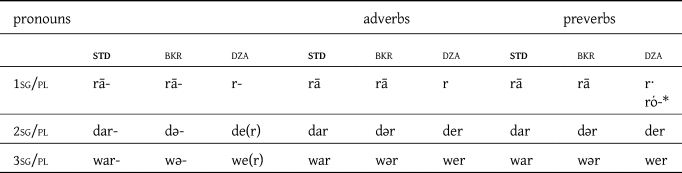
Dialects, unlike std, tend to diversify paradigms. A privileged axis of differentiation is that of the opposition pronoun (nominal actant) vs. adverb + preverb (verbal group). Examples are in Table 8.
Functions and forms of the directional pronouns.

* /r·/ imperfective, /ró-/ perfective.
The difference between the latter two functions (verbal group: adverb vs. preverb) is clearly shown by the use of the /wǝ́-/ of perfective in forms 2 (dir adv + sv) or not (cvp with p = dir).Footnote 37
As an example of this, consider the two sentences: Homāyun xpəl daftar ta rā ú-ɣoxtələm [= rā wə́-γux̌tələm] “Homayun called me to his office” and aɣǝ wɛl: na na sanḍa = de rā ·kə́ṛɛ [= rā·kəṛe] “He said, ‘No, no! You gave me a buffalo’” (examples from De Chiara and Septfonds Reference De Chiara and Septfonds2022).
The following origins have been proposed for the directionals:
-
rā: Darmesteter (Reference Darmesteter1888–90: LXXXII) proposed a derivation < Av. aθra. Morgenstierne accepts this derivation (Reference Morgenstierne1926: 35; EVP 63; 1942a: 113; NEVP 69), adding that the difference between rā < *aθrā́ and ər < *áθra could depend on the sentence stress (EVP 63). NEVP 69 adds that “Av. iθra ‘here’ is also a possible etymon”.
-
dar: Darmesteter (Reference Darmesteter1888–90: LXXXII) proposed a derivation < *tvaθra-, but Morgenstierne (Reference Morgenstierne1926: 35; EVP 21–2; 1942a: 113; NEVP 22 [*ta-θra]) prefers < *taθra.
-
war: Darmesteter (Reference Darmesteter1888–90: LXXXII) proposed a derivation < *awaθrā, also accepted by Morgenstierne (Reference Morgenstierne1926: 35; EVP 88; 1942a: 113), even if in NEVP 89 he proposes < *awáθra, adding “Wan. ór(ə) “there”, in compounds orə-pas, orə-vapas “then, thereupon”; (h)or-ta, (h)or-čī “there, in that place” < *áwaθra”. Cf. Khot. vara “there”, according to Bailey < *avaθrā (DKS 376), Šγ. εwd “here” < **awatā (EVShG 16), Yd. hurō̆, ūra, etc. “there” (IIFL II 214–15), etc.
As to the Pamir languages, Morgenstierne notes (EVShG 105) that “W[a.] agrees with Š[γ.] in having, e.g., tr-ā there (remote); tr-εt there (middle distance); tr-εm here (= Š[γ.] tar-ů(d), tar-ēd, tar-am).”
The verbs most frequently used with prefixed directionals are in particular kawə́l “to do”, tləl “to go”, wṛəl “to bring” and °wastəl “to lead”.Footnote 38 As a result, each verb shows three orientations and a “neutral” form (this is most evident for tləl).Footnote 39 These verbs are among the most used verbs in common conversation and are part of the fundamentalFootnote 40 Pashto lexicon.
rā·kawə́l: rā·kawí راکول tr. “to give to me/us; to sell to me/us” (Pashtoon Reference Pashtoon2009)
1. “to give (Lit. To do or make to me)” (Raverty Reference Raverty1860)
“رااخيستل، له مقابل طرف نه د يو شي تر لاسه کول، د ورکول ضد” (PP, Daryāb Reference Momand1994)
2. The form of the perfective past is provided by Aslanov (Reference Aslanov1966): را يې کړ. The other orientations are: dar·kawə́l « to give to you » and war·kawə́l « to give to him/her/them ».
3. Etymology: rā/dar/war + kawə́l: see pre·kawə́l.
rā·tlə́l: rā·jí راتلل intr. “1 to arrive; come running up to (animals), come flying (birds) 2 to approach (of a time) 3 to eventuate, happen 4 to undergo, experience something 5 to fall under (the influence) 6 to occur, be used (of words, expressions) 7 to come through, arrive (documents)” (Pashtoon Reference Pashtoon2009)
1. “venir” (Akbar Reference Akbar2015)
“to come, reach, attain, go to, get to, arrive” (Raverty Reference Raverty1860)
“راتګ کول، د تلل مقابل، له بله
دېخوا راتګ کول ” (PP, Daryāb Reference Momand1994)2. This is probably the most irregular verb in Pashto, comprising four different stems. The simple verb is tləl, a mixed verb with a nominal base (see ix̌odə́l above). The verb rātləl in Table 9 shows its paradigm (see De Chiara and Septfonds Reference De Chiara and Septfonds2019: 71).Footnote 41
The other orientations are dar·tlə́l “to go to you” and war·tlə́l “to go to him/her/it/them”, and show a similar paradigm, with just a change in the preverb.
3. Etymology: rā/dar/war + tləl. The etymology of this latter component is not clear and will be treated in detail elsewhere. According to Morgenstierne, the origin is PIr. *tač- “to flow, run, walk” (Cheung Reference Cheung2007: 372–4), but many problems remain. The first problem is represented by the initial t-, as PIr. *t > Pšt. l. The imperfective present j- is also of problematic interpretation. We can compare here the two verbs Khot. ttajs- “to run, flow” and jsā- “to go”, the former derived < PIr. *tač- “to flow, run, walk” (SGS 38 and Cheung Reference Cheung2007: 373) and the latter < PIr. *gaH- 1 “to go, move” (SGS 37 and Cheung Reference Cheung2007: 93–4). These two comparisons are certainly cogent: however, the etymological details require in-depth analyses.
4. Morgenstierne (EVP 80) states that: “Imperf. 3 sg. m. tə, Waz. tã, might be derived from *taxta- […] In that case we must assume that tә is the original form, that the forms with l (tlo, 1 sg. tləm etc.) have been influenced by perf. part. tәlai, and that the infin. tlәl is due to a tendency to avoid a very short form like *tәl.” He then suggests a possible derivation from a Dardic source: “Cf. however Dard forms like Torw. til-, Gauro till- ‘to go’ (Dhātup. til-), from which tləl might have been borr.”Footnote 42 He concludes with a hypothesis on the imperfective present j-: “If we derive tә < *taxta-, it is poss. to explain the pres. jәm, cәm etc. as a contamination of *cwam < *čiyaw- (…) and *tcam < *tač-”, quoting the comparison with some Pamir languages, Wa. tukan, pres. cauam, Sar. tīdao, tejam, Shgh. tīzd, and asserting that “This explanation has the advantage of connecting the Psht. forms of this verb with the Pamir ones” (EVP 80–1).
In NEVP 81 all his proposals were confirmed, with the exception of the Dardic borrowing.Footnote 43
Skjærvø (Reference Skjærvø and Schmitt1989: 402) writes that: “rather than < *ǰā-, in view of the dial. forms in c- perhaps < *ati-ǰā-”.
Among the many comparisons of the IIr. root *tač-, it will be sufficient to quote here Av. tak-, pres. tača- (Kellens Reference Kellens1995: 24) and Skt. tak- (Monier-Williams Reference Monier-Williams1899).
 دېخوا راتګ کول ” (PP, Daryāb
Paradigm of rā·tləl.

rā·wṛə́l: rā·wṛí راوړل tr. “1 to bring, deliver, convey 2 to obtain, extract 3 to bring in, mention 4 to give birth to 5 to effect, accomplish” (Pashtoon Reference Pashtoon2009)
1. “apporter, mentionner” (Akbar Reference Akbar2015)
“to bring, fetch, bear, convey, carry, etc. (applied only to things inanimate)” (Raverty Reference Raverty1860)
”۱ يو شی له يوه
ته را انتقالول ۲ زېږول، بچی زېږول؛ اولاد زېږول؛ (PP); “ و (۱) زېږول، بچی زيږول، اولاد زيږول شی له يو ته راانتقالول، (٢)” زوی يې راوړی دی “ (Daryāb Reference Momand1994)2. PP provides the forms of the imperfective present, راوړي , of the perfective future, را به وړي and of the perfective past, را يې ووړ. The other orientations are: dar·wṛə́l « to bring to you » and war·wṛə́l « to bring to him/her/them ». The simple verb is wṛəl, a mixed verb (see ix̌odə́l above), whose paradigm is: present/past imperfective wṛ-, present perfective yó-s-, past perfective yó-wṛ-.
3. Etymology: rā/dar/war + wṛəl. This latter < *bartá-: *bará-, with secondary present from the past stem, according to Geiger's proposal (EP 283), followed also by Morgenstierne (EVP 92, NEVP 92).Footnote 44 In origin, then, we should imagine that the verb was wṛ-: *wr-, like xwaṛ-: xor- “to eat” (with ṛ < *rt), with the opposition between the past and the present stem displaying ṛ vs. r.
4. The root *bar- “to bring, carry” is well known and has many parallels, from Av. bar-, to Skt. bhar-, and so on: see Cheung (Reference Cheung2007: 6–10) for all comparisons.
 ته را انتقالول ۲ زېږول، بچی زېږول؛ اولاد زېږول؛ (PP); “ و (۱) زېږول، بچی زيږول، اولاد زيږول شی له يو
 ته راانتقالول، (٢)” زوی يې راوړی دی “ (Daryāb
rā·wastə́l: rā·wáli راوستل tr. “1 to bring, deliver someone 2 to obtain, extract 3 to force 4 to bring water to, irrigate 5 to bring about (e.g., revolution) 6 to advance arguments” (Pashtoon Reference Pashtoon2009)
1. “amener” (Akbar Reference Akbar2015)
“to bring, lead along, convey, etc. (applied to objects animate)” (Raverty Reference Raverty1860)
”رالېږدولی، راوستل شوی، يو ساه لرونکی يا بې ساه (لکه کوم ارابه لرونکی ) شی خپلې خواته را (PP); انتقال شوی “ رالېږدول، يو سالرونکی (انسان، حيوان ) په خپلو
يا يو بې سا (د وسيلې په واسطه ) خپلې خوا ته رانقلول، د بوتلل /بيول “ ” ضد (Daryāb Reference Momand1994)2. Aslanov (Reference Aslanov1966) provides the different themes: present: راولي rā́vali, past: را يې وست rā=ye-wəst, را يې ووست rā́=ye-wəst. The other orientations are: dar·wastə́l « to lead to you » and war·wastə́l « to lead to him/her/them ». The verb °wastə́l does not exist as a “radical simple verb”; rather, it is only attested prefixed with directionals.
3. Etymology: rā/dar/war + °wastəl. This latter < *wásta-: *wáda-, to the root *Hu̯ad- “to carry, lead (away); to marry (a wife)” (see Cheung Reference Cheung2007: 200–01). Missing in EVP, the etymology of this verb is acknowledged in Morgenstierne's personal notesFootnote 45 and in NEVP 87.
4. Cf. Av. vad- “emmener” (Kellens Reference Kellens1995: 49), etc.: see Cheung (Reference Cheung2007: 200–01) for full comparisons.
 يا يو بې سا (د
 وسيلې په واسطه ) خپلې خوا ته رانقلول، د بوتلل /بيول “ ” ضد (Daryāb
Conclusion
In conclusion, the behaviour of the preverbs analysed in this article is similar to and replaces that of the perfectivizing preverb wə́-. In simple verbs the perfective aspect is marked by preverbation of the stressed and (under certain conditions) separable wə́-. Similarly, in the compound verbs with preverb, the preverb assumes the same functions of the wə́- in simple verbs: it draws the stress and is separable in certain conditions. In a future article (De Chiara Reference De Chiaraforthcoming a) I will draw some diachronic and morphosyntactic conclusions in this regard.
All the preverbs entering into the formation of these CVP, with the exception of cə-, fulfil other functions, such as that of adverbs, postpositions or even personal pronouns (the directionals). Their other functions are not taken into account here, but without doubt deserve further investigation.
The path of this research turns now towards the perfective aspect, which will be treated in the next article, with the aim of improving our understanding of the origin and the dynamics at play in the formation of the Pashto verbal system.
Acknowledgements
As always, I warmly thank Mauro Maggi for his kind and illuminating suggestions.
Abbreviations
- ADV
Adverb
- Av.
Avestan
- B.
Buddhist
- Bactr.
Bactrian
- Bal.
Balochi
- Bart.
Bartangi
- Chr.
Christian
- CV
Compound verb
- CVP
Compound verb with preverb
- DIR
Directional
- IA.
Indo-Aryan
- IE.
Indo-European
- IIr.
Indo-Iranian
- Ir.
Iranian
- irr.
Irregular
- Išk.
Iškašmi
- Khot.
Khotanese
- Khwar.
Khwarezmian
- Kurd.
Kurdish
- Lhd.
Lahndi
- Man.
Manichaean
- Mnj.
Munǰi
- MPrs.
Middle Persian
- OCS
Old Church Slavonic
- OPrs.
Old Persian
- Orm.
Ormuri
- Oro.
Orošori
- Oss.
Ossetian
- P
Preverb
- Pa.
Pāli
- Par.
Parači
- PIr.
Proto-Iranian
- Prs.
Persian
- Prth.
Parthian
- Pšt.
Pašto
- reg.
Regular
- Roš.
Rošani
- Sar.
Sariqoli
- Sgl.
Sangleči
- Si.
Sindhi
- Skt.
Sanskrit
- Sogd.
Sogdian
- SV
Simple verb
- Šγ.
Šuγni
- Ved.
Vedic
- Wa.
Wakhi
- Waṇ.
Waṇeci
- Waz.
Waziri
- Xu.
Xufi
- Yd.
Yidγa
- Yγn.
Yaγnobi
- Yzg.
Yazgulami
 ‘stone wall’ < PIr. *upā-č-, and swəl: swají سول ‘to burn’ (intrans.) < PIr. *sauča-)”.
 “1 to order, reserve; subscribe 2 to summon; invite” or rā·kx̌ə́l
 “1 to take out, extract 2 to procure 3 to draw, pull something in 4 to drag 5 to gather, assemble (e.g., troops) 6 to draw, illustrate 7 to draw, delineate, illustrate”. Moreover, rā can be prefixed to any other verb: see Septfonds (