Introduction
How and why US Navy hospital ships deploy has changed dramatically since the 2004 Asian tsunami. Part One of this research was a systematic literature review of both peer-reviewed and grey literature related to US Navy hospital ship humanitarian assistance and disaster response missions from 2004-2012.Reference Licina1 The three most significant findings were: (1) the dearth of Navy hospital ship empirical studies; (2) the scant number of sources describing partnership impact; and (3) the complete absence of diplomatic, development, and host nation primary author publications related to Navy hospital ship missions. The systematic literature review supported existing criticism of the Department of Defense (DoD) need to more effectively measure humanitarian assistance mission impact.
The purpose of Part Two of this research study was to understand how and why US Navy hospital ship humanitarian assistance missions influence partnerships. Perceived advantages and disadvantages of partnering on a US Navy hospital ship mission as well as the facilitators and barriers to effective partnership were explored. The study identified how participating organizations changed as a result of the partnership and what impact the partnership had on each organization. A case study of the hospital ship Mercy mission to Timor-Leste during Pacific Partnership 2008 and 2010 (PP08 and PP10) was used. The single case study across two time periods provided rich information to assess how participants change as a result of the partnership and increase the validity and generalizability of the findings. Findings of this study inform a proposed theoretical framework that can be used to improve future hospital ship partnership impact.
Ethical clearance was obtained from The George Washington University and Medical Center Office of Human Research and the Timor-Leste Ministry of Health Cabinet of Health Research and Development.
Methods
Overview
A qualitative study design was used to fill the literature void of hospital ship partnership impact. Qualitative study designs are ideal for research questions that require the understanding of participants’ views.Reference Green and Thorogood2 This study used open-ended interviews with key stakeholders and a review of documentary materials provided by the study participants as the sources of evidence. Open-ended questions were used to collect participant views of the hospital ship mission and across the major domains of a proposed partnership theoretical framework. This framework was adapted from research conducted by Boydell and Rugkasa (2007).Reference Boydell and Rugkasa3 Their conceptual model described how partnerships could serve as a mechanism for reducing inequalities in health and was based on the Realistic Evaluation approach used in evaluating partnerships.Reference Pawson and Tilley4 Data analysis occurred using a sequence of interrelated steps including reading, coding, displaying, reducing, and interpreting the data.Reference Ulin, Robinson and Tolley5
Timor-Leste represented a unique case (recent post-conflict nation) among all countries visited by the Mercy during the PP08 and PP10 missions and served as the single case in this study. Embedded within this unique single case were multiple participating organizations that served as the units of analysis. The four embedded units were the US government (USG), partner governments (PN), host nation government (HN), and nongovernmental organizations (NGO). These subunits presented further opportunity for extensive analysis in the single case.Reference Yin6 This ensured all aspects of the partnership were revealed and understood both within and across the participating organizations.Reference Baxter and Jack7 Collectively, this qualitative study design is known as an embedded case study design.Reference Yin8
Study Sample
The specific study target population included personnel from each partner organization representing the strategic (policy), operational (planning), and tactical (implementing) levels. Using purposeful sampling, one-on-one, open-ended interviews were conducted with key stakeholders.Reference Miles and Huberman9 Additional contacts were obtained and pursued as part of a snowball sampling strategy with the original key stakeholders. This strategy ensured information-rich participants were pursued and interviewed until information saturation was reached.
Data Collection
Key stakeholder interviews were conducted in person from July through December 2012 in Washington, DC and Dili, Timor-Leste. Interview participants in Timor-Leste were coordinated with the US Agency for International Development (USAID) and Ministry of Health (MoH) in Timor-Leste. Telephonic interviews from Washington, DC also were conducted. Each interview took approximately one hour to complete. An interview guide composed of open-ended questions was used to obtain stakeholder perspectives. The questions explored the experiences of each participant and were analyzed using a priori domains in the proposed partnership theoretical framework. These included the partnership goals, advantages and disadvantages of the partnership, facilitators and barriers to joining the partnership, external and internal constraints to the partnership, organizational change, and successful partnership attributes. Audio recordings of each interview were sent to contract support personnel for transcription. Each interview transcript was reviewed and crosschecked with field notes to validate transcription accuracy. Validated transcripts were imported into QSR International NVivo 10.0 software (QSR International Inc., Burlington, Massachusetts USA) for data management and analysis.
The collection and review of documentary materials is a technique used by researchers to gain a better understanding of the events that one was unable to witness.Reference Stake10 In this study, planning documents used to shape the PP08 and PP10 mission directly and indirectly were requested by the principal investigator upon conclusion of the key stakeholder interviews. The documents provided historical context and insight into the culture of each participating organization. Furthermore, the information gathered during the review of documentary materials helped substantiate data from the key stakeholder interviews.
Data Analysis
This study used a data analysis process designed for qualitative public health studies and included reading, coding, displaying, reducing, and interpreting the data.Reference Ulin, Robinson and Tolley5 The themes within the partnership theoretical framework that correspond to the research questions served as the a priori codes (eg, barriers, facilitators, constraints, etc). A codebook was generated and included the definitions of a priori codes and any new emerging codes to facilitate coding consistency and clarity. All interview transcript line-by-line coding was conducted using QSR NVivo 10.0 software on a continuous basis.
Once all documents were coded, the data was displayed by thematic area using the prescribed codes. Comparison of themes within and between each unit of analysis led to the development of theoretical explanations that assisted in validating or rejecting previous and emerging conclusions.Reference Ulin, Robinson and Tolley5 After the data was displayed, data reduction commenced. Primary and secondary themes were prioritized and non-essential information excluded from further interpretation. The final step of data interpretation included the determination of relationships and patterns as well as more focused explanations of the data's essential meaning.Reference Miles and Huberman9
Results
Study Participants
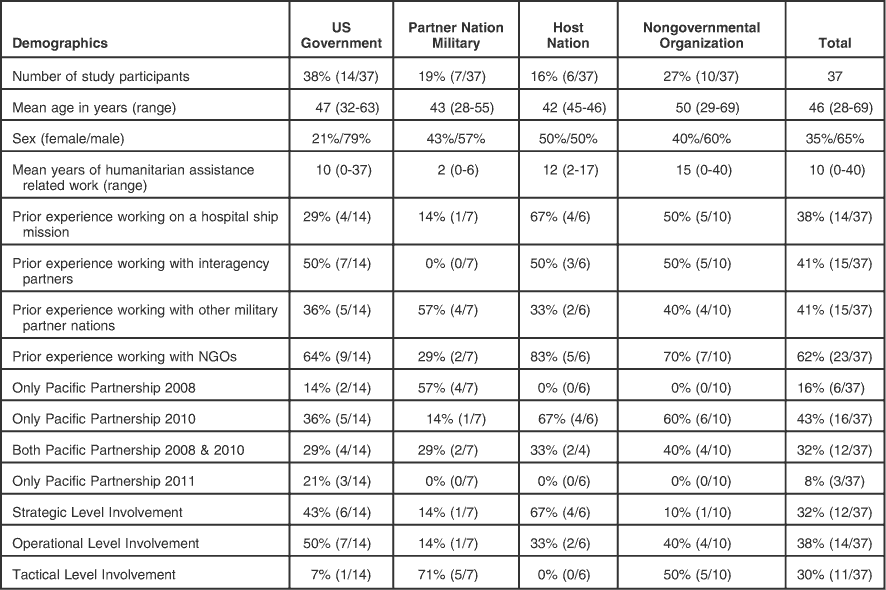
The key stakeholders for the case study included 37 individuals representing the US Government, Timor-Leste Government, Partner Nation Militaries, and NGOs (Table 1). An average number of 9.3 participants per organization were interviewed with the highest number of participants from the US Government (n = 14) while the Timor-Leste Government had the lowest number of participants (n = 6). The average age of the stakeholders was 46 years; the youngest participant was 28 and represented the partner nation militaries, and the oldest was 69 and represented the NGOs. Thirty-five percent (13/37) of the stakeholders were female.
Key Stakeholder Descriptive Statistics

Abbreviations: NGO, Nongovernmental organization
The stakeholders had an average of 10 years of experience conducting humanitarian assistance related work with partner nation military participants having the least (two years) and NGOs the most (15 years). Thirty-eight percent (14/37) of participants had prior experience working on Navy hospital ship missions with the lowest reported by partner nation participants (14%) and the highest by Timor-Leste Government participants (67%). These results are not surprising since the hospital ship Mercy visited Timor-Leste on four different missions. Exactly half of the US Government, Timor-Leste Government, and NGO participants reported prior experience working with US Government interagency partners. This too is not surprising since USAID is a key interagency partner within the USG and works with NGOs to implement development programs in foreign nations such as Timor-Leste. None of the partner nation military participants reported similar interagency experience. Forty-one percent (15/37) of the stakeholders reported prior experience working with other military partner nations, with the partner nation military participants reporting the highest level of prior experience at 57% (4/7) and host nation participants reporting the lowest level of prior experience at 33% (2/6). This finding reinforces the historical willingness of militaries to collaborate and the more recent evolution of military-to-civilian collaboration. Almost two-thirds (23/37) of participants reported prior experience working with NGOs. Timor-Leste Government officials reported the highest level of NGO working experience at 83% (5/6) with partner nation military participants the lowest at 29% (2/7). The high percentage among host nation participants is expected based on the large role NGOs played in supporting the recent post-conflict nation. The low percentage among partner nation military participants might suggest cultural differences between the units of analysis.
In terms of Pacific Partnership hospital ship missions, 32% (12/37) of the stakeholders participated in both PP08 and PP10. Sixteen percent (6/37) took part in only PP08 and 43% (16/27) only PP10. Overall, a similar number of participants representing the strategic, operational, and tactical levels of involvement were interviewed. Strategic participants made up 32% (12/37) of the stakeholders, while 38% (14/37) worked at the operational and 30% (11/37) at the tactical levels. Strategic level participants varied across units of analysis with Timor-Leste Government officials having the highest at 67% (4/6) and NGOs the lowest at 10% (1/10). Operational level involvement was highest among US Government participants at 50% (7/14) and lowest among partner nation military participants at 14% (1/7). Tactical level involvement was highest among partner nation military participants at 71% (5/7) with none (0/6) of the Timor-Leste Government participants working at this level during the hospital ship missions.
Perceived Mission Goal
As described in Part One of this research, the secondary mission of the Navy hospital ship is to provide humanitarian assistance. The US Pacific Command exercises this task through the biennial Pacific Partnership mission. One of the stated goals of the Pacific Partnership mission is to build regional partnerships. The results of this study suggest the units of analysis perceived the goals of the mission and the ability to achieve them differently. United States Government and NGO participants identified building partnerships, providing a training opportunity, and rendering humanitarian assistance as the three goals of the mission. Opinions were mixed as to whether the goals were achieved. Partner nation participants mentioned partnerships and rendering humanitarian assistance as the two goals with predominantly positive opinions of achievement. The host nation participants identified rendering humanitarian assistance as the only goal and all stated it was achieved.
Partnership Definition
With a better understanding of how each unit of analysis defines the hospital ship mission goals, which included partnership, there was a need to understand how different participants define “partnership.” Two additional questions were asked of the key stakeholders and included defining partnership in their own terms and the ability of the hospital ship partnership to achieve their stated definition. An overarching theme of “two separate entities working towards a mutual goal” was prevalent among US Government participants with mixed opinions in terms of the mission achieving this definition. Many partner nation military participants used the term equity to define partnership and they too expressed mixed opinions of the mission achieving their definition. Host nation participants used terms such as mutual understanding, collaboration, and commitment to define partnership and almost all felt their definition was achieved. “Working together as a team” was a recurring theme when NGOs defined partnership and like two other units of analysis, their opinions about achievement were mixed.
Partnership Themes
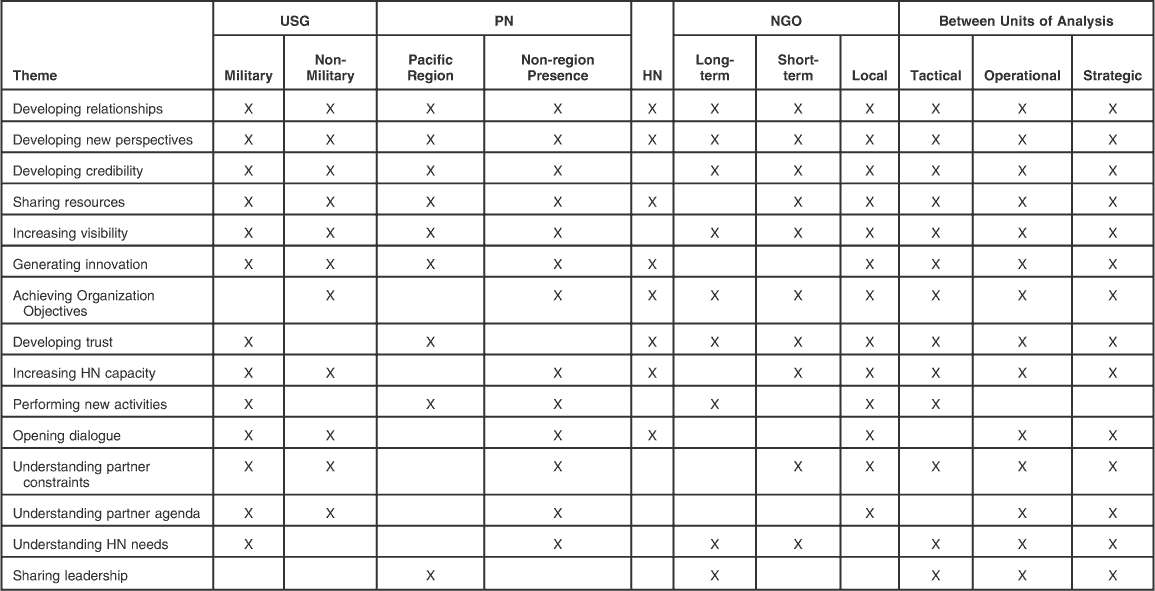
In order to understand “how” and “why” Navy hospital ship missions influence partnerships, the 15 themes emerging from the key stakeholder interviews were linked to the partnership theoretical framework (Figure 1). Overall, the results suggest hospital ship missions increase connections, facilitate learning, and generate actions among participating organizations that produce impacts at both the individual and overall partnership level. Increasing connections through the partnership assists in opening a dialogue and developing trust, relationships, and credibility among the partners. The theme developing relationships was mentioned by all participants and had the highest number of references in the coded transcripts. Opening a dialogue and developing credibility were themes mentioned by more than two-thirds of participants. Developing trust was mentioned by 57% of participants. Based on the theoretical framework that depicts increasing connections as the first step in the partnership process, having a high number of references to these supporting themes fits conceptually.
Partnership Themes Linked to Theoretical Framework [framework adapted from Boydell and Rugkasa, 2007]
The study findings also suggest the partners learn during the hospital ship mission and develop new perspectives, gain a better understanding of partner constraints and agendas, and understand the needs of host nation. Three of the four themes were mentioned by more than two-thirds of participants and developing new perspectives was the second most cited theme. These findings also conceptually support that learning occurs after connections are made among the participants while acknowledging it is an iterative process.
The mission also facilitates action among partners that results in the sharing of resources, innovation in how the partnership is fostered, and the ability of partner organizations to achieve their parent organizations objectives. Sharing resources featured in more than two-thirds of the interviews while the other two themes were mentioned by less than two-thirds. This finding suggests the downstream effects of the partnership as depicted in the theoretical framework are not fully realized among the participants. This shortfall was reinforced by lower response rates to impact related themes. Increased visibility, the sharing of leadership, the performance of new activities, and increased host nation capacity were described as impacts produced by the mission. Although increasing HN capacity featured in more than two-thirds of the interviews and most of the documentary review references, increasing visibility and sharing leadership themes were the least coded and only featured in three documentary references combined. The 15 themes related to partnership emerging from the 469 pages of interview transcripts are depicted in Table 2.
Partnership Themes Listed by Frequency Within and Between Units of Analysis
Abbreviations: HN, host nation; NGO, nongovernmental organization; PN, partner nation; USG, United States government
Facilitators and Enablers Overview
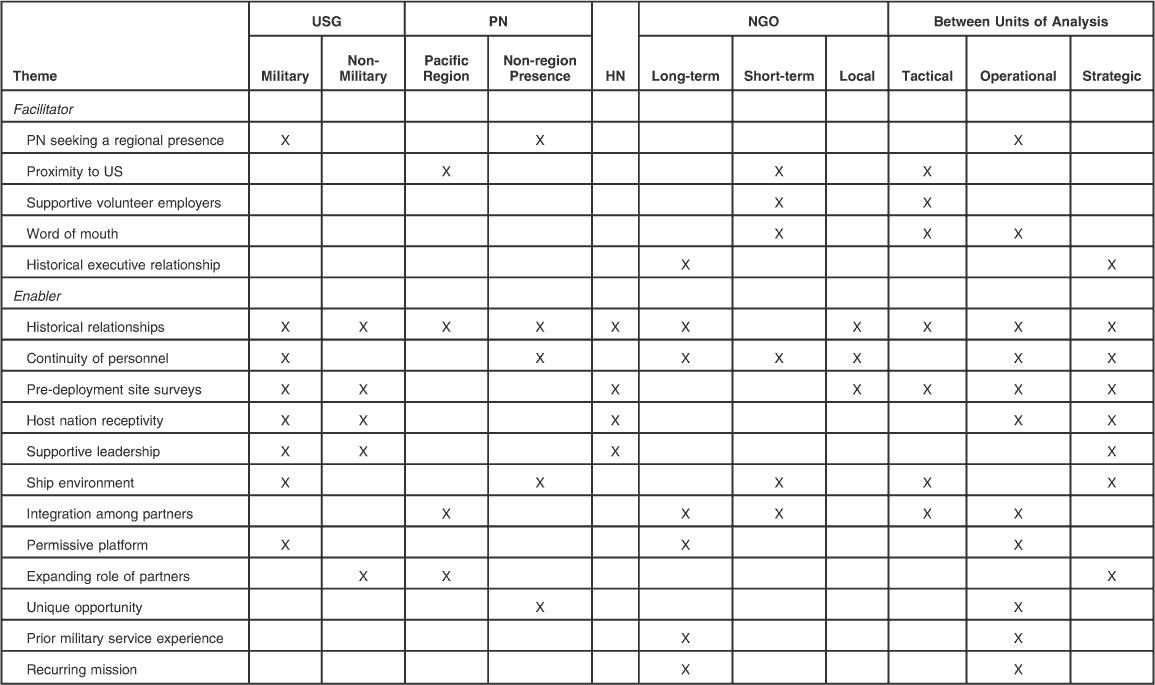
Many factors can facilitate or stymie organizations from joining the hospital ship partnership and also constrain the partnership from achieving their stated goals. The original definition used in this study for partnership facilitator was factors that enable entry to the US hospital ship partnership. Although a few study participants mentioned facilitators in this context, most did not have historical knowledge at an organizational level to fully describe these factors. Facilitators to joining the mission included partner nations seeking a regional presence, historical relationships between senior executives of participating organizations, and word of mouth between organizations. Historical relationships between senior executives facilitated membership to the hospital ship missions for a few organizations, but what is less clear is whether the partnership builds links to all participating organizations networks outside of the partnership. Enablers of the partnership included historical relationships, host nation receptivity, continuity of personnel, and integration among partners. Facilitators and enablers within and between units of analysis are listed in Table 3.
Facilitators and Enablers by Frequency Within and Between Units of Analysis
Abbreviations: HN, host nation; NGO, nongovernmental organization; PN, partner nation; USG, United States government
Barriers and Constraints Overview
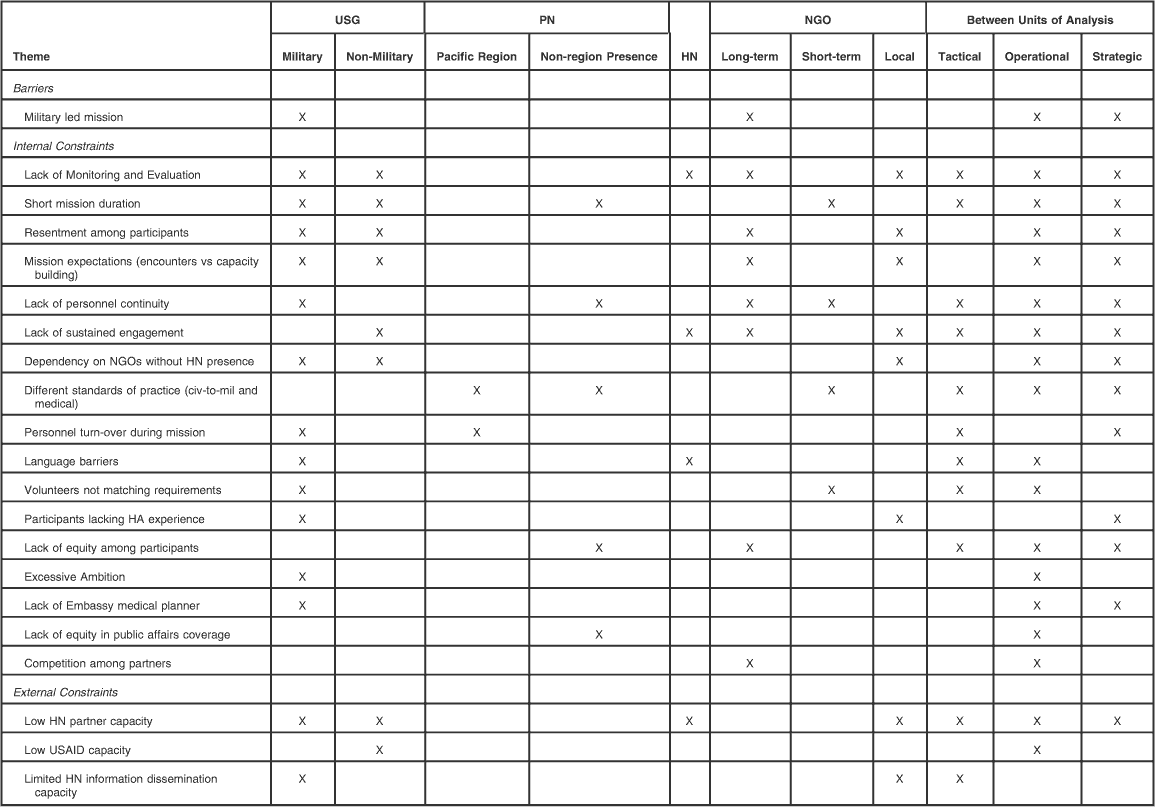
Barriers were defined as factors that restrict entry to the US hospital ship partnership. It is important to understand barriers in order to inform mitigation strategies that increase the likelihood of organizations joining the partnership. Similar to facilitators, most study participants did not have the historical knowledge to describe barriers in this context. Many participants did describe constraints as factors that prevent the partnership from achieving its goal and can be either external beyond the control of the partnership or internal and inherent to the partnership. Overall, the US military leading the hospital ship mission was identified as a barrier to joining the partnership – specifically among NGOs. Internal constraints to the partnership identified included the short mission duration, resentment among participants, and a lack of personnel continuity. External constraints included low host nation and USAID capacity. Barriers and constraints within and between units of analysis are listed in Table 4.
Barriers and Constraints by Frequency Within and Between Units of Analysis
Abbreviations: HA, humanitarian assistance; HN, host nation; NGO, nongovernmental organization; PN, partner nation; USAID, United States Agency for International Development; USG, United States government
Documentary Review
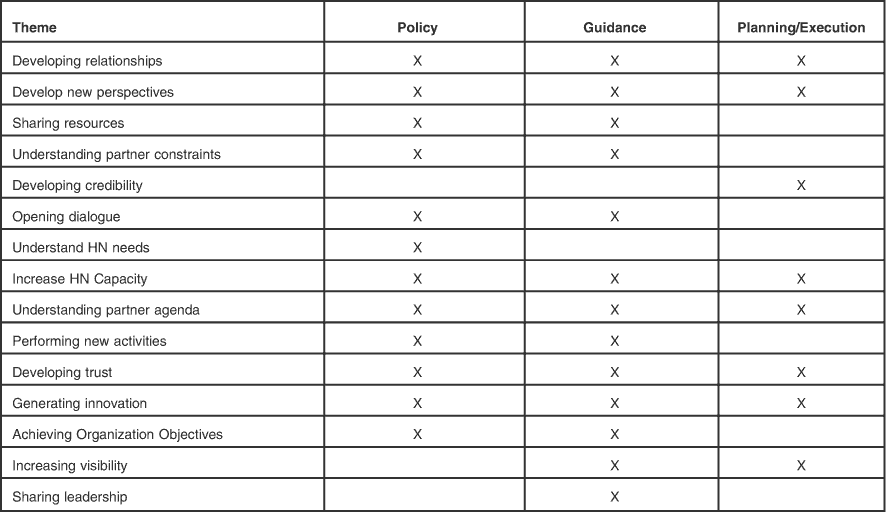
The DoD does not have a single policy or guidance document dedicated to establishing and maintaining partnerships. However, the notion of building partnerships is present in different documents, such as the US National Military Strategy, and those documents were used to shape PP08 and PP10 directly and indirectly. Documents obtained from the study participants included policy, guidance, and planning/execution references. Policy documents were identified as those that specify responsibilities and that must be adhered to among the various departments and individuals within the parent organization. Examples included the DoD Humanitarian and Civic Assistance Activities Instruction and US National Security Presidential Directive-44 on Management of Interagency Efforts Concerning Reconstruction and Stabilization. Guidance documents were identified as those that provide recommendations or suggestions on how to implement specified policies of the parent organization. Examples included the US Pacific Command Strategic Guidance, Department of State (DoS) Quadrennial Diplomatic and Development Review, the Government of Timor-Leste Strategic Development Plan, and Ministry of Defense and Security National Strategy among others. Planning and execution documents were identified as references used by participating organizations pre, during, and post deployment to inform and conduct the hospital ship humanitarian assistance mission during PP08 and PP10. Examples included the DoD Pacific Partnership Concept of Operations and post-deployment Command briefings.
A total of 22 documents were reviewed and included five policy, 12 guidance, and five planning/execution references. Partnership themes from the documentary review that matched the case study findings are found in Table 5. Caution was exercised to ensure confidentiality; compromising documents obtained from various partner nations and NGO participants were excluded from this list and only information with a classification marking of “unclassified” or lower described. Partnership themes from each document were extracted and used in triangulating themes that emerged from the key stakeholder interviews and Part One, the systematic literature review.
Documentary Partnership Themes Matching Case Study
Abbreviations: HN, host nation
All 15 themes emerging from the key stakeholder interviews were described either directly or indirectly in the policy, guidance, and/or planning/execution documents. These findings are not surprising given the fact 10 themes were discussed in the National Military Strategy alone. Most policy and planning/execution documents are informed by this strategic guidance and as such, themes are described in a cascading manner. The policy documents reviewed did not mention increasing visibility, sharing leadership, or developing credibility. Although these themes are clear elements of successful partnerships, without a dedicated guidance document to partnerships, it is difficult to specify these themes as responsibilities that must be adhered to by the Services. Seven themes (46.7%) emerging from the key stakeholder interviews were not mentioned in the planning and execution documents. Knowing these documents inform the hospital ship mission pre, during, and post deployment, this finding may suggest the following themes are not currently a priority of effort among the partners: understanding partner constraints; understanding HN needs; sharing leadership; performing new activities; opening a dialogue; sharing resources; and achieving organization objectives.
Discussion
This research finds the idea of building partnerships through hospital ship missions exists among most units of analysis. It is reasonable to hypothesize individuals or organizations establish partnerships to accomplish a common goal that would be more difficult to achieve in isolation.Reference Boex and Henry11 With this in mind, congruency in mission goals among the four units of analysis was expected. However, the variability in goals described by the participants, with the exception of rendering humanitarian assistance, suggests a lack of common purposefulness. The USG and NGO participants were consistent in their view of mission goals that included building partnerships, providing a training opportunity, and rendering humanitarian assistance. However, although the concept of a training opportunity was described as a benefit to the mission, partner nation participants did not describe it as a mission goal. Host nation participants did not identify building partnerships and providing a training opportunity as goals of the hospital ship mission. This inconsistency was also prevalent across units of analysis. Strategic level participants typically captured all three of the perceived goals in their responses while tactical level participants primarily responded to rendering humanitarian assistance. Without a consistent goal of building partnerships within and across all units of analysis, accomplishing this objective was challenging. As one NGO participant with the experience of multiple hospital ship missions stated, “for volunteers that don't understand the concepts of the medical diplomacy and the relationship building and that sort of thing, when they're there just to help sometimes you got to really manage that expectation.”
Although building partnerships did not emerge as a common goal within and across all units of analysis, there was consistency in how the units of analysis defined partnerships. However, among the three units of analysis that described building partnerships as a mission goal (USG, PN, NGO), all three had mixed opinions of the mission achieving their definition of partnership. A USG participant said, “it serves more the purpose of the people who are coming in and not necessarily the objective that it's supposed to achieve in sustaining a sort of a partnership that the Ministry feels that they can rely on in the future.” The lack of equity among partners was a key shortfall identified by PN and NGO participants. They highlighted this perspective when describing their experience as “participants” rather than “partners.” Ironically, host nation participants did not describe building partnerships as a mission goal but all participants felt their definition of partnership was achieved. This could be attributed to their definition including concepts such as mutual understanding, collaboration, and commitment instead of equity. A split was evident between operational and tactical level participants. Operational level participants did not feel equity was achieved in the partnership while tactical level partner nation participants overwhelmingly felt their experiences met their definition of partnership.
The 15 partnership themes emerging from the key stakeholder interviews and documentary review increased our understanding of “how” Navy hospital ship missions influence partnerships. However, the results show a delay in downstream effects of the hospital ship mission on generating action and impact among the participants as depicted in the theoretical framework. Without policy, guidance, and planning documents reinforcing these two constructs, achieving downstream partnership effects will remain challenging. In addition, efforts should be made by the hospital ship mission participants to magnify the facilitators and enablers while developing mitigation strategies for the barriers and constraints identified by the key stakeholders. Doing so should increase the participants’ ability to achieve the partnership themes and goal. In total, the study findings suggest hospital ship missions influence partnership among the units of analysis as theorized in the proposed framework. Yet, there are lessons to be learned as they relate to successful partnership.
Develop Common Goal and Partnership Definition
Senior leaders within each unit of analysis should jointly develop and publish mission goals and a partnership definition that would result in a symbiotic relationship yielding interdependence. This interdependence would produce a level of commitment and trust among all participants in meeting the partnership goal and trickle down from the strategic to tactical level.Reference Kumar, Scheer and Steenkamp12
Prioritize Downstream Partnership Themes
A direct approach of prioritizing efforts to focus on themes related to partnership action and impact that did not feature prominently during the study could be employed now and may produce near term effects. These themes include: generating innovation, achieving parent organization objectives, increasing visibility, performing new activities, and sharing leadership. Focusing on these themes could mitigate internal constraints identified by participants such as short mission duration, lack of personnel continuity, and resentment among participants while achieving downstream partnership effects. Examples of how this could be achieved are listed below.
Generating Innovation
During hospital ship missions, host nation militaries are looked upon to provide medical, engineering, security and other personnel to support the mission. Should their resources be limited, there is significant value added in pursing the support of National Police elements to meet the mission security requirements. In doing so, the hospital ship partners will be exposed to and integrated with another sector in the host nation.
Leveraging police in lieu of military personnel to provide security in less stable environments could lighten the burden placed upon the military and allows them to focus their efforts on providing humanitarian assistance to the local population. Through the collaboration of host nation police and military personnel during hospital ship missions, their legitimacy among the host nation population may be increased. Expectations regarding National Police actions consistent with international law and in support of the hospital ship mission can be articulated, agreed upon, and enforced. This subtle, but vital articulation and enforcement of security expectations is important in post-conflict and developing nations such as Timor.
Furthermore, incorporating host nation police and military participants could increase the trust between these organizations. In developing countries where both organizations may compete for limited security sector resources from their government and international donors, building trust between hospital ship partners from the host nation is vital. The potential increase in communication and trust between the police and military theoretically should be replicated between these host nation actors and other partners in the hospital ship missions. Although sustainability of the partnership remains to be measured between the actors, the potential for new partnerships to grow and offset existing requirements is great.
Another consideration impacting the partnership is the short mission duration. Participants unanimously acknowledged the limited amount of capacity building that can be achieved using the average two-week mission template. The short duration poses challenges for post-conflict nations such as Timor-Leste, with limited resources to perform as an equal partner. As such, experience suggests the US military and other partner nations assume a greater role in order to accomplish the mission. If a true partnership exists between the various hospital ship mission participants, these findings should generate innovation. Lessons could be learned from Mercy Ships, the largest international NGO operating a hospital ship.
When deployed to developing country ports, their ship remains on site for up to 10 months to address the medical needs of the population and build capacity of the host nation medical personnel through training programs conducted both on and off the ship. Longer duration missions will limit the number of nations visited by the US hospital ships; however, the partnerships generated may be more meaningful and lasting. This concept is similar to one suggested by Welling et al (2010) in describing sins of humanitarian medicine when they said, “It is better to pick one country and continue to serve it well, than to hopscotch all over Africa, going everywhere and truly getting nowhere.”Reference Welling, Ryan, Burris and Rich13 The longer duration could more effectively support ongoing development efforts within the HN in partnership with hospital mission participants and other actors representing different sectors and nations in Timor-Leste.
Achieving Parent Organization Objectives
The shortfall in USG and NGO participants achieving parent organization objectives as a result of the hospital ship mission centered on their perception of limited partnership and health impact. The hospital ship mission developed military-to-military partnerships; however, the missions’ impact on civilian-to-civilian and civilian-to-military partnerships was limited. In the context of health impact, The RAND Corporation and the US Navy Bureau of Medicine have developed methods to quantify health impact.14, 15 Another concept beyond their efforts to assess health impact used cost-benefit analysis and emerged in discussion with PP08 participants. Participants collected data capturing the numbers and types of activities performed during PP08. Estimated cost savings were calculated using domestic Diagnosis Related Groups (DRG) and Relative Value Units (RVU).
Building on this novel concept, HN cost avoidance estimates could be generated for activities and procedures provided on future missions. Average unit costs per inpatient service and surgical procedure as calculated during the 2008 MoH Hospital Costing Study for the National Hospital and five referral hospitals in Timor-Leste could be matched to services provided both on board the Mercy and ashore at each of the mission sites. The total number of surgeries performed could be converted using unit cost per surgical procedure for the National Hospital in Dili. Unit costs for laboratory, radiology, and intensive care unit recovery days on board the Mercy could also be calculated for services provided should the data be available. Ashore medical civic action program missions could be matched to the closest referral hospital and each patient provided medical services during the mission categorized as an outpatient visit and cost estimate generated. The overall calculation would provide a cost estimate of medical services conducted during the hospital ship mission using Timor-Leste Ministry of Health rates. The estimate could be compared to the annual MoH operating budget to gain a sense of cost-avoidance if the MoH provided the services in lieu of the hospital ship mission.
Increasing Visibility
Partner nation military participants highlighted the desire to increase their regional presence as a facilitator to joining the partnership. However, examples were cited where PN participants requested the support of US public affairs to help achieve this objective through increasing their amount of print and video coverage and it was not provided. Conversely, the long-term relationship NGO felt there was too much equity in terms of visibility. One participant with the experience of multiple missions said, “There's a lot of NGOs that do participate and get their logo on the PowerPoint slide that are really just providing some supplies.” Finally, a senior level military participant reflected on the comment of a general officer when they said “Maybe we need to be a little less showy and we need to feature the local Mayor and local person because by making that Mayor or that Minister of Health look good, we strengthen that country by strengthening the support that the citizens have towards their government.” Ironically, the HN participants themselves did not identify with the need to increase their own visibility, which may be a cultural standard. Bearing in mind the various level of visibility desired and achieved, the Navy should consider embarking partner public affairs officials or assume the responsibility for increasing the visibility of all participants. Each participating organization provides a specific service that meets a requirement of the partnership. Although the contribution may not be equitable in terms of resources, highlighting their comparative advantage in an equitable manner will empower the participants and further support achieving the hospital ship mission partnership goal. Furthermore, increasing the visibility of each partner in a methodical manner may reduce the internal constraints of resentment and competition among various partners.
Performing New Activities
Nongovernmental organization participants described half of all references coded as performing new activities. This finding suggests NGOs are learning as a result of the partnership and employing skills obtained toward new activities in the partnership. A culture of deliberate and slow change among US and PN military participants may preclude turning new activities observed or conducted into follow-on missions. A significant internal constraint identified to the partnership is the lack of continuity among individual participants. Using the same individuals on future missions may be more important than leveraging the same organizations especially with the HN where individual relationships are so vital. Expanding the role of local NGOs could fill this gap.
Leveraging international NGOs currently operating in the host nation through USAID to support hospital ship missions proved to be a vital component of the missions. This aspect of the NGO “partnership” is often overlooked as they do not actually travel on the hospital ship to each country visited during the mission. They typically speak the local languages, have a robust understanding of the various cultures, and long standing relationships with the MoH. At times, they are the initial face of the hospital ship mission to the host nation population. Using local NGOs already working in the host nation also reduces costs associated with deploying NGOs on board the United States Naval Ship (USNS) Mercy and extends the capability and reach of activities performed in the country. Although there may be a need for technical expertise beyond local NGO capability, they routinely have the essential connections with the local government through the MoH and other formal and informal social networks. Their influence extends beyond the national to district and community levels and is vital in planning and executing outreach missions.
Sharing Leadership
In order to address the barrier of a military led mission, mitigate the internal constraint of lacking equity among partners, and encourage the enablers to expand the role of partners, the US Navy should pursue sharing leadership of hospital ship missions. The PN participants recognized the Navy as a learning organization when they allowed the Australian Defense Force to lead the Pacific Partnership 2010 mission to Papua New Guinea using their own ship with embarked partners to include the US military. This specific leg of the PP10 mission did not include the Mercy; however it did pursue similar goals of providing humanitarian assistance support to the local population and building partnerships. Long-term NGO participants conveyed similar remarks when highlighting that the US Navy allowed individual NGO representatives “to take Officer in Charge roles or site Officer in Charge roles, which is a big step.” These two examples highlight the ability of partners to effectively take on various leadership roles at different levels. In doing so, equity is shared among the partners and the roles of the partners are expanded. The latter also led to an increase in resources invested in the partnership by PN participants (eg, ships and personnel).
Additional consideration should be given to the leadership role of the DoS and HN personnel within the countries visited during the hospital ship missions. Participants representing different levels within the USG (DoD and USAID), PN, and NGOs (long-term and local) highlighted the heavy hand approach of the DoD in assuming leadership of the mission when the Ministry of Health did not meet their compressed timeline. Furthermore, a local NGO participant with experience of both gray hull and white hull missions felt undue pressure was placed upon the Ministry of Health during hospital missions to take the lead for their country while the Ministry of Defense and Security would assume the lead for gray hull missions. Encouraging a greater US DoS and Timor-Leste Ministry of State and Foreign Affairs leadership role in country may support a true, whole-of-government approach for both nations during these missions. The historical relationship between these partners should enable a more successful mission in the near term and yield a greater partnership impact in the long-run.
Increasing the role of the DoS as a leading partner may also support an increase in shared resources. Given the fiscal constraints of the DoD that led to the cancellation of the 2013 Continuing Promise hospital ship mission, the DoS may be able to provide financial assistance to sustain these missions. As one DoS participant stated, “I think out of my three years of service in Timor-Leste the greatest display of US commitment to Timor-Leste was manifested through the visit of the Mercy…Just the impact that we had on showing the flag and showing that Americans cared to the average citizen of Timor-Leste, including in some very remote areas of the country, was exceptional, it exceeded my expectations.” Consistent with this view, other partners felt the DoS received the greatest return on investment during these missions and could increase their financial support in a more equitable manner.
Update Policy Documents to Reflect Partnership
Policy documents such as the Joint Publication 3-29 (published in 2009), which defines the DODs role in foreign humanitarian assistance, repeatedly describes NGOs, international organizations, and other hospital ship mission organizations as nothing more than “participants” in foreign humanitarian assistance. The key stakeholder interviews reinforced the perception among hospital ship mission partner nations as being more of a participant in the mission than a true partner. This publication also stated DoS and USAID will work with NGOs and other private sector partners who share USG objectives. It leads the reader to perceive partnerships as military-military and civilian-civilian with the exception of military-to-civilian within the US Government interagency. The DoD and other hospital ship mission participants should modify the language in their current policies, guidance, and planning/execution documents that relate to partnership from “participant” to “partners.”
Limitations
Validity
Internal validity can be challenged in case studies when an investigator does not directly observe an event and makes inferences of causality based on interview and documentary analysis.Reference Yin8 In order to ensure the internal validity of the study findings, this research specified units of analysis and a theoretical framework prior to data collection. Relying on partnership theoretical propositions to guide data analysis of information collected from the various mission participants ensured the evidence was treated fairly and produced compelling analytic conclusions.Reference Yin8 Furthermore, by using multiple sources of evidence during data collection and analysis which included the systematic literature review, key stakeholder interviews, and documentary material review, convergent lines of inquiry were explored further increasing the internal validity of the research findings with reality.Reference Yin8 External validity deals with the generalizability of the study findings beyond the immediate case study.Reference Yin8 Although this research assessed the partnership impact of the USNS Mercy mission in Timor-Leste (a post-conflict nation), the findings should be generalizable to other countries visited during PP08 and PP10 and more broadly to other Mercy missions. However, the historical context in Timor-Leste preceding the 2008 and 2010 missions may require adaptation of the theory to countries being engaged for the first time. These generalizations are not spontaneous, but if tested using a multiple case study design and similar results were found, this would provide external validity to the theoretical framework and study findings from Mercy hospital ship missions.
Reliability
Reliability in qualitative research can be defined as the likelihood that a similar study would elicit similar themes and findings.Reference Green and Thorogood2 The reliability of the research findings was supported through the consistent and thorough documentation of all procedures conducted throughout this research ensuring the replicability for future studies. Reliability of the research findings was increased by using a published embedded case study protocol that included an Institutional Review Board (IRB) approved interview guide based on the a priori theoretical framework, conducting specific field procedures such as presentation of credentials through IRB-approved telephone/email introduction scripts and employing language used to protect human rights in the IRB-approved informed consent form.
Bias
The potential for interviewee selection bias also existed. Requesting individuals from each organization with the largest amount of involvement in the PP08 and PP10 mission mitigated this effect. This research also sought to minimize selection bias through the balanced representation across all units of analysis from the policy, operational, and implementation levels. Incorporating participants from the diverse range of partners representing different levels of involvement during the two missions also increased the richness and generalizability of the findings between each unit of analysis and among the different countries visited during the missions. Unfortunately, requests for Ministry of Defense participation routed by the principal investigator through the US Embassy Timor-Leste Senior Defense Official were not supported. Contacts obtained through the Ministry of Health for Ministry of Defense personnel were explored. The principal investigator met with a Ministry of Defense PP10 participant at the Ministry of headquarters building in Dili. The request to coordinate interviews was made; however, the individual was not authorized to support the research until the request was cleared through the Ministry of Defense. The earliest date to brief the Ministry of Defense and obtain approval was after the principal investigators departed Timor-Leste. This HN military partnership effect shortfall should be explored in future research.
Conclusion
This is the first study to scientifically assess through rigorous methods the partnership impact of US Navy hospital ship missions. Through the use of triangulation of multiple data sources (Part One systematic literature review, key stakeholder interviews, and documentary review), the various views of hospital ship mission partnership impact were compared and corroborated. The specific embedded case study design met the conditions for testing and confirming the hospital ship partnership theory and the four embedded units of analysis presented further opportunity for extensive analysis.Reference Yin8 Including the four units of analysis representing the various hospital ship mission participants ensured all aspects of the partnership were revealed and understood both within and between the participating organizations.Reference Baxter and Jack7 Using multiple units of analysis with sufficient representation among the various levels of involvement among all countries visited by the USNS Mercy during the PP08 and PP10 missions increases the richness and generalizability of the findings to other countries where the Mercy deployed as part of PP08 and PP10 or more broadly, to missions where the USNS Comfort may deploy in the future. Additionally, the partnership theory could be applied to other contexts beyond hospital ship missions where the USG partners with foreign nations, host nations, and NGOs to support health and public diplomacy efforts. These research approaches, which minimized selection bias, facilitated reliability, and ensured internal validity, all came together to support the analytical generalizability of the findings. The scientific rigor of this research effort supports the legitimacy of the findings and recommendations presented.
Future studies should explore the partnership impact on host nations in various stages of transition from recent post-conflict (eg, Timor-Leste) to developing nations (eg, Vietnam). Each phase has different needs in terms of the partnership and what type of assistance is rendered. Post conflict nations may require more direct humanitarian assistance whereas developing nations are better positioned to engage in capacity building efforts. Assistance contributed by each organization in the partnership can also vary in terms of leadership, resources, and speed. In disaster response and humanitarian assistance phases, speed in collaboration, response time, and ability to mobilize external resources are essential. These conditions may demand a shift in partnership leadership with external partners (eg, partner nations and NGOs) playing a leading role in coordinating and leading the response effort with facilitation from the host nation. In development phases, existing relationships among the participants may demand greater contributions from the host nation. Leveraging resources currently in the host nation with whom the ministries have long standing relationships would be feasible and more practical. The host nation ministries are better positioned and more capable in terms of capacity to lead the routine humanitarian assistance mission and development activities. Furthermore, the host nations could teach other organizations within the partnership how to facilitate transition between crises and development stages. They have first-hand experience dealing with challenges in isolation and in conjunction with the international community. The partnership would gain a better understanding of the various international actors and capabilities and various metrics that could be used as triggers to shift priorities of effort as the host nation assumes greater responsibility in the partnership.
The partnership theory could also be applied to other contexts beyond hospital ship missions, where the USG partners with similar international public and private actors to support health and public diplomacy efforts. One example could be the DoD overseas labs where they partner with Ministries of Health, Ministries of Defense, academia, and international organizations among others in pursuit of force health protection research and development that supports the global good.16 This program provides a unique opportunity to validate the partnership theory beyond hospital ship missions and could bridge the rift with humanitarian actors while establishing, enabling, and sustaining meaningful partnerships with the US DoD.
If the DoD continues to deploy hospital ships in an effort to build partnerships, employing the aforementioned recommendations will move the ships and their efforts on course. Furthermore, the partnership theoretical framework validated through this rigorous research effort could help the DoD quantify partnership impact. Publishing policy, guidance, and planning documents reinforcing the downstream partnership effects will buttress these efforts. Magnifying the facilitators and enablers while developing mitigation strategies for the barriers and constraints should be initiated immediately. Now is the time in this era of global fiscal constraints and a shift toward international partnerships for actors participating in Navy hospital ship missions to objectively measure their impact. It can and must be done.
Acknowledgements
The authors thank Marsha Regenstein, PhD, Sarah Baird, PhD, and Jim Sherry, MD, PhD (all from George Washington University) for their guidance in the research study design and Douglas Robb, MD (US DoD Joint Staff) and Scott Zuerlein, PhD (US DoD Center for Disaster and Humanitarian Assistance Medicine) for their critical review of the dissertation. The authors had full access to all of the data in the study and take responsibility for the integrity of the data and the accuracy of the data analysis.
Disclaimer
The views expressed in this article are those of the authors and do not reflect the official policy or position of the Department of the Army, Department of Defense, or the US Government.