Introduction
Spain is one of many European countries to expect drastic demographic changes in the coming years. These predictions suggest that research into the health needs of older adults has never been more pressing, given that an unprecedented proportion of the population will be at a stage of life where they are more vulnerable to disability.
To best serve the population of older adults, it is crucial to understand the adverse conditions most likely to arise in old age, so public health policies and programs can best prepare adults for the deterioration in functioning and increased susceptibility to illness and injury often attributed to aging. Thus, this study is an attempt to inform the literature on successful aging.
As the International Classification of Functioning, Disability, and Health (ICF) model suggests, the study of health and disability requires a multidimensional approach, including investigation into the personal factors that influence and are influenced by the health condition of an individual (World Health Organization, 2001). The focus of this study will be one of these personal factors, SOC, as SOC is thought to act as a buffer against poor health.
SOC was coined in 1979 by Aaron Antonovsky, a renowned medical sociologist credited with introducing an alternative model of health of which SOC is the central concept. Antonovsky's approach to health promotion, salutogenesis, views health as a continuum and emphasizes investigation into the degrees of wellness as opposed to the degrees of illness. Inspired by the impressive health of a group of Holocaust survivors, Antonovsky studied the characteristics of individuals who remained healthy despite exposure to stressful life events which compromised the health of countless others (Lindström and Eriksson, Reference Lindström and Eriksson2005a). He identified what he termed “generalized resistant resources” (GRRs), or aspects of individuals, groups, or situations that aid in coping with life stressors (Antonovsky, Reference Antonovsky1996). Repeated exposure to these resources help individuals to have a better understanding of the world around them, a characteristic which manifests itself in cognitions, emotions, and behaviors. In Antonovsky's theory, it is this orientation that promotes wellness.
To represent the extent to which individuals can conceptualize and react to stressful situations, Antonovsky developed the term SOC and the associated scale. It embodies 3 concepts: comprehensibility, manageability, and meaningfulness (Eriksson and Lindstrom, Reference Eriksson and Lindstrom2005). As the theory goes, individuals with high SOC reap the benefits of this adaptive attribute. They are thought to be in some way resilient to certain negative health effects, both mental and physical.
The aging process can be more taxing on some than others. Thus, Antonovsky's salutogenic, stress-resource focus is helpful in capturing these individual differences in the psychological and physical response to aging. This study adds to the existing literature on SOC in general, as well as SOC in older adults, by investigating this variable in a large sample, comparing it to a variety of health and sociodemographic variables, and shedding light on the state of the Spanish elderly. Of the studies that discuss older adults, findings include associations between SOC and functional status, depression, health, and social variables (Lundberg and Peck, Reference Lundberg and Peck1995; Nesbitt and Heidrich, Reference Nesbitt and Heidrich2000; Sarvimäki and Stenbock-Hult, Reference Sarvimäki and Stenbock-Hult2000; Suominen et al., Reference Suominen, Helenius, Blomberg, Uutela and Koskenvuo2001; Borglin et al., Reference Borglin, Jakobsson, Edberg and Hallberg2006; Virués-Ortega et al., Reference Virués-Ortega, Martínez-Martín, Del Barrio and Lozano2007; Mellqvist et al., Reference Mellqvist, Wiktorsson, Joas, Ostling, Skoog and Waern2011; Kahana et al., Reference Kahana, Kelley-Moore and Kahana2012; Martínez-Martín et al., Reference Martínez-Martín2012; Tan et al., Reference Tan, Vehviläinen-Julkunen and Chan2013).
Antonovsky's theory suggests that SOC may buffer against functional deterioration. Studies have found functional status to be related to psychological and social factors, such as participant's sense of purpose (Sarvimäki and Stenbock-Hult, Reference Sarvimäki and Stenbock-Hult2000). In a recent longitudinal study, decreased social engagement was associated with greater functional limitation (Kahana et al., Reference Kahana, Kelley-Moore and Kahana2012). These findings suggest that there may be an underlying link between SOC and functional status.
In terms of physical health, one study found that changes in SOC of older adults after housing relocation mediated changes in natural killer cell activity, suggesting that low SOC may be related to weakened immunity (Lutgendorf et al., Reference Lutgendorf, Vitaliano, Tripp-Reimer, Harvey and Lubaroff1999). A number of studies report that SOC is related to both perceived and actual health. Findings support that perceived health of older adults is explained in part by SOC (Söderhamn and Holmgren, Reference Söderhamn and Holmgren2004; Eriksson and Lindström, Reference Eriksson and Lindström2006). In terms of actual health, high SOC and better health appear to be related (Virués-Ortega et al., Reference Virués-Ortega, Martínez-Martín, Del Barrio and Lozano2007; Tan et al., Reference Tan, Vehviläinen-Julkunen and Chan2013). In a longitudinal study, high SOC predicted good health four years later (Suominen et al., Reference Suominen, Helenius, Blomberg, Uutela and Koskenvuo2001).
Regarding mental health status, previous studies have found SOC in older adults to be related to depression (Virués-Ortega et al., Reference Virués-Ortega, Martínez-Martín, Del Barrio and Lozano2007; Mellqvist et al., Reference Mellqvist, Wiktorsson, Joas, Ostling, Skoog and Waern2011). Researchers have suggested that SOC may be an inverse measure of depression, given the strong negative correlation between SOC and depression found consistently in the SOC literature (Geyer, Reference Geyer1997).
Another study indicated associations between SOC and social variables, for example, if participants spent limited time with children or grandchildren or changed residencies within the last five years (Mellqvist et al., Reference Mellqvist, Wiktorsson, Joas, Ostling, Skoog and Waern2011). A longitudinal study on the stability of SOC over time reported a relationship between decreases in SOC and decreases in perceived health and social support (Nilsson et al., Reference Nilsson, Holmgren, Stegmayr and Westman2003).
There is much research on the relationship between SOC and quality of life (QoL) in older adults. Findings imply that high SOC is associated with high QoL (Nesbitt and Heidrich, Reference Nesbitt and Heidrich2000; Borglin et al., Reference Borglin, Jakobsson, Edberg and Hallberg2006; Eriksson and Lindström, Reference Eriksson and Lindström2007). Another study found moderate correlations between SOC and QoL (Virués-Ortega et al., Reference Virués-Ortega, Martínez-Martín, Del Barrio and Lozano2007). Our previous studies on this sample illustrate a relationship between SOC and global QoL, which takes into account participants’ satisfaction across a number of domains, including health status, environment, economic status, and social relationships (Martínez-Martín et al., Reference Martínez-Martín2012).
Overall, the literature supports that SOC in older adults is related to QoL, depression, functional status, overall health, and social variables. The objectives of this study are to describe the functional status and SOC of a sample of community-dwelling older adults in Spain as well as to analyze the relationship between SOC and both health and sociodemographic variables. The study hypothesizes that a high SOC will be correlated with higher levels of functional independence in daily activities.
Methods
Design and sample
The study followed a cross-sectional design involving a representative sample of 1,106 community-dwelling adults aged 60 years and older in Spain (Fernandez-Mayoralas et al., Reference Fernandez-Mayoralas, Giraldez-Garcia, Forjaz, Rojo-Perez, Martínez-Martín and Prieto-Flores2012). This sample was collected from a total population of 9,812,307 adults aged 60 years or older in Spain. A sample size of 1,106 allowed for a sampling error or level of precision of ±3.5.
We used geographically based proportional stratified sampling, the strata of which included 14 groups categorized by autonomous region, seven groups by town population size, three groups by age, and two groups by sex. Participants who met the following description were included in the sample: aged 60 years or older; community-dwelling; gave written informed consent; and had less than five errors on the Spanish version of the Pfeiffer's Short Mental Status Questionnaire, used to assess if participants had the cognitive ability to respond to survey questions (Martínez de la Iglesia et al., Reference Martínez de la Iglesia, Dueñas Herrero, Onís Vilches, Aguado Taberné, Albert Colomer and Luque Luque2001). Of the original sample, 4.4% (51 participants) was disqualified due to their scores on this questionnaire.
Informed consent was obtained from each participant. Those who did not wish to participate were replaced by others from their stratum. The study was approved by the Bioethics Committee of the Carlos III Institute of Health.
Assessments
To measure SOC, the Spanish version of the simplified scale was employed (Lundberg and Peck, Reference Lundberg and Peck1995). This 3-item scale is a shortened version of Antonovsky's original scale, but acts to preserve the scale's core concepts: manageability, meaningfulness, and comprehensibility. Lundberg and Peck recommend the condensed scale for multipurpose surveys which feature other measures of QoL and health, as was the case with our survey, so the length of the survey will not be burdensome for respondents (Lundberg and Peck, Reference Lundberg and Peck1995). Each question of the survey reflects one of these dimensions. Scores range from 0 to 6, higher values indicating lower SOC.
To measure functional independence, we included the BI and FIS. The BI is commonly used in research of this kind and, therefore, permits comparisons across population groups (Mahoney and Barthel, Reference Mahoney and Barthel1965). The scale has ten items regarding the participant's ability to realize certain daily activities. A score of 0 indicates complete dependence and a score of 100 indicates complete independence.
The FIS was designed and validated specifically for the population of non-institutionalized older adults in Spain (Martínez-Martín et al., Reference Martínez-Martín2009). It assesses the extent to which individuals can perform given activities of daily living. For each item, participants chose from 3 responses: can do it without help, need help to do it, or cannot do it and someone does it for you. Items regarding household duties also include the following response option: have never done it. High scores signify greater functional independence.
The PWI, EQ-5D scale, and HADS-D scale provided additional assessments of general QoL, health-related QoL, and depression, respectively. PWI is a scale that measures subjective wellbeing by determining satisfaction with the QoL domains. The scale includes seven items, one for each domain (International Wellbeing Group, 2006). Participants ranked their satisfaction with the domains on a scale of 0, “completely dissatisfied,” to 10, “completely satisfied.” A question about satisfaction with life in general was presented to participants before the PWI scale, as recommended (International Wellbeing Group, 2006). A study has confirmed the validity of this measure (Rodriguez-Blazquez et al., Reference Rodriguez-Blazquez2011).
The EQ-5D scale is a standardized self-report questionnaire of health status and health-related QoL (The EuroQol Group, 1990). This study utilized three EQ-5D measures. The descriptive system comprises five dimensions: mobility, personal care, daily activity, pain/discomfort, and anxiety/depression. Possible responses indicate that participants have no problems (1), some problems (2) or many problems/are unable to perform (3) in a given dimension. The EQ-5D scale also includes the visual analog scale (VAS), on which participants rank from 0 (“worst imaginable health state”) to 100 (“best imaginable health state”) their current state of health. A question about general health condition in the last 12 months asks if the participants’ current health is better, the same, or worse than it was 12 months before. Normative values are available for the Spanish population (Badia et al., Reference Badia, Roset, Herdman and Kind2001). Using the trade-off method, the EQ-5D descriptive system scores were converted into one index, ranging from −1.00 to 1.00 (Badia et al., Reference Badia, Monserrat, Roset and Herdman1999), with higher values indicating a better QoL.
Finally, the depression subscale of the HADS-D measures the likelihood that a non-psychiatric patient is suffering from depression. The scale is formed by seven items regarding personal feelings over the past week and is self-rated on a 4-point scale (0–3) (Zigmond and Snaith, Reference Zigmond and Snaith1983). Scores of 7 or less are classified as non-cases, of 8–10 as doubtful cases, and of 11 or higher as cases of depression.
Data analysis
To determine the functional status and SOC of the population, the descriptive statistics of this sample were computed. To assess the relationship between SOC and the rest of variables, we calculated Spearman correlation coefficients between SOC, the sociodemographic variables and the scales. The BI, EQ-5D, and HADS-D were categorized into two groups: for the BI, no disability (score = 100) or moderate/severe (< 100); for the EQ-5D dimensions, no problems (1) or some/many problems (2–3); and for HADS-D, no case (8) or possible case (8–21). SOC scores were compared based on these groups, using the Mann-Whitney test.
In addition, we created multivariate linear regression models to identify the determinants of SOC. After checking for collinearity, we ran a regression model using the stepwise technique. Independent variables included in this analysis were the following sociodemographic variables and scales, after checking for collinearity: age, sex, marital status, education level, PWI, HADS-D, and BI.
Results
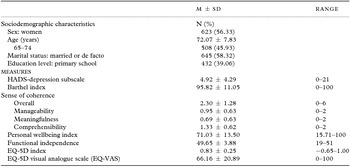
Table 1 shows the descriptive statistics for the sociodemographic characteristics of the sample, indicating that the majority of participants were female (56.33%), between 65–74 years of age (72.07 ± 7.83), married or with a partner (58.32%), and had completed primary school education (39.06%). Table 1 also summarizes participants’ mean scores for each scale.
Summary of descriptives for sociodemographic characteristics and scale (n = 1,106)

HADS = hospital anxiety and depression scale.
According to the BI, 837 participants (75.7%) reported no functional limitation in any activity of daily living (BI score of 100). Regarding the EQ-5D items, 22.0% of participants reported problems with mobility, 9.1% reported problems with personal care, 17.6% had trouble performing daily activities, 50.5% experienced pain and/or discomfort, and 21.3% suffered from anxiety and/or depression. Based on participants’ scores on the HADS-D scale, 74.8% of respondents did not suffer from depression.
SOC was negatively associated with the BI (r = −0.21, p < 0.001) and FIS (r = −0.25, p < 0.001). A moderate correlation was found between SOC and HADS-D (r = 0.47, p < 0.001) as well as PWI (r = −0.49, p < 0.001).
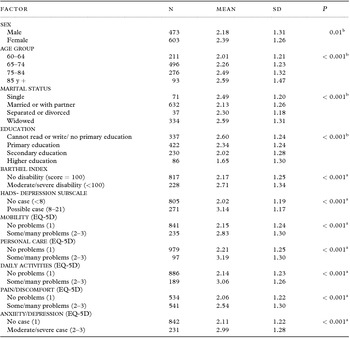
Table 2 displays the results of the mean comparison tests of SOC by sociodemographic variables as well as groups defined by scales. Mean comparisons between groups of each factor revealed that significantly higher SOC was observed in men (p = 0.01), married participants (p < 0.001), and those who had completed higher level education (p < 0.001). In addition those with no disability, without depression and with no problems in the areas of mobility, personal care, daily activities, pain/discomfort, and anxiety/depression had higher SOC than participants with problems in these areas (p < 0.001).
SOC by sociodemographic and health variables: mean comparisons

aMann–Whitney test, bKruskal–Wallis test.
SOC = sense of coherence; HADS = hospital anxiety and depression scale.
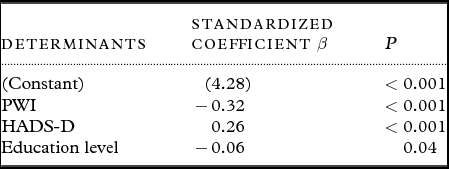
Of the variables tested in the regression analysis, results indicated that PWI, HADS-D, and education level contributed to SOC (Adjusted R 2 = 0.294; F31,025 = 143.905, p < 0.001) (see Table 3). PWI was the most influential determinant (beta = −0.32, p < 0.001). The other variables, including age and gender, were not significant.
Linear regression model for sense of coherence scale

(Only significant relationships shown.)
Adjusted R 2 = 0.294.
Model adjusted by the following variables: age, sex, civil status, education level, PWI, HADS-D, BI.
SOC = sense of coherence; PWI = personal wellbeing index; HADS-D = hospital anxiety and depression scale-depression subscale; BI = Barthel index.
Discussion
This study sought to investigate SOC in community-dwelling Spanish older adults and analyze how SOC is influenced by sociodemographic and health-related variables. In support of the hypothesis, higher SOC was significantly associated with higher functional status. However, functional status is less influential than presumed, as it was not a main determinant of SOC.
The contributions of this study include our findings on the main determinants of SOC and the additional factors that appear to be related to SOC. This is crucial for understanding SOC as a buffer against life stressors (Kahana et al., Reference Kahana, Kelley-Moore and Kahana2012). These results help to conceptualize the model of aging adults on the continuum of SOC, emphasizing the conditions that are associated with the maintenance of high SOC.
Wellbeing, measured by the PWI, was the most influential determinant of SOC in this sample. Therefore, self-ranked life satisfaction explained most of the variation in SOC. To the extent that PWI is a measure of QoL, this result agrees with the literature which correlates high SOC with high QoL (Nesbitt and Heidrich, Reference Nesbitt and Heidrich2000; Borglin et al., Reference Borglin, Jakobsson, Edberg and Hallberg2006; Eriksson and Lindström, Reference Eriksson and Lindström2007; Virués-Ortega et al., Reference Virués-Ortega, Martínez-Martín, Del Barrio and Lozano2007; Martínez-Martín et al., Reference Martínez-Martín2012).
Our results imply that SOC and PWI are in a direct relationship, as are SOC and functional status (as determined by BI).
Conversely, depression was associated with lower SOC. SOC was also lower among participants burdened by problems with mobility, personal care, daily activities and pain/discomfort, as opposed to those with no problems in these areas. These findings agree with and add to the literature on depression and functional independence in relation to SOC (Virués-Ortega et al., Reference Virués-Ortega, Martínez-Martín, Del Barrio and Lozano2007; Mellqvist et al., Reference Mellqvist, Wiktorsson, Joas, Ostling, Skoog and Waern2011; Soderhamn et al., Reference Soderhamn, Dale and Soderhamn2013).
Finally, there seems to be a trend regarding education: the higher the level of education the older adult had achieved, the higher his/her SOC. The importance of education in determining SOC has not been researched in much detail in this population. Our results suggest that this topic should be given more attention. Future studies should look at the role of sex and age in SOC. These variables could be considered psychosocial GRRs and may be influential in the development of SOC.
There are a number of stress-resource models like Antonovsky's salutogenic model such as, for example, the Proactivity Model of Successful Aging (Kahana et al., Reference Kahana, Kelley-Moore and Kahana2012). This study attempts to inform stress-resource models by naming potential determinants of high SOC which may be relevant players in the dynamic between stress-resources and healthy aging. These determinants may contribute to the protective internal resource, Antonovsky describes. Future research should investigate the role of these factors, as well as others, in fostering such resources as SOC. Knowledge of the determinants of personal resources like SOC could develop into a powerful tool for health promotion and successful aging, if it were possible to encourage the internalization of this sort of mental orientation, to prepare adults for aging and protect them against stressors. Interventions for the older adult community should consider the role SOC plays in wellness and evaluation of these interventions would measure the impact of addressing a global orientation like SOC on the health status of the elderly. These findings support current literature of this type in advocating a salutogenic approach to healthcare.
It is important to note that few studies have analyzed SOC as a dependent variable, as does this study. Olsson et al. (Reference Olsson, Hansson, Lundblad and Cederblad2006) compiled a list of 400 articles on SOC and found that of these, only four used SOC as a dependent variable in a stepwise or hierarchical multivariate regression analysis. In these studies, the variables found to contribute to SOC in explanatory models included personality traits, stress, sociodemographic variables, family relational variables and psychopathological variables. Our study explores this perspective further.
The relationship between SOC and associated factors is probably dynamic and circular. Variables such as functional status may modify SOC, as these factors may influence the way older adults cope with aging. It may also be that SOC determines how older adults manage the results of aging, which often include changes in such factors as functional status. Because this study does not assume causality, we can only conclude that these factors may be associated with SOC. Longitudinal studies or structural equation modeling could look at whether or not these relationships are directional, but this is out of the scope of the study.
It would require further research to determine if changes in these factors result in changes in SOC over time. It would then be necessary to confirm whether improvements in these factors could improve SOC in the long-term. However, these results only describe the population of community-dwelling older adults in Spain and, therefore, cannot be generalized to individuals in residential care or individuals with cognitive impairments.
Although much research has connected SOC to health improvement and to factors such as those in this study, it is necessary to exercise caution in developing public health interventions based on these results. Eriksson and Lindström remind us that the original purpose of Antonovsky's scale was to move away from studying risk factors and short-term solutions (Lindström and Eriksson, Reference Lindström and Eriksson2006). Interventions have been associated with short-term improvements of SOC, however long-term improvement of SOC has yet to be confirmed (Lindström and Eriksson, Reference Lindström and Eriksson2005). Rather, following a salutogenic approach, public health initiatives should develop strategies to encourage long-term health promotion by considering functional status, mental health status, personal wellbeing, educational level as conditions associated with SOC. To conclude, further exploration of SOC offers the opportunity to unravel the mechanism behind resilience in old age, to thereby develop interventions which facilitate coping in older adults.
Conflict of interest
None.
Descriptions of authors’ roles
R. Giglio conducted statistical analysis and drafted the manuscript. C. Rodríguez-Blázquez supervised data analysis, drafting of the manuscript, and was responsible for final approval of the article. M.J. Forjaz and J. de Pedro-Cuesta were responsible for a critical review of the draft for important intellectual content and for final approval of the manuscript.
Acknowledgments
The Spanish Ministry of Science and Innovation (national R&D&I Plan: ref. SEJ2006-15122-C02-00) supported this study. We wish to acknowledge the members of the Spanish Research Group on Quality of Life and Ageing:
M. João Forjaz, Carmen Rodríguez-Blázquez and Alba Ayala at the Carlos III Institute of Health; Gloria Fernández-Mayoralas and Fermina Rojo-Pérez at the Spanish National Research Council (CSIC); Pablo Martínez-Martín, Belén Frades-Payo, Beatriz León-Salas and Marina Ávila at the Research Unit, CIEN Foundation, Institute of Health Carlos III, Alzheimer Center Reina Sofia Foundation; Salomé Martín-García and Iluminada Martínez-Lopez at EULEN Sociosanitary services; and María Eugenia Prieto-Flores at UNED University.