INTRODUCTION
Palliative care (PC) delivers individualized healthcare and services to people who have intractable chronic or terminal illnesses in the environment of the person's choice, thus providing the best possible quality of life for the client and family (World Health Organization, 2002). PC focuses on symptom control such as managing distressing clinical problems including pain management, (Van Vorst, Reference Van Vorst2006; Kuehn, 2007), and supporting processes and interventions to assist with the physical, psychological, emotional, and spiritual needs of the client's family (Hudson et al., Reference Hudson, Aranda and Kristjanson2004; Van Vorst, Reference Van Vorst2006), www.who.int/cancer/palliative/definition/en/. Outcome measures in PC require constructs that reflect the specific goals of PC (Kaasa & Loge, Reference Kaasa and Loge2003) and include, in addition to clinical outcomes, improvement in quality of life, maintained or increased dignity, family support, psychological well-being, and access to PC services (Aoun et al., Reference Aoun, Kristjanson and Currow2005).
Health-related quality of life (HRQoL) is a multidimensional and complex measure. Studies have explored the subjective well-being of the dying and quality of life in terminal illness, and have identified five HRQoL determinants, namely: the client state; quality of PC received; and the client's physical environment, relationships, and outlook (Cohen & Leis, Reference Cohen and Leis2002). Most researchers and clinicians agree that HRQoL is related to the individual's symptom experience, level of functioning, and existential well-being (The Support Principal Investigators, 1995; Boyd & Munhall, Reference Boyd and Munhall2001). Studies that have measured quality of life for terminally ill clients have found that the quality of life of these clients is often poor, which is mainly because HRQoL was measured at a late stage rather than when the patient was newly referred to the PC service (Viney et al., Reference Viney, Walker and Lilley1993; Fredheim et al., Reference Fredheim, Borchgrevink and Saltnes2007). In addition, various quality of life tools used in these studies measured different aspects, therefore the results were reflective of the domain measured and can be compared only with data obtained using the same tools. Therefore, this study will contribute to the PC literature by providing the newly referred clients' perspective of their quality of life.
PC affects not only the client but also the caregiver. Literature highlights the nature and extent of physical and psychological morbidity and economic disadvantage home palliative caregivers suffer as a direct result of their caregiving role (Aoun et al., Reference Aoun, Kristjanson and Currow2005). Caregivers have been identified as a vulnerable group and have reported substantial life changes including negative physical, mental, and caregiver strain (Winterling, et al., Reference Winterling, Wasteson and Glimelius2004). Care burden, restricted activities, fear, insecurity, loneliness, facing death, lack of emotional/practical information also have been identified as situations which, when present, can increase the caregiver's vulnerability, and may be risk factors for burnout/fatigue (Strang et al., Reference Strang, Koop and Peden2002). The highest burden has been reported among caregivers with limited social networks and more restrictions in their activities, and those who were younger (Goldstein et al., Reference Goldstein, Concato and Fried2004).
The time commitment required to provide informal care for a spouse or parent is associated with an increased risk of depressive symptoms for the caregiver (Loke, Reference Loke2003). Caregivers have indicated a sense of helplessness, associated with illness progression, their inability to relieve pain and discomfort, and decision making related to client admission to a PC unit (Hudson et al., Reference Hudson, Aranda and Kristjanson2004). Caregivers have reported that existential issues are difficult to handle and that they feel lost. Existentialism in this context is the recognition and appreciation of one's life patterns in order to find meaning and balance amid disease and disorganization (Van Vorst, Reference Van Vorst2006). In so doing, individuals are able to move toward a higher level of consciousness that recognizes the existence of health and harmony, even in the presence of terminal disease.
However, despite the focus of the negative outcomes for caregiver, some do not perceive the caring role to be a burden, rather they report that what they do is important to their loved ones, and therefore meaningful to them (Koop & Strang, Reference Koop and Strang2003; Mok et al., Reference Mok, Chan and Chan2003). Although positive changes such as caregiver's self acceptance, meaning, and closure have been reported, these have been minimal (Hudson, et al., Reference Hudson, Aranda and Kristjanson2004; Milberg, et al., Reference Milberg, Strang and Jakobsson2004; Winterling, et al., Reference Winterling, Wasteson and Glimelius2004).
Overall, caregivers of clients in the terminal stages of cancer have reported that they need more support and information from healthcare providers (Hudson, et al., Reference Hudson, Aranda and Kristjanson2004). As PC services become increasingly community based, understanding HRQoL of clients and caregivers is vital for planning and delivery of PC services. It is therefore vital to explore newly referred clients and their caregiver's HRQoL and perceptions of services, especially in the community context. This prospective descriptive study is significant because it evaluates the effect of a multiservice/multidisciplinary approach to PC on quality of life for the client and caregiver, from their perspectives. It is important to continue providing services in the home to minimize caregiver and client stress. This study adds to the literature by examining a specific population of PC clients' quality of life and service use.
AIM OF THE STUDY
The aim of this prospective study was to describe the HRQoL of clients newly referred to a metropolitan community PC service and of their caregivers before and after receiving home-based PC services. This study is part of a larger study titled, “Quantifying and assessing the impact of PC services on quality of life for clients and caregivers” (Connell, Reference Connell, Fernandez and Griffiths2010; Connell et al., Reference Connell, Griffiths and Fernandez2011).
METHOD
Patients with a life-limiting illness who were estimated to survive >30 days were recruited from five PC services in metropolitan Sydney, Australia. These patients were eligible for the study if they were newly referred to the community PC service, had an Eastern Co-operative Oncology Group Score (ECOG) (Zubrod et al., Reference Zubrod, Ipsen and Frei1960; Oken et al., Reference Oken, Creech and Tormey1982) between one and four, had estimated survival time of >30 days, had access to a telephone at home, and lived within the study geographical area. Caregivers of eligible patients who were willing to participate were recruited. Caregivers were self selected as the primary caregiver of the client.
A detailed recruitment method is presented elsewhere (Connell, Reference Connell, Fernandez and Griffiths2010). All clients newly referred to the service were screened by the PC nurses to determine eligibility. The researcher contacted the client and obtained oral consent to participate in the study and a convenient appointment time was made for data collection, which took place in the client's home. At the appointment time, informed consent was obtained prior to data collection. The client and caregiver were asked to complete the questionnaire. The researcher assisted the participants when required, to complete the survey. The exact procedure was followed for the 8 week follow-up.
Data Collection
Data relating to gender, marital status, employment status, language spoken at home, diagnosis, private health insurance, health status, and HRQoL were obtained for both client and caregiver. The HRQoL of the client was measured using the McGill Quality of Life instrument (MQoL) (Cohen et al., Reference Cohen, Mount and Bruera1997) and that of the caregiver was measured using the Caregiver Quality of Life Cancer Index (CQoLC) (Weitzner et al., Reference Weitzner, Jacobsen and Wagner1999).
The MQoL is a subjective, valid, and reliable 16 item tool that has been used in the PC clinical setting (McMillan, Reference McMillan1995). The test–retest reliability of MQoL as measured by an interclass correlation coefficient has been reported to range from 0.69 to 0.78 (Cohen & Mount, Reference Cohen and Mount2000). The CQoLC was developed to measure the overall impact of the caregiver experience on the caregiver's perception of their HRQoL and consists of 35 items rated using a five-point Likert scale. It is a self-report instrument that has five domains including burden (18 questions), disruptiveness (6), positive adaptation (8), financial concerns (3), and total HRQoL. The test–retest reliability of the scale was 0.95 and internal consistency was 0.91. The instrument has good convergent validity with other HRQoL and emotional distress measures (r = 0.50–0.65) (Weitzner et al., Reference Weitzner, Jacobsen and Wagner1999).
Ethics approval to undertake this study was obtained from the University of Western Sydney Human Research Ethics Committee, and from the Area Health Service Ethics Committee.
Data Analysis
All data were analysed using SPSS for Windows version 12. Descriptive statistics were calculated for demographic characteristics and score of MQoL domains. Data from the MQoL scale and the CQoLC were scored according to the guidelines for the scales (Cohen et al., Reference Cohen, Mount and Bruera1997; Weitzner, et al., Reference Weitzner, Jacobsen and Wagner1999). The maximum total score for the CQoLC instrument is 140. The maximum total score for the MQoL is 160. Both student's paired t test and nonparametric paired test were used to compare MQoL and CQoLC baseline and follow-up. Statistical significance level was determined at α = 0.05. Data from these 22 clients were compared to their baseline values (matched pairs).
RESULTS
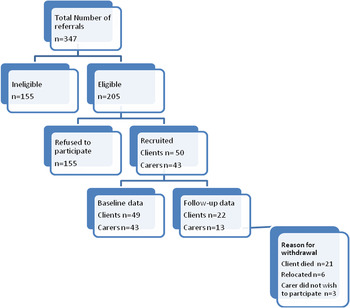
The sample in this study consists of 49 clients and 43 caregivers at baseline, and 22 clients and 13 caregivers at follow up (Fig. 1) (Connell et al., Reference Connell, Griffiths and Fernandez2011).
(Color online) Flow chart of participants through the study.

Client and Caregiver Demographic Characteristics at Baseline
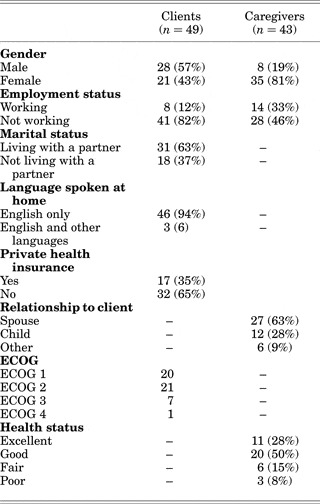
The mean age of the clients was 68.3 years (range 45.3–88.5 years). Approximately 60% of clients were male living with a partner, and only 17 (35%) had private health insurance. Of the 43 caregivers, 27 (63%) were a spouse of the client and 28 (66%) were not working. At baseline, the majority of the clients had an ECOG score of one (n = 20) or two (n = 21). Seven clients had an ECOG score of three and one had an ECOG score of four. The main diagnosis for the majority of clients was cancer (n = 42). Caregivers mainly rated their own health status as good or excellent (77%) (Table 1).
Demographic characteristics of clients and caregivers at baseline.

ECOG, Eastern Co-operative Oncology Group Score.
Client and Caregiver HRQoL
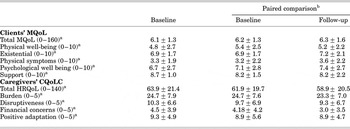
Clients reported a low mean score for physical symptoms domain (mean 3.3 ± 1.9, range 0–10) but a high one for support (mean 8.7 ± 1.0, range 45–10). The mean score for physical well-being was 4.8 ± 2.7 (range 0–10), lower than the psychological and existential well-being scores, which were rated equally at 6.7 ± 2.7 (0–10), and 6.9 ± 1.7 (2–10), respectively. Clients indicated that they had extreme, worrisome symptoms, and reported that pain, breathlessness, and fatigue were impacting on their HRQoL. A subgroup analysis was undertaken based on the client's ECOG status. The lowest subscore was for clients with an ECOG of 2 (3.4). At follow-up, 22 clients completed the MQoL questionnaire. There was no statistically significant difference (paired) between baseline and follow-up HRQoL scores in any of the domains (Table 2).
Clients' MQoL and caregivers' CQoLC at baseline and follow-up (Mean ± SD)

aNumbers in brackets are theoretical range of the scores.
bNo differences in quality of life of clients and caregivers between baseline and follow-up.
MQoL, McGill Quality of Life instrument; CQoLC, Caregiver Quality of Life Cancer Index
HRQoL, health-related quality of life.
The scoring for the MQoL scale involves transposing the scores for questions 1, 2, 3, 5, 6, 7, 8 and subtracting the raw score from 10 for each subject. The five MQoL domains are reported separately. An overall index score is calculated from the means of the five subscales.
The CQoLC scale is a self-report instrument that assesses four domain items using a five-point Likert scale ranging from 0 to 5 to assess QoL in the family caregiver of cancer clients. The caregiver rates the items in each of the four domains: burden (18 items), disruptiveness (6 items), positive adaptation (8 items), and financial concerns (3 items). The maximum total score for the instrument is 140. A lower overall score indicates a better HRQoL.
For caregivers, the mean total CQoLC score at baseline was 63.9 ± 21.4, (22–110). Scores were: burden domain 24.7 ± 7.9, disruptiveness 10.3 ± 6.6, financial concerns 4.5 ± 3.9, and positive adaptation 9.3 ± 4.9. Comparison between baseline and follow-up in CQoLC for the 13 caregivers revealed no statistically significant differences in total score and domains (Table 2). A total of 43 carers completed the baseline questionnaire. At follow-up, only 13 carers participated, because of some being at work at the time of the visit (Table 2). Carer QOL scores are presented in Table 2. The highest scores were for caregiver burden and overall QOL.
DISCUSSION
Outcome measures in PC require constructs that reflect the specific goals of PC, such as improving HRQoL before end of life, symptom control, and clients' perceptions of “purpose” and “meaning of life” (Kaasa & Loge, Reference Kaasa and Loge2003). Clients with terminal illness suffer from diverse physical and PC interventions need to target the domains of physical symptom and existential well-being of clients. During end-of-life care, spirituality and existential issues become most prominent, therefore assessing those aspects of HRQoL during the terminal phase of illness should be part of the client's case management at that time. Clients' own perceptions of their physical, psychological, and existential well-being in the palliative home care setting remain largely unknown.
Overall HRQoL was rated poorly by the clients. Scores for the individual scales of the HRQoL were highest for support, psychological well-being, and existential well-being and lower for physical symptoms and physical well-being. A low physical domain score may be explained by the high prevalence of physical symptoms reported by these participants, with the most troublesome symptoms reported being pain, breathlessness, and fatigue.
Psychological well-being was rated as the second highest domain (mean score = 7.1). The psychological domain explores issues such as feeling depressed, worried, sad, or being afraid of the future. The psychological domain has been shown to be an important factor in determining HRQoL in PC populations. Uncertainty, control, coping, enjoyment of life, and cognitive function have also been found to be important to HRQoL (Cohen & Leis, Reference Cohen and Leis2002). The high scores may be related to the individual client's perspective on life, or their faith. A faith and/or an optimistic perception may influence the perceived quality of life of a client.
Existential suffering, in particular difficulty finding the meaning of existence near the time of death, has been reported in cancer clients in various studies (Yan & Kin-Fong, Reference Yan and Kin-Fong2006). Home PC clients in other studies have reported relatively low scores for the existential domains with mean scores of 6.12 ± 1.6 out of 10 (Yan & Kin-Fong, Reference Yan and Kin-Fong2006). In this study, similarly, the existential domain of quality of life was considerably lower than the psychological and support domains for terminally ill cancer clients who received palliative home care. The findings suggest that an individual's rating of psychological well-being and existential well-being may remain constant or improve despite objective functional deterioration. Individuals facing end of life may adjust their expectations of health to reflect their physical state and may make adjustments in the importance of life domains, becoming more appreciative of the support resources that assist their activities of daily living.
High scores on the support subscale are consistent with other studies (Douglas, Reference Douglas2007). Most clients were receiving care from more than one specialist PC clinician, which may have contributed to clients' feeling well supported, which in turn may have enhanced their ability to cope. Previous published studies suggest that fear of becoming a burden to loved ones is one of the greatest stressors in terminally ill clients (Steinhauser et al., Reference Steinhauser, Christakis and Clipp2000). Perhaps those with strong support networks experience greater anxiety about caregiver burden, counteracting the positive aspects of having loved ones around them. Support has also been rated highly in other PC studies (Douglas, Reference Douglas2007), and that was also reported in this study by clients expressing their appreciation of the support received from family caregivers and PC staff.
It is important to gain an understanding of both client and caregiver need, as clients' need for more information or support may not be congruent with caregiver need (Hudson et al., Reference Hudson, Aranda and Kristjanson2004). Caregivers were studied in response to other research indicating that caregivers also have unmet needs, and a divergence between client and caregiver needs has been reported. The needs of caregivers are also important considerations when designing services and referring clients to services for care. PC affects not only the client but also the physical, psychological, emotional, and spiritual aspects of their caregivers (Hudson et al., Reference Hudson, Aranda and Kristjanson2004). In previous studies, difficulties have been generally perceived by caregivers in caregiving, namely: the relationship with the care receiver, emotional reactions to caring, physical demands, and a restricted social life (Loke, Reference Loke2003). The caregiver role can have a negative impact on health, schedule, anxiety, and energy of the person (Martin et al., Reference Martin, Leak and Aden1992; Aranda & Hayman-White, Reference Aranda and Hayman-White2001). The caregiver is a valuable member of the healthcare team, but caring at home involves balancing care burden and capacity to cope (Proot et al., Reference Proot, Abu-Saad and Crebolder2003).
Providing informal care for a spouse or parent imposes considerable time demands on caregivers and has been shown to be associated with increased risk of depressive symptoms in that group (Newton et al., Reference Newton, Bell and Lambert2002). The study reported here highlights this burden of care from the perspective of the caregiver, with some caregivers being required to review their way of life and initiate changes to work and social activities (Newton et al., Reference Newton, Bell and Lambert2002). The majority of caregivers in this study reported spending >12 hours each day performing that role, despite use of hospice services and assistance from family members. For some caregivers the caregiving burden was additional to existing full-time work commitments or other commitments including caring for children. Therefore, it is important to ensure appropriate home attendance by PC services. Respite opportunities for caregivers are also essential to support the caregiver and enable the client to be maintained in the community (Jarrett et al., Reference Jarrett, Payne and Wiles1999).
Variations exist in the intensity of caregiver burden based on subjective experiences and social support; therefore, clinicians need to consider individual need, and design interventions to target these issues (Goldstein et al., Reference Goldstein, Concato and Fried2004).
Continuing previous activity, hope for the future, keeping control, satisfaction and good support are factors that may decrease the caregiver's vulnerability (Strang et al., Reference Strang, Koop and Peden2002). Quality of life issues are important to explore in PC caregivers, as it is linked to satisfaction with care and symptom relief (Tierney et al., Reference Tierney, Horton and Hannan1998). Therefore, caregiver social ties need to be increased, to decrease the risk of social isolation. Support may mitigate the depressive effects of caring for a disabled or ill family member.
The burden for family caregivers includes time and logistics, physical tasks, financial costs, emotional burdens, and mental and physical health risks. Currently, a model for conceptualizing the experience of family caregiving within the domain of PC has not been developed. Until researchers and healthcare professionals develop and validate a model for family caregiving that is directly applicable to understanding the family caregiver experience, there will continue to be difficulties for practitioners in applying a suitable framework for guiding their care decisions. Two conceptual models underpin this research: the timely/team oriented Longitudinal, Collaborative and Comprehensive (TLC) model (Jerant et al., 2004), (related to other findings in the study) and the Conceptual Framework for PC practice model (Ferris et al., 2002). These models, outlined in the following discussion, describe a person-centered, holistic approach to care, which is the ideal of palliation. The Conceptual Framework asserts that clients with life-threatening illnesses have various needs and expectations for care. These factors are conceptualized in domains of care elements, resulting in the ability to formulate a plan of care within a multidisciplinary system, to achieve end-of-life outcomes.
Future studies could explore this issue further and implement changes to support caregivers. Among informal caregivers of clients receiving home PC, higher levels of client distress was associated with increased caregiver burden and psychological morbidity. In response to addressing the unmet psychological needs of caregivers, services must meet the psychological needs of clients. Additionally, clients' unrelieved symptoms were associated with increased caregiver burden and psychological morbidity. Therefore, two approaches in maintaining the psychological health of caregivers as well as clients are client symptom control and education for caregivers on symptom control (Duffield, 2001). PC services need to address the support needs of caregivers, to enable them to provide care and to enhance their current and future health outcomes.
CONCLUSION
This study has provided service delivery/HRQoL evidence that can inform service development and specific interventions that may improve outcomes for PC clients and their caregivers. Future studies using larger sample sizes should evaluate the HRQoL of clients and caregivers at baseline and after a given period. This information will enable the development of guidelines and implement interventions to support the caregivers. Models of respite services for carers need to be considered as a means of improving their QoL. Carers need time away from their caregiving role to reduce caregiver burden and to allow other tasks to be completed. The needs of carers should also be considered when developing individual care plans. The case management approach to care should be used to ensure that services are coordinated, appropriate, and effective for each client. Greater emphasis on existential issues when providing PC services to clients and their carers is required. This can be achieved by assessing these needs on an ongoing basis, through QoL tools, questionnaires, or prompt lists. PC services, therefore, need to determine the holistic needs of their clients and take these into account when designing services.
Limitations of the Study
The study is limited by the sample size, although substantial for a PC population. The participants were excluded if English was their secondary language, and it would be useful to replicate the study with a population of non-English-speaking participants. A limitation of the data collection methods was that the researcher was the primary investigator and completed all aspects of the study, therefore increasing the chance of bias. Furthermore, no recordings were taken to verify the findings. The client's actual illness might also be a limitation in the study. There was a low participation rate for the study (a 30% participation rate), possibly influenced by the fact that clients were newly diagnosed and coming to terms with having a terminal illness. A larger sample size would highlight trends in the data.
Despite the limitations, this study has several strengths. First, the methodological rigour used in the study is a major strength. The use of a validated tool to measure HRQoL enables comparisons with other published literature. Clients were given the option of having the questions read to them by the researcher, which allowed participants to reflect on the questions, and lessened their chance of fatigue. Some clients also had poor vision, and therefore may not have been able to adequately read the questions had not the option of assistance to complete the survey been offered. Completing the questionnaire in the client's home allowed privacy, confidentiality, and freedom of speech for the client. Also, the client was interviewed alone without the caregiver being present. Caregivers completed the tool alone with the researcher; this ensured privacy and allowed openness without the client being present.
ACKNOWLEDGMENTS
The authors acknowledge the participants in the study, the Sydney South West Area Health Service Palliative care service, and the research supervisors/expert opinions, as well as the nurses for the PC services who recruited the clients.