In the presidential address he delivered in 2009, Colin Jones noted that most of his predecessors at the helm of the Royal Historical Society (RHS) had been English historians, and had chosen to frame their four successive annual lectures around ‘the state of a key issue or else to offer a synthesis in regard to some knotty problem or major theme in, usually, English history’. His approach to the anniversary lectures, as a French historian with eclectic tastes, was to range ‘more widely and more disparately than is the presidential custom’, so as to play to his strengths while following his interests. Like Goldilocks sampling the Bear family's porridge, I have borrowed selectively from these contrasting presidential paradigms. Like most previous incumbents, I too am an English or British historian, but like Colin before me in his ‘French Crossings’ lectures, I intend to connect Britain's so-called ‘island history’ to its wider European and global moorings.Footnote 1 To do so, I too will range widely in my four lectures over time and space. However, in keeping with the majority of my presidential forebears, I will retain the predominant convention of articulating a sustained focus. I do so not by offering ‘a synthesis’ that addresses a continuous narrative or ‘knotty problem’, but rather by opting to explore, through four different case-studies, the implications for modern British history of the cluster of methodological practices within our discipline known collectively as the ‘material turn’.
I use the phrase ‘material turn’ in two linked senses, one relating to material culture and the other to material or economic life. Since at least the 1980s, historians have increasingly turned to material objects as primary sources that can illuminate aspects of the past which are obscured if we attend to textual evidence alone. Drawing from disciplines that include anthropology, archaeology and sociology, they have found in material culture rich new records of the past and novel ways of explaining human behaviours in historical contexts. Some within this school count objects listed in textual sources such as inventories and wills, and derive from these quantitative data new insights into past social worlds.Footnote 2 Others are inspired by theorists who argue that material objects not only shape but actively collude in social processes and historical change. Rather than resting in humans alone, historical agency – these proponents of the material turn argue – resides in a fluid, animating interface that connects material things to persons.Footnote 3 Human histories are thus both entangled in and propelled by the force of ‘vibrant matter’.Footnote 4
A second type of material turn has ensued from historians’ growing disenchantment with the perceived excesses of linguistic and cultural analysis, the twin methodologies that increasingly supplanted social, economic and political history-writing from the 1980s onward.Footnote 5 Tempering the claims of the linguistic and cultural turns of these decades, historians are now reclaiming (and reformulating) traditions of materialist history that developed in the Victorian era and dominated our discipline for much of the twentieth century. ‘Fifty years ago, history was anchored in what Geoff Eley and Keith Nield term a “sovereign materialism”’, Kenneth Lipartito has recently observed. In contrast, ‘Much of the debate in the profession over the past half-century has been about establishing the authority of ideas, values, and identities independent of coarse materiality or narrow economic interests.’ Combining cultural and linguistic historians’ earlier insights with a renewed conviction that economic and material life profoundly shape the course of history, a rising methodological pulse within present-day historical analysis, he observes, argues that ‘Things, nature, technologies…and commodities count, not just as cultural representations or referents in language, but in their own right.’Footnote 6
For scholars of eighteenth- and nineteenth-century Britain – my own field of specialism – the rise of these two versions of the material turn has been closely associated with the decline of a more insular, national narrative of British history, and with the corresponding growth of interest in Britain's imperial landscapes. Whereas foundational interpretations of the economic history of modern Britain focused on domestic coal mining, iron smelting and cotton manufacture, more recent materially minded researchers have turned instead to histories of sugar, tea and chintz.Footnote 7 The Caribbean, the Cape and the Indian subcontinent have emerged in this context as vital fonts of British goods, British identities and British power.Footnote 8 In this paper, I explore a further frontier of this nexus of imperial and material connections by turning to the practice of history-writing itself. Focusing on material histories of loot that reach from the seventeenth century through and beyond the Victorian era and which stretch geographically from south India to Scotland, I explore the relationship between plunder, on the one hand, and the writing of history, on the other. In doing so, I seek to bring Georgian-era imperial and material histories home to bear on the discipline of history in Victorian Britain in the first decades of the RHS's operation. Colonial loot and military booty, I argue, played an active role in inciting historical practice in nineteenth-century Britain. On the eve of our sesquicentennial anniversary year, it is fitting to reflect back on that neglected material history.
I
Let me begin by sketching the main accepted narrative of how history as a discipline developed in Britain in the Georgian and Victorian eras. Three successive phases of history-writing dominate received understanding of the nineteenth-century discipline. From the publication of David Hume's History of England in 1754 and of William Robertson's History of Scotland in 1759 to the end of the Napoleonic Wars, Scottish Enlightenment thinking held sway within British history. Cosmopolitan in tone, the phenomenally popular histories penned in this period became increasingly ‘conjectural’ in their methodology. Deduction from assumed universal principles of human behaviour shaped the Enlightenment historical paradigm, which traced a progressive arc from ‘rude’ and ‘barbaric’ early societies to modern, commercial ‘civilisations’. Human nature – innately both inquisitive and acquisitive – was in this conjectural model ‘the engine bringing both limitless potential energy and dramatic forward motion to…history’.Footnote 9 Written in Scotland, England and on the European continent by men employed as librarians, chaplains, private tutors, personal secretaries and university professors, this was at its core a textual and philosophical mode of historical interpretation. This domestic variant of Enlightenment history was typically composed at a distance from the European and imperial wars that raged in these decades, by men (and occasionally women) safely ensconced within the comforts of the urban salon or the domestic home.Footnote 10
The years after 1815 – so the accepted narrative tells us – witnessed a sharp constriction of British historians’ vision. This period, stretching roughly to the Franco-Prussian War of 1870–1, saw the Scottish Enlightenment paradigm subsumed within so-called Whig history.Footnote 11 In John Burrow's formulation of this ‘Liberal descent’, the late Georgian and early Victorian Whig writers who monopolised history after 1815 discerned ‘in English history the continuous presence…of an abiding spirit of liberty’, an overweening liberal force-field that lent their writing an inherently celebratory, nationalist tone.Footnote 12 This school of historians borrowed liberally from literary sources and took much pride in literary style, but its practitioners’ predominant concern was to champion a politics of freedom and progress. Associated with a coterie of white, male, propertied authors that included Thomas Babington Macaulay (1800–59), William Stubbs (1825–1901) and Edward Freeman (1823–92), the Whig tradition, in Michael Bentley's description, ‘saw as imperative the task of communicating their work to the widest audiences…to mould its taste…to a tradition of constitutional continuity stemming from Saxon liberties through Magna Carta and the Bill of Rights to the Hanoverian…mixed constitution…that accounted for Britain's, and especially England's, greatness’.Footnote 13
Puncturing this triumphalist liberal narrative of British history from the 1870s onwards was a third historiographical epoch, which saw the growing impact in Britain of assumptions and working methods pioneered in Prussia from the 1820s by Leopold von Ranke.Footnote 14 The Rankean school was characterised by an (ostensibly novel) empiricist emphasis on facts and a deep belief in the virtues of immersion in manuscript archives. As Anthony Grafton observes, ‘collections of primary sources…acted on Ranke like clover on a pig’.Footnote 15 These tenets challenged not only the conjectural methodology of Enlightenment history but also the Whig historians’ reliance on literary sources and liberal ideals to narrate the triumphal progress of the English nation.Footnote 16 British historians’ acceptance of continental European methodologies, to be sure, was patchy. But champions of Ranke nonetheless numbered both among the foremost historians of late Victorian and Edwardian Britain and among the founding fathers of the RHS. British historians who ‘studied in Germany and returned to England with a passion for research’ included distinguished RHS fellows, council members, vice presidents and presidents such as Samuel Gardiner (1829–1902), Sir John Robert Seeley (1834–95), Charles Firth (1857–1936) and Sir George Prothero (1848–1922).Footnote 17
The historical traditions of the world beyond the Occident were progressively effaced as these three phases of history-writing unfolded. Scottish Enlightenment historians, although domiciled in Europe, allowed their imaginations to range freely beyond these familiar Western precincts. Their curiosity about the wider world was matched with a methodological proclivity for cross-cultural comparison, further feeding their global outlook.Footnote 18 At Edinburgh, William Robertson (1721–93) followed his 1759 and 1769 works on Scottish and continental European history with a 1777 History of America and a 1791 Historical Disquisition concerning the Knowledge which the Ancients Had of India.Footnote 19 Domestic British engagement with extra-European histories was both mirrored and extended by the labours of Enlightenment-era ‘Orientalist’ scholars on the Indian subcontinent. Typically employed in the East India Company's civil service, men such as William ‘Oriental’ Jones (1746–94), John Howell (1711–98) and the Perthshire Orientalist Alexander Dow (1735/6–79) deployed their new knowledge of Asian languages to write Enlightenment histories of the subcontinent.Footnote 20 Crucially, these Orientalists’ scholarly labours drew upon not only the linguistic expertise but also the manuscripts and methodologies of Indian scribal elites – Hindu and Muslim bureaucrats and scholars schooled in their own vibrant traditions of historical scholarship.Footnote 21
Nineteenth-century British Whig historians were, in contrast, contemptuous of both Asian history and Asian history-writing. The publication of James Mill's militantly utilitarian History of British India in 1817 set the prevailing, derogatory tone, for Mill argued that India lacked a history: dominated by despotism, its culture and polity had failed to manifest progress.Footnote 22 In Macaulay's works, this disdain for the subcontinent reached new, morbid heights. As Catherine Hall has argued, his distaste for both India and Indians – born of his bureaucratic labours on the subcontinent in the 1830s – became an integral component of his liberal historical vision.Footnote 23 Notoriously, Macaulay in 1835 asserted ‘the intrinsic superiority of…Western literature’ and (acknowledging that he had ‘no knowledge of either Sanscrit or Arabic’) claimed ‘that a single shelf of a good European library was worth the whole native literature of India and Arabia’.Footnote 24 Nor did the Rankean historiographical revolution of the later Victorian years reverse this trend. Georg Iggers has observed that Ranke declined ‘to deal with the histories of China and India because he claims that they have no histories in any real sense, but are stagnant and thus at best have “natural histories”’.Footnote 25
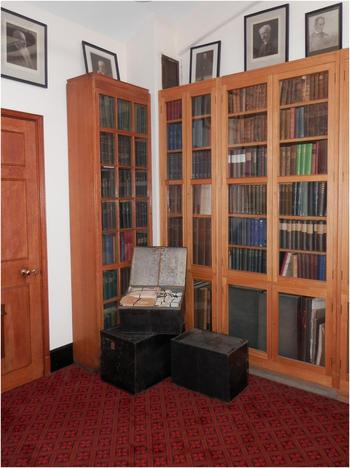
Taken together, these three phases of British and European history-writing suggest a lineage for the discipline that uncannily resembles the interior decor of the RHS Council Room (Figure 1). In this materialised representation of our discipline's evolution in Britain, modern historical practice appears to march forward as generations of be-suited, bearded white men give way to generations of be-suited, clean-shaven white men. Surrounded by books and manuscripts culled (in the best Rankean tradition) from British and European archives, their presidential portraits on our walls give no hint of these men's investment in (and our inheritance from) Britain's empire and its history – substantial although these often were. Yet this image of the RHS conceals cross-cultural historical traditions, embedded in the imperial past, which contributed to the making of modern British histories. By turning to the Anglo-Maratha War of 1817–18, I hope to disrupt the seemingly natural British and European progression – to ‘provincialise’ this historiography, in Dipesh Chakrabarty's resonant phraseFootnote 26 – and to begin to recover the vibrant alternatives to the Whig and Rankean Victorian traditions that emerge from our own woodwork, if we take a material turn.
Royal Historical Society Council Room, November 2017: the walls are decorated with portraits of each of the Society's past presidents. Photograph: James Dawkins.

II
Britain waged three Anglo-Maratha Wars between 1775 and 1818. The focus here, the Third (also known as the Pindari) War began in 1817 and ended in 1818, with mopping-up campaigns extending into the following year.Footnote 27 The terms ‘Third Anglo-Maratha War’ and ‘Pindari War’ describe two intertwined conflicts fought contemporaneously on overlapping ground by conjoined British armies. Both phrases are misleading, not least because they suggest Manichean oppositions. For these wars did not unilaterally pitch the British against the Marathas – the Hindu claimants to the western lands of the crumbling Islamic Mughal empire. Nor did they set the British unambiguously against the Pindaris – freebooting raiders who exploited the endemic military dislocation in western India after 1800 to sweep down into the fertile Deccan from their strongholds on the banks of the Narbudda. Rather than dualistic combat, these years saw the East India Company's army ally with selected Maratha chiefs even as they battled against others in their campaign to suppress the so-called Pindari hordes. Maratha princes likewise allied selectively with and against each other, the British and the Pindaris. Their armies were fundamentally hybrid: Arab, European and Indian Muslim mercenaries joined Hindu princely armies in their efforts to fight free of British control in the Anglo-Maratha and Pindari Wars.Footnote 28
Loot and plunder were central aspects of these battles, a circumstance that reflects much longer traditions of warfare in Central and South Asia. The wars originated in autumn 1817 with a major British campaign to suppress what the British termed the ‘predatory system’, the increasingly violent plundering expeditions mounted in the Deccan by Pindari horsemen. The etymology of ‘Pindari’ is unclear: contemporaries variously ascribed Afghan, Jat and Maratha origins to these mobile warriors. The first credible reference to them, as mercenaries in the Mughal army, dates from 1689.Footnote 29 By the later eighteenth century, Pindaris were instead mercenaries in the Maratha armies of the successor states fighting free from the Mughal grip.Footnote 30 Shifts of allegiance such as this were characteristic of Pindari strategy. Light horsemen armed with spears and matchlocks and organised into parties of from 1,000 to 3,000 men, they were highly mobile freebooters. On horseback they could cover up to fifty miles in a single day, operating only loosely linked to the armies of their sometime Maratha allies. Charged with harassing enemy camps and villages, their function was not to stand and fight but rather to ride and plunder. They swept rapidly into enemy territory, seized any valuable booty, loaded up their hardy steeds, set fire to looted habitations and sped onward to their next victims.Footnote 31 One British observer compared the Pindaris to Cossacks on the Russian steppes. They practised ‘rapine, accompanied by every enormity of fire and sword, upon the peaceful subjects of the regular governments’, he commented. ‘The cruelties they perpetuated were beyond belief.’Footnote 32
In the aftermath of the Second Anglo-Maratha War, Pindari depredations escalated sharply. Defeat in the Second War had forced the leaders of the Maratha Confederacy to cede substantial territory to the British. The peace treaties these leaders signed swelled the Pindari ranks by depriving tens of thousands of armed mercenaries of employment. British officials estimated that there were fewer than 3,000 Pindari horsemen in 1800; by 1817, this figure had risen to between 25,000 and 50,000.Footnote 33 In the intervening years, the Pindaris turned to increasingly autonomous campaigns of plunder, disrupting trade, despoiling villages and stripping assets from territories farmed for revenue by the Marathas, the English East India Company and Muslim princely states. A handful of successful Pindari leaders acquired great wealth and built military followings that rivalled those of the Maratha chiefs they had earlier served.Footnote 34
As mounting piles of booty enabled the Pindaris to construct new power bases by recruiting men from the Deccan's growing pool of unemployed mercenaries, atrocity stories proliferated in British commercial and military accounts. An East India Company investigation of 1815 reported that 339 villages had been plundered by Pindaris, with 182 persons killed, 505 wounded and 3,603 tortured.Footnote 35 By 1816, Pindari raids threatened the Company's territories from Madras to Bombay.Footnote 36 Responding to this crisis, in autumn 1817 Francis Rawdon-Hastings (1754–1826), governor general of India, formed two armies to crush the Pindari threat: the so-called Grand Army, under his own command, and the Army of the Deccan, led by Sir Thomas Hislop (1764–1843). Mustering 114,000 men in ten divisions, these two armies – Hastings's Grand Army marching from the north and Hislop's Deccan Army up from the south – sought to force the Pindaris home to the banks of the Narbudda.Footnote 37
This mass deployment of British forces against the Pindaris precipitated the Third Anglo-Maratha War, by affording disaffected Maratha chiefs an opportunity to reassert their claims to western India, while the British were distracted by their campaign to suppress the Pindaris. A loose, often internally divided congeries of princely kingdoms, the Maratha Confederacy or empire traced its origins to the seventeenth-century warrior Shivaji Bhonsale (1630–80). Shivaji had won a decisive battle over the forces of the western Deccan's ruling dynasty in 1659, defeating his opposing general – so legend proclaimed – by eviscerating him with a baghnaka, a lethal weapon shaped like a tiger's claw.Footnote 38 His success in the next decades in contesting Mughal might rested on a sophisticated system of plunder that converted military loot into government revenue. James Grant Duff (1789–1858) – a captain in the Bombay army and the father of the RHS's fourth president – detailed Shivaiji's system of loot as statecraft in his 1826 history of the Marathas. ‘All plunder…was the property of government’, he reported. ‘It was brought at stated times to Sivajee's…public audience, and individuals formally displayed and delivered their captures.’ The phrase ‘to plunder the enemy’, he observed, ‘is to this day used by the Mahrattas to express a victory, of which it is in their estimation the only real proof’.Footnote 39
Crowned Maratha monarch in 1674, Shivaji founded the dynasty to which Maratha princes still, in the 1800s, owed spiritual allegiance. But by the later eighteenth century, Maratha power was wielded not by the Satara Rajas descended from this founding father, but rather by the peshwa or prime minister, based at Poona (present-day Pune). In 1802, on the eve of the Second Anglo-Maratha War, the British had deposed the sitting peshwa and installed in his place (as a puppet ruler) Baji Rao II (1775–1851). Shackled to the British by an extortionately costly alliance, Baji Rao fumed, schemed and – in November 1817 – waged open war against his oppressive allies.Footnote 40 While the British began to move against the Pindaris, Baji Rao's army looted and burned to the ground Poona Residency, the East India Company's regional seat and the official home of its chief diplomat, Mountstuart Elphinstone (1779–1859). Elphinstone – later to become a noted historian – escaped the Residency with his retainers, but his library of rare Persian, Sanskrit, Hindi and Marathi books and manuscripts was destroyed in the flames.Footnote 41
Baji Rao's treachery was swiftly compounded by the defection to his cause of other Maratha chiefs. These events compelled the two British armies formed to suppress the Pindaris to fight simultaneously on multiple fronts. In the next months, these armies gradually forced the Pindaris toward the hills and jungles of the Narbudda by a pincer-like movement between Hastings's Grand Army, and Hislop's Deccan divisions. As they retreated, Baji Rao and his Maratha allies – assisted on occasion by fleeing Pindaris – evaded capture by the Deccan Army's infantry and cavalry. Rumoured to be simultaneously in multiple, far-flung corners of the Deccan and moving with little resistance through the territories of Britain's supposed allies, Baji Rao was to evade capture until June 1818. In the meantime, epidemic cholera struck the British forces, exacerbating the heavy toll of their military losses. As British casualties mounted, the senior officers orchestrating pursuit of the peshwa across the Deccan struggled to maintain authority over their own forces. Plunder and looting – the very practices the Pindari War had been waged to suppress – now emerged as a shared modus operandi of Pindari, Maratha and British alike.Footnote 42
Since the reign of Shivaji in the seventeenth century, loot had been the vital cog around which Maratha military strategy turned, just as plunder later became the prime goal and military function of the Pindaris. These extractive modes of warfare extended far beyond the Maratha territories and were entrenched in India long before Europeans established a substantial territorial presence. It was plunder that provided much of the capital that allowed Afghan, Sikh, Jat and Maratha freebooters, active from Central Asia down to the Deccan, to attract and deploy the mercenary horsemen who secured the new regional states that displaced Mughal imperial rule. In this turbulent political era, Jos Gomans observes, ‘there was no clear-cut distinction between war and peace and between plundering and revenue collection…In fact, looting was considered as an irregular form of tax collection by the enemy.’ Hoards of accumulated plunder functioned for Indian princely aspirants as private banks which ‘could be used…to attract new adventurers or converted into ready cash by sale’.Footnote 43 Loot, moreover, provided the essential glue that made both Indian and British multi-ethnic armies coalesce and function: ‘the best way of keeping an army…together was…the prospect of…plunder’.Footnote 44
The British presence added to these Central and South Asian traditions of extractive statecraft one novel component predicated on European conventions of war. This new factor was the prize system. Legal structures for adjudicating the allocation of ships and cargoes seized in war had developed in the sixteenth century in maritime Europe, and from the seventeenth century Admiralty courts oversaw the distribution of so-called prize, the spoils of British naval combat.Footnote 45 Military prize as it developed in seventeenth-century Britain was, in sharp contrast, ramshackle, partisan, Byzantine and tortuously slow. Whereas legal courts adjudicated maritime prize, only the sovereign had the ultimate authority to determine which officers and men should enjoy proceeds from the sale of booty captured in territorial campaigns. In theory, the prospect of military prize granted by the king bolstered soldiers’ valour in the battlefield whilst diminishing their incentive to engage in indiscriminate plunder at or before the point of victory. Battlefield practice, however, departed radically from this ideal, for prize procedure demanded labyrinthine bureaucracy and delayed gratification, while loot lay readily and immediately at hand. Under prize procedure, in the aftermath of each territorial battle, commanding officers established committees responsible both for collecting, inventorying and disposing of booty seized from the enemy and for compiling detailed lists of who had served under whom in each campaign – thereby seeking to establish combatants’ entitlement to prize.Footnote 46 These voluminous records were then sent to Whitehall, for the sovereign's consideration. Already onerous in European theatres of war, these cumbersome prize processes were rendered yet more burdensome in the Anglo-Maratha campaigns by the vast distances that booty, documents, and men traversed; by the cacophony of languages spoken by officers and their men; and by the sheer scale of plundered material objects that surfaced in the course of the Deccan Army's protracted pursuit of the peshwa.Footnote 47
As they were chased by the Deccan Army from hill forts to princely courts, from princely courts to jungles and from jungles to the plains, Baji Row and his allies mobilised their accumulated hoards of treasure to attract mercenaries, to provision their armies and to purchase the silence of neutral princes through whose territories they fled. Comprising jewels, textiles, plate, gold and silver coins, religious statues and weaponry, this liquid capital was variously heavy, fragile, cumbersome to pack and difficult to transport or conceal. Its materiality – its heft, its size, its configuration and composition – shaped its appeal, use and value, both in transit and, if captured by the British, once revealed. Packed in bullock carts, loaded onto camels, dispatched on the backs of horses and elephants, vast sums of treasure flowed across the Deccan to fund Maratha warfare.
The siege and capture of Rhygur Fort illustrate the material, cultural and military processes simultaneously at play as Maratha treasure was transmogrified into British booty and set on its rocky road to becoming British prize. Rhygur had played a vital military and ritual role in Shivaji's seventeenth-century empire, but its strategic importance was heightened in 1818 by the fact that it was to this fort and its commandant, Narroba Outia (who also served as Baji Rao's treasurer), that the peshwa had dispatched his wife for safety. Women played active roles in Maratha war and politics. Shivaji's mother, Jijabai (1598–1674) figures prominently in the Maratha powadas (heroic poems) that chronicled her son's military victories; wives, widows and mothers featured conspicuously among the Maratha rulers who contested Mughal power in the following decades.Footnote 48 At least one female leader was beheaded by her clan during the Pindari War, to remove her from power.Footnote 49 In warfare, the wives of Maratha and Pindari chieftains were also instrumental in transporting princely treasure. Reporting the movements of the Pindari Chitu in January 1818, the Bombay Gazette noted that his party included ‘six elephants, two for the conveyance of his Wife, Son, and Mother, and the rest…laden with Treasure’.Footnote 50 Where there were insurgent Indian women, British military men rightly suspected, there was also likely to be loot, or prospective prize.Footnote 51 When, after eighteen days of bombardment by British artillery, Rhygur at last capitulated, the attention of Lieutenant-Colonel David Prother and his men was fixed equally on its commandant, Narroba, and on the peshwa’s wife, Bhai Sahib.
The terms of capitulation agreed at Rhygur stipulated that all of the peshwa’s treasure hidden in the fort, as well as two-thirds of Narroba's personal fortune, was to become British booty. Early estimates suggested that the coin alone of the peshwa’s ample hoard comprised 19,000 gold mohurs and 4½ lacs of silver rupees.Footnote 52 Booty seized in warfare, this wealth was vibrant matter, animated with the potential to become military prize, through the king's gift in England.Footnote 53 As Prother's men dug into the walls of the fort to extract the peshwa’s concealed hoard of treasure, rumours of its vast extent proliferated. So too did suspicion that Narroba's men would carry British booty with them as they marched in defeat from the fort. The discovery of thirty-eight empty money bags within Rhygur's walls fuelled already rampant speculation along these lines. As the peace negotiations and search for booty continued, claims that Narroba's servants were sewing gold coins into their turbans, so as to carry illicit property to their master's home in Poona, reached a hysterical pitch.Footnote 54
Already seething, these rumours escalated after Narroba's troops marched out, for the combined impact of the prize committee's inventory of the peshwa’s hoard and the departure for Poona of the peshwa’s wife brought home to observers both the vast extent of the wealth mobilised by the Marathas in this war and the unlikelihood of ever seizing it in full. Prother's prize committee documented page after page of booty, the proceeds of which might – or, might not – someday be awarded to the Deccan Army, at the king's pleasure. Having itemised sixteen boxes, bags and baskets of jewels and gold ornaments, the prize committee required a further 180 numbered bags to bundle the remaining items for transport. Solid gold bracelets, armlets set with pearls and diamonds, head ornaments, gold rings, garnet pendants, silver bangles and shawls figured in these ledgers, alongside a gold helmet, a gold lion and a gold elephant.Footnote 55 The departure of the peshwa’s wife inevitably stoked British suspicions that booty was slipping through their hands and returning with her to replenish the peshwa’s dispersed and mobile treasuries. Propriety dictated that neither she nor her female servants could be searched, and Maratha dress was well suited to conceal mobile treasure. Prother duly extracted prize from the Bhai Sahib of 29,000 rupees in coin, two horses, nineteen gold or silver figures of gods, jewels, plate and textiles.Footnote 56
Glistening in the sunlight, fascinating the connoisseurial eye, heavy in the hand, the consignment of material booty and prospective prize from Rhygur paled in the imagination when compared to the potential booty that had surely accompanied the Bhai to Poona. The stakes were high. Prize money could eclipse officers’ military pay. Arthur Wellesley – who as the duke of Wellington was later to be appointed Deccan Prize Fund's senior trustee in London – had netted £25,000 of prize for his service in the first two Anglo-Maratha Wars.Footnote 57 The Rhygur officers’ high expectations, however, were dealt a severe blow when the dust of battle settled. Prother was an experienced commanding officer: between December 1817 and April 1818, his forces succeeded in capturing eighteen Maratha hill forts. But neither he nor his officers spoke Marathi, the language in which the Rhygur treaty of capitulation was drawn up. To their fury, once he had reached the safety of Poona and assumed the identity of a mere civilian, they discovered that Narroba's oral agreement to surrender two-thirds of his property as booty was absent from the treaty's written stipulations.Footnote 58 Infighting and mutual accusations of blame were soon rife among the British officers serving in the Deccan, entangling a broader constellation of officials in adjudicating claims about loot, booty and prize.
III
The men who were instrumental in these booty disputes were all clients in the patronage network of Mountstuart Elphinstone. Captains John Briggs (1785–1875), James Grant Duff (1789–1858) and Henry Dundas Robertson (1790–1845) were, like Elphinstone himself, Scots or of Scottish descent.Footnote 59 They formed a close-knit Celtic administrative network based in Deccan outposts that stretched from Poona and Satara in the north to Khandesh in the south. Feeding vital information to each other and to Elphinstone as they struggled to impose order in the wake of war, they encouraged agriculture, battled epidemic cholera, laboured to suppress looting (by Pindari, Maratha and British troops) and sought to ensure that legitimate booty seized by the army divisions that continued to chase insurgents across their territories was secured either for the East India Company's coffers or for military prize committees. In performing these duties, both perforce and by inclination, Elphinstone's men became enthusiastic historians.
The fundamental incoherence and the extraordinary inconvenience of military prize processes are under-examined leitmotifs of British imperial warfare, and in India the vagaries of prize assumed an exaggerated form. Basic questions about how Indian booty should be capitalised remained unanswered until after 1857.Footnote 60 To whom should the king attribute booty seized from the Marathas – and thus, to whom should he confer prize money? Was payment for booty owed to the Company's directors in London, to its governors in India or to officers and troops? Were only men engaged in actual combat in a given battle entitled to prize, or was the Deccan Army collectively entitled to any and all Maratha booty? Did the Grand Army merit prize alongside the Deccan Army – notwithstanding that its divisions, preoccupied with suppressing the Pindaris, did not participate in the campaigns against the peshwa? Lack of secure knowledge that war booty would indeed result in prize payments encouraged British officers and their troops to loot alongside Indian mercenaries and villagers. John Briggs, himself already embroiled in a fierce dispute with fellow-officers over his seizure for the Company of the famed Nassak diamond, condemned ‘the enormities committed by the Europeans, & natives’, observing that in Khandesh it was under British officers’ oversight that ‘property…and…household goods were carried off, the temples polluted’.Footnote 61 In this febrile military context, producing historical narratives that either justified or discredited claims to prize came to occupy many Company men alongside their efforts to bring the peshwa’s territories under control.
The private letters of James Grant Duff, Elphinstone's man in Satara, and John Briggs, his man in Khandesh, demonstrate how key officers were drawn ineluctably into historical research and publication by the demands and opportunities of military employment.Footnote 62 As they laboured to restore order in the Deccan, Grant Duff and Briggs wrote regularly for (and with) advice and information both to each other and to their patron, who carefully archived their letters as he rebuilt his library after the sack of Poona Residency. Their voluminous correspondence preserved, chronicled and interpreted the vital dates, key personnel, official documents and confused events of successive battles, establishing an historical matrix from which a stable narrative of the Deccan campaign could be assembled. Like colonial knowledge production more broadly, these historical endeavours relied fundamentally on the expertise of ‘native’ informants and interlocutors. Exploiting the skills and collections of a dense network of Maratha and Persianate scribes and badgering local princes for access to their genealogical collections, Briggs and Grant Duff immersed themselves in Indian historical manuscripts.Footnote 63
Their private correspondence pullulates with an enthusiasm for archival documents, original research and evidence-based historical analysis that pre-dates publication of the German historian Leopold von Ranke's first book and pre-figures many of the methodologies he would later champion from his base in German universities and European state archives. In these officers’ letters, the conjectural methodologies of Scottish Enlightenment history were put into productive dialogue not only with the administrative demands of military pacification but with Maratha and Mughal traditions of historical writing – themselves shaped by pragmatic administrative and military agendas, and likewise in flux in these years.Footnote 64 Plunder in the midst of battle and prize claims in the aftermath of war both fuelled and problematized these military men's labours. The correspondence sent by James Grant Duff and John Briggs to Elphinstone was larded with reports of actual looting, suspected booty and putative prize, and with repeated pleas for assistance in distinguishing between these troublesomely labile material categories. ‘Treasure-hunting does indeed make men keen – here is Grant [Duff] who set his face against it writing volumes to shew how laudable it is’, Henry Dundas Robertson observed to Elphinstone in 1818.Footnote 65 Over time, this burgeoning correspondence grew to encompass much wider narratives of state formation and empire-building.
From 1818, constantly consulting Maratha manuscripts in his search for evidence of the location of hidden treasure, Grant Duff began to collect and transcribe his own proprietary Maratha archive. From his research in the primary materials he used to search for booty and to allocate pensions to toppled warlords, it was but a short step to historical scholarship. ‘I shall have the whole of them copied’, he wrote to Elphinstone of his collected manuscripts in July 1819. ‘A long time ago I had a floating idea of throwing some light on Mahratta History, the possession of such materials…enables me to authenticate a great deal of what concerns this country.’Footnote 66 With Elphinstone's encouragement, Grant Duff now committed to write the history of ‘the modern expansion’ of the Deccan states.Footnote 67 By 1820, he had begun to write a book, acknowledging ruefully that ‘I had no conception of the labour’ this would entail.Footnote 68 In Khandesh, John Briggs also turned his attention from booty disputes to historical research, and the pair agreed a division of labour, with Briggs focusing on the Mughal empire and Grant Duff on the Marathas.Footnote 69 Grant Duff's letters to Elphinstone were now animated not by stories of hidden treasure but by reports of progress on his book manuscript and insistent requests for feedback on his draft chapters.Footnote 70
Availing himself of a vibrant community of British military officer-historians, Grant Duff sent his burgeoning manuscript out from Satara for successive rounds of peer review, developing normative practices of anonymity that will be familiar to present-day professional historians. The reason that he had asked for readers’ feedback to be written not on the manuscript itself but on separate slips of paper, he explained to Elphinstone, was ‘that I may have the benefit of several opinions without one opinion being influenced by another’.Footnote 71 Then as now, subjection to peer review was often painful, but Grant Duff accepted criticism stoically, resorting to military metaphor to signal the virtues of this stringent discipline. ‘Kennedy has given my 1st Volume such a castigation! the lash clotted with my blood is still whirling in his hand…and I really think that most of what he has said is very fair’, he observed philosophically.Footnote 72
Neither Grant Duff's manuscript, which he completed in Britain and published as a three-volume tome in 1826, nor John Briggs's four-volume 1829 History of the Rise of the Mahomedan Power in India, embraced the emerging orthodoxies of Whig history, any more than they relied upon Whig methods of analysis. Grant Duff was dismissive of James Mill's 1817 History of British India, a work damning of Indians and Indian history alike but which the Whig historian Thomas Macaulay would later hail as ‘the greatest historical work which has appeared in our language since Gibbon’.Footnote 73 In Grant Duff's contrasting estimation, Mill suffered from ‘an inclination to find fault where he does not really understand, a total want of genius and the want of an Indian spirit’.Footnote 74 Unlike Mill, both Grant Duff and Briggs recognised that the Marathas had a history and had evolved their own historiographical traditions to interpret it. They openly acknowledged that their weighty tomes rested on original documents and research produced by Indian forebears and Indian co-producers of historical scholarship. Grant Duff's preface duly thanked East India Company men but also praised Brahmin and Maratha friends for the generosity of their scribal assistance, gifts of manuscripts and guidance with historical interpretation.Footnote 75 Briggs's acknowledgement of the labours of his Indian munshi both named this fellow-historian and imbued him with distinction. ‘Fortunately the person who was my first assistant in 1812 remained with me till I left India in 1827, and his whole life has been devoted to the study of Indian history’, he informed his readers. This individual, ‘to whom I feel myself bound to say I owe so much is Meer Ally Khan…a person of good family in…Agra’.Footnote 76
Both Briggs and Grant Duff, indeed, wrote scathingly in their histories about misguided British interpretations of Indians. Briggs's work was a translation, annotation and elaboration of the Muslim historian Mahomed Kasim Ferishta’s (1560–1620) treatise, and offered an explicit defence of both Indian history and Indian historians. ‘The perusal of their history cannot be otherwise than instructive if it be merely to show the certain effects of good and bad government among a people whom our ignorance disposes us to consider as devoid of moral energy’, he asserted in his preface. ‘It is not my intention to dilate on the origin of this misconception of the Indian character…a volume would not suffice to point out all the instances to the contrary with which the work abounds’, he concluded.Footnote 77 In Grant Duff's History of the Mahrattas, even the Pindaris – notwithstanding their propensity to plunder and enacting murderous violence – were accorded some sympathy. For Grant Duff blamed the development of their predatory system on ‘the half measures and selfish policy adopted by the British government’.Footnote 78
Rejecting the emerging verities of Whig history, Grant Duff's treatise instead bears the impress of earlier strands of Scottish conjectural history, in which a society's level of civilisation could be gauged by the status of its women – with higher female status betokening higher levels of civilisation.Footnote 79 ‘The women of the Mahratta country are well treated; they are helpmates, but by no means the slaves of their husbands; nor are they in the degraded state…which some travellers have described’, he asserted at the outset of his History.Footnote 80 Compatible with conjectural methodology, this assessment was also rooted in military praxis. It reflected Grant Duff's repeated contests for authority over the youthful Raja of Satara with the Raja's widowed mother, who was understandingly reluctant to cede power to the British and emphatically capable of exercising independent agency. Reporting one of many standoffs between the Raja and his mother to Elphinstone in 1818, Grant Duff had observed that ‘the old lady turned and looked…as if she could have spit in his face or kicked his shins, or tore his little snub nose off, & the poor little fellow was so cowed that I quite pitied him in having such a b_ of a mother’.Footnote 81
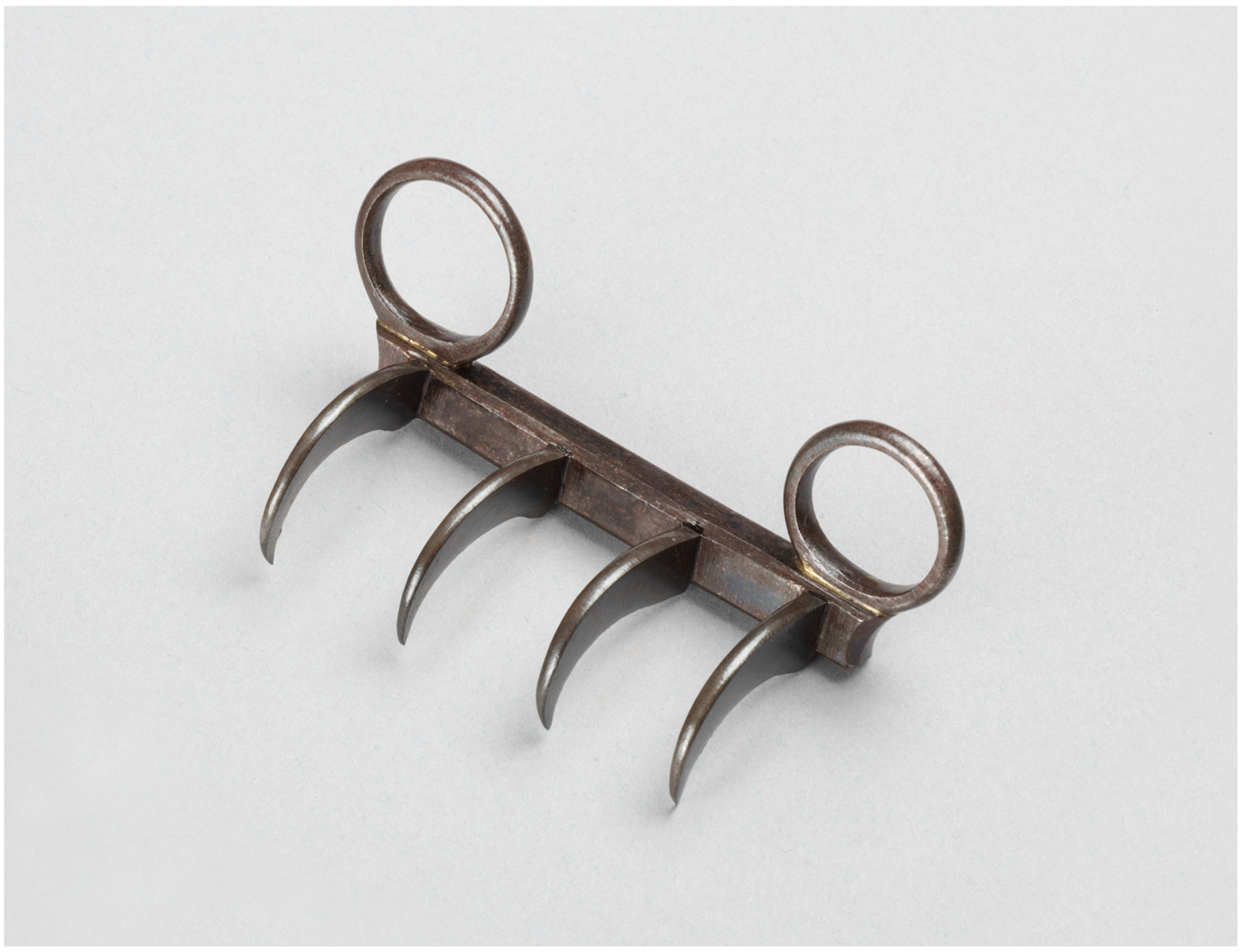
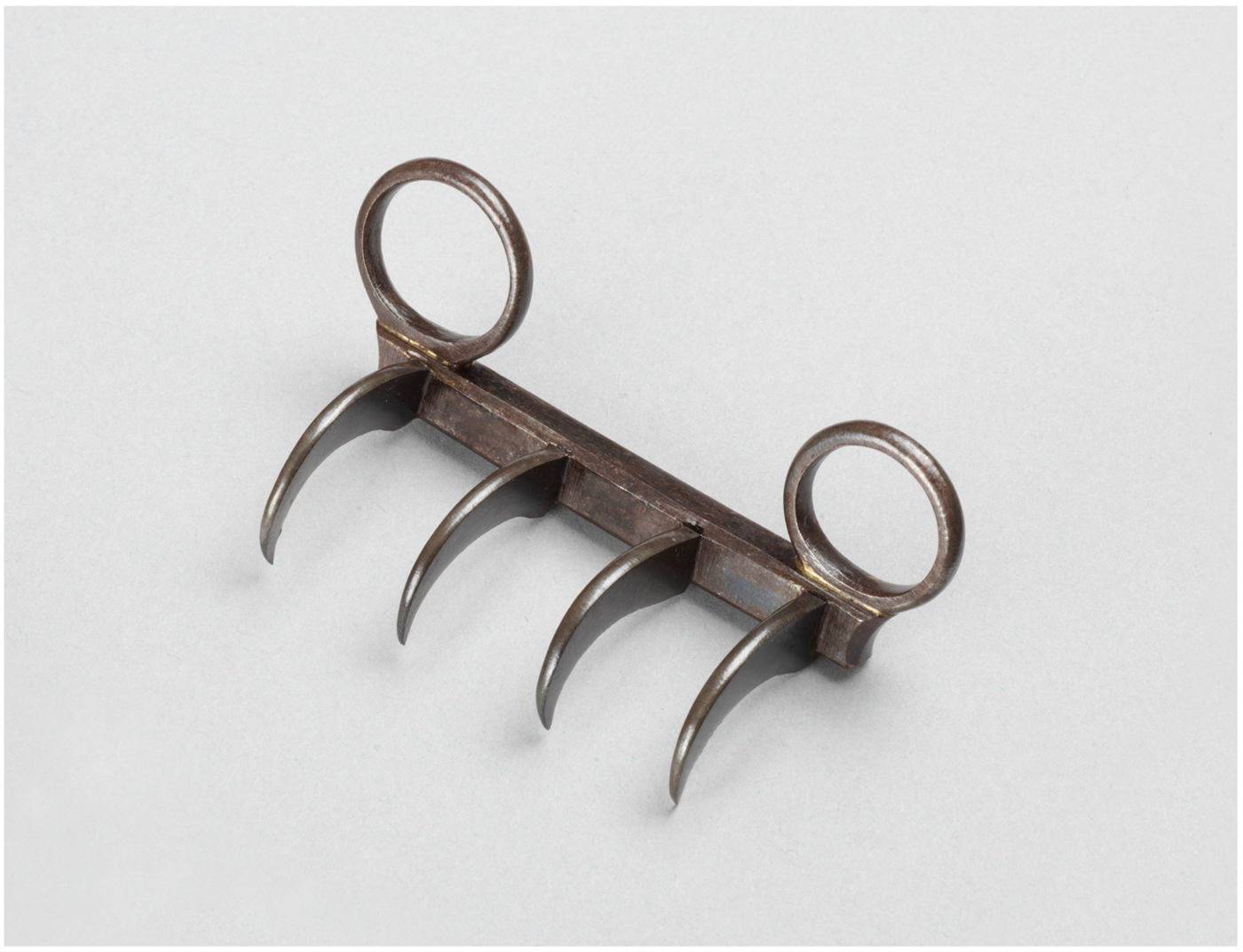
Grant Duff's History married his conjectural reflections with ‘modern’ historical methodologies that included not only deep archival research (referenced in footnotes) but also an appreciation of material culture that resonates with the arguments of recent historians who have taken the material turn. Illustrations of Maratha weaponry punctuate the pages of his History, in which Grant Duff depicted the weapons themselves as animating agents of Maratha history. Experienced commanding officers in the Deccan typically allowed defeated mercenaries to retain their swords and daggers, which they understood to be not inert objects but rather named heirlooms to which powerful identities and histories were attached. First in the battlefield and then from his base at Satara, Grant Duff had closely observed the function of such material objects as vibrant matter. In his interpretation, the Maratha archive comprised both historical manuscripts and political things-cum-persons. Shivaji's sword, he reported in his History, ‘which he named after the goddess Bhowanee [Bhavani], is still preserved by the Raja of Satara with the utmost veneration, and has all the honours of an idol paid to it’. In a footnote, Grant Duff added that the sword's ‘whole history is recorded by the hereditary historian of the family’.Footnote 82 So great was his appreciation of the power of Maratha material culture, indeed, that Grant Duff's archival acquisitions appear to have crossed the porous boundaries that divided plunder, loot, booty and prize. Gifted to the Victoria and Albert Museum in 1971, the baghnaka or tiger claw (Figure 2) that made its way from Satara to his home in Scotland in the 1820s figures in family legend as the very weapon used by Shivaji to eviscerate his rival and thereby establish the Maratha empire.Footnote 83
The baghnaka or tiger claw, reputedly used by Shivaji, taken to Britain by James Grant Duff and subsequently donated by the family to the Victoria and Albert Museum. © Victoria and Albert Museum, London.
IV
Resting on plunder and its suppression, born of booty and its administration, activated by the pursuit and deflection of prize claims, late Georgian history-writing in India suggests an alternative trajectory from the Scottish Enlightenment to disciplinary modernity than the one conventionally traced through liberal Whigs to the Rankean historians of the later Victorian era.Footnote 84 Both loot – a term with Sanskrit and Hindi origins that reflect its extended history as a military modality in Central and South Asia – and prize – a practice developed by European nation-states to regulate plunder in first their domestic and then their imperial wars – shaped the practice of nineteenth-century British history-writing. Warfare on the Indian subcontinent promoted an evidence-based vein of historiography deeply rooted in British and Indian archives of the imperial state. Through the operation of the prize system, booty was freighted with expectations of material profit that only precise historical narratives supported by documentary evidence could deliver, once battle had ceased and the army's post-conflict systems had lumbered into gear. Entitlement to prize required proof of battle; evidence about where, how and when booty had been seized; and contextual information on its provenance – in short, it demanded historical documents and historical analysis.
Instrumental resort to the archives constructed by Elphinstone and his men can be tracked through their correspondence well beyond the 1820s, as the officers whose booty disputes they had adjudicated in India returned to Britain and appealed to the treasury, the privy council, chancery, parliament and the press for payment of prize from the Pindari War. Company men clamorous for prize appealed to Elphinstone's collection of private letters and government documents, using these manuscripts to substantiate their narratives of the Deccan campaigns and thus to justify their receipt of prize.Footnote 85 References to published histories (themselves based on private archives) written in the wake of battle further augmented these efforts.Footnote 86 Defeated Marathas likewise appealed to these manuscripts to advance counter-claims against British seizure of the peshwa’s treasure.Footnote 87 Constantly delayed, repeatedly interrupted and never enough, the successive royal warrants that belatedly released prize awards from sale of the Deccan booty in the 1820s, 1830s and 1840s go far to explain the appeal of loot today over prize tomorrow in the British empire. The Third Anglo-Maratha and Pindari War ended in 1818, but the final payment recorded in the Deccan Prize ledgers dates from 1897, and (at this late date) was inevitably made not to an actual combatant of the campaigns but to a long-deceased officer's adult children.Footnote 88
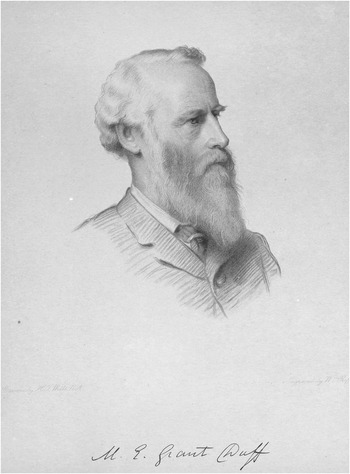
What happened in Britain to the innovative historical methodologies forged in these Indian wars?Footnote 89 Can we discern any legacies of James Grant Duff's pioneering archival research, his appreciation of Indian history or his enthusiasm for Maratha material culture in the works of his son, Mountstuart Elphinstone Grant Duff (1829–1906), fourth president of the RHS (Figure 3)? At first glance, the answer to this question appears to be an emphatic negative: James Grant Duff's Indian legacy was ostensibly effaced in Britain by the triumph of the Whigs. Notwithstanding he read German fluently and spent much time on the continent consorting with European intellectuals, the influence of Ranke is absent from M. E. Grant Duff's historical writings. Best known for his talent for ‘collecting interesting…historical anecdotes, pithy sayings and literary curiosities’, he was a fixture in Victorian gentlemen's clubs.Footnote 90 His Notes from a Diary begins, unpromisingly but not uncharacteristically, by recording his first sighting of an olive.Footnote 91
The Right Honourable Sir Mountstuart Elphinstone Grant Duff (1829–1906), president of the Royal Historical Society, 1891–99. RHS Archives.

Explicit adherence to the Whig interpretation of British freedom coloured M .E. Grant Duff's approach to India. It was he who initiated the RHS's annual presidential addresses, but the pages of the Transactions reveal scant evidence of his father's historiographical footprint. Bereft of footnotes, Grant Duff's eight anniversary lectures typically found their inspiration not in archives but in texts by classical authors such as Tacitus, evidence he combined with personal reminiscences of eminent Victorian men among his friends. Only his last lecture, in 1899, engaged substantially with India, and his analysis – decisively shaped by the ‘calamity’ of the 1857–8 Mutiny and Rebellion – was steeped in the tenets of liberal imperialism.Footnote 92 Whereas his father's years in India had produced an historical interpretation that recognised Marathas as effective state-builders with their own historical traditions, M. E. Grant Duff instead drew upon his experience as governor of Madras Presidency (1881–6) to infantilise Indians and Indian politics. ‘Demands are made from time to time for even more self-Government but they are altogether in the nature of the cries of children to whom their nurses refuse the enjoyment which they expect to derive from a case of razors’, he observed, praising ‘the impartial justice’ with which the British government had treated ‘our Indian fellow subjects’.Footnote 93
To trace the enduring imprint of the Indian careers of men such as James Grant Duff on British history-writing, we must dig a little deeper, and look in rather different (and more material) directions. Two vantage points are arguably most productive. The first is recognition that the material wealth that allowed M. E. Grant Duff to rise to the RHS presidency and to support other Victorian learned societies – he presided, for example, over the Royal Geographical Society as well – was substantially Indian in origin. Named after his father's East India Company patron, who had naturally stood as his godfather, Grant Duff enjoyed an education and social status derived from Indian capital. His father's net worth at death in 1858 was £43,354 10s 1d (well over £4 million at current values); his military savings, prize payments and Company pension allowed James Grant Duff to leave an Aberdeenshire country estate to this, his eldest son. Together with money inherited from M. E. Grant Duff's mother – the daughter of an eminent Company physician and botanist – this Indian hoard ensured that whereas his father at sixteen had left school in Scotland for military service on the subcontinent, the son would attend the Edinburgh Academy, matriculate at Balliol, be called to the Inner Temple, serve as a Liberal MP and be appointed to the lucrative governorship of Madras.Footnote 94
A second legacy is revealed in M. E. Grant Duff's travel-writing – a genre in which (in contrast to his presidential lectures), he placed the Company colonialism of his father's generation into explicit dialogue with post-Mutiny politics. In this text, material objects emerged both as bearers of meaningful Indian histories that could still speak to Britons and Marathas alike and as emblems of the economic modernity which – he suggested – would one day render India eligible for liberal freedoms. His 1876 Notes of an Indian Journey saw Grant Duff use his father's 1826 History to reflect on the Marathas’ pathway to modernity. Here, extended quotations from his father's book allowed M. E. Grant Duff to construct a ‘picturesque’ history in which British officers such as James Grant Duff chased Pindaris and the ‘unmitigated scoundrels’ of the Maratha ‘nation’ from their hill forts to establish a precarious colonial rule.Footnote 95 As a site of political power, Satara (which ‘was within an ace of giving trouble in 1857’) served in this interpretation as a problematic emblem of the tenacity of Maratha historical consciousness. ‘I confess I did not much like the look of things…at Satara’, he opined. ‘The people seem to cherish the recollections of old times quite as much as is desirable, and while they are peculiarly attentive to the representative of the Satara family, they rather fail in the respect paid throughout the empire to the local British authority.’Footnote 96
Like his father before him, M. E. Grant Duff braided material histories into his political analyses, recognising the vital force of things as agents of both historical memory and historical change. At Satara, his Maratha hosts brought out Shivaji's iconic sword and baghnaka (the pair of which had allegedly accompanied James Grant Duff home to Britain):
In the course of the day, Bhowanee (Sivajee's sword) came to visit me. She is a fine Genoa blade…I say she, for to this day she is treated in all respects, not as a thing, but as a goddess…With her came other interesting objects, among them two Wagnucks which her illustrious owner used on one critical occasion…one is a facsimile of that in my possession.Footnote 97
Couched in the language of vibrant matter, M. E. Grant Duff's description of Maratha material artefacts echoed his father's recognition of the power of objects to serve as historical archives. From this base, he elaborated a material future for Indian manufacture in which reproduction of traditional ‘native’ wares – textiles, carpets and enamels, of which he was himself a keen consumer – for British markets would fuel modernisation on the subcontinent.Footnote 98
Still figuring in the footnotes of scholarship on South and Central Asia today, the works of East India Company military historians such as James Grant Duff form part of a much broader Victorian corpus of military history that is also rich in social, cultural, material and political evidence, commentary and analysis.Footnote 99 Many of these works conform very poorly to Whig paradigms and methodologies, a finding that should not surprise us. Military men who – like James Grant Duff – peppered requests in their private correspondence for peer review of their book manuscripts with casual comments about the necessity of quelling plunder by summary hangings or firing insurgents from cannons may well have found the language of liberalism inadequate to the task of empire.Footnote 100 Men, moreover, who had privileged access both to original records of overturned states and to rich collections of Indian material culture were unlikely to be impressed by the Whigs’ belated discovery of the archive. History-writing was an integral accompaniment and consequence of British military campaigns in India. Already in the 1810s and 1820s, the military officers charged with distributing the spoils of imperial warfare were also experimenting with many of the modes of historical practice now current within the discipline today. They did so in active dialogue with Indian historians, trained in a rich tapestry of ‘native’ historiographical traditions. By taking the material turn and inserting loot back into our narratives of history-writing, we can thus also take important steps in the wider project of acknowledging our discipline's cross-cultural, global formation.