1. The Problem Of Idealizations
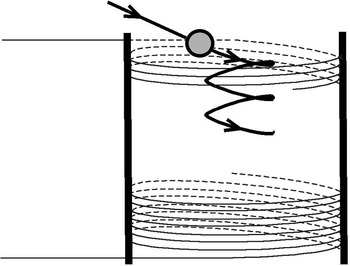
To motivate the main problem of this article, it will be best to focus on an example. Suppose a small charged particle is fired at an angle into a long cylindrical tube, around which a current-carrying wire has been tightly wrapped. Such a particle will travel in a helical path, as depicted in figure 1. Suppose now that a physicist is interested in calculating the radius of this helical motion.
Charged particle in a solenoid.

There are many ways to proceed—I sketch the most elementary approach, although I claim that its most salient features apply generally. In this approach, the physicist assumes that the wire is infinitely thin and wound infinitely tightly around the cylinder.
The physicist also assumes that the current is completely constant throughout the wire and that the cylinder is infinitely long. The net result of these assumptions is that the solenoid is treated as an infinite, homogeneous cylindrical ‘sheet’ of circulating charge. The physicist argues (with the help of Ampere's law) that the magnetic field inside the cylinder is uniform and calculates its strength. The particulars of the helical motion are then completely determined by applying the Lorentz force law to the case of a charged particle in a uniform magnetic field of given strength. If there is nothing especially irregular about the actual experimental setup, the physicist is justified in concluding that the radius of the helical motion is approximately equal to the result of this calculation. In fact, having seen this calculation through, the physicist can now explain why the particle exhibits the sort of motion that it has.
Note that even though the calculation in question gives an exact numerical value for the radius of motion, the conclusion C drawn by the physicist is of the more modest form ‘the radius of the helical motion is approximately r’ for some specific value of r. This statement C about the approximate value of the radius is the only conclusion that can be justifiably drawn from the chain of reasoning sketched above.Footnote 1
Abstracting away from the details of the example, the physicist has performed a calculation using assumptions (or premises)  . These assumptions contain, among other things, the highly idealized description of the system. The result of this calculation is a conclusion C about the approximate radius of motion of the particle. The calculation persuades the physicist that C is true, and I will assume that the physicist, having seen this calculation through, is not only justified in believing C but can explain why C is true.
But this is puzzling. If the physicist proceeds in the way just outlined, he is not justified in believing all the premises  . The wire is not infinitely thin, the current is not constant throughout the wire, and the wire and the cylinder have inhomogeneities and other imperfections—in fact, the solenoid is known not to be an infinite, homogeneous cylindrical sheet of circulating charge. Nevertheless, the mathematical argument that takes these premises to the conclusion C justifies belief in C. I take this to be a general feature of reasoning involving idealizations. Such reasoning generates justified beliefs from known falsehoods. That this can happen is deeply strange and demands investigation. The main goal of this article will be to tell a story about how it is possible to explain and justify beliefs from a basis of known falsehoods in this way.
It might be thought that this puzzle can be avoided by talking in a fairly straightforward way about approximations. For although the physicist derives C from  , it might be hoped that with a little extra mathematical effort it could be shown that C follows merely from the approximate truth of
 . (Recall that C is already only a statement about the approximate radius of the helical motion.) In this way, one might hope to reformulate the physicist's argument so that it involves only an inference from the approximate truth of the premises
 to the conclusion C. Because the physicist is justified in believing the approximate truth of the premises
 , this new argument for C only invokes justified beliefs as premises, and the source of our puzzlement disappears. In section 2 of this article, however, I shall argue that this quick attempt at a solution does not work.
Given this, one might try to argue instead that belief in C is justified by the fact that we have good inductive grounds for thinking that particles in everyday, regular solenoids behave as if they were charged particles fired into ideal solenoids. In this way, provided that we understand how ideal solenoids are supposed to behave, our belief in C can be given a fairly straightforward inductive justification, regardless of whether we have worked out the intricate mathematical details of how slightly less than ideal solenoids are supposed to behave. Although I think this suggestion is closer to being correct, I shall also argue in section 2 that the most natural ways of developing this idea do not work. The pair of criticisms developed in section 2 then define the challenge to be met in the remainder of the article: in virtue of what can facts about ideal solenoids justify beliefs and explain facts about slightly less than ideal solenoids, if not through a detailed mathematical study of approximations and if not by simply relying on the inductive evidence we have that such idealizations work? What other possibilities are there?
In section 3 I lay the groundwork for a different account of idealizations. The core idea will be that idealized descriptions of systems should be understood as true descriptions relative to a ‘set of standards’. This practice is manifest in ordinary language (as when we say ‘John is 6 feet tall’), and there is no reason to deny it of the physicist. I will also argue that we should not think of talk of ‘sets of standards’ as shorthand for some sort of claim about approximations.
In section 4 I will examine the effect of this account on our conception of what exactly we take the laws of physics to be saying. The main claim will be that laws should be taken as true claims about systems described according to certain sets of standards. This will render arguments involving certain sorts of idealizations unproblematic. (It does not render all reasoning involving idealizations unproblematic, but that is not the goal of the article.) I shall argue that the concept of physical law that emerges not only is coherent but has virtues that its rivals lack. Finally, in section 5 I discuss some remaining metaphysical questions. In particular, I consider whether we must think that there is some fundamental nonidealized way of describing the physical world, in terms of which the truth conditions of our idealized claims can (in principle) be spelled out.
2. Some Candidate Solutions
In this section, I will consider and reject two ways of thinking about how justified belief is generated in the case of our solenoid. Our main example involves an argument A with premises  and conclusion C in which we are not justified in believing all the premises, and yet the argument itself gives us justified belief in the conclusion C. That this is possible seems odd. A natural explanation of this is that the argument A, as presented, is in fact not the argument that delivers justified belief in C. Instead, the argument A should be thought of as ‘shorthand’ for a possibly more complicated argument A′ that only takes justified beliefs as premises and delivers the same conclusion C. The purpose of the argument A is not to generate justified belief itself—instead, the purpose of argument A is to point us toward a more complicated argument A′ that does deliver justified belief in C.
Whether this suggestion works depends on whether a good candidate for A′ can be found. I will argue that, in general, no such A′ exists, and therefore this suggestion does not work.
I will consider and reject two proposals for such an A′. The first proposal is what I will call a mathematico-deductive proposal, while the second proposal is what I will call an inductive proposal.
2.1. A Mathematico-Deductive Proposal
Let us start with the more obvious proposal for A′. From the laws of electrodynamics and the claims that the wires are almost negligibly thin, the current almost constant, and so on, it should be possible to calculate an approximate value for the radius of the helical motion. This refined argument is our A′. Roughly speaking, the construction of A′ has three steps:
1. State the laws of electromagnetism (Maxwell's equations) and any other laws to be used in the remainder of the argument.
2. Argue that if the usual ideal assumptions are made about the solenoid, the resulting radius of the helical motion will be exactly r.
3. Argue that by adding small but bounded width to the wires, small but bounded inhomogeneities in the current, and so on, one gets a small but bounded difference in the radius of motion. Calculate the largest size
 of an ‘error’ that might be introduced in this way to the previous calculation of the radius, and infer that the radius of the particle lies in the range .
 of an ‘error’ that might be introduced in this way to the previous calculation of the radius, and infer that the radius of the particle lies in the range
 .
This is our candidate for A′. Because it only involves the premises that the wires are almost negligibly thin (and so on), it looks like it only relies on justified beliefs as premises. I call the proposal mathematico deductive because it allows us to calculate the approximate radius r by applying only valid mathematical and deductive forms of argument to statements about the laws of nature and the approximate initial state of our system.
It is perhaps relevant to note that no one has ever produced such an argument A′. The technical difficulties are immense. It is certainly possible to determine the behavior of systems that depart from the ideal in very simplistic ways. For instance, suppose we introduce a small, semicircular ‘bump’ into some portion of the wire in our ideally described system (see fig. 2). The effect that a very idealized inhomogeneity of this sort has on the resulting helical motion can be calculated, and an error bound for the radius obtained. But in this calculation it is still assumed that the wire is infinitely thin—or at least that the cross-section of the wire has circular symmetry. When these further assumptions are dropped (as they must be if unjustified claims about the system are to be eliminated), the effect of more significant inhomogeneities in the wire will have to be calculated. Technically, this is extremely difficult (if not impossible), except for the most ‘ideal’ inhomogeneities. But even more serious problems quickly ensue. The ‘current’ is being viewed as something flowing uniformly through the wire. This is inaccurate—a current is the flow of a swarm of electrons, each of which may be moving in a different direction but which collectively move in the direction of the current. It must somehow be argued that our idealized representation of the current has only a small effect on the radius of the helical motion of our particle. At some point, all the substance of the cylinder and wire will also have to be treated from a molecular point of view.
Ideal deviation from ideality.

There are rough ways to perform some parts of some of these steps. But rough arguments are not what is needed—any calculation that, for instance, assumes that terms of higher order in a Taylor series can be ignored is making an idealized assumption that must be removed at some point, if the strategy in question is to be followed to completion. Following this strategy to completion would at the very least have to involve a rigorous derivation of the macroscopic behavior of an enormous set of point charges in some initial macroscopic configuration, evolving solely in accordance with Maxwell's equations. It is far from clear what this argument would look like.
The moral of the story is that we can write down arguments of the desired form A′ only if we assume that the actual system differs from the ideal system in very specific and ideal ways. Insofar as any A′ that we can actually write down still involves idealized assumptions, our main challenge is not addressed by moving to any A′ that we know of. (Note that this difficulty is quite distinct from the difficulty that one may not have enough knowledge about the initial state of the system to perform this calculation.)
Still, one might wonder whether such an argument A′ nevertheless exists (even if its technicalities are too much for any mortal to comprehend) and whether the mere existence of such an A′ is perhaps enough to get us what we want. For suppose we had grounds for thinking that such an argument A′ existed. We could then claim that A was simply shorthand for this argument A′. If we are justified in thinking that A′ (with conclusion C) exists, and we somehow know that we are justified in believing all the premises of A′, then we would be justified in believing C. In this way, we might not need to know all the details of A′ to be justified in believing C.
I claim, however, that we are not even justified in believing that such an A′ exists. More specifically, we do not have grounds for thinking that such an A′ exists whose premises do not involve idealizations and that only invokes laws of nature in which we already have justified belief.
To see why, let us suppose first that the only laws of nature we want to invoke are Maxwell's equations. Maxwell's equations cannot account for the stability of the atom, and thus the calculation involved in A′ must have as its conclusion that no stable matter exists shortly after the system is set up. A calculation with a result like this is not very helpful. (For further discussion of questions about the stability of matter in classical electrodynamics, see Frisch [Reference Frisch2004] and Belot [Reference Belot2007].) The lesson here is that Maxwell's equations are tremendously useful if we are interested in physical systems about which we have made a host of idealized assumptions and on which a host of idealized constraints have been imposed, but they are completely useless if we are interested in applying them in a literal manner to an unidealized description of matter.
So no argument of the form A′ exists that invokes only nineteenth-century physics. What if fancy modern theories are allowed? Quantum mechanics, of course, resolves the problem of the stability of the atom, so the calculation of A′ should be expected to be quantum mechanical. But if one is to account for all idealizations in the system in question, one must also include an account of gravity, for if A′ is to do its job, it must include a subargument to the effect that the gravitational attraction of all the nuclei in our system has a negligible effect on the resulting helical motion. Such an argument is impossible to make using only laws of nature in which we currently have justified belief because no sufficiently well-developed theory of quantum gravity exists. Even worse, the quantum field theory we actually use assumes a flat spacetime and involves approximations—more specifically, perturbation expansions—in most of its applications.
I am not denying that an argument of the form A′ with conclusion C (all of whose premises we were justified in believing) could exist if we had justified belief in a very different set of physical laws. The question that matters, however, is whether we have any reason to believe that such an argument A′ exists that only invokes laws of nature in which we currently have justified belief, for I take it that the calculations currently done by physicists succeed now in justifying beliefs about the helical trajectories of charged particles moving through solenoids. I have argued for a negative answer to this question. For these reasons, I think that mathematico-deductive attempts to construct an A′ do not work.
2.2. An Inductive Proposal
In this section, I wish to consider and criticize what I will call an inductive proposal for an argument A′ that takes only justified beliefs as premises and gives the conclusion C. Suppose that after conducting a great number of experiments on different solenoids, our physicist discovers that the actual trajectories of charged particles in carefully constructed solenoids are very much like the mathematically predicted helical trajectories of idealized charged particles in idealized solenoids. In such a case, the physicist becomes inductively justified in believing that actual charged particles in carefully constructed solenoids have trajectories very much like the helical trajectories of idealized charged particles in ideal solenoids.
When presented with a carefully constructed solenoid and a charged particle inside it, the physicist can then proceed as follows:
1. Point out the inductive evidence that suggests that charged particles in carefully constructed solenoids behave like ideal particles in ideal solenoids.
2. Calculate the exact radius r of the helical motion of an appropriately chosen ideal particle traveling through an appropriately chosen ideal solenoid.
3. Conclude that the radius of motion in the actual case is approximately r.
This is the proposal for A′. I call this proposal inductive because it revolves around an inductive argument for treating actual carefully constructed solenoids as if they were ideal solenoids.
Unlike the deductive proposal, I think this proposal successfully justifies belief in C. The problem, however, is that it justifies belief in C in too modest a way. The inductive proposal begins with the observation that reasoning as if our system were ideal is a reliable method of belief formation. Belief in C is then justified because this particular reliable method of belief formation yields C. But surely we want more than this sort of justification. It is natural to think, after all, that the calculation that uses Maxwell's equations explains why the radius of motion will be approximately r. But it is difficult to see how the inductive proposal can account for this. Insofar as the inductive proposal invokes nothing other than the reliability of treating actual systems as if they were ideal, there is no sense in which the mathematical calculation provides us with an explanation of its conclusion. Something more than the mere reliability of a belief formation mechanism is needed for that.
To make this clearer, consider an analogy. Suppose Bob has a friend who is a very accomplished mathematician. Bob often asks her whether certain mathematical claims are true, and she always gives the right answer (as Bob is generally able to confirm later). Suppose Bob asks her one day whether some particular T is true, and she tells him that it is. Bob is justified in believing T is true because he has strong inductive grounds for trusting his friend. However, Bob has no understanding of why T is true. The mathematician, however, is justified in believing T because she has presumably constructed a proof. She not only understands that T is true—she also understands why T is true.
Returning to the physicist, if we take a calculation involving ideal solenoids to be nothing more than an instance of a reliable belief formation mechanism, then belief that the radius of motion will be approximately r is justified in no deeper sense than Bob's belief in T—it is simply the result of a reliable method of belief formation. But if we want to say (as I think we should) that the calculation shows the physicist why r has the rough value it does, then we must view the physicist as doing something more than merely exploiting a reliable method of belief formation. Because of this, the inductive proposal is an unsatisfactory explanation of how the physicist manages to generate justified belief.
The challenge that we face should now be clear. If we demand that we be able to prove that all our idealizations and approximations are innocent, we raise the standards too high. But if we settle for an inductive justification that draws on nothing but the reliability of our idealizational procedures, we let our standards drop too low and end up without scientific explanations in the cases in which we want them the most. The question is how to account for the generation of justified beliefs and explanations from idealized assumptions in such a way that we avoid these unattractive extremes.
3. Standards, Truth, and Justification
To begin tackling the problem I have just outlined, it will help to focus on what is involved in attributing shapes, lengths, and other magnitudes to objects—as occurs when we say that a solenoid is cylindrical, that it is 1 meter long, or that a current of a certain magnitude runs through it. To do this, it will be useful to first think about the way in which we use magnitudes in our everyday nonscientific linguistic practices and then move on to the more specialized case of the use of magnitudes in physics.
3.1. Magnitudes in Everyday Linguistic Practice
In our everyday linguistic practices, we sometimes take sentences like ‘John is 6 feet tall’ to be true. But few people are literally and exactly 6 feet tall, according to the most rigorous and precise definition of height. Given this, what sense are we to make of the assertion that John is 6 feet tall?
One point of view is that claims like ‘John is 6 feet tall’ are almost always literally false, but for certain purposes such claims can still be informative and, if appropriately hedged and modified, even true. I think that this way of talking is quite unattractive, and I will argue in the next section that it is especially so in the case of physics.
What seems more natural is to say that according to certain standards for talking about heights, ‘John is 6 feet tall’ is the sort of thing that has a decent chance of being outright true, even in situations in which by other standards for talking about heights the claim is false. So according to the standards we use in everyday situations when figuring out who is taller than whom, it may well be true that John is 6 feet tall, while according to the standards used in certain laboratory situations, the claim that John is 6 feet tall will almost certainly be false.
For another example, consider the claim ‘the apple is completely green’. Even in situations in which we want to say that this is true, it has to be admitted that it is only the skin of the apple that is green—and even then, only the exterior of the skin. In fact, even the exterior of the skin is unlikely to be literally completely green according to the most stringent standards. Nevertheless, by the usual standards one uses in shopping for fruit, it is true that some apples are completely green, even though were we to apply the strictest laboratory standards we would probably have to say that no apple is completely green.Footnote 2
But what exactly does it mean to apply a ‘set of standards’ in determining length or some other quality? One might think that a set of standards is just something like a conventionally agreed upon degree of accuracy. I shall argue in the next section that this is not quite right. For now, it will suffice to characterize sets of standards extremely loosely as criteria employed by a community for the attribution of properties to objects. So our everyday practices embody a set of criteria for talking about heights of people when making broad judgments about who is taller than whom, just as the laboratory scientist's practices embody a set of criteria for talking about lengths of objects in cases where great precision is required. Because it is difficult to be much more specific than this, I will take the idea of a set of standards to be intuitive from here onward, although I will make four cautionary remarks.
First, it must be stressed that the basic claim here is not just that assertions about justified belief or assertability must be assessed relative to a set of standards, even though it is certainly true that whether we are justified in claiming that John is 6 feet tall will depend on which standards are being invoked. The basic claim here is rather one about truth conditions. The claim is that the truth conditions for ‘John is 6 feet tall’ or ‘the apple is completely green’ depend on the specification of a set of standards for talking about height, color, completeness, and so on. Although these standards are often not explicitly stated, in a given context one set of standards will typically be the most appropriate. In such a context, this ‘most appropriate’ set of standards will be the set of standards relative to which the truth conditions of the relevant claims will be assessed. In fact, it is because truth conditions are standards dependent in this way that corresponding claims about justification will also be standards dependent.
The fact that conversational contexts often determine the appropriate set of standards is quite compatible with the fact that standards can change during a conversation. For instance, consider the following conversation:
A: John is 6 feet tall.
B: Yes, I measured John in my laboratory, and he's 6.015 feet tall.
A: See, I was right.
Here, even though  , A and B take themselves to be in agreement. This is due to the fact that the claims that A and B make about John's height invoke different standards.
Second, one might worry that our reference to the practices of communities means that claims about height (for instance) are now purely subjective. But this worry is misguided. A claim of the form ‘by standards X, John is 6 feet tall’ is the sort of thing that will be objectively true or false. The accidents, reasons, and whims that lie behind the community's adoption of standards X in no way undermine the objectivity of the claim that by those standards some object has such and such a height or length.
Third, when different standards of attributing quantitative measures to an object are in play, one must be careful about what sort of inferences one employs. For instance, consider the following conversation:
A: John is 6 feet tall.
B: Does that mean that you think that the sixth significant digit of his height in feet is 0?
Here, the inference implicitly made by B is invalid, in spite of the fact that the sixth significant digit of 6.00000 is 0. What makes the inference invalid is that there is an implicit change of standards invoked in B's reply, and the relationship between the standards in question does not allow for the given inference. In particular, the inference “by ordinary standards John is 6 feet tall, and the sixth significant digit of 6.00000 is 0, therefore by heightened standards, the sixth significant digit of John's height is a 0” is not valid. (It is not possible to assign any real meaning to the claim that by ordinary standards, the sixth significant digit of John's height is a 0.) Contrast this with the following conversation:
A: John is 6 feet tall.
B: Well Bob is 5.5 feet tall, so John is taller than Bob.
Here there is no change in standards, and so the inference is valid. Moreover, it is valid because  .
Fourth, when there are relaxed and raised standards for assigning magnitudes to objects, and we have a set S of objects whose elements have been distinguished by judgments involving raised standards, there will often be issues of vagueness when one asks which elements of S have a certain property relative to relaxed standards. Consider, for instance, two ways of assigning heights to people: our everyday way according to which people are 5′6″, 5′7″, 5′8″, and so on, and a more scientific way that involves accuracies of hundredths of an inch. Think of the former way of talking about heights as one involving relaxed standards and the later way of talking about heights as one involving raised standards. Now imagine a line of 101 people whose heights according to raised standards are 5′6″, 5′6.01″, 5′6.02″, … , 5′7″. One might worry that by relaxed standards everyone in this line has the same height as his neighbor(s), and yet that even by relaxed standards the 5′6″ person at the beginning of the line and the 5′7″ person at the end of the line have different heights. This, of course, is a contradiction. This is really just a version of the sorites paradox.
In contemporary discussions of the sorites paradox, it is relatively standard to invoke the notion of vagueness. In our case, although there are people who by relaxed standards are clearly 5′6″, and people who by those same standards are clearly 5′7″, there are also intermediate cases where it is not quite clear whether to call the person 5′6″ or 5′7″. Because of this, it is best to think of the predicate ‘being 5′6″ by relaxed standards’ as having vague extension. In more detail, let S be the set of heights that are taken to be distinct relative to our raised standards, so that

Which elements of S are such that someone with that height is 5′6″ by relaxed standards? We find ourselves hard pressed to give an answer. The predicate ‘being 5′6″ by relaxed standards’ is only vaguely defined on the set S. This phenomenon is quite general—predicates involving relaxed standards will often be only vaguely defined on sets of objects that have been distinguished by invoking raised standards.
None of this is intended to shed any light whatsoever on the sorites paradox. I have not said what vagueness is and have no intention of trying to analyze this thorny concept here. All I wish to point out is that issues of vagueness often arise when moving between different standards. I shall leave questions about how semantics and inference work in the presence of vague concepts to the relevant experts.
3.2. Magnitudes in Physics
I have argued that sets of standards are involved in the truth conditions of many of the claims of ordinary language. This claim applies equally to the claims of physics. Everything we said about ‘John is 6 feet tall’ could have been said about ‘Alpha Centauri is 4.4 light years from earth’ with only minor modifications. But standards also appear in more subtle ways in physics. These subtler ways will be our real focus and will help shed light on the problems about idealization described in the beginning of this article.
Let us go back to the territory of our initial example. In electrodynamics, a straight current-carrying wire will often be treated as if it were a (one-dimensional) line segment of charge with a constant charge density  and a constant current density
 . In this case, it is natural to talk about the standards of classical, macroscopic electrodynamics, according to which we think of charges as points, wires as one-dimensional, solenoids as two-dimensional, and so on. According to these standards, it may well be true that a given wire is a line segment of charge with constant charge density and constant current density. According to these standards, it may also be true to say of a tightly wound cylindrical solenoid that it is a finite sheet of uniformly circulating charge.Footnote 3
Of course, ‘the standards of classical macroscopic electrodynamics’ really refers to a large cluster of standards, insofar as in some contexts we might be happy to describe a wire as a straight line segment, while in other contexts we will want to take the bending of the wire into account. This cluster of standards, however, is bound together by commitment to such things as point charges, well-defined charge distributions, and continuous current densities.Footnote 4 When we talk about the application of the standards of classical macroscopic electrodynamics to a physical system, we therefore really mean the application of some member of this cluster, where we are assuming that the context makes clear which member is intended.
With this in mind, let us return to one of the important questions posed in the previous subsection. Should we view quantitative claims that are true relative to a set of standards as claims that are true in some more absolute sense but that happen to involve certain conventionally agreed upon degrees of accuracy? For instance, when we describe a wire as a one-dimensional carrier of continuous current, should we think of this claim as nothing more than a claim to be evaluated relative to a particular ‘coarse’ set of standards, or should we think of it as an abbreviation for the more complicated claim that the wire has 0 width within a certain margin of error, the carriers of charge (i.e., electrons) are of size 0 within a certain margin of error, the carriers of charge are very densely but smoothly distributed along the wire, and so on?
For reasons that have already been rehearsed, I think that this latter way of trying to make sense of the claim ‘the wire is a one-dimensional carrier of continuous charge’ is not attractive. To see why, let us go back to the case of the solenoid and suppose that what we mean when we say that it is a cylindrical surface of uniformly circulating charge is some very complicated claim about the radii of the electrons lying in a numerical range, the width of the wire lying in a certain numerical range, and so on. From this, we want to be able to infer that an electron fired into the solenoid will (probably) move in a helical path. Justifying this inference, however, now requires a rigorous and immensely complicated calculation of the macroscopic behavior of an enormous set of point charges in some initial macroscopic configuration, evolving solely in accordance with Maxwell's equations. No derivation of this sort has ever been produced. This makes a mockery of the idea that we have some sort of mathematical justification of the fact that electrons fired through solenoids follow helical paths. But it is even worse than that. If our goal is to interpret ‘the wire is a straight line and carries a constant current’ as a literally true claim involving margins of error, it will not do to come up with a classical description involving margins of error—our description will have to make claims about wave functions. Even this, however, will not quite do, as presumably some new sort of mathematical structure is required for describing the states of systems in the full setting of quantum mechanics with gravity. Because of this, even if we wanted to read ‘the solenoid is a cylindrical surface of uniformly circulating charge’ as a literally true claim involving margins of error, we could not do so, because we have absolutely no idea what such a claim would look like, let alone how to infer anything from it about the trajectories of electrons fired into the solenoid. Analogous claims can be made about ‘the wire is a one-dimensional carrier of continuous charge.’
The situation we are left in is this: we cannot view the claims made in accordance with the standards of classical macroscopic electrodynamics as literally true claims involving margins of error, if our goal is to use these claims in the usual sorts of inferences in such a way that those inferences are manifestly justified. Because of this, it is difficult to see how invoking a set of standards in our description of the solenoid could amount to making a literally true claim involving conventionally agreed upon degrees of accuracy.
4. Understanding Laws
4.1. Laws and Standards
I have argued that the best way of making sense of propositions in physics that involve length, shape, current, and so on, involves us thinking of the truth conditions of these propositions as dependent on sets of standards. In this section, I turn to the topic of laws. I argue that insofar as we take ourselves to have inductive evidence for the laws of physics, they too must be understood as claims about quantities attributed to objects relative to sets of standards. This then provides us with a straightforward way of talking about the case of the solenoid without falling into either of the unattractive positions sketched in section 2.
Consider Ampere's law, according to which

that is, the integral of the magnetic field around the boundary of a surface is proportional to the electric current that passes through the surface. We are justified in applying this law to ordinary macroscopic electromagnetic systems, such as our solenoid. But how should we understand what is going on when we apply this law in a justified way? The claim cannot be that Ampere's law describes a literal, unqualified truth about the world independent of any standards, for such a claim would both be unjustified and false. Nor can the claim be that Ampere's law should be understood as a literal, unqualified truth about the world where all the quantities involved lie within certain margins of error, for the reasons described in the previous sections.
Instead, the claim being made in Ampere's law should be thought of as something like this: if we represent a physical surface, calculate the net magnetic field around it, describe the net current that passes through it, and take the ratio of these quantities all according to certain standards—standards according to which we treat charges as points, wires as one-dimensional carriers of current, all quantities are calculated to two or three significant figures (let us say), and so on—then the result will be constant. Of course, even this is not completely true, as we can engineer macroscopic systems where classical electrodynamics fails and quantum electrodynamics must be employed in its place. But at the very least, Ampere's law thus understood still holds true of many macroscopic systems and was a law that it was perhaps once plausible to believe held true of all systems described in accordance with any of the standards of classical macroscopic electrodynamics.
Given this understanding of Ampere's law and laws like it, our calculation involving the solenoid and the charged particle is now easy to understand. According to the everyday standards of classical electrodynamics, the solenoid is a finite cylinder of uniformly circulating charge, and the charged particle being fired into it is a charged point particle with some particular mass—that is to say, it is true that the solenoid is a finite cylinder of uniformly circulating charge, and it is true that the charged particle fired into it is a point particle with some particular charge and mass. Applied to physical systems of this sort that have been described using the standards appropriate for calculations in macroscopic electrodynamics, Maxwell's equations and the Lorentz force law are true. Thus, we may apply these laws to our system in the usual textbook manner. It is easy to show that the electromagnetic field inside the solenoid is essentially the same whether the cylinder is finite or infinite, and so the usual calculation shows that the particle will assume a helical trajectory. We may assume that the actual radius of helical motion is therefore given by the result of this calculation, at least when the radius of motion is described according to the same sorts of standards with which the rest of the system was described.Footnote 5 So we are justified in believing that the particle will move in a helical trajectory with a given radius, and moreover, we are justified in believing that this will happen precisely because our mathematical calculation makes a sequence of true claims (relative to certain standards). Our result is not merely the output of a reliable mechanism of belief formation—instead, the calculation is explanatory and shows in a straightforward way why the result is mathematically forced on us.
The broader claim here is that this is the right way to understand the mathematical laws of physics in general. Such laws purport to capture mathematical relationships that exist in physical systems when those systems are mathematically represented in accordance with a given set of standards. Thus understood, such laws make literally true claims about objects in the world and so may be employed in ordinary inference schemes in a more or less unproblematic way. It is only when viewed in this way that something like Ampere's law has any chance of being true and that we have any chance of having justified belief in it and its mathematical consequences.
Although this approach is able to account for many of the idealizations of physics, it would be overstating things to say that it gives us a way of thinking about all idealizations in physics. For instance, in the mid-nineteenth-century Clausius and Kroenig used an idealized description of a gas in a box in which all the particles of the gas moved only in directions parallel to the walls of the container. (This was part of an attempt to derive the Maxwell-Boltzmann distribution for the velocities of the particles in the gas.)Footnote 6 It is difficult to see that there are any standards according to which all the particles in a gas have this property (as Clausius and Kroenig surely knew). The modern theory of lattice gases is similar in many respects. Because of this, the success of these theories cannot be explained in the way that I have explained the success of classical macroscopic electromagnetism.
One response here would be to say that the arguments of Clausius and Kroenig were so crass that they did not produce justified belief in the Maxwell-Boltzmann distribution. As such, in this situation there is no philosophical puzzle to be solved about how justified beliefs are generated from hypotheses in which we do not have justified belief. Although I find this response tempting, a full discussion of Kroenig and Clausius's models or the models of lattice gas theory would need to draw on the details of statistical mechanics, and so I cannot pursue this here. Instead, I will simply restrict my attention to the simplest cases of idealization and leave open the question of whether there is a class of more complicated idealizations in science whose justification must proceed on different grounds.
4.2. The Semantic View of Theories
It is worth taking a brief detour to discuss the impact of all this on the so-called semantic view of scientific theories. I will argue that although the view developed in the previous sections is antithetical to some of the earliest characterizations of the semantic view, the modern proponent of the semantic view can (and in fact should) incorporate the claims of the previous sections into her view of scientific theories. In this way, the claims of the previous sections offer a fresh perspective on the semantic view.
My focus will be on the semantic view of scientific theories originally developed by van Fraassen (Reference van Fraassen1980), Cartwright (Reference Cartwright1983), and Giere (Reference Giere2004). Central to this sort of semantic view is the idea that the laws of nature postulated by physicists are not literally true claims about reality, nor are they ever intended to be. Cartwright tells us that “the fundamental equations [of physics] do not govern objects in reality” (Reference Cartwright1983, 129), while Giere says, “My view … is that, if understood as universal generalizations, [empirical laws] are either vacuously true, or else false and known to be so” (Reference Giere2004, 745). Instead, the semantic theory holds that the laws of nature are true (and purport to be true) only in abstract mathematical models. Cartwright says that “it usually does not make sense to talk of the fundamental laws of nature playing out their consequences in reality. For the kind of antecedent situations that fall under the fundamental laws are generally the fictional situations of a model, prepared for the needs of the theory, and not the blousy situations of reality” (Reference Cartwright1983, 160). Searching for objects of which we might say that the laws of nature hold, Giere tells us: “If we insist on regarding principles as genuine statements, we have to find something that they describe, something to which they refer. The best candidate I know for this role would be a highly abstract object, an object that, by definition, exhibits all and only the characteristics specified in the principles. So the principles are true of this abstract object, though in a fairly trivial way” (Reference Giere2004, 745). To give an example, Cartwright and Giere do not believe that the solar system obeys Newton's inverse square law of gravitation—instead, they believe that it is only in an idealized (and literally false) model of the solar system that the inverse square law of gravitation holds.
A problem with this view is that if the laws of nature (as we currently understand them) hold only in idealized mathematical models and not in reality, it is quite unclear how the application of such laws to idealized mathematical models can generate justified beliefs about reality. If we try to solve this problem by saying that the models and laws are ‘approximately true’, we face the problems of section 2.1, while if we try to solve the problem by thinking of models and laws as nothing more than reliable mechanisms for the formation of empirically verifiable beliefs, we face the problems of section 2.2. As far as I can tell, such problems are intractable.
As a further example of the kinds of obstacles involved in trying to solve such problems, consider Pincock's discussion of idealizations (Reference Pincock2007). There is much in Pincock's article that resonates with the view developed here, especially his use of contextualism. But there are also some important differences. Pincock argues that when we describe a physical system in an idealized way, there are two structures involved—a ‘matching model’ that represents reality ‘perfectly’ and an ‘equational model’ that represents reality in an idealized form. For Pincock, an idealized representation is a bona fide representation if there is a particular sort of transformation from the matching model to the equational model. Bracketing the question of what sort of transformation this is supposed to be, it is difficult to see how we can have a justified belief about the existence of such a transformation when we have no real idea what the ‘matching model’ is. This problem seems fatal to me.
It is not tenable to think of the laws of nature as holding only in idealized models, with physical systems and their idealized representations subsequently standing in some sort of mysterious relationship to one another. But this brings us to a more positive proposal. There is really no reason for a proponent of the semantic view to think of physical systems and their idealized representations as distinct things in this sort of way. The proponent of the semantic view can reject the idea that the inverse square law of gravitation holds only in abstract mathematical models. Instead, she should concede that idealized mathematical models are true descriptions of actual physical systems relative to a set of standards and that described according to certain standards, the actual solar system (for instance) does obey an inverse square law of gravitation. The inverse square law therefore holds in both an idealized model and physical reality. In a similar way, it would be much more straightforward for Pincock to claim that the equational model is a bona fide representation of a physical system if the equational model makes a set of true claims about the physical system relative to an appropriate set of standards. In this way, questions about the nature of the transformation between the matching model and the equational model are completely avoided, and we get to keep the attractive features of Pincock's account while steering clear of some of its problems.Footnote 7
The most important part of the semantic view is the rejection of the idea that doing science involves making claims about reality that are true in some absolute, metaphysical sense—or in my own terminology, true independently of any set of standards. Instead, the semantic view holds that science proceeds by making claims about models—where in my account, this amounts (in many cases) to making claims about the world whose truth conditions involve a set of standards. In my account, we can keep this core insight of the semantic theory without falling into the sort of model/reality dualism that is the source of so many intractable problems. This way of thinking about the semantic view makes it a much more attractive account of scientific theories than that given by its earlier formulations.
5. Metaphysical Conclusions
5.1. Fundamental Descriptions
Let us suppose then that our actual physical ascriptions of magnitudes (such as length) to physical objects have truth conditions that depend on sets of standards. One might still wonder whether claims of the form ‘object X is y meters long’ could be true independently of any set of standards, even if the truth conditions of the length ascriptions we actually make do depend on sets of standards. It is difficult to see, however, how standards-free ascriptions of length could be possible. Quantum mechanics tells us that objects rarely have determinate positions but are rather ‘smeared’ over space in a cloud of probability. This suggests that objects do not really have precise lengths and that it is only by adopting a set of standards for length ascriptions that a claim of the form ‘object X is y meters long’ can ever be true.
Even if objects do not have standards-independent lengths, one might wonder whether it is the case that to each object there corresponds some sort of mathematical structure that captures all the fundamental physical qualities of that object perfectly—something like a complete and exact mathematical description of the physical state of that object—where this description is not to be understood as involving any set of standards but is instead a description that is to be understood as true simpliciter. Even if unambiguous lengths cannot be read from this mathematical structure, such a structure would provide us with a way of talking about a set of fundamental physical qualities possessed by that object in a standards-free way.
A specification of lengths could not constitute such a description for the reasons just described. Instead, a specification involving wave functions seems to be needed. But given the problems associated with quantum gravity, there is good reason to think that descriptions involving the usual sorts of wave functions over spacetime are equally idealized. So it is doubtful that the kinds of mathematical structures we currently use to describe objects could provide us with the basis for a standards-free description. In fact, it is not clear how we could ever be justified in believing that some specific mathematical structure constituted an exact description of this sort, given that all the measurements we actually make seem to involve idealizations and, hence, sets of standards.
The claim that for any object, some sort of fundamental, standards-free mathematical description of that object exists strikes me as a metaphysical conjecture at best. It is certainly possible that this conjecture is true. But it is difficult to see what would count as evidence for this conjecture. Modern physics provides us with no reason to believe this conjecture, and it seems perfectly possible that this conjecture might be false. The claim that there is some way of talking (in principle) about the exact state of a physical object in a standards-free way should therefore not be taken as obvious or necessary or even supported by the available evidence.
5.2. Objections
In response to this claim, an opponent might argue that physics at least purports to be standards free or that physics must necessarily rest on some sort of bedrock of standards-free descriptions of physical systems (whether we know what these descriptions are or not). In this final section, I wish to address these sorts of concerns by formulating a sequence of ways in which they might be articulated and responding to them.
Objection 1
When they were first proposed, Maxwell's equations of electrodynamics were taken to be literally true claims about the fundamental nature of physical reality, independent of any set of standards. Of course, physicists subsequently had to retreat from that position. But that does not contradict the basic fact that much fundamental physics as originally proposed purports to express literal truth—that is, truth independent of any set of standards.
Reply
I am not convinced of the truth of the historical aspect of this claim about Maxwell's electrodynamics, but I will not press this point. Let us think instead about the kind of evidence we have for Maxwell's equations. We notice that particles fired through solenoids move in helical trajectories, that current-carrying wires generate magnetic fields, and so on. What this amounts to in practice is that we notice that when we describe physical systems in certain idealized ways (treating wires as one-dimensional line segments, and so on) and do certain calculations, we get results in agreement with experiment. But this is not evidence for the literal, standards-free truth of Maxwell's equations because wires are not literally one-dimensional line segments, and so on. The only claim we have evidence for is that if we describe nature in a particular idealized way, then certain calculations give predictions in agreement with reality. Insofar as we take our best theories to express standards-free truths, they are not supported by evidence, but insofar as we take our best theories to express truths relative to a set of standards, they are supported by the evidence. Because of this, I do not think that physics correctly understood even purports to be standards free.
Objection 2
Begin with the claim that Maxwell's equations of electrodynamics are true relative to some set of standards. What explains this fact? Surely the most straightforward explanation is that Maxwell's equations of electrodynamics express literal, standards-free truths. Thus, an inference to the best explanation gives us a standards-free set of truths. So again, much more of physics purports to be standards free than you have acknowledged.
Reply
There are a couple of things that need to be distinguished here. The first is whether the literal truth of some specific theory—say, Maxwell's electrodynamics—is the best possible explanation of the fact that Maxwell's equations are true relative to a particular set of standards. Here, the answer is an easy negative. We have good reason to think that Maxwell's electrodynamics (and even quantum electrodynamics) are not literally true because as they stand, both of these theories presuppose a classical spatiotemporal background. No theory constructed on a classical spatiotemporal background can be the literal truth about the electromagnetic field in the presence of gravity, so far as anyone can tell.
A different question is whether an inference to the best explanation tells us that there is some way of describing nature and its laws without any talk of standards, even if this inference to the best explanation does not tell us exactly what those general laws are. Such an argument might involve the assertion that the success of physics in producing a stream of increasingly accurate descriptions of the physical world is best explained by the hypothesis that there is some sort of description of the world and its laws that is true, independent of any set of standards, and that it is this standards-free description of the world toward which our stream of increasingly accurate descriptions is moving. But it is not clear how this inference to the best explanation is supposed to work. The capacity to come up with mathematical formalisms that may be relied on as increasingly ‘exact’ standards are applied does not give us grounds for thinking that it is possible to come up with an unidealized, standards-free mathematical formalism any more than the discovery that matter can be divided into smaller and smaller units gives us grounds for believing in point particles.
Objection 3
In order for an explanation to count as a bona fide explanation, it must involve facts whose truth conditions are independent of any standards. So insofar as physics is explanatory, it must at least purport to be standards free.
Reply
Suppose at the local theme park there is a sign that says ‘you must be at least 5 feet tall to enjoy this ride’ and that Johnny is only 4 feet tall. The fact that Johnny was not allowed to get on the ride is explained by the fact that he is only 4 feet tall and that there is a requirement that one be 5 feet tall to ride. This is as bona fide as any explanation can be, even though the height ascriptions in this explanation are surely idealized and involve a set of standards. Likewise, the explanation of the fact that charged particles have helical trajectories inside solenoids is provided by the usual argument involving the application of Ampere's law to an idealized description of the solenoid, followed by an application of the Lorentz force law to an idealized description of the particle. It is equally difficult to see what criterion for a good explanation is being violated here.
Objection 4
By everyday standards, objects fall toward the earth with a constant acceleration of  . In order to deduce the rough position of an object in free fall, we must therefore solve the differential equation
 . Doing so yields
 . After having done this calculation, we are justified in holding certain beliefs about the position of a freely falling object at a given time. Note, though, that differential equations work by telling us how quantities change over extremely minute amounts of time, and so the derivation of our expression for
 involves making claims with extremely high standards. According to the view presented in this article, we are surely not justified in making such claims; that is, we are surely not justified in making claims about how the position of the object changes over a period of
 s. The upshot of this is that our freshman physics calculations now look unjustified. So there is a dilemma—either relativize all the statements of physics to standards and posit that we have justified beliefs involving certain sets of standards only, in which case very ordinary physics looks unjustified, or take a claim like
 to be a claim that at least purports to be true independently of standards. The former view is surely unacceptable, and therefore we must adopt the later view, contrary to the main argument of the article.
Reply
We presumably have no justified beliefs about how exactly the position of a freely falling macroscopic object changes over a period of  s. But we do have justified beliefs about how the position of such an object changes over time periods that are quite small, perhaps even periods of
 s. That is enough to justify the approximate truth of
 applied to values of t whose differences are macroscopically meaningful. It is also enlightening to look at things the other way around. The formula
 is empirically well confirmed. In virtue of this, we have inductive evidence that
 for small values of
 . But it is surely not the case that confirming
 with ordinary macroscopic measurements gives us inductive evidence that
 for arbitrarily small values of
 . Such an induction would be unjustified. Knowing that
 for small values of
 is good enough—the discrepancy between the differential equation and the relevant difference equation (applied to small but finite intervals
 ) gives no meaningful difference relative to the standards at play. It is in virtue of these sorts of considerations that we are justified in using differential equations and the machinery of calculus in physics.