You should look for the music … in the purest region of your brain, where the imagination soars to the heights, to the pure, clear air of mountain glaciers, to keen, absolute intellectual freedom – a region to which, I know, you readily and easily soar.
(Hugo von Hofmannsthal to Richard Strauss)Footnote 1In Autumn 1912, on hearing that Richard Strauss was having difficulty conceiving music for the title character in their ballet collaboration Josephslegende, Hugo von Hofmannsthal tried to assist his partner by describing the elevated mindset appropriate to Joseph:
[Joseph's] search for God, in wild thrusts upward, is but a wild leaping towards the lofty fruit of inspiration. The clear, glittering solitude of the mountain heights has accustomed him to strain higher, ever higher towards a lone, pure ecstasy, and to tear off from the unattainable brightness above him (which no art, if not music, can possibly express) a little piece of heaven, to tear it to his heart; this fleeting state of exaltation, this trance he calls God …. When to my amazement I see you stuck at this point, I can only imagine that the Alpensymphonie (which I do not know) is in your way, that you wish to avoid the upward surge, the soaring towards? – well, towards ‘God’ – which you sought and found there.Footnote 2
Even without his admission of ignorance, one would probably have concluded that Hofmannsthal was writing with little knowledge of Strauss's still incomplete tone poem. There is a notable discrepancy between the theocentric focus of Hofmannsthal's comments and the now-famous note Strauss wrote on his calendar a year earlier, in which he fulminated against the continued influence of Christianity on contemporary life and stated his intention of calling his Alpensinfonie ‘der Antichrist’ after Nietzsche's controversial essay (a plan later abandoned, presumably for pragmatic reasons).Footnote 3 Early commentators, who lacked knowledge of Strauss's private intentions, dismissed the work as ‘Tonmalerei [tone painting] in naked form, a musical pictorialism not even pretending to clothe itself with ideas’, as Christopher Morris puts it.Footnote 4 By contrast, recent scholars have eagerly seized on Strauss's deliberate anti-Christian, indeed anti-metaphysical agenda as a way of rehabilitating the piece. Charles Youmans ingeniously linked the seemingly facile nature depictions with Strauss's deeper purpose, noting that the ‘shift toward illustration [over the course of the work's gestation] clearly intensified the work's critical impact vis-à-vis metaphysics’.Footnote 5 Like many, Peter Höyng reads Strauss's interest in mountaineering through a Nietzschean lens, regarding it as ‘egocentric self-affirmation and quasi-spiritual activity’.Footnote 6 Morris sees Nietzsche as having
transform[ed] the romantic summits in German culture and beyond. … No longer the locus of an encounter with an external transcendence, the high mountains would be associated with a confrontation with and remaking of the self, while the clear air and distant horizons would dispel the sultry air of Romantic depths.Footnote 7
It is with such a modernist, anti-Romantic programme that Strauss's final tone poem is seen to be engaged.
The importance of Nietzsche's ideas for understanding Eine Alpensinfonie is indisputable, and much has already been written on this topic. However, perhaps because the Nietzschean influence on the gestation of the work is so obvious nowadays, the relationship between Strauss's tone poem and earlier artistic representations of mountains remains underexplored. When we situate this work against a backdrop of similarly themed Romantic paintings, poetry, travelogues and musical compositions, many telling points of resemblance emerge, along with some deliberate dissimilarities. Within the broader Germanic socio-cultural imaginary, the Alps had indeed changed radically between the early nineteenth and twentieth centuries, not least owing to the growth of recreational mountaineering.Footnote 8 Nonetheless, Strauss relied heavily on long-established tropes of representing mountain scenes, even as he (arguably) put them to new ends.
The first section of the article clarifies my specific focus, which is how human responses to mountains are portrayed artistically; in other words, how protagonists within a poem, travel diary, painting or musical work are depicted as reacting to various mountain-related scenes, rather than our reactions as readers, viewers or listeners (for which the in-work response may of course serve as a model). Strauss's ways of depicting the human as something distinct from nature in the first half of the Alpensinfonie will be analysed in detail. In the second section, I explore how Strauss represents the moment of arrival on the peak, which leads in the third section to a wider discussion of the symbolic significance given to mountains in romantic literary and visual artworks, some of which were probably known to Strauss and others he is unlikely to have encountered. The point is less to establish definite lines of influence on the composer than to situate his tone poem in a suitable intertextual nexus so as to expand the ways in which it might be heard and understood. Romantic-era reactions were by no means univocal: mountains elicited overtly religious exhalations, atheistic refutations of such supernatural connections, pantheistic nature-worship, and also artworks which avoided all such matters entirely. And while Strauss's was an avowedly godless perspective, I will argue in the final section of the article that he casts the climber's post-peak response to the sublime encounter in a parareligious light that again has romantic precedents.
The solitary climber's ascent
I must stay alone and know that I am alone to contemplate and feel nature in full; I have to surrender myself to what encircles me, I have to merge with my clouds and rocks in order to be what I am. Solitude is indispensable for my dialogue with nature.
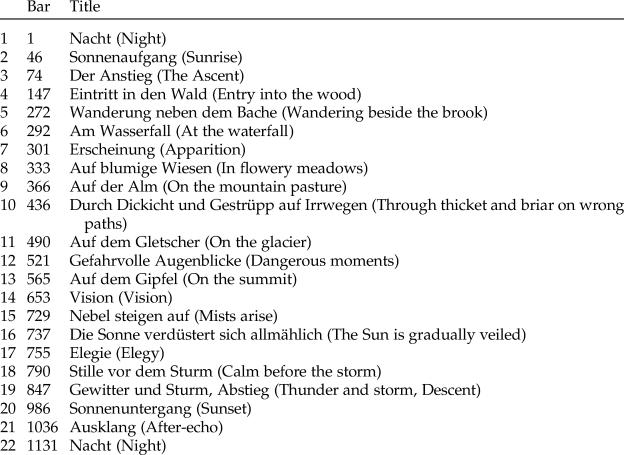
(Caspar David Friedrich)Footnote 9The 22 programmatic titles within the score of Eine Alpensinfonie (see Table 1) tell the story of a dawn-to-dusk mountaineering expedition, a journey through a variety of landscapes en route to and from the summit. Some of the titles refer to natural features (‘Sonnenaufgang’ (Sunrise), ‘Nebel steigen auf’ (Mists arise)), others to human action or experience (‘Der Anstieg’ (The ascent), ‘Gefährvolle Augenblicke’ (Dangerous moments)). More subtly than this somewhat schematic division would suggest, Strauss uses both explicit tone portraiture of landscape scenes and passages of less specific emotional evocation. This blend is similar in kind to that found in the Ur-exemplar of nineteenth-century symphonic representations of nature, Beethoven's Pastoral Symphony, although different in degree. Beethoven famously protested that his aim was ‘more the expression of feeling than painting’, but the latter element is clearly not wanting.Footnote 10 One need only think of the analogical similarities between the incessantly flowing accompaniment and the brook in the second movement (‘Szene am Bach’ (Scene by the brook)), or the dissonance and percussive violence of the tempest in the fourth movement (‘Gewitter, Sturm’ (Thunder, Storm)). Their lineal descendants are, respectively, Strauss's ‘Wanderung neben dem Bache’ (Wandering by the brook) and ‘Gewitter und Sturm’ (Thunder and storm), which employ similar representational codes, although the presence of a wind-machine in his storm shows that Strauss is more invested than Beethoven in finding quasi-realistic sonic analogues for natural phenomena.
Programmatic indications in the score of Strauss's Alpensinfonie

The titles of the first and final movements of the Pastoral Symphony stress the other dimension, the expression of emotions: ‘Erwachen heiterer Empfindungen bei der Ankunft auf dem Lande’ (Awakening of cheerful feelings upon arrival in the countryside), and ‘Hirtengesang. Frohe und dankbare Gefühle nach dem Sturm' (Shepherd's song. Happy and thankful feelings after the storm). But the matter of who is cheerful, or who is happy and thankful is underdetermined in Beethoven's symphony.Footnote 11 To use a visual metaphor, the human protagonist (Beethoven himself, perhaps) is situated outside the frame.Footnote 12 A parallel might be found in the human-less painting Riesengebirgslandschaft mit aufsteigendem Nebel (Giant mountain landscape with rising mist) by the early nineteenth-century German painter, Caspar David Friedrich.Footnote 13 Given the angle and perspective, we might choose to posit a viewer whose vantage point we share, and through whose eyes we are looking out over the landscape (Joseph Koerner has argued that Friedrich's canvasses strongly invite such inferencesFootnote 14).
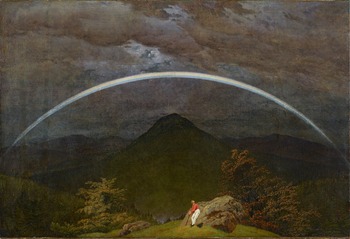
But Friedrich is perhaps better known for those paintings in which a landscape contains one or more seemingly incidental figures, a practice known in art history as staffage. For instance, Gebirgslandschaft mit Regenbogen (Mountain landscape with rainbow) features a puny human dressed in red and white in the foreground who serves to render the dark majesty of the distant mountain all the more impressive (Fig. 1). This male spectator leaning on his cane is turned away from the viewer, making him a Rückenfigur (literally, ‘back figure’). Not seeing his features lessens his individuality and draws attention to the object he himself is viewing: the natural scene before us. In Koerner's words, the Rückenfigur ‘functions to infuse Friedrich's art with a heightened subjectivity, and to characterize what we see as already the consequence of a prior experience’.Footnote 15
Caspar David Friedrich, Gebirgslandschaft mit Regenbogen (1809–10)Footnote 16

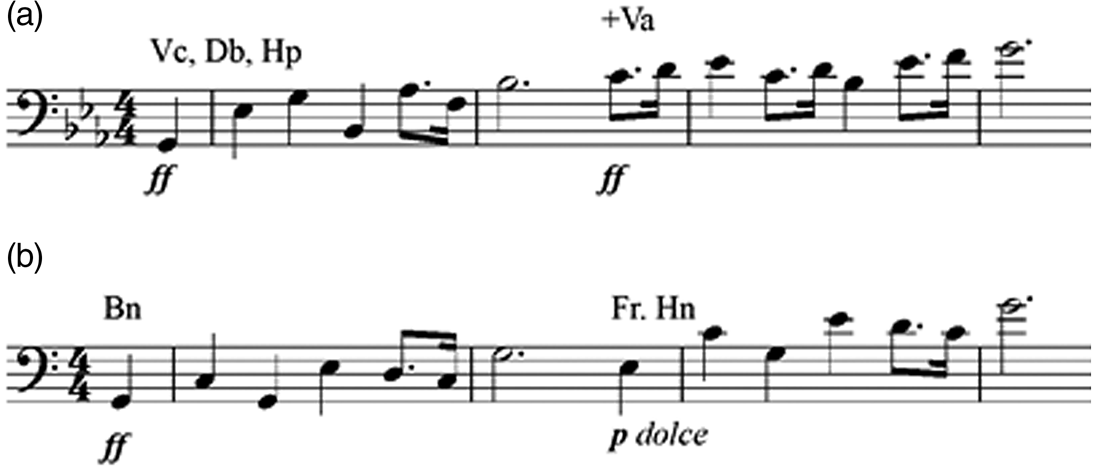
In a fashion more like Friedrich than Beethoven, Strauss makes his experiencing subject a central feature of his tone poem, most obviously through the use of a theme first heard at the start of ‘Der Anstieg’ (see Ex. 1a). While there is nothing in the section titles to rule out a group expedition, the character of this Ascent theme strongly suggests a stereotypical lone male protagonist of an echt-Beethovenian sort.Footnote 17 It has become known through the discovery of an entry Strauss made in a Winterthur hotel guestbook in 1934 that this theme derives from a motif in the coda of the finale of Beethoven's Fifth Symphony (see Ex. 1b).Footnote 18 Moreover, the arpeggiated low string sound and E-flat-major tonality establish a less exact kinship with the first theme of the Eroica Symphony, traditionally associated with a heroic individual.
(a) Alpensinfonie, ‘Der Anstieg’, bars 74–77; (b) Beethoven, Symphony No. 5, mvt iv, bars 318–321

Thereafter the Ascent theme is employed leitmotivically to indicate the presence of the climber in different scenes. Often it is associated with the resumption of activity (for instance, it reappears in bar 333 after the halt by the waterfall), or to signal an injection of energy (see bar 159, marked ‘etwas drängend’ (somewhat urgent), after the ‘sehr getragen’ (very sustained) theme that marked the entry into the wood). As is well known, the hasty storm-driven descent of the climber is represented through the inversion of Ex. 1a (bar 853ff).
Further support for positing a solitary wanderer as the protagonist of the Alpensinfonie might be found in Nietzsche's work, particularly Also sprach Zarathustra. In the prologue the prophet is described as having lived without human company in the mountains for ten years, before deciding to go down among men; later, when he is surrounded by disciples, he yearns again for his solitary wanderings. A representative passage is found at the start of the Third Part, in the section entitled ‘Der Wanderer’.
Now as Zarathustra climbed the mountain he thought as he travelled about his many lonely wanderings since the time of his youth, and about how many mountains and ridges and peaks he had already climbed.
I am a wanderer and a mountain climber, he said to his heart. I do not like the plains and it seems I cannot sit still for long.
And whatever may come to me now as destiny and experience – it will involve wandering and mountain climbing: ultimately one experiences only oneself.Footnote 19
This same impression of a solitary figure alone with nature is also captured in a photograph from c. 1918 which shows Strauss, an avid hillwalker, seated alone on the peak of the Loser in Austria.Footnote 20 Of course, the existence of a photographic record of this event gives the lie to the semblance of solitude – as with all instances where the composer was captured on camera during a hike, at least one other companion was present behind the shutter.Footnote 21 But group experiences may not necessarily have been completely different to those of the archetypal lonely wanderer. William Wordsworth, another keen hiker, ascended Mount Snowdon in the company of a friend and a local guide, but as he described it in The Prelude, it was essentially a solitary experience:
In what follows, therefore, a single experiencing subject will be posited.Footnote 23
The Ascent theme is not the only way Strauss suggests a distinction between his human protagonist and the natural scene. This theme is entirely absent in ‘Auf der Alm’; however, I suggest that the alternations of texture-orientated passages (e.g. bars 379–382) and more melodic sections (e.g. bars 383–386) are intended to be evocative of nature and the human respectively. There are several precedents for this representational code: in Mendelssohn's Hebrides Overture the first section is constructed out of short-breathed motifs suggestive of waves and winds, while the lyrical second theme played by the cellos is imbued with a kind of ‘subjective presence’, as Thomas Grey has persuasively argued.Footnote 24 Similarly, in Strauss's own symphonic fantasy Aus Italien (1886), the third movement ‘Am Strande von Sorrent’ (On the beach at Sorrento) begins with a fluttering, ravishingly orchestrated passage explicitly identified in the composer's programme note with the ‘tender music of nature’. Again, this is followed by a more traditionally melodic passage, representative of what Strauss called ‘the sensations experienced by the human listener’. These ideas are initially juxtaposed before their eventual ‘partial union’, indicating that the observer has entered into a state of communion with the natural scene.Footnote 25
In ‘Auf der Alm’, the nature-focused sections utilize an overlapping yodelling figure and are more likely to be accompanied by cowbells (possibly a nod to Mahler's well-known pastoral idiom) than the tuneful, human sections. As happened in Aus Italien, this initial alternation gives way to a fusion: melody, cowbells and yodel-like figuresFootnote 26 are deployed together from bar 393. Taken together with other traditional markers of the pastoral, such as the tonal-harmonic stasis – it is in E-flat major throughout, and largely confined to an E@ pedal note – it suggests that the hero has paused on his hike to enjoy the bucolic scene. For such a purpose the Ascent theme, with its onward-and-upward impetus, would be unsuitable. Note the added urgency at the end of the idyll conveyed by expression marks such as ‘Schnell’ (quick, bar 415) and ‘Frisch vorwärts’ (briskly onwards, bar 421) as the protagonist resumes his climb.
This last example also serves as a reminder that an Alpine landscape was not a one-note experience, no matter how ubiquitously mountains are regarded as a locus of the grand and the sublime. Wordsworth acknowledged that his youthful wanderings in the Alps awoke a variety of sensations in him:
In a similar fashion, Strauss's protagonist takes some time to appreciate fully the rustic sights and sounds of the Alpine meadow, but dramatic scenes have a quicker effect. An obvious example is the abrupt turn from E-flat major to C minor at the start of ‘Eintritt in den Wald’, where the swaying and swishing sounds of the wind passing through leaves and branches (suggested by the rapid string crossings) instantly darken the climber's hitherto ebullient spirits. The immediacy of the change may reflect the mysterious nature of forests: Friedrich Schiller spoke about ‘des Waldes Geheimniß’ (the secret of the woods), the sense of darkness and confinement which travellers may feel on entering them.Footnote 28 Not for nothing has the forest played such a huge role in German history, legends and fairy-tales, making it perhaps the most endemically ‘Germanic’ of landscapes.Footnote 29
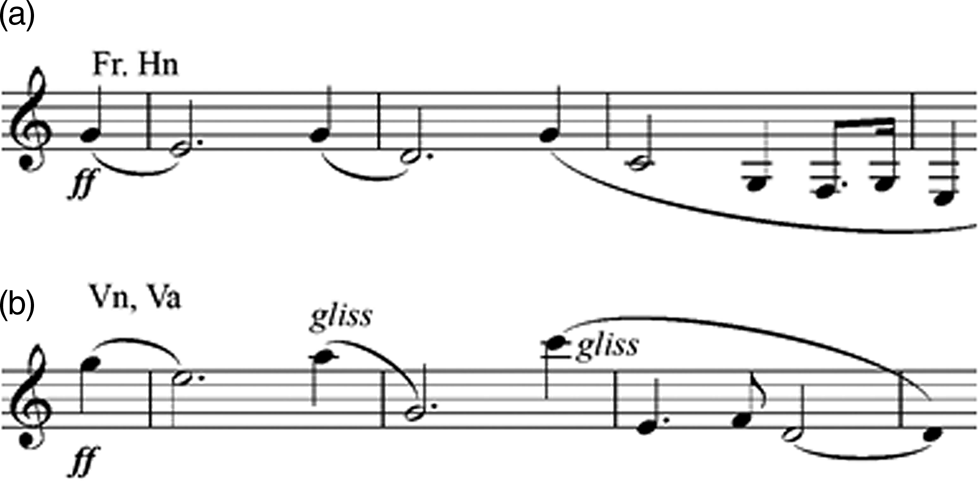
But it is not always a matter of deducing the climber's response from the emotional temperature of a passage, for Strauss on occasion uses a theme specifically associated with admiration and wonder. This is first heard at ‘Am Wasserfall’ (At the waterfall), one of Strauss's most brilliant pieces of musical depiction. The sonic equivalent of misty spray is suggested by harps and celeste along with ricochet strings and arpeggiated woodwind lines, the different internal beat divisions helping to create an aural sfumato effect. The Admiration theme (bars 325ff; a later occurrence is reproduced in Ex. 2a) bears a striking similarity to a passage from the second movement of Bruch's Violin Concerto No. 1, a resemblance which Strauss wryly acknowledged on more than one occasion.Footnote 30 Strauss's sketch includes the words ‘wie schön’ (how beautiful) under the first descending pair of notes, and the theme itself is entitled ‘Refrain: das Verweilen’ (Refrain: lingering).Footnote 31 The conjunction of these two labels recalls one of the most famous lines from Goethe's Faust: ‘Verweile doch! du bist so schön’ (‘Oh stay! You are so beautiful’, line 1700), the temptation to linger which Faust must avoid or Mephistopheles will claim his soul.Footnote 32 Like the eternally unsatisfied Faust or the archetypal romantic wanderer, Strauss's climber cannot stay long in any one place, no matter how beautiful. However, unlike them, he has a specific goal: the mountain summit.
Alpensinfonie ‘Auf dem Gipfel’ (a) bars 603–606; (b) bars 607–609

Peak experience
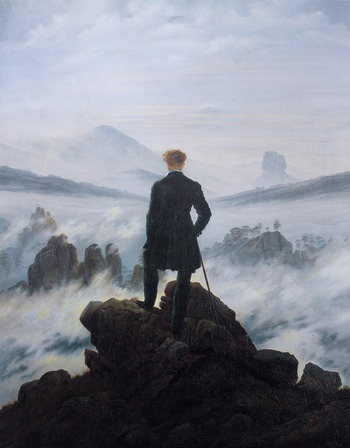
For both musicians and visual artists, representing a peak offers particular challenges. In an essay written in 1911, coincidentally the same year in which Strauss resumed work on Eine Alpensinfonie, Georg Simmel problematized the depiction of mountains in painting, noting that it was impossible to capture adequately ‘the impression of overwhelming mass’ on canvas, thus contravening the principle whereby ‘forms and scale constitute an inseparable unity of aesthetic impression’.Footnote 34 Nearly a century before, Friedrich found an ingenious solution to these issues in his best-known painting, Der Wanderer über dem Nebelmeer (The Wanderer above the Sea of Fog, see Fig. 2). This is a rare instance in his output where the human figure is in a position of eminence, and consequently is looking down upon, or out over, the vista, rather than gazing up at a mountain from lower down (as was the case in Fig. 1).Footnote 35 The figure on the rocky outcrop has presumably reached a summit of some kind, but this remains a matter of inference, since any view of the lower slopes is masked by the fog. Opting for an occluded landscape over the sight of foreshortened slopes and valleys is the practical exemplification of Friedrich's belief that ‘when a landscape is covered in fog, it appears larger, more sublime, and heightens the strength of the imagination and excites expectation, rather like a veiled woman’.Footnote 37 As if in compensation for the restricted view, the Rückenfigur here is no miniature human inserted to give a sense of proportion to a distant mountain, but instead is positioned front and centre in the canvas. With our attention tilted away from the natural scene towards the brooding human, it is not by chance that this painting has become an iconic representation of romantic subjectivity.
Caspar David Friedrich, Der Wanderer über dem Nebelmeer (1818)Footnote 36

The difficulties of adequately representing a summit are even more formidable in music than in visual art. Unlike the landscape features that Strauss's climber encountered earlier in his ascent, a peak is a static object defined by its position and does not have an obvious sonic correlate. There are no opportunities for iconicity, such as hunting horns and cowbells, nor even a sense of movement, for which Strauss had found ingenious musical analogies in representing the forest, stream and waterfall. Strauss does opt for the musical equivalents of bigness (the mass of orchestral sound created by over 100 players) and height (the six-octave registral span from bass to treble instruments at bar 638), but there is little incentive to interpret these as topographic signifiers. Instead, the music that follows the attainment of the summit can more plausibly be heard as evoking the climber's response, and the two section titles during this extended passage – ‘Auf dem Gipfel’ (On the summit) and ‘Vision’ – suggest again a privileging of the protagonist's experience. The turn to emotional evocation after so much quasi-realistic depiction recalls Strauss's much earlier response when Cosima Wagner suggested he was too reliant on his intellect in composing: ‘wherever the heart beats strongly at all, it will always burn through the rational side.’Footnote 38
Attaining the summit is preceded by three sections suggesting difficulty and stress both in their titles and musical substance: pressing on after the hiatus in the pasture, the wanderer has gone astray in the thickets (‘Durch Dickicht und Gestrüpp auf Irrwegen’), ended up on a glacier (‘Auf dem Gletscher’), and experienced danger in the last phase of the ascent (‘Gefahrvolle Augenblicke’). Such moments of peril are hugely relevant to the emotional response of both climber and audience. The emotional tension in ‘Gefahrvolle Augenblicke’ is palpable – tremolo strings, nervously disjointed presentations of motifs, sudden brief darts of dynamic intensity, tonal instability – and this mood is not completely swept away by the fortissimo F major chord and Zarathustra-derived Naturthema (here F–C–F) in bars 565–570, which open ‘Auf dem Gipfel’ (On the summit). The two phrases of the extended oboe solo that follow (bars 571–591) have been interpreted by Matthew Werley as ‘the instrumental embodiment of the first-person pronoun’,Footnote 39 and the short-breathed, syncopated phrases may well suggest the breathlessness of the climber as he recovers his equilibrium.Footnote 40 This prolonged pause at the start of ‘Auf dem Gipfel’ recalls an older aesthetic debate about human responses to a sublime encounter: Strauss's representation of the climber's experiences at the peak resonates with the theories of Johann Gottfried Sulzer, who believed that while the sublime encounter had immediate results, ‘the longer one lingers with it and the more closely one observes it, the more forcibly one feels its effect’.Footnote 41
Ultimately, this quiet stock-taking gives way to a far longer passage of exultant orchestral plenitude, a last exhalation of nineteenth-century monumentalism. The ordering of events here conforms to Kant's belief that the pleasure of the sublime is generated ‘by the feeling of a momentary inhibition of the vital powers and the immediately following and all the more powerful outpouring of them’.Footnote 42 More recently, Frederick Jameson has argued that the sublime ‘is not a sound, or an effect, or a level, that one can simply occupy …. It must be reached and attained, and this is a movement which is always imagined in terms of a rising to a certain height, as with an orator or with music.’ This can happen in two ways: ‘the first suggesting an eruption from the depths, the second an arduous climbing and movement upward’.Footnote 43 Strauss more closely follows the latter model, leading to these five climactic minutes which represent the core encounter of the protagonist with the sublime landscape during his hike. As the new tonic C major is cadentially confirmed (bar 597), the Zarathustra arpeggio sounds again (now C–G–C), followed by a major-mode version of the rugged chordal Mountain theme, first heard in brooding minor-mode chromaticism in bars 9–16.Footnote 44 The Admiration motif, last heard at the waterfall, returns again in its original guise (Ex. 2a), and is immediately changed into a hyperbolic version with characteristically wide Straussian leaps in place of the original narrow intervals (Ex. 2b), surely a marker for the heady exhilaration felt by the protagonist at the summit.
Bar 638 marks the dynamic highpoint and the place of maximal registral displacement, occurring in tandem with the appearance of the Sunrise theme (initially presented in bar 46), now in full C major glory. The lush, full-bodied texture continues through the ‘Vision’ section which follows, with a brief abatement of dynamic at bar 673 before it builds up again. It is only with the collapse of the texture at the start of ‘Nebel steigen auf’ (bar 729) that the mood radically changes.
Once he has reached the summit, Strauss's climber, like Friedrich's wanderer before him, displaces the landscape as the locus of his creator's interest. This turn to interiority rather than the representation of the external scene might be best explained in the words of G.K. Chesterton's Father Brown, who observed that ‘Heights were made to be looked at, not to be looked from. … One sees great things from the valley; only small things from the peak.’Footnote 45 This typically Chestertonian paradox is a fitting response to the essential paradox of peaks: they only act as a locus of the sublime to the extent that they are still distant, unconquered. The eye seeks them out, and the imagination is stimulated by their seeming or actual inaccessibility. When one has attained the summit, the peak qua peak literally becomes invisible, and one's attention is necessarily directed elsewhere.
What lies beyond
Where, then, does the successful climber's attention go? Strauss provides few direct clues, beyond the abatement of the representational realism which dominated the first part of the tone poem. As was summarized in the introductory section, scholars today are in agreement that Strauss's attitude to nature in this tone poem and elsewhere reflected his immanent frame of reference, emblematic of the ‘disenchantment’ (Entzauberung) which the composer's exact contemporary Max Weber regarded as a component of secularized modernity.Footnote 47 In this reading, the man who contemplated calling his work Der Antichrist had taken to heart Nietzsche's call: ‘remain faithful to the earth and do not believe those who speak to you of extra-terrestrial hopes!’Footnote 48 The climber's feeling of exaltation would thus have to be characterized as a type of emotional catharsis: heady satisfaction at his achievement in attaining the summit after a dangerous climb, and a renewal of the wonder and appreciation he felt on seeing the waterfall earlier, now vastly augmented by the panorama before him. The despised extra-terrestrial would not, could not, be in any way relevant.
This anti-metaphysical paradigm actually dates back further than Nietzsche, even if it is something of a minority position in the early nineteenth century. In what follows, three different strains in romantic artistic representations of mountains will be surveyed: (1) artworks that link mountains with traditional religious imagery; (2) artworks that challenge or reject any such connection; and (3) artworks that avoid any mention of the supernatural. This last position in turn can be related to the pantheism that was so widespread among the romantics, in which nature was exalted, even divinized as an entity in itself. The step from pantheism to Nietzsche's stance towards nature is not as big as might be imagined. The purpose of this lengthy survey is to tee up the final part of the article, where I make the case that the Alpensinfonie, seemingly squarely in line with the third position in its avoidance of any hint of the otherworldly, may be less hermetically sealed off from the religious position than is commonly thought to be the case.
Artworks that link mountains with traditional religious imagery
It is commonplace for early romantics to include openly religious exhalations in their responses to mountainous scenes. Consider, for instance, Coleridge's poetic speaker gazing up at Mont Blanc:
In fact, Mont Blanc had never been present to Coleridge's own ‘bodily sense’ before he penned these lines. Rather, as he acknowledged to a correspondent, it was on one of the highest peaks in England, Scafell in the Lake District, where he ‘involuntarily poured forth a Hymn in the manner of the Psalms’. After reading ‘Chamounix beym Sonnenaufgange’ (Chamonix at sunrise) by the Danish poet Friederike Brun, Coleridge ‘adapted [his] former feelings to these grander external objects’, without any public acknowledgement of his debt.Footnote 50 However, unlike Coleridge, Brun had been inspired by direct experience of the glaciers in the region surrounding Mont Blanc, which she visited in May 1791.Footnote 51 Her poem also sees the hand of a biblical God in nature, an idea strengthened by her chosen epigraph from Metastasio (La Terra, il Mare, le Sfere / Parlan del tuo potere; The earth, the sea, the skies speak of your power) which in turn echoes the Sanctus from the Mass liturgy (Pleni sunt coeli et terra gloria tua; heavens and earth are full of your glory).Footnote 52 After a repeated series of questions asking who ordained various visible facets of nature, Brun gives the answer in her final verse:

In Coleridge's ‘Hymn’, similar questions meet with very similar answers:
This turn from contemplating mountains to contemplating their creator was a common one in artistic representations around this time. Goethe's Werther, eponymous hero of Die Leiden des Jungen Werthers (1774) and prototype of the tormented romantic hero, describes himself as coming to feel at one with nature after gazing upon a sublime mountainous scene, and his language again invokes the deity:
I felt myself exalted by this overflowing fullness, as if a god myself, and the glorious forms of an infinite universe stirred within my soul! Stupendous mountains encompassed me, abysses yawned at my feet, and cataracts fell headlong down before me; rivers rolled through the plains below, and the rocks and mountains resounded from afar. … From the inaccessible mountains, across the wilderness which no mortal foot has trod, far as the edge of the immeasurable ocean, the spirit of the eternal Creator breathes; and every speck of dust which He has made finds favour in His sight.Footnote 55
Friedrich Hölderlin also draws divine inferences from the sight of a mountain in the poem ‘Heimkunft’ (Homecoming, 1801). In the dawn light, the ‘silvery heights’ (sibernen Höhen) and ‘shining snow’ (leuchtende Schnee) lead to the following acknowledgement:

Later in the poem reference is made again to the ‘great Father’ (grossen Vater) ‘who renews the wandering hours up there on high and reigns over the mountains’ (welcher die wandernde Zeit / Droben in Höhen erfrischt, und waltet über Gebirgen (lines 86–87)). As Luke Fisher puts it, ‘Hölderlin thus renders natural phenomena as a transparency through which the god is beheld, synthesises nature and spirit, the sensible and the supersensible’.Footnote 57
For painters, too, mountains were locations where one could experience the numinous. In the second of his Nine Letters on Landscape Painting (1815–1824), Carl Gustav Carus described mountains in terms which closely match Coleridge's language:
Climb to the topmost mountain peak, gaze out across the long chain of hills, and observe the rivers in their courses and all the magnificence that offers itself to your eye – what feeling takes hold of you? There is a silent reverence within you; you lose yourself in infinite space; silently, your whole being is purified and cleansed; your ego disappears. You are nothing; God is all.Footnote 58
Several of Carus's canvases bring together mountainous locations and Christian symbols.Footnote 59 In this, he was only following the lead of his teacher, Casper David Friedrich, who repeatedly explored this conjunction, most famously in Das Kreuz im Gebirge, also known as the ‘Tetschen Altar’ (1808).Footnote 60 The ubiquity of such symbols bears out Marie Bang's more general assessment of the painter: ‘To Friedrich the aim of a true landscape painting was not merely a rendering of nature's outer manifestations. The true aspect of nature was the divine spirit inherent in all things.’Footnote 61 These crosses and statues are more than just token markers of peaks, such as can still be found on many German mountains to this day, for in some cases humans are seen interacting with them. Morgen im Riesengebirge (Morning in the giant mountains, 1810) shows a climber being pulled up the final few metres by an obviously preternatural female figure who is herself holding onto the Cross at the summit. In Madonna im Gebirge (Statue of the Madonna in the Mountains, 1804), there is a tiny, easily overlooked pilgrim, bowed on his knees in prayer at the base of the statue. Unlike picturesque ruins of churches used to symbolize the passage of time in some of Friedrich's other paintings, here the religious objects retain their original devotional function.Footnote 62
Among musicians of the era there were a few who responded creatively to texts which yoked together the mountainous and the religious. A particularly interesting precedent for Eine Alpensinfonie is provided in Liszt's so-called Bergsymphonie (Mountain Symphony, 1854), one of Liszt's programmatic orchestral works which Strauss had conducted many times and openly acknowledged as pointing the way to his own tone poems.Footnote 63 Liszt's work was published under the title Ce qu'on entend sur la montagne (What one hears on the mountain) and was based on Victor Hugo's poem of the same name (published in the 1831 collection Feuilles d'automne). The speaker in the poem, having ‘climbed the mountain, calm and silent, in the presence of the heavens’ (calme et silencieux / Monté sur la montagne, en presence des cieux, lines 1–2), has a vision. From the ocean on one side and land on the other come commingled two voices. The speaker associates the voice from the ocean with nature, harmonious and beneficent, attuned to the will of God, a ‘song of glory! Blissful hymn’ (chant de gloire! Hymne heureux!). The other (coming from the land) is discordant with the tortured cries of blasphemous humanity. The coexistence of good and evil is unfathomable, which leaves the speaker in a state of existential angst. Nonetheless, his doubts still are expressed within a theistic frame, to judge from the frequent references to God, right up to the closing question: ‘Et pourquoi le Seigneur, qui seul lit à son livre, / Mêle éternellement dans un fatal hymen / Le chant de la nature au cri du genre humain?’ (why should the Lord, who alone reads in his book, / have mingled eternally in a fatal marriage / The song of nature with the cries of humanity?, lines 80–82).Footnote 64 The Catholic Liszt provided a more affirmative conclusion to his mountain symphony in the form of a chorale marked Andante religioso.
It is perhaps worth emphasizing here that allusions to a deity or the presence of religious iconography in an artwork are not necessarily indicators of the artist's spiritual disposition or belief system, even in those cases espousing a first-person perspective. Still more caution is needed when assessing a case like Goethe's Werther, where the passage quoted earlier was given in the voice of a character. The complexity of Goethe's personal attitudes to notions of the divine and nature are in fact considerable. In December 1777 he climbed the snow-bound Brocken, the highest peak in the Harz mountains and later the location of the Walpurgisnacht orgy in Part I of Faust. His descriptions of what was an important symbolic event for him personally are loaded with religious imagery: his diary account of reaching the summit concludes with a quotation from Psalm 8: ‘bright, splendid view, the whole world in clouds and fog and everything above bright. What is man, that you should keep him in mind.’Footnote 65 When he recounted the event to Charlotte von Stein, he wrote: ‘There lies the Brocken before me above the firs in the noble magnificent moonlight, and I was up there today, and on the Devil's Altar I offered my dearest thanks to my God.’ Goethe is here indulging in what Nicholas Boyle has called ‘a touch [of] provocative Satanism’: the ‘Devil's Altar’ is a portmanteau reference to two rock formations on the mountain (the Devil's Pulpit and Witch's Altar).Footnote 66 The borderline between autobiography and literature was ever a permeable one for Goethe, so it is no surprise that he recast these experiences, cleansed of their satanic overtones, in ‘Harzreise im Winter’ (published 1789). The speaker describes a climber beaten down by fate, with the more savage aspects of nature presented as a kind of redemptive force in themselves, a naturalized religious experience:

But even amid this celebration of the natural sublime the speaker offers a prayer to an unspecified deity (the ‘father of love’) on behalf of the wanderer

Artworks that challenge or reject the notion of a divinity
Examples of conjunctions between mountainous scenes and various strains of religiosity could be multiplied many times over in late eighteenth- and early nineteenth-century art. As was pointed out earlier, the presence of religious imagery in itself does not necessarily imply any kind of credal adherence: in fact, it could be invoked specifically to call into question or deny outright the validity of the theistic frame. Such artworks can be understood as deliberate inversions of the widespread trope whereby the sight of the upward-pointing mountain leads to thoughts of God. Georg Herwegh's ‘Auf dem Berge’ (On the mountain, 1839) clearly rejects any such conjunction of ideas.Footnote 68 The speaker of the poem begins by acknowledging a loss of faith: ‘Da wären sie, der Erde höchste Spitzen! / Doch wo ist der, der einst an sie gegelaubt?’ (There they are, earth's highest peaks! / But where is he who once believed in them? lines 1–2). His earlier attitude to the landscape was squarely in line with that of Coleridge and Bruns: ‘Hier mit der Donnerstimme des Profeten / Gotttrunken jauchzen in den Katarakt’. (Here with the thunderous voice of the prophet / (I wanted) To rejoice, God-inebriated, in the waterfall, lines 11–12). And yet, his retreat to the mountains left him yearning for the human world he had fled, with all its enmities and sorrows. The final verse consolidates this conjunction of mountains and the supernatural, both of which he rejects:

For an atheist such as Percy Bysshe Shelley, nature carried with it no implication of a creator's hand. And yet, when he wrote Mont Blanc: Lines Written in the Vale of Chamouni, he did not treat the scene in a purely materialist spirit, as if the issue were decided.Footnote 70 In part, this was because he was writing with knowledge of and in response to Coleridge's ‘Hymn’, which led him to interrogate the link between nature's sublimities and a divine creator. Shelley's poem dates from his visit to the Chamonix massif in July 1816, his ‘attempt to imitate the untameable wildness and inaccessible solemnity from which those feelings sprang’.Footnote 71 The resulting verses move from apostrophizing the dramatic landscape (with its ‘dark mountains’, ‘giant brood of pines’, ‘chainless winds’, ‘ethereal waterfall’, and ‘dizzy ravine’) to existential questions. The sight of the heights above leads to a meditation on the question of a creator:
Shelley acknowledges that two responses to nature are possible:
The final lines of the poem (addressed again to Mont Blanc) invite the reader to grapple with the implications of living in a godless universe, and how that would impact on one's attitude to the natural world:
Artworks that avoid any mention of the supernatural
The answer to Shelley's pregnant final question need not be nihilistic. Friedrich Schiller, for one, believed that the sublime manifestations of nature were a beneficent force in themselves, a corrective for over-civilized modern man.Footnote 73 It was Schiller who, in his 1788 poem ‘Die Götter Griechenlands’, famously coined the phrase ‘die entgötterte Natur’ (nature deprived of its gods).Footnote 74 A later poem ‘Der Spaziergang’ (1795, published 1801) exemplifies this perspective, in that it avoids virtually all religious symbolism and any sense of the transcendent. Like Eine Alpensinfonie, it features a speaker who takes a walk into the hills; the sights he encounters (meadows, woods, deep gullies, mountain hamlets) lead to an extended meditation. This train of thought is concerned with human history stretching back to a prelapsarian classical past and the problematic consequences of the progress of civilization. The supernatural is thus almost entirely absent; the very few references to a divinity suggest loss or distance, such as might accord with Schiller's own Deist beliefs. For instance, one dystopian line of thinking leads him to a vision of a darkening world:

And yet, a godless but still sublime encounter can be a source of inner renewal. Towards the end of the poem, the speaker awakens from his meditation on human progress to discover that, in the interim, he has left behind human habitations and wandered to the edge of a precipice. This has a restorative effect on him – ‘Mit dem stürzenden Thal stürzte der finstre hinab’ (With the precipitous fall of the valley the darkness too fell away, line 188) – and the poem concludes optimistically.Footnote 75
The non-religious framing of a sublime encounter was not reserved for Schiller alone. On occasion Goethe, too, presented his mountain climbs as purely immanent experiences. In 1779, two years after his Brocken expedition, he climbed La Dôle in the Swiss Jura, as part of a Bildungsreise he undertook with his employer, Carl August of Weimar.Footnote 76 The trip was subsequently memorialized with the publication of the Briefe aus der Schweiz 1779. In one of these letters, the view from the mountain top inspired the following reflections:
There are no words to express the grandeur and beauty of this view. … [T]he line of glittering glaciers was continually drawing the eye back again to the mountains. The sun made his way toward the west, and lighted up their great flat surfaces, which were turned toward us. How beautifully before them rose from above the snow the variegated rows of black rocks! – teeth, towers, walls; wild, vast, inaccessible vestibules! – and seeming to stand there in the free air in the first purity and freshness of their manifold variety. Man gives up at once all pretensions to the infinite, while he here feels that neither with thought nor vision is he equal to the finite.Footnote 77
After descriptions loaded with the familiar vocabulary of the sublime, the concluding sentence makes an interesting turn: Goethe deliberately resists the turn to the unearthly precisely because of the ungraspable nature of the earthly. Treating the sublime experience as wholly produced by and explicable in terms of this world ties in with the pantheistic turn in early romanticism, which itself can be traced back to a revival of interest in Baruch Spinoza at the end of the eighteenth century. Disagreement over the conclusions drawn from Spinoza led to the so-called Pantheismusstreit (the pantheist controversy) which divided the romantics. While the details of the debate lie outside the concerns of this article, Spinoza's maxim ‘Deus sive natura’ (God or Nature) was interpreted as bringing the divine within the natural order, rather than understanding it as something outside of the circles of creation. As Frederick C. Beiser observes, ‘Spinoza's dictum divinized nature as much as it naturalized the divine’. Where Spinoza in his lifetime and afterwards had been suspected of atheism, for Novalis he was a ‘God-inebriated man’ (der Gott betrunkene Mensch).Footnote 78 Neo-Spinozean pantheism came to be regarded as a middle position between atheism and theism. A slew of figures made professions of their Spinozism, among them Lessing, Herder and Goethe. The last named, in a famous letter to Friedrich Heinrich Jacobi, one of Spinoza's severest critics, proclaimed: ‘As a poet and an artist I am a polytheist, as a scientist, however, a pantheist; the one is as firm a conviction as the other. And if as a moral being I require a God, that too has been granted.’Footnote 79 This passage was transcribed (inexactly) by Strauss into a notebook late in his life, his habit when he came across phrases during his reading that appealed to him.Footnote 80
This survey of mountains representations in romantic-era artworks has demonstrated the variety of ways in which artists could frame the sublime experience associated with lofty places. Many, perhaps the majority, resorted to overtly sacrilizing language or religious iconography. Others avoided allusions to a transcendental divinity entirely, or actively challenged and subverted such associations. Of these last two positions (which might be characterized for convenience as the irreligious and antireligious respectively), the antireligious seems more typical of the age (Shelley, Herwegh) than the simple absence of such references (Schiller), indicative, perhaps, of how normalized the numinous frame of reference was at the time, and consequently how it needed to be openly resisted by those so minded rather than simply ignored.
Thus Strauss's avowedly godless perspective on nature aligns him not only with Nietzsche's antimetaphysical doctrines, but also has earlier ancestors in the challenges to transcendental paradigms put forth by Herwegh and Shelley, and the immanent frame of reference consciously chosen by Goethe in 1779. In terms of the creative strategies he employs to further his aim, Strauss might actually be closest to Schiller: the path to the peak in Alpensinfonie simply lacks any suggestion of the otherworldly, the composer relishing instead the representation of the real, physical world. It must be remembered that Strauss was living in a far more secularized era than the one inhabited by his romantic-era precursors a century earlier; Charles Taylor has noted that ‘in the late nineteenth and early twentieth centuries … the alternatives open to unbelief [were] multiplied and enriched’, something he labels the ‘nova’ effect.Footnote 81 In particular, Nietzsche's polemics against a religious worldview would have made it unnecessary for Strauss to replicate this type of active defiance of an already fading convention, in a medium (music) which was inherently less suited to such propositional debates or polemical stances.
However, we have not yet gotten to the end of the tone poem. There are elements in the post-peak music that complicate this notion of Strauss as a pure materialist. These, I will claim, further align Strauss with his romantic precursors, as his mode of representing the climber's response to nature, coupled with the composer's personal attitudes to the natural world, might in fact bring him closer to the kind of pantheistic position espoused by his beloved Goethe.
Down the mountain
[Having climbed to the summit of the Pfeiffer Alm near Garmisch-Partenkirchen] Mahler drank in the wonderful view, and, even more deeply, the profound stillness of the place. I have forgotten now what led up to the following remarks, once he had broken the silence: ‘Music must always contain a yearning, a yearning for what is beyond the things of this world.’Footnote 82
In the 1911 calendar entry where he announced his intention of calling the Alpensinfonie ‘Der Antichrist’, Strauss outlined the three (Nietzschean) values which the tone poem would embody: ‘moral purification through one's own effort, liberation through work [and] the adoration of eternal, glorious nature’.Footnote 83 This private manifesto brings him very close to the ‘nonreligious man’ defined by Mircea Eliade:
Modern nonreligious man … accepts no model for humanity outside the human condition as it can be seen in the various historical situations. Man makes himself, and he only makes himself completely in proportion as he desacralizes himself and the world. The sacred is the prime obstacle to his freedom. He will become himself only when he is totally demysticized. He will not be truly free until he has killed the last god.Footnote 84
Strauss's first two values align closely with this. However, even as he fulminated against the continued influence of Christianity, Strauss still described his attitude to nature in religious terms (Anbetung betokens worship, traditionally of a divinity). This does not square with the notion of a ‘radically desacralized nature’ which Eliade, writing in the 1950s, diagnosed as a comparatively recent attitude. Strauss's word choice in itself might not have been particularly significant, as terms originating in one domain are often applied metaphorically to new situations. However, additional evidence for what might be regarded as a quasi-pantheistic view of nature can be found in the second half of the tone poem, where the climber's purely materialist frame of reference is shaken.
While instrumental works do not usually engage in debates about the existence of God (as does Shelley's poem), or self-consciously steer thought from the supernatural back to the natural (as Goethe did in 1779), Strauss had actually attempted something of the sort earlier in his career. In ‘Von den Hinterweltlern’ (Of the Backworldsmen) near the start of Also sprach Zarathustra, citations of ‘Credo’ and ‘Magnificat’ chants, representing primitive religious faith, are swept away by the mounting excitement of ‘Von der grossen Sehnsucht’ (Of the great longing). We observed a different strategy in operation in the first half of Eine Alpensinfonie, where the focus on the quasi-realistic representation suggests a deliberately desacralized attitude to nature. Like Goethe the Naturforscher, rather than Goethe the mouthpiece of Werther, Strauss is concerned with describing accurately various aspects of nature rather than reflecting on any metaphysical significance they might have. Yet, even here, there are moments when his purely immanent focus is breached. The enigmatic ‘Erscheinung’ (Apparition) section, a continuation of the Waterfall music, was explicitly linked in Strauss's early plans with the appearance of a water sprite, variously described as a Wasserfee and Alpenfee (water / Alpine fairy) in the sketches.Footnote 85 Perhaps the lack of specification in the final score betokens a change of heart; not unlikely, given the extensive changes the tone poem had undergone in the interim. In the final version all the other annotations in the first part of the tone poem refer to landscape features which are objectively present, or to the climber's experiences, but the notion of an apparition of some undetermined kind was still retained, a momentary glimpse of a re-enchanted world.
After the peak is reached there is less in the way of representational literalism than in the earlier parts of the tone poem. Since we have already accompanied the climber through a long succession of different environments en route to the top, this might be to avoid the tedium of a twice-told tale. The compressed reprise of some of these scenes during the storm-hastened descent provides enough in the way of pictorialism without putting the listener through the full palindromic experience of traversing the journey in reverse.Footnote 86 But there is more to it than the wish to avoid redundancy: section titles like ‘Vision’, ‘Elegie’ and ‘Ausklang’ indicate that the protagonist's thoughts and imaginings are given a new prominence. Morris glosses this as ‘naïveté’ giving way to ‘a more reflective and self-aware subjectivity’ on the part of Strauss's protagonist.Footnote 87
The peak has clearly changed things for the climber. Earlier, I offered a reading of this climactic passage that adhered to current scholarly orthodoxy in remaining on an immanent plane, but now I want to complicate this. First, it has to be recognized that the fulsome musical depiction of exaltation in ‘Auf dem Gipfel’, while not explicitly religious, uses tropes which are familiar from other metaphysically charged artworks. The sense of a sustained climax again has ancestors in Beethoven's Pastoral (mvt v, bars 133, and, especially, 190 and 219), but more immediately, in Mahler's Second Symphony (mvt v, bar 162). The Mahler example, from the finale of his most metaphysically charged work, is a particularly close precedent: both emerge out of a quiet passage (the oboe figure in Strauss, a brass chorale for Mahler), with a sudden crescendo to a tutti orchestration accompanying the decisive turn to C major. Beyond such technical similarities, the sense of apotheosis (a word meaning ‘deification’) is startlingly similar in both. For Mahler, this breakthrough moment has clear salvific overtones, a precursor to the proclamation of the Resurrection (‘Aufersteh'n’) with which the symphony concludes. But for Strauss? One could of course maintain that he is harnessing an earlier trope to his own immanent ends. Such an act of reappropriation would accord well with Strauss's earlier strategy when he lost faith in Wagner's Schopenhauerian metaphysics, which led his former mentor Alexander Ritter to complain: ‘You retain nothing of Wagner's worldview anymore. What is the only part of Wagner that remains to you? The mechanics of his art.’Footnote 88 Strauss had no sympathy for the religious dimension of Mahler's art, as witness the famous 1911 calendar entry: ‘As a Jew, Mahler could still find Christianity uplifting. … It's perfectly clear to me that the German nation can gain new strength only by breaking free from Christianity’.Footnote 89 But the resultant effect of this breakthrough passage in the Alpensinfonie can also be read another way: that nature has been ‘divinized’, as it might have been for the pantheists a century earlier.
‘Vision’, as was mentioned earlier, directly follows ‘Auf dem Gipfel’ and continues its graphic emotionalism. This title is not to be found in the sketches, only in the final score, and Strauss left no further indication as to the nature of the vision.Footnote 90 The somewhat tortured musical language here – preponderance of minor mode, frequent dissonances, tonal instability, restless motivic action – distinguishes it from the majestic C-major tonal certainty of ‘Auf dem Gipfel’.Footnote 92 The repeated invocations of the Admiration theme in the minor, each time with the final descending fifth twisted into a tritone (bars 665–668), suggest a note of desperation rather than calm appreciation. The final, incomplete iteration of this figure (bars 718–719) leads into a fff return of the Mountain theme in its original minor modality, which initiates the spectacular collapse at bar 729. A comparison with a similar drop-off in Also sprach Zarathustra provides a possible key to this passage. In the earlier tone poem, the climactic return of the opening nature fanfare (bars 329–336) occurs in a section entitled ‘Der Genesende’ (The Convalescent), in which Nietzsche's protagonist confronts his ‘most abysmal thought’.Footnote 93 He collapses, and after slowly coming to himself again, the convalescent teaches the doctrine of eternal recurrence. As glossed by Youmans and others, Strauss's Zarathustra recognizes through contemplating the mysteries of nature that he cannot give up completely the ‘extra-terrestrial’ hopes he despises.Footnote 94 In a similar fashion, I suggest, the vast panorama and vertiginous experience has been too much for the protagonist of Alpensinfonie, and has shaken his closed-off, immanent frame of reference.Footnote 95
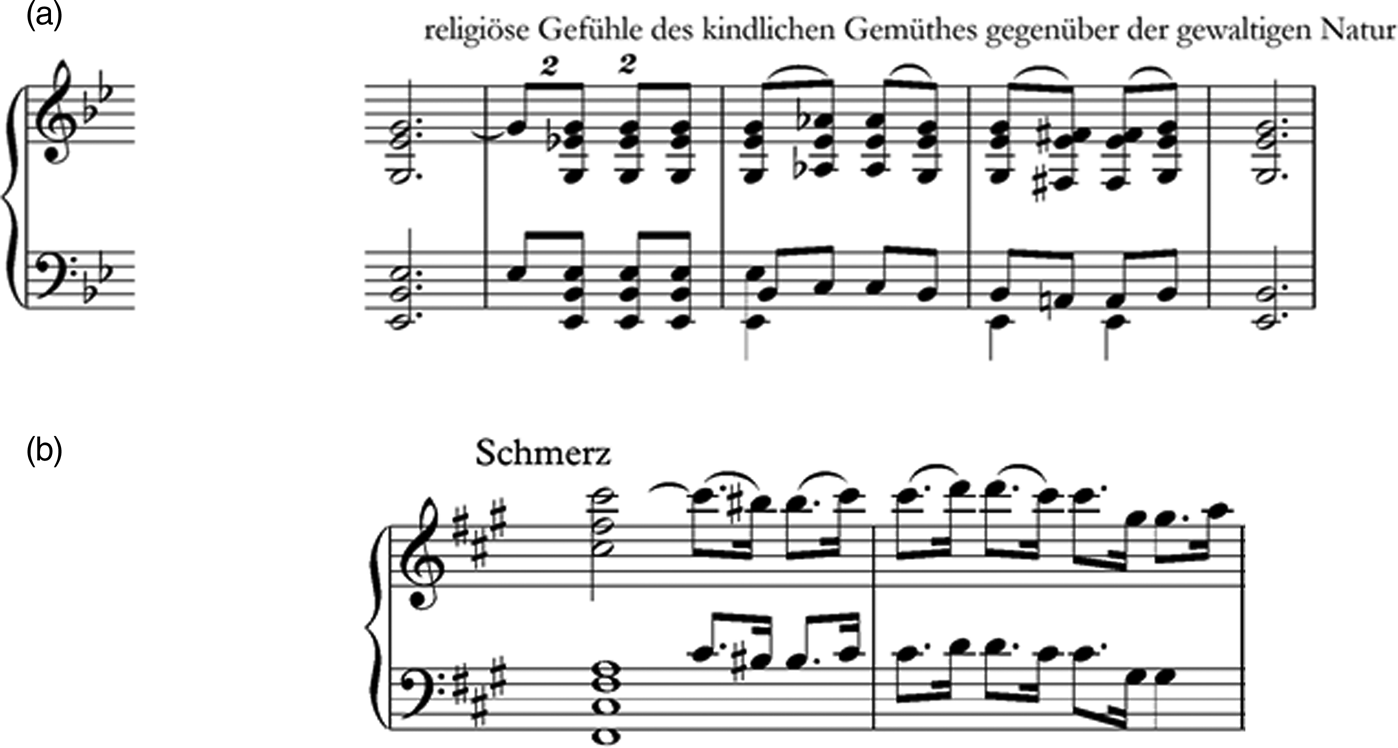
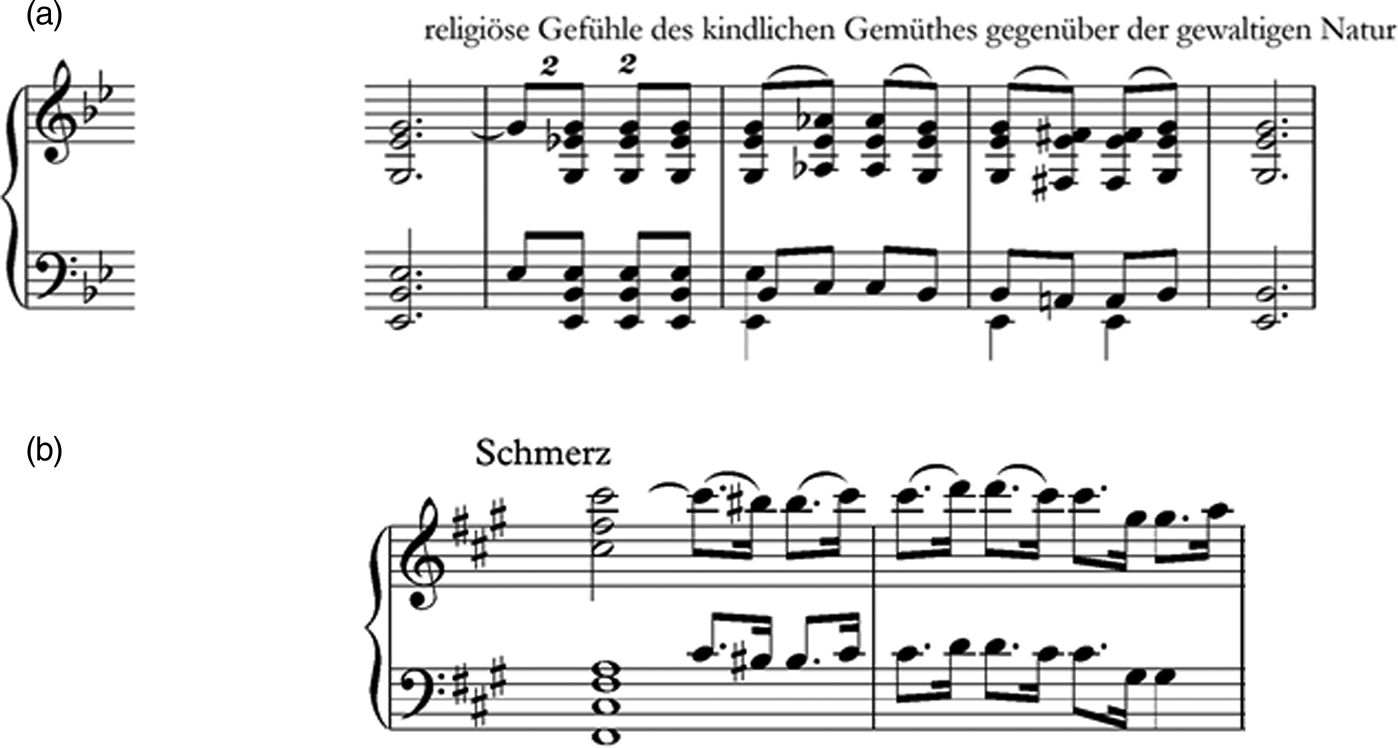
‘Elegie’ is another section which may obliquely hint at the great beyond. The opening of this passage, variously called ‘Schmerz’ (sorrow) and ‘Melancholie’ (melancholy) in sketches,Footnote 96 may have a distant ancestor in a sketch for Künstlertragödie, the project which eventually morphed into Eine Alpensinfonie (see Ex. 3). This earliest version is annotated ‘religiöse Gefühle des kindlichen Gemüthes gegenüber der gewaltigen Natur’ (religious feelings of the childlike mind when confronting powerful nature). The euphonious major-mode music here is kin to ‘Von den Hinterweltlern’ in Also sprach Zarathustra, which has a similar programmatic purpose of representing a primitive religious response to nature. Strauss wrote this theme out a second time nearly a decade later, directly above a sketch for the opening of the ‘Elegie’ section, here called ‘Schmerz’. Aside from this possibly fortuitous proximity, both melodies circle by semitone around a prominent chordal pitch using a sighing two-note motif.Footnote 97 Working on the assumption of an intentional kinship between the two, I suggest that the elegiac, minor-mode theme might represent the climber's melancholy over the loss of religious or metaphysical certainty which was once his. Even Nietzsche's prophet could understand such momentary backslidings: ‘Nor is he [Zarathustra] angered by the convalescent when he tenderly gazes upon his delusion and sneaks around the grave of his God at midnight’.Footnote 98
a) Transcription of Sketchbook 9, 3, staves 17–18 (also found in Sketchbook 9, 27, staves 9–10); (b) Transcription of Sketchbook 9, 27, staves 15–16, used at the start of ‘Elegie’ in Alpensinfonie, bars 755–756Footnote 91
This dotted-note ‘Elegie’ figure returns after the storm, in the section entitled ‘Sonnenuntergang’ (Sunset, bar 994). Here it is initially in the major, and is counterpointed against an idea drawn from the Ascent theme (the last 2 bars of Ex. 1a). Interspersing these passages are single phrases from the original Sunrise theme, each vastly augmented. The impassioned tone of this section suggests the protagonist is battling with the melancholic feelings, and resolution seems imminent as the music begins to home in on B major (around bar 1012, notated enharmonically as C-flat major in some parts). But a stable cadential termination never arrives, despite repeated attempts. In a happy marriage of music-theoretical terminology with the programmatic purpose, something remains unresolved.
This impasse ends with the decisive organ entry in E-flat major at the beginning of ‘Ausklang’. This title, which Bayreuther groups with ‘Vision’ as the least concrete in the score, can been translated as ‘fading sounds’, ‘dying away’, or simply as ‘end’.Footnote 99 That we are nearing the end is unquestionable: we have returned to the key in which the heroic climber set out, and the warmly lyrical tone and slow tempo make it feel like a valediction. Motivically, the Admiration theme (in both its original ‘Bruch’ and hypertrophic ‘Straussian’ forms; see Ex. 2) dominates at the start of this section, with the Ascent theme later reappearing in modified (bar 1075ff) and original (bar 1089ff) forms. A satisfying cadence in E-flat major is achieved (bar 1105), but shortly after, this hard-won stability is again called into question: the Sunrise theme enters one final time in A major (now suggesting the last rather than the first glimmer of light on the horizon), and the music is twisted towards B-flat minor as night falls. This sequence of keys (E-flat major, A major, B-flat minor) is an exact mirror image of the opening of the work.
How might this factor into the interpretation I'm advancing? Most obviously, the emergence of the organ at the start of ‘Ausklang’ has overtly religious associations. The mere sonority of the instrument alone might not automatically carry these connotations – in the storm, the prolonged chords on the instrument have no ecclesial overtones – but combined with the chorale-like tread of melody and harmony here, the intimations of liturgical sentimentality are unmissable. Like so many of his nineteenth-century predecessors, Strauss has adapted musical tropes associated with the numinous and the hallowed to his own presumably immanent, secular ends. However, the consequences of this importation arguably exceed his intentions: it allows a sense of the sacred to pervade the experience. I am not claiming that this amounts to a re-enchantment of the material world; still less does it betoken a return to any credal position. It is better regarded as a passing, regretful acknowledgement of a lost transcendent frame of reference, such as was provoked by the peak. This would align with what Eliade saw as the dominant response to nature, even in modern times.
Experience of a radically desacralized nature is a recent discovery; moreover, it is an experience accessible only to a minority in modern societies, especially to scientists. For others, nature still exhibits a charm, a mystery, a majesty in which it is possible to decipher traces of ancient religious values. ... We refer not only to the esthetic, recreational, or hygienic values attributed to nature, but also to a confused and almost indefinable feeling, in which, however, it is possible to recognize the memory of a debased religious experience.Footnote 100
The affirming E-flat major, the key associated with the climber, ultimately does not last. In the end, the light fades and night falls again, restoring the cluster-like stillness of the opening. In the beginning of the work, there were no intimations of the human: not until night had given way to sunrise did the climber enter the picture. The ending almost completely erases the human presence again, with only a ghostly shadow of the first phrase of the Ascent theme emerging and dissolving away on the final chord.
To talk about a musical work evoking a sense of the transcendent is a slippery business. The sense in which Morris and I are using the term requires a middle course to be steered between Schopenhauer (for whom music has a ‘profound significance that refers to the innermost being of the world and our own self’, and thus even more than the other arts is a way of stilling man's will and ‘deliver[ing] him from life … for a few moments’), and Lyotard (for whom the arts by their nature can only ever ‘fail to present the absolute’, the sublime arising from our ‘pleasure in pain’ at trying and failing in such representations).Footnote 101 For us, music can evoke a sense of the transcendent under certain circumstances. The question is whether Strauss's Alpensinfonie gives us reason to interpret the encounter between the climber and the Alps as being framed in these terms. It is here that I diverge from Morris's assessment that Strauss is solely concerned with the remaking of the self at the expense of any encounter with ‘external transcendence’. The ‘worship’ of nature that Strauss himself professed is translated in the latter portion of the tone poem into the climber's response, one which suggests that at least a vestigial sense of the sacred is being invoked. I consequently also disagree with Adorno's assessment that ‘unlike his mentor, Nietzsche, Strauss, the anti-metaphysician, does not challenge metaphysics as ideology, nor does his tone include the slightest trace of sorrow at its futility. His sounds frolic in the merely existent like glistening fish in water.’Footnote 102 Much of Alpensinfonie does indeed focus on the merely existent; however, there is more to the piece than this. One might regard the penultimate section ‘Ausklang’ as sentimental, even saccharine, but not, I think, as cynical or insincere.Footnote 103 It relishes the opportunity for lyricism, but recognizes that it cannot last, no more than could the exaltation at the summit, and just like so many of Strauss's earlier tone poems, Eine Alpensinfonie ebbs away into silence. Even Adorno conceded that ‘solely in decline, perhaps, is there a trace of what might be more than mortal [in Strauss's music]: inextinguishable experience in disintegration’.Footnote 104 If this work is taken as a parable for human existence, its message is stark to the point of bleakness: we enter, participate and depart, leaving barely a wrack behind. But the sublime experience at the peak offered the climber a sense of something beyond the trammels of the merely existent. Strauss the man may have been firmly atheist, but the reactions of the climber harken back to the numinous mountain encounters depicted by his romantic forebears, leavening the Alpensinfonie with tantalizing hints that nature might still be a conduit to what Hofmannsthal called ‘the upward surge, the soaring towards? – well, towards “God”’.