


Introduction
A fear of others is shared by both individuals with paranoia and those with social anxiety (Newman-Taylor and Stopa, Reference Newman-Taylor and Stopa2013). Paranoia consists of beliefs that others are likely to cause harm to the individual and is maintained by processes such as interpretation bias (e.g. Savulich et al., Reference Savulich, Freeman, Shergill and Yiend2015). In contrast, social anxiety relates to a fear of negative evaluation from others and is maintained by safety-seeking behaviours and avoidance of social situations (e.g. Clark and Wells, Reference Clark, Wells, Heimberg, Liebowitz, Hope and Schneier1995; Newman-Taylor and Stopa, Reference Newman-Taylor and Stopa2013). Both difficulties have a relatively high prevalence rate; social anxiety is the most commonly reported anxiety disorder (Michail et al., Reference Michail, Birchwood and Tait2017) and paranoid thoughts are experienced by 10–15% of the population (Freeman, Reference Freeman2007). In recent years it has been argued that there is a significant overlap between these two difficulties due to their shared feature of interpersonal threat (e.g. Freeman, Reference Freeman2007).
Paranoia can be understood as a hierarchy. This encompasses expectation of severe threat (e.g. in psychosis) to the more common experience of interpersonal worry (e.g. in social anxiety; Freeman, Reference Freeman2007; Freeman et al., Reference Freeman, Garety, Bebbington, Smith, Rollinson, Fowler, Kuipers, Ray and Dunn2005). The anticipation of threat has been shown as process in common with social anxiety; however, persecutory thoughts are defined as anticipating and managing a fear of physical, social or psychological harm. This is in contrast to social anxiety in which the individual anticipates rejection from others due to them acting in a humiliating or embarrassing way (Newman-Taylor and Stopa, Reference Newman-Taylor and Stopa2013).
Further processes which have been found as common between social anxiety and paranoia include worry, jumping to conclusions bias, negative interpretation bias and safety-seeking behaviours (SSBs; Freeman, Reference Freeman2007; Newman-Taylor and Stopa, Reference Newman-Taylor and Stopa2013; Savulich et al., Reference Savulich, Freeman, Shergill and Yiend2015; Startup et al., Reference Startup, Pugh, Dunn, Cordwell, Mander, Černis, Wingham, Shirvell, Kingdon and Freeman2016), alongside the shared characteristic of poor self-concept (Newman-Taylor and Stopa, Reference Newman-Taylor and Stopa2013).
As a result of this overlap, a cognitive model of the maintenance of paranoia has been proposed by Newman-Taylor and Stopa (Reference Newman-Taylor and Stopa2013) based on Clark and Wells’ (Reference Clark, Wells, Heimberg, Liebowitz, Hope and Schneier1995) model of social phobia. The clinical implication is that well-evidenced interventions for social anxiety may be able to form the basis of treatments for paranoia.
There is limited research exploring whether cognitive behavioural therapy (CBT) interventions for social anxiety could be effective for individuals with paranoia; however, a study by Freeman et al. (Reference Freeman, Waller, Harpur-Lewis, Moore, Garety, Bebbington, Kuipers, Emsly, Dunn, Fowler and Jolley2015) found a brief CBT module targeting anxiety-related cognitive processes to have promising results. Their ‘Getting Out and About’ intervention supported individuals with persecutory delusions to use strategies such as changing the focus of attention, dropping SSBs and decatastrophizing; strategies also used in CBT for social anxiety (Clark, Reference Clark, Crozier and Alden2005). As a result of the intervention, levels of distress reduced and participants showed less anxious and paranoid responses in social situations. This suggests that methods used in CBT for social anxiety may also be effective when working with individuals with paranoid thoughts.
This paper will explore whether using a clinical model of the maintenance of paranoia (Newman-Taylor and Stopa, Reference Newman-Taylor and Stopa2013) followed by manualized CBT for social anxiety (Clark, Reference Clark, Crozier and Alden2005) can be an effective formulation and intervention method in a case where social anxiety processes appear to be maintaining paranoid thoughts.
Method
Design
This case study used an A-B single case experimental design. Anxiety and fear of negative evaluation were assessed during baseline (A) and during CBT for social anxiety (B). Psychological distress was measured at the start of the baseline period and after the final CBT session as a service requirement (see below for further details).
Hypothesis
The hypothesis was that fear of negative evaluation and anxiety will reduce during Clark’s (e.g. 2005) manualized CBT for social anxiety.
Participant
The participant in this case study was Anna, a 42-year-old White British lesbian woman who was referred to the Psychological Therapies Service (PTS) by the Community Mental Health Team (CMHT). Anna was seen for three assessment sessions followed by nine treatment sessions of CBT. Anna’s case is presented as an example of formulation and intervention in cases where social anxiety processes appear to be maintaining paranoid thoughts.
Presenting complaints
Anna presented with paranoia, anxiety, panic attacks and low mood. Anna’s paranoid beliefs were that others were talking negatively about her behind her back and deliberately acting against her interests. These difficulties existed alongside low self-esteem and grief for the death of her brother four years prior. She described that ‘other people think I’m a tramp’ and ‘I’m trying, but other people make me miserable’. She felt it was about ‘the way people look at me’ and that she ‘can tell what they are thinking’. Due to these difficulties Anna found it difficult to leave the house or talk on the telephone, was not working and avoided socializing or getting to know other people.
History
Anna’s parents were both alcoholics; she experienced physical abuse from her father, physical and emotional abuse from her mother, and significant neglect from both her parents. Her younger brother was also abused and neglected but she saw their strong relationship as a protective factor. As a result of the neglect, Anna would often attend school looking unkempt and was bullied by the other children for her appearance. These early experiences resulted in Anna developing a negative sense of self.
In adulthood Anna isolated herself, finding it difficult to interact with other people as she felt they were thinking negatively about her. She struggled to develop friendships, to hold down jobs in the long term and had a 15 year relationship with an abusive female partner. Over time Anna gradually moved from feeling very angry towards other people, seeing it as ‘everyone else’s fault’, to a wider awareness of her difficulties. She began to see these thoughts as paranoia rather than reality.
Age 37, Anna still struggled with paranoia, panic attacks and social anxiety, fluctuating mood, was abusing alcohol and struggling with her sleep and eating. She was referred to the CMHT and received Quetiapine medication and CBT for anxiety and panic. She made good progress and was discharged two years later.
Six months after discharge, Anna’s brother died from taking MDMA and her mother took a non-fatal overdose. Anna struggled to cope with this and was re-referred to the CMHT. Anna attended an assessment for further psychological work; however, therapy was felt to be inappropriate at that time whilst she was still grieving for her brother. Anna attended a ‘Coping with Difficult Emotions’ group and was then re-assessed two years later and considered suitable for this phase of CBT input aged 42.
Measures
The following measures were used to assess the impact of the CBT sessions:
Brief Fear of Negative Evaluation Scale – II (BFNES-II). Administered weekly to assess fear of negative evaluation, the BFNES-II is a 12-item scale in which fears are rated on a 5-point Likert scale. The scale has shown excellent internal consistency and good validity (Carleton et al., Reference Carleton, Collimore and Asmundson2007).
Beck Anxiety Inventory (BAI). Administered weekly to assess severity of anxiety, the BAI is a 21-item scale assessing the presence of specific anxiety symptoms. Research has found the BAI to be a reliable and valid means of assessing the severity of anxiety (Muntingh et al., Reference Muntingh, van der Feltz-Cornelis, van Marwijk, Spinhoven, Penninx and van Balkom2011).
Clinical Outcomes in Routine Evaluation – Outcome Measure (CORE-OM). Administered prior to assessment and at completion of intervention to assess psychological distress as a requirement of the service in which Anna was seen, the CORE-OM is a 34-item measure of psychological distress, divided into the domains of wellbeing, symptoms, functioning and risk. The CORE-OM has been shown as valid, reliable and sensitive to change (Evans et al., Reference Evans, Connell, Barkham, Margison, McGrath, Mellor-Clark and Audin2002).
Assessment
An in-depth assessment was completed with Anna using a structured clinical interview over three 1-hour sessions. A risk assessment was also completed. The referral suggested that Anna was experiencing social anxiety with resulting paranoia about what other people think of her; however, through assessment it appeared that these symptoms were interacting and potentially being maintained by similar processes. Anna’s goals included feeling more confident in her interactions with others, to go out more, reduce her anxiety and to get a job.
A search of the literature suggested that social anxiety and paranoia could be understood as existing within the same continuum (see above). The assessment and formulation information (see below) was then considered with Anna and a treatment plan of manualized CBT for social anxiety (Clark, Reference Clark, Crozier and Alden2005) was agreed.
Formulation
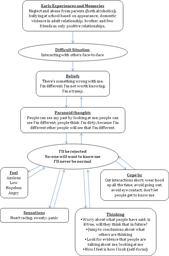
Over the three assessment sessions information was gathered and developed collaboratively into a formulation which fitted the cognitive model of paranoia (Newman-Taylor and Stopa, Reference Newman-Taylor and Stopa2013). The most recent formulation is shown in Fig. 1 and represents the understanding that Anna found most helpful. As a result the boxes do not reflect exactly Newman-Taylor amd Stopa’s (Reference Newman-Taylor and Stopa2013) model, but reflect how Anna understood the formulation.
Diagrammatic formulation of Anna’s difficulties as used in therapy and to guide the treatment plan.

From the first session Anna was able to describe how her early experiences of abuse and neglect had shaped her negative self-beliefs. She commented how these had been reinforced by bullying at school where she was picked on for being poorly kempt. We explored how situations in which she has to interact with others face-to-face will trigger these negative self-beliefs (e.g. ‘I’m a tramp’) and result in paranoid thoughts about what others think of her. Anna described how she would expect to be rejected by others, and that she felt threatened by the sense of never fitting in.
Over the next assessment sessions (and throughout treatment) Anna and the therapist discovered how the expectation of rejection was being maintained by her thinking style, SSBs, feelings and sensations. Anna described how she would keep herself safe from being rejected by avoiding or cutting short interactions with others, wearing her hood up, avoiding eye contact and not letting people get to know her. She also discussed actively looking for evidence that fitted with the expectation of being rejected, jumping to conclusions about what others were thinking and worrying for hours about what people may have thought or said about her. We discussed how Anna became very hyper-aware of her appearance, concentrating on how she may have looked if anyone acknowledged her. Anna identified a link between her feelings of anxiety and hopelessness, and associated sensations, that they maintained the expectation that no-one would want to get to know her. In sketching out the formulation over the course of assessment and treatment Anna began to identify areas where she felt able to make changes: ‘I should try and put my hood down this week then’.
Intervention
Anna was seen for nine treatment sessions which were all 1 hour long. The sessions were delivered at a clinic based in a GP surgery local to Anna’s home and followed CBT for social anxiety (e.g. Clark et al., Reference Clark, Ehlers, Hackmann, McManus, Fennell, Grey, Waddington and Wild2006). All sessions began with agenda setting and included a review of homework and reflection on Anna’s experiences in the past week.
Sessions 1 – 3. Assessment sessions.
Session 4. Exploring the formulation together and gaining a better understanding of Anna’s SSBs. The metaphor of ‘comfort blankets’ was used to consider the range of SSBs that Anna was using. How Anna was feeling in-session was used to explore self-focus, resulting in her thinking that ‘I feel anxious so I must look anxious’ and ‘I feel like a tramp so I must look like a tramp’, etc. A brief exercise on changing the focus of attention (Clark et al., Reference Clark, Ehlers, Hackmann, McManus, Fennell, Grey, Waddington and Wild2006) was completed and Anna rated her anxiety as lower when her attention was focused externally.
Session 5. Video and written feedback task to restructure Anna’s distorted self-image (Harvey et al., Reference Harvey, Clark, Ehlers and Rapee2000; Leigh and Clark, Reference Leigh and Clark2016) with feedback from the stooge on her interaction with Anna. The task was conducted twice, firstly with Anna focusing her attention internally and secondly with her focusing externally. Unfortunately due to a technological issue, the video recorder did not successfully record this session. Anna reviewed her predictions and found that external focus resulted in reduced anxiety and improved performance.
Session 6. The task from session 2 was reviewed by looking at the written feedback from the stooge. The stooge’s feedback contradicted Anna’s predictions on what she would think of her. The formulation sketch was looked at to reference the way Anna’s predictions impact negatively on her by maintaining her beliefs further.
Session 7. Training in externally focused attention using progressively more challenging situations (Leigh and Clark, Reference Leigh and Clark2016) which Anna then continued to practise over the following week.
Session 8. Specific unhelpful belief identified that ‘others decide whether someone is worth knowing based on their appearance’ and survey designed collaboratively (Clark et al., Reference Clark, Ehlers, Hackmann, McManus, Fennell, Grey, Waddington and Wild2006) based on this. This was then fed back at the start of session 6 with the formulation supporting discussion around how Anna may have developed an unhelpful belief around how other people decide whether someone is worth knowing.
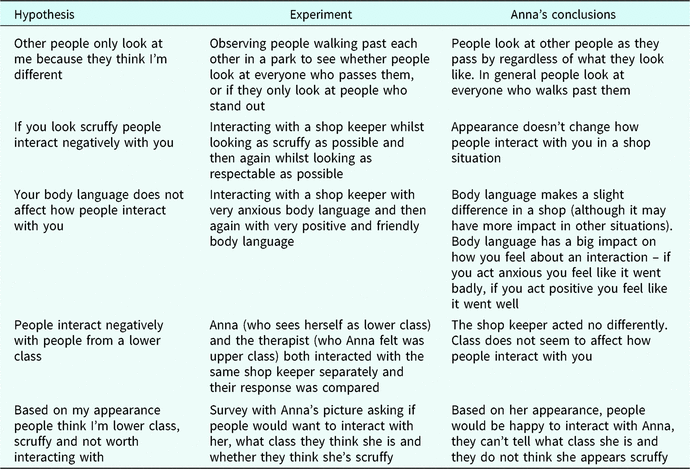
Sessions 9–12. Behavioural experiments designed collaboratively to test out beliefs around specific anxiety-provoking situations (Clark et al., Reference Clark, Ehlers, Hackmann, McManus, Fennell, Grey, Waddington and Wild2006). These were completed either during the session or between sessions by Anna (see Table 1). Session 9 was also used to review and reflect on the therapy as a whole. Anna discussed feeling that the sessions had been helpful in helping her meet her short-term goals, but that she would need to work hard to continue challenging her thinking and increase her levels of interaction with others.
Examples of behavioural experiments designed and completed by Anna

Results
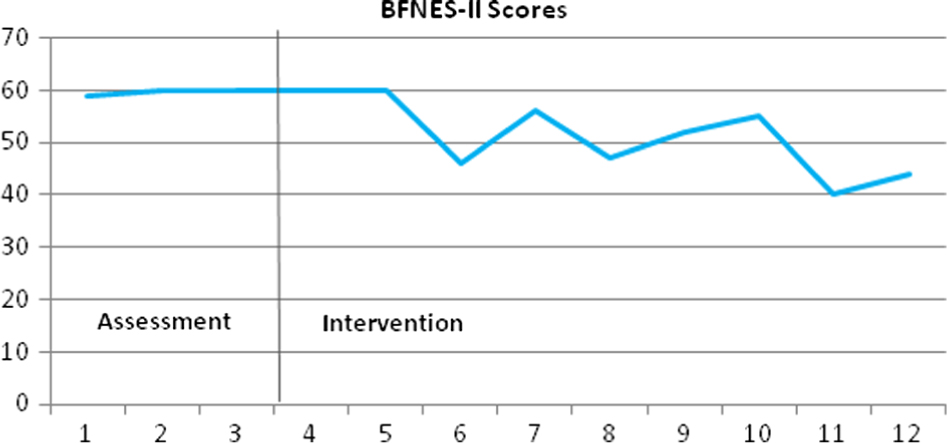
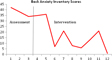
As shown in Fig. 2, Anna’s scores on the BFNES-II were stable across the baseline period and then reduced from 59/60 to 45/60 during intervention, suggesting a reduction in her fear of negative evaluation (the content of her paranoid thoughts). Her scores on the BAI reduced from 42/63 to 1/63, indicating a reduction in anxiety from severe to normal/mild (see Fig. 3).
Graph showing Anna’s scores on the BFNES-II over the course of assessment and intervention sessions.

Graph showing Anna’s scores on the BAI over the course of assessment and intervention sessions.

There was a noticeable reduction in both anxiety and fear of negative evaluation after sessions 5 and 7 (see Figs. 2 and 3). It may be that this reduction is as a result of those sessions both illustrating the impact of an external focus of attention. Both sessions may have helped Anna focus her attention on the outside world which then provided evidence against her paranoid thoughts.
Total scores on the CORE-OM reduced from 3.03 to 1.88, with the sub-scores of functioning and risk showing clinically significant change from the first to the last session and the areas of wellbeing, problems and risk moving from above to below the clinical means (see Table 2). Anna reported that over the course of the intervention she had met her short-term goal of reducing anxiety and had felt able to increase her frequency and intensity of interaction with others in situations outside of the sessions. She was also working towards her long-term goal of getting a job by arranging volunteer work with the support of her care coordinator.
A comparison of Anna’s CORE-OM scores at session 1 and session 12

Discussion
This paper illustrates the use of a clinical model of the maintenance of paranoia (Newman-Taylor and Stopa, Reference Newman-Taylor and Stopa2013) followed by CBT for social anxiety (Clark, Reference Clark, Crozier and Alden2005) in a case where social anxiety processes appear to be maintaining paranoid thoughts around negative evaluation from others. Using this approach, levels of anxiety reached non-clinical levels, fear of negative evaluation began to reduce and improvement in overall wellbeing occurred.
Previous research has suggested that both paranoia and social anxiety have in common an anticipation of threat alongside certain cognitive biases and a poor self-concept (e.g. Freeman, Reference Freeman2016); however, they differ in the nature of the perceived threat (e.g. Newman-Taylor and Stopa, Reference Newman-Taylor and Stopa2013). This case supports Freeman et al. (Reference Freeman, Waller, Harpur-Lewis, Moore, Garety, Bebbington, Kuipers, Emsly, Dunn, Fowler and Jolley2015) suggestion that methods used in CBT for social anxiety can be used to reduce anxiety and the distress associated with paranoid thoughts, and supports Newman-Taylor and Stopa’s (Reference Newman-Taylor and Stopa2013) clinical model of the maintenance of paranoia as a useful formulation tool.
Clinical implications
Using CBT for social anxiety (e.g. Clark, Reference Clark, Crozier and Alden2005) may be a useful intervention in cases where individuals are experiencing paranoid thoughts relating to interpersonal threat. The intervention was adapted to the specific thoughts and beliefs held in Anna’s case; however, the approaches used (e.g. self-focus experiments, attention training and behavioural experiments) would appear to be effective despite the beliefs being different in content to those commonly held in individuals presenting with social anxiety.
Anxiety has been suggested as occurring when the perceived probability and awfulness of the situation outweigh beliefs about coping and resources (Beck et al., Reference Beck, Emery and Greenberg1985). The majority of behavioural experiments in this case challenged Anna’s perceived probability of negative evaluation. It would be interesting to explore in further research whether focusing on challenging beliefs about awfulness, coping or resources – or a balanced combination of all of the above – may result in even more positive changes through therapy.
Due to the nature of a single case experimental design it is not possible to draw definitive conclusions as to whether CBT for social anxiety guided by a cognitive model of paranoia is an effective treatment for individuals where social anxiety processes appear to be maintaining paranoid thoughts. In this specific case, the cognitive model of paranoia fitted with Anna’s described experiences and this was found as acceptable by both Anna and the therapist as a helpful way to understand Anna’s difficulties and guide treatment. Working with the model guided Anna and the therapist towards treatment involving changes in attention, SSBs and methods to challenge unhelpful beliefs, all of which are included in CBT for social anxiety (Clark, Reference Clark, Crozier and Alden2005). Based on the results of this study, further research into using this as a treatment approach is warranted.
Limitations
In this case the level of harm anticipated was not severe; therefore it is not clear whether this approach would be suitable with individuals who may be anticipating a more severe threat to life as illustrated at the top of Freeman’s (Reference Freeman2007) paranoia hierarchy.
Poor self-concept is described as a key feature of both social anxiety (Ritter et al., Reference Ritter, Ertel, Beil, Steffens and Stangier2013) and paranoia (Tiernan et al., Reference Tiernan, Tracey and Shannon2014). It is not clear from this case whether an intervention targeting beliefs of the self (e.g. CBT for self-esteem) would have also resulted in changes for Anna.
No follow-up data were collected for this case; therefore it is not clear whether the reduction in anxiety and fear of negative evaluation will be maintained in the long term.
Personal reflections
The formulation was developed fairly quickly through discussion and Socratic questioning and it was noted privately by the therapist how similar this was to Newman-Taylor and Stopa’s (Reference Newman-Taylor and Stopa2013) cognitive model of paranoia. On reflection, sharing this model with Anna may have helped give her a sense of her difficulties being understood more widely than just within the therapist–client relationship. I felt that collaboration could have been improved as I was too focused on trying to appear as an ‘expert’.
The treatment chosen was guided by collaborative decision making on what areas of the formulation could be areas of potential change. As Anna picked out aspects such as changing SSBs and ‘not jumping to conclusions’ it was felt that CBT for social anxiety may be appropriate; however, more time could have been spent exploring the evidence base and discussing this with Anna as another source of guidance beyond her formulation.
Acknowledgements
The author would like to thank Anna for consenting to this article. Thanks also to the author’s supervisors who contributed to the understanding of this case.
Ethical statement
The name used in this report has been changed to maintain confidentiality. The client who is the subject of this case study gave consent for this case report. The author has abided by the Ethical Principles of Psychologists and the Code of Conduct as set out by the APA. Ethical approval was not needed for this case report.
Conflicts of interest
The author has no conflicts of interest with respect to this publication.
Financial support
This research received no specific grant from any funding agency, commercial or not-for-profit sectors.
Key practice points
(1) Social anxiety and paranoia share similar underlying processes.
(2) A cognitive model of paranoia based on the cognitive model of social anxiety can usefully be used to guide treatment with an individual with paranoia.
(3) CBT for social anxiety may be an effective intervention for individuals with paranoia, supporting a reduction in both anxiety and the distress associated with paranoid thoughts.
(4) Further research is warranted on whether CBT for social anxiety is effective for paranoia as the results of this study cannot be generalized beyond this single case.




Comments
No Comments have been published for this article.