Introduction
Hurricane Dorian’s devastation of The Bahamas in September 2019 (GLIDE TC-2019-000099-BHS) resulted in at least 74 deaths and exposed critical vulnerabilities in health care information infrastructure.Reference Latto, Hagen and Berg 1 The Category 5 storm destroyed medical records at the Rand Memorial Hospital and clinics throughout Grand Bahama and Abaco. Decades of patient documentation were permanently lost to flooding and wind damage. 2 As a community medicine physician working in Grand Bahama and a Hurricane Dorian survivor, the author witnessed firsthand the clinical consequences of this information loss. Providers treating displaced patients faced dangerous uncertainties: diabetic patients requiring insulin without documentation of usual regimens, patients with chronic conditions but no record of medications, and documented allergies unavailable to prevent contraindicated prescriptions.
Following Hurricane Katrina (2005, GLIDE TC-2005-000144-USA), an estimated 164,000 patient records were lost,Reference Brodie, Weltzien and Altman 3 and 40% of evacuees with chronic diseases could not obtain medications because neither patients nor providers could remember regimens.Reference Brodie, Weltzien and Altman 3 Hospitals themselves faced parallel operational strain, as custodial institutions struggled to coordinate patient evacuation, transfer, and continuity of care under the same conditions that caused record loss.Reference Gray and Hebert 4 Hurricane Maria (2017, GLIDE TC-2017-000136-ATG) contributed to an estimated 2,975 excess deaths in Puerto Rico,Reference Kishore, Marqués and Mahmud 5 with disrupted health care services including lost medical records identified as significant contributing factors.Reference Santos-Burgoa, Sandberg and Suárez 6
Medical record loss creates immediate threats to patient safety. Patients with complex regimens face life-threatening risks when providers lack documentation.Reference Tomio and Sato 7 Post-Katrina emergency treatment facilities reported a substantial burden of visits for chronic disease exacerbations, with cardiovascular disease and diabetes among the most common preexisting conditions, reflecting the clinical consequences of disrupted routine care and lost records.Reference Sharma, Weiss and Young 8 The post-disaster period sees increased hospitalizations for chronic disease complications when providers cannot access baseline values or previous treatments.Reference Santos-Burgoa, Sandberg and Suárez 6 , Reference Zhong, Clark and Hou 9
Current electronic medical record (EMR) systems, while beneficial for routine care,Reference Menachemi and Collum 10 typically employ centralized architectures that create a single point of failure at the facility level: when a local server is damaged, its records are lost with no independently functioning copy elsewhere. When hurricanes damage primary facilities, patient information becomes inaccessible for weeks or months. In Grand Bahama, five of nine community clinics were completely destroyed along with decades’ worth of patient records. The paper-based medical records system at the hospital was also inaccessible when the facility was evacuated and damaged.
Post-Dorian attempts to establish a centralized database solution for Grand Bahama were hampered by 3 obstacles, identified through the author’s direct involvement in these efforts as a practicing physician in the affected facilities. First, intermittent post-storm connectivity prevented reliable real-time synchronization with a single central server. Second, the centralized model faced scalability limits as individual clinics attempted to reconnect once partially restored, since all traffic depended on one central point. Third, geographic constraints left outer-island facilities dependent on a single communication path to the capital, so damage anywhere along that path isolated them entirely. The architecture proposed here directly addresses each obstacle: a store-and-forward, delay-tolerant networking (DTN) model allows each node to continue operating and queue updates through intermittent connectivity rather than requiring a continuous link; a hub-and-spoke design in which every node retains a full, independently functioning local replica removes the scalability bottleneck of a single central server; and tiered synchronization combined with autonomous per-site operation ensures outer-island facilities remain fully functional even when isolated from the capital, rather than depending on one connectivity path.
This study presents a distributed EMR architecture specifically designed for hurricane-prone regions, addressing the documented gap between clinical information needs during disasters and the vulnerability of current centralized systems.
Methods
Design Rationale and Development Process
This distributed EMR architecture was developed through a systematic yet pragmatic process drawing on multiple complementary information sources, with artificial intelligence (AI) assistance for manuscript preparation and technical concept development as described in the Acknowledgments section.
Personal experience as disaster survivor and practicing physician
As a community medicine physician working in Grand Bahama during Hurricane Dorian, the author directly experienced the destruction of decades of medical records at the author’s health care facility and witnessed the clinical consequences firsthand. In the weeks following Dorian, the author treated patients without access to their medication lists, allergies, or chronic disease histories, experiencing daily the safety concerns and treatment uncertainties that motivated this work. Of 9 community clinics in Grand Bahama, 5 were completely destroyed, taking with them irreplaceable patient documentation. This direct experience informed the system’s clinical priorities and design requirements.
Literature review
The author conducted a narrative review of published literature documenting medical record loss and clinical consequences during major hurricanes, including Katrina (2005) and Maria (2017), and reviewed literature on distributed database systems, health care information system resilience, and disaster medicine. This review revealed consistent patterns of preventable morbidity associated with information loss across multiple disaster events and provided a technical foundation for distributed architecture approaches.
Infrastructure assessment based on operational experience
Through work across multiple health care facilities in The Bahamas, the author assessed baseline infrastructure capabilities including telecommunications reliability, power system vulnerabilities, and limited information technology (IT) capacity typical of resource-constrained settings. This practical knowledge, gained through years of clinical practice, informed realistic design constraints that the system must accommodate.
Hurricane risk considerations
The author reviewed hurricane patterns affecting The Bahamas, informed by direct experience of Dorian and knowledge of historical storms, to inform optimal geographic distribution of data replication sites. The key insight, that replication partners must be unlikely to be simultaneously affected by single storm systems, was directly informed by observing how Dorian simultaneously devastated both Grand Bahama and Abaco, demonstrating the vulnerability of proximate backup sites. These 4 inputs: direct clinical experience, literature review, infrastructure assessment, and hurricane risk analysis, collectively shaped the design requirements and architecture presented in Results.
Cost Analysis Methodology
Implementation costs were estimated using 2024 market pricing. Hardware costs were calculated by specifying the number of units and unit price for each site category. Hardware is provisioned at the regional/island-hub level (approximately 12 domestic nodes: Nassau, Grand Bahama, Abaco, and 1 hub per remaining Family Island grouping) rather than at each individual clinic; smaller community clinics within a given island connect to their nearest hub node over a local area network rather than hosting independent server hardware. Each primary domestic site (Nassau, Grand Bahama, Abaco, and the Family Island clinics) requires 1 enterprise-grade database server at an estimated unit cost of $8,000-$12,000, yielding an aggregate hardware cost of approximately $120,000 across all domestic nodes. Networking equipment (managed switches, virtual private network (VPN)-capable routers, and uninterruptible power supply units (UPS)) was estimated at $5,000-$8,000 per site, for an aggregate of approximately $75,000. The Miami external backup facility, using co-location data center services rather than owned hardware, was estimated at $15,000 annually for rack space, power, and connectivity. Initial implementation and configuration services, database installation, replication configuration, and testing, were estimated at $80,000 based on consultant day-rate benchmarks for the Caribbean region.
Training costs were estimated for 3 personnel categories: (1) clinical end users requiring basic EMR operation training (approximately 150 personnel across all facilities, 8 hours per person at $15 per training hour = $18,000); (2) facility-level IT coordinators requiring database monitoring and backup verification training (approximately 20 personnel, 40 hours each at $40 per training hour = $32,000); and (3) central IT personnel requiring advanced distributed-systems training (approximately 5 personnel, 80 hours each at $60 per training hour = $24,000). Total training cost is estimated at approximately $74,000 for initial implementation, with annual refresher costs of approximately $10,000. These estimates are broadly consistent with reported EHR training cost ranges for clinical and technical staff in comparable low-resource implementation contexts.Reference Bostan, Johnson and Jaspersen 11
Operational costs include annual telecommunications circuits between domestic sites ($60,000), Miami co-location fees ($15,000), maintenance contracts ($25,000), and ongoing technical support ($35,000), totaling approximately $135,000 annually, or $675,000 over 5 years. Software costs include PostgreSQL database licensing (open source, no licensing fee), synchronization tooling ($20,000 initial), and monitoring software ($5,000 annually). Total 5-year implementation cost is $1,975,000, as presented in Table 3. These figures represent order-of-magnitude feasibility estimates rather than precise budget projections, and should be refined through formal procurement processes before implementation. The analysis assumes a 5-year implementation timeline for The Bahamas’ population of approximately 400,000 residents.
Results
System Architecture and Implementation
Applying the design rationale above, the resulting architecture employs a hub-and-spoke design with bidirectional synchronization (Figure 1). Unlike a conventional centralized system, no single node, including the central repository, holds the only complete copy of the database; every domestic hub site and the external backup site each retain a full, independently functioning local replica.
Distributed EMR architecture showing full local replication at every node. Each domestic hub site (Nassau, Grand Bahama, Abaco, and the Family Islands) and the external Miami backup maintains a complete, independently functioning local replica of the patient record database, synchronized bidirectionally with a central repository that serves a coordination and monitoring role rather than acting as the system’s only complete copy. This design eliminates the single point of failure inherent in a conventional centralized database: if any one hub site, including the central repository itself, is destroyed, every remaining hub site retains full, independent access to patient records.

Figure 1. Long description
A central repository node is positioned at the heart of the diagram. It contains a cylinder icon labeled Central Repository (Database I — Full Copy). Below it, a mathematical expression states: A plus B plus C plus D plus E plus F plus G plus H equals Database I (replicated at all nodes).
Five peripheral nodes surround the center, each containing computer monitor icons and a cylinder icon labeled Local D B — Full Copy of Database I. Bidirectional arrows connect each peripheral node to the center. Dark blue arrows pointing outward are labeled Replication O U T (Database I distributed). Teal arrows pointing inward are labeled Local updates synced.
* Top-Left: Location 1 (Nassau) containing monitors A and B.
* Top-Right: Location 2 (Grand Bahama) containing monitors C, D, and E.
* Bottom-Right: Location 4 (Family Islands) containing monitors G and H.
* Bottom-Left: Location 3 (Abaco) containing monitor F.
* Bottom-Center: Miami External Backup containing a local database copy.
A legend in the bottom-right corner confirms the arrow meanings: dark blue for Replication O U T and teal for Local updates synced.
Each health care hub site maintains a full local replica synchronized bidirectionally with the central repository and, through it, with every other hub site. Database capacity at each site (Table 1) substantially exceeds the storage footprint of text-based EMR data for its population, providing ample margin for full-system replication as the network grows. This geographic redundancy means that if any location is destroyed (as occurred in Grand Bahama during Hurricane Dorian), patient records remain accessible at every other location.
Geographic distribution of distributed EMR system for the Bahamas

Table 1. Long description
The table contains five columns and five data rows.
* Row 1: Location is Nassau (Princess Margaret Hospital); Primary population is approximately 275,000 (70 percent); Database capacity is 10 T B; Replication partners are All locations plus external; Hurricane risk is Moderate.
* Row 2: Location is Grand Bahama (Rand Memorial); Primary population is approximately 60,000 (15 percent); Database capacity is 3 T B; Replication partners are Nassau, Abaco, external; Hurricane risk is High.
* Row 3: Location is Abaco (Reconstruction); Primary population is approximately 17,000 (4 percent); Database capacity is 2 T B; Replication partners are Grand Bahama, Nassau, external; Hurricane risk is High.
* Row 4: Location is Family Islands (distributed); Primary population is approximately 40,000 (10 percent); Database capacity is 2 T B each; Replication partners are Nassau, external; Hurricane risk is Variable.
* Row 5: Location is Miami, F L (external backup); Primary population is N / A (backup only); Database capacity is 15 T B; Replication partners are All Bahamas locations; Hurricane risk is Moderate (correlated risk; selected for infrastructure capacity—see External Backup Site Selection).
Note: Listed database capacities substantially exceed the storage footprint of text-based EMR data and provide margin for full-system replication at every hub site. The Bahamas’ broader network of approximately 75 community clinics is served by these approximately 12 replication hub sites; not every individual clinic hosts independent database hardware.
The architecture satisfies 4 design requirements.
Geographic Distribution places primary domestic sites in Nassau (Princess Margaret Hospital), Grand Bahama (Rand Memorial Hospital), and the reconstructed Abaco facility, supplemented by an external backup in Miami, Florida; while Miami shares some hurricane exposure with The Bahamas (see External Backup Site Selection in Discussion), this distribution ensures that no single storm system can simultaneously destroy every replication node.
Autonomous Operation allows each site to function independently when isolated, continuing clinical operations on locally stored records without external connectivity.
Tiered Synchronization prioritizes critical information—active medications, allergies, and recent visits—when bandwidth is limited, so essential safety data remains accessible even under degraded conditions.
Conflict Resolution is handled through conflict-free replicated data types (CRDTs),Reference Shapiro, Preguica, Baquero, Défago, Petit and Villain 12 which resolve simultaneous updates at different sites and ensure data consistency once connectivity is restored.
Table 1 details the geographic distribution of system components across The Bahamas. The system employs PostgreSQL databases with built-in replication capabilities,Reference Austin, Sun and Lim 13 connected via encrypted VPN tunnels over existing telecommunications infrastructure. Each facility operates a local database server containing a full replica, synchronized with partner sites during normal operations; the hub-and-spoke architecture centers on Nassau’s Princess Margaret Hospital, which serves as the primary coordination node while maintaining full autonomous capabilities at each spoke location.
When connectivity is disrupted, local databases continue serving their patient populations while queuing updates for transmission once connectivity is restored, applying established conflict-resolution protocols from distributed systems theory to ensure data consistency when multiple sites update patient records simultaneously.
Resilience Comparison
Table 2 compares the proposed distributed architecture with existing approaches to EMR disaster resilience. Traditional backup/recovery systems require weeks to months for restoration and provide no access during disasters. Cloud-based solutions depend on connectivity, which is frequently disrupted during hurricanes. The distributed architecture provides immediate access to critical patient information and supports continued clinical operations under degraded conditions.
Comparison of EMR disaster resilience approaches

Table 2. Long description
The table consists of six columns and four rows including the header.
Column headers from left to right are: Approach, Single point of failure, Data access during disaster, Recovery time, Initial cost, and Autonomy.
Row 1: Proposed Distributed Architecture. Single point of failure: No. Data access during disaster: Immediate. Recovery time: Hours. Initial cost: Moderate. Autonomy: High.
Row 2: Traditional Backup forward slash Recovery. Single point of failure: Yes. Data access during disaster: None. Recovery time: Weeks-months. Initial cost: Low. Autonomy: Low.
Row 3: Cloud-Based (A W S or Azure). Single point of failure: No. Data access during disaster: Depends on connectivity. Recovery time: Days. Initial cost: Low-moderate. Autonomy: Low.
Cost-Benefit Analysis
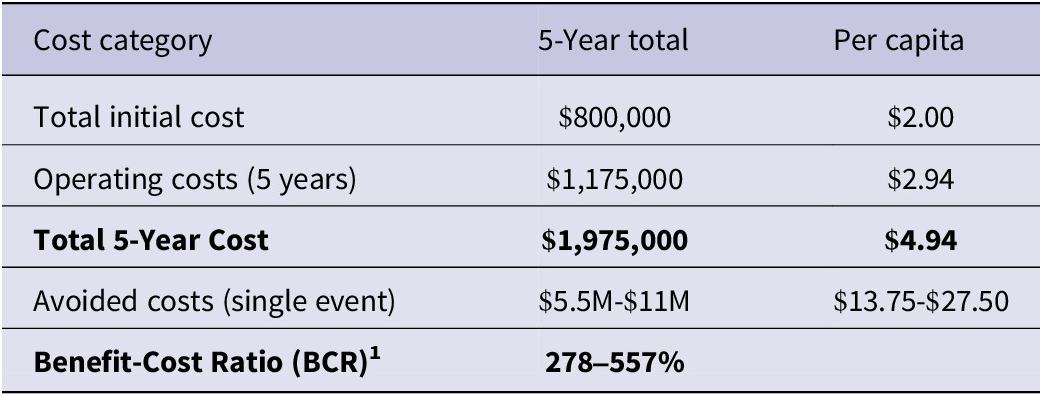
Implementation costs total $1,975,000 over 5 years for The Bahamas, equivalent to $4.94 per capita (Table 3; full cost derivation in Methods). This compares favorably with estimated costs of preventable complications ($5.5-$11 million) and record reconstruction ($0.5-$1 million) from a single major hurricane event. The estimated benefit-cost ratio ranges from 278% to 557%; that is, avoided costs from a single major hurricane event are estimated at 2.8 to 5.6 times the total implementation cost, demonstrating strong economic justification for implementation; see Budget Proportionality in the Discussion for how this cost compares to national health expenditure.
Cost-benefit analysis for the Bahamas implementation

Table 3. Long description
The table consists of three columns: Cost category, 5-Year total, and Per capita.
* Row 1: Total initial cost is $800,000 total and $2.00 per capita.
* Row 2: Operating costs for 5 years are $1,175,000 total and $2.94 per capita.
* Row 3: Total 5-Year Cost is $1,975,000 total and $4.94 per capita.
* Row 4: Avoided costs for a single event range from $5.5M to $11M total, and $13.75 to $27.50 per capita.
* Row 5: Benefit-Cost Ratio B C R is 278 to 557 percent.
1BCR = benefit-cost ratio, calculated as avoided costs ÷ total implementation cost, expressed as a percentage. This reflects avoided costs relative to total investment and does not net out the initial investment (i.e., it is not a return-on-investment figure).
Avoided-cost calculations are based on documented post-hurricane health care expenses from Katrina and Maria events, adjusted for Bahamian population and health care costs, consistent with documented economic impacts of hurricane-related evacuation and operational disruption in other coastal hospital settings.Reference Desai, Gordon and Harris 14 Preventable complications include emergency department visits for medication interruptions, hospitalizations for uncontrolled chronic diseases, and adverse drug events from unknown allergies. Record reconstruction costs include staff time for data re-entry, patient interviews for medication reconciliation, and system downtime during recovery operations.
Discussion
This distributed EMR architecture addresses a critical gap in health care system resilience for hurricane-prone regions. By maintaining patient information accessibility during and after catastrophic events, the system directly targets documented causes of preventable morbidity in post-disaster settings.
Clinical Impact and Patient Safety
The immediate availability of medication lists, allergies, and recent clinical encounters addresses the most critical information needs during disaster response. Post-Katrina studies documented that 40% of evacuees could not obtain necessary medications due to lost records.Reference Brodie, Weltzien and Altman 3 Similar scenarios occurred throughout The Bahamas following Dorian, where providers treating displaced patients faced dangerous uncertainties about chronic conditions and medications. In Grand Bahama, emergency shelters housed diabetes patients whose insulin regimens were unknown, hypertensive patients without documentation of current medications, and elderly patients with complex pharmaceutical interactions but no accessible medication reconciliation. The distributed architecture ensures this essential information remains accessible even when primary facilities are destroyed.
Technical Feasibility and Infrastructure Requirements
The proposed system leverages existing telecommunications infrastructure while acknowledging the realities of resource-constrained health care environments. Database replication technology for health care records is well established: PostgreSQL has been used as the foundation of a full electronic health record server implementation,Reference Austin, Sun and Lim 13 and its built-in streaming replication provides the technical foundation for the bidirectional synchronization proposed here. Large-scale health IT investments have demonstrated measurable returns in comparable public-sector health systems, such as the U.S. Department of Veterans Affairs,Reference Byrne, Mercincavage and Pan 15 supporting the feasibility of the investment case presented here. As a design specification rather than a field-validated measurement, the system is designed around approximately 100 Mbps baseline connectivity for near-real-time synchronization, degrading gracefully to store-and-forward operation when bandwidth is limited.
Power requirements are modest: UPS systems and backup generators sized for 72-96 hours of autonomous operation per site (approximately 5 kW), well within standard hospital emergency power capabilities, since database servers draw far less power than imaging equipment or clinical devices.
Patient data protection is designed around encryption in transit and, where implemented, encryption at rest, together with role-based access controls consistent with internationally recognized health care information security practices. The Health Insurance Portability and Accountability Act (HIPAA) itself is a United States regulatory framework and has no direct jurisdiction in The Bahamas; the design instead aims for HIPAA-equivalent protections such as encryption, access controls, and breach accountability comparable to those required internationally under frameworks such as the European Union’s General Data Protection Regulation (GDPR), as a familiar benchmark for reviewers.Reference Conduah, Ofoe and Siaw-Marfo 16 The Miami backup facility would operate under data processing agreements intended to preserve Bahamian regulatory jurisdiction over patient information.
Implementation Considerations
Successful implementation requires coordination between government health authorities, health care facilities, and telecommunications providers. A phased rollout with Nassau and Grand Bahama first, then Abaco and the Family Islands, then the Miami external backup, allows operational testing before full deployment.
Training requirements focus on basic database operation and synchronization monitoring rather than complex technical administration. Clinical staff require minimal additional training beyond standard EMR operation, as the distributed architecture operates transparently during normal conditions. IT personnel need training in database monitoring, backup verification, and disaster recovery procedures; the experience of nurse informaticists supporting EHR implementation in other resource-limited settings underscores the practical value of this kind of dedicated, locally based technical support role.Reference Asif and Khan 17 The system includes automated monitoring and alerting capabilities to minimize manual oversight requirements.
Regulatory considerations include data protection compliance and cross-border data storage agreements for the Miami facility. Open-source EHR implementations in resource-limited settings also face recurring socioenvironmental and organizational barriers beyond the purely technical,Reference Bostan, Johnson and Jaspersen 11 relevant to phased rollout planning.
External Backup Site Selection
The selection of Miami as the external backup site warrants specific justification, since historical data show that South Florida and The Bahamas can be affected by the same storm system. The 1926 Great Miami Hurricane, one of the most intense United States landfalling hurricanes on record, tracked through the Bahamas, passing near Bimini and Andros at major-hurricane intensity before striking Miami directly the next day.Reference Blake, Landsea and Gibney 18 , Reference Landsea, Feuer and Hagen 19 More recently, Hurricane Irma (2017) caused significant damage across both the southern Bahamas and Miami-Dade County within the same event.Reference Cangialosi, Latto and Berg 20 Miami is therefore not categorically low-risk for correlated hurricane impact, and Table 1 reflects this as “Moderate (correlated risk).”
Miami’s selection is instead justified on infrastructure capacity grounds: the availability of enterprise-grade data center facilities with redundant power and cooling systems, established cross-border health care data processing relationships between Bahamian and Florida institutions, and a demonstrated capacity to function as a disaster relief coordination hub, as occurred during Hurricane Dorian, when Miami served as a primary staging area for international assistance to The Bahamas while the domestic health care system remained disabled. Systems implementing this architecture elsewhere should evaluate whether a more geographically distant backup site, such as an inland data center or a geographically distributed cloud-replication service, would provide superior resilience against simultaneous-impact events. The fundamental requirement is that the external backup site possess sufficient geographic and infrastructural independence to survive events that simultaneously affect all domestic nodes.
Budget Proportionality and Financial Feasibility
The total 5-year implementation cost of $1,975,000 should be considered against The Bahamas’ national health expenditure. Current health expenditure per capita in The Bahamas was $2,262 in 2023, the most recent year available in the World Bank/WHO Global Health Expenditure Database. 21 For a population of approximately 400,000, this implies national health expenditure on the order of $900 million annually, or roughly $4.6 billion over a 5-year period. The proposed system’s 5-year cost therefore represents on the order of 0.04% of projected national health expenditure over the same period, a modest proportional investment relative to the scale of potential avoided costs from a single major hurricane event (estimated at $5.5-$11 million per event, representing avoided costs several times the total implementation cost).
This proportional analysis suggests the 5-year implementation cost is unlikely to represent a prohibitive fiscal challenge in aggregate. However, the upfront capital expenditure of $800,000 may present a more immediate budgetary constraint than the annual operating costs, and would likely need to be phased or externally supported (for example through PAHO or Caribbean Development Bank mechanisms) rather than funded from a single fiscal year’s domestic health budget.
Broader Applications
While designed for The Bahamas, this architecture has broad applicability to other small island states and hurricane-prone regions. Similar challenges of geographic isolation, limited infrastructure, and hurricane exposure affect many Caribbean and Pacific Island nations. Climate-adaptation case studies of health facilities across the Caribbean similarly emphasize the need for continuity of health services during extreme weather events,Reference Lichtveld, Hospedales and Davenport 22 and the burden of chronic disease management after Caribbean hurricanes further underscores the value of preserved medication and encounter records specifically.Reference Hassan, Nguyen and Buchanan 23 The Eastern Caribbean, with its distributed population across multiple islands and frequent hurricane exposure, represents an ideal candidate for similar implementation. Pacific island nations facing typhoon risks could adapt the architecture to address similar vulnerabilities.
The architecture’s core principles also extend beyond hurricanes to other hazards that can destroy centralized, facility-based health records, including earthquakes and volcanic eruptions. A recent analysis of post-disaster recovery across the Caribbean, spanning storms, earthquakes, and volcanic eruptions across Antigua and Barbuda, The Bahamas, Dominica, Guyana, Jamaica, and Saint Vincent and the Grenadines, found common recovery challenges across hazard types, supporting the broader applicability of a geographically distributed, autonomous-operation health information architecture rather than one designed for hurricanes alone.Reference Jones, Doughorty and Brown 24 Wildfires pose a similar threat outside small island contexts: the 2018 Camp Fire in Paradise, California, destroyed the town’s only hospital, illustrating how wildland–urban interface fires can eliminate local health care infrastructure with little warning.Reference Schulze, Fischer and Hamideh 25
Limitations
This design represents one approach to distributed EMR architecture and has not been implemented or tested in an operational setting. Cost estimates are based on current market pricing and may vary with implementation specifics and local procurement realities. The system requires reliable local power generation and basic telecommunications infrastructure, which may not be available in all resource-constrained settings.
As a single-author analysis informed by personal experience, this work would benefit from multi-stakeholder input and formal systematic review of disaster medicine literature. The methodology, while grounded in practical experience and literature review, represents a narrative rather than systematic approach to evidence synthesis. Implementation would require extensive testing, regulatory approval, and coordination across multiple health care organizations.
The proposed architecture assumes basic telecommunications connectivity for synchronization, which may be intermittent or unavailable in some settings. While the system is designed to function autonomously during outages, extended isolation periods could result in data fragmentation requiring manual reconciliation. Additionally, the system does not address all aspects of health care IT, focusing specifically on patient record accessibility rather than comprehensive hospital information system functionality.
Conclusions
Distributed EMR architectures represent a practical and economically viable approach to maintaining patient information accessibility during catastrophic hurricanes. By eliminating single points of failure and enabling continued clinical operations under degraded conditions, this approach directly addresses documented vulnerabilities that contribute to preventable morbidity in post-disaster settings.
For small island states facing regular hurricane threats, the proposed architecture provides a path toward health care system resilience that acknowledges both the clinical imperative for information access and the operational realities of resource-constrained settings. Implementation of such systems should be prioritized as an essential component of disaster preparedness infrastructure, comparable to emergency power systems and structural hardening measures.
This approach treats patient record accessibility as critical infrastructure deserving the same attention as emergency power and water systems. As climate change increases the frequency and intensity of extreme weather events, health care systems must evolve toward proactive resilience planning rather than reactive disaster response.
Acknowledgments
The author acknowledges the health care providers and patients of Grand Bahama who experienced Hurricane Dorian’s aftermath and whose resilience in the face of unprecedented challenges motivated this work. The author is grateful for the technical guidance provided by Claude (Anthropic), an AI assistant, whose capabilities were instrumental in developing the distributed architecture concepts, refining technical specifications, and manuscript preparation. The AI tool was used to generate portions of the manuscript text, analyze technical requirements, verify supporting references, and provide feedback on architectural design concepts. All AI-generated content was thoroughly reviewed, validated against clinical requirements, and integrated with the author’s professional experience and domain expertise.
Author contribution
As sole author, the author is responsible for all aspects of this work, including conceptualization, methodology, design rationale development, system design, cost analysis, literature review, manuscript writing, and final approval. The use of AI assistance was supervised and directed by the author, with all final decisions and content validation remaining the author’s responsibility.
Funding statement
This work received no external funding. System design and manuscript preparation were conducted independently by the author.
Competing interests
The author declares no conflicts of interest. The author is the sole developer of the proposed architecture and has no financial relationships with any technology vendors, database companies, or telecommunications providers.