INTRODUCTION
The earliest protohistoric sites of the late Holocene period in West Bengal in eastern India have been dated to the middle of the second millennium BCE using the conventional radiocarbon (14C) dating method. However, these dates are few and insufficiently represent more than 100 protohistoric sites in West Bengal region (Chattopadhyay et al. Reference Chattopadhyay, Sengupta and Chakrabarty2005). In India and also in West Bengal, archaeological sites are dated on the relative dates of artifacts, such as coins and in many cases, pottery. In this paper, we report the first 14C dates using accelerator mass spectrometry (AMS) from an archaeological site in the context of humid tropical coast of eastern India presently comprising of the district of east Medinipur, West Bengal (Figure 1). Niyogi (Reference Niyogi1970) described the geological history of this region as part of a paleo-delta of the Suvarnarekha river situated to the immediate west of the Ganga-Brahmaputra delta (GBD) stretching across India and Bangladesh. The application of the 14C dates from this region have cultural, historical as well as geo-archaeological implications. Previous geo-archaeological investigations have noted difficulties to ascertain the spatial and temporal evolution of the human settlements in the GBD in absence of absolute dating and the limitation of conventional radiocarbon chronology in the fluvial system wherein sediment organic carbon relationship remains suspect (Rajaguru et al. Reference Rajaguru, Deotare, Gangopadhyay, Sain and Panja2011). It has been argued in certain geoarchaeological research (Morley and Goldberg Reference Morley and Goldberg2017), that humid tropic and subtropics pose challenges to the archaeologists and geoarchaeologists because of the problem in preservation of materials such as bones, organic biomarkers, etc. They pointed the following problems: (i) the existence of rich biological life, which interferes with the archaeological sediments, (ii) monsoon rains and effects of running water, (iii) the high temperature and groundwater may affect diagenetic and taphonomic processes, and (iv) the formation of soil horizons may also impact upon the preservation of archaeological sites. Many of these problems are applicable also to the region referred to in this paper. Therefore, the wider scope of the paper pertains to the geoarchaeology of the coastal environment. Datable samples may be poorly preserved and prove a challenge for sample collection, particularly those located at considerable depth below the surface. Therefore, it is only through studies of multicultural sites with relatively shallow stratigraphy (2 m) that may be used to carefully collect samples from a section starting at the beginning of human occupation and ending at the top. This may not be possible for multicultural sites, which are in most cases, deeply stratified and human occupation may be several meters thick. Dated evolution of landscape during the mid-Holocene period in the Ganga Brahmaputra Delta has been published (Stanley and Hait Reference Stanley and Hait2000a, Reference Stanley and Hait2000b) but human adaptation to this landscape has not been properly investigated. The site of Erenda proves to be an ideal sample site for such an investigation.
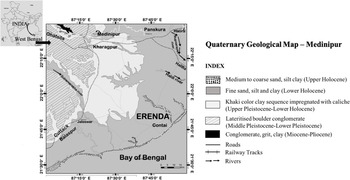
Geological location of Erenda, East Medinipur district, West Bengal, India (based on Quaternary Atlas of West Bengal, Medinipur Sheet).

The conventional samples collected for datable materials are charred remains of wood or twigs, which must have been used for either cooking or resulted from other thermal activities. For the charred remains however, two different spatial contexts have been differentiated, macro and micro (Boaretto Reference Boaretto2009). The macro contexts are those which are the visible archaeological stratum while the micro context is the overall landscape from where the sample has been drawn. The samples reported in this paper are from the macro context of archaeological stratum discussed in the next section.
A Short Summary of Excavations at Erenda
Erenda (21°55'4.8"N, 87°34'42.4"E), is located in the East Medinipur district on the margin of the GBD and in the transitional zone between the present littoral and interior alluvial uplands (Figure 1). This paleo-delta of the Suvarnarekha river developed in the regressive phase between ca. 10,000 and 6000 BP following transgression phase during the late Pleistocene and early Holocene, which was marked by a shift of the Bengal coastline several kilometers inland (Niyogi Reference Niyogi1970). The present coastline along West Bengal was attained about 6000 BP (Banerjee and Sen Reference Banerjee and Sen1987). The two lithological units on which the site is located are unoxidized sediments or unit II overlying Sijua formation and unit I corresponding to marine transgressive phase (Das et al. Reference Das, Gangopadhyay, Ghosh, Biswas, Bera, Ghosh, Paruya, Naskar, Mani, Kalpana and Yoshida2021; Quaternary Geological Atlas). Therefore, the unoxidized sediments are probably of the mid-late Holocene in age.
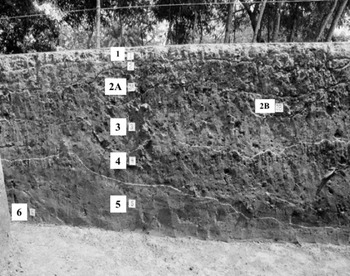
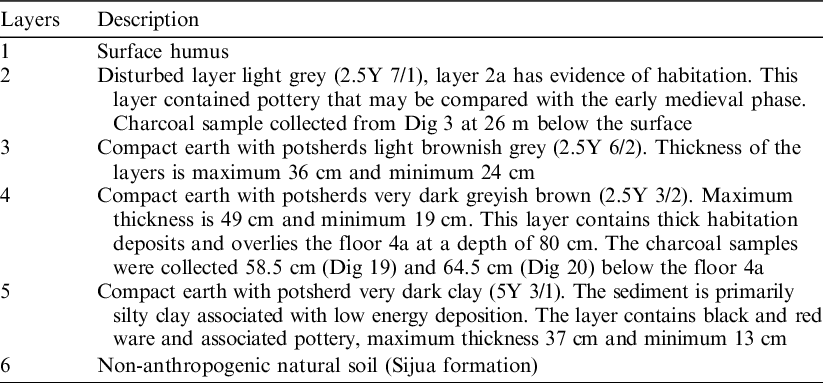
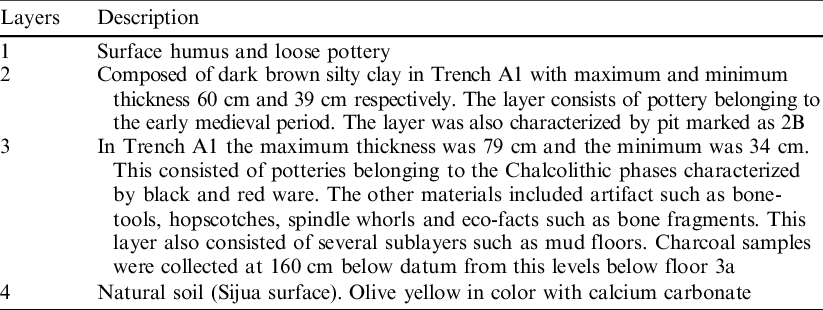
The extant area of the site of Erenda is about 900 m2 but it is estimated that more than 50% of the site had been destroyed due to cultivation. Three square trenches excavated were the trenches ZA1, A1, and A2, each measuring 5 × 5 m. In order to maintain a fixed record and compare the different units or layers in the stratigraphy, all the measurements of depth have been done after choosing a fixed point (datum point) assuming it to be 5 m above the present mean sea level, because the region lies below 10 m contour line in the India topographic sheet. In the present excavations, stratigraphic layers have been differentiated on the basis of the nature of sediments and archaeological objects. There were six layers in the trench ZA1 with layer 1 as the modern humus and layer 6 as the natural surface (Figure 2). The descriptions of each layer in Trench ZA1 have been provided in Table 1. Similarly, four layers were found in Trench A1 with layer 1 as the modern layer and layer 4 as the natural surface (Table 2)
Section of Trench ZA1, Erenda, showing all the layers (1–6).

Layer description of Trench ZA1 (based on Munsell soil color chart, 2000 edition).

Layer description of Trench A1.

As layers are in certain stratigraphically superimposed order, archaeological objects can be assigned a relative age based on the depth and the layers in which they are generally found. Following this principle, it is possible to suggest that the archaeological site of Erenda is in the same chronological bracket as with the unoxidized sediment layer (unit II) of the mid-late Holocene period. The anthropogenic sublayers or habitation floors are also of the same chronological brackets. Unit II would be contemporary or a slightly earlier than the first human settlement (ca. 3 ka BP). As mentioned above, initially excavated artifacts were studied and compared with that of other site with absolute dates and following this procedure, the authors could assign a relative date of the site.
These artifact pottery typologies aided us to relatively date the anthropogenic layer and sediments layers consisting of pottery to the protohistoric phase, which is dated from the middle of the second millennium BCE at the site of Mahisdal in Birbhum district of West Bengal with the help of conventional radiocarbon dating (Possehl Reference Possehl1994). However, the total deposit of the archaeological artifacts and features is 1 m and 60 cm thick (1.60 m); therefore, it was important to date from the lowest to the top of the archaeological deposit. The dates reported in this paper are the early dates of human settlements at this site.
Archaeological Contexts for Dating and Sample Collection
The samples for dating were collected from archaeological layers representing anthropogenic activity areas or “floors” with black and red ware pottery of the protohistoric period representing an early part of habitation when people may have resided in very rudimentary structures, which have now decomposed. These layers were rich in organic matter. The samples were charcoal fragments: bones and shells, indicating refuse areas from food consumption at or near that spot. Charcoals are suited for an understanding of changes in the stratigraphy (Reingruber and Thissen Reference Reingruber and Thissen2009). The stratigraphy is the most important observational aspect of developing the relative chronology of an archaeological site. Absolute dates, as provided by 14C from clear stratigraphic units, inform us about evolution and transformation of human culture vis-a-vis the environmental contexts of the culture in question. Charcoals were found from all the archaeological layers mentioned above but not from the layer of the Sijua as it was not under human occupation. The charcoal samples represented the entire archaeological sequence of a maximum of 1.60 m thickness. We have so far analyzed most samples from lower depths to ascertain the absolute temporal bracket of the earliest human habitation in the region.
EXPERIMENTAL
Chemical Treatment and AMS Measurement
After samples were collected, they were thoroughly cleared of debris and unwanted stones, pebbles, etc. Samples were air-dried, finely pulverised and kept for further experimentation. Sample preparation and AMS radiocarbon analysis were performed at the Inter University Accelerator Centre (IUAC) in New Delhi. 5 mg of segregated charcoal samples picked up from collected sediments was subjected to acid-base-acid (ABA) treatment prior to AMS measurement and combustion in oxygen environment (Nemec et al. Reference Nemec, Wacker, Hajdas and Gäggeler2010). ABA treatment included addition of 0.5 M HCl to sample, kept O/N in thermal shaker at 60°C followed by washing off HCl. Next, 0.1 M NaOH was added, kept in thermal shaker at 60°C for 1 hr. This step was repeated three times, after which 0.5 M HCl was again added and kept in a thermal shaker at 60°C for 1–2 hr. Finally, after thorough washing, all samples were kept for freeze-drying. Dried samples were combusted in automated graphitization equipment (AGE) and produced CO2 was purified and reduced to graphite involving hydrogen gas in the presence of catalyst Fe powder. Graphite powder was packed in a capsule and loaded in ion source of AMS instrument based on 500 kV Tandem ion accelerator. A precision of ∼1% (14C/12C) and background level of 1 × 10–15 was achieved by AMS radiocarbon analysis at IUAC (Sharma et al. Reference Sharma, Kumar, Ojha, Gargari and Chopra2020).
An OX II (oxalic acid) sample procured from NIST, USA, was used as reference material. Background values derived from blank samples during the measurement was 0.503 ± 0.0144 percentage modern carbon (pMC) and that corresponds to 14C/12C ratio (5.3698 ± 0.1536) × 10–15. Data quality was monitored with secondary standard sample (IAEA-C8). Its consensus value (pMC = 15.03 ± 0.17) was matching with its experimental result (pMC= 14.95 ± 0.09). Data were collected for about 30 min (in 10 runs) from each sample and obtained ratio of 14C/12C was background corrected, normalized to reference material and finally corrected for δ13C, which is considered to be (–25.00 ± 2.000)% for all the samples. To interpret the results, Libby age was calibrated to calendar age using online calculator Calib 8.2 (Reimer et al. Reference Reimer, Austin, Bard, Bayliss, Blackwell, Ramsey, Butzin, Cheng, Edwards, Friedrich, Grootes, Guilderson, Hajdas, Heaton, Hogg, Hughen, Kromer, Manning, Muscheler, Palmer, Pearson, van der Plicht, Reimer, Richards, Scott, Southon, Turney, Wacker, Adolphi, Büntgen, Capano, Fahrni, Fogtmann-Schulz, Friedrich, Köhler, Kudsk, Miyake, Olsen, Reinig, Sakamoto, Sookdeo and Talamo2020).
RESULTS
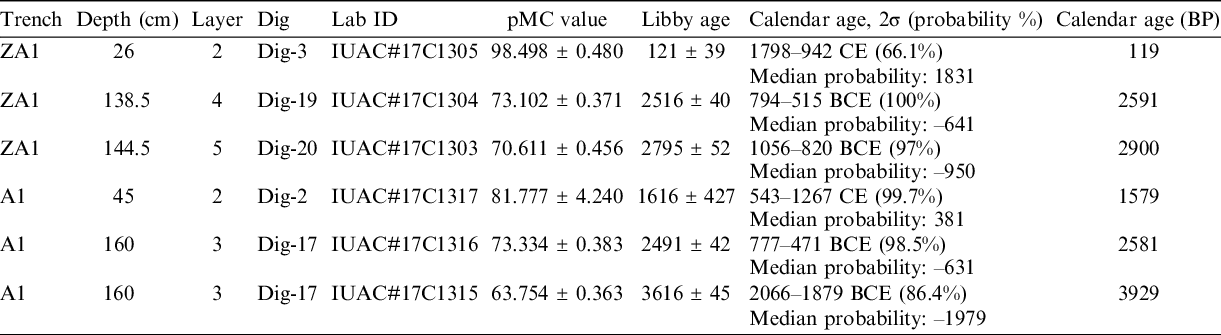
The Archaeological Chronologies (Table 3 ): Layers 2, 4, and 5 in the trench ZA1 have provided three dates: 119 BP, 2591 BP, and 2900 BP, respectively. The last two dates are associated with layers 4 and 5 at 138.5 and 144.5 cm below the datum. Therefore, layers 4 and 5 can be placed in the earliest cultural period (Pd I) at the site and can be labeled as the protohistoric phase. The date of 119 BP comes from a depth of 26 cm representing the modern period. Layers 2 and 3 from the trench A1 has also provided three calendar dates; 1579 BP, 2581 BP, and 3929 BP. The last date 3929 BP may be an outlier, as this date does not match the general stratigraphy. The last two dates are collected from a depth of 160 cm below datum and the date of 1579 BP was from a depth of 45 cm. The dates from layer 3 indicate that this period is earlier than 2500 BP, and generally associated with the protohistoric period. Layer 2 belongs to the historical period. Considering the earliest dates from both trenches, period I has been designated as a clear protohistoric period (>2500 BP).
Calendar ages obtained for different layers (by converting Libby age using Calib 8.2 software).

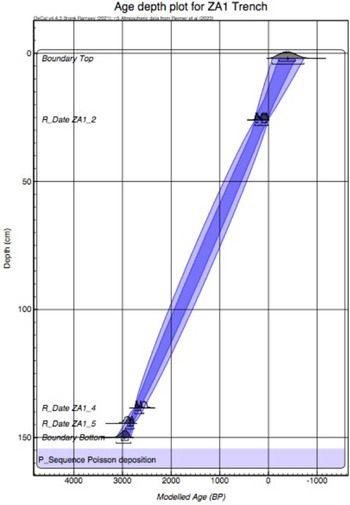
The significance of the dates reported by us in the paper from the site representing layers of period I and also period II strongly supports the fact that there was a continuation of human habitation (631–641 BCE). The graphical representation in the age-depth plot for trench ZA1 is shown in Figure 3. In cultural terms, the multicultural sites like Erenda provide a rather comprehensive perspective on continuation and fluctuation of human habitation in the humid coastal zone of eastern India for over two millennia. These dates provide the importance of the earliest village settlements in the region from the beginning of the first millennium BCE and also provide a datum to interpret the cultural and environmental proxies (Gangopadhyay et al. Reference Gangopadhyay, Halder and Chowdhury2017; Das et al. Reference Das, Gangopadhyay, Ghosh, Biswas, Bera, Ghosh, Paruya, Naskar, Mani, Kalpana and Yoshida2021).
Age-depth plot for Trench ZA1, Erenda.

The other dates from both A1 were from the upper levels (layer 2, dig 2) in period II, 381 CE (Table 3). This date also coheres well with archaeological materials including pottery. Therefore, calibrated radiocarbon dates prove equally important to identify a late historical and early medieval phase at this site and ratifies the conclusion made on the basis of archaeological artifacts.
DISCUSSION
The Material Culture Transition
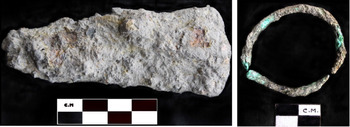
The protohistoric phases at the site of Erenda are now clearly divided into two cultural phases; the earliest dates of which are between ∼950–631 BCE and can be placed within the overall “Chalcolithic” and Iron age phase of Eastern India. The continuity of this cultural phase is supported from similar archaeological materials, which have been found in stratigraphic layers of 5 and 4, Trench ZA 1, and layer 3, Trench A1. There are series of floors, use of metal and continuation of the pottery craft along with use of bone tools for subsistence and also other domestic purpose works. Small terracotta spindle whorls indicate the use of spun cotton and/or existence of a fishing community. The two metal objects found from the upper levels of this protohistoric phase are an iron chisel and a copper ring (Figure 4). The inhabitants produced simple, mostly handmade pottery, known as the black and red ware, along with ceramics ranging from red, buff, grey, and black ware. The people lived in simple wattle and daub houses and also engaged in subsistence activities of fishing and farming in a humid tropical climatic context (Das et al. Reference Das, Gangopadhyay, Ghosh, Biswas, Bera, Ghosh, Paruya, Naskar, Mani, Kalpana and Yoshida2021). These dates provide an opportunity to compare the site with similar sites in Eastern India.
Photographs of iron chisel and copper ring obtained from the site of Erenda.

West Bengal, which geographically corresponds to the lower Ganga valley, was possibly affected by the development of a protohistoric phase in the middle Ganga valley in the second millennium BCE and this led to the development of sedentary settlements with pottery such as the black and red ware, black slipped ware, red and grey wares. Archaeological excavations at the protohistoric sites in the upland alluvium zones such as Pandu Rajar Dhibi demonstrated evidence of floors and cooking hearths with remains of consumed animal bones and also edible crops like rice (Dasgupta Reference Dasgupta1964). The radiocarbon date from Pandu Rajar Dhibi, an important protohistoric site in the Burdwan district, is 2973 ± 115 BP (Possehl Reference Possehl1994). As far as the chalcolithic period is concerned, the earliest date from Erenda matches well with those from Pandu Rajar Dhibi chalcolithic phase. There are two more sites, which must be called into discussion; firstly, the site of Mahisdal and the second is Hatikra. The site of Hatikra, located in Birbhum on the banks of the Bakreshwar river has seven dates reportedly from the Iron age levels; amongst these dates 2870 ± 120 BP (cal BCE 1005 ± 125) is the earliest. From the site of Mahisdal, also in the Birbhum district, the date of the early Iron age is 2565 BP (cal BCE 690) whereas the late Chalcolithic is reported at 2725 ± 100 BP (cal BCE 855). To cite another example from Eastern India, the site of Chirand, a very important site in Bihar, has one date of 2640 ± 95 BP (cal BCE 720 ± 110) along with the black, red ware and iron, whereas the earliest date from this site is 3390 ± 90 BP (cal BCE1540) for the Neolithic and Chalcolithic phase, and period II of Chalcolithic is dated at 2590 ± 105 BP (cal BCE 720 ± 110). The proto-historic dates from other sites (Chalcolithic and Iron age) cohere well with dating of the proto-historic phase at Erenda.
The cultural change that follows this phase is marked by the appearance of early medieval pottery and figurines, a single date of 381 BCE, from trench A1, layer 2, marks the lower-most age of this period II. The site continued to thrive in the historical period and in the early medieval period as evident from few dates from the upper levels. But it never developed into an urban settlement. Existence of rural settlements is known in this region as early as 6th century CE (Furui Reference Furui2011). The site and the absolute dates support evidence from inscriptions. We are therefore in a better position to understand the changes and developments within a rural community through time as may be observed in changes occurring in material culture, namely, pottery, use of metal and bone artifacts.
Other than the new cultural interpretations, the importance of these dates can be extended to geoarchaeological implications. Geoarchaeological research in the humid tropical regions have been rather burdened with problems related to preservation of archaeological sites. The GBD is an ideal area for researching into the problems related to geo-archaeology of the humid tropics and the dynamic landscapes of coastal and deltaic region. The difficulties arising out of sediment and organic material mismatch was effectively addressed in this excavation and it is claimed that in-situ organic matter like charcoal can be effectively used to date not only cultural materials but also the sedimentary units in the deltaic regions of the humid tropical region of Bengal. Secondly, recent research on the site using palaeo-botanical evidence (Das et. al. Reference Das, Gangopadhyay, Ghosh, Biswas, Bera, Ghosh, Paruya, Naskar, Mani, Kalpana and Yoshida2021) clearly suggests environmental conditions in the late Holocene period in the region and provides a glimpse into the nature of human habitation. These geoarchaeological investigations will be greatly aided by the 14C dates discussed in this paper.
CONCLUSIONS
It is concluded that dating sites in the humid tropical environment using AMS most effectively addresses cultural dynamics as it requires a very small amount of sample, and this is important because wood charcoal is difficult to be preserved in this climate with high rainfall and silty clayey surface. As earlier studies have generally targeted pits for retrieval of samples for dating, this study proves that evidence of human colonization can be dated by using AMS and the dates provide a temporal anchor to evolution of deltaic landforms and human culture in these very dynamic landforms during the last 3 ka BP. The question of sea-level changes can also be addressed pre- and post-occupation by the earliest settlers at Erenda. The geo-archaeological studies may also challenge the existing models of local sea-level changes in the region and ultimately provide a better view of how humans adapted to the dynamic landscapes of the GBD and the areas which were connected to it. It was previously assumed that the region under investigation including the coastal zone of Bengal experienced a late phase of cultural development beginning only toward the end of the first millennium CE (Sengupta 1995). The systematic excavations at the site of Erenda clearly proved the earliest human settlements belongs to the beginning of the first millennium BCE, if not earlier.
ACKNOWLEDGMENTS
For the excavation the authors are beholden to the University of Calcutta and the Inter-University Accelerator Centre, New Delhi, for providing funds for the excavations and facilities for dating. The Archaeological Survey of India is thanked for issuing the license for excavating the site. We acknowledge the support of the local people in the village of Erenda and the final-year students of the department of Archaeology, University of Calcutta (2015–2016 and 2016–2017) for participation in the excavations and collecting the samples. Meghamala Ganguly is acknowledged for digitizing the map of the Quaternary Atlas of India.