Significant outcomes
• Ceftriaxone especially with dose of 200 mg/kg twice a day had a considerable antiallodynic and antihyperalgesic activity in neuropathic pain.
• Compared with hyperalgesia, allodynia is more attenuated.
• This drug could be a novel and promising pharmacological approach in neuropathic pain treatment.
Limitations
• Widespread use of antibiotics can lead to microbial resistance in communities.
Introduction
Chronic neuropathic pain is a specific pain syndrome which is manifested with continuous pain and two hallmarks of increasing response to noxious stimuli (hyperalgesia) as well as nociceptive response to non-noxious stimuli (allodynia). These hallmarks are routinely observed in neuropathic patients and relevant animal models. This kind of pain arises from various conditions including a primary nerve injury or a disease that leads to triggering a cascade of pathological changes Reference Zimmermann1. Some common types of nerve damage that may give rise to neuropathy include trauma, nerve compression, surgery, metabolic diseases such as diabetes mellitus, infectious diseases like herpes zoster and chemotherapy Reference Woolf and Mannion2, Reference Dworkin, Backonja and Rowbotham3. Despite extensive attempts to identify underlying mechanisms of this syndrome and introduce newer pharmacological strategies, management of neuropathic pain still remains problematic and disappointing. Up to now there is limited satisfaction with the current drugs including antidepressants, anticonvulsants, local anesthetics, antiarrhythmics, non-narcotic and narcotic analgesics. The reason is that these drugs have undesirable adverse reactions and low efficacy in most of conditions. Hence, treatment of neuropathic patients is still an ongoing challenge in clinical research for finding better therapeutic targets Reference Fitzgerald, Romero and Saberski4, Reference Dworkin5. One of the important aspects of poor response to available drugs is inadequate information regarding to the mechanisms involved in induction of neuropathic pain. Various neurotransmitters and mediators including cytokines, chemokines, eicosanoids, bradykinins, serotonin and glutamate are involved in this syndrome and their interactions are still to be determined Reference Schafers, Marziniak, Sorkin, Yaksh and Sommer6, Reference Berrocoso, de Benito and Mico7, Reference Petcu, Dias, Ongali, Thibault, Neugebauer and Couture8, Reference Whitehite, Jungung and Milleriller9, Reference Coderre10.
Glutamate an important excitatory neurotransmitter in extracellular space is responsible for normal brain function. Although, it has an essential role in excitatory neural circuits such as learning and memory, excessive amount of this neurotransmitter results in cell death (excitotoxicity) and a variety of neurodegenerative diseases Reference Procter, Lowe and Palmer11, Reference Mcdonald and Johnston12, Reference Mayer and Westbrook13. There is no enzyme for degradation of glutamate after release in extracellular space, therefore, any malfunctioning in release or uptake of this neurotransmitter can result in neurotoxicity. Glutamate transporters (GLTs) that efficiently pump glutamate into neurons and glia protect neurons from excess exposure to glutamate Reference Beart and O’Shea14. The contribution of these transporters in pain modulation has also been reported previously Reference Sung, Lim and Mao15, Reference Mirzaei, Manaheji, Maghsoudi and Zaringhalam16.
A recent study carried out on a thousand of Food and Drug Administration (FDA) approved drugs has shown that, only beta-lactam family, most widely used antibiotics, including penicillins and cephalosporins selectively lead to increase in expression and activity of GLT1Reference Rothstein, Patel and Regan17. Another investigation reported by Hu et al. Reference Hu, Li and Lu18 suggested an antinociceptive effect of ceftriaxone in the CCI model of neuropathic pain in Sprague–Dawley rats Reference Hu, Li and Lu18. Nevertheless, further information is not available on more behavioural tests. The optimal antinociceptive dose of this drug has also not been determined yet. Therefore, this study was undertaken to evaluate mechanical and thermal antiallodynia as well as thermal antihyperalgesia of different doses of ceftriaxone in a CCI model of neuropathic pain in rats in comparison with gabapentin as a standard drug.
Materials and methods
Animals
Adult male Wistar rats weighing 220–270 g at the time of surgery were used in this study. These animals were obtained from the animal house of the Faculty of Pharmacy, Mashhad University of Medical Sciences, Iran. The animals were housed under standard environmental conditions (12-h light/dark cycle at 22° C) and allowed free access to food and water. All of experiments were done between 08:00 and 13:00 h to prevent fluctuation in response. The procedures in this study were approved by Isfahan University of Medical Sciences and conducted in accordance with the internationally accepted principles for laboratory animal use and care Reference Zimmermann19. All of the experiments were done by a person who was blinded to treatment conditions.
Drug administration and experimental design
Ceftriaxone (Jaber Ebne Hayyan Pharmaceutical Co., Tehran, Iran) was dissolved in saline solution and injected at the doses of 100, 150 and 200 mg/kg (i.p.) once daily and also twice daily for the dose of 200 mg/kg. Gabapentin was donated by Tehran Darou Pharmaceutical Co. (Tehran, Iran), dissolved in saline solution and injected at a dose of 100 mg/kg (i.p.). Injections of drugs started immediately after surgery and continued up to 7 days post-surgery. Drug concentrations were adjusted so that they were injected at a volume of 1 ml/kg. Control and sham animals received a similar volume of the saline solution (1 ml/kg) once daily. Ketamine and xylazine (Alfasan Pharmaceutical Co., Woerden, Holland) were injected at the doses of 64 and 1.6 mg/kg (i.p.), respectively.
Surgery
The experimental model of CCI was chosen as described previously by Bennett and Xie Reference Bennett and Xie20. The procedure of CCI surgery was performed under anesthesia with a combination of ketamine and xylazine with mentioned doses injected intraperitoneally. At first, an incision was made on the skin of left hind paw and the proximal and distal parts of the biceps femoris muscle were separated. Sciatic nerve was exposed at the mid-thigh and isolated from adhering tissues. Four loose ligation of chromic gut at intervals of 1 mm were made around the separated nerve. The muscle and skin were then sutured in two separate layers with 4-0 silk thread. In the sham group, the left sciatic nerve of animal was exposed, but not ligated. Animals with a movement disorder were excluded from the experiment.
Behavioural tests
All of the behavioural tests were performed 1 day before surgery (baseline) and 30 min after daily injection of drugs and vehicle on days 3, 5, 7 and 14 after surgery. Experimenters blind to treatments performed behavioural testing and analysis.
Mechanical allodynia
To quantify mechanical allodynia, animals were placed in an elevated transparent plexiglas chamber with dimensions of 30 × 30 × 30 cm and a wire mesh floor. They were allowed to acclimate to the new environment for about 15 min. Once animals became calm and ended walking and exploration, a series of von Frey filaments (Steeling, Wood Dale, IL, USA) with logarithmically increasing stiffness were used. Log stiffness of the hairs is determined by log10 (milligrams × 10). These filaments were in order of the following log-stiffness values (value in grams is given in parentheses): 3.84 (0.6 g), 4.08 (1 g), 4.17 (1.4 g), 4.31 (2 g), 4.56 (4 g), 4.74 (6 g), 4.93 (8 g), 5.07 (10 g), 5.18 (15 g), 5.46 (26 g) and 5.88 (60 g) Mn forces. The filaments were applied perpendicularly below the middle of plantar hind paw until a slight buckling occurred. The filaments were used in an ascending order from weakest to strongest force and every application was performed five times with an interval of 5–6 s. If withdrawal was not observed during trial, next thicker filament was used and on the contrary a weaker stimulus was tried Reference Stuesse, Crisp, Mcburney, Schechter, Lovell and Cruce21. Three times withdrawal out of five ones was considered as a positive response to the force produced by that filament or the minimum response threshold.
Thermal allodynia
This stage was performed after 10–15 min of finishing von Frey test. For measuring sensitivity to cold innocuous stimulus, one drop of acetone was applied to plantar surface of animal through wire mesh with a syringe without touching the skin of animal. This trial was repeated five times with an interval of 30–60 s as described by Choi et al. Reference Choi, Yoon, Na, Kim and Chung22. A response was considered positive if animal withdrew or shook its hind paw in response to the acetone drop. The response was calculated as the percent of paw withdrawal frequency (PWF) with applying this equation: (number of trials accompanied by brisk foot withdrawal) × 100/(number of total trials).
Thermal hyperalgesia
After that, the acetone test was done, animals were placed in the plexiglas chambers of plantar test apparatus (model 37370; Ugo Basile Biological Instruments, Comerio, Italy) for 15 min to adapt to the new environment. After ending exploratory behaviour, the infrared light stimulus was switched on. Thermal sensitivity was determined by using hind-paw withdrawal latencies to a movable noxious radiant heat stimulus aimed under the hind paw of animal according to Hargreaves' method Reference Hargreaves, Dubner, Brown, Flores and Joris23. The average of latencies was calculated based on latency of three or four times hind-paw elevation, after that the automatic timer was switched off. A cut-off time was set at 30 s to avoid tissue injury.
Statistical analysis
SPSS software package, version 15 was used for analysing the data. All data were expressed as mean ± SEM for six to eight rats per group. Parametric values were analysed by one-way analysis of variance followed by Scheffe post hoc test. For analysing differences in one group before and after treatment paired t-test was used. For analysing differences between two groups for which the data were not normally distributed, nonparametric statics (Mann–Whitney U-test) was used. p-Value less than 0.05 was considered as significant.
Results
Effects on mechanical withdrawal threshold
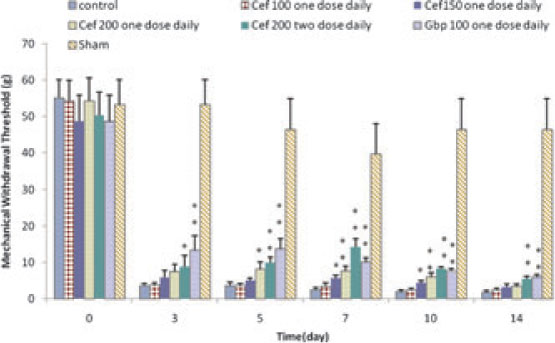
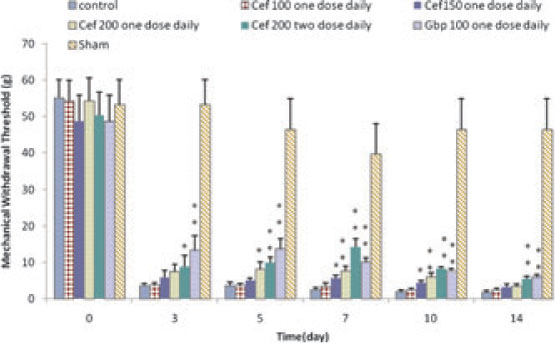
A pre-surgery test on day 0 (1 day before surgery) showed no significant difference in response to von Frey filaments among animals and almost all of them tolerated forces up to about 26 and 60 g. Three days following surgery animals subjected to CCI surgery and treated with normal saline (NS) (control) showed progressive increased sensitivity to innocuous mechanical stimulation with von Frey hairs. Most of the animals withdrew their hind paw, abruptly to very weak von Frey filaments especially 4, 2, 1.4, 1 and 0.6 g forces. However, sham-operated group did not show any significant variation to tactile stimulation pre- and post-surgery during 14 days assessment and differed significantly with control group. Mechanical withdrawal threshold for control group was 55 ± 5 g on day 0 and 7.7 ± 1.3 g on day 7 (p < 0.01 by paired t-test). Withdrawal threshold for sham group was 53.2 ± 7 and 39.6 ± 8.4 g on these days, respectively (not significant at p < 0.05 by paired t-test). Ceftriaxone at the dose of 100 mg/kg/i.p. once daily administration for 7 days had no effect on symptoms of neuropathic pain in animals. Tactile allodynia after CCI was partially attenuated by the doses of 150 and 200 mg/kg once daily on days 5, 7 and 10 after surgery (p < 0.05 and p < 0.01, respectively), but this effect disappeared until day 14. Administration of 200 mg/kg of ceftriaxone twice daily produced a significant alleviation of tactile allodynia (mechanical withdrawal thresholds on day 7: 14.1 ± 2.3 g, p < 0.01) very similar to reference group, gabapentin (mechanical withdrawal thresholds on day 7: 10.1 ± 1 g, p < 0.01). This improvement was continued until post-operative day 14 (Fig. 1).
The effect of various doses of intraperitoneal administration of ceftriaxone (Cef) on mechanical allodynia caused by CCI surgery on the left sciatic nerve in rats. Groups of n = 6–8 animals were chosen. Values are based on mg/kg of animal weight. Administration of drug was done in day 1 and continued until day 7. Baseline assessment (day 0). Data were analysed by nonparametric statics (Mann–Whitney U-test) and presented as mean ± SEM. *p < 0.05, **p < 0.01 versus control group (CCI + i.p. NS group).
Effects on thermal withdrawal frequency
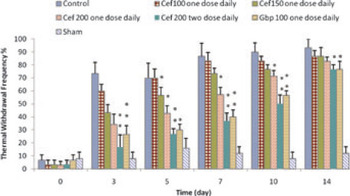
Following CCI surgery, animals which received vehicle showed a progressive sensitivity to acetone application during the observed period. The PWF reached from 6.6 ± 1.4% on day 0 to 86 ± 9.9% on day 7. On the other hand, Sham-operated group remained unresponsive throughout 14 days observation, which shows absence of thermal allodynia in this group. Thermal allodynia appeared in animals treated by doses of 100 and 150 mg/kg ceftriaxone daily and there was no difference compared to control group. Administration of ceftriaxone (200 mg/kg once daily) slightly attenuated sensitivity to acetone on days 5, 7 and 10 but this effect disappeared by the 14th day. Nevertheless, animals treated with ceftriaxone at the dose of 200 mg/kg twice a day revealed no thermal sensitivity to acetone test as compared to control group (PWF = 36.7 ± 6.1% on day 7, p < 0.01) and this effect was very similar to protective effect produced by reference drug, gabapentin (PWF = 40 ± 5.1% on day 7, p < 0.01). Decreased sensitivity to acetone stimulus in the two later groups continued throughout the study (Fig. 2).
The effect of various doses of intraperitoneal administration of ceftriaxone (Cef) on thermal allodynia induced by CCI surgery on the left sciatic nerve in rats. Groups of n = 6–8 animals were chosen. Administration of drug was done in day 1 and continued until day 7. Baseline assessment (day 0). Data were analysed using nonparametric statics (Mann–Whitney U-test) and presented as mean ± SEM. *p < 0.05, **p < 0.01 versus control group (CCI + i.p. NS group).

Effects on thermal withdrawal latency
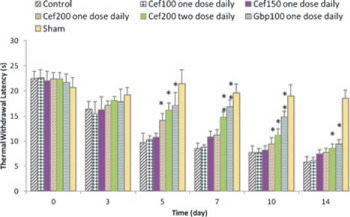
A progressive hyperalgesia to thermal stimulus was seen during the observed period in vehicle-treated animals following CCI surgery. This latency decreased from 22.4 ± 1.3 s on day 0 to about 7.8 ± 1.3 s on day 7. Sham-operated group did not show any significant change in withdrawal latency throughout the observation period. While ceftriaxone at the doses of 100 and 150 mg/kg once daily could not prevent thermal hyperalgesia, a dose of 200 mg/kg of this drug partially improved thermal hyperalgesia (p < 0.05). Ceftriaxone at a dose of 200 mg/kg, given twice daily significantly increased withdrawal latency to painful thermal stimulus and this effect was sustained throughout 14 days observation period. This improvement was as much as what gabapentin did on thermal hyperalgesia (14.8 ± 1 s for ceftriaxone and 16.7 ± 1.3 s for gabapentin on day 7) (Fig. 3).
The effect of various doses of intraperitoneal administration of ceftriaxone (Cef) on thermal hyperalgesia induced by CCI surgery on the left sciatic nerve in rats. Groups of n = 6–8 animals were chosen. Administration of drugs was done in day 1 and continued until day 7. Baseline assessment (day 0). Data are analysed by one-way analysis of variance followed by Scheffe post hoc test and presented as mean ± SEM. *p < 0.05, **p < 0.01 versus control group (CCI + i.p. NS group).

Discussion
In this study CCI model of neuropathic pain was used. This common type of experimental neuropathic pain mimics the clinical condition of chronic nerve compression such as that occurring in nerve entrapment neuropathy in lumbar disk herniation that causes spinal root irritation. As mentioned in Introduction section, glutamate has a key role in the pathogenesis of neuropathic pain Reference Mirzaei, Manaheji, Maghsoudi and Zaringhalam16. On the other hand, Rothstein et al. reported that beta-lactam antibiotics including ceftriaxone selectively promote GLT1 expression and function Reference Rothstein, Patel and Regan17. The results of this study in agreement with those of Hu et al. Reference Hu, Li and Lu18 showed the beneficial effects of ceftriaxone in neuropathic pain. In this study, ceftriaxone in a range of doses (100–400 mg/kg) was used. A dose of 400 mg/kg (200 mg/kg twice daily) showed considerable and consistent antiallodynic and antihyperalgesic activity, so that its effects remained even for 1 week after discontinuation of the drug (day 14). In addition to mechanical allodynia which was used by Hu et al., thermal allodynia (acetone test) was evaluated in this study. This test also confirmed antiallodynic activity of ceftriaxone and is being reported for the first time here. Among the symptoms of neuropathic pain, allodynia, a more pronounced feature of neuropathic pain, is less sensitive to the most current drugs Reference Esser, Chase, Allen and Sawynok24, Reference Esser and Sawynok25, Reference Hofmann, de Vry, Siegling, Spreyer and Denzer26. However, on the basis of our results, in contrast with Hu et al. observations, it seems that both mechanical and with lesser extent thermal allodynia are more attenuated with ceftriaxone compared with hyperalgesia suggesting more association and dependency of these symptoms with function of GLTs in the central nervous system. The differences between our results and the previous study Reference Hu, Li and Lu18 may be due to different animal species and experimental conditions.
Although some antibiotics have been used for non-infectious diseases [e.g. demeclocycline for inappropriate antidiuretic hormone syndrome Reference Goh27], it seems that widespread use of antibiotics can lead to microbial resistance in communities. However, by designing structure-activity studies, it is possible to provide compounds with little or no antimicrobial effect while preserving GLT1 gene activation. The findings in this study clearly show that ceftriaxone can be included in treatment protocols of neuropathic pain. As oetiology of neuropathic pain is very complex and many mediators are involved in its development, several investigators have attempted combination therapy instead of administering a single drug Reference Dworkin, O’Connor and Backonja28, Reference Chonghong and Brandner29.
In this regard ceftriaxone has the potential to be selected as one of the useful drugs in combination therapy. In conclusion, administration of this interesting drug in forthcoming clinical researches can result in finding novel and promising pharmacological treatments in neuropathic pain and other glutamate-dependent diseases.
Acknowledgements
This research project was supported by the research council of the Isfahan University of Medical Sciences, Isfahan, Iran. There is no conflict of interest with any of authors for publication of this research.