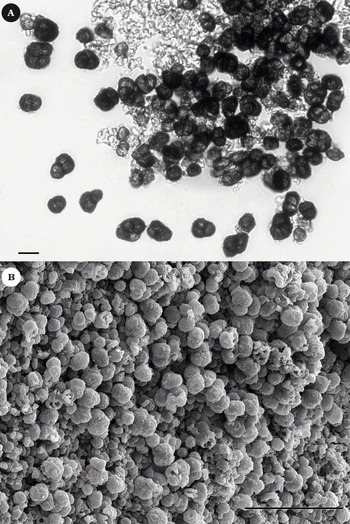
Himalayan specimens of Umbilicaria decussata deposited in the herbaria M (Munich) and KRAM (Krakow) were examined during a revision of the genus Umbilicaria. From the Himalayas, Poelt (Reference Poelt1977) reported together with a typical variety of U. decussata (Vill.) Zahlbr. a newly circumscribed variety, U. decussata var. rhizinata Frey & Poelt. He distinguished the new taxon by the presence of whitish, cylindrical rhizines on the lower surface, but probably did not recognize it at the species level because he mistakenly reported that the both varieties were characterized by the same type of thalloconidia, i.e. 2- or rarely 3-cellular thalloconidia produced on the lower cortex (see Poelt Reference Poelt1977, pp. 404, 411). However, more recent investigations suggest, var. decussata is characterized by the presence of mainly unicellular, and only occasionally by 2-cellular thalloconidia (Hestmark Reference Hestmark1990), whereas, the type material of var. rhizinata (M) has generally 3- or 4-cellular thalloconidia (Fig. 1) and only occasionally produces 2- or 1-cellular thalloconidia.
Umbilicaria rhizinata (M-0035585—lectotype). A, individual 3-, 4-cellular thalloconidia (light microscopy); B, multicellular thalloconidia covering the lower side of the thallus (SEM). Scales: A = 10 μm; B = 50 μm.

Asexual propagules, including thalloconidia, are one of the most important diagnostic characters of Umbilicaria (e.g. Krzewicka & Wilk Reference Krzewicka and Wilk2009; Krzewicka et al. Reference Krzewicka, Garcia, Johansen, Sancho and Martín2009). Their presence or absence as well as the number of septa are used to distinguish the taxa at the species level (e.g. Krog & Swinscow Reference Krog and Swinscow1986; Hestmark Reference Hestmark1990). Furthermore, the presence or absence of rhizines is also a valuable diagnostic feature within this genus (e.g. Llano Reference Llano1950; Poelt Reference Poelt1977; Krzewicka Reference Krzewicka2004). I therefore propose to recognize Umbilicaria decussata var. rhizinata at the species level.
Umbilicaria rhizinata (Frey & Poelt) Krzewicka comb. nov
Umbilicaria decussata var. rhizinata Frey & Poelt, Khumbu Himal 6: 419 (1977); type: Nepal Himalaya, Mahalangur, Himal Khumbu, Moränen des Lobuche-Gletschers bei Lobuche, 4950–5000 m, September 1962, J. Poelt, L247a (M-0035585—lectotype!; M-0035586—isolectotype!, designated here).
(Fig. 1)
Thallus foliose, umbilicate, thin, rigid, monophyllous, small, up to 1–2(–3) cm diam. Upper surface dark grey to brownish grey, coarsely granulose, ridged, with a distinct reticulate pattern at the centre. Lower surface smooth, sooty black, brown to pale brown or mottled towards the margin. Rhizines long, cylindrical to flattened, simple or dichotomously branched, whitish creamy to brownish grey, especially abundant towards the margin, absent around the umbilicus. Thalloconidia dark brown, mainly 3- or 4-cellular, rarely 2- or occasionally unicellular, 8–10 × 10–14 μm, produced exclusively from the lower cortex of thallus in sooty black patches.
Apothecia not observed.
Umbilicaria rhizinata is distinguished by the presence of rhizines, and by 3- or 4-cellular thalloconidia produced in black patches on the mottled lower surface, whereas U. decussata is characterized by the absence of rhizines, unicellular thalloconidia, 6–8 × 5–8 μm, and a completely sooty black lower surface (Hestmark Reference Hestmark1990). The other species with a similar upper surface is U. krascheninnikovii (Savicz) Zahlbr., but this species differs by its pale creamy lower surface without thalloconidia and by the lack of rhizines (Krzewicka & Smykla Reference Krzewicka and Smykla2004). Umbilicaria formosana is similar due to the presence of rhizines and thalloconidia that are, however unicellular and very small, up to 4·2–5·4 × 3·6–4·5 μm (Davydov & Zhdanov Reference Davydov and Zhdanov2010).
Distribution. This species occurs on the highest mountains of the world. It was previously known only from the Himalayas. Two further isolated populations are recorded here, one in Africa from Mt Kilimanjaro and the other from the Andes in South America.
Taxonomic note. The type material of Umbilicaria decussata var. rhizinata designated by Poelt as the holotype (M – J. Poelt, L247a) is stored in 2 packets glued on to one sheet. The material was divided up for technical reasons only according to the information given on the label. Two specimens of Umbilicaria aprina are included in the upper packet along with the type specimens of Umbilicaria decussata var. rhizinata. This was noted by Wei in 1997 who selected the lectotype for the variety and made an appropriate annotation: “247a lectotype of Umbilicaria decussata var. rhizina[ta] Frey & Poelt, HMAS-L det. Wei J. C. 1997”. For this reason the material was annotated as holding the lectotype collection in M herbarium. However, Wei did not designate from the original material the collection considered by him as the nomenclatural type. Because Wei did not effectively select a lectotype and subsequently did not publish his lectotypification it cannot be treated as valid. The nomenclatural type was designated during this study according to the diagnosis and the type specimen has been separated in a micro-packet from the mixed material and clearly annotated.
Remarks. The specimens recognized by Poelt (Reference Poelt1977) as U. decussata var. decussata and var. rhizinata in fact belong to a few species. As indicated the type material of var. rhizinata (L247a) is a mixed collection. Unfortunately the paratypes listed in a protologue, i.e. L 245 and L 250, were not available in the herbarium (M) during this study. However, Poelt (Reference Poelt1977) observed that the specimens L 245 are atypical, very old, and rather big, reaching up to 4 cm in diameter, with flattened rhizines. According to Davydov & Zhdanov (Reference Davydov and Zhdanov2010) this material (L 245) in fact belongs to Umbilicaria formosana Frey. Other material named by Poelt (Reference Poelt1977) as var. decussata is also mixed and belongs to different taxa, such as U. decussata (L 246, L 257) and U. formosana (L 255, L 265) (see also Davydov & Zhdanov Reference Davydov and Zhdanov2010).
Specimens examined. Tanzania: Ostafrica, Kilimandscharo, Süd-Mawenzi, 4500–5100 m, 12 x 1889, H. Meyer (WRSL).—Bolivia: Province of Murillo: Department La Paz, East Cordillera, upper part of the valley under Mt. Chakaltaya, alt. 4980 m, 1620′41″S, 6808′10″W, 2004, A. Flakus 5700c (KRAM, LPB); ibid.: K. Wilk 2634 (KRAM).
Material of Umbilicaria decussata (Vill.) Zahlbr. examined. Antarctic: King George Island: Sphinx Hill, N slope, 140 m, J. Smykla (KRAM).—Nepal: Himalayas, Machhermo, 4020 m, xii 2004, T. Zielonka (KRAM); Mahalangur, Himal Khumbu, Höhe W Lobuche, 5100 m, 1962, J. Poelt L 246 (M); Mahalangur, Himal Khumbu, Nordlich Lobuche, 5000 m, 1962 J. Poelt L 257 (M).—Poland: High Tatra Mts., Kazalnica Mt., 2040 m, 17 viii 2000, B. Krzewicka (KRAM).—USA: Alaska: Gates of the Arctic National Park, Anaktuvuk Pass. 1 vii 1949, G. Llano (KRAM).—Bolivia: Province of Murillo: Department La Paz, valley under Mt. Chacaltaya, 4980 m, 2004, A. Flakus 5700k (KRAM, LPB).
I am grateful to the reviewers for their constructive comments of the manuscript. I thank the Curators of the herbaria cited for their valuable assistance and Bartosz Płachno (Kraków) for the SEM photographs.