Introduction
Health problems occurring after disasters have been well-known.Reference Ishikuro, Nakaya, Obara, Sato, Metoki, Kikuya, Tsuchiya, Nakamura, Nagami, Kuriyama and Hozawa 1 On March 11, 2011, the Great East Japan Earthquake struck with a magnitude 9.0 and triggered a powerful tsunami. Since the earthquake and tsunami caused great damage, there was concern for the adverse health effects of those in the disaster area.Reference Noji 2 - Reference Aoki, Fukumoto and Yasuda 4 Not only acute diseases, but also chronic ailments, such as cardiovascular diseases and structural brain changes, have been reported after the Great East Japan Earthquake.Reference Kario, Matsuo and Shimada 3 , Reference Aoki, Fukumoto and Yasuda 4 Since those chronic ailments might increase in the disaster area longitudinally, it is crucial to monitor the health of the local people and provide medical care over the long term. In particular, medical and health care systems were collapsed after the disaster. Therefore, conducting a genome study to establish an advanced medical system and practice, such as personalized health care and medicine using genomic information in the disaster area, also appears to be essential for sustainable restoration of medical services.
In February 2012, Tohoku University (Sendai, Japan) established the Tohoku Medical Megabank Organization (ToMMo) for conducting the project, along with Iwate Medical University (Morioka, Japan), to build an advanced medical system to foster reconstruction after the Great East Japan Earthquake. The mission of ToMMo was to facilitate the solution of medical problems in the aftermath of the disaster by introducing personalized health care and medicine that used genomic information into the disaster area. One of their projects was to conduct health research in the disaster area in order to assess the current health status of those affected by the disaster and to provide quality-oriented care through personalized and precise treatments. They decided to include genomic analysis in this health research project; however, public perception of such testing methods was a challenge for the project. A previous epidemiological study in the 2005 Hurricane Katrina (Gulf Coast, USA) post-disaster area attempted to identify both genotypic and phenotypic factors affecting posttraumatic stress, including exposure to the disaster.Reference Sekiguchi, Sugiura and Taki 5 It is important to collect the current and future health information of those living in disaster areas to provide appropriate health support and quality-oriented care.
Some research on public perception of health surveys and genomic analysis has been conducted.Reference Dunn, Solovieff and Lowe 6 - Reference Ishiyama, Nagai and Muto 8 However, there has been no study investigating public perception of health or genomic studies conducted in the Great East Japan Earthquake disaster area. Therefore, before introducing the ToMMo project in this area, it was necessary to know the local people’s thoughts regarding health research and genomic analysis to create a better plan for the project. This report briefly details the results of a survey on public attitudes toward an epidemiological study with genomic analysis in the post-disaster area in Japan.
Methods
Setting
A survey was conducted in Yamamoto Town, a coastal area located in the southern part of Miyagi Prefecture in Japan. On the day of the Great East Japan Earthquake, 37.2% of Yamamoto Town area was affected by the tsunami. The population in 2012 was 13,732 (6,740 male and 6,992 female).Reference Kaufman, Murphy and Scott 9 The latest number of deaths and missing persons (February 17, 2015) on the death register is 636, 10 and the number of houses fully destroyed is 2,217 10 (as of May 24, 2013).
Design
The study was conducted over three days from September 26 to October 4 in 2012, 1.5 years after the disaster. The study participants were those who attended a specific health checkup in Yamamoto Town. Yamamoto Town usually performs the health checkup for a week, and the days for the survey were selected by the consultation between the municipality and the study group. A questionnaire was distributed to all people who attended the health checkup over three days. After that, ToMMo and its projects were introduced, and then all participants who agreed to join the survey were asked to fill out an anonymous questionnaire. Questionnaires were collected on the spot. Any information of genetic analysis and the pros and cons of the analysis were not introduced before the questionnaire survey because such information might affect attitudes toward the analysis. The study protocol was approved by the Institutional Review Board at Tohoku University.
Questionnaire
A questionnaire was newly developed consisting of simple questions such as the participants’ level of interest in joining a long-term health survey, focusing especially on the following data collection methods: questionnaires, blood tests, urine tests, magnetic resonance imaging (MRI) examination, and home blood pressure (BP) measurements. The level of interest in genomic analysis and receiving the health survey results were also asked (Appendix 1; available online only). Both epidemiologic and genome researchers, as well as science communicators, finalized the questionnaire.
Analysis
The differences in the answers to each question were assessed by sex (men and women) and age (<60 years, 60-69 years, and ≥70 years) using the chi-square test or Fisher’s exact test. The SAS package (version 9.3, SAS Institute Inc.; Cary, North Carolina USA) was used for statistical analysis.
Results
The questionnaire was distributed to 308 people, and 286 completed responses were returned (92.2% response rate). Two persons did not provide their sex or age and were excluded. Therefore, 284 people (51.8% women; 81.0% aged ≥60 years) were eligible for analysis.
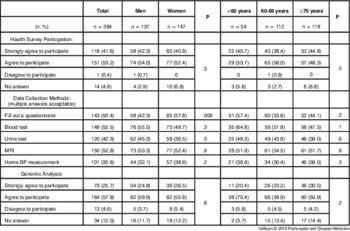
In both men and women, more than 90% of the participants agreed to join a health survey investigating the adverse effects of the disaster (Table 1). As for data collection methods, the highest percentage of men agreed to have a blood test, whereas the highest percentage of women agreed to fill out the questionnaire (Table 1). In the <60 years age group, the highest percentage of participants agreed to a blood test, followed by a questionnaire, MRI, urine test, and home BP measurement, in that order. An MRI examination was the most preferable method among the 60-69 years and ≥70 years age groups (Table 1). One-third of the participants were willing to participate in home BP measurement; this rate was the lowest in both sexes of all age groups (Table 1). As for genomic analysis, more than 80% of the participants in both sexes and all age groups answered that they agreed to have the analysis (Table 1). Men tended to show more interest in genomic analysis than women; however, there was no significant difference.
Public Perceptions of a Health Study and Genomic Analysis

Abbreviations: BP, blood pressure; MRI, magnetic resonance imaging.
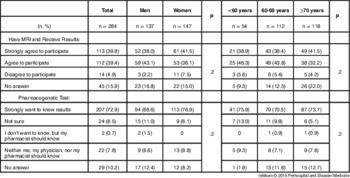
The participants were also asked whether they would want an MRI examination if the results were returned to them. A higher percentage of men agreed with having an MRI examination than women if the results were provided (Table 2). Over 70% of the participants wanted to have a pharmacogenetic test and to receive feedback on which medications were suitable or unsuitable for them. In particular, women relatively wanted to receive the results of a pharmacogenetic test directly more than men (Table 2).
Interest in Receiving MRI and Pharmacogenetic Test Results and Feedback

Abbreviation: MRI, magnetic resonance imaging.
Discussion
Most people were interested in joining a health survey and in receiving genomic analysis in the post-disaster area. This is the first report to reveal public perceptions of a health survey and genomic analysis during the post-disaster period of the Great East Japan Earthquake.
Perceptions of a Health Survey in the Disaster Area
Men tended to be more interested in blood tests, and women were significantly more interested in questionnaires than other data collection methods (P =.009). Although the reason for these sex differences is unclear, several possibilities were considered. Markanday et al stated that the non-participation rate of men for a cohort study was 10% higher than that of women. 11 They considered that the higher non-participation rate among men might be due to men having more “time constraints” than women. 11 It is speculated that men usually have work commitments and often do not have enough time to participate in questionnaires or might feel that they are more cumbersome than women do. The same reasoning might be applied to these study results, which showed that men preferred to participate in less time-consuming tests.
An MRI examination was the most preferable data collection method among the ≥60 years age group. This may be because MRI examination is not an essential test performed during normal health checkups. In contrast, both sexes and all age groups were the least interested in home BP measurements. The brain structure change and high prevalence of cardiovascular diseases in the Great East Japan Earthquake disaster area have been confirmed in the post-disaster period.Reference Kario, Matsuo and Shimada 3 , Reference Aoki, Fukumoto and Yasuda 4 Furthermore, increases in BP levels had also been reported.Reference Noji 2 In a survey of access to health services and care-seeking behaviors after the 2007 Peru earthquake conducted by Daniels et al,Reference Markanday, Brennan, Gould and Pasco 12 28% of households reported their family members needed, but did not seek, care in the six months following the disaster. This previous study also found that people living in temporary housing sought medical care more than those living in permanent housing in the first two weeks after the earthquake.Reference Markanday, Brennan, Gould and Pasco 12 It is important to introduce health indicators such as BP measurement to local people after a disaster because increased BP levels may indicate stress.Reference Daniels, Chapin and Aspilcueta 13 Although health research during the post-disaster period should be conducted based on the needs and feelings of the local people, BP monitoring should be promoted even if the people are not very interested in home BP measurements.
Perceptions of Genomic Analysis
A previous study in Japan investigated public attitudes toward genetic studies and found that 69.4% of the participants approved the promotion of genomic studies related to medicine, while 1.3% disapproved, and 29.3% were undecided.Reference Yoshizawa, Ho and Zhu 7 A higher proportion of participants in the present study agreed to join a genomic analysis study than that previous study, yet the proportion of those who did not want to join such testing was also high. This may be a reflection of increased genomic literacy and concerns for genomic analysis. In Japan, the public is aware of privacy protection so that the government established the “Act on the Protection of Personal Information” in 2003. However, a previous study, which analyzed public attitudes towards the use of genetic information for medical purposes, showed that 42.9% of the study participants did not really think that the law was substantively adequate.Reference Dunn, Solovieff and Lowe 6 It is important that a future study clarify public opinions on genomic analysis so that research in the post-disaster area is conducted under well-defined social and legal conditions. In particular, genomic analysis and research have several considerable issues that are potentially more critical in disaster-stricken populations, such as incidental findings, support for genetic-related diseases, and discrimination.
Perception of Receiving Results of MRI and Pharmacogenetic Test
Nearly 80% of the participants wanted to have an MRI examination and 70% wanted to have a pharmacogenetic test if they could receive the results. The high rates for preferring feedback may have affected the results of interest in joining the health survey. A previous study analyzing the factors affecting participation in a large genetic cohort study found that returning individual research results, including genetic test and nongenetic test results, motivated people to join the study.Reference Ishiyama, Nagai and Muto 8
Limitations
There were some limitations in the present study. First, participants were recruited from people who attended a specific health checkup in one municipality. Therefore, the participants in the present study may be especially interested in maintaining their health. It indicates that the study might have had a selection bias. The interpretation of the result should be careful and further assessment is needed. Second, these study results might have been biased by the elderly population in this area. According to basic resident register, the proportion of persons over 65 years old in Yamamoto Town, Miyagi Prefecture (which Yamamoto Town belongs to), and Japan was 30.9%, 22.5%, and 23.4% in 2012, respectively. The proportion of elderly people in Yamamoto Town is higher than Miyagi Prefecture and the whole of Japan. However, the tsunami greatly attacked Yamamoto Town as it is along with the coast, and the response rate of the present study is over 90%. Therefore, the result of the present study might reflect most of the opinion of people living in the disaster area.
Conclusion
It was found that most people living in the disaster area were interested in a health survey. Most of the participants were also likely to be interested in receiving genomic analysis. However, further research focusing on the level of knowledge regarding genomic analysis within the general public and whether their thoughts would change if they were fully aware of the benefits and risks associated with such testing should be conducted.
Acknowledgement
This work was supported by MEXT Tohoku Medical Megabank Project and the Japan Agency for Medical Research and Development (AMED). Questionnaires were collected by the following members: Noriko Osumi, Hideyasu Kiyomoto, Atsushi Hozawa, Naoki Nakaya, Masahiro Kikuya, Taku Obara, Fuji Nagami, Maiko Kageyama, Soichiro Toda, Soichi Ogishima, Mami Ishikuro, and Chika Igarashi.
Supplementary Material
To view supplementary material for this article, please visit http://dx.doi./org/10.1017/S1049023X16000182