


Defining and measuring the influence of interest groups on legislators is far more challenging than quantifying visible instruments of power, such as campaign contributions (Bombardini and Trebbi Reference Bombardini and Trebbi2020; Fairfield Reference Fairfield2010; Reference Fairfield2015a; Mitchell Reference Mitchell1997). Nevertheless, the question of how organized interests shape policy decisions remains central to understanding representative democracy and policymaking (see, e.g., Gilens and Page Reference Gilens and Page2014; Haggard, Maxfield, and Schneider Reference Haggard, Maxfield, Schneider, Maxfield and Schneider2018; Rasmussen and Reher Reference Rasmussen and Reher2023; Schneider Reference Schneider2004; Reference Schneider, Coen, Grant and Wilson2010). This topic has become increasingly complex in the age of digital democracy, where messaging tools facilitate communication with legislators and their aides, making lobbying harder to trace (Chalmers and Shotton Reference Chalmers and Shotton2016; van der Graaf, Otjes, and Rasmussen Reference van der Graaf, Otjes and Rasmussen2016). Despite a rich literature on interest group influence, causal identification remains difficult (de Figueiredo and Richter Reference de Figueiredo and Richter2014). Although some studies examine how lobbying affects legislators’ actions (Baumgartner et al. Reference Baumgartner, Berry, Hojnacki, Kimball and Leech2009; Bergan Reference Bergan2009; Butler and Miller Reference Butler and Miller2022; Grose et al. Reference Grose, Lopez, Sadhwani and Yoshinaka2022; Kalla and Broockman Reference Kalla and Broockman2016), we still lack a clear understanding of when and why politicians pay attention to lobbyists’ demands (Ainsworth Reference Ainsworth1997; Boehmke, Gailmard, and Patty Reference Boehmke, Gailmard and Patty2013; Mooney Reference Mooney1992; Vallejo Vera Reference Vallejo Vera2023)—particularly net of confounders, such as executive pressure, ideological alignment, or monetary contributions.Footnote 1
This article places legislators at the center of analysis (Skocpol Reference Skocpol, Rueschemeyer, Evans and Skocpol1985) and argues that they respond to informational cues in lobbying messages—particularly signals about a group’s economic relevance and the breadth of its coalition. These cues function as persuasive heuristics, helping lawmakers assess which demands are politically credible and safer to support. Building on the literature on informational lobbying and elite signaling, I show how interest groups actively construct and communicate their breadth to enhance influence. Rather than relying on latent structural advantages, groups seek to shape perceptions through strategic message framing that amplifies their visibility, legitimacy, and relevance in policy debates.
I study this process using a combination of field experimental, survey experimental, and qualitative interview evidence. The context is a prominent and highly consequential pension reform in the Brazilian Congress. Pension reform offers a rigorous test case: it is considered a “third rail” of politics (Madrid Reference Madrid2002; Mesa-Lago and Müller Reference Mesa-Lago and Müller2002; Myles and Pierson Reference Myles, Pierson and Pierson2001; Pierson Reference Pierson2002), with legislators facing electoral and ideological trade-offs. Furthermore, a recent shift in electoral finance rules eliminated corporate donations (Fisch and Mesquita Reference Fisch and Mesquita2022), providing a unique opportunity to study lobbying effects in the absence of direct (legal) financial incentives.
Empirically, the study rests on a field experiment that randomly varied whether legislators received a message from a prominent pro-business interest group that emphasized its economic and coalitional characteristics.Footnote 2 The group lobbied federal deputies using printed letters and WhatsApp messages in the days leading up to the reform vote. Politicians in the control group received a message crafted by the organization that did not include information about the size or number of companies in the association. Deputies in the treatment condition were significantly more likely to support the group’s preferred policy, suggesting that these cues influenced real legislative behavior.
To probe the mechanisms behind this effect, I conduct a survey experiment with professional lobbyists and in-depth interviews with key political figures—including a former president, ministers, and legislators. The survey experiment suggests that messages highlighting organizational coalitional scale and economic importance increase the perceived likelihood that legislators will engage with and support the policy. The interviews provide context for how such cues are interpreted by political elites.
This study contributes to three core literatures. First, it advances research on interest group influence by using a controlled experimental design in a real-world legislative setting. Ecological validity (Morton and Williams Reference Morton and Williams2010) is increased by a realistic treatment, research environment, population, and outcomes. Second, it contributes to the literature on informational lobbying by identifying two salient cues—economic relevance and coalition breadth—that shape political attention and responsiveness. The evidence indicating that politicians adjust their behavior after receiving information from interest groups aligns with broader literature on the importance of signaling for lobbying success in both the United States and Europe (Lohmann Reference Lohmann1993; Mause Reference Mause2024; Walker and Stepick Reference Walker and Stepick2014). Finally, it expands empirical research on elite persuasion in the Global South, where data limitations have long hindered studies of lobbying (Rozbicka and Mahrenbach Reference Rozbicka and Mahrenbach2023; Seligman and Mello Reference Seligman and Mello2018). Together, the results suggest that politicians are responsive to the communication strategies of interest groups.
DO POLITICIANS RESPOND TO INFORMATIONAL CUES FROM INTEREST GROUPS?
Why do legislators pay attention to some interest groups and not others? Classic theories often emphasize instrumental forms of power—such as campaign contributions or direct access to policymakers—as a primary source of influence (Culpepper Reference Culpepper2015; Fairfield Reference Fairfield2015b; Grossman and Helpman Reference Grossman and Helpman2002; Kalla and Broockman Reference Kalla and Broockman2016; Speck Reference Speck2016). However, a relevant body of literature highlights how groups affect policy through the strategic provision of information, especially under conditions of uncertainty and complexity (Austen-Smith Reference Austen-Smith1995; Bennedsen and Feldmann Reference Bennedsen and Feldmann2002; Bombardini and Trebbi Reference Bombardini and Trebbi2020; Lohmann Reference Lohmann1993; Schnakenberg Reference Schnakenberg2017). In this perspective, interest groups serve as informational allies, helping legislators understand policy implications, anticipate constituent reactions, and calculate the political risks of their positions.
This article builds on that tradition by focusing on two types of informational cues that interest groups can emphasize to increase their influence: (a) economic relevance and (b) coalition breadth. These cues help legislators infer how costly or beneficial it may be—electorally, economically, or politically—to support or ignore a group’s demands. Rather than assuming that business groups exert power simply by threatening disinvestment or exit, the study investigates how such groups seek to shape legislators’ beliefs by signaling their importance through observable features.
Interest groups signal their economic relevance by highlighting contributions to GDP, employment, or investment. These metrics offer legislators information for gauging the broader stakes of a policy proposal. Groups perceived as central to economic performance are more likely to be viewed as electorally salient, and politically consequential. Such cues help policy makers anticipate how specific policy choices might affect macroeconomic outcomes—and, by extension, their own political standing (Duch and Stevenson Reference Duch and Stevenson2008; Klüver Reference Klüver2013). Economic voting serves as an indirect channel through which business preferences gain traction in the policy-making process (Bernhagen Reference Bernhagen2007).
Second, groups can signal political breadth through the size and diversity of their coalitions. A large, cross-sectoral membership suggests that a group’s position is broadly supported—or at least politically safe to align with. Such signals are particularly influential when legislators lack clear information about how an issue resonates across constituencies. Lobbying is often a collective enterprise (Hula Reference Hula1999; Junk Reference Junk2019; Klüver Reference Klüver2013), and coalition building enhances credibility by showing that multiple actors have converged on a shared policy goal. Research shows that coalitions are more likely to succeed when they appear representative and politically balanced (Berkhout et al. Reference Berkhout, Carroll, Braun, Chalmers, Destrooper, Lowery and Otjes2015; Mahoney and Baumgartner Reference Mahoney and Baumgartner2015; Walker and Stepick Reference Walker and Stepick2014). By mobilizing broad alliances, interest groups can amplify their message and reduce the perceived political risk of support.
This framework clarifies how lobbying can be effective even in the absence of material exchanges. It builds on the idea that lobbying is not just about asking for something—it is about being perceived as worth listening to. Legislators operate with limited time and attention. In crowded policy environments, informational cues about a group’s importance help policymakers decide which actors to engage and which preferences to prioritize.
The mechanisms connecting interest group messaging to legislators’ support for a bill involve three intermediate steps. First, legislators must be aware of the group’s demands. Contact with lobbyists is a crucial precursor to influence (Miller Reference Miller2022; Wright Reference Wright1996), as it makes private preferences salient to legislators. In other words, interest groups must capture the attention of lawmakers to influence them (Goel et al. Reference Goel, Malkin, Gaynor, Jojic, Miler and Resnik2023; Hall and Wayman Reference Hall and Wayman1990), either through direct targeting or by engaging with their aides. Lobbying is thus defined as the transfer of information from interest groups to politicians and their staff, serving as a tool to shape policy outcomes (de Figueiredo Reference de Figueiredo2002; Lohmann Reference Lohmann, Mause and Polk2023).
Second, legislators must incorporate this information into their decision making. According to the political economy literature, a politician’s objective function includes reelection (Mayhew Reference Mayhew1974), promotion to higher or different office (Samuels Reference Samuels2003), and ideological or policy goals (Strom Reference Strom1990). Information provided by interest groups helps politicians decide on positions by calculating how these decisions will affect their reelection, career prospects, and ideological goals (de Figueiredo Reference de Figueiredo2002).
Third, politicians must assess the risks of revealing their positions to both interest groups and the broader electorate of unorganized and “rationally ignorant” voters (Downs Reference Downs1957). Misjudging the importance of an issue to voters can damage political careers (Arnold Reference Arnold1990; Weaver Reference Weaver1986). Comparative studies offer mixed evidence on whether voters punish politicians for cutting welfare programs, for instance (Giger Reference Giger2010; Nery Reference Nery2017). In short, interest groups that effectively signal their economic relevance and coalition breadth are more likely to gain political traction.
THE CASE: BRAZILIAN PENSION REFORM
The case of a prominent pension reform in Brazil provides a compelling opportunity to study whether legislators respond to persuasive cues from interest groups—specifically, cues related to their economic relevance and coalition breadth. First, political scientists, sociologists, and economists have long highlighted the remarkable resilience of existing pension arrangements in Latin America (Mesa-Lago and Müller Reference Mesa-Lago and Müller2002). The reform of the Brazilian pension system, in particular, has been identified as an example of a seemingly impossible policy change (Limongi and Figueiredo Reference Limongi and Figueiredo1999; Melo Reference Melo2002). Over the course of a century, pensions were expanded to include an increasing number of organized and powerful groups, each receiving specific benefits (Malloy Reference Malloy1979; Mesa-Lago Reference Mesa-Lago1978). For instance, wealthier private-sector workers retired, on average, 10 years earlier than poorer workers (Constanzi and Ansiliero Reference Constanzi and Ansiliero2016). Moreover, the level of subsidies was disproportionately higher for the wealthier segment of the population (see Appendix A of the Supplementary Material).
For decades, public sector workers and privileged groups have mobilized successfully against proposed reforms (Giambiagi and Estermínio Reference Giambiagi and Estermínio2006; Hiroi Reference Hiroi2008; Nakahodo and Savoia Reference Nakahodo and Savoia2008). These well-organized efforts targeted various groups of lawmakers, causing the executive’s proposals to confront “interests crystallized in the status quo, not only from the opposition but also from segments of [the president’s own] coalition” (Velasco Junior Reference Velasco Junior2005). At the time this experiment was conducted, anti-reform groups were in a particularly weak financial position (Appendix B of the Supplementary Material), although unions continued to engage in lobbying, bargaining, and mobilization efforts targeted at voters and legislators to block or dilute the reform proposal (Silva Reference Silva2007; Reference Silva2021).Footnote 3
At the same time, the sustainability of the pension system had reached a tipping point (Tafner and Nery Reference Tafner and Nery2018). As a result, pro-business organizations mobilized in an unprecedented manner to advocate for this reform. According to accounts in the press and from academics, as well as interviews conducted for the project, extensive lobbying was necessary to overcome opposition and ensure the passage of a reform that initially faced substantial resistance (Scaramuzzo, Agostini, and Scheller Reference Scaramuzzo, Agostini and Scheller2019). The formation of a coalition of industrial, financial, and other elites was crucial to the success of the pension reform (Costa and Wiggan Reference Costa and Wiggan2023).
Finally, potential explanations for legislative success do not adequately explain why such a major pension reform was passed by Congress at that specific time (all analyses are presented in Appendix F of the Supplementary Material). The literature on the “presidential toolbox” (see, e.g., Pereira and Bertholini Reference Pereira and Bertholini2018) identifies factors that typically enhance a president’s ability to advance their policy agenda, including policies that are considered especially hard to achieve. These factors include the size of the presidential coalition, the degree of power-sharing within the coalition, the strategic use of pork-barrel spending to secure Congressional support, ideological alignment with the Congressional median voter, and the president’s popularity. However, at the time of the pension reform, the executive faced the weakest political position experienced by any president in at least 25 years: a smaller coalition, a higher concentration of power within the president’s own party, greater ideological distance from the floor median, and less discretionary power to target budgetary amendments for legislators’ projects in exchange for support.
The pension reform debate lasted nearly a year in Congress and remained a highly salient issue throughout. Around the time of the vote, a majority (70%) of Brazilians reported being aware of the proposed changes to the pension system. Among those mobilized either for or against the bill, the most educated (93%) and wealthiest (95%) individuals reported feeling “informed” or “very informed” about the matter (Datafolha 2019). A week before the vote, almost 80% of business owners supported the proposal. The reform was approved by the Chamber of Deputies in July 2019, marking a significant legislative achievement. The approval process required extensive negotiations, reflecting the complexity of the reform and initial resistance it faced. Ultimately, the proposal received 74% of the votes during the roll-call sessions, surpassing the three-fifths majority needed for constitutional amendments.Footnote 4
DATA AND DESIGN
I use three types of data and methods to test whether politicians respond to interest group messages that emphasize economic significance and broad coalition support. Since we cannot directly observe legislators’ internal deliberations, I employ a field experiment to test whether a group’s messaging—highlighting these two attributes—affects roll-call behavior. To explore mechanisms, I also use a survey experiment with professional lobbyists and qualitative interviews with politicians. Together, these methods provide complementary causal and interpretive evidence about how organized interests attempt to shape legislative decisions through informational cues (data are available at Mello Reference Mello2026).
Field Experiment: Design
The experiment evaluates whether signaling the economic relevance and coalition breadth of an interest group affects legislators’ behavior. The setting is the Brazilian National Congress during the 2019 vote on pension reform, a high-stakes policy change. Rather than comparing lobbying to no lobbying, the design varies the informational content of messages sent by a well-known business group while holding the sender constant. This design isolates the persuasive effect of emphasizing organizational characteristics.
Legislators were randomly assigned to receive treatment or control versions of a message from a pro-business organization called the Movement for a Competitive Brazil (in Portuguese Movimento Brasil Competitivo, henceforth MBC)—which comprised 51 of the largest national and international companies operating in Brazil.Footnote 5 MBC was founded in the early 2000s by Jorge Gerdau, a well-known business magnate in the steel industry. Gerdau has been described as one of Brazil’s most influential and vocal businessmen (Diniz and Bresser-Pereira Reference Diniz, Bresser-Pereira, Fontaine and Stehnken2016; Melo, Pereira, and Souza Reference Melo, Pereira and Souza2010), with a strong “reputation as a spokesperson for business” interests (Schneider Reference Schneider2014), and he has been actively involved in lobbying for decades (Schneider Reference Schneider1997). Therefore, MBC is a particularly strong representative of business interests across various sectors of the economy. Only two years after the pension reform, MBC launched a Congressional Caucus for a Competitive Brazil (Frente Parlamentar pelo Brasil Competitivo), comprising over two hundred legislators from both the Chamber of Deputies and the Senate.Footnote 6
Treatment and control messages emphasized the primary argument that the reform was “an essential measure for the resumption of sustainable economic growth” and necessary to “resume growth and generate more jobs.” In other words, both messages employed identical pro-reform language. However, the treatment message was specifically designed to convey credible information about two key organizational characteristics: economic relevance and coalition breadth.Footnote 7 While the control message identified only the Director of MBC as the sender, the treatment message explicitly stated that MBC “brings together 51 of the largest companies in Brazil, including multinationals.” This bundled approach was selected because the main goal was to empirically test for a causal relationship (Druckman et al. Reference Druckman, Green, Kuklinski and Lupia2006) and acknowledging the risk of being underpowered (Arel-Bundock et al. Reference Arel-Bundock, Briggs, Doucouliagos, Aviña and Stanley2026).
The inclusion of the treatment information served two purposes: it emphasized the group’s direct ties to major employers and investors in the country (economic relevance), and it suggested broad cross-sectoral representation (coalition breadth). By contrast, the control message omitted this organizational profile, presenting the same pro-reform argument without contextualizing who was behind it. Finally, the control message omitted the link to the organization’s members. These features of the treatment message were designed to activate the informational cues theorized above, helping legislators assess whether MBC’s position was credible and politically advantageous to support.
As part of its strategy to advocate for pension reform, MBC decided to make a final push in support of the proposed Constitutional Amendment, with the expectation that there were legislators still weighing the risks of revealing a pro-reform stance or those with no clear position on the topic. The organization did not conduct any institutional communications regarding the pension issue before or after the experiment, although other pro- and anti-reform groups were actively lobbying. These prior lobbying activities are expected to be balanced across treatment and control groups. Three days before the vote in the Chamber of Deputies, printed copies of MBC’s position were delivered in person to each deputy’s chief of staff by two deputies. The documents were handed over in sealed envelopes, with the legislator’s name printed on a tag. Both the treatment and control assignments were randomized, as were the offices visited by each representative, to ensure that any effects were due to the content of the message rather than the personal ability of the person delivering it (Figure 1).
Printed Version of the Letters Sent to Lawmakers
Note: The signature and name were blurred to protect the privacy of the institution’s director.

Figure 1. Long description
The figure contains two panels separated by a vertical black line. Both panels feature a letterhead at the top center with a green and yellow abstract logo next to the acronym M B C, with the text Movimento Brasil Competitivo underneath.
Left Panel:
* Top Left: C T C S 000 forward slash 19.
* Top Right: Brasília, July 8, 2019.
* Subject: Pension Reform Invitation.
* Body: The text begins ‘Dear Deputy, this is [blurred name] I am the superintendent of the Competitive Brazil Movement, a civil society organization that brings together 51 of the largest companies in the country, including multinationals.’ It continues to advocate for the Pension System constitutional amendment as essential for economic growth and job creation. It includes a link: h t t p colon forward slash forward slash w w w dot m b c dot org dot b r forward slash portal forward slash quem-somos forward slash.
* Bottom: ‘Respectfully,’ followed by a large blurred rectangular box where a signature would be.
Right Panel:
* Top Left: C T C S 000 forward slash 19.
* Top Right: Brasília, July 8, 2019.
* Subject: Pension Reform Invitation.
* Body: This version is slightly condensed. It begins ‘Dear Deputy, this is [blurred name] I am the superintendent of the Competitive Brazil Movement.’ The subsequent paragraphs regarding the importance of the constitutional amendment and the request to keep states and municipalities in the project are identical to the left panel, but the specific mention of 51 companies and the website link are omitted.
* Bottom: ‘Respectfully,’ followed by a large blurred rectangular box.
In addition, the same messages were sent to deputies’ personal cell phones via WhatsApp Messenger on the morning of the vote. The roll call began at night and concluded the following morning, after 6 hours of debate (Câmara Reference Câmara2019a). Access to these personal phone numbers is not public, unlike the institutional emails for each deputy, which are publicly available on the Congress’s official website in a standard format. These emails typically yield lower response rates (Franklin et al. Reference Franklin, Soares, Marques and Campos2020).
Both the treatment and control messages were delivered in person and via WhatsApp, in line with evidence suggesting that online and offline lobbying activities are interconnected (Kim, Russo, and Amnå Reference Kim, Russo and Amnå2017).Footnote 8 Printed messages had to pass through the chiefs of staff, and even with the second delivery method, there was no guarantee that legislators themselves read the content. Yet the combined approach was designed to maximize the likelihood that legislators would receive the message—either through their staff or directly through their phones.
The primary preregistered outcome consists of the roll call votes on the constitutional amendment, including two rounds of voting on the main bill (spaced more than a month apart). The votes are coded as dummy variables, with value 1 for a vote in favor of the bill and 0 otherwise. To address concerns about the nonindependence of votes cast by the same legislator across different roll calls, I also report models restricted to the first vote cast by each legislator. A supplementary robustness check includes the votes on various filibuster attempts and procedural discussions proposed by the opposition to block the approval of the proposal. In this context, a vote to end the filibuster indicates support for changing the pension system. Thus, a NAY vote is coded as 1 and a YEA vote is coded as a 0. This alternative outcome is expected to present an even tougher test. Lawmakers who prefer not to disclose their stance often support delaying discussions to avoid revealing their actual position. As a result, the cost of postponing the vote is lower than casting a recorded vote, leading to an expectation of a smaller treatment effect.Footnote 9
Several key steps were followed in the design. To increase precision and control for party ideologies before treatment assignment, deputies were blocked into three groups: government supporters, government opponents, and swing parties. Brazil had 27 parties represented in Congress, making it impossible to block by party. Blocking enhances the efficiency of the design by accounting for outcome variation attributable to pretreatment characteristics (Gerber and Green Reference Gerber and Green2012, 87). My prior assumption was that the different party groups had distinct positions on the bill. Moreover, the smaller the sample, the larger the advantage from blocking, which was the case. Therefore, treatment and control groups were randomized with 50% probability within each block.Footnote 10
The timing of the treatment assignment also helps mitigate potential spillover effects. While it is possible for deputies to communicate and share the messages they received, the organizational structure of deputies’ offices reduces this risk. Offices are not organized by party, making it more challenging for chiefs of staff to interact with co-partisan colleagues. In fact, the probability of co-partisan deputies being office neighbors in the Chamber is only 9.7%. On average, co-partisans were separated by 8.3 offices, and the office network exhibited a very low level of assortativity (0.03). This indicates little to no tendency for offices from the same party to connect more frequently than those from different parties (see Appendix F of the Supplementary Material).
Second, the phone messages were sent just hours before the vote, leaving little time for direct discussion. Third, because all legislators received some message from the lobbying group, deputies would have needed to carefully compare messages to identify the key difference. In any case, any spillover effects would likely bias the results against detecting a treatment effect. For estimation, I first calculate the intent-to-treat (ITT) effect for the randomized block experiment without any covariates.Footnote 11 I also report the following models with controls:

where Y
i
represents roll call votes from individual i on the constitutional amendment or filibustering propositions on the floor of the Chamber;
$ {D}_i $
 represents the treatment assignment;
$ {X}_i $
 is a vector of pretreatment controls; and
$ {J}_{1i} $
 ,
$ {J}_{2i} $
 , and
$ {J}_{3i} $
 are dummy variables indicating each block (fixed effects). Standard errors are clustered by legislator, with the exception of models for only the first vote cast by the legislator, when just one roll call is considered for each legislator (Abadie et al. Reference Abadie, Athey, Imbens and Wooldridge2023).
Blocking ensures that treatment and control units are comparable within strata, but covariates can further improve the precision (Gerber and Green Reference Gerber and Green2012). I use individual parties, and country region to capture variation within blocks, controlling for more granular partisan differences. In addition, the amount of resources received by individual legislators through pork budgetary amendment control, before treatment assignment, is also included (Senado Federal 2019). These amendments allow legislators to allocate government funds to specific projects in their constituencies, a crucial tool for Brazilian presidents seeking to build parliamentary support (Pereira and Bertholini Reference Pereira and Bertholini2018; Pereira, Bertholini, and Melo Reference Pereira, Bertholini and Melo2023). Finally, the total amount spent by the deputy from their office budget (Câmara dos Deputados 2019) works as a proxy for their inclination to save or spend public resources.
Ethics
Several steps were taken to ensure that the experiment was conducted in accordance with ethical principles for research involving public officials. First, the study did not involve deception. Legislators received messages from a legitimate interest group as part of the group’s independent strategy. MBC had planned to advocate for the pension reform regardless of the involvement in the research. The organization’s contact with the research team started with an interview for a related project two years before the project started. The organization’s director expressed interest in using the results to inform and refine their messages. All final decisions regarding the content, timing, and delivery of the messages were made exclusively by MBC. The role of the research team was limited to advising on experimental design and conducting analysis. The organization managed all communications and message distribution, including the use of phone numbers, which were never retained by the researcher.
Additionally, during the week of the vote, there was a strong expectation that the reform would pass, as the Speaker of the House would not have brought it to the floor otherwise (Câmara Reference Câmara2019b). When the final result of the first round was announced by the Speaker of the House, 74% of federal deputies supported the constitutional amendment to reform the pension system—14 percentage points above the minimum threshold of 60% of all possible votes. Thus, it is highly unlikely that the measured treatment effect determined the outcome. The broader implications of the reform—whether it was socially regressive or progressive—were not discussed with the organization, who defined its strategy to engage with legislators before the project started. However, consistent with arguments by scholars and policy analysts, the Brazilian pension system has long been identified as a key contributor to income inequality due to its regressive structure and benefits distribution.Footnote 12
Field Experiment: Results
To examine whether legislators respond to informational cues embedded in interest group messaging, I begin by reporting the simple difference in the proportion of YEA votes by treatment status, disaggregated by block (Table 1). The overall ITT effect, estimated across all blocks, constitutes the primary estimand. This estimate is design-based, transparent, and easily interpretable, as it relies exclusively on the randomization procedure and block structure, without introducing controls or additional modeling assumptions. This approach also addresses concerns about vote dependence by focusing exclusively on the first vote cast by each legislator.
Proportion of YEA Votes by Block and Treatment Group

Table 1. Long description
The table consists of six columns: Block, Y-bar sub t (treatment mean), Y-bar sub c (control mean), N (sample size), Y-bar sub t minus Y-bar sub c (difference), and P-value.
* Government block: Y-bar sub t is 97.1, Y-bar sub c is 95.4, N is 349, difference is 1.70, P-value is 0.297.
* Opposition block: Y-bar sub t is 12, Y-bar sub c is 4.1, N is 99, difference is 7.92, P-value is 0.143.
* Independent block: Y-bar sub t is 60.6, Y-bar sub c is 50, N is 65, difference is 10.61, P-value is 0.274.
* Pooled I T T: N is 513, difference is 4.03, P-value is 0.046.
A note below the table explains that the Pooled I T T is a weighted average of the within-block differences, calculated as (349 / 513 times 1.7) plus (99 / 513 times 7.9) plus (65 / 513 times 10.6) which is approximately 4.03.
Note: The dependent variable is a dummy equal to one if the legislator voted YEA on the first vote cast. Entries report simple differences in means between treatment and control. The “Total” row reports the overall intention-to-treat (ITT) effect under the blocked randomization design. The blocked ITT equals the block-size–weighted average of within-block differences:
$ (349/513\times 1.7)+(99/513\times 7.9)+(65/513\times 10.6)\approx 4.03 $
 . P-values are computed using randomization inference, conditional on the blocked assignment.
To assess the likelihood that these differences could have arisen by chance, I calculate a randomization-inference p-value using permutations consistent with the blocked assignment. Specifically, I compute the probability of obtaining an average treatment effect at least as large as the observed value under the sharp null hypothesis of no effect, conditional on the randomization.Footnote 13 The resulting one-sided p-value is 0.046.
In Appendix E of the Supplementary Material, I present supplementary regression results disaggregated by block, which incorporate control variables and clustered standard errors. While these block-specific estimates provide additional descriptive insights, they should be interpreted with caution given the small size of some blocks, which limits statistical power and yields imprecise estimates. Particularly in designs with small blocks, this approach improves the precision of the overall average treatment effect, even when within-block estimates are individually non-significant.
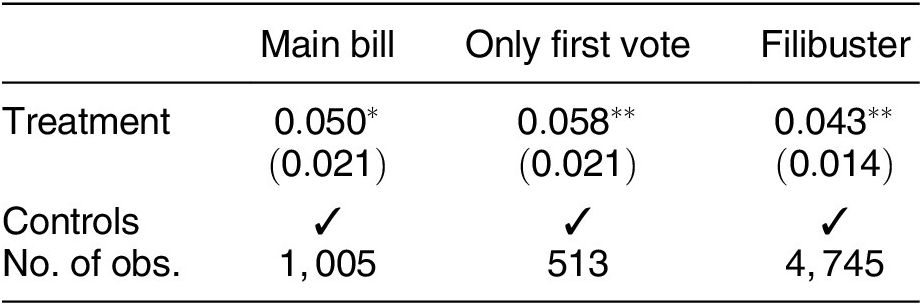
Because treatment was randomized within blocks, I next estimate OLS regressions of support for the pension reform (YEA vote) on treatment status, including fixed effects for each randomization block and relevant control variables. Table 2 presents the estimated treatment effects for two outcomes: votes on the main constitutional amendment and votes on filibuster proposals introduced by the opposition to delay or block the reform (p values between
$ <0.01 $
 and
$ <0.05 $
 ).Footnote
14
OLS Estimates for the Intent-to-Treat Effect

Table 2. Long description
The table consists of four columns and five primary rows.
Header Row: The first column is blank, followed by Main bill, Only first vote, and Filibuster.
Treatment Row:
- Main bill: 0.050 with one asterisk.
- Only first vote: 0.058 with two asterisks.
- Filibuster: 0.043 with two asterisks.
Standard Error Row (values in parentheses):
- Main bill: 0.021.
- Only first vote: 0.021.
- Filibuster: 0.014.
Controls Row: All three columns contain a checkmark symbol.
Number of Observations Row:
- Main bill: 1,005.
- Only first vote: 513.
- Filibuster: 4,745.
Footer Legend: Three asterisks indicate p is less than 0.001; two asterisks indicate p is less than 0.01; one asterisk indicates p is less than 0.05.
Note: The dependent variable is a dummy that takes the value of one if the legislator voted in favor of the main bill or in favor of ending filibuster. Standard errors are clustered by legislator, with the exception of the model for only the first vote cast. All models include block fixed effects to account for the block randomization.
$ {}^{***}p<0.001 $
 ;
$ {}^{**}p<0.01 $
 ;
$ {}^{*}p<0.05 $
 .
The results are also consistent with the preregistered hypothesis. Legislators exposed to the treatment message—highlighting the economic importance and broad coalition backing of the business group—were significantly more likely to vote in favor of the main reform proposal. The same pattern holds for the supplementary robustness checks: treated legislators were also more likely to support ending filibuster efforts, aligning with the pro-reform position of the business coalition. These effects persist when considering only first votes cast.
The magnitude of the average effect—between 4 and 5 percentage points—is consistent with field experimental findings in other legislative contexts, including the United States (Kalla and Broockman Reference Kalla and Broockman2016; Zelizer Reference Zelizer2018). The estimated effect—while moderate in size—is meaningful in a context where baseline support was already high. In such settings, room for persuasion is inherently constrained, and effect sizes are expected to be smaller. Moreover, as this is an ITT estimate, the effect likely understates the impact among those who actually engaged with the treatment, given the possibility that some participants may have only minimally processed or ignored the treatment information.
Anecdotal evidence further illustrates how legislators incorporated informational cues into their decision making. Several deputies responded formally to the organization, confirming receipt of the message and explicitly stating their support for the reform. Figures C8 and C9 in the Supplementary Material display examples of these responses. One deputy wrote: “I would like to inform you that I have received a letter from the Movement for a Competitive Brazil inviting me to support the pension reform. First, I want to congratulate you on your important work in persuading parliamentarians. I would also like to state that I fully support the reform and agree with all the points in your letter. Let’s work together for a better Brazil!”
Overall, the results support the hypothesis that legislators do consider the specific cues of interest groups. In this specific context, a key player in informing politicians about the positions of large businesses coalition was able to sway votes in their favor. Although it is impossible to capture the internal calculations of legislators, the results align with the main theory.
Robustness Check
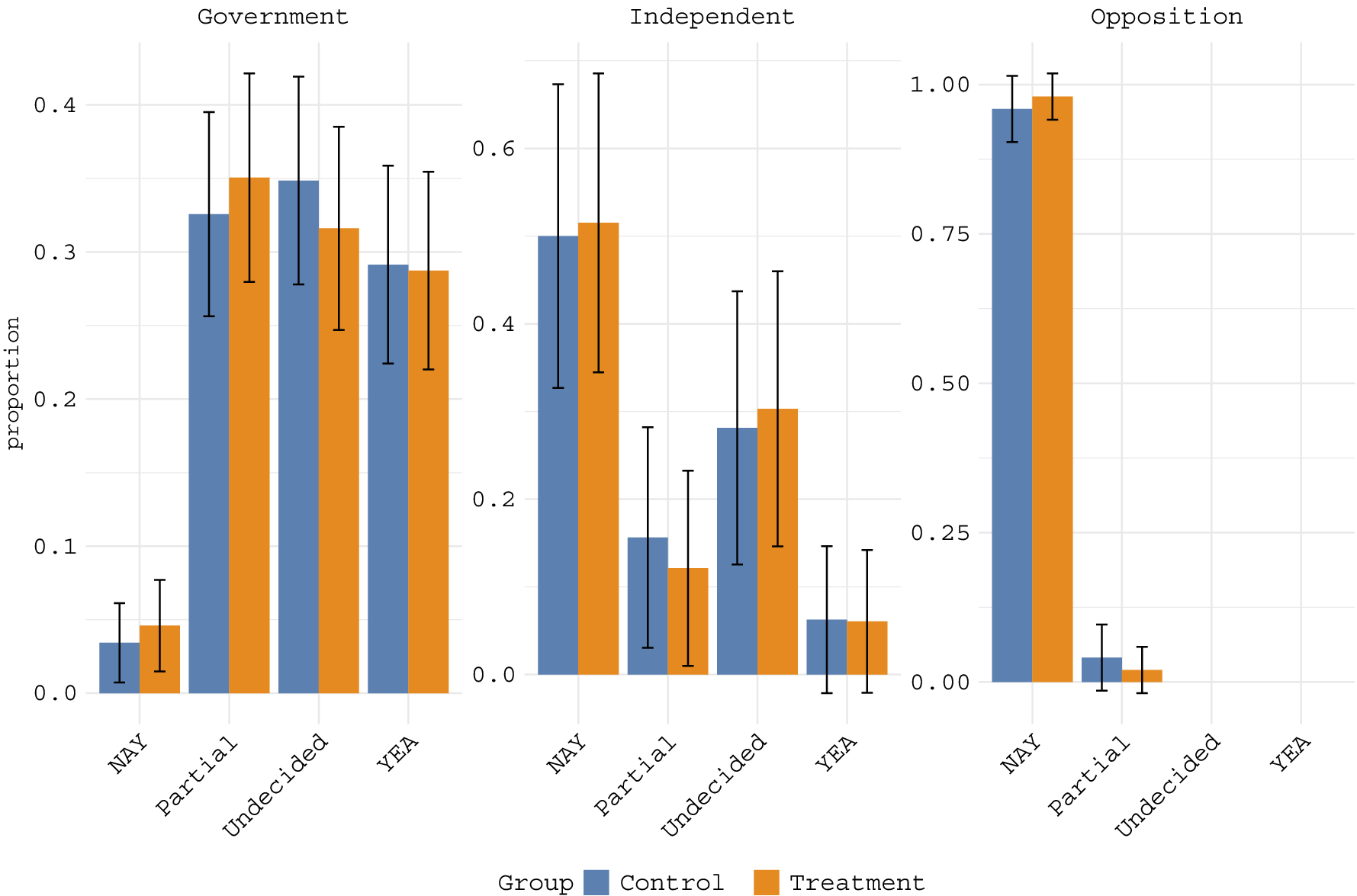
While legislators only reveal their true positions during roll-call votes, it is possible to approximate their latent behavior prior to treatment assignment to test for differences in behavior before and after the experimental manipulation. Six months before the vote on the Constitutional Amendment, Valor Econômico, a leading newspaper, launched an online daily tracker of pension reform votes in partnership with the polling company Atlas Intel. Each time a legislator publicly declared their stance on the pension reform, it was recorded in the tracker. Four months before the vote, only 28% of federal deputies had revealed their support for the proposal (Mendonça Reference Mendonça2019). A week before the vote, 46% had publicly expressed some level of support for the proposal (24% fully in favor and 22% partially in favor, with disagreements on specific aspects of the proposal), still below the 60% threshold needed to amend the constitution (Klein, Cristian Reference Klein2019). Approximately 26% of the deputies refused to disclose their votes in advance, but the expectation among political actors was that the reform would pass with a significant margin of votes (Campos Reference Campos2019).
Figure 2 shows that there was no significant difference in pretreatment behavior between the treatment and control groups (118 deputies in the treatment group declared a YEA or partial vote prior to treatment assignment, compared to 117 in the control group). Furthermore, the vote declarations in Valor Econômico by deputies from both groups were evenly distributed across the different block groups. The figure provides evidence for the balance of the randomization at the block level (see more in Appendix D of the Supplementary Material).
Pretreatment Proxy for Roll Call Behavior
Note: Valor Econômico/Atlas Intel daily tracking, collected the day before treatment assignment.

Figure 2. Long description
The graph consists of three vertical panels. The Y-axis is labeled proportion and ranges from 0.0 to 1.0. A legend at the bottom identifies blue bars as Control and orange bars as Treatment. Each bar includes a vertical error bar representing confidence intervals.
* Panel 1 (Government): Proportions are highest for Partial and Undecided categories, both around 0.3 to 0.35. YEA is slightly lower at approximately 0.3, while NAY is the lowest, under 0.1.
* Panel 2 (Independent): NAY has the highest proportion at approximately 0.5. Undecided follows at roughly 0.3. Partial and YEA categories show lower proportions, with YEA being the lowest at under 0.1.
* Panel 3 (Opposition): This panel shows a different scale on the Y-axis reaching 1.00. NAY is the dominant response, with both Control and Treatment bars near 0.95. Partial is very low, under 0.05, while Undecided and YEA show zero or near-zero proportions.
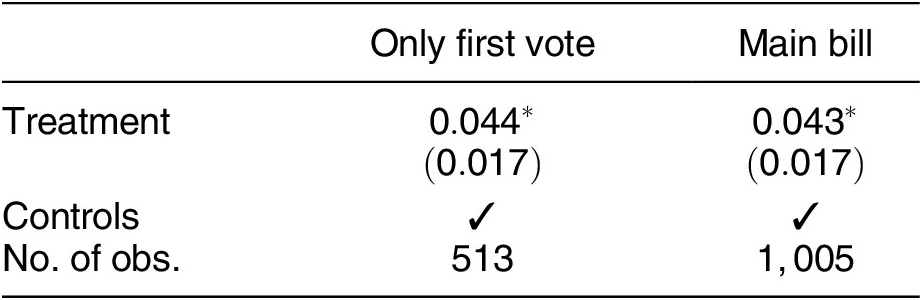
To evaluate the changes from the pre- and post-treatment legislators’ positions, I present some exploratory analyses (not preregistered) of the positions registered by the national newspaper. The Valor Econômico/Atlas Intel daily tracking presented information about legislators who said that they were fully against the proposed reform and those who said that they disagreed with parts of the legislation. I create dummy variables that track changes in votes from the newspaper’s tracker and the tally to the final vote. I estimate the same OLS regressions on the change in positions considering the two different measures of support for the pension reform: the vote on the main bill and against the filibuster attempts. Specifically, a higher number of federal deputies in the treatment group (4 percentage points) shifted their votes from a NAY to a YEA after receiving the treatment message.
Finally, I present the complete balance tests for the field experiment in Appendix D of the Supplementary Material. I address in more detail the concern that the main results might be influenced by systematic disparities in support for the executive’s proposals. Prior to the reform vote, legislators in the treatment group did not systematically support the executive’s agenda more than those in the control group (Table 3).
OLS Estimates for Changes from Pretreatment “Vote” to the Roll Call

Table 3. Long description
The table consists of three columns. The first column lists the variables, while the second and third columns provide data for Only first vote and Main bill respectively.
* Treatment: 0.044 with a single asterisk in the first column and 0.043 with a single asterisk in the second column. Standard errors of 0.017 are listed below both values.
* Controls: Both columns contain a checkmark symbol indicating controls were applied.
* Number of observations: 513 for Only first vote and 1,005 for Main bill.
The footer defines the significance levels: triple asterisk p is less than 0.001, double asterisk p is less than 0.01, single asterisk p is less than 0.05, and dot p is less than 0.1. A note specifies that the dependent variable is a dummy taking the value of one if the pretreatment vote changed from against to full support, with standard errors clustered by legislator.
Note: The dependent variable is a dummy that takes the value of one if the pretreatment vote changed from “against” to the full support in the actual bill. Standard errors are clustered by legislator.
$ {}^{***}p<0.001 $
 ;
$ {}^{**}p<0.01 $
 ;
$ {}^{*}p<0.05 $
 ;
$ {}^{\cdot }p<0.1 $
 .
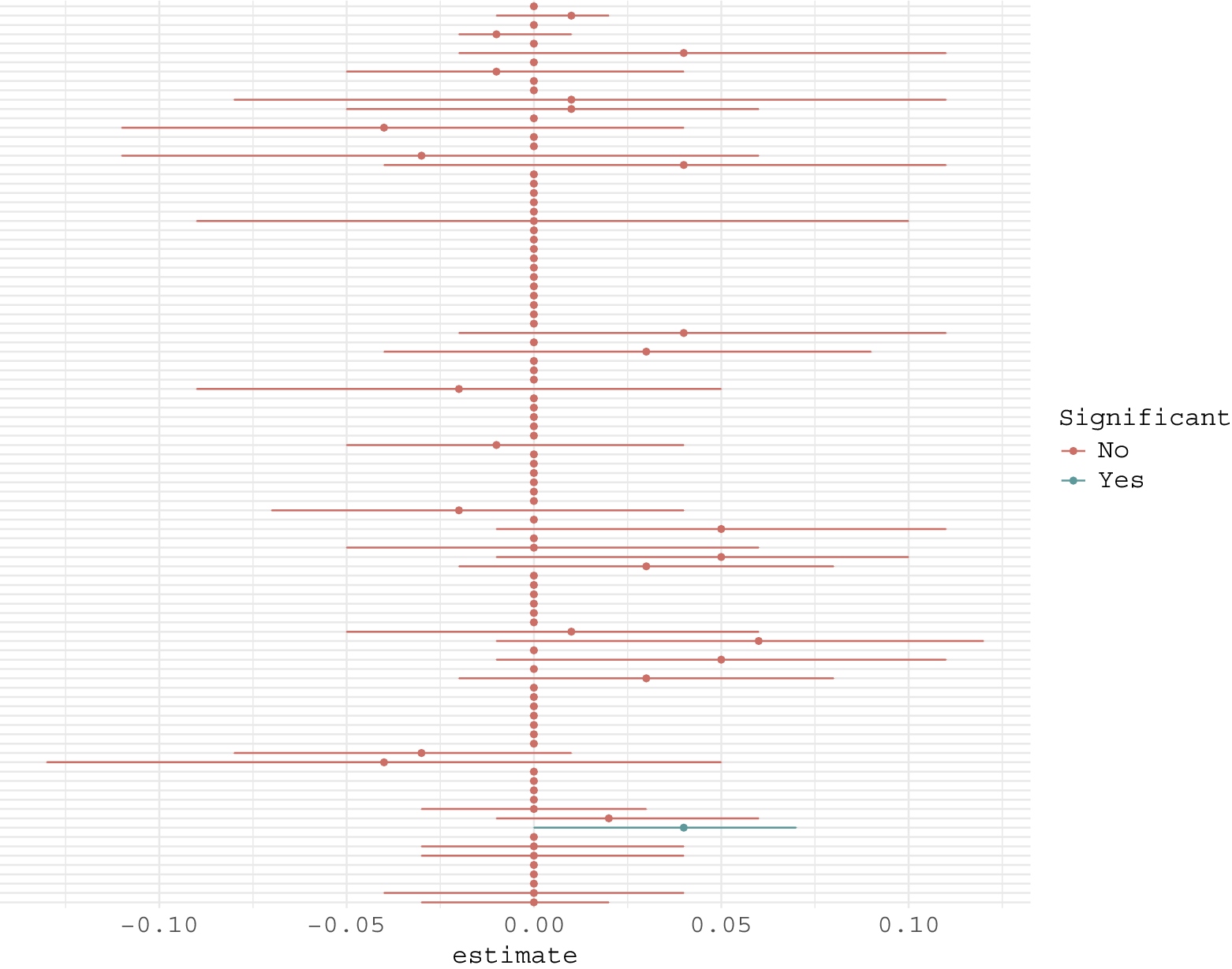
This pattern remained unchanged after treatment assignment: there is no evidence that the treatment influenced legislators’ behavior on other policy issues. Specifically, voting patterns on all subsequent roll call votes for only substantive bills, excluding any bureaucratic votes (over 34,000 individual votes distributed on 97 roll calls), do not show systematic differences between groups. As shown in Figure 3, the distribution of post-treatment roll call votes is centered around zero, and only 1 out of 97 votes showed a statistically significant difference between the treatment and control groups and this other bill was part of the pension reform negotiation.Footnote 15 These results reinforce the interpretation that the observed effect is specific to the pension reform vote and not driven by broader changes in political alignment or spillover effects.Footnote 16
Differences between the Treatment and Control Do Not Occur for Other Bills

Figure 3. Long description
A coefficient plot with a horizontal x axis labeled estimate, ranging from -0.10 to 0.10 with a vertical grid line at 0.00. The y axis contains numerous unlabeled rows representing different bills. A legend on the right titled Significant indicates that red dots represent No and teal dots represent Yes.
* The plot contains approximately 60 rows of data.
* Most rows feature a red dot exactly on the 0.00 vertical line with no visible error bars, indicating a null effect.
* Several rows show red dots slightly to the left or right of zero with horizontal error bars that cross the 0.00 line, confirming they are not statistically significant.
* Near the bottom of the plot, one single data point is teal, located at approximately 0.04 on the x axis. Its horizontal error bar does not cross the 0.00 line, indicating it is the only statistically significant estimate in the set.
* The distribution of non-significant estimates is roughly symmetrical around the zero baseline.
Survey Experiment: Design
To better understand the mechanisms that explain how informational cues about a group’s economic relevance and coalition breadth affect perceptions of influence, I conducted a survey experiment with professional lobbyists affiliated with Institute for Government Relations (IRelGov), the largest association of lobbying professionals in Brazil. While surveying legislators directly was not feasible, lobbyists are well-positioned to assess the kinds of messages that shape legislators’ responsiveness. As part of their professional practice, they are routinely engaged in crafting persuasive communications and gauging what types of signals—such as who speaks, on whose behalf, and with what organizational backing—are most effective in influencing policymakers. These professionals thus provide a unique window into the mechanisms of informational lobbying.Footnote 17 Because of the time-sensitive and high-pressure nature of lobbying work, the organization agreed, through a Memorandum of Understanding, to a short and focused survey design. This format allowed for the collection of theoretically relevant data while respecting respondents’ limited availability and demanding professional schedules.
The survey was distributed to 808 registered members of Irelgov via 6 separate messages sent through the association’s official WhatsApp and email lists. A total of 262 professionals completed the survey, yielding a response rate of 32.4%. This rate surpasses typical response rates for elite surveys in the United States (Butler and Powell Reference Butler and Powell2014) and is comparable to other elite-level surveys in Brazil (Toral Reference Toral2024). The survey was designed to examine how different informational messages affect respondents’ perceptions regarding their ability to influence politicians. After answering pretreatment questions (e.g., age, gender, organization, and state), participants were randomly assigned to receive one of the same messages used in the field experiment, with the organization’s name anonymized and replaced by a generic label. By randomizing exposure to these messages, the survey enables estimation of the impact of message type on lobbyists’ perceptions, as well as indirectly identifying the mechanisms respondents believe underlie politicians’ behavior, without explicitly prompting for those mechanisms.Footnote 18
The field experiment bundled cues about economic relevance and coalition breadth because these two dimensions typically vary together in the real world. The survey therefore evaluates whether random exposure to the message changes respondents’ expectations about legislators’ attention and vote responsiveness, and which organizational attributes they view as most persuasive. The field experiment provides the causal estimate of the bundled cue on votes, while the survey and interviews offer complementary evidence about how practitioners and elites interpret the sources of that influence. Conditions capture how exposure to the bundled cue shifts which dimensions are salient, rather than merely mirroring message content.
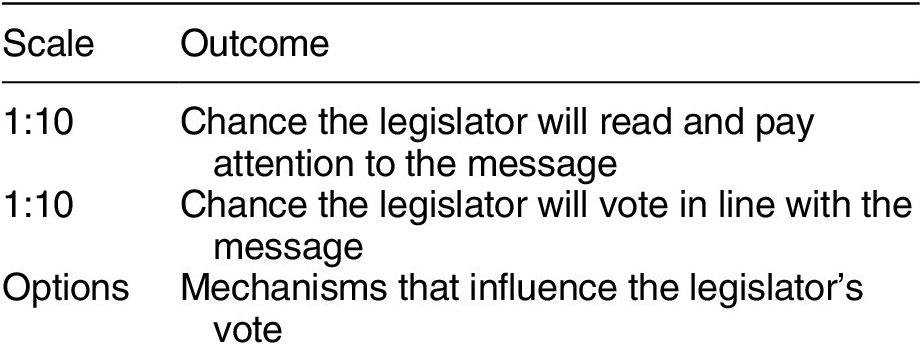
After exposure to the messages, respondents were asked to assess the likelihood that a legislator would first pay attention to the message and then use the information within it to form an opinion on specific legislation. This two-part structure allows for a more precise measure of informational influence—capturing both immediate attentiveness and the deeper persuasive impact of different message types. Respondents answered three outcome questions, presented in Table 4. The two main outcomes focus on how different types of information affect legislators’ attentiveness and responsiveness, as evaluated by professional lobbyists. To probe the mechanisms underlying these effects, respondents were asked which factors might explain why a legislator would pay attention to and rely on a message when making decisions: (a) economic relevance of the organization, (b) political influence of the organization, (c) presence of a broad, cross-sector coalition, (d) technical expertise or credibility on the policy issue, (e) personal proximity to the sender, and (f) other [open-ended response].
Mechanisms for the Lobbying Effect

Table 4. Long description
The table consists of two columns labeled Scale and Outcome.
* Row 1: Scale is 1 to 10. Outcome is the chance the legislator will read and pay attention to the message.
* Row 2: Scale is 1 to 10. Outcome is the chance the legislator will vote in line with the message.
* Row 3: Scale is Options. Outcome is the mechanisms that influence the legislator's vote.
Six hypotheses were preregistered, focusing on how exposure to different informational cues affects lobbyists’ perceptions of message effectiveness.Footnote 19 These hypotheses include expectations about whether messages that emphasize an interest group’s economic relevance and coalition breadth are perceived as more persuasive. I use responses to survey questions—rated on a 10-point scale—about the likelihood that legislators would read and use the information to evaluate whether lobbyists believe such cues enhance a message’s influence. Specifically, I regress respondents’ answers on an indicator for assignment to the treatment or control condition. This allows me to assess whether lobbyists perceive that highlighting organizational attributes such as economic importance or cross-sectoral support increases the persuasive power of lobbying communications.
Survey Experiment: Results
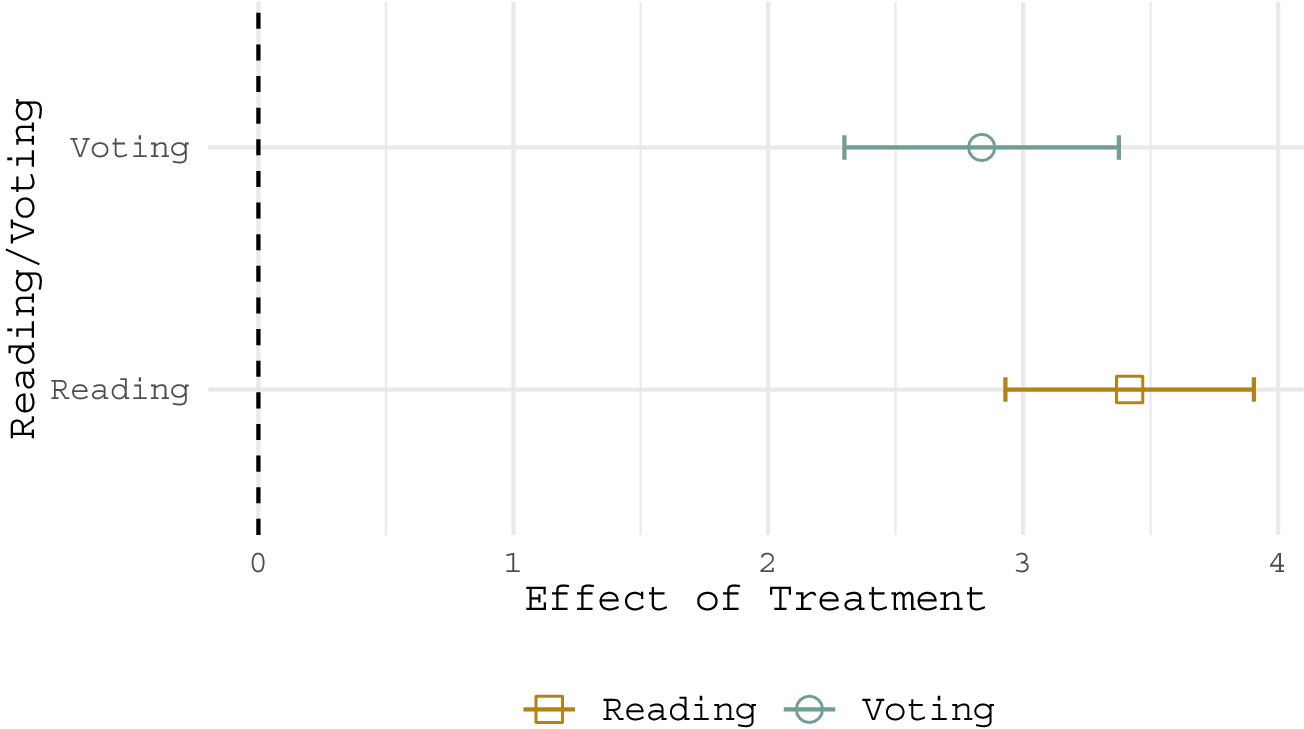
Figure 4 presents the main results. Lobbyists who were exposed to the treatment message rated the probability of a legislator reading the message 3.4 points higher than those in the control group, on a scale from 1 (lowest probability) to 10 (certainty). The results indicate that the treatment message is associated with a 0.68 standard deviation increase in the perceived likelihood that a legislator would read the message (
$ p<0.001 $
 ).
Treatment Effect on the Probabilities of Legislators Reading and Using the Messages
Note: Lobbyists were asked to evaluate probabilities on a scale of 1–10. The plot illustrates the average treatment effect, with robust standard errors and 95% confidence intervals.

It is theoretically expected that not all legislators who engage with the message will actually use it in their decision-making process. Even those who weigh the message within their own utility calculations might not incorporate it into their voting decisions. Nevertheless, lobbyists do think that information about the power of a certain group will influence legislators’ votes. The treatment effect is 2.8 points on the scale (
$ p<0.001 $
 ), corresponding to a 0.57 standard deviation increase in the perceived likelihood that a legislator would use the information about the power of the interest group in their voting choices.
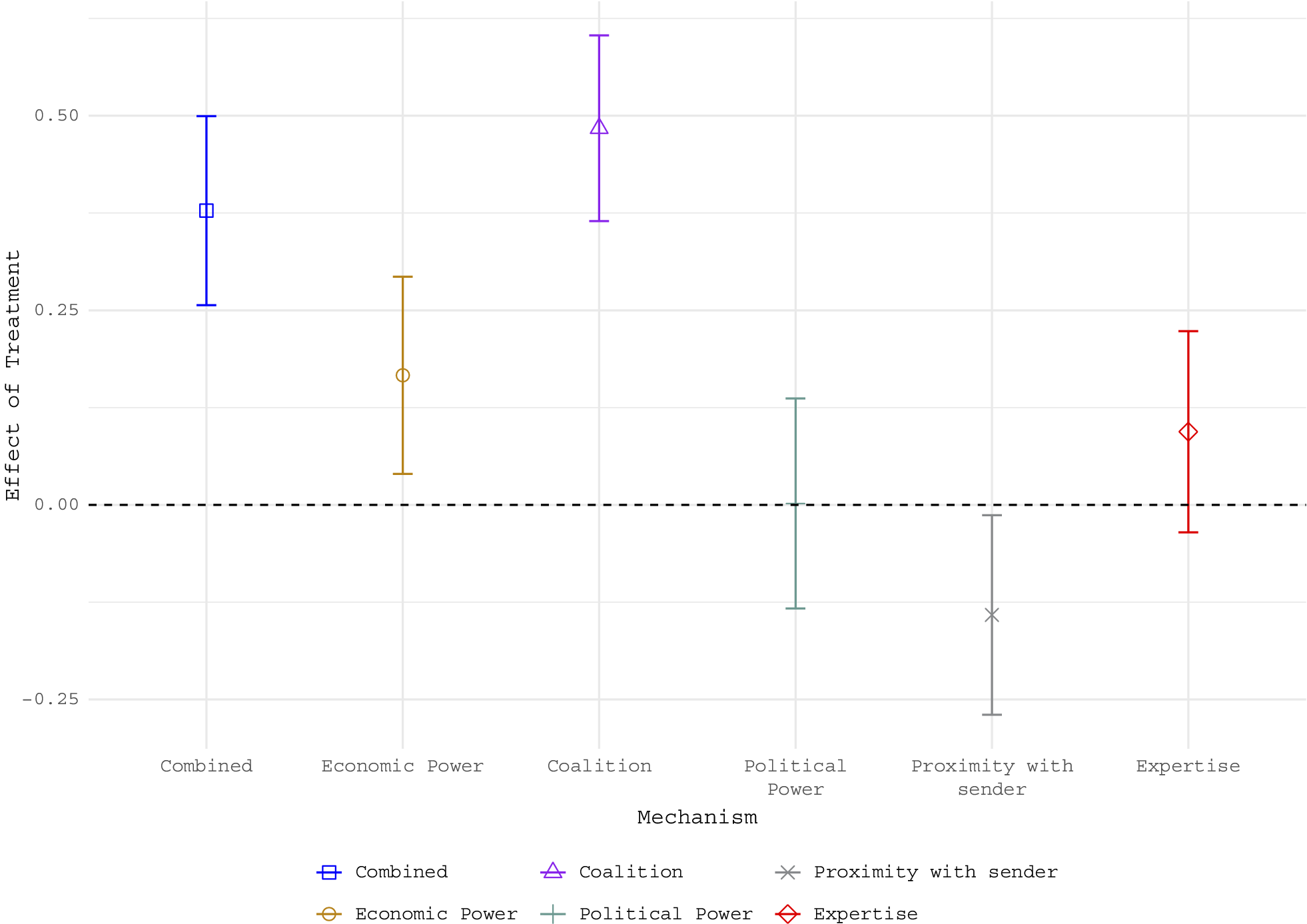
To more directly test the mechanisms behind when politicians weigh the power of interest groups, I use the open list of possible explanations presented to lobbyists. Respondents could choose any number of pre-established mechanisms or provide their own answers. Each topic was transformed into a binary variable. Figure 5 presents the results. The economic and coalitional mechanisms are consistent with the expectations.
Expected Mechanisms Driving Legislators’ Decisions
Note: The plot illustrates the difference in the proportion of participants who chose a specific mechanism between the treatment and control groups, with robust standard errors and 95% confidence intervals.

Figure 5. Long description
The Y-axis is labeled Effect of Treatment and ranges from -0.25 to 0.50 with a dashed horizontal baseline at 0.00. The X-axis is labeled Mechanism and contains six categories. From left to right, the data points are as follows.
* Combined: A blue square point at approximately 0.38 with a confidence interval from 0.25 to 0.50.
* Economic Power: A gold circle point at approximately 0.17 with a confidence interval from 0.04 to 0.29.
* Coalition: A purple triangle point at approximately 0.48 with a confidence interval from 0.37 to 0.59.
* Political Power: A teal plus sign point at approximately 0.00 with a confidence interval from -0.13 to 0.14.
* Proximity with sender: A grey X point at approximately -0.14 with a confidence interval from -0.27 to -0.01.
* Expertise: A red diamond point at approximately 0.10 with a confidence interval from -0.04 to 0.23.
A legend at the bottom maps these symbols and colors to their respective mechanism names.
Lobbyists exposed to the treatment message were significantly more likely to identify economic and coalitional dimensions as mechanisms influencing legislators’ decisions. Specifically, the likelihood of selecting economic power as a persuasive factor was 16 percentage points higher in the treatment group compared to the control group. The effect was even stronger for coalitional breadth: lobbyists in the treatment group were over 40 percentage points more likely to cite this factor. Moreover, the share of respondents who selected both economic and coalitional mechanisms was 38 points higher in the treatment group. These sizable effects suggest that messages emphasizing an interest group’s breadth and economic relevance are seen by practitioners as considerably more persuasive—consistent with the informational lobbying theory that cues about who is speaking and on whose behalf shape elite responsiveness (Figure 5).
The political influence mechanism did not show a statistically significant difference between the treatment and control groups. One plausible explanation is that corporate campaign contributions are prohibited in Brazil, which may lead professional lobbyists to view political power—at least in its financial form—as a less relevant or viable channel of influence. Alternatively, respondents may have been reluctant to associate their profession with politically sensitive practices, such as illegal donations, even in a hypothetical setting. Importantly, political influence was not directly cued in the treatment message: the communication did not include any information about revolving doors, partisan alliances, or campaign relationships. As such, the instrumental dimension of lobbying power—linked to access or resource exchanges—remains underexplored in this design and should be the focus of future work.
Interestingly, additional evidence for the persuasive value of organizational cues comes from responses about personal proximity to legislators. When exposed to the treatment message emphasizing economic and coalitional breadth, lobbyists were significantly less likely to attribute influence to personal closeness between the message sender and the legislator—a 15 percentage point decrease (
$ p=0.016 $
 ). This suggests that when organizational strength is clearly signaled, individual-level access or personal ties become comparatively less important. These findings help disaggregate the mechanisms by which informational lobbying shapes elite behavior.
INTERVIEWS
Between 2019 and 2023, I conducted 18 in-depth interviews, each lasting over 30 minutes, with key political actors and lobbyists. Out of these, 11 conversations were on the record and most of them were recorded on video with the participants’ explicit consent. These individuals—including a former president, three ministers, and key deputies such as the Speaker of the House, the rapporteur, and the president of the Special Committee responsible for drafting the pension reform—rarely engage with academics. The interviews served as an alternative to a survey experiment involving legislators.
The interviews consistently indicated that lobbying plays a crucial informational role in prominent issues, such as the pension reform. The interviewees noted that roll call votes are typically public, while other legislative votes may not be. In highly prominent discussions, individual votes are often publicized through press and social media. Consequently, the visibility of these roll call votes can place legislators in potential conflict with interest groups or particular voter segments. In these cases, the economic and coalitional power of lobbyists organizations become even more important.
Former President Michel Temer (2016–18), who previously served as Vice President and Speaker of the House, offered key insights. Despite using the traditional tools available to presidents, Temer was unable to convince the legislature to approve a pension reform that was central to his platform. However, a similar proposal was successfully passed just six months after he left office. In an interview conducted for this project, Temer attributed the contrasting outcomes to the mobilization of both pro- and anti-reform groups during the two attempts. He explained that his initial failure helped frame the issue, allowing pro-reform groups to subsequently position the reform as critical to the economy, thereby shaping legislators’ decision-making.
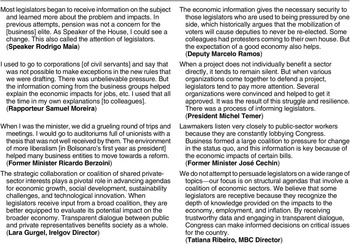
Deputy Marcelo Ramos chaired the special commission responsible for drafting the proposal and became the target of various lobbying efforts. In this influential position, Ramos had direct access to key decision-makers and an in-depth understanding of the legislative process, enabling him to assess the impact of lobbying on legislators. According to Ramos, information about the size of the pro-reform coalition and the economic significance of the involved companies influenced legislators’ calculations. The Speaker of the House, who was responsible for bringing the pension reform to the floor, also acknowledged that the information presented to legislators helped advance the proposed changes.Footnote 20 Finally, the bill’s rapporteur, deputy Samuel Moreira, stated that he extensively used information provided by the private sector to argue for the proposal’s economic impacts (Table 5).
Coalitional and Economic Power Mechanism

Table 5. Long description
The table consists of eight rows of text, each attributed to a specific individual.
* Row 1: Speaker Rodrigo Maia discusses how legislators began receiving information on pension problems and impacts, noting a shift in interest from the business elite.
* Row 2: Deputy Marcelo Ramos explains that economic security helps legislators withstand pressure from protesters, balanced by the expectation of a good economy.
* Row 3: Rapporteur Samuel Moreira describes the pressure from civil servant corporations and how information from business groups regarding jobs and economic impacts helped justify the new rules.
* Row 4: President Michel Temer notes that when various organizations unite to defend a project, legislators pay more attention, highlighting a process of informing lawmakers.
* Row 5: Former Minister Ricardo Berzoini mentions grueling meetings with unionists and how the liberal environment of the Bolsonaro administration's first year encouraged business entities to support reform.
* Row 6: Former Minister José Cechin states that lawmakers listen to public-sector workers but that a large business coalition was necessary to pressure for change based on economic impacts.
* Row 7: Lara Gurgel, I R E L G O V Director, emphasizes that strategic collaboration among private-sector interests is pivotal for economic growth and transparent dialogue.
* Row 8: Tatiana Ribeiro, M B C Director, explains that their focus is on structural agendas and providing trustworthy data on employment and inflation to help Congress make informed decisions.
CONCLUSION
This article demonstrates how politicians respond to cues embedded in communications from interest groups, particularly when those cues convey the organizational strength and credibility of the messenger. Legislators were more likely to support a high-stakes reform proposal after receiving a message that emphasized the economic scale and coalition breadth of a well-known pro-business group. By varying only the informational content of messages—while holding the sender constant—the experiment isolates how persuasive signals about a group’s relevance can shape roll call behavior. These findings underscore the role of informational lobbying in influencing legislative decisions, even in contexts where baseline support for a proposal is already high (over 70%).
The case presents specific characteristics that warrant discussion. Brazil has recorded the highest number of parliamentary parties in the history of the democratic world (Zucco and Power Reference Zucco and Power2021), and its parties are often considered ideologically incoherent (Kellam Reference Kellam2015). Consequently, interest groups may be more likely to influence legislators who are less constrained by party leaders and voters (Chang et al. Reference Chang, Kayser, Linzer and Rogowski2010). Furthermore, the pension reform differed from ordinary legislation because it was not only a highly salient issue but also received strong support from private-sector actors in opposition to unions. This alignment created greater homogeneity among business organizations, which is not always the case (Olson Reference Olson1965). Moreover, the organization involved in the field experiment is recognized for its substantial influence in representing the positions of major businesses in Brazil.
Nevertheless, this context offers an opportunity to examine how interest groups strategically frame their communications to influence legislative agendas and critical votes. What insights can comparativists draw from this article? The study provides a causal explanation for when and why lobbying messages are effective: legislators respond to persuasive cues about the representativeness, and economic relevance of the messenger. By highlighting how political elites incorporate these informational signals into their decision-making, the article fills an important gap in the literature.
SUPPLEMENTARY MATERIAL
To view supplementary material for this article, please visit https://doi.org/10.1017/S0003055426101865.
DATA AVAILABILITY STATEMENT
Research documentation and data that support the findings of this study are openly available at the American Political Science Review Dataverse: https://doi.org/10.7910/DVN/DAJ0YH.
ACKNOWLEDGEMENTS
I am grateful to Tatiana Ribeiro, from Movimento Brasil Competitito, and Lara Gurgel, from Irelgov, for the participation in the implementation of the field and survey experiments. I thank Barbara Geddes, Simon Chauchard, Michael Thies, Guillermo Toral, Cesar Zucco, Patrick Kraft, Paul Atwell, Miguel Pereira, Natalia Bueno, Tamar Zeilberger, the anonymous reviewers, and audience members at EPSA 2025, MESS 2024, APSA 2022, Carlos III University, and Insper for comments and suggestions.
FUNDING STATEMENT
This research was funded by UCLA’s Dissertation Year Fellowship and Summer Mentored Research Fellowship. The author also received funding from the European Research Council (ERC) under the European Union’s Horizon 2020 Research and Innovation Programme (Grant Agreement No. 101002985 [ERC POLARCHATS Project]).
CONFLICT OF INTEREST
The author declares no ethical issues or conflicts of interest in this research.
ETHICAL STANDARDS
The author declares that the human subjects research in this article was reviewed and approved by the University of California, Los Angeles (Protocol IRB 19-001016) and by the UC3M’s GDPR data protection and ethical officers. Certificates are provided in the Dataverse. The author affirms that this article adheres to the principles concerning research with human participants laid out in APSA’s Principles and Guidance on Human Subject Research (2020).





 Open access


Comments
No Comments have been published for this article.