Introduction
Preventing and relieving suffering lies at the heart of the definition and aim of palliative care (WHO, 2021). The word ‘suffering' translates from the Latin verb ‘sufferer' as ‘to undergo,' ‘to bear,' or ‘to carry' (Browning, Reference Browning, Berzoff and Silverman2004). Suffering is often viewed as inherently multidimensional; that is, simultaneously physical, emotional, psychological, social, existential and/or spiritual in nature (Williams, Reference Williams2004; Sacks and Nelson, Reference Sacks and Nelson2007; Sudore et al., Reference Sudore, Villars and Carey2010; Krikorian et al., Reference Krikorian, Limonero and Mate2012; Montoya-Juarez et al., Reference Montoya-Juarez, Pas Garcia-Caro and Campos-Calderon2013a; Beng et al., Reference Beng, Guan and Seang2014). This holistic view of suffering is akin to the concept of ‘total pain,’ coined by the founder of the modern hospice movement, Dame Cicely Saunders. ‘Total pain’ “include[s] physical symptoms, mental distress, social problems, and emotional difficulties” (Clark, Reference Clark2016, p. 131); if physical pain is difficult to treat, it may be connected to nonphysical elements, resulting in ‘total pain,' or ‘total suffering' (Saunders et al., Reference Saunders, Baines and Dunlop1995). Saunders' conceptualization of suffering, along with Dr. Eric Cassell's (Reference Cassell1982) which defines suffering as “the state of severe distress associated with events that threaten the intactness of the person” (p. 640), are widely referenced in the palliative care literature. Like Saunders, Cassell, too, believes that suffering should not be separated into physical and nonphysical realms (Cassell, Reference Cassell2004). Cassell is credited with moving medicine's understanding of suffering away from a focus on solely its bodily or physical manifestations, to an understanding of suffering as that which affects — or “afflict[s]” — a ‘person,' or one's personhood (Cassell, Reference Cassell2004, p. xii).
Both research and front-line practice reveal, however, that physical suffering and nonphysical suffering do not always co-exist, and can be distinct experiences for patients, families, and clinicians alike. Nonphysical suffering includes suffering that is emotional, psychological, existential, spiritual, and/or social in nature. Increasing our understanding of nonphysical suffering is important — vital, in fact — to the work of palliative care practitioners across all disciplines, which is the aim of this scoping review.
Methods
Scoping Reviews are systematic ways of examining a large body of literature, “especially when an area is complex or has not been reviewed comprehensively before” (Arksey and O'Malley, Reference Arksey and O'Malley2005, p. 21). ‘Suffering’ is described as complex and multifaceted in the palliative care literature (Daneault et al., Reference Daneault, Lussier and Mongeau2006; Sacks and Nelson, Reference Sacks and Nelson2007; Montoya-Juarez et al., Reference Montoya-Juarez, Pas Garcia-Caro and Campos-Calderon2013a), and a scoping review specific to suffering, let alone nonphysical suffering, within palliative care has not been completed before.
Inclusion and exclusion criteria
Inclusion and exclusion criteria were developed at the review's outset and refined as the process unfolded (Arksey and O'Malley, Reference Arksey and O'Malley2005). Levac et al. (Reference Levac, Colquhoun and O'Brien2010) noted that in scoping reviews, “Study selection involves post hoc inclusion and exclusion criteria. These criteria are based on the specifics of the research question and on new familiarity with the subject matter through reading the studies” (p. 3). All articles had to be peer reviewed and published in English. Studies needed to have as a primary purpose either a focus on suffering that was specifically nonphysical in nature, or a focus on trying to better understand ‘suffering,' including both nonphysical and physical elements. Studies that focused exclusively on physical suffering or did not specify the nature of suffering (whether physical and/or nonphysical) were excluded, as were studies that asked patients about their experiences of nonphysical aspects of ‘pain' or ‘distress,' but not ‘suffering.' All study participants had to be themselves receiving palliative care and/or living with an advanced illness, or be caregivers/family members of patients receiving palliative care and/or living with an advanced illness. In studies focusing on clinician experiences working with nonphysical suffering, clinicians had to work specifically with individuals receiving palliative care and/or living with an advanced illness. The author of this paper chose to exclude one of their own studies that would have met the inclusion criteria.
Search strategy
A computerized search was conducted of sources published as of February 2020 in the following databases: CINAHL, MEDLINE, and PsycINFO. The following keywords were used: (suffering) AND (palliative OR “end of life” OR “end-of-life” OR hospice OR dying OR terminal* ill*). As CINAHL does not offer the option to search by ‘keyword,' terms were searched using the ‘MJ Word' option. This search strategy resulted in 447 records. Of the 447 records, 125 were duplicates. The total number of records rejected was 241: 11 were rejected outright because they were book reviews, conference abstracts, or on an unrelated topic, and an additional 230 articles were rejected because they were not research studies (e.g., conceptual papers, commentaries, etc.). Of the 87 research studies, including 6 that were identified through hand searching reference lists, 30 met this scoping review's inclusion/exclusion criteria. See Table 1 for the study's Prisma flowchart.
Prisma flowchart

Data analysis
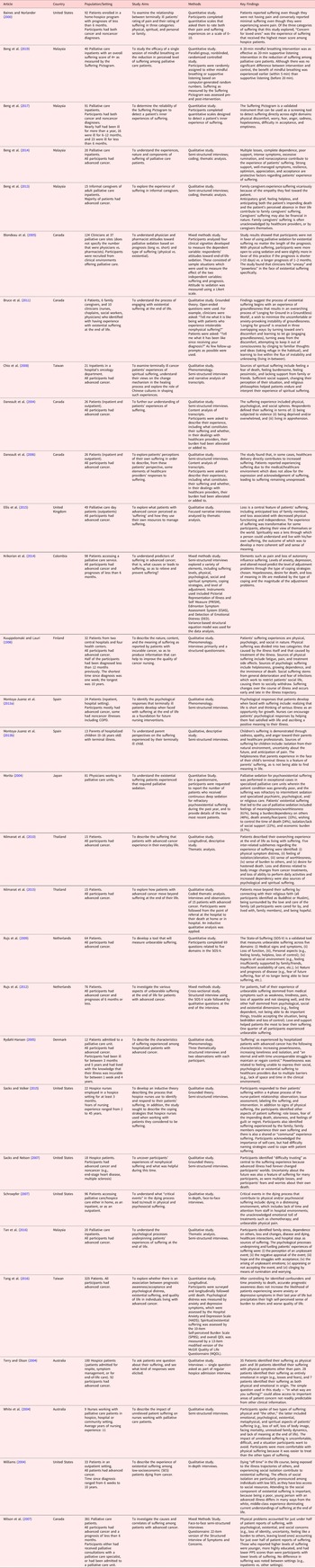
Arksey and O'Malley's (Reference Arksey and O'Malley2005) five stages framework for scoping reviews guided the review process. Stage 1 is the ‘Identification of a Research Question.' The research question guiding this scoping study is: What is known from the research about nonphysical suffering within the context of palliative care? Its purpose is to gain a better understanding of nonphysical suffering, to identify gaps in the research, and to consider implications for both front-line practice and future research. Stage 2 involves the ‘Identification of Relevant Studies' and Stage 3 is ‘Study Selection'; closely following the inclusion and exclusion criteria developed for this review helped in the identification and selection of 30 relevant studies. Stage 4 involves ‘Charting the Data'; a technique that entails “sifting, charting and sorting material according to key issues and themes,” and “collecting standard information on each study” (Arksey and O'Malley, Reference Arksey and O'Malley2005, p. 26). Table 2 provides a brief summary of standard study characteristics, including study settings (e.g., inpatient and outpatient palliative care programs), study location (country), and patient diagnoses. A chart of all studies included in the review was developed to track study aims and key findings (see Table 3). From there, commonalities and differences were noted across all findings which allowed for the identification of seven themes. Stage 5 of Arksey and O'Malley's (Reference Arksey and O'Malley2005) model is summarizing and reporting the results, which is the focus of the following section.
Summary of study characteristics

Summary of studies included in the scoping review (n = 30)

Results
In total, 30 studies were reviewed. Seven themes can be identified: (i) patients’ experiences of nonphysical suffering; (ii) patient coping mechanisms; (iii) efforts to measure nonphysical suffering; (iv) palliative sedation; (v) requests for hastened death; (vi) family suffering; and (vii) clinician suffering.
Theme 1: Patients’ experiences of nonphysical suffering
Thirteen of the 30 research studies included in the scoping review focus on trying to explain or understand patients’ experiences of nonphysical suffering.
Losses
The multiple and accumulated losses that individuals experience in the advanced stages of illness are a key component of nonphysical suffering, including loss of independence (Daneault et al., Reference Daneault, Lussier and Mongeau2004; Wilson et al., Reference Wilson, Chochinov and McPherson2007; Nilmanat et al., Reference Nilmanat, Chailungka and Phungrassami2010; Beng et al., Reference Beng, Guan and Seang2014; Ellis et al., Reference Ellis, Cobb and O'Connor2015; Tan et al., Reference Tan, Loh and Lam2016; Tang et al., Reference Tang, Chang and Chen2016), functional losses (Kuuppelomaki and Lauri, Reference Kuuppelomaki and Lauri1998; Beng et al., Reference Beng, Guan and Seang2014), and loss of control (Kuuppelomaki and Lauri, Reference Kuuppelomaki and Lauri1998; Rydahl-Hansen, Reference Rydahl-Hansen2005; Wilson et al., Reference Wilson, Chochinov and McPherson2007; Rujs et al., Reference Rujs, Kerkhof and van der Wal2012). Loss from physical changes also comes in the form of changes to one's body image, which can be related to the effects of treatments, surgeries, and the illness itself (Kuuppelomaki and Lauri, Reference Kuuppelomaki and Lauri1998; White et al., Reference White, Wilkes and Cooper2004; Nilmanat et al., Reference Nilmanat, Chailungka and Phungrassami2010). The loss or “erosion” of one's social roles and/or social identity is another aspect of nonphysical suffering prominent in the research (Daneault et al., Reference Daneault, Lussier and Mongeau2004, p. 9; Wilson et al., Reference Wilson, Chochinov and McPherson2007; Rujs et al., Reference Rujs, Kerkhof and van der Wal2012; Ellis et al., Reference Ellis, Cobb and O'Connor2015). Participants throughout the studies experience profound social isolation, loneliness, and alienation, even when they are receiving care and are near the people in their life — another key aspect of nonphysical suffering (Kuuppelomaki and Lauri, Reference Kuuppelomaki and Lauri1998; Williams, Reference Williams2004; Wilson et al., Reference Wilson, Chochinov and McPherson2007; Nilmanat et al., Reference Nilmanat, Chailungka and Phungrassami2010, Reference Nilmanat, Promnoi and Phumgrassami2015; Montoya-Juarez et al., Reference Montoya-Juarez, Garaa-Caro and Schmidt-Rio2013b). Loss-induced suffering is also experienced in the form of patients anticipatorily grieving their families, including chosen family. One study describes it as, “anticipated separation from family, [and] anticipated loss of all things in the end, including their own existence” (Beng et al., Reference Beng, Guan and Seang2014, p. 49). The losses associated with not being able to achieve one's goals, and, in general, grieving a future that they will not be a part of is another aspect of nonphysical suffering described in the research (Daneault et al., Reference Daneault, Lussier and Mongeau2004; Ellis et al., Reference Ellis, Cobb and O'Connor2015).
Fears
Nonphysical suffering also comes in the form of fears. Patients' fears include fear of the future, the unknown, uncertainty, future suffering, death, and fear of being burdensome (Kuuppelomaki and Lauri, Reference Kuuppelomaki and Lauri1998; Daneault et al., Reference Daneault, Lussier and Mongeau2004; White et al., Reference White, Wilkes and Cooper2004; Williams, Reference Williams2004; Sacks and Nelson, Reference Sacks and Nelson2007; Chio et al., Reference Chio, Shih and Chiou2008; Rujs et al., Reference Rujs, Onwuteaka-Philipsen and van der Wal2009; Montoya-Juarez et al., Reference Montoya-Juarez, Garaa-Caro and Schmidt-Rio2013b). Patients’ nonphysical suffering comprise fears of how death will happen, as well as fears that death will happen (Daneault et al., Reference Daneault, Lussier and Mongeau2004; Terry and Olson, Reference Terry and Olson2004), with research participants expressing, for example: “I get caught up in fear. I don't want to have a drawn out agony [when I die]” (Daneault et al., Reference Daneault, Lussier and Mongeau2004, p. 10), and “I don't want to die, I'm scared” (Terry and Olson, Reference Terry and Olson2004, p. 605). One study notes that dying young or “off time” contributes to existential fears and suffering (Williams, Reference Williams2004, p. 27), with another study finding that patients’ prognostic awareness increases suffering (Tang et al., Reference Tang, Chang and Chen2016).
Worries about family/friends
Patients’ worries about their family and/or friends are another key component of nonphysical suffering. Patients’ worries stem from how family members are currently coping and how they will cope after they die (Baines and Norlander, Reference Baines and Norlander2000; Rydahl-Hansen, Reference Rydahl-Hansen2005; Beng et al., Reference Beng, Guan and Seang2014; Ellis et al., Reference Ellis, Cobb and O'Connor2015). One research participant shares: “ … Umm I just feel sometimes you know the hurt that I've given to my husband and the boys. Umm … and they're going to have to cope afterwards … That's what hurts the most” (Ellis et al., Reference Ellis, Cobb and O'Connor2015, p. 203). Additionally, patients feel “emotional pain” (Ellis et al., Reference Ellis, Cobb and O'Connor2015, p. 204), grief and helplessness watching their family members experience the advanced stages of their illness, and imagining their family's future without them (Beng et al., Reference Beng, Guan and Seang2014). Patients also suffer from knowing that they are causing worry for their family and friends, and leaving them to grieve (Wilson et al., Reference Wilson, Chochinov and McPherson2007; Beng et al., Reference Beng, Guan and Seang2014; Tan et al., Reference Tan, Loh and Lam2016), as well as from “unresolved family dynamics” (White et al., Reference White, Wilkes and Cooper2004, p. 440).
Barriers to expressing nonphysical suffering
Patients face several barriers in expressing their nonphysical suffering to healthcare providers. Patients shared feeling too physically and mentally exhausted to articulate their suffering to healthcare providers, with one study revealing that patients were in this sense, “ … at the mercy of the professionals, one's articulateness” (Rydahl-Hansen, Reference Rydahl-Hansen2005, p. 217). Patients also experience difficulty in expressing their nonphysical suffering because it is simply hard to do so; they may choose to under-report or minimize their suffering so as to not become overwhelmed by it (Daneault et al., Reference Daneault, Lussier and Mongeau2004, Reference Daneault, Lussier and Mongeau2006; Rydahl-Hansen, Reference Rydahl-Hansen2005). The clinical environment also contributes to patients’ nonphysical suffering remaining unexpressed. The research shows that a lack of time and space within the clinical environment, and feeling rushed during clinical encounters, are additional barriers to suffering's expression (Daneault et al., Reference Daneault, Lussier and Mongeau2004, Reference Daneault, Lussier and Mongeau2006; Rydahl-Hansen, Reference Rydahl-Hansen2005; Schroepfer, Reference Schroepfer2007; Beng et al., Reference Beng, Guan and Seang2014). Lack of information and limited attention from staff can also lead to patients experiencing “psychosocial suffering” (Schroepfer, Reference Schroepfer2007, p. 143).
Theme 2: Patients' coping mechanisms
Seven of the 30 research studies in the scoping review focus on ways that patients can respond to, cope with, and/or heal their nonphysical suffering. Five of the 7 studies note that how patients choose to view or appraise their situation is a determining factor in whether they will ‘suffer.’ Choosing to view one's illness in a positive light (Chio et al., Reference Chio, Shih and Chiou2008; Krikorian et al., Reference Krikorian, Limonero and Roman2014; Tan et al., Reference Tan, Loh and Lam2016), as an opportunity for personal growth, and being hopeful and accepting of one's situation (Montyoa-Juarez et al., Reference Montoya-Juarez, Pas Garcia-Caro and Campos-Calderon2013a; Nilmanat et al., Reference Nilmanat, Promnoi and Phumgrassami2015; Tan et al., Reference Tan, Loh and Lam2016) are identified in the research as effective ways of responding to nonphysical suffering. By changing their mindset, patients' nonphysical suffering can be transformed or transcended (Chio et al., Reference Chio, Shih and Chiou2008; Montoya-Juarez et al., Reference Montoya-Juarez, Pas Garcia-Caro and Campos-Calderon2013a; Krikorian et al., Reference Krikorian, Limonero and Roman2014; Nilmanat et al., Reference Nilmanat, Promnoi and Phumgrassami2015; Tan et al., Reference Tan, Loh and Lam2016); what one study describes as “cognitive restructuring” (Krikorian et al., Reference Krikorian, Limonero and Roman2014, p. 539). As one study notes, patients’ own “psychological patterns have been perpetuating their suffering; they have a choice to stop the perpetuation; and they have the full capacity to liberate themselves from being stuck in their own set patterns of perceptions” (Tan et al., Reference Tan, Loh and Lam2016, p. 5). Changing patients’ perceptions of suffering is the focus of another study that finds a mindfulness breathing technique helpful in this regard (Beng et al., Reference Beng, Jie and Yan2019). Other research notes that adopting a religious or spiritual approach can help patients transform their nonphysical suffering, and find meaning in it (Ellis et al., Reference Ellis, Cobb and O'Connor2015; Nilmanat et al., Reference Nilmanat, Promnoi and Phumgrassami2015).
Theme 3: Efforts to measure nonphysical suffering
Two of the 30 research studies in the scoping review focus on ways clinicians can measure a patient's suffering, including both physical and nonphysical elements. Because suffering is thought to be a subjective experience, the research reveals efforts to try to objectively measure it. In one study, the reliability of the Suffering Pictogram to detect a patient's inner experiences of suffering was confirmed; it requires patients to use Likert Scales to assess their feelings across eight domains, including worry, fear, anger, sadness, hopelessness, difficulty in acceptance, emptiness, and physical discomfort (Beng et al., Reference Beng, Ann and Guan2017). Another study developed and validated a quantitative tool to measure advanced cancer patients’ ‘State of Suffering' across nearly 70 aspects of suffering on a five-point scale, with participants themselves distinguishing sources of suffering as having physical (e.g., weakness, tiredness, pain, loss of appetite, and not sleeping well) vs. psychological, social, and existential dimensions (e.g., “loss of function,” “feelings of not any longer being the same person,” “feeling lonely,” and “fear of future suffering”) (Rujs et al., Reference Rujs, Onwuteaka-Philipsen and van der Wal2009, p. 4).
Theme 4: Palliative sedation
Palliative sedation is the focus of two of the 30 research studies; both focus on clinician attitudes or experiences with palliative sedation in the context of existential suffering specifically. One study explores palliative care physicians’ and pharmacists’ attitudes toward palliative sedation based on prognosis (long vs. short) and type of suffering (physical vs. existential) (Blondeau et al., Reference Blondeau, Roy and Dumont2005), finding that participants were much more reluctant to support palliative sedation for existential suffering than for suffering that was physical in nature, even when a patient's prognosis was short (<10 days). The second study explores aspects of existential suffering that may lead a palliative care physician to provide a patient with palliative sedation (Morita, Reference Morita2004, p. 445). The study concludes that “palliative sedation for psychoexistential suffering could be ethically permissible in exceptional cases,” for such aspects of suffering as feeling worthless, burdensome, isolated, and fearful and/or anxious about death (Morita, Reference Morita2004, p. 449).
Theme 5: Requests for hastened death
Four of the 30 studies in the scoping review reveal requests for hastened death as a feature of patients’ nonphysical suffering. In particular, increasing dependency on others and associated burdensome feelings can be sources of nonphysical suffering that may lead a patient to request a hastened death (Daneault et al., Reference Daneault, Lussier and Mongeau2004; Nilmanat et al., Reference Nilmanat, Chailungka and Phungrassami2010). Additionally, “Not being able to assess the duration of anticipated suffering may be conducive to wishes for an accelerated death” (Daneault et al., Reference Daneault, Lussier and Mongeau2004, p. 10). One study reveals that sources of nonphysical suffering are just as likely to contribute to a patient's experience of “unbearable suffering,” and therefore consideration of hastened death, as are physical sources (Rujs et al., Reference Rujs, Kerkhof and van der Wal2012, p. 1). Another study finds that lack of attentive care from healthcare providers and feeling unsupported by one's clinical team or family around treatment decisions contribute to “psychosocial suffering” that may lead a patient to consider a hastened death (Schroepfer, Reference Schroepfer2007, p. 143).
Theme 6: Family suffering
While the majority of research on nonphysical suffering within palliative care focuses on the individual living with an advanced illness, that their family members and/or caregivers (including chosen family) suffer, too, is also evident. Two of the 30 studies reveal that family caregivers experience nonphysical suffering in a variety of ways: (i) witnessing their ill family member experience pain and other symptoms, which can evoke both worry and empathy that can feel like suffering (Bruce et al., Reference Bruce, Schreiber and Petrovskaya2011: Beng et al., Reference Beng, Guan and Seang2013); (ii) witnessing the dying process can contribute to family suffering; (iii) and anticipating both the imminent death of their ill family member, and a future without them, are also sources of suffering for family caregivers (Bruce et al., Reference Bruce, Schreiber and Petrovskaya2011; Beng et al., Reference Beng, Guan and Seang2013). Family caregiver suffering is described as “silent” or “disenfranchised,” because it “is often unacknowledged by healthcare providers or by [family caregivers] themselves” (Beng et al., Reference Beng, Guan and Seang2013, p. 487). Another study reveals that the helplessness and frustration parents experience when they feel they cannot help their terminally ill child engenders within the parents a deep sense of suffering (Montoya-Juarez et al., Reference Montoya-Juarez, Garaa-Caro and Schmidt-Rio2013b).
Theme 7: Clinician suffering
The impact of witnessing patients’ nonphysical suffering on the palliative care clinician is highlighted in three of the 30 studies, two of which focus specifically on nurses. Across the three studies, clinicians describe feeling helpless and like a failure in the face of patients’ nonphysical suffering ( White et al., Reference White, Wilkes and Cooper2004; Bruce et al., Reference Bruce, Schreiber and Petrovskaya2011; Sacks and Volker, Reference Sacks and Volker2015), particularly “given the underlying philosophy of palliative care” (White et al., Reference White, Wilkes and Cooper2004, p. 442). Clinicians experience feelings of distress, vulnerability, frustration, sadness and overwhelm when they are unable to relieve patients’ nonphysical suffering, and are much more comfortable working with patients’ physical suffering because it is easier to treat than suffering that is nonphysical in nature (White et al., Reference White, Wilkes and Cooper2004). One study notes that palliative care providers need to learn to “be okay with not being okay … [and] that it is okay to feel inadequate when faced with existential questioning of dying persons” (Bruce et al., Reference Bruce, Schreiber and Petrovskaya2011, p. 6).
The impact of patients’ nonphysical suffering on clinicians’ personal lives is also noted in the research. Strategies clinicians employ to cope with this aspect of the work include taking time away from work, seeking professional help, and “chang[ing] patients” (White et al., Reference White, Wilkes and Cooper2004, p. 442). Clinicians can feel isolated in their work with patients’ nonphysical suffering, and finding or seeking support from friends or family can be difficult (White et al., Reference White, Wilkes and Cooper2004). The research also reveals that “educational programs, build[ing] supportive environments, and develop[ing] policies to support their staff” (Sacks and Volker, Reference Sacks and Volker2015, p. 490) are integral to helping palliative care clinicians cope with patients', and their own, suffering. In particular, work environments where the suffering of clinicians can be openly and safely discussed are imperative (White et al., Reference White, Wilkes and Cooper2004).
Discussion
This scoping review confirms that there is much variability in terms of how suffering is studied within the field of palliative care. To be included in this scoping review, studies had to consistently use methods to assess nonphysical ‘suffering,' rather than ‘pain' or ‘distress.' Studies that used these terms interchangeably and whose methods did not specifically explore ‘suffering' were excluded (e.g., Duggleby, Reference Duggleby2000; Strang et al., Reference Strang, Strang and Hultborn2004). While ‘suffering' is consistently conflated with ‘distress' (White et al., Reference White, Wilkes and Cooper2004; Krikorian et al., Reference Krikorian, Limonero and Mate2012; Smith et al., Reference Smith, Amella and Edlund2014) and physical pain (Cassell, Reference Cassell2004; Morrissey, Reference Morrissey2011) within the palliative care literature, there are also important distinctions. Suffering is thought to be a more all-encompassing, enduring, and intense experience than ‘distress' (Chapman and Gavrin, Reference Chapman and Gavrin1993; Rodger and Cowles, Reference Rodger and Cowles1997; Cassell, Reference Cassell2004; Krikorian et al., Reference Krikorian, Limonero and Mate2012; Beng et al., Reference Beng, Ann and Guan2017), which is considered to be more of a “transient or fleeting experience” (Chapman and Gavrin, Reference Chapman and Gavrin1993, p. 6). Related to its enduring nature, there is thought to be a temporal element to ‘suffering' (Cassell, Reference Cassell1982; Strang et al., Reference Strang, Strang and Hultborn2004; Fishbain et al., Reference Fishbain, Lewis and Gao2015); that is, “in order for a situation to be a source of suffering it must influence the person's perception of future events” (Fishbain et al., Reference Fishbain, Lewis and Gao2015, p. 1058). Pain and suffering are also not synonymous (Baines and Norlander, Reference Baines and Norlander2000; Cassell, Reference Cassell2004; Morrissey, Reference Morrissey2011); an individual can experience pain without suffering, and suffering in the absence of pain (Chapman and Gavrin, Reference Chapman and Gavrin1993; Baines and Norlander, Reference Baines and Norlander2000; Morrissey, Reference Morrissey2011). This review, therefore, highlights the importance of language in the study of ‘suffering,' vs. ‘distress' and/or ‘pain' that is nonphysical in nature.
While Saunders’ and Cassell's longstanding and important conceptualizations of ‘suffering' as an integrated, multidimensional experience encompassing both physical and nonphysical elements are widely used throughout the palliative care literature, this scoping reveals that suffering can also be a fragmented experience. For example, suffering is fragmented in the design of studies in this scoping review: studies by Sacks and Nelson (Reference Sacks and Nelson2007) and Bruce et al. (Reference Bruce, Schreiber and Petrovskaya2011) specifically ask participants about their experiences with ‘nonphysical suffering'; the study by Schroepfer (Reference Schroepfer2007) seeks to understand sources of ‘psychosocial suffering' vs. ‘physical suffering'; and the Baines and Norlander study (Reference Baines and Norlander2000) examines patients’ ratings of suffering in three distinct categories: physical, spiritual, and personal or family. Suffering is also fragmented in several studies’ findings in this scoping review, with patient participants explicitly differentiating their experiences of suffering into physical and nonphysical elements [e.g., studies by Kuuppelomaki and Lauri (Reference Kuuppelomaki and Lauri1998), Daneault et al. (Reference Daneault, Lussier and Mongeau2004), Terry and Olson (Reference Terry and Olson2004), Wilson et al. (Reference Wilson, Chochinov and McPherson2007), Nilmanat et al. (Reference Nilmanat, Chailungka and Phungrassami2010), Rujs et al. (Reference Rujs, Kerkhof and van der Wal2012) and Sacks and Volker (Reference Sacks and Volker2015)]. Additionally, when suffering has a physical element, research findings show that palliative care providers know better what to ‘do’; whereas when suffering does not have a physical component, palliative care providers feel inadequate and helpless in their abilities to relieve suffering that is nonphysical in nature (e.g., studies by White et al., Reference White, Wilkes and Cooper2004 and Blondeau et al., Reference Blondeau, Roy and Dumont2005). This scoping review demonstrates, then, that researchers, patients and clinicians distinguish physical from nonphysical aspects of suffering. Suffering may be multidimensional and integrated, and it may also not be; both exist, rather than one or the other. This is an important finding from this scoping review, as it expands palliative care's understanding of suffering beyond current conceptualizations. It is imperative for patients, families, and clinicians to understand and appreciate that suffering may manifest physically, it may have both physical and nonphysical elements (as per ‘total pain'), or it may be suffering that is solely nonphysical in nature.
One of the most significant outcomes of this review is that losses, fears, and worries are primary sources of patients’ nonphysical suffering. These aspects of nonphysical suffering are consistently noted across the research studies, despite cultural and geographic diversity — a significant finding that lies in contrast to palliative care's discourse that describes suffering as complex, multifaceted, subjective, and affecting each individual uniquely (Chapman and Gavrin, Reference Chapman and Gavrin1993; Daneault et al., Reference Daneault, Lussier and Mongeau2006; Sacks and Nelson, Reference Sacks and Nelson2007; Montoya-Juarez et al., Reference Montoya-Juarez, Garaa-Caro and Schmidt-Rio2013b; Ellis et al., Reference Ellis, Cobb and O'Connor2015). Historically, psychosocial interventions to relieve patients’ nonphysical suffering have focused on facilitating meaning-making and fostering personal growth (Saunders, Reference Saunders1966; Cassell, Reference Cassell1982; Byock, Reference Byock1994; Cherny, Reference Cherny, Cherny, Fallon, Kaasa, Portenoy and Currow2015). While meaning- and growth-oriented interventions continue to play a significant role in addressing suffering, how might understanding nonphysical suffering as losses, worries, and fears affect the way we might additionally conceive of psychosocial interventions to address this type of suffering? Approaches that support and acknowledge patients’ profound and varied losses, worries, and fears require further exploration and integration into front-line clinical care.
That patients struggle to express their nonphysical suffering to healthcare providers, and the reasons why, is another key finding from this review; much nonphysical suffering remains unshared due to multiple barriers. How, then, can barriers to nonphysical suffering's expression be reduced and/or removed in the provision of palliative care? This review reveals efforts to quantitatively capture patients’ experiences of nonphysical suffering; how might these and other approaches help to facilitate the expression of nonphysical suffering within the constraints of clinical environments? While it is common practice in palliative care to ask patients about pain, nausea, anxiety, and more, what could be learned from asking patients whether they are suffering (Cassell, Reference Cassell1982), and in what ways (Terry and Olson, Reference Terry and Olson2004)?
This review reveals that patients can effectively cope with and minimize their nonphysical suffering by opting to perceive their situation in a positive, hopeful, and accepting way — an idea that is pervasive within the palliative care discourse (Chapman and Gavrin, Reference Chapman and Gavrin1993; Mount, Reference Mount2003; Byock, Reference Byock2009). While this will be an effective approach for some, care must also be taken to validate and support the patients for whom grief, worry, and fear may persist, and may understandably not be amenable to a change in one's perception.
The multilayered, isolating nature of nonphysical suffering experienced by family caregivers and palliative care clinicians is another key outcome of this review. While the suffering of clinicians and family members are noted in the palliative care discourse (Klagsburn, Reference Klagsburn1994; Witt Sherman, Reference Witt Sherman1998; Rushton, Reference Rushton2001; Sudore et al., Reference Sudore, Villars and Carey2010; Krikorian et al., Reference Krikorian, Limonero and Mate2012; Cherny, Reference Cherny, Cherny, Fallon, Kaasa, Portenoy and Currow2015), they remain under-researched. How might psychosocial interventions aimed at addressing family members’ nonphysical suffering be conceptualized? Might family members, like patients, benefit from being asked specifically about their own suffering? The research also reveals that palliative care clinicians feel helpless and inadequate in the face of nonphysical suffering, and are much more comfortable addressing physical suffering. How might clinicians, then, be differently trained and supported to address nonphysical suffering? And in what ways can work environments create safety and space for clinicians’ own suffering to be expressed and normalized?
The sensitive and contentious interplay between nonphysical suffering and both palliative sedation and requests for hastened death is also revealed in this scoping review, highlighting the longstanding and unique struggle that nonphysical suffering — and specifically existential suffering — presents within the provision of palliative care (Cherny et al., Reference Cherny, Coyle and Foley1994; Rousseau, Reference Rousseau2001, Reference Rousseau2005; Bruce and Boston, Reference Bruce and Boston2011; Karsoho et al., Reference Karsoho, Fishman and Wright2016; Bozzaro and Schildmann, Reference Bozzaro and Schildmann2018; Rodrigues et al., Reference Rodrigues, Crokaert and Gastmans2018). And finally, the scoping review reveals that palliative care's understanding of nonphysical suffering is primarily informed by the adult advanced cancer experience, as nearly all research participants have advanced cancers. While limited research currently exists (Montoya-Juarez et al., Reference Montoya-Juarez, Garaa-Caro and Schmidt-Rio2013b; Smith et al., Reference Smith, Amella and Edlund2014), further research is needed on whether and how the experience of nonphysical suffering may differ for individuals with other life-limiting illnesses beyond cancer, as well as for pediatric populations.
Conclusion
Palliative care is a discipline dedicated to the prevention and relief of suffering, both physical and nonphysical (WHO, 2021). Nonphysical suffering — suffering that is emotional, psychological, existential, spiritual, and/or social in nature — is a central part of palliative care provision, yet existing research on this topic is not well known. This is the first scoping review to map palliative care's research specific to suffering that is social, emotional, spiritual, psychological, and/or existential in nature. To date, research on nonphysical suffering within palliative care has focused on: (i) patients’ experiences of nonphysical suffering; (ii) patient coping mechanisms; (iii) efforts to measure nonphysical suffering; (iv) palliative sedation; (v) requests for hastened death; (vi) family suffering; and (vii) clinician suffering. The review's results increase our understanding of nonphysical suffering within palliative care and have significant implications for front-line clinical care and future research.
Funding
This work is supported by a Social Sciences and Humanities Research Council Doctoral Fellowship.
Conflict of interest
The author declares no potential conflict of interest with respect to the research, authorship, and publication of this article.