Introduction
Panendoscopy involves examination of the nasopharynx, oral cavity, oropharynx, hypopharynx and larynx, as well as bronchoscopy and oesophagoscopy, performed under general anaesthesia. It has traditionally been employed in the routine evaluation of head and neck cancer patients. In addition, panendoscopy remains a part of the National Cancer Care Network guidelines for investigating newly diagnosed squamous cell carcinoma (SCC) of the head and neck when clinically indicated, although there is minimal guidance as to what this includes. It aims to determine the extent, accessibility and resectability of the primary tumour.
Panendoscopy also has a role in the identification of synchronous primary tumours which may arise in upper aerodigestive tract mucosa that has been altered by long-term exposure to known carcinogens such as alcohol and tobacco.Reference Slaughter, Southwick and Smejkal1 This concept of field cancerisation has long been used as the rationale for routine panendoscopy protocols. However, the incidence of human papillomavirus (HPV) related head and neck cancer is rising in developed countries. These cancers have been shown to be biologically and clinically distinct from other SCCs of the head and neck, rendering this concept less generally applicable. This is supported by reports of low rates of synchronous primary tumours in HPV-related oropharyngeal SCC.Reference van Monsjou, Balm, van den Brekel and Wreesmann2 Furthermore, the necessity of such procedures has been called into question with developments in in-office biopsy capabilities and increasingly sensitive radiological techniques.
Our study aimed to retrospectively review all panendoscopies performed across two institutions, and redefine clear indications for panendoscopy in newly diagnosed head and neck cancer patients, in order to improve patient treatment pathways and prevent delays in definitive therapy. We also aimed to investigate the rate of synchronous primary tumours in cancers of the head and neck.
Materials and methods
The Royal Adelaide Hospital and Flinders Medical Centre Human Research Ethics Committees granted approval for this study. A retrospective review was conducted of all patients with previously untreated head and neck SCC who underwent panendoscopy at the two centres between January 2014 and December 2015, inclusive. Panendoscopy involved examination and palpation of the oropharynx, hypopharyngoscopy, laryngoscopy, nasoendoscopy, and oesophagoscopy. Flexible nasoendoscopy and stroboscopy were performed in laryngeal disease patients whilst they were awake to determine the mobility of the vocal folds.
Data collection
Demographic data, clinical notes, operative records, radiological investigation findings, tumour pathology details and multidisciplinary meeting documents were reviewed. Patients with non-SCC pathology and those with recurrent disease were excluded.
Patients were considered smokers if they were regular smokers currently or in the past. Similarly, a positive alcohol history was assigned when any past or present regular alcohol intake was reported. Non-smokers and non-drinkers were those who had never been exposed to these risk factors.
P16 was used as a surrogate marker for the presence of HPV. Formalin-fixed, paraffin-embedded tissue sections were incubated with a p16INK4a mouse monoclonal antibody, and p16 positivity was regarded when there was more than 75 per cent nuclear and cytoplasmic staining.
Panendoscopy indications
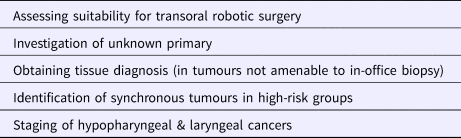
Records were retrospectively analysed to determine the indications for and outcomes of panendoscopy. These were categorised as per the following: tissue diagnosis, unknown primary SCC, surgical planning including assessment of suitability for transoral robotic surgery, and second primary identification (Table 1).
Indications for panendoscopy

Panendoscopy efficacy
In order to determine the impact of panendoscopy on the clinical approach to a patient, we collected information on whether there was a tissue diagnosis, including fine needle aspiration of neck nodes, and relevant imaging results available prior to the panendoscopy. We also noted whether the primary tumour was amenable to in-office biopsy. These included tumours of the oral cavity and tonsils, or those otherwise accessible transorally. Operative reports detailing findings during the examination were reviewed for synchronous primary tumours, which were defined as tumours identified at the time of panendoscopy, with the more advanced disease regarded as the index tumour.
Results
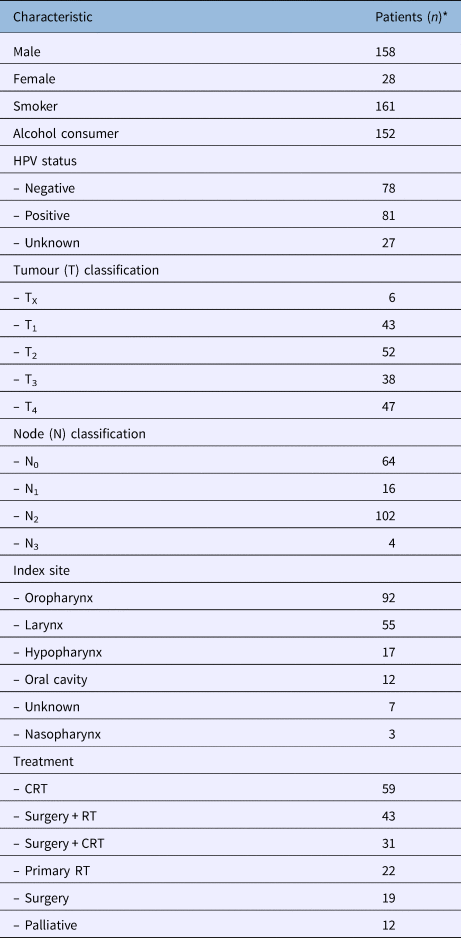
A total of 186 patients underwent panendoscopy during their investigation for newly diagnosed head and neck cancer between January 2014 and December 2015 at the two centres (126 patients at Royal Adelaide Hospital and 60 at Flinders Medical Centre). P16 staining findings were available for 157 patients (85.8 per cent). Characteristics of this cohort are shown in Table 2.
Patients’ characteristics

*Total of 186 patients with an average age of 62 years. HPV = human papillomavirus; CRT = chemoradiotherapy; RT = radiotherapy
Primary panendoscopy indications
The most common outcome of panendoscopy in newly diagnosed head and neck cancer patients was the obtaining of a tissue diagnosis (n = 121). This was followed by surgical planning (n = 42), carcinoma of an unknown primary (n = 21) and identification of a synchronous primary tumour (n = 2).
Diagnostic process
Prior to panendoscopy, 121 patients (65 per cent) did not have a tissue diagnosis confirming SCC. Of these, 50 patients (41.3 per cent) were considered to be amenable to in-office biopsy based on tumour location. Sixty-five patients (35 per cent) had a tissue diagnosis, including those based on fine needle biopsy of neck nodes, confirming SCC prior to panendoscopy.
All but three patients had undergone staging contrast computed tomography (CT) prior to panendoscopy. Additional radiological investigations were also performed: positron emission tomography (PET) (n = 52), magnetic resonance imaging (n = 7) and all three imaging techniques (n = 7).
Panendoscopy for tissue diagnosis
The most common indication for panendoscopy was to obtain tissue for diagnosis. In this group of 121 patients, 94 were eligible for transoral robotic surgery and underwent assessment for suitability for the procedure simultaneously. The remaining 27 patients only required panendoscopy for tissue diagnosis.
Surgical planning
The second most common indication for panendoscopy was for surgical planning, this being either assessment of suitability for transoral robotic surgery or for other surgical planning including resectability assessment. Of this subgroup consisting of 42 patients, 28 underwent panendoscopy for transoral robotic surgery assessment and 14 for surgical planning. Other surgical planning included microlaryngoscopy of early glottic lesions for resectability using laser. One patient was deemed to have poor access to the anterior commissure and did not proceed to surgical therapy.
Panendoscopy for carcinoma with unknown primary
Patients presenting with carcinoma of an unknown primary were routinely investigated with contrast-enhanced CT of the neck and chest, and fluoro-deoxy-glucose PET scanning, prior to panendoscopy. In the 21 patients with carcinoma of an unknown primary, the primary tumour was identified macroscopically during the examination under anaesthesia in 9 patients. Selective biopsy sampling led to the identification of a primary tumour on histopathology in another six patients. In the remaining six patients, the panendoscopy did not yield a diagnosis.
Synchronous second primary tumours
Two patients were found to have a synchronous primary tumour identified on panendoscopy, generating a yield of 1.1 per cent. A 54-year-old woman presenting with a soft palate lesion was found to have a separate tonsil mass, with both tumours being p16-negative SCC. She had previously been alcohol dependent and had a strong tobacco history of 60 pack-years. Similarly, a 63-year-old man was found to have tumours of the pyriform sinus and the contralateral tonsil. He also had a background of alcohol abuse and 20 pack-years of smoking. All tumours demonstrated a p16-negative status in these cases.
Discussion
Panendoscopy, including bronchoscopy and oesophagoscopy, is performed under general anaesthesia to examine the upper aerodigestive tract in newly diagnosed head and neck cancer. This provides valuable information about the extent of disease and its relationship to surrounding structures, and informs the decision on resectability. This procedure is also critical in the investigation of unknown primary cancers, affording detailed examination of the mucosa and tissue sampling. Traditional teaching encourages the routine use of panendoscopy prior to treatment. However, with the advent of advanced clinical and radiographic techniques, we aimed to re-evaluate our findings and indications for panendoscopy in order to minimise unnecessary procedures that add anaesthetic and procedural risks, and delay the time to definitive treatment.
The majority of panendoscopy procedures were performed for tissue diagnosis and surgical assessment (65 per cent). Tissue sampling was the principal outcome in 27 of such patients (14.5 per cent). Based on their location, these tumours were likely amenable to in-office biopsy, possibly averting the need for panendoscopy. However, in this retrospective study, we did not investigate complicating factors such as pain, trismus, gag reflex and patient's wishes that would hinder this approach.
In fact, multiple authors have reported on the safety and efficacy of in-office techniques used as alternatives to examination and biopsy under anaesthesia.Reference Chandran, Woods, Ullah, Ooi and Athanasiadis3–Reference Lippert, Hoffman, Dang, McCulloch, Hartig and Dailey6 Lippert et al. demonstrated safe and successful tissue sampling of oropharyngeal, hypopharyngeal and laryngeal lesions using both transnasal and transoral techniques.Reference Lippert, Hoffman, Dang, McCulloch, Hartig and Dailey6 The procedures were well tolerated by the majority of patients, with only 2 out of 116 patients not completing the procedure because of excessive gagging and coughing. The authors noted a significant reduction in time to definitive treatment and use of general anaesthesia with this approach.
Transnasal oesophagoscopy has been described as successful in the literature. It is reported as being safe, effective and well tolerated, allowing biopsies to be performed using ports in the instrument.Reference Thota, Zuccaro, Vargo, Conwell, Dumot and Xu4 Some authors have shown a similar diagnostic yield to panendoscopy with this approach.Reference Postma, Bach, Belafsky and Koufman5 The low rate of synchronous disease in asymptomatic patients with no evidence of metastasis on staging CT may mean that this investigation is sufficient in most cases.Reference Guardiola, Pivot, Dassonville, Poissonnet, Marcy and Otto7 Efforts to employ in-office techniques provide benefits for both patients and clinicians, by providing a more cost-effective alternative that facilitates efficient utilisation of resources and planning of operating theatre schedules.Reference Naidu, Noordzij, Samim, Jalisi and Grillone8
The emergence of transoral robotic surgery has spawned ‘transoral robotic surgery feasibility assessment’ as a modern indication for panendoscopy. This was the most common surgical planning assessment (66.7 per cent), as opposed to surgical planning for non-transoral robotic surgery procedures (33.3 per cent). Transoral robotic surgery feasibility assessment involves evaluating tumour dimensions and invasion into surrounding structures by inspection and manual palpation, and inserting the relevant mouth gag to ensure that transoral access to the tumour is achievable. These features cannot be reliably and comfortably appreciated in the awake patient using in-office techniques.
Our institution deems those with stage T1 and T2 tumours, 1.5 cm of mouth opening, and tumours that are not fixed to structures or those crossing the midline, as being amenable to transoral robotic resection. Bedside biometric measures have been investigated as an alternative approach to determine feasibility for transoral robotic surgery, in order to expedite this process. Mandibular body height, hyoid–mental length, mouth opening and neck circumference have been shown to predict suitability for transoral robotic surgery in cadaveric studies.Reference Arora, Kotecha, Acharya, Garas, Darzi and Davies9 However, until such time when these results are validated in live subjects, it will remain imperative for treating surgeons to evaluate patients with examination under anaesthesia.
Similarly, concurrent examination of the larynx as part of the panendoscopy is required to plan surgical therapy for early glottic lesions. Microlaryngoscopy, performed to visualise the entire larynx, particularly the anterior commissure, is an essential prerequisite for successful laser microsurgery, in order to determine which lesions are amenable to line-of-sight laser resection. In our cohort, 10 patients with T1a glottic SCC underwent this assessment, 1 of which was found to have difficult access, leading to the recommendation for non-operative management.
Panendoscopy remains strongly indicated in the investigation of a carcinoma of an unknown primary. This should be performed following the completion of all radiological investigations, to prevent false positive results from surgical trauma and to direct the biopsy of suspicious regions. Examination under anaesthesia also affords an opportunity for bilateral tonsillectomy and/or tongue base mucosectomy in cases of HPV-associated disease.Reference Krishnan, Connell and Ofo10
Advances in imaging technologies have increased the use of fluoro-deoxy-glucose PET (FDG-PET)/CT as an adjunctive investigation. Studies have reported sensitivity and specificity of 97 per cent and 68 per cent, respectively, and an identification rate of 44 per cent in cases of carcinoma of an unknown primary.Reference Kwee and Kwee11, Reference Zhu and Wang12 In a meta-analysis of 16 studies, FDG-PET also led to the discovery of a previously unrecognised tumour on conventional investigation in 24.5 per cent of cases.Reference Rusthoven, Koshy and Paulino13 Despite this, panendoscopy remains highly indicated because of certain limitations of this radiological investigation. The resolution of FDG-PET limits the detection capability to tumours sized 5 mm or greater, lending it to false negative results. Indeed, studies examining the yield of investigations for carcinoma of an unknown primary have shown that panendoscopy identified the primary lesion in the setting of a negative FDG-PET/CT because of its ability to inspect minor mucosal abnormalities that could not be detected radiologically.Reference Mani, George, Nash, Anwar and Homer14, Reference Miller, Karnad, Eng, Hussey, Stan McGuff and Otto15 Additionally, physiological uptake in lymphoid tissues may be difficult to interpret, leading to unnecessary investigations and clouding the decision-making process. Hence, the role of panendoscopy remains essential, irrespective of the FDG-PET/CT findings.
Synchronous primary tumours are defined as malignancies diagnosed during the investigation of an index cancer. Traditionally, panendoscopy was indicated to investigate for these lesions because of their high prevalence, with rates of 5–16 per cent reported in early studies.Reference Shaha, Hoover, Marti and Krespi16 With the emergence of HPV-associated malignancies of the head and neck, the significance of field cancerisation as described by Slaughter et al.Reference Slaughter, Southwick and Smejkal1 has diminished. This has been supported by a trend for lower reported rates of synchronous primary tumours in more recent investigations (1–4.8 per cent).Reference Krishnatreya, Rahman, Kataki, Das, Das and Lahkar17–Reference Haughey, Arfken, Gates and Harvey23 Whilst in the past, oropharyngeal cancer had the highest rate of synchronous primary tumour, it has now declined to carry the lowest risk of any subsite in the head and neck. Population-based studies have demonstrated this by showing a temporal relationship with the emergence of HPV-associated oropharyngeal SCC and a reduction in the number of second cancers.Reference Jain, Sikora, Baxi and Morris22
In our study, a synchronous primary tumour was identified in only two patients, yielding a rate of 1.1 per cent. Both patients had significant smoking and alcohol histories, demonstrating the overarching negative impact of these predisposing factors. Alternatively, no synchronous primary tumours were identified in the investigation of p16-positive disease, which is supportive of recent studies suggesting the limited benefit of screening non-smokers with HPV-associated cancers for synchronous primary tumours.Reference Xu, Biron, Puttagunta and Seikaly24
At our institution, the majority of patients presenting with an unknown primary SCC in the neck will be diagnosed with HPV-associated disease based on a neck node biopsy. This allows for the possible streamlining of panendoscopy and a reduction in time to treatment in this group. There is, however, a small group of patients that presents with either an unknown HPV status (including where there was insufficient tissue for HPV analysis) or HPV-negative disease. In such cases, this approach may result in the delayed commencement of definitive therapy, in an attempt to identify a synchronous primary tumour. Given this is a small number of patients, streamlined indications for panendoscopy will undoubtedly reduce investigation time in the group as a whole.
Whilst the rate of synchronous primary tumour may be miniscule, the significance for the individual patient upon discovery of a second cancer can be critical for the treatment approach. In a retrospective study, Panosetti et al. demonstrated a change in management in 49.4 per cent of patients based on the finding of a second cancer on panendoscopy.Reference Panosetti, Luboinski, Mamelle and Richard25 However, considering the low rates of second primary tumours in recent studies and the improvement in radiological techniques, the number of patients adversely affected by the discovery of a synchronous primary tumour at the time of definitive therapy appears to be small. Furthermore, studies suggest that overall survival is poor for cases of second primary tumours, irrespective of whether they are detected as synchronous or metachronous cancers.Reference Rennemo, Zatterstrom and Boysen21, Reference Priante, Gross, Sztokfisz, Nishimoto and Kowalski26
The panendoscopy procedure carries both surgical and anaesthetic risks for the patient, and can lead to delays in the initiation of definitive treatment. Although small, these procedures have potential for oesophageal perforation with both flexible (0.03 per cent) and rigid oesophagoscopy (0.68 per cent).Reference Gustafson and Tami27 The anaesthetic risk may also rise to significance in this population, which often has a poor fitness status as a result of malnutrition and cardiorespiratory disease arising from tobacco and alcohol use.
• Panendoscopy is integral for transoral robotic surgery suitability assessment, unknown primary cancer investigation and synchronous tumour identification in high-risk groups
• It is also used to obtain a tissue diagnosis in tumours not amenable to in-office biopsy, and for hypopharyngeal and laryngeal cancer staging
• The most common indication for panendoscopy in this cohort was tissue diagnosis; many of those cases were amenable to in-office biopsy
• Refining indications for panendoscopy may reduce the need for this procedure, and avoid its associated complications and delays to definitive therapy
• The rate of synchronous second primary tumours was 1.1 per cent; all tumours were p16-negative and developed in patients with smoking and alcohol histories
An important limitation of routine panendoscopy in head and neck cancer investigation is the delay in time to definitive therapy. Many studies have examined the significance of this variable. Waaijer et al. compared CT scans taken for staging and radiotherapy treatment planning, which were on average 56 days apart.Reference Waaijer, Terhaard, Dehnad, Hordijk, Van Leeuwen and Raaymakers28 An average increase of 70 per cent in tumour volume was observed, which resulted in an upgrade of disease staging in 23 per cent of patients.Reference Waaijer, Terhaard, Dehnad, Hordijk, Van Leeuwen and Raaymakers28 Such delays have been shown to be associated with reduced tumour control with radiotherapy, an increased risk of local recurrence and reduced survival.Reference Huang, Barbera, Brouwers, Browman and Mackillop29–Reference Wyatt, Beddoe and Dale31 Panendoscopy provides a potential logistical hurdle in the treatment pathway for cancer sufferers, making the completion of staging and organisation of treatment within the recommended two weeks from initial consultation challenging.Reference Vergez, Moriniere, Dubrulle, Salaun, De Mones and Bertolus32
The limitations of our study include the retrospective design, which lends itself to possible bias when considering the information obtained from the panendoscopy based on clinical records. Furthermore, the potential for in-office biopsy was assumed only by the location of the lesion, as information on the tolerability of in-office biopsy and patients’ wishes were inconsistently documented. Similarly, subtle findings on panendoscopy that influenced surgical resectability and treatment decisions were documented with varying degrees of detail in operative reports, making definitive analysis difficult. The limited sample size in this study makes generalisations regarding wider practice difficult. Larger, prospective studies, with detailed clinical criteria, may provide better insight into the scenarios where examination under anaesthesia may be the most beneficial course for the patient. These may also be used to investigate the feasibility of in-office biopsy examination and biopsy techniques.
Conclusion
Although traditionally a standard approach in the investigation of head and neck cancer, the use of panendoscopy may be rationalised with the advent of more advanced investigations and developments in knowledge of the disease process. We have reviewed the indications for and outcomes of panendoscopies performed at our institutions, and attempted to identify cases where streamlining this investigation may lead to potential reductions in the time to treatment, patient morbidity and costs to the public health system. Our findings promote a patient-focused approach to care, by identifying situations in which panendoscopy remains an essential component of the newly diagnosed head and neck cancer patient's investigative journey.
Competing interests
None declared