INTRODUCTION
Billfish, Mediterranean spearfish (Istiophoridae: Tetrapturus belone, Rafinesque, 1810) and swordfish (Xiphiidae: Xiphias gladius, Linnaeus 1758), are highly migratory and top predator marine fish (Palko et al., Reference Palko, Beardsley and Richards1981; Nakamura, Reference Nakamura1985) of high commercial value. Mediterranean spearfish have a distribution limited to the Mediterranean Sea, although some specimens have been recorded from the Atlantic side of the Strait of Gibraltar (Di Natale et al., Reference Di Natale, Mangano, Celona and Valastro2005b). Moreover, this species is considerably abundant around Italy (Nakamura, Reference Nakamura1985), particularly in the Tyrrhenian Sea, where it is caught as by-catch of large pelagic fisheries and in the Strait of Messina (Di Natale et al., 2005b). Swordfish is found in the open waters of tropical, subtropical and temperate oceans of the world, including the Mediterranean Sea (Palko et al., Reference Palko, Beardsley and Richards1981; Di Natale et al., Reference Di Natale, Mangano, Celona and Valastro2005b). After the crisis in swordfish fishery in recent years, worsened by the European ban on driftnets since 2002 (UE Regulation No. 1239/98), harpoon and long lines are the only fishing gear permitted for the catch of both pelagic species, although, in the Strait of Messina, spearfish and swordfish are caught only by harpoon, using traditional boats called ‘feluche’ or ‘passerelle’, from the late spring to summer. These boats, once used mainly to catch swordfish and bluefin tuna (Thunnus thynnus), are now adapted to fishing activity in relation to resource availability and behaviour, also selecting spearfish as a target species (Sisci, Reference Sisci1984, Cavallaro & Lo Duca, Reference Cavallaro and Lo Duca1996; Di Natale et al., Reference Di Natale, Mangano, Navarra, Schimmenti, Valastro, Bascone and Asaro1996, 2005b; Potoschi, Reference Potoschi2000; Romeo et al., Reference Romeo, Ancora, Manganaro, Andaloro and Fossi2001, Reference Romeo, Ancora, Consoli, Ausili, Fossi and Andaloro2003). Information on harpoon catch data of T. belone from the Strait of Messina are reported by Di Natale et al. (Reference Di Natale, Mangano, Celona, Navarra and Valastro2003, Reference Di Natale, Celona and Mangano2005a,Reference Di Natale, Mangano, Celona and Valastrob), Potoschi (Reference Potoschi2000) and Romeo et al. (Reference Romeo, Ancora, Manganaro, Andaloro and Fossi2001), although scanty information on its biology (Potoschi, Reference Potoschi2000) and feeding ecology is available (Spartà, Reference Spartà1961; Nakamura, Reference Nakamura1985; Castriota et al., 2008).
Regarding X. gladius, several aspects of fishery, biology, genetics and stock structure have been studied in the Mediterranean Sea (De Metrio et al., Reference De Metrio, Megalofonou, Tselas and Tsimenides1989; Cavallaro & Lo Duca, 1996; Di Natale & Mangano, Reference Di Natale and Mangano1995; Tserpes & Tsmenides, Reference Tserpes and Tsimenides1995; Di Natale et al., Reference Di Natale, Mangano, Navarra, Schimmenti, Valastro, Bascone and Asaro1996; Romeo et al., Reference Romeo, Ancora, Manganaro, Andaloro and Fossi2001, Reference Romeo, Ancora, Consoli, Ausili, Fossi and Andaloro2003). However, the feeding ecology of this billfish has been not investigated in this area; studies took place in other Mediterranean areas such as the Aegean Sea (Salman, Reference Salman2004; Peristeraki et al., Reference Peristeraki, Tserpes and Lefkaditou2005), the Adriatic Sea (Bello, Reference Bello1991) and the Ligurian Sea (Orsi-Relini et al., Reference Orsi-Relini, Palandri, Garibaldi and Cima1996).
Studies on trophic ecology of fish are useful and fundamental in understanding the functional role of different fish within aquatic ecosystems (Wootton, Reference Wootton1998; Blaber, Reference Blaber2000; Cruz-Escalona et al., Reference Cruz-Escalona, Abitía-Cárdenas, Campos-Davila and Galvan-Magana2000; Linke et al., Reference Linke, Platell and Potter2001; Hajisamae et al., Reference Hajisamae, Chou and Ibrahim2004). Pelagic top predators may be considered as potential competitors for food, although it is possible that they adopt different strategies for exploiting the same environment (Dagorn et al., Reference Dagorn, Menczer, Bach and Olson2000). The analysis of feeding habits and trophic relationships of these fish will be crucial for the successful management and conservation practices (Gerking, Reference Gerking1994). Then, our main goals are to describe the dietary habits of these two predators and to explore the ways in which food resources are partitioned among them, in order to identify interactions between the two billfish.
MATERIALS AND METHODS
The catch data of Mediterranean spearfish and swordfish were collected daily in the Strait of Messina (central Mediterranean Sea) from 2004 to 2006, using fishermen's logbooks and interviews with the crews from all the harpoon fishery boats. A sample boat was selected for the daily boarding of a scientific observer. The number of caught fish was recorded for every fishing day.
The study focused on diet was carried out on the stomach content of 53 spearfish and 95 swordfish. Fish were measured to the nearest centimetre from the tip of the bill to the posterior margin of the middle caudal rays (lower jaw fork length (LJFL)).
The stomachs were removed and stored in a 70% alcohol solution for content analysis. In the laboratory, all prey items were identified to the lowest possible taxonomic level, then counted and weighed to the nearest 0.1 g. All stomach contents were preserved in 70% ethanol, while cephalopod beaks were preserved in a glycerol solution and 70% ethanol.
The degree of prey digestion was determined according to the following scale (Vaske et al., Reference Vaske, Vooren and Lessa2004): ND, non digested prey; ID, initial digestion, with loss of parts of skin and fish scales, and of carapaces for crustaceans; AD, advanced digestion, with loss of fins and muscular parts; and CD, complete digestion, only the remains of muscle, bones, carapaces and cephalopods beaks. Preys classified in the ND and ID stages were measured to the nearest millimetre (total length for fish, mantle length for cephalopods, carapace length for crustaceans).
As hard parts resistant to digestion (i.e. cephalopod beaks, fish otoliths and eyes) cumulate in the stomachs over more meals, leading to overestimation of the importance of prey they belong to, only prey bearing fleshy remains were considered for the analyses, as they were supposed to have been recently eaten by the predator (see Santos et al., Reference Santos, Clarke and Pierce2001 for details on this matter). Cephalopod beak lengths—the lower rostral length and the lower hood length in decapods and octopods respectively (Clarke, Reference Clarke1986)—were used to estimate mantle length of digested cephalopods and to reconstitute their weights, using relationships either in the literature (Clarke, Reference Clarke1986; Bello, Reference Bello1991), or from measurements on specimens in our reference collection (ICRAM collection).
Data analysis
Vacuity index (V) for empty stomachs was calculated as a percentage of the total number of stomachs.
The PRIMER software was utilized to compute prey species accumulation plots as an average of 999 curves based on varying random orders of the stomach. In order to assess whether the curve reached an asymptote, the logistic and linear regressions were calculated and their integrity of fit coefficient R2 were compared: the sample size was considered sufficient if the R2 for the logistic curve resulted higher than the R2 for the linear relation (Castriota et al., Reference Castriota, Scarabello, Finoia, Sinopoli and Andaloro2005).
The importance of the different prey items was evaluated by calculating the frequency of occurrence F% = (ni/N)*100, abundance N% = (ni/nt)*100 and weight W% = (wi/Wt)*100. These values were used to calculate the index of relative importance (IRI%) for each taxonomic category using mass: IRI% = (N% + W%)*(F%) (Pinkas et al., Reference Pinkas, Oliphant and Iverson1971; Hyslop, Reference Hyslop1980; Hacunda, Reference Hacunda1981).
Diet breadth was calculated by Levin's standardized index (Krebs, Reference Krebs1989; Labropoulou & Papadopoulou-Smith, Reference Labropoulou and Papadopoulou-Smith1999) for biomass:
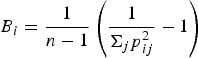
This index ranges from 0 to 1; low values indicate a diet dominated by few prey items (specialist predators), while high values indicate generalist diets (Gibson & Ezzi, Reference Gibson and Ezzi1987; Krebs, Reference Krebs1989).
The degree of dietary overlap between X. gladius and T. belone was calculated using the Schoener index (Reference Schoener1970), as follows:

where px fi and py fi are the proportions by weight in stomachs of the resource ‘fi’ (prey category) for species x and y, corresponding to spearfish and swordfish, respectively. This overlap index varies from 0, when the two species use a totally different resource, to 1, when they use the same prey category in the same proportions.
This index is one of the least objectionable indices available when food availability data are unavailable. The Horn index of resource overlap (Horn, Reference Horn1966) was also calculated, because it guarantees good results compared to other overlap indices (Cailliet & Barry, Reference Cailliet, Barry, Lipovsky and Simenstad1979) and it is subject to low bias due to variation in sample size and resource categories (Smith & Zaret, Reference Smith and Zaret1982).
This index was calculated as follows:
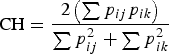
where pij and pik are the percentages of the ith group of n preys found in stomach contents of predators 1 and 2, corresponding to T. belone and X. gladius, respectively. The value of CH ranges from −1 (no overlap) to 1 (perfect overlap).
The definition of overlap rate was modified by Langton (Reference Langton1982): low overlap 0.0–0.29, moderate overlap 0.30–0.59 and high overlap (to be biologically significant) 0.60–1.00. Following Sturdevant et al. (Reference Sturdevant, Brase and Hulbert2001), diets were considered similar for CH > 0.6. Overlap was first calculated using prey weight and computed at a family level.
To assess the adequacy of the number of samples analysed, the cumulative number of new prey types against the cumulative number of non-empty stomachs were plotted (Ferry & Caillet, Reference Ferry, Caillet, MacKinlay and Shearer1996).
Prior to the statistical analysis, data were square root transformed. The similarity matrix was constructed to form a multi-dimensional scaling ordination (MDS), i.e. using a PRIMER statistical package version 5 (Clarke & Gorley, Reference Clarke and Gorley2001).
A one-way similarity analysis (ANOSIM) was performed on the similarity matrices to test whether the dietary samples of both species were different. To assess which dietary items offer the greatest contribution to the similarity, a similarity percentage (SIMPER) was used.
RESULTS
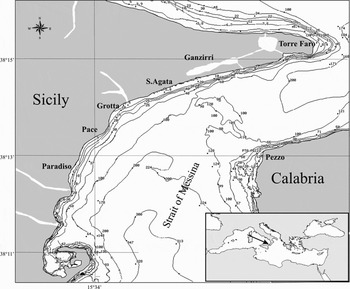
A total of 261 T. belone and 518 X. gladius were caught over three years by the total number of harpoon fishery boats in the central Mediterranean Sea (Strait of Messina) (Figure 1).
Study area.

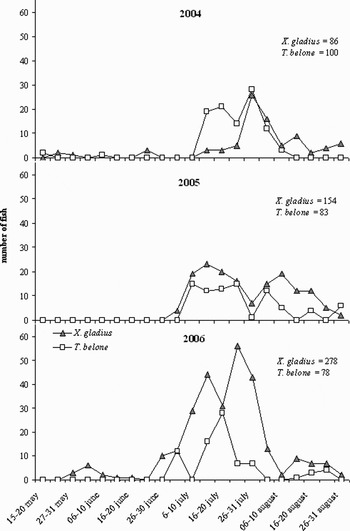
The two species occur each year in the same area and period, mainly in July and August, as shown by the trend on the catch (Figure 2).
Number of specimens of Xiphias gladius and Tetrapturus belone caught during the period 2004–2006 by the total boats of harpoon fishery.

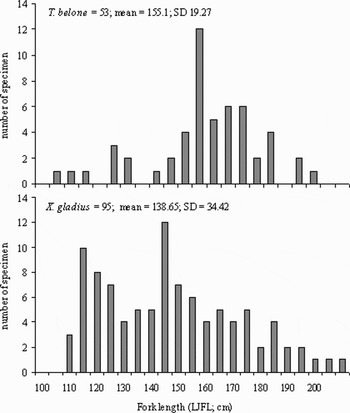
Fifty-three stomachs of T. belone with a length ranging between 105 and 195 cm (LJFL) and ninety-five stomachs of X. gladius with a length ranging between 110 and 210 cm (LJFL) were collected from the sample boat. Data on fish length/frequency are given in Figure 3. The vacuity coefficient analysed for specimen sampled was 2.10% for spearfish and 7.36% for swordfish.
Length–frequency distributions of Tetrapturus belone and Xiphias gladius examined for stomach contents during the season 2004 to 2006.

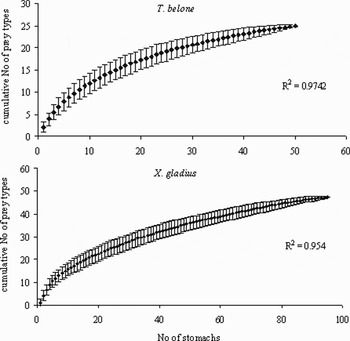
The cumulative prey types curve (Figure 4) computed for T. belone and X. gladius resulted to be more adequate when using a logistic curve (R2 = 0.9742, F(1,51) = 5384.51, P < 0.0001 and R2 = 0.954, F(1,93) = 6987.27, P < 0.0001, in T. belone and X. gladius, respectively) than when using a linear relation (R2 = 0.9174, F(1,51) = 1939.56, P < 0.0001 and R2 = 0.9384, F(1,93) = 2540.11 P < 0.0001, in T. belone and X. gladius, respectively). Therefore, the sample sizes were considered sufficient to describe the diet of both species.
Prey species accumulation plots as an average of 999 curves based on different random orders of the stomachs extracted. Vertical bars represent standard deviation.

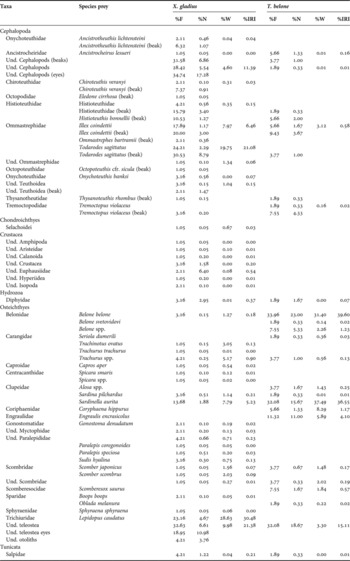
Twenty-four taxa and 300 prey individuals were found in the stomachs of spearfish; 46 taxa and 1968 prey individuals in the stomachs of swordfish (Table 1), belonging to six main taxa: Hydrozoa, Crustacea, Cephalopoda, Tunicata, Chondroichthyes and Osteychtes. Only 16 food items were found in both predators.
Per cent frequency of occurrence (%F), per cent abundance (%N), percentage by weight (%W) and index of relative importance (IRI) for prey types of Xiphias gladius and Tetrapturus belone.

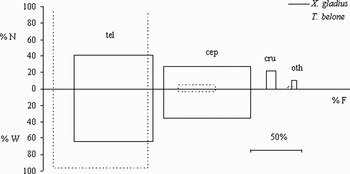
In T. belone, fish were the dominant group according to all numerical indicators (F% = 92.5; N% = 93.5; W% = 96.7; IRI% = 99.1), as shown in Figure 5. Eight families were identified among them, dominated by Belonidae and Clupeidae, which represented 40.9% and 36.8%, respectively, of the total preyed items in terms of IRI% and were mostly composed of Belone belone (IRI% = 39.6) and Sardinella aurita (IRI% = 36.6), followed by other fish species such as Engraulis encrasicolus, Coryphaena hippurus and Scomberesox saurus. Identified cephalopods were mainly in complete digestion degree (only beak), with the exception of Ancistrocheirus lesueri and Tremoctopus violaceus that were in initial digestion degree.
Per cent frequency (%F), per cent number (%N), per cent weight (%W) for the main food categories in the diet of Tetrapturus belone and Xiphias gladius.

The diet of X. gladius was typified by teleosts and cephalopods, which represented 59% and 39.1%, respectively of the total preyed items in terms of IRI% (Figure 5). Eleven teleost and five cephalopod families were recognized among them, dominated by Trichiuridae (IRI% = 30.5) and Ommastrephidae (IRI% = 27.6). The former was represented only by the presence of Lepidopus caudatus (IRI% = 30.5), followed by S. aurita (IRI% = 5.2), while the latter was represented by Todarodes sagittatus (IRI% = 21.1) and Illex coindetii (IRI% = 6.5).
Other fish species, belonging to Paralepididae, Carangidae, Scombridae and Sphyraenidae families, were occasionally recorded. Tremoctopus violaceus, Thysanoteuthis rhombus, Octopoteuthis cfr. sicula, Eledone cirrhosa and Histiotheuthis bonnellii were found only in advanced or complete digestion degree and recognized by beaks. Swordfish also preyed on crustaceans that were mainly represented by Euphasidae (IRI% = 0.5).
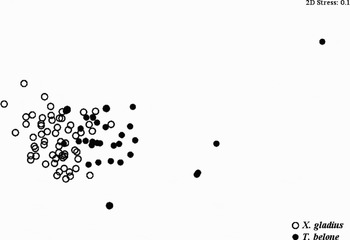
When the volumetric dietary data recorded for each one of the two species were grouped into families and subjected to MDS ordination, the points of the dietary samples of T. belone and X. gladius formed two groups that were practically distinct from one another. Although the stress level for the ordination (Figure 6) is quite high, i.e. 0.1, it is relevant that one-way ANOSIM demonstrates that the dietary compositions differed significantly between the two species (P < 0.05%) and produced a global R statistic of 0.201. Results from a similarity percentage analysis (SIMPER) showed that the diet of T. belone was mainly represented by teleosts belonging to the Clupeidae and Belonidae families.
MDS ordination of the dietary samples of Tetrapturus belone and Xiphias gladius.

In contrast, the diet of X. gladius was typified by fish species belonging to the Trichiurudae family and cephalopods belonging to the Ommastrephidae family.
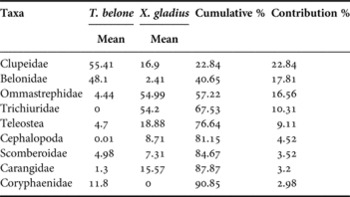
SIMPER showed that the diet of X. gladius was distinct from that of T. belone because of the presence of relatively greater amounts of Ommastrephidae and Trichiurudae and by a relatively lower volume of Clupeidae and Belonidae (Table 2).
Similarity percentage (SIMPER) analysis showing dietary items mostly contributing to the dissimilarity (mean = 95.07) between Tetrapturus belone and Xiphias gladius.

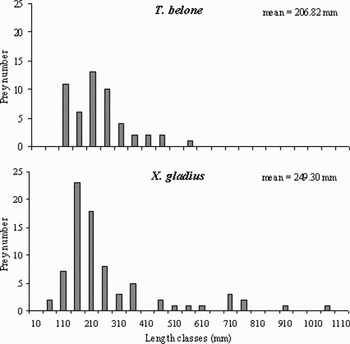
Tetrapturus belone total prey length ranged between 110 and 560 mm, with a mean length of 207 mm (Figure 7). All measured prey items were fish, while all cephalopods analysed in the stomach contents were in advanced or complete digestion degree. The prey items that contributed to a greater extent to the mean lengths observed were S. aurita and B. belone. Swordfish prey total length measured on a range between 60 and 1060 mm, with a mean length of 249 mm. Most prey items ranged between 160 and 210 mm in body length and they were represented by the cephalopods Ommastrephidae T. sagittatus and I. coindettii. Prey items with a length > 210 mm were exclusively fish and mostly represented by L. caudatus.
Length–frequency distributions of preys found in the stomachs of Tetraturus belone and Xiphias gladius.

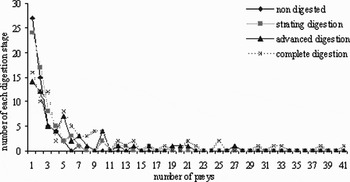
The feeding rhythm was determined according to prey digestion degree and stomach fullness. For the two specimens, non-digested prey items were recorded in stomachs containing from 1 to 7 prey items (Figure 8). In the stomachs containing up to 16 prey items, only advanced and complete digested prey items were observed. Nine stomachs contained only cephalopod beaks, ranging from 18 to 41 completely digested beak units.
Number of prey found in the individual stomachs with respective digestion stage which were observed.

As regards the diet breadth, Levin's standardized index was 0.15 in spearfish and 0.18 in swordfish. Regarding the diet overlap between the two species in the central Mediterranean Sea, Schoener and Horn indices showed low values (0.23 and 0.21 for the two indices, respectively).
DISCUSSION
This study represents the first evaluation of food partitioning between swordfish and Mediterranean spearfish. Analysis of catch data showed the contemporary presence of both billfish in the Strait of Messina, for the three fishing seasons investigated. Then, swordfish and spearfish live in the same area during the same period, thanks to the considerable upwelling that brings food and nutrients to the upper layers of the Strait (Guglielmo et al., Reference Guglielmo, Marabello, Vannucci, Guglielmo, Manganaro and De Domenico1995; Zagami et al., Reference Zagami, Badalamenti, Guglielmo and Manganaro1996).
Results of a multivariate statistical analysis (ANOSIM and MDS) demonstrated that the dietary compositions differed significantly between swordfish and spearfish. A previous study on diet analysis of T. belone, carried out in the same area, but during a different period (1995–2004), reported that cephalopods were the main prey items, followed by teleosts, even if the specific composition showed the same results with the dominance of S. aurita as a preferential species (Castriota et al., Reference Castriota, Campagnuolo, Romeo, Finoia, Potoschi and Andaloro2008).
In contrast, the diet of X. gladius was typified by fish and cephalopods Ommastrephidae, as already reported by other studies carried out in the Mediterranean Sea (Bello, Reference Bello1991; Salman, Reference Salman2004; Peristeraki et al., Reference Peristeraki, Tserpes and Lefkaditou2005) and in other areas (Moreira, Reference Moreira1990; Hernández-Garcia, Reference Hernández-Garcia1995; Vaske & Lessa, Reference Vaske and Lessa2005). Fish were mainly represented by Trichiurudae Lepidopus caudatus, while cephalopods were represented by squids Todarodes sagittatus and Illex coindetii. According to other studies (Carey & Robinson, Reference Carey and Robinson1981; Takahashi et al., Reference Takahashi, Okamura, Yokawa and Okazaki2003), these Ommastrephidae are generally preyed upon at nighttime, when they migrate to the surface. Moreover, the low values of both Schoener and Horn overlap indices also underlined food partitioning between the two species, which avoid competitive exclusion. It is worth noting that our results highlight a feeding strategy more related to the habitat of the species than to the food availability. In fact, migration patterns of the two predators are quite different. Swordfish show vertical migrations from 0 to 800 m (Carey & Robinson, Reference Carey and Robinson1981; Canese et al., Reference Canese, Garibaldi, Giusti, Romeo and Greco2004), while spearfish are characterized by limited migrations, ranging between 0 and 200 m depths (Roper, Reference Roper1974). The observation of specific prey items in the stomach content of both billfish confirmed the bathymetric range of their migrations. Actually, mesopelagic fish (Paralepididae) and cephalopods (O. banksi) were found exclusively in the stomachs of X. gladius and they were totally absent in T. belone, where food items were dominated by epipelagic species such as B. belone and S. aurita (Tortonese, Reference Tortonese1975; Roper et al., Reference Roper, Sweeney and Nauen1984; Whitehead, Reference Whitehead1985). The round sardinella represents the best prey for pelagic fish in the Strait (Spartà, Reference Spartà1961; Campo et al., Reference Campo, Mostarda, Castriota, Scartabello and Andaloro2006). In fact, this species is fished every day by pole and line to be used as bait for Scombridae fish, such as the Atlantic bonito, Sarda sarda, and the little tunny, Euthynnus alletteratus (Andaloro, Reference Andaloro2004).
Considering the low values of the Levin index in diet breadth and the occurrence of S. aurita in the sampling area (personal comment), we can suppose that X. gladius and T. belone are specialist feeders, meaning that they selectively feed.
The high number of Tremoctopus violaceus in the stomach contents of T. belone, also reported in a previous study (Castriota et al., Reference Castriota, Campagnuolo, Romeo, Finoia, Potoschi and Andaloro2008), confirms the preferential epipelagic habitat of the species. In fact, Octopoda most unlikely descends below the thermocline (Voss, Reference Voss1953; Thomas, Reference Thomas1977; Bello, Reference Bello1993). The ingestion of epipelagic species, such as Trachinotus ovatus, B. belone, S. aurita, observed in X. gladius stomach contents, is an occasional event that partly explains the occurrence of swordfish on the sea surface also during day-light hours (Romeo et al., Reference Romeo, Ancora, Consoli, Ausili, Fossi and Andaloro2003).
The prey status shows that feeding behaviour of billfish involve an unusual method of catching the prey, by using the bill. Actually, swordfish stomachs contained whole fish and parts of fish; many ingested L. caudatus were found in large portions (3–4); the body of squids T. sagittatus and I. coindetii were divided in mantle and head, with beak and tentacles, by the whipping action of the bill, as reported also by other studies (Tibbo et al., Reference Tibbo, Day and Doucet1961; Stilwell & Kohler, Reference Stilwell and Kohler1985).
The discovery of beaks of T. rhombus and Octopoteuthis cfr. sicula in swordfish stomachs confirms the role of large predators as effective biological samplers for collecting information on nektonic organisms, as well as on ‘rare species’, as suggested by Bello (Reference Bello1993).
The data, considering the few studies conducted in the Mediterranean Sea, will be useful in ecological modelling for the better representation of the trophic flows associated with large, medium and small pelagic fish.
ACKNOWLEDGEMENTS
The research was supported by the ICRAM Institute within the framework of the ecosystem approach project EOLIDE. We thank Dr G. Bello for cephalopod beak identification, and student C. Pedà for collaboration with stomach analysis.