INTRODUCTION
Freshwater eels of the genus Anguilla have a catadromous life history and are widely distributed throughout the world. Sixteen species, of which three have been divided into subspecies of Anguilla, have been reported worldwide, thirteen of which occur in tropical regions (Ege, Reference Ege1939; Watanabe et al., Reference Watanabe, Aoyama and Tsukamoto2009). Of the thirteen species found in tropical areas, seven species or subspecies occur in the western Pacific around Indonesia and Malaysia, i.e. Anguilla celebesensis Kaup 1856, Anguilla interioris Whitely 1938, Anguilla bengalensis bengalensis Gray 1831, Anguilla marmorata Quoy & Gaimard 1824, Anguilla borneensis Popta, 1924, Anguilla bicolor bicolor McClelland 1844 and Anguilla bicolor pacifica (Schmidt, 1928) (Ege, Reference Ege1939; Castle & Williamson, Reference Castle and Williamson1974; Arai et al., Reference Arai, Aoyama, Limbong and Tsukamoto1999). Molecular phylogenetic research on freshwater eels has revealed that tropical eels are the most basal species originating in the Indonesia and Malaysia regions and that freshwater eels radiated out from the tropics to colonize the temperate regions (Minegishi et al., Reference Minegishi, Aoyama, Inoue, Miya, Nishida and Tsukamoto2005). Recently, various aspects of the biology of tropical eel species in Indonesian waters, including species composition, distribution, life history and migration, have been gradually accumulated (e.g. Arai et al., Reference Arai, Aoyama, Limbong and Tsukamoto1999, Reference Arai, Limbong, Otake and Tsukamoto2001, Reference Arai, Marui, Miller and Tsukamoto2002, Reference Arai, Miller and Tsukamoto2003; Sugeha, et al., Reference Sugeha, Arai, Miller, Limbong and Tsukamoto2001; Chino & Arai, Reference Chino and Arai2010a, Reference Chino and Araib; Arai & Chino, Reference Arai and Chino2012, Reference Arai and Chino2013; Arai, Reference Arai2014a, Reference Araib). However, for Malaysia, there is relatively little information available on such aspects of eel biology. Malaysia should not be excluded as a study area, as it is one of the important geographical niches for anguillids; eel biology research in Malaysia could provide details on their species diversity, evolutionary pathway and life history.
According to several past studies, the tropical eel species Anguilla bicolor bicolor and Anguilla marmorata have been found in Peninsular Malaysia (Ng & Ng, Reference Ng and Hg1989; Ahmad & Lim, Reference Ahmad and Lim2006; Azmir & Samat, Reference Azmir and Samat2010; Arai et al., Reference Arai, Chino, Zulkifli and Ismail2012). However, these studies did not perform the comprehensive identification methods required for identifying the anguillid species. The identification of eels at the species level using solely visual observation is known to be difficult because of the similarities and overlapping morphological characteristics in eels, particularly in tropical anguillids (Ege, Reference Ege1939; Watanabe et al., Reference Watanabe, Aoyama and Tsukamoto2004). To validate the identification of the tropical eel species, it is crucial to utilize both morphological and molecular genetic analyses.
Recently, Arai et al. (Reference Arai, Chino, Zulkifli and Ismail2012) reported the tropical eel species Anguilla bicolor bicolor in the western parts of Peninsular Malaysia based on key morphological characteristics. In the present study, we collected anguillid eels from Penang Island, Peninsular Malaysia. These eels were subjected to identification using both morphological analyses and mitochondrial cytochrome oxidase subunit I (COI) sequence analysis. The present study suggests the limitations of tropical eel species identification based solely on morphological analyses and the need for further molecular genetic analysis for the accurate validation of a species.
MATERIALS AND METHODS
Fish and morphological observation
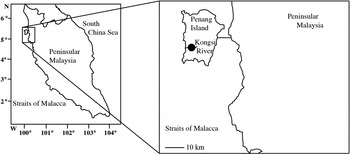
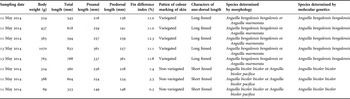
Eight anguillid eels were collected using fish traps and angling fishing in the Kongsi River in Penang Island, Peninsular Malaysia, from 11 to 14 May 2014 (Fig. 1). The external morphometric characteristics were measured for each sample according to the morphological description of Ege (Reference Ege1939) and Watanabe et al. (Reference Watanabe, Aoyama and Tsukamoto2004) (Table 1) and, thereafter, the dorsal fins were clipped and preserved in 96% ethanol for molecular genetic analysis.
Sampling site at Kongsi River, Penang Island, Peninsular Malaysia.

Biological data of Anguilla spp. collected in the Kongsi River, Penang Island, Peninsular Malaysia.

Based on the anguillid morphological identification keys developed by Ege (Reference Ege1939), the fin difference index (FDI) provides the highest resolution with the least ambiguity when distinguishing eels at the species level. The FDI for the distance between the verticals, from the beginning of the dorsal fin (Z) to the anus (ano-dorsal length), relative to the total length (L T) (Ege, Reference Ege1939), was calculated as follows:
 $${\rm FDI}= 100\, \, {\rm Z}L_{\rm T}^{ - 1}.$$
Anguilla has been clearly divided into four different species groups based on the external morphological characteristics of each species: the first group (four species) has variegated skin with broad maxillary bands of teeth; the second group (four species/subspecies) has variegated skin with narrow maxillary bands of teeth; the third group (six species) has non-variegated skin with a long dorsal fin; and the fourth group (five species/subspecies) has non-variegated skin with a short dorsal fin (Ege, Reference Ege1939; Watanabe et al., Reference Watanabe, Aoyama and Tsukamoto2004).
Molecular genetic analysis
The mitochondrial gene, cytochrome oxidase c subunit 1 (COI), was studied for the identification of the samples.
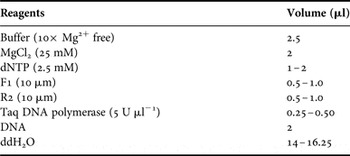
DNAs were extracted from the dorsal fin, following the protocol of INTRON G-Spin™ Total DNA Extraction Kit (Cat. No.: 17045). The DNAs were amplified using polymerase chain reaction (PCR) according to the thermal cycling conditions modified from Ward et al. (Reference Ward, Zemlak, Innes, Last and Hebert2005). An approximate of 700 base pairs of the COI gene were amplified using reagents from INTRON i-Taq™ Plus (Cat. No.: 25152). The fish primers F1 (5′-TCA ACC AAC CAC AAA GAC ATT GGC AC-3′) and R2 (5′-ACT TCA GGG TGA CCG AAG AAT CAG AA 3′) were employed in this process (Ward et al., Reference Ward, Zemlak, Innes, Last and Hebert2005). The PCR was performed in a volume of 25 µl for each sample, with the reagent proportions shown in Table 2. The PCR was initiated at 94°C for 2 min, followed by the denaturation at 94°C for 30 s, the annealing at 53–54°C for 30–40 s and an extension at 72°C for one minute. These steps were repeated for 29–34 cycles, followed by a final extension at 72°C for 10 min. The PCR products were eventually kept cool at 4°C.
Volume (μl) and concentration of reagents used for PCR.

All PCR products were visualized with 2% agarose gel electrophoresis stained with ethidium bromide. Successful PCR products were sent to First BASE Laboratories Sdn. Bhd. for purification and sequencing.
DNA sequences obtained were aligned in MEGA 6, followed by BLAST for identification on a GenBank sequences database produced by the National Centre of Biotechnology Information (NCBI).
RESULTS
Morphological implications
Five of the eight samples had skin with variegated markings, narrow maxillary bands of teeth and long dorsal fins. The other samples had skin without variegated markings and short dorsal fins (Table 1).
Five of the eight samples were assigned into the second group of the genus Anguilla based on their variegated skin and narrow maxillary bands of teeth (Ege, Reference Ege1939; Watanabe et al., Reference Watanabe, Aoyama and Tsukamoto2004). Within the second group, Anguilla bengalensis labiata and Anguilla reinhardtii exist in the mid-south-eastern region of Africa and eastern Australia and Tasmania, respectively (Ege, Reference Ege1939) (Table 2). Therefore, both of these species were not considered when identifying the samples in the present study. The FDI of the other two species, Anguilla bengalensis bengalensis and Anguilla marmorata, was studied further. According to the key morphological characteristics used for identification (Ege, Reference Ege1939; Watanabe et al., Reference Watanabe, Aoyama and Tsukamoto2004), the FDI of Anguilla marmorata is in the range of 12–20, higher than that of Anguilla bengalensis bengalensis, which is in the range of 8–14 (Ege, Reference Ege1939; Watanabe et al., Reference Watanabe, Aoyama and Tsukamoto2004). Five samples in the present study had FDIs in the range of 11–12 (Table 1) which overlapped within the FDI range of Anguilla bengalensis bengalensis and Anguilla marmorata.
Three of the samples were assigned into the fourth group of anguillid eels based on their non-variegated skins and short dorsal fins. Based on the geographical distribution of the anguillid species in the fourth group, those samples could be confirmed as either Anguilla bicolor bicolor or Anguilla bicolor pacifica. These two subspecies, however, are almost identical in their morphological characteristics (Ege, Reference Ege1939; Watanabe et al., Reference Watanabe, Aoyama and Tsukamoto2004) and only the genetic characteristics enable them to be divided into different subspecies.
Genetic implications
The mitochondrial cytochrome oxidase c subunit I (COI) of all samples was successfully amplified using PCR. The mitochondrial region revealed definitive identity matches in the range of 96–100% for all collected samples, indicating highly significant similarities. The NCBI reference sequences had a high agreement with the samples that were identified as Anguilla bengalensis bengalensis for five variegated long-finned eels and Anguilla bicolor bicolor for three short-finned eels.
The DNA sequences of five haplotypes of Anguilla bengalensis bengalensis were deposited in the GenBank sequences database with the accession numbers KM875498 to KM875502, whilst the DNA sequences of three haplotypes of Anguilla bicolor bicolor were deposited in the same database with the accession numbers KM875503 to KM875505.
DISCUSSION
This is the concrete description of the occurrence and distribution of Anguilla bengalensis bengalensis and Anguilla bicolor bicolor in Peninsular Malaysia as identified by both morphological and molecular genetic analyses.
Anguilla bengalensis bengalensis is widely distributed in Sri Lanka, Bangladesh, India, Myanmar, Sumatra Island in Indonesia and the Andaman Islands (Ege, Reference Ege1939; Watanabe et al., Reference Watanabe, Aoyama and Tsukamoto2004). In previous studies, Anguilla marmorata was reported to exist in Peninsular Malaysia (Ahmad & Lim, Reference Ahmad and Lim2006; Azmir & Samat, Reference Azmir and Samat2010). After a thorough morphological re-examination by Ahmad & Lim (Reference Ahmad and Lim2006) of one formalined sample of Anguilla marmorata, the true identify of that particular sample was actually Anguilla bengalensis bengalensis based on the value of 9 in the FDI (Arai, Reference Arai2014b). The species misidentification in the previous study may have been due to an insufficient morphological characteristic analysis. In fact, the difficulty in distinguishing both Anguilla marmorata and Anguilla bengalensis bengalensis is augmented by their overlapping morphological characteristics, which cause further identification ambiguities. The FDI values in the long-finned eels were 11–12 and could not be used to identify samples morphologically in the present study due to the overlapping geographical distribution of several eel species and proximity in the tropical region. Thus, comprehensive morphological and molecular genetic identifications are needed for the tropical eel species of tropical regions to further validate the true identity of a species.
Anguilla bicolor has the second widest geographic distribution of any species of the genus Anguilla, except for Anguilla marmorata. Anguilla bicolor is distributed from the eastern coast of Africa, through the Indonesian Seas to New Guinea, adjacent to the Pacific Ocean (Ege, Reference Ege1939). Ege (Reference Ege1939) divided Anguilla bicolor into the two subspecies Anguilla bicolor bicolor and Anguilla bicolor pacifica, primarily because of the slight difference in their means and ranges of total number of vertebrae. The distribution range of Anguilla bicolor bicolor includes the coast of Africa, India, Sri Lanka, Bangladesh, Myanmar, north-western Australia and the Greater Sunda Islands, and the distribution range of Anguilla bicolor pacifica includes the coast of China, Vietnam, the Philippines, Borneo Island, Sulawesi Island and New Guinea Island. Recently, Arai et al. (Reference Arai, Chino, Zulkifli and Ismail2012) found a new distribution range of Anguilla bicolor bicolor in Peninsular Malaysia using morphological characteristics, and the present study also supports the occurrence of Anguilla bicolor bicolor in Peninsular Malaysia by means of molecular genetic signatures. Malaysia, however, locates the boundary or overlapping parts of the ranges of the two subspecies. Thus, both morphological and molecular genetic identifications are needed for accurate species identification.
This study highlights the occurrence of Anguilla bengalensis bengalensis and Anguilla bicolor bicolor in Malaysian waters. Although those species are widely distributed throughout the Indo-Pacific region, little or almost no information is available on the life history and migration pattern of this species. Therefore, further studies regarding the distribution, biology and ecology of tropical anguillid eels using valid species identifications methods are needed to understand their mysterious life history.
ACKNOWLEDGEMENTS
We are grateful to Ms Siti Tafsil Raudah and Ms Razikin Amalina for their kind assistance with the field survey, to Ms Adibah Abu Bakar for her assistance with the molecular genetic analysis and Drs Shahrul Anuar Mohd Sah and Mahadi Mohammad for their kind provision of facilities at the Centre for Marine and Coastal Studies, Universiti Sains Malaysia. This study was financially supported by the Ministry of Higher Education, Malaysia, under the Fundamental Research Grant Scheme (Vot No. 59281).