Introduction
Secure access to adequate amounts of healthy and nutritious food is considered to be a foundational determinant of health (Muldoon et al. Reference Muldoon, Duff, Fielden and Anema2013). Food insecurity is conceptualised as limited or uncertain access to adequate food, and encompasses food availability, access and utilisation (Mengistu et al. Reference Mengistu, Regassa and Yusufe2009; United States Department of Agriculture, 2016). Ending hunger and achieving food security is one of the United Nation's Sustainable Developmental Goals (SDG) to be achieved by 2030 (United Nations, 2015). In Ethiopia, both chronic and transitory (seasonal) food insecurity are persistent problems for a large segment of the population (Mengistu et al. Reference Mengistu, Regassa and Yusufe2009). In 2012, there was an 82.3% prevalence of household-level food insecurity in a zone in southern Ethiopia (Regassa & Stoecker, Reference Regassa and Stoecker2011).
The associations between food insecurity and physical health problems are well documented, but the links between food insecurity and mental illness have been less well characterised (Collins, Reference Collins2005). Ethnographic work has linked the experience of food insecurity with mood disorders, symptoms of anxiety and depression (Kempson et al. Reference Kempson, Keenan, Sadani, Ridlen and Rosato2002), poor mental health in general (Xiong et al. Reference Xiong, Philips, Hu, Wang, Dai, Kleinman and Kleinman1994) and higher levels of stress, anxiety, irritability, social isolation and depression (Collins, Reference Collins2005). In cross-sectional studies, a consistent association has also been found between depression and anxiety and food insecurity (Hadley & Patil, Reference Hadley and Patil2006; Sorsdahl et al. Reference Sorsdahl, Slopen, Siefert, Seedat, Stein and Williams2009; Cole & Tembo, Reference Cole and Tembo2011), including within Ethiopia (Hadley et al. Reference Hadley, Tegegn, Tessema, Cowan, Asefa and Galea2008; Maes et al. Reference Maes, Hadley, Tesfaye and Shifferaw2010; Jebena et al. Reference Jebena, Taha, Nakajima, Lemieux, Lemessa, Hoffman, Tesfaye, Tefera Belachew, Workineh, Kebede, Tariku, Segni, Kolsteren and al'Absi2015). There have been few longitudinal studies to examine the direction of association, but it is hypothesised that depression or anxiety are more likely to be a consequence than a cause of poverty and associated food insecurity (Lund et al. Reference Lund, Breen, Flisher, Kakuma, Corrigall, Joska, Swartz and Patel2010).
The risk of food insecurity has been much less well studied in people with severe mental disorders (SMD; including schizophrenia, schizoaffective disorder, bipolar disorder or severe depression/depression with psychotic features). In a study from the USA, 45.8% of people with SMD were classified as food insecure, of which 29.2% experienced very low food security (Goetz, Reference Goetz2008). Such studies are unlikely to be generalisable to low- and middle-income countries (LMICs), where the background burden of food insecurity is higher and the consequences of food security more dire.
In this study, we evaluated food insecurity in a population sample of people with SMD identified before introduction of integrated primary care-based mental health care in a rural Ethiopian district. The study aimed to compare food insecurity in households with a person with SMD compared with households from the general population.
Methods
Study design
A community-based, comparative cross-sectional study was conducted between December 2014 and August 2015.
Setting
The study was carried out in Sodo District, Gurage Zone, of the Southern Nations, Nationalities and Peoples’ Region (SNNPR) of Ethiopia, which is located 100 km from the capital city, Addis Ababa. Sodo comprises 58 sub-districts (kebeles), with a total estimated population of around 165 000 (Lund et al. Reference Lund, Tomlinson, De-Silva, Fekadu, Shidhaye, Jordans, Petersen, Bhana, Kigozi, Prince, Thornicroft, Hanlon, Kakuma, McDaid, Saxena, Chisholm, Raja, Kippen-Wood, Honikman, Fairall and Patel2012). The district is mostly rural, with the majority of the population relying on subsistence farming. At the time of this study, there were no mental health services within the district. As part of the Programme for Improving Mental health carE (PRIME) (Lund et al. Reference Lund, Tomlinson, De-Silva, Fekadu, Shidhaye, Jordans, Petersen, Bhana, Kigozi, Prince, Thornicroft, Hanlon, Kakuma, McDaid, Saxena, Chisholm, Raja, Kippen-Wood, Honikman, Fairall and Patel2012), primary care workers were trained to detect and treat people with SMD, epilepsy, depression and alcohol use disorders. This study was nested within the PRIME project activities with people with SMD.
Sampling and recruitment
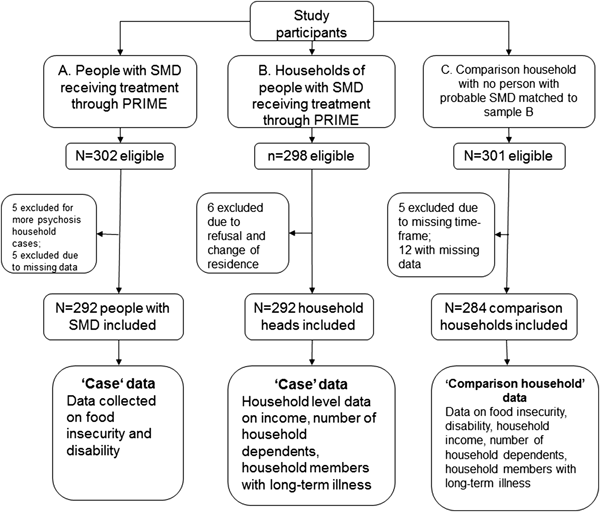
A summary of the study sampling and recruitment is found in Fig. 1. There were three sources of data: (1) person with probable SMD or their caregiver (PRIME project), (2) household of a person with SMD and (3) control household without a person with SMD. Data sources (2) and (3) were obtained from a household economic survey conducted by a linked project, Emerald (Emerging mental health systems in LMICs) (Semrau et al. Reference Semrau, Evans-Lacko, Alem, Ayuso-Mateos, Chisholm, Gureje, Hanlon, Jordans and Thornicroft2015).
Flow chart of participant recruitment.

People with probable SMD were identified by community-based health extension workers, community leaders and project outreach workers who had received half a day of training on common presentations of SMD for the setting (Fekadu et al. Reference Fekadu, Hanlon, Medhin, Alem, Selamu, Welde-Giorgis, Shibre, Teferra, Tegegn, Breuer, Patel, Tomlinson, Thornicroft, Prince and Lund2016). This key informant method has been shown to be an effective means of community ascertainment of SMD for this setting (Shibre et al. Reference Shibre, Kebede, Alem, Negash, Kibreab, Fekadu, Fekadu, Jacobsson and Kullgren2002). People with suspected SMD were then referred to the nearest primary health care (PHC) centre and evaluated by primary care workers who had been trained in the World Health Organisation's mental health Gap Action Programme (mhGAP) base course (World Health Organisation, 2008; Dua et al. Reference Dua, Barbui, Clark, Fleischmann, Poznyak, van-Ommeren, Taghi Yasamy, Ayuso- Mateos, Birbeck, Drummond, Freeman, Giannakopoulos, Levav, Obot, Omigbodun, Patel, Phillips, Prince, Rahimi-Movaghar, Rahman, Sander, Saunders, Servili, Rangaswamy, Unützer, Ventevogel, Vijayakumar, Thornicroft and Saxena2011). For those who received a PHC worker diagnosis of ‘psychosis’ or ‘bipolar disorder’, a confirmatory clinical interview was conducted by a psychiatric nurse using the semi-structured Operational Criteria for Research (OPCRIT) interview guide (McGuffin et al. Reference McGuffin, Farmer and Harvey1991). Eligible people were then recruited into the study on the basis of the following criteria:
Eligibility criteria for people with SMD:
• Aged 18 years or older,
• Planning to stay resident in the district for the next 12 months,
• Provided informed consent (evaluated by trained psychiatric nurses) or, if lacked capacity to consent, did not refuse and guardian permission was obtained,
• Psychiatric nurse confirmed diagnosis using the OPCRIT, and
• Able to understand Amharic, the official language of Ethiopia and the working language of the study site.
Eligibility criteria for respondent from household of person with SMD:
• Having a person with SMD in a household; aged 18 years or above; provided informed consent; resided in the household for a minimum of 4 months; household head or the older person if two household members contributed equally to household decision-making;
Eligibility criteria for control households:
• No person/family member with suspected or confirmed SMD within the household; aged 18 years or above; providing informed consent.
• Matched to a household in which a person with SMD resided [on the basis of age (±5 years), sex, village (gott), household position (head v. not head) and household size, using a complete census of the district as a sampling frame (Fekadu et al. Reference Fekadu, Medhin, Selamu, Hailemariam, Alem, Breuer, Lund, Prince and Hanlon2014)]. If more than one match was identified, the household was selected by lottery. If no respondent was identified for the first matched household after three home visits, or if they declined to participate, the next reserve was selected.
Sample size and power calculation
The sample size for this study was determined by the sample sizes for the PRIME and Emerald studies which were powered to detect change in symptoms and economic status in people with SMD and their households after introduction of mental health care. The PRIME study recruited 300 people with SMD. The Emerald study recruited 300 households of people with SMD and 300 households of controls. Details of the power that this sample size afforded us to detect differences in the prevalence of food insecurity are provided in Supplementary File 1.
Measures
Primary outcome: food insecurity
Food insecurity was measured using the Household Food Insecurity Access Scale (HFIAS) (Coates et al. Reference Coates, Swindale and Bilinsky2007). The HFIAS was administered to people with SMD and the respondent for the control households. The HFIAS was developed to reflect three domains of the experience of inadequate household-level food access: (1) anxiety or uncertainty about food supply/access (item 1); (2) insufficient quality, which includes variety and preferences (items 2–4); and (3) insufficient quantity of food supply, the amount consumed and the physical consequences of insufficiency (items 5–9) (Swindale & Bilinsky, Reference Swindale and Bilinsky2006). An Amharic version of the HFIAS-9 has been used in Ethiopia (Hadley et al. Reference Hadley, Tegegn, Tessema, Cowan, Asefa and Galea2008; Maes et al. Reference Maes, Hadley, Tesfaye and Shifferaw2010; Jebena et al. Reference Jebena, Taha, Nakajima, Lemieux, Lemessa, Hoffman, Tesfaye, Tefera Belachew, Workineh, Kebede, Tariku, Segni, Kolsteren and al'Absi2015) and is reported to be valid in this setting (Gebreyesus et al. Reference Gebreyesus, Lunde, HaileMariam, Woldehanna and Lindtjørn2015). During piloting, there were acceptability concerns about items asking about missing meals. A contextualising lead-in statement was added, which led to improved acceptability. The HFIAS was administered by trained lay interviewers.
Primary exposure: SMD
The OPCRIT semi-structured interview was used to diagnose the presence of SMD (McGuffin et al. Reference McGuffin, Farmer and Harvey1991). OPCRIT comprises a 90-item checklist of psychiatric symptoms, which is administered by a mental health professional and was used to generate psychiatric diagnoses according to the Diagnostic and Statistical Manual for mental disorders, version IV (McGuffin et al. Reference McGuffin, Farmer and Harvey1991; Azevedo et al. Reference Azevedo, Soares, Coelho, Dourado, Valente, Macedo, Pato and Pato1999). OPCRIT allows the rater to make use of all available information sources, including clinical interviews with the person and their caregiver and case records and applies operational diagnostic criteria through a computer algorithm (Operational Criteria for Research, 2004). OPCRIT has been shown to have good inter-rater reliability, including among raters from different geographical and theoretical backgrounds (McGuffin et al. Reference McGuffin, Farmer and Harvey1991; Williams et al. Reference Williams, Farmer, Ackenheil, Kaufmann and McGuffin1996). OPCRIT was administered by psychiatric nurses and only administered to people with suspected SMD.
Potential mediator: functional impairment
The World Health Organisation Disability Assessment Schedule 2.0 (WHODAS) was used to measure functional impairment (World Health Organisation, 1985). The WHODAS has been validated for use in people with SMD in rural Ethiopia (Habtamu et al. Reference Habtamu, Alem, Medhin, Fekadu, Dewey, Prince and Hanlon2017). The WHODAS has both 36- and 12-item versions, with the 12-item version found to have equivalent psychometric properties to the longer version (Ustün et al. Reference Ustün, Chatterji, Kostanjsek, Rehm, Kennedy, Epping-Jordan, Saxena, von-Korff and Pull2010). In the control households, the 12-item version of WHODAS was used. In the sample of people with SMD, the 12-item WHODAS was extracted from the longer 36-item version.
Potential confounders
Household measures
Structured lay interviewer-administered questions were used to assess household income, the number of household members with a long-term illness and the number of dependents (age 17 years or less) living in the household, employing items used in the WHO study on global ageing and adult health (World Health Organisation, 2013). Other potential confounders were age, sex, residence (urban or rural), household position (being a household head v. not being a household head) and educational level of the respondent. Month of assessment was also a potential confounder due to seasonal variation in food security.
Training of data collectors
The lay data collectors had completed at least tenth grade education and were recruited from the local area. The training was conducted for 12 days by project psychologists, public health and social work professionals and covered the following topics: basic interviewing skills, particular skills for interviewing people with SMD and their caregivers, ethical considerations and detailed training on the study instruments. The training included role play and observation of practice interviews.
Training of clinician assessors
The project psychiatric nurses were given intensive training by senior Ethiopian psychiatrists in the clinician-administered measures over a period of seven days. The training included observed interviews and feedback, although formal inter-rater reliability was not assessed formally.
Data management
Double data entry was carried out using EpiData software (Lauritsen & Bruus, Reference Lauritsen and Bruus2003–2008). To maintain data quality, the field supervisor and principal investigator (PI) made unannounced visits to attend interviews at the site, with frequent and close supervision and cross-checks. Random quality checks of questionnaires were also made by the field supervisor and PI. Confidentiality was ensured. Hard copies of data were stored in a secure place, while the soft copies of data were saved on password-protected computers which could only be accessed by authorised members of the research team.
Statistical analysis
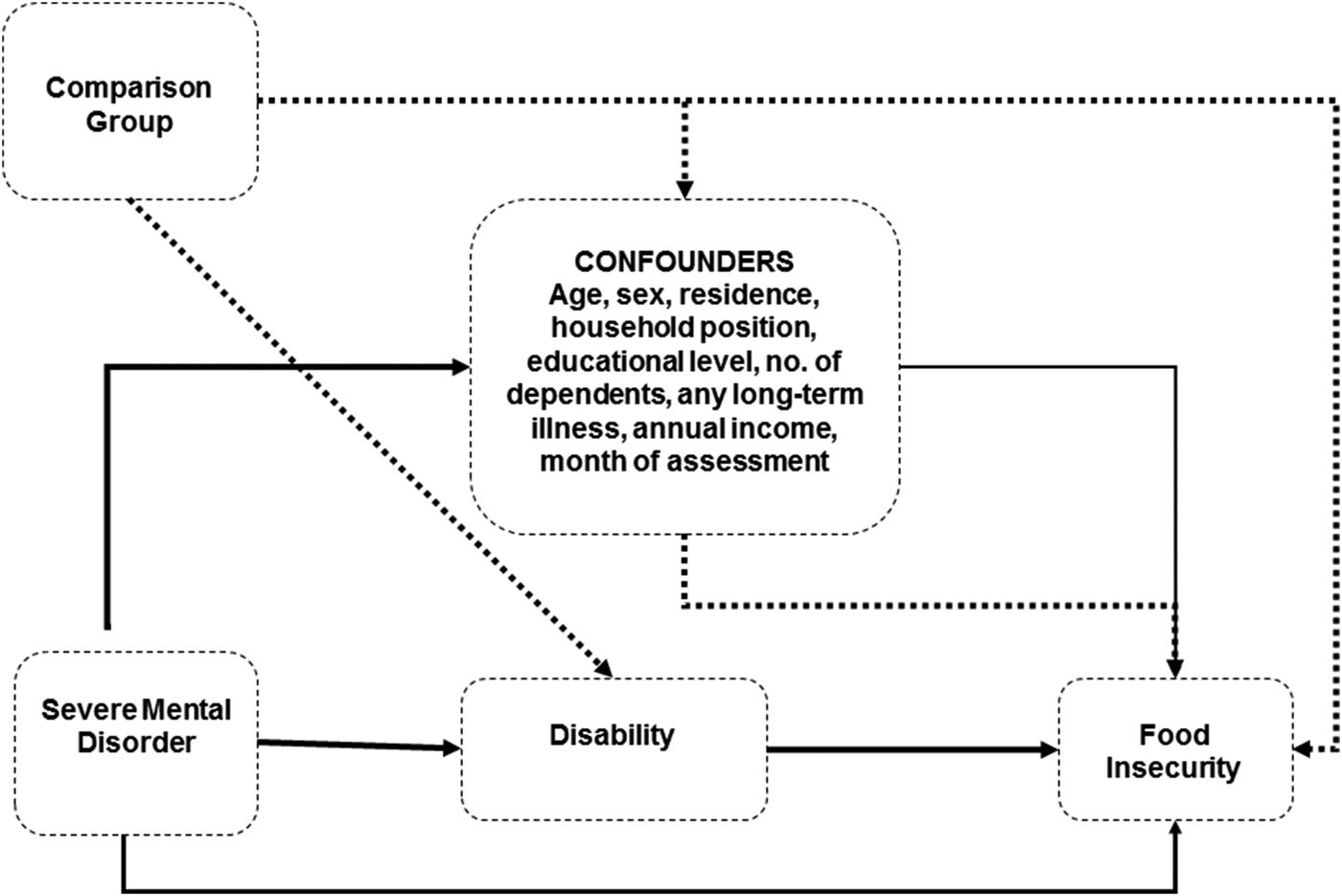
Data analysis was carried out using STATA software version 13.1 (StataCorp, 1985–2013). A conceptual model depicting hypothesised associations among the variables is presented in Fig. 2. The descriptive characteristics of cases (individual-level data from person with SMD combined with household reports) and controls were compared using Pearson χ 2 test for categorical variables, Kruskal–Wallis (P < 0.001) for continuous non-normally distributed variables and two-sample t-test for continuous normally distributed variables.
Conceptual model for hypothesised associations between severe mental disorder, disability and food insecurity.

Multiple logistic regression was conducted to test the hypothesis that the presence of a household member with SMD was associated with food insecurity in that household. The HFIAS total score was dichotomised into severely food insecure v. combined categories of mild or moderate food insecurity or food secure (Swindale & Bilinsky, Reference Swindale and Bilinsky2006). The rationale for this categorisation was that severe food insecurity was expected to be relatively common in the study setting and to represent a threshold which was likely to motivate intervention. We also repeated the analyses using a dichotomisation of no/mild food insecurity v. moderate/severe food insecurity as an exploratory secondary analysis. The potential confounders identified a priori (see above) were included into the model. In order to explore whether disability mediated the association between SMD and food insecurity, the total WHODAS score was added into the fully adjusted model with food insecurity as the dependent variable.
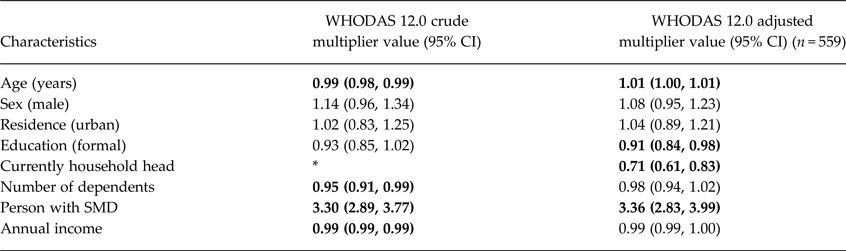
A further multivariable analysis was then conducted to examine factors associated with disability (total score on the WHODAS12-item version). On inspection, a histogram of WHODAS scores indicated excess zeroes. Variance in WHODAS scores was greater than the mean score (177.48 > 13.89), indicating overdispersion. The Vuong test z-value was significant, indicating that a zero-inflated negative binomial model was more appropriate than the standard negative binomial model. Coefficients are on a log scale and for ease of interpretation were exponentiated.
Results
Participant and household characteristics
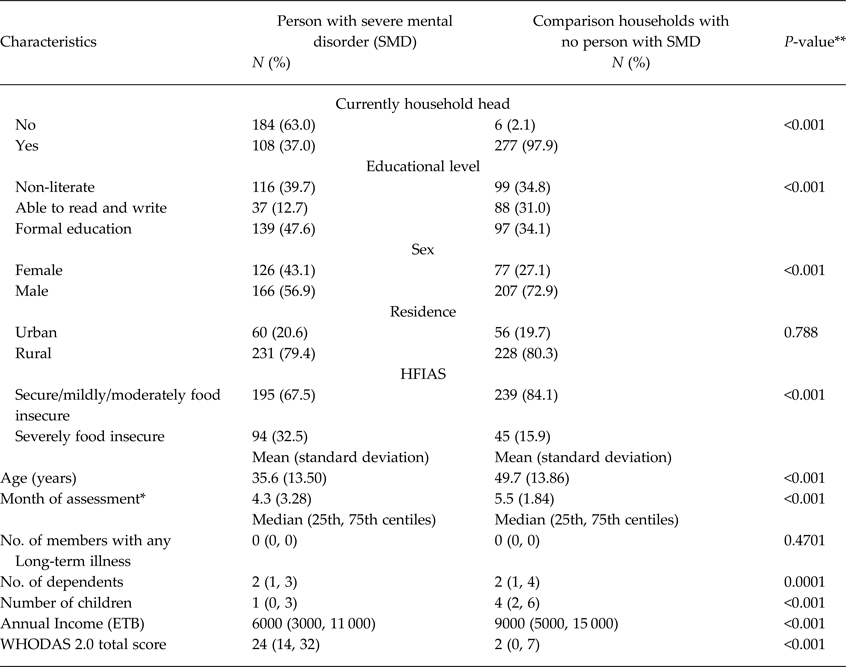
Participant recruitment is summarised in Fig. 1. The characteristics of participants are summarised in Table 1. Respondents who had SMD were less likely to be the household head and to have dependents and more likely to be female, younger and have higher disability scores, formal education and lower annual income. The timing of assessments for case and comparison households differed significantly (see Supplementary File 2 for distribution). The assessment was conducted during the rainy season (June to August), a time of relative food insecurity, for 14.7% of case households and 43.3% of the comparison group. There was no significant difference in the location of the household (rural or urban) or presence of a household member with a long-term illness (excluding the person with SMD).
Characteristics of households with a person with severe mental disorder (SMD) and comparison households
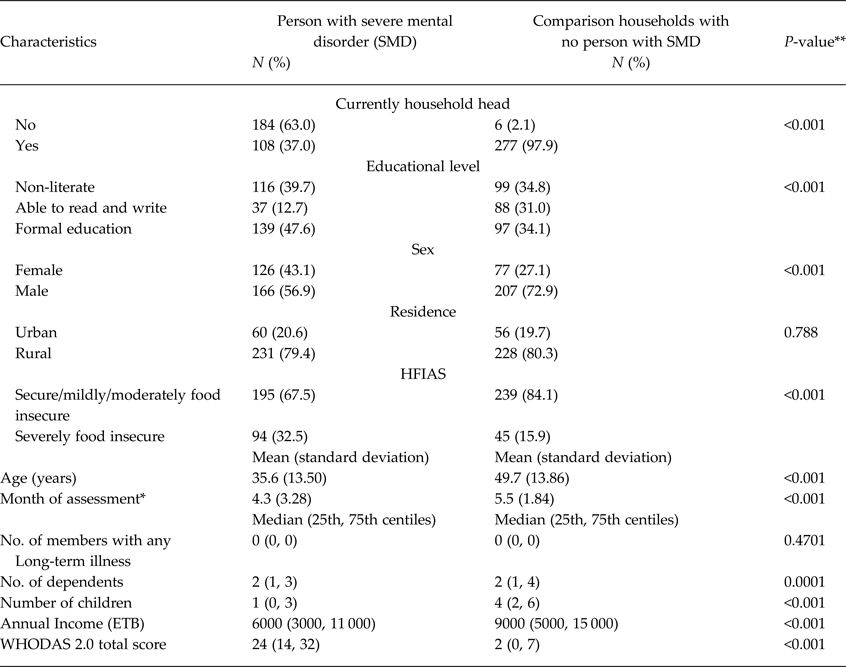
* Months numbered starting from January. ETB: Ethiopian Birr; WHODAS: World Health Organisation Disability Assessment Schedule.
** P-value of Pearson χ2 for categorical variables, Kruskal–Wallis for continuous non-normally distributed descriptive variables and two-sample t-test with equal variances for continuous normally distributed variables.
SMD and food insecurity
The percentage of respondents reporting severe household food insecurity was 32.5% for people with SMD and 15.9% for the control households. The median HFIAS score was higher for people with SMD (median 15, IQR 10) compared with control households (median 12, IQR 7) (P < 0.001).
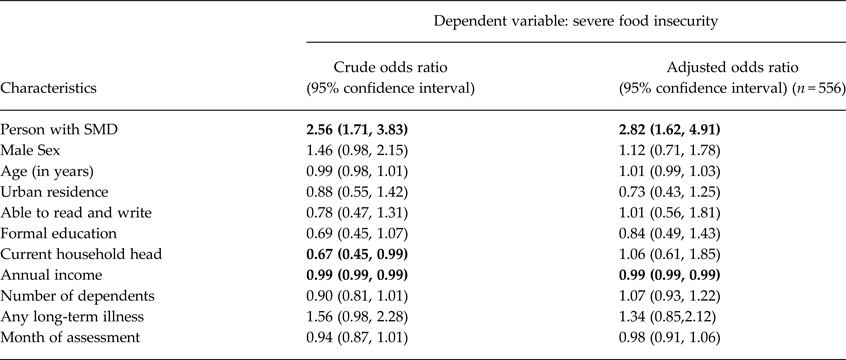
In keeping with the hypothesis, SMD was associated with severe food insecurity (adjusted OR = 2.82; 95% CI 1.62, 4.91) after adjustment for potential confounders (Table 2). Higher annual income was found to be associated independently with lower odds of food insecurity. There was no difference in the findings when the food insecurity score was categorised as no/mild food insecurity v. moderate/severe food insecurity (see Supplementary File 3).
Crude and adjusted model for association between severe mental disorder and severe food insecurity
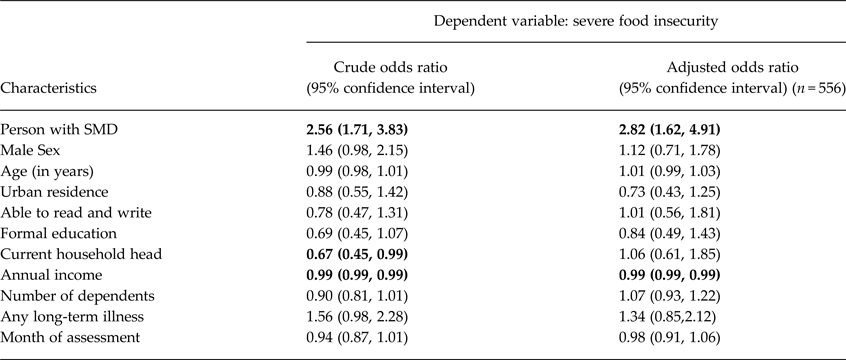
SMD: severe mental disorder.
Exploring mediation
After including total WHODAS 12.0 score in the multivariable model with food insecurity as the dependent variable, the association between SMD and food insecurity became non-significant, indicating the probable mediating role of disability in this relationship. Annual income remained associated significantly with food insecurity even after including disability within the model (Supplementary File 4).
Factors associated with disability
In the multivariable model, having SMD and increasing age were associated with increased disability, whereas formal education and current household head position were associated with lower disability (Table 3).
Crude and adjusted models for factors associated with disability score
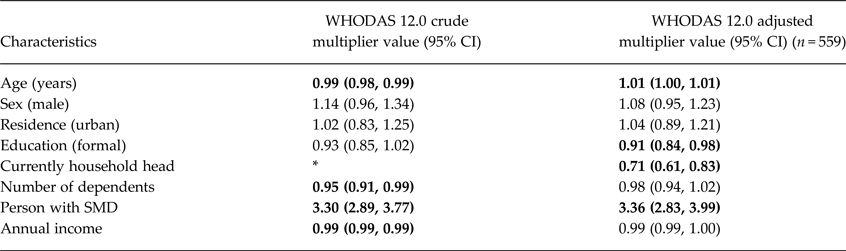
SMD: severe mental disorder; WHODAS: World Health Organisation Disability Assessment Schedule.
* Fitting constant-only model; long iteration output.
Discussion
In this community-based study conducted in rural Ethiopia, severe food insecurity and disability were increased significantly among people with SMD compared with general population controls, in support of our hypothesis.
The prevalence of severe food insecurity was more than twice as high in households with a member living with SMD compared with households from the general population, which is in keeping with the findings from a small study from the USA (Goetz, Reference Goetz2008) and a facility-based case–control study from India (Trani et al. Reference Trani, Venkataraman, Mishra, Groce, Jadhav and Deshpande2016). SMD was associated with household food insecurity independently of household annual income. In this subsistence farming community, food insecurity is related to the amount of food available due to household production and not just to income. In addition to the impact of disability of the person with SMD, the opportunity costs of other household members due to engagement in caregiving activities and direct reductions in productivity of caregivers are likely to contribute to an overall decrease in household productivity (Flyckt et al. Reference Flyckt, Lothman, Jorgenson, Rylander and Koering2011). In a qualitative study from the same area, respondents conceptualised disability in people with SMD as arising from a combination of direct effects of the illness, poverty and stigma (Habtamu et al. Reference Habtamu, Alem and Hanlon2015). Stigma and discrimination extends beyond the individual person with SMD to affect the whole household (Shibre et al. Reference Shibre, Negash, Kullgren, Kebede, Alem, Fekadu, Fekadu, Medhin and Jacobsson2001), which may lead to decreased co-operation with community members for key farming activities and resultant decrease in food production.
Ethiopia is reported to have well-established and strong programmes to address the food security needs of vulnerable groups (Combaz, Reference Combaz2013; Endalew et al. Reference Endalew, Muche and Tadesse2015). In the Productive Safety Net Programme, rural households facing chronic food insecurity are supported to resist financial shocks, create assets and become food self-sufficient by providing predictable transfers, as food, cash or a combination of both (Ministry of Agriculture & Rural Development, 2009; Endalew et al. Reference Endalew, Muche and Tadesse2015; World Food Program, 2016) conditional upon engagement in daily labouring activities. Households of people who are ‘chronically sick, disabled or mentally challenged in such a way as to prevent them from undertaking work’ are explicitly excluded from this scheme but considered eligible for permanent direct support and the possibility of linkages to appropriate social services, where capacity exists at the district level (Ministry of Agriculture, 2014); however, the extent to which households with a person with SMD are able to access this support is unknown and likely to be low. As well as the prevailing low levels of awareness about mental health and illness, the stigma and social exclusion associated with SMD (Shibre et al. Reference Shibre, Negash, Kullgren, Kebede, Alem, Fekadu, Fekadu, Medhin and Jacobsson2001) are likely to act as barriers to participation in interventions to address food insecurity.
The consequences of exposure to food insecurity in people with SMD in this setting may be profound. A previous study found that people with SMD in a rural Ethiopian district were more likely to be undernourished compared with community controls (Lijalem, Reference Lijalem2002). Excess mortality in people with SMD in Ethiopia has been linked to undernutrition (Fekadu et al. Reference Fekadu, Medhin, Kebede, Alem, Cleare, Prince, Hanlon and Shibre2015). Food insecurity is likely to also affect access to, and engagement with, care. In a qualitative study of people with SMD and their caregivers in a food-insecure area, justification for ongoing use of khat (chewing leaves containing the amphetamine-like substance cathinone) against medical advice was in part to curb one's appetite even though there was awareness that it could worsen the person's mental health (Teferra, Reference Teferra2011). Formative work indicated the need for interventions to address basic needs, including food security, among people with SMD in Ethiopia to ensure equitable access to care (Hailemariam et al. Reference Hailemariam, Fekadu, Selamu, Medhin, Prince and Hanlon2016; Mall et al. Reference Mall, Hailemariam, Selamu, Fekadu, Lund, Patel, Petersen and Hanlon2017).
Our findings suggest that interventions to address food insecurity need to include both expanded access to mental health care (to reduce disability) and strategies to alleviate poverty, particularly for vulnerable individuals living with SMD. Through the PRIME project, and in keeping with the policy of the Federal Ministry of Health of Ethiopia, access to mental health care is being increased through integration into PHC in this district (Fekadu et al. Reference Fekadu, Hanlon, Medhin, Alem, Selamu, Welde-Giorgis, Shibre, Teferra, Tegegn, Breuer, Patel, Tomlinson, Thornicroft, Prince and Lund2016). Although there is an emphasis on community mobilisation in the PRIME Ethiopia plan, at the individual level the intervention is mostly centred on facility-based treatment and, specifically, on psychotropic medication combined with provision of information (‘psychoeducation’). An evaluation of the BasicNeeds model of providing development interventions (e.g. income-generating activities and interventions to promote sustainable livelihoods) alongside mental health care (BasicNeeds, 2008; Raja et al. Reference Raja, Underhill, Shrestha, Sunder, Mannarath, Kippen-Wood and Patel2012) found improved economic status in people with SMD (Lund et al. Reference Lund, Waruguru, Kingori, Kippen-Wood, Breuer, Mannarath and Raja2013); however, the study design could not distinguish the effects of mental health care alone from any added value of development interventions. Within PRIME, planned follow-up assessments after 12 months of the new integrated service will help to answer the question of whether treatment alone is sufficient to address indicators of poverty in general, and food insecurity in particular. A community-based rehabilitation (CBR) intervention trial for people with schizophrenia is also underway in Ethiopia (Asher et al. Reference Asher, De-Silva, Hanlon, Weiss, Birhane, Medhin, Ejigu, Patel and Fekadu2016). The CBR model includes facility-based treatment, home-based sessions from community workers and community mobilisation. The goal of CBR is to promote restoration of functioning and recovery which is expected to translate into improved social inclusion, economic status and food security. The findings will show whether such an intensive intervention yields dividends over and above the PRIME service.
There were limitations of our study. Although the HFIAS is a household measure, the information for the ‘case’ group was provided by the person with SMD. It is possible that they reported higher food insecurity levels than other household members due to less access to household resources than other household members or that they experienced greater hunger due to appetite-stimulating effects of antipsychotic medication (Teferra et al. Reference Teferra, Hanlon, Beyero, Jacobsson and Shibre2013); however, only a third (35.0%) of people with SMD were taking psychotropic medication at the time of assessment so this is unlikely to be the full explanation. Furthermore, the HFIAS is designed to capture household-level information regardless of the respondent. Respondents may have given affirmative responses in the expectation that they would receive some kind of aid, although this would have applied to both case and comparison groups. Social desirability could also have led to minimisation of the true experience of food insecurity due to the sensitivity of the topic. There may have been inadequate adjustment for seasonal variation in food insecurity. Strengths of the study include the use of a culturally validated measure of food insecurity, use of standardised diagnostic assessment by mental health specialists to define SMD, the large sample size and the community-based ascertainment of cases which reduces the risk of selection bias.
Conclusions
People with SMD living in a rural Ethiopian district experienced higher levels of severe food insecurity than the general population. The inclusion and prioritisation of people with SMD in food security programmes and development opportunities, including income-generating opportunities and schemes should be ensured. This requires awareness-raising and tackling the stigma, which undermines inclusion of people with SMD. Increasing access to holistic mental health care is also expected to reduce food insecurity through a reduction in the disability associated with mental illness.
Supplementary material
The supplementary material for this article can be found at https://doi.org/10.1017/S2045796017000701
Acknowledgements
The authors sincerely thank their respondents, data collectors, field supervisors, psychiatric nurses and the Sodo district health centre staff.
Financial Support
This study is a direct output of the PRogramme for Improving Mental health carE (PRIME). This work was supported by the UK Department for International Development [201446]. The views expressed do not necessarily reflect the UK Government's official policies. Research leading to these results was also funded by the European Union's Seventh Framework Programme (FP7/2007-2013) under grant agreement no. 305968 as part of the Emerald project (Emerging mental health systems in low- and middle-income countries).
Conflict of Interest
None.
Ethical Considerations
Ethical approval was obtained from the College of Health Sciences Institutional Review Board, Addis Ababa University (Ref. 026/15/Psy). Written informed consent was obtained from literate participants. For non-literate respondents, verbal consent was accompanied by a finger print in the presence of a literate witness. All participants with SMD were offered mental health care through the PRIME project. For people with SMD who lacked capacity to consent and were not refusing participation, caregiver permission was obtained.
Availability of Data and Materials
The data are being used for a PhD student (KT) for his thesis and are not, therefore, available at the present time to the general public. The data may be requested from the corresponding author for verification of the analyses in this paper.