Many social and economic historians have by now demonstrated the great importance of poor relief for the history of early modern and early industrial Europe. As an increasing proportion of the European population became dependent on wage labour between the sixteenth and nineteenth centuries, poor relief arrangements became an ever more vital resource to cover periods of unemployment or to complement low wages. With poor relief a critical element in the survival strategies of the labouring poor, it played a crucial role in the functioning of labour markets, and became a valuable instrument of social policies aimed at moral reform, wage control or political stability. Who received what was generally a question of policy objectives and available resources, and had a profound impact on the living and working conditions of the labouring poor.Footnote 1
Belonging was a key element of virtually all relief arrangements. Throughout the early modern and much of the industrial period, poor relief remained organised on a local basis and was permeated by the general principle that every local entity (parish, commune or village) should look after its own poor. Hence, membership of the local (and religious) community was generally a precondition for relief. As growing mobility confounded senses of spatial belonging and increasing proletarianisation boosted relief expenditures, the definition of insiders and outsiders became a matter of codification from the sixteenth century onwards. The common feature of such settlement legislation was that it defined a person's settlement, i.e. the local entity considered responsible to provide assistance in time of need. In many cases this was the place of birth, but transfers of settlement were provided for under given conditions, for instance after a certain length of stay in another community.Footnote 2 In defining the criteria of belonging, settlement legislation determined the transferability of relief entitlements. Given the central importance of relief in the life and labour-cycles of the European poor, the transferability of entitlements had a profound impact on migration behaviour and could constitute an important element of local policies to oust unwanted newcomers. Consequently, settlement law and practice had an important influence on the spatial scope of social interactions, conceptions of identity and community, and the allocation of labour, and by extension on social, economic and cultural life as a whole.Footnote 3
Most research and debate on the causes and consequences of settlement legislation in the early modern and early industrial period has centred on England and Wales. This particular attention is mainly attributable to the precocity of national poor relief and settlement legislation in these regions, traceable to Elizabethan times, and to Britain's particular path of economic development making it the ‘first industrial nation’ by the early nineteenth century. Both factors have invited a great deal of scholarly attention on the contents, motives, and practical implications of the English poor law and its associated settlement law, whereby their precise relation, stimulating or constraining, to the country's path of economic development forms an important subject of debate.Footnote 4 Implicit and sometimes explicit in most of these studies is a strong sense of English particularity concerning relief and settlement practice in the early modern period.Footnote 5 To be sure, Britain was the only European country to develop a nationally endorsed legislative framework on these matters in the pre-industrial period, and this uniqueness has to be attributed to a particular conjunction of political, economic and social forces at the time. However, if the focus is shifted from the formal legislative framework to actual practice, it is clear that several continental regions had relief and settlement practices which showed many resemblances to those in England and Wales at different points in time.Footnote 6 It is the argument of this paper that a systematic incorporation of continental legislation and practice in the settlement law debate would enhance our understanding of the particularities and generalities of the English/Welsh case, and of the social and economic implications of different settlement arrangements.
One main obstacle to a geographical enlargement of the settlement law debate is that spatial relief entitlements remain understudied for most other European countries and that existing research has seldom found its way to international forums. This paper aims to bridge these national divisions and discrepancies in settlement research by examining settlement law and practice in the Southern Low Countries, later Belgium, in comparison with the best studied and most debated setting, that of early modern and early industrial England. Although the paucity of existing studies dealing with settlement in the Southern Low Countries hampers a full comparison, the paper draws on existing literature and selective archival research to expose a long and complex history of local, regional and national settlement arrangements from the sixteenth to the twentieth centuries, which displayed some remarkable similarities and striking differences to the English situation. Together with the region's precocious industrialisation, this makes the Southern Low Countries a particularly interesting comparative case to study variety and change in local, regional and national settlement arrangements, and to gauge more precisely their implications vis-à-vis economic development on the one hand and the lives of the labouring poor on the other.
In the following pages I will first clarify the relevance of settlement legislation for the social and economic history of the early modern and early industrial periods by reviewing the main historiographical debates, insights, claims and contentions on settlement law in England and Wales. This provides the comparative background for an overview of the evolution of settlement legislation in the Southern Low Countries in the early modern and early industrial period in the second and third sections, which also address the differential trends in settlement legislation and practice. A fourth section, finally, elaborates on the implications of these dissimilar developments for the lives and survival strategies of the labouring poor.
A varied practice: settlement in British historiography
In early modern England and Wales, settlement legislation was intimately connected with the country's poor law. Although they took almost a century to be generally implemented, the Elizabethan poor laws of 1598 to 1601 laid down the national basis of a universal parochial system of poor relief, financed by a compulsory tax on rateable value and administered by local overseers of the poor. While the parochial basis of administration and the discrimination against ‘unworthy poor’ were traits in common with many contemporary relief systems on the Continent, the national character and universal implementation of this legislation was a distinctively English and Welsh feature.Footnote 7 The obligation on parishes to take care of their own poor in turn necessitated a legal definition of belonging, which found its best known reflection in the Settlement Act of 1662. Together with many additions and amendments in later years, that Act decided on the definition of a parish's own poor, and on that of a person's settlement, i.e. the parish that was considered responsible for his or her maintenance. Although the relative importance of these factors varied, the main criteria determining a man's settlement consisted of family history, residence, employment and wealth, while married women and children took their husband's or father's settlement.Footnote 8
While building on existing conceptions of belonging, the settlement laws were, like the poor law, distinctive in providing a universal definition applicable in the whole of the country, guaranteeing that every English and Welsh subject in principle had a settlement to which he or she could turn in times of need.Footnote 9 The principle of removal, however, was symptomatic of a very localised notion of belonging and of an overall conception that the poor should stay put: people living in a parish which was not their legal settlement – often called sojourners – could be physically removed to their place of settlement should their presence be considered undesirable or risky to the parish. These parochial and sedentary notions would continue to permeate most settlement legislation until a drawn-out struggle for irremovability and spatial integration of poor law administration eventually marginalised its importance in 1865 and 1876. Although settlement legislation would only be truly abolished by the mid-twentieth century, the late nineteenth and early twentieth centuries were the closing stages of more than two centuries of legislation, disputes and arrangements on the questions of settlement and removal.
The appreciation of the English and Welsh settlement laws was strongly negative in early historiography. Laissez-faire economists condemned them as a barrier to labour mobility, while labour historians criticised them as an instrument of repression towards the working classes. In both interpretations, the threat of removal to which sojourners were exposed was considered a barrier to migration decisions and the cause of much personal grievance.Footnote 10 Recent reappraisals on the actual practice of settlement law administration, however, have yielded a more mixed view on the implications of poor relief and settlement legislation in relation to the country's path of economic development on the one hand, and the lives of poor migrants on the other. Several studies have revealed that in reality three main facets of settlement practice could attenuate the theoretical threat of removal towards sojourners, and in some cases even provided a stimulus to specific migration flows.
The first of these softening conditions was of course the possibility for migrants to acquire a settlement in their new place of residence. A new settlement could be gained not only by owning or renting property above a certain value or paying parish rates, but also by completing a legal apprenticeship or a one-year service while unmarried, or by serving a public office for a year. These were introduced as heads of settlement in the Act of 1691.Footnote 11 Attainable by ‘merit’ rather than wealth, service and apprenticeship represented important channels for wage-dependent sojourners to establish settlement in their place of residence in the eighteenth century. Over time, however, changes in employment structure, parish boycott strategies, and legislative restrictions all tended to curtail the possibilities of gaining a settlement via service or apprenticeship. As a result, a growing proportion of labouring poor did not succeed in gaining a settlement of their own, instead ‘inheriting’ that of their father.Footnote 12 This increased proportion of derived settlements in turn implied a growing dissociation between place of residence and that of settlement among the labouring poor in the course of the late eighteenth and nineteenth centuries, augmenting the number of sojourners who were subjected to the threat of removal.Footnote 13
At least as important as transfers of actual settlements, especially in the nineteenth century, were the transfers of relief between different parishes, which represented a second amelioration of the theoretical threat of removal. Although there was no legal obligation nor provision to do so, practices arose whereby parishes relieved their out-resident poor from a distance, often via the overseers of the sojourners' places of residence. This so-called out-parish or out-resident relief helped poor sojourners in overcoming difficult periods in their life-cycles or labour-cycles while being an alternative to removal.Footnote 14 Several scholars have argued that at a larger scale this practice would have amounted to a spatial transfer of relief funds from backward regions to centres of economic expansion, as parishes were only likely to provide out-parish relief when the alternative of a sojourner's return was deemed even less advantageous, i.e. when employment opportunities were greater in his or her parish of residence than that of settlement. Hence, some studies have argued that out-parish relief was pervasive in the early nineteenth century among migrants in the industrial north, thus amounting to a substantial subsidisation of industrial labour by their mainly rural parishes of origin, and so being a major facilitator for the Industrial Revolution.Footnote 15 Recent additions have demonstrated that in this period out-parish relief was frequent in the south-east as well, where it mainly suited the agrarian labour market demands of the landed interest.Footnote 16 Unfortunately, the overall scale or timing of out-parish relief practices remain very difficult to assess, as their extra-legal character hampered any systematic recording in the sources. The available fragmentary and qualitative evidence, however, in any case clearly indicates that out-parish relief was a frequent practice in certain regions by the early nineteenth century, and an important factor in the experiences of sojourning paupers.Footnote 17
A third feature that in reality could attenuate the threat of removal were different individual or collective guarantees. The first such legal guarantee was embodied in the 1697 Act, which protected sojourners provided with a so-called certificate from removal unless they became chargeable. A settlement certificate was an official document by which a parish stated the bearer to be settled there, thus acknowledging responsibility for his or her relief. Building upon a long tradition of different types of securities or warranties, such certificates had the great advantage of avoiding any discussion as to a sojourner's settlement should he or she become chargeable, thereby protecting the parish of residence from incurring any possible costs thereupon, and facilitating potential arrangements for out-parish relief. Because of its obvious advantages, many parishes required newcomers to provide such certificates, and sometimes used the threat of removal to obtain them from their parish of settlement.Footnote 18 By the end of the eighteenth century, the protection against removal until actually chargeable was extended to virtually all sojourners. From then onwards, one could only be removed if and when one applied for relief, which, in fact, largely corresponded to much actual practice.Footnote 19 More decisive, but much later, were the residence-based protections against removal of 1846, 1861 and 1865: from then onwards, a sojourner was protected against removal after a period of residence of five, three and eventually one year respectively. Although officially not the same as settlement, these irremovability measures amounted to a transfer of settlement obligations to their actual place of residence, at least as long as they stayed there. From then onwards, possible relief costs for ‘irremovable’ poor could no longer be charged to their parishes of settlement, but were paid by the common poor law union fund of their place of residence, an important step towards the eventual marginalisation of parochial settlement legislation through its greater spatial integration with union-based poor relief administration.Footnote 20
From this brief overview of the different limitations upon the threat of removal, it is clear that settlement law administration in early modern and early industrial England and Wales was a miscellaneous and changing matter. National legislation provided only a very broad framework for local practice, which was fed by different traditions and parochial expediencies to develop relatively autonomous and diverse policies towards sojourners.Footnote 21 The true nexus of settlement administration was not the national legal framework but myriad inter-parish negotiations, conflicts, and agreements, which was a situation, as we will see, very similar to that in the Low Countries and other continental regions. Given its stakes and complexity, it is evident that settlement arrangements gave rise to a great deal of conflict and litigation between parishes, in particular as regards acknowledging or renouncing settlement. On the other hand, the development of certificates or practices of out-parish relief, neither of which were conceived in national legislation, attest to the development of consensual inter-parish relations in devising innovative bottom-up strategies to overcome problems of trust and potential conflict.Footnote 22
Thus from the seventeenth to the mid-nineteenth centuries, existing settlement legislation and arrangements provided local authorities with a wide array of policy options towards sojourners: they could facilitate settlement acquisition, or deter them from gaining a new settlement, while in the case of chargeability, they could remove them, or provide casual relief, or request that their parish of settlement provide out-parish relief. Which options were chosen depended among other things on economic opportunities, inter-parish and intra-parish power relationships, and administrative competence. Employers often favoured measures which enlarged the pool of suitable labour and lowered wages, while ratepayers were primarily concerned with avoiding additional relief costs. However, employers and ratepayers were usually the same or an overlapping group of people.Footnote 23 Several studies have demonstrated that settlement policies often formed an important instrument for local and regional labour market regulation, and were a main object of intra-parish conflict.Footnote 24 In this context, the policies chosen were generally selective towards the sojourners involved: while removals mainly concerned elderly people, single mothers and children, or large families, out-parish relief often served to overcome temporary unemployment of otherwise productive households.Footnote 25 In that respect, settlement practice may well have benefited employers in expanding industrial sectors, not only by subsidizing their labour, but also by allowing them the pick of the best workers.Footnote 26 On the other hand, settlement and relief legislation also provided landed interests with the means of keeping their labour in situ, thus hampering transfers of labour from agriculture to industry in the early nineteenth century.Footnote 27 As long as the actual costs and gains of relief transfers cannot be systematically quantified, due to a lack of regular recording and much local variation, the precise relationship between settlement practice and the Industrial Revolution remains subject to debate.
It is clear, however, that the Industrial Revolution created a situation in which settlement legislation and practice became the object of considerable national concern, and of a relatively clear-cut conflict of interest between representatives of manufacturing districts on the one hand, and the landed aristocracy on the other. Whereas the direct implications of settlement administration had hitherto been situated at a local and inter-parish scale, the eighteenth- and nineteenth-century processes of industrialisation and urbanisation gave it a wide inter-regional and even national scope. While growing rural-urban migrations tilted the balance of out-parish relief practices in favour of industrial towns, the northern townships became posited against the landed interest of the south-east in their striving to attract as much labour as possible, while avoiding the relief costs of cyclical unemployment – which in different ways was pervasive in industry and agriculture alike. The outcome was a series of legislative measures in the mid-nineteenth century of a twofold nature. On the one hand, the gradual decrease of the residential criterion for irremovability favoured rural parishes in discharging them from the relief costs for their out-resident poor in industrial townships.Footnote 28 On the other hand, the move towards union chargeability and equal rating (based upon value rather than respective pauperism) harmed landed interests which had sometimes minimised their relief costs via the creation of close parishes.Footnote 29 At the same time these legislative innovations of the mid-nineteenth century implied a curtailing of the policy options available at the local level, thus aligning local practices with national balances of power, which would eventually entail a much reduced role for settlement legislation in the early twentieth century.
Where did all these developments leave the labouring poor, whose sources of income and employment options were often at stake in settlement practice? Did the threat of removal deter them from leaving their place of settlement and add to the grievances of sojourning poor? It is clear that settlement legislation did not prevent geographical mobility: migration was, as we now know, pervasive in early modern and early industrial England.Footnote 30 Removals, moreover, were much less frequent than could be envisaged on the basis of legislation alone. When they took place, they were generally biased towards elderly and multiple-children households, while the more employable were likely to be relieved via alternative measures. On the other hand, removals did take place, and sometimes on a massive scale, such as during the industrial slump of the 1840s.Footnote 31 Although the threat could be more rhetorical than real, removal loomed large over the lives of poor sojourners, and constituted a risk which could deter them from applying for relief.Footnote 32 In turn, out-parish relief might at first sight be a convenient alternative to removal in times of need, yet it was an uncertain, selective and irregular source of income. At all times, the home parish could opt for removal rather than out-resident relief, and the limitations of accounting and money transfers meant that out-parish relief was often delayed and irregular. The physical distance between relieving authorities and pauper, moreover, complicated the bargaining position of out-resident poor.Footnote 33
Young, unmarried and childless sojourners were the least likely to be confronted with removal. Before the irremovability acts of the mid-nineteenth century, however, none was exempt. Almost all protections against removal which existed were discriminatory and revocable in the case of chargeability, hence, a strong degree of uncertainty, risk and precariousness accompanied the lives of sojourners. This legal insecurity of one's entitlements to relief and of one's right to stay must have deterred more people from leaving their settlement than in a situation where spatial relief transfers were guaranteed. Nevertheless, some have argued that even this tenuous ‘right to relief’ elsewhere still provided a greater stimulus to migration than the continental situation where relief entitlements were supposedly less clearly defined, a point which shall be pursued below. According to this interpretation, England's poor and settlement laws actually stimulated the migration of the young, fit and easily employable to places of economic expansion, hence benefiting an efficient allocation of labour.Footnote 34 Even for these favoured groups, however, being a sojourner added to the insecurities of life, could hinder access to relief provisions, and increased overall life-cycle precariousness, with removal looming larger as one grew older. It was only with the irremovability acts of the mid-nineteenth century that the fundamental insecurity and vulnerability which had characterised sojourner's lives for more than two centuries became cushioned at last.
Settlement practice in the Southern Low Countries under the ancien régime
Let us now turn to the Southern Low Countries, that is, to a part of the Continent where many English historians have assumed that settlement was less developed than in England and Wales. That relief arrangements on the continent were on the whole less uniform or universal than across the Channel, was not necessarily because of a lack of central guidelines. Thus an edict of Charles V in 1531 called for a general reorganisation of poor relief administration in all the towns and villages of the Low Countries, demanding a grouping of available funds in one bourse commune and a discriminate distributive practice aimed at enforcing the obligation to work for able-bodied poor. Although the edict of 1531 had an important influence on the organisation of poor relief in several towns and regions for centuries to come, a strong degree of local and regional autonomy meant that its application was very selective and often adjusted to local circumstances.Footnote 35
Early guidelines on the spatial belonging of the poor in the Low Countries were ambiguous, at times relegating the poor to their place of birth,Footnote 36 and at times to their place of residence.Footnote 37 An interpretative decree of the archdukes Albrecht and Isabella in 1618 aimed to settle this ambiguity by restating the obligation for each town, village or parish to look after its own poor, and by assigning the responsibility of relief to the place where the poor were born, unless they had resided elsewhere for more than three years, in which case relief responsibility was transferred to their place of residence. Married women and underage children were to follow the settlement of the household head.Footnote 38 Although considerable normative ambiguity remained, these guidelines (place of birth, transferable after three years residence or via marriage for women) became firmly established in case law and remained in place as the sole legal framework on settlement at the central level up until the French Revolution.Footnote 39 However, this did not prevent local and regional authorities developing deviating practices, and establishing a whole range of settlement arrangements and policies which were much more varied and dynamic than national instructions would suggest, and which bore many resemblances to their counterparts in contemporary England and Wales.
One of these practices was the spread of so-called borgbrieven or actes de garant (‘warranties’), which, in fact, were the equivalent of English settlement certificates. A borgbrief was a document issued by the poor relief administrators of a particular parish, acknowledging responsibility for the bearer's relief, and sealed and signed by local aldermen.Footnote 40 As in England, the origins of the practice of demanding borgbrieven can be traced to the late medieval practice of demanding securities or warranties from newcomers whose reputation or means were unknown to local authorities.Footnote 41 Hence, the eldest surviving warranties were often ‘trust’ letters, in which local residents vouched for the reliability and creditworthiness of newcomers.Footnote 42 From the seventeenth century onwards, borgbrieven were increasingly standardised in the context of settlement administration, and issued mainly by local relief administrators. Nevertheless, important regional differences existed as to their frequency and use. In the County of Flanders, the practice appears to have been very widespread.Footnote 43 Likewise, the many collections of warranties in the local archives of what is now the province of Antwerp attest to their very frequent use in the northern part of the then Duchy of Brabant.Footnote 44 In the south of the same Duchy, however, they appear to have been much less frequent.Footnote 45 In addition, they were used in different ways. While most local authorities in Flanders required borgbrieven from newcomers at the time of their arrival, in the Campine area they appear to have demanded them only if and when sojourners married and established a household.Footnote 46 The latter practice was probably related to the greater likelihood (and higher cost) of becoming chargeable as a family than as a single sojourner.
Notwithstanding its obvious advantages, the use of borgbrieven could also cause serious inconveniences, as far as we can judge from contemporary complaints. The joint village officers of the kwartier of Arkel to the south of Antwerp, for instance, pleaded for the abolition of the practice in 1776, arguing that a lack of enforceability and uniformity in the issuing of borgbrieven led to ‘much confusion and costly litigation’, as some towns and villages had stopped providing them, while other authorities still requested them from newcomers. The lifelong – and even intergenerational – responsibility which certificates entailed had made many local authorities increasingly reluctant to provide them, while the cities of Antwerp, Mechelen and Lier had abolished them altogether. The ensuing confusion, they argued, had created an uncertificated group of paupers ‘transported from one village to the next without support or mercy’, who ‘have nothing to expect but death by hunger.’Footnote 47 Several high-rank judicial officers likewise pleaded against the use of warranties in the second half of the eighteenth century, arguing that it represented a serious barrier to labour mobility.Footnote 48 Nevertheless, the practice remained in use, and even received legal sanction in the territory of Flanders by an imperial decree of 1750.Footnote 49
As an alternative to individual warranties, local authorities could and increasingly did resort to ‘collective warranties’ from the eighteenth century onwards. These consisted of reciprocal arrangements on settlement between local authorities within a certain area. The ‘Concordat of Ypres’ (1750), for example, represented a voluntary agreement between different West-Flemish cities and villages to respect the criterion of birthplace in their reciprocal arrangements on settlement, rather than the three-years' residence clause provided for in national legislation. If a sojourner became chargeable, his or her parish of birth could choose either to provide out-parish relief or to have him or her sent back.Footnote 50 A similar arrangement was later established, and nationally sanctioned, in the Waasland region in the east of the County of Flanders.Footnote 51 The advocates of the birthplace criterion argued that it would simplify the confusion and litigation arising from settlement disputes, and would prevent fraudulent practices whereby out-parish relief was secretly given to sojourners long enough to have them acquire a new settlement.Footnote 52
Local authorities did not necessarily adhere to one sole definition of settlement in their inter-parish relationships. On the contrary, several appear to have maintained different types of settlement arrangements with distinct local authorities. The city of Antwerp, for instance, had concluded separate agreements with the town of Lier (1760) and the village of Gierle (1770) to use the birthplace criterion in their reciprocal settlement arrangements, while it endorsed the three-years-residence criterion in a bilateral agreement with the town of Turnhout (1770), and agreed with the suburban village of Ekeren in 1778 that mutual costs for sojourners would be relieved on a fifty-fifty basis.Footnote 53 That the varying nature of these bilateral agreements was based mainly on ad-hoc cost-benefit calculations may be illustrated by an internal memo concerning the settlement arrangements to be followed in relation to the French city of Lille (1730s): here, the Antwerp overseers advised the city to endorse the principle of residence rather than that of birth, as they estimated that there were more than half as many Antwerp-born living in Lille than Lille-born living in Antwerp.Footnote 54
In addition to concluding bilateral and multilateral agreements over the heads of paupers, local authorities also devised different methods of control and repression targeted directly at unwanted newcomers, like surveillance at city gates, control over landlords and inns, and the demolition of pauper dwellings.Footnote 55 That these measures were often aimed at restricting settlement is illustrated by the 1780 decree on newcomers in Antwerp, which obliged all new residents to declare their presence and sources of income to the city council. The length of residence necessary to acquire a new settlement would henceforth be calculated as beginning only on the day this declaration was made, thus barring all those who had not been recorded.Footnote 56 At the same time, an internal memo forbade the clerk to accept any such declaration from persons likely to become chargeable.Footnote 57 The monitoring of immigration as such does not appear to have been the main purpose here, but rather the restricting of possibilities for newcomers to gain a settlement.
It is therefore clear that in the seventeenth and eighteenth centuries local authorities in the Southern Low Countries enjoyed a large degree of autonomy to devise unilateral, bilateral and multilateral arrangements on settlement which deviated from the national legal guidelines, sometimes even with the approval of the central authorities. In the bottom-up measures devised to deal with the complexities of spatial relief entitlements, one can encounter the same devices and instruments which were in use across the Channel, from certificates and removals to out-parish and casual relief, the respective scales of magnitude of which remain very difficult to assess, as in England and Wales, because of a lack of systematic recording. While several of these devices attest to the development of consensual settlement relations between different localities, the myriad, sometimes contrary, settlement measures and agreements also yielded considerable conflict and litigation, to which the multitude of settlement-related lawsuits in local, regional and national courts attest.Footnote 58 Most of these lawsuits explicitly or implicitly endorse the principle of a right to relief, in particular as regards the elderly, orphaned, widowed or invalid poor. Interestingly, these lawsuits were often instigated at the request of paupers, who apparently successfully appealed to court if an inter-parish conflict over their settlement deprived them of relief.Footnote 59 The different court cases pursued ‘on request’ of the paupers themselves, indicate that at least some of them were aware of their right to relief and able to enforce it. In that respect, settlement legislation, as in England and Wales, also placed upon parishes the obligation to look after their ‘own poor’.
Alongside some remarkable resemblances, however, the Southern Low Countries and England and Wales also displayed some striking differences. First, the criteria of belonging were not uniform throughout the Habsburg Netherlands. Although everyone in principle had a settlement, local and regional authorities could establish bilateral and multilateral criteria of belonging which deviated from the central guidelines. This implies that local manoeuvrability and autonomy in dealing with sojourners was even greater than across the Channel, as it encompassed the definition of settlement itself. For paupers and sojourners, the existing multitude of settlement arrangements is likely to have produced even more confusion and uncertainty than among their English and Welsh counterparts. On the other hand, settlement arrangements between parishes at relatively short distances and within the same regions were generally well-established and stable. As the majority of migration happened between villages and over short distances, most moves were probably framed by well-known and time-honoured agreements between parish of settlement and that of residence, which might have added up to a de facto stability in the experience of settlement practice for sojourners.
A second important difference was in the actual criteria used in defining belonging. At no time did employment, or wealth, for that matter, appear to have been a relevant criterion by itself in the Habsburg Netherlands. The only heads of settlement conceived or discussed were place of birth or length of residence (and marriage, for women), and the prime motivation, at least expressed publicly, for one or the other was mainly situated in the domain of administrative convenience.Footnote 60 This is not to say that administrators did not see a connection between settlement practice and the functioning of labour markets,Footnote 61 but it never led to the introduction of employment criteria such as the completion of an apprenticeship or a one-year service. In that sense, labour-market regulating interventions in the domain of settlement practice could only take place indirectly, for instance via the development of selective migration policies or the ‘subsidisation’ of sojourning labour.
A third and possibly most important difference lay with the financing and nature of poor relief. Unlike the situation in England and Wales, relief institutions in the Habsburg Netherlands were, at least in principle, self-reliant and to a certain extent independent institutions. Subjected to a combined supervision of clerical and secular authorities, they administered and invested their own outlay of capital which they mainly derived from charitable gifts and legacies. Occasionally, relief institutions would receive subsidies from worldly authorities or be granted the revenue of a special (consumer) tax, but these measures were exceptional and temporary.Footnote 62 This loose connection between tax and relief implies that local middle and upper classes were financially less involved with the administration of relief than in England and Wales, where each decision on the granting of relief had an impact on local rates. At the same time, their interference was also less direct: although legislative guidelines were laid down by town or village councils, administrative responsibility for relief institutions was placed fully with a handful of ‘masters of the poor’, elected for a given number of years by the local council.Footnote 63 Such relief organisation contributed to a situation where poor relief seems to have been more discriminatory and residual than across the Channel, and concerned mainly with the ‘deserving poor’, the young, sick, invalid and elderly.Footnote 64 Again, this would have made for a lesser connection between relief policies, and by extension settlement policies, and labour market regulation than in England and Wales. In turn, this state of affairs can eventually be related to a very different agrarian structure in both countries: the continued predominance of small-scale farming, often in combination with domestic industry, in most Habsburg provinces ensured that the social and economic challenges of agrarian transformation were, although grave, ultimately less momentous than in many arable regions across the Channel.Footnote 65
As in England and Wales, then, settlement legislation provided local authorities in the Habsburg Netherlands with a range of instruments which could be used to deal with sojourners. Nevertheless, there are several reasons to assume that settlement was on the whole less of a pressing matter than in England and Wales for most of the early modern period. This was because relief practices had fewer financial repercussions for local property holders, because there was a weaker link with labour-market regulation, and because the challenges of proletarianisation were less momentous. It is telling in this respect that settlement regulation appears to have come higher on the agenda as time wore on, and came to the centre stage of local, regional and national concern by the second half of the eighteenth century, when a growth spurt of the population went hand in hand with rising levels of proletarianisation and geographical mobility, and when a restructuring of industrial activity placed new demands on strategies of labour-market regulation.Footnote 66 The growing litigation on settlement issues, and the many complaints by local authorities in this period, appear to expose the limits of a system based mainly upon the autonomous and ad hoc decisions of local authorities in the context of profound social and economic transformation. It was under the impulse of this growing contentiousness that the central government resorted to several attempts to establish uniform settlement legislation in the second half of the eighteenth century.Footnote 67 All these efforts succumbed, however, to disagreements as to which criteria of settlement to adopt.Footnote 68 It was only after the revolutionary changes of the turn of the century, when processes of industrialisation and urbanisation gave a new dimension to the long-standing debates on settlement, that uniform legislation would be conceived at national level.
Settlement legislation during the industrial transition
Present-day Belgium was one of the first areas on the Continent to follow England's path of mechanisation and industrialisation. Until the mid-nineteenth century, Belgium's industrial revolution remained a highly localised process, which penetrated deeper in town and country alike as the century wore on, accompanied by a considerable growth of cities. Building upon a strong urban tradition, the proportion of Belgium's population living in cities of more than 5,000 inhabitants grew from around thirty per cent in 1800 to fifty-two per cent by 1900. By that time, one in four Belgians lived in one of the five major cities or its mushrooming suburbs, and the ‘new industries’ had come to employ a large part of the country's workforce.Footnote 69 These profound economic and social changes together with the formation of a relatively liberal state gave a new dimension to the long-standing issue of settlement, and made it the subject of a comprehensive national body of settlement laws, which placed it at the centre of the wider political and geographical antagonisms of the early Belgian state.
The move towards a general harmonisation of legislation commenced under French rule, when in 1797 a one-year residence became sufficient to acquire a new domicile de secours. As poor relief in the new Republic was organised and distributed via national accounts and agencies rather than based on local funds, the importance of settlement was much mitigated in this period.Footnote 70 With national provisions not necessarily sufficient, however, some communes are known to have informally resorted once more to the practice of warranties in the years which followed the new legislation.Footnote 71 After the downfall of Napoleon and the crisis of 1816–1817 a more encompassing law on onderstandswoonst was proclaimed by William I, which aimed to determine each person's lawful settlement unambiguously in the newly established United Kingdom of the Netherlands, in which poor relief had again been organised on a local basis. The length of residence required to transfer one's settlement was raised considerably to four consecutive years (six for non-nationals). Any remaining practices of actes d'indemnité or other warranties were abolished and replaced by an explicit clause that allowed temporary support to sojourners to be reclaimed from their rightful settlement, ‘lorsque l'exception trouve son motif dans la justice et l'humanité’.Footnote 72 These principles were further confirmed, enhanced and refined by the next major revision of settlement legislation by the then Belgian government in 1845, again a time of severe rural crisis. On the one hand, the conditions for acquiring a new settlement were tightened further, to no less than eight consecutive years of residence, not counting the periods during which one had received public assistance of some kind. On the other hand, the law further clarified and facilitated the procedures to reclaim disbursements for sojourners' relief from their rightful settlement.Footnote 73 These instructions governed settlement policy for another thirty years, until the law of 1876 brought down the required length of residence from eight to five years, still excluding periods during which relief was received. The new regulations also established that a place of settlement could no longer be charged in full for the relief of out-resident poor who had been absent for more than five years. Only one quarter of the relief costs of these long-absent poor was to be reimbursed by their place of settlement, while the remaining sum was to be paid out by a newly created provincial fonds commun, to which all towns and villages contributed in accordance with their number of inhabitants.Footnote 74 A new major revision of poor relief administration in 1891, finally, maintained the principle of settlement only for disbursements of indoor relief for the elderly or orphans, which in practice greatly diminished the importance of settlement legislation for the lives of the labouring poor.Footnote 75
The overall trend of Belgian legislation in the nineteenth century, then, was to make it more difficult to acquire a new settlement via residence – which was, in fact, the opposite of what was taking place in England and Wales at the time. The Belgian trend towards a gradual lengthening of the required period of residence was only slightly reversed in 1876, when residential requirements were brought down from eight to five years. Even then, however, the additional clauses made sure that only a small proportion of sojourners could qualify for a transfer of settlement on these grounds. This gradual toughening of the residential settlement criteria has traditionally been explained in terms of a general desire to sedentarise the labouring classes and to reduce rural-urban migration.Footnote 76 However, as the English example well illustrates, it would be mistaken to assume that a restriction of the opportunities to transfer one's settlement was necessarily a barrier to geographic mobility. On closer inspection it appears that each move towards a toughening of residential criteria in Belgium in the course of the nineteenth century was in fact accompanied by a facilitation of out-resident relief procedures. The possibility of granting out-resident relief was legally endorsed in William's 1817 law, and further elaborated in the laws of 1845 and 1876. These specifications placed the decision to grant relief to sojourners entirely in the hands of their place of residence, while obliging their place of settlement to reimburse any relief costs made. The only say of the latter in the whole operation was that they could have their sojourners sent back if they wished.Footnote 77 National legislation even specified standard accounting procedures to be followed for out-resident relief, and provided standard forms by which to settle out-resident relief balances between different local authorities.Footnote 78 The actual implication of nineteenth-century settlement legislation in the Southern Low Countries, both de iure and de facto, was a growing dissociation between one's place of settlement and that of residence. While impeding the spatial transfer of settlement, it greatly facilitated the possibilities of relief transfers between the places of settlement and residence.
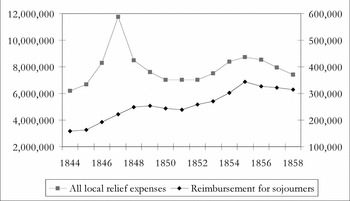
Yearly local relief expenses in Belgium, 1844–1858 (in Belgian franks).
Source: Exposé de la situation du Royaume. Statistique générale de la Belgique (Période décennale de 1851–1860), III (Bruxelles, 1865), pp. 100Q ff.
Note: Local relief expenses are expressed in relation to the axis on the left, reimbursements in relation to that on the right.

Figure one gives an overview of total relief expenses as well as the sum of all reimbursements for sojourners as figuring in aggregate national statistics between 1844 and 1858. The first series of figures illustrates the long-run tendency for relief expenses to increase strongly in Belgium over the nineteenth century, driven by growing proletarianisation and boosted by periodic crises such as the dramatic events of the 1845/6 famine.Footnote 79 As the traditional and largely self-reliant sources of income of relief institutions increasingly fell short of meeting the rising costs, subsidies by local authorities took up an ever more important and regular part in relief expenses. As these subsidies were in turn financed primarily by local taxes, the link between relief expenses and local taxation became considerably tighter in the course of the nineteenth century than it had been in preceding centuries.Footnote 80 At the same time, the proportion of out-resident recipients was clearly on the rise. The second series of figures expressed in figure one indicates how the law of 1845 substantially facilitated the transfer of relief made for sojourners, which almost doubled from a total of around 160,000 franks in 1844 to more than 300,000 franks by 1855. By that time, recorded reimbursements for sojourners represented four per cent of all relief expenses made by local authorities. Given the many problems in collecting trustworthy accounting details from sometimes unprofessional overseers, there is no doubt that this percentage represents an absolute minimum. Moreover, it is clear that the specificities of migration patterns ensured large local variations in the proportion of sojourners relieved. Tentative figures for the city of Ghent in the 1850s, for instance, suggest that there at least ten per cent of the households receiving outdoor relief were sojourners whose relief costs were reimbursed by their place of settlement and there are several reasons to judge this a conservative estimate.Footnote 81 By the 1870s, sojourners took up almost one in three patient days of paupers relieved at the Antwerp city hospital.Footnote 82
As cities were the main beneficiaries of net migration balances throughout the nineteenth century, the characteristics of Belgian settlement legislation implied that the relief costs of many urban immigrants continued to be borne by their, mostly rural, place of settlement. In contemporary opinion, there appears to have been a growing awareness of the increasing unevenness in the distribution of sojourners' relief costs between town and countryside. As proletarianisation coupled with urbanisation to raise both relief expenses and the number of sojourners, settlement legislation came at the centre of a conflict of interest between representatives of urban and rural interest groups, which, in the political setting of nineteenth-century Belgium, broadly corresponded to a conflict between liberals and Catholics respectively. The eventual compromise reached in 1876 amounted to a collectivisation of sojourners' costs which had previously been borne mainly by their places of origin. Even in this constellation, cities remained on the winning side, as they stood to gain considerably more than they would lose from a fonds commun to which the contribution was based solely on population figures: a tentative exploration of the urban payments to and disbursements from the fonds commun in the 1880s so far indicates that the urban balance of payment remained very positive indeed.Footnote 83
Why was the evolution of both settlement legislation and practice in nineteenth-century Belgium so contrary to what was happening across the Channel at the time, and so patently in favour of cities? The answer to that question deserves further systematic comparative research and elaborate consideration. At present, two main arguments can be raised. The first is the question of parliamentary balances of power. In the liberal state of Belgium, founded as a constitutional monarchy in 1830, industrial and financial interest groups were relatively strongly represented in parliament and this was undoubtedly a factor of importance in developing city-friendly settlement legislation. Yet, a conservative landed interest maintained the upper hand, especially in the early decades of the new Kingdom, and was supported by the powerful Catholic church. In that sense, the parliamentary influence of urban industrial and financial interest groups in Belgium was not decisively greater than in England and Wales, where parliamentary activity likewise represented shifting coalitions and compromises between industrial and agricultural interests.Footnote 84 However, agrarian property relations and agricultural activity were fundamentally different in Belgium from those across the Channel. The predominance of small-scale farming in combination with other income activities (mostly domestic industry), especially in the northern part of Belgium, made for a very different outlook of rural interest groups, in which for instance the question of ‘open’ and ‘close’ parishes had much less resonance than in England.Footnote 85
In that sense, the main argument might be of a somewhat paradoxical nature. Although a lengthening of residential criteria for settlement was against the interest of rural communities as such, there are different reasons why rural interest groups did not squarely thwart the proposals raising the required period of residence, at least during the first half of the nineteenth century. The most important of these was that the elite representatives of rural society remained in favour of retaining people in the countryside, as their presence raised agrarian rents while lowering the cost of agricultural and proto-industrial labour. In addition, migration to the cities was conceived very negatively, as being conducive to social unrest and stimulating the spread of revolutionary thought. In that sense, lowering the residential criteria for the acquisition of settlement was deemed undesirable in that it would have facilitated the switch from countryside to town. Hindering the transfer of settlement, in other words, was a way of ensuring a continued link and means of control between potential urban migrants and their place of birth. Rather than a victory of urban over rural interest groups, nineteenth-century settlement legislation in the Southern Low Countries can be interpreted as the outcome of a paradoxical compromise between these interest groups, glued by the fear of social disorder.Footnote 86 It is no coincidence in this respect that the two most important settlement laws in the first half of the nineteenth century, those of 1817 and 1845, were realised in periods of severe rural crisis, when the fear of large-scale urban migration and social upheaval loomed large.Footnote 87
By the second half of the nineteenth century, however, the uneven financial implications of settlement legislation became of greater concern than its supposed gains in terms of social stability. As unprecedented levels of urbanisation disproportionately raised the relief burden on the countryside and invalidated the underlying motives of maintaining rural sedentarity, rural representatives ended up lobbying for a significant lowering of the residential criteria for settlement transfer.Footnote 88 The eventual outcome of this conflict of interest, as we have seen, was a move towards the collectivisation of the costs for sojourners' relief in 1876, which in reality continued to favour urban finances, but at least relieved individual rural communities from sometimes very uneven costs for long-absent migrants.
As settlement legislation evolved in the course of the nineteenth century, it enlarged the autonomy of local authorities in their decisions about how to deal with sojourners. The law placed the decision of whether or not to grant relief, and if so, how much and for how long, firmly in the hands of the relief authorities of a sojourner's place of residence, while those of the place of settlement could only agree (implying a full reimbursement) or not (risking a removal) with the course of action taken. A first exploration of the balances of payment for sojourners' relief in nineteenth-century Ghent indicates that the reimbursed sums more or less equalled the relief costs incurred, thus suggesting a high degree of enforceability of the droit de remboursement. Footnote 89 In that sense, nineteenth-century settlement legislation greatly facilitated out-resident relief while placing the management firmly in the hands of sojourners' places of residence.
This state of affairs means that the different inferences which have been made concerning the practice of out-resident relief in early industrial England can be raised even more strongly in the Belgian case. As in England, we can expect communities of settlement to have agreed to providing out-resident relief primarily in situations where the return of sojourners was deemed less advantageous than their temporary subsidisation, i.e. in situations where employment or other supportive opportunities were higher in the place of residence than that of settlement. Given the spatial distribution of employment opportunities and the direction of net migration flows, this means that the balance of relief transfers would have favoured cities. In the English case it has been argued that out-resident relief may therefore have constituted an important subsidy to the early industrial urban sectors, the exact scale of which remains impossible to quantify because of inadequate recording. As Belgian legislation provided not only a legal but also an administrative framework for out-resident relief, the Belgian case provides much more promising opportunities to quantify the volume and direction of these labour subsidies via local, provincial and national accounts, an undertaking on which I will be embarking in the near future.
A central research question in this new undertaking is not only to estimate the overall timing and scale of relief transfers from countryside to town, but also to investigate potential divergences in sojourner policies between different towns. For instance, we may expect that cities whose economic base relied heavily on immigrant labour, like the port of Antwerp, might have pursued a more liberal policy towards sojourners than cities whose economic activities relied more on the skills of a trained home-grown labour force, like the textile centre of Ghent.Footnote 90 In addition to differences in economic structure, pre-existing arrangements concerning settlement probably had an important influence on the evolution of sojourner policy in nineteenth-century towns. Although the scale and overall direction of urban migration patterns underwent many changes in the nineteenth century, regional migration fields were generally marked by a strong degree of continuity.Footnote 91 Therefore, pre-existing custom and arrangements with hinterland villages might have been of great importance in the ways cities coped with new settlement challenges. The extent of continuity and discontinuity in actual practice therefore needs to be taken into consideration when evaluating nineteenth-century urban policies. An interesting hypothesis in this respect is that cities whose migration field underwent a fundamental make-over, like the mushroom industrial centres in Hainaut, were confronted with greater problems in the management of settlement issues than cities whose strong continuity in migration fields ensured that they could rely on long-standing relationships with their sojourners' communities of origin.
Caught between law and practice
What implications did nineteenth-century settlement reform have on the lives of Belgian sojourners and their likelihood to migrate? On the one hand, the expansion and standardisation of the possibilities of out-resident relief may have facilitated sojourners' access to relief, and therefore may have made migration a more likely option. On the other hand, the continual toughening of settlement requirements increased the legal insecurity of newcomers, at least in theory. Their access to relief provisions and even their right to reside in their new place of residence remained dependent upon ad hoc administrative arrangements which could, in principle, be revoked at any time without reason or justification by the Charity Office of either their place of residence or that of settlement. In that sense, the threat of being closed off from relief or removed would loom much longer over the lives of newcomers than in a situation where they could actually transfer their settlement to their place of residence. Whether these threats were theoretical or real, however, can only be judged from actual practice. Therefore, a systematic analysis of differences in urban policy towards sojourners is not only likely to give more insight into the scale of labour subsidies from countryside to towns, but also forms a necessary step to gauge the impact of settlement reform on the lives and fears of the labouring poor.
The real insecurity of sojourners' lives, as against their theoretical insecurity, was determined primarily by the likely outcome of a demand for relief: to be granted support, to be refused such, or to be removed. Unfortunately, we have no indication so far as to the frequency of removals in nineteenth-century Belgium. An analysis of a few hundred settlement examinations in mid-nineteenth century Antwerp gives some indication of the likely outcomes of a sojourner's application for relief. Of a sample of 191 Belgian sojourner's households examined in 1855 after an application for outdoor relief, there are only five cases where the authorities of their place of settlement refused out-resident relief, preferring that the households be sent back. In all the other cases, the reimbursement of relief costs appears to have taken place without much trouble.Footnote 92 In the case of foreign sojourners, the risk of removal appears to have been smaller still: from a sample of 220 Dutch sojourner's households examined between 1849 and 1851 after a relief application, none was refused support.Footnote 93 No indications were found of a situation wherein the Antwerp authorities refused relief to applying sojourners, but this might be attributable to the source materials used and/or to the conditions of a port town. Given the incentive structure of settlement legislation, however, we may hypothesise that relief authorities had little financial reason to refuse relief to sojourners but in the most destitute of cases, as the principle of reimbursement made sure they would get their money back. Such a situation could even result in a disproportionately generous attitude towards sojourners. An indication in that direction is that in Ghent in the 1870s the average relief granted to sojourners' households was up to fifty per cent higher than that of settled relief applicants (in the 1880s, however, it was significantly lower).Footnote 94 These fragmentary indications suggest that the life of a sojourner might in some cases have even been preferable to that of a settled pauper. However, the source materials used here are far too selective to allow a comprehensive evaluation. In order to evaluate the actual risks and benefits of being a sojourner, it is necessary to dig deeper into the frequency and likelihood of removals, the fluidity of reimbursement practices, and the distribution practices towards sojourners. In addition, pauper letters can provide a vital addition to these quantitative measures in order to provide further insight into the actual fears and expectations of sojourners' households.Footnote 95 The analysis which has been made so far of the geographical spread and contents of Belgian pauper letters suggests that paupers living in industrial Walloon areas were more likely to address higher authorities in their demand for relief.Footnote 96 This could indicate that the inter-local channels for out-resident relief were comparatively less developed in the Walloon areas than in the north of the country, possibly because of the more fundamental geographical restructuring of economic activity.Footnote 97
Conclusions
This exploration of settlement law and practice in present-day Belgium from the early modern period to the late nineteenth century has yielded some remarkable resemblances and striking differences to the situation in England and Wales. In the seventeenth and eighteenth centuries, settlement practice in the Southern Low Countries had several features in common with that in England and Wales. First and foremost, there existed a loose central guideline on the criteria of settlement coupled with the threat of removal, which was underpinned by a sense of a right to relief (at least for the ‘deserving poor’). Secondly, local authorities made use of certificates and other inter-parish agreements and bargaining strategies, including practices of out-resident relief. However, the situation differed significantly from that across the Channel in that there were no uniform criteria of settlement, and in that the relative independence and residual nature of relief organisation gave local property holders and employers fewer stakes in the actual administration of relief and settlement. This may explain why the whole issue of settlement remained of somewhat minor concern for most of the early modern period. It is only from the mid-eighteenth century onwards that an acceleration of processes of population growth, agrarian change, proletarianisation and geographic mobility went hand in hand with a surge in legislative and juridical activity in the domain of settlement. The precise scale and implications of these differences, both in the domain of social policy and in relation to sojourners' lives, can only be assessed through further analysis of local and regional variations in the administration of settlement in the early modern Southern Low Countries. Doing this in a comparative perspective, then, is likely to yield further insight into the debates surrounding the causes and consequences of settlement legislation in England and Wales, and into the economic, social and cultural implications of spatial belonging in early modern Europe in general.
In the nineteenth century, settlement legislation and practice in the Southern Low Countries came to resemble that in England and Wales more closely in many respects. First, the regime changes of the turn of the century helped to establish a national legislative framework with a relatively clear and uniform definition of settlement and of the right to relief. Second, the share of local taxes in relief expenses increased considerably in the course of the nineteenth century, thus strengthening the link between relief administration and local rates. These developments took place, moreover, in a society whose path of industrialisation and urbanisation bore many resemblances to that of England and Wales. Notwithstanding these growing similarities, however, the overall direction of nineteenth-century legislative change ran counter to that across the Channel. Whereas the different irremovability acts in England and Wales allowed for a de facto transfer of one's settlement to one's place of residence, the residential criteria for gaining settlement in the Southern Low Countries and later Belgium toughened over time. While the causes of this dissimilar development require further research, it is clear that the consequences of Belgium's peculiar path of settlement legislation urgently raise several issues which figure prominently in English debates on nineteenth-century relief and settlement. The fact that Belgian legislation came to endorse and even enforce practices of out-resident relief implies that the scale of relief transfers between countryside and cities can be addressed and measured more directly and exhaustively in the sources than in England and Wales. At the same time, the implications of out-resident relief and removal activity for the lives and fears of sojourners and would-be migrants can be addressed on a broader comparative scale. In the end, it remains evident that the true nexus of settlement practice, in the early modern period as well as in the nineteenth century, and both in England and Wales and in the Southern Low Countries, lay at the local level, framed by regional traditions and central guidelines. Including the diversity of settlement practice in several continental regions when analysing local and regional variations in settlement administration, will much enhance our understanding of the overall causes and consequences of different definitions of spatial belonging.
Acknowledgements
An earlier version of this article was presented at the conference ‘Narratives of Poverty: English Pauper Letters 1780–1840 in Comparative Perspective’ at the Fern Universität of Hagen (Germany) 4th to 7th October 2007, organised by Thomas Sokoll and Steve King. I thank the organisers and participants for their valuable comments, and I am grateful to Keith Snell, Catharina Lis and Hugo Soly for their constructive remarks on draft versions.