Introduction
Synchronized Direct Current Cardioversion (SDC) is an established therapy for the termination of supraventricular tachycardia (SVT – either atrio-ventricular nodal reentry tachycardia (AVNRT) or atrio-ventricular reentrant tachycardia (AVRT)) with poor perfusion. In the Australian prehospital setting, this therapy is rarely utilized, as episodes of SVT are often well tolerated, self-limiting, or can be terminated effectively using vagal maneuvers or pharmacological agents. Of eight Australian ambulance services, only four have included SDC in clinical guidelines for SVT with poor perfusion. The range of prescribed Joules settings (from 75 or 100 initially, then 150, 200 and 300 subsequently) suggests a need to quantify the practice within a clinical study. This case provides a previously unreported example of the safety and effectiveness of prehospital SDC for SVT (whose poor perfusion was precipitated by a Valsalva Maneuver) by Victorian paramedics, and discusses the available literature regarding the effectiveness and safety of this practice.
Permissions were sought and granted by Monash University Human Research Ethics Committee and Ambulance Victoria Research Governance Committee to produce this case report.
Report
A 46-year-old male experienced a sudden onset of palpitations whilst driving his car. After several minutes, he also developed central chest pain, nausea and heaviness across his shoulders that radiated down both arms. He parked his car and telephoned for an ambulance. On arrival, Mobile Intensive Care Ambulance (MICA) paramedics observed that the patient was conscious (Glasgow Coma Score (GCS) = 15) although anxious, rated his chest pain at 4/10 severity, and was lying semi-recumbent in his car. Initial observations indicated a respiratory rate of 20 breaths per minute with a clear chest and SPO2 of 78% on room air. His systolic blood pressure (SBP) was 85 mmHg and he had a weak pulse and rate difficult to determine. Application of a three-lead cardiac monitor indicated a narrow complex regular tachycardia of 220 per minute. A subsequently applied 12-lead ECG revealed SVT (Figure 1).
Pre-SDC 12-Lead ECG
Abbreviations: ECG, electrocardiogram; SDC, Synchronized Direct Current Cardioversion

Intravenous access was gained and the patient was transferred to the ambulance. Morphine 2mg was administered intravenously. This had no effect on the pain score but eased his anxiety. The Ambulance Victoria (AV) Clinical Practice Guideline (CPG) for the management of SVT indicated that a Valsalva Maneuver (VM) should be performed as first line management except when the patient is poorly perfused or rapidly deteriorating. A single VM attempt failed to terminate the arrhythmia. However, the SBP and GCS dropped to 55 mmHg and 12, respectively, and his diaphoresis and complaint of feeling quite unwell continued. The AV CPG restricts use of pharmacological agents (Verapamil or Aramine) to transport times to hospital of >30 minutes, therefore the paramedics prepared for the SDC procedure. A dose of 1 mg midazolam IVI was administered prior to SDC at 70 Joules, with 71.9 Joules delivered (Figure 2).
Paramedic Capture of SDC Application on Phillips MRx Cardiac Monitor-Defibrillator
Abbreviation: SDC, Synchronized Direct Current Cardioversion

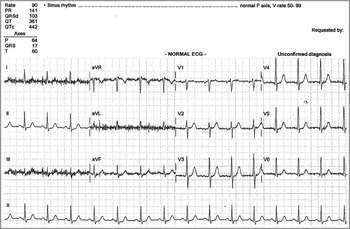
Sinus rhythm of 90 beats per minute (Figure 3) was established. The patient's vital signs demonstrated rapid improvement, with blood pressure increasing to 130/70 mmHg, GCS improving to 15, respirations of 20 per minute with a clear chest and SPO2 99% at room air. The patient's symptoms resolved rapidly. There was no recurrence of the SVT in paramedic care and the patient was stable and pain free upon delivery to the Emergency Department.
Post-SDC 12-Lead ECG
Abbreviations: ECG, electrocardiogram; SDC, Synchronized Direct Current Cardioversion

Discussion
This case demonstrates both a successful and uncomplicated SDC of SVT in the prehospital setting by paramedics. There is a paucity of reports of the effectiveness of SDC for hemodynamically unstable SVT, and there are a number of reasons for this.
Firstly, most reports have been of atrial fibrillation (AF) within the hospital and cardiac laboratory environment.Reference Botto, Politi, Bonini, Broffini and Bonatti1-Reference Boodhoo, Bordoli, Mitchell, Lloyd, Sulke and Patel4 As the mechanism of AF differs from SVT, extrapolation of the findings should be interpreted with care.Reference Lown, Kleiger and Wolff5-Reference Sinclair-Smith7
Secondly, nodal-dependent tachyarrhythmias, like SVT, usually can be terminated using much lower current than those with nodal-independent arrhythmias (eg atrial fibrillation).Reference Kirchhof, Eckhardt, Loh, Weber, Fischer and Seidl2, Reference Sinclair-Smith7-Reference Sucu, Davutoglu and Ozer11 However, no study has quantified optimum Joules settings for SVT patients. The AV CPG prescribes the use of 75 Joules for SDC of SVT, and the application of 70 Joules in this case was a pragmatic decision made by the paramedics due to the inability of the AV monitor/defibrillator to be set at this value.12 Also, no study has identified the optimum electrode placement. The anterior-lateral (as opposed to anterior-posterior) electrode application by paramedics was in accordance with the AV CPG.12 Three studies have reported the waveform used for termination of SVT.Reference Mayr, Ritsch, Knotzer, Dunser, Schobersberger and Ulmer13-Reference Van Der Watt, Aboo and Scott Millar15 As all employed a monophasic waveform, none provides evidence of biphasic waveform effectiveness.
Thirdly, with regard to the SDC safety, there are no reports of deaths. Complications described were respiratory depression, airway compromise and hypotension, all likely to have resulted from over-sedation.Reference Boodhoo, Bordoli, Mitchell, Lloyd, Sulke and Patel16, Reference Botkin, Dhanekula and Olshansky17 Botkin et al described 15 complications of SDC including aspiration pneumonia, bradycardia, cerebrovascular events and pulmonary edema. However, these in-hospital complications were attributed to anesthesia, airway management, and anticoagulation therapy (for atrial fibrillation patients) rather than the SDC.Reference Botkin, Dhanekula and Olshansky17 The use of minimal dosages of midazolam to reduce patient discomfort (through both its amnesic and sedation properties) enables AV MICA paramedics to avoid issues associated with the need for protracted or invasive airway management, or the potential for drug-induced hypotension following termination of the arrhythmia.
A single article reported the effectiveness of prehospital SDC in a physician-staffed prehospital emergency care system.Reference Roth, Elkayam, Shapira, Sander, Malov and HKehati14 Of the 84 cases where monophasic SDC was employed (at a mean of 118 Joules, SD = 69), 66 (77%) had SVT. Where hypotension, severe pulmonary congestion or significant angina pain was observed, SDC was considered. All patients were reverted with one to three SDC attempts after failure of vagal maneuvers and pharmacological interventions. It was concluded that prehospital SDC was safe and effective providing that physicians staffed the ambulance. In Victoria, SDC is restricted to MICA paramedics who complete a graduate diploma qualification at Monash University and a further year of clinical assessment in the field.
Rostagno et al undertook a 10-year retrospective review of prehospital SVT management, focused on vagal maneuvers and pharmacological reversion.18 Of 376 patients managed by physicians staffing a prehospital mobile intensive care response system, 311 (82.7%) were successfully reverted to sinus rhythm using vagal maneuvers and/or pharmacological agents. Significantly, this study excluded those patients with hemodynamic instability who received SDC, and yet the authors concluded that SDC was unsuitable for the prehospital environment without providing a rationale. The suggestion that physician control is required to provide safe and effective SDC in the prehospital setting has not been adopted by Australian prehospital systems, where SDC remains an integral part of the CPGs for patients with complicated SVT.18-22
The potency of vagal maneuvers can be dramatic when applied to patients with inadequate perfusion. This case, and anecdotal reports of increased VM potency in the setting of hypotension, has resulted in revision of the AV CPG. The VM is now contraindicated where the SBP is <100 mmHg. Also, adenosine will replace verapamil for the management of SVT.12
Conclusion
This case supports the effectiveness and safety of prehospital SDC by paramedics, the low Joules setting required and the adequacy of minimal sedation. Despite a paucity of evidence, the urgency for restoration of adequate perfusion ensures that SDC remains a therapeutic option in the prehospital setting for the treatment of SVT with poor perfusion.