Population registration has figured only peripherally in histories of state formation in modern Europe. Although the population registration regulations that were issued in the German states and elsewhere in continental Europe beginning in the sixteenth century were primarily intended to facilitate the policing of the mobile underclasses, the function of population registries changed fundamentally between the middle of the nineteenth and the middle of the twentieth centuries. The emergence in the latter decades of the nineteenth century of a global order of nation-states, whose legitimacy depended on their success in regulating the social and economic domains and promoting the welfare of their individual citizens, transformed personal data or information—that is, information pertaining to identifiable individuals and their vital, biopolitical activities—into one of the central elements of state power. Although the population registries never entirely shed their security function, during this period they became the most important source of individualized population information for the local, and then the national, interventionist state. It was also during these years that population registration, as well as the identification and control practices to which they gave rise, came to be seen as natural attributes of the state—a process that Mara Loveman has characterized, following Pierre Bourdieu, as “the primitive accumulation of symbolic power”Footnote 1—and that the associated forms of administrative knowledge came to be seen as natural and self-evident precisely because they made it possible to carry out essential state functions.
Anthony Giddens provides a useful set of concepts for thinking about the relationship between population registration, information, information processing, and state formation during this period. Giddens begins with the organization, which he defines as “a collectivity in which knowledge about the conditions of system reproduction is reflexively used to influence, shape or modify that system reproduction,” and he defines the political in terms of the administrative power of organizations, that is, their capacity to marshal the “authoritative resources” through which dominion over the activities of human beings is exercised.Footnote 2 Giddens argues that surveillance, or the collection, storage, and dissemination of coded information about the individual members of the population and the subsequent use of this information to superintend and control their activities, is the primary means for the concentration of the authoritative resources involved in the formation of the nation-state and thus the necessary precondition of their administrative power.Footnote 3 Although Giddens himself shows how official statistics exemplified the reflexive use of information by the nation-state to monitor and control the process of social reproduction, I argue that the personal information collected by the population registries could be used to govern individuals, populations, and large-scale social processes in a way that aggregate statistical data could not.
In Prussia, which set the pace for developments in other German states after unification, the population registration system assumed its recognizably modern form in the second half of the nineteenth century, and from this point onward the role of the population registries as sources of administrative information increasingly came to rival their original security function. The ways in which and the extent to which this information could be used to govern the population were, however, limited by the information processing technologies available at the time. Solving these problems—problems where surveillance and information processing were two sides of the same coin—was crucial to the development of the modern state. Although Jon Agar has noted that it is important to put the “bureau” back into studies of “bureaucracy,” I would suggest that it is equally important to understand the intimate relationship between bureau and kratos Footnote 4—that is, between information processing technologies and power or authority.
The history of Europe between the 1860s and the 1970s can be conceptualized in terms of the consolidation, and then the incipient dissolution, of both territory and the specific forms of power associated with control over bordered political space. The key to understanding this power is the intensity with which territory is penetrated and its potential resources mobilized, actualized, and transformed into power. As Charles Maier has written:
National power and efficiency rested on the saturation of space inside the frontier. National space was to be charged with “energy” throughout, like the ether … Territory would be pervaded with prefectures and subprefectures, post offices, railroads and infrastructure, mass-circulation newspapers, telegraphic communication, and the possibilities of electrical power in general. Territorial consciousness now meant that no point inside the frontiers could be left devoid of the state's control, just as no point within a field was devoid of physical force. Administrative energy in the form of primary schools, prefectures, and railroads would pervade and “fill” the nation's space.Footnote 5
This relationship among information, territory, and “administrative energy” was mediated by the development of the bureaucratic infrastructure of the state. In Prussia, and presumably elsewhere as well, the success of the Napoleonic era reforms was predicated on the creation of a modern administration—with its distinctive culture and practices—to implement these policies.Footnote 6 The 1850s witnessed a European revolution in political and administrative practice as moderate reformers, whose policies centered on the creation of the material infrastructures that they saw as the key to economic growth, progress, and the resolution of the social question, sought to create the bureaucratic infrastructure (including statistical offices) needed to formulate and implement coordinated policies for the nation as a whole.Footnote 7 In Germany, the state bureaucracy assumed its ideal-typical form during the Empire. The internal division of labor and the reliance upon professional expertise increased rapidly in tandem with industrialization, urbanization, and the expanding regulation of economic and social life, and this increasingly professionalized administration reached deeper into society and radiated outward from the cities into the countryside in the manner of the electromagnetic fields invoked by Maier.Footnote 8 At the same time, the increasing reliance upon bureaucratic procedures, formalized reporting requirements, the written word as a means of communication, and new office technologies was altering the nature of public administration and making possible the exercise of power by means of reiterative files, whose authority derived not from some transcendental authority, but rather from their repeated, mutually-authenticating reference to the larger, systemic whole to which they belonged.Footnote 9 The formalization of the population registration system and the integration of the population registries with other bureaucracies and other bodies of bureaucratic knowledge was an integral element of this process.
The historiography of the German population registration system has been dominated by a single slim volume: Götz Aly and Karl Heinz Roth, The Nazi Census (1984). In this book, which was researched and written during the 1983 census boycott, Aly and Roth argued that the population registration system and other population technologies were, if not distinctly Nazi, then at least intrinsically repressive, and they sought to undermine the legitimacy of the 1983 census by establishing continuities in personnel and policy between the Third Reich and the country's postwar statistical apparatus.Footnote 10 However, this and other attempts to link writing, population registration, and population knowledge to the growth of state power in the transition to European modernity have been challenged by an important collection of essays edited by Keith Breckenridge and Simon Szreter. Breckenridge and Szreter argue that civil registration, that is, the administrative recording of the birth, death, and marital status of individual citizens, their familial relationships, and their property, has always been the most important means for recognizing and documenting individual membership in the community and that, as the crucial instrument through which the individual has been able to assert his or her claim to the rights and entitlements associated with such membership, it has been a precondition of individual and collective welfare. The contributions to the volume argue that church registries and those maintained by property and land record offices, by poor relief authorities, and by voter registration, education, and public health offices enjoyed the broad popular support that they needed to function because they served a variety of vital communal ends, which ranged from establishing the right to poor relief to creating stable relations between individuals and promoting the security of marriage, property, and commercial intercourse.Footnote 11
These forms of civil registration must be distinguished from population registration or enumeration, and Breckenridge and Szreter argue that the instrumental dimension of the latter comes to the fore precisely because the element of recognition is almost entirely lacking in those population registration systems created by the central state in the nineteenth and twentieth centuries to meet its own needs.Footnote 12 This distinction between “good” and “bad” forms of registration, however, lets in through the back door the disciplinary state that they sought to banish through the front. The result is to underemphasize the welfare goals of the central state, the disciplinary potential of local organizations, and the overall ambiguity of the relationship between rights and registration. Nevertheless, their volume effectively undermines the assumption that registration must be understood primarily as a mechanism through which the state exercises control over a passive civil society, and it opens the door to historical analysis of their functioning in specific contexts. It also raises the question of the relationship between civil and population registration.
The story of population registration in modern Germany cannot be told apart from the histories of both civil registration, which established central elements of the administrative identity of the person, and identification documents and practices, which sought to ensure that this information was linked to the proper physical individual and which were the precondition for the exercise of administrative power and social control at a scale that transcended that of the face-to-face community. The political scientist and administrative historian Thomas Ellwein has argued that the establishment of a secularized civil registration system first made possible the comprehensive registration of the population. I argue, however, that origin and locality are mutually implicating, that the civil and population registries each capture different dimensions of the administrative identity of individuals, and that, just as the population registration system depended on the civil registries to establish the identity of new residents, so, too, would the civil registration system have been ineffectual without the ability to locate specific individuals.Footnote 13
Population Registration and Information Processing in Nineteenth-Century Prussia
Population registration regulations were codified for the Prussian state by the settlement law that was promulgated at the turn of 1842–1843 in conjunction with laws governing communal responsibility for poor relief, the punishment of vagrants, beggars, and the work-shy, and the acquisition and loss of Prussian citizenship. Although freedom of movement had been established by the early nineteenth-century reforms, settlement proved to be a stickier issue, and, together, population registration and the new poor relief system were the administrative links between movement and settlement.Footnote 14
At the time, the Prussian government was eager to promote labor mobility and industrialization. However, officials worried that such a policy would overburden the towns with the cost of relieving the poor who moved there in search of work. The so-called “relief residence system” sought to assure the poor that they would not find themselves entirely without a safety net as they moved in search of work while assuring the towns that they would not have to unfairly bear the burden of supporting these persons. The poor law regulated the distribution of relief costs by dividing the entire state territory into poor law districts and establishing a mechanism by which, as a result of the presence (or absence) of the individual for a specified period of time (and thus his or her contribution to the local economy and the finances of local government), the obligation to assist this person in case of need was placed upon (or removed from) individual districts. The settlement law codified the right of all independent persons to take up residence where they pleased. It also required all persons desiring to settle in a new location to register with local authorities and provide relevant information concerning their personal circumstances. In this way, the registration of settlement for police purposes also started the clock governing the acquisition and loss of a relief residence.Footnote 15
The introduction of near-universal freedom of movement by the North German Confederation in 1867, the abolition of internal passports that same year, and the extension of the Prussian relief residence system to the entire country after 1871 forced the other states to revise their population registration regulations to bring them into accord with this more liberal order. Although the idea of uniform national regulations for the registration of both citizens and foreigners had a certain appeal, Imperial and Prussian officials felt that it was important to give local officials the authority to determine precisely how registration was to be carried out and the period within which persons were required to register.Footnote 16 Consequently, the Reich government never made use of its authority to supervise state settlement legislation (§4 Abs. 1 of the April 1871 Reichsverfassung), including the registration obligations associated therewith, and population registration remained a matter for the states.
Because population registration fell within the purview of the interior ministries and the police, registration requirements could be altered by ordinance. Consequently, population registration only rarely became a matter of explicit legislative concern at either the Reich or the state level, and most differences that did arise were resolved through negotiations within the state bureaucracies or between officials in the individual states. In practice, the responsibilities of the registry offices evolved primarily through the accretion of new tasks imposed by legislation in other areas rather than as a result of direct legislative modification of the registration system itself.
Two practitioner's guides published at the end of the century—one for Berlin, the other for the Rhenish town of Mülheim (now part of Cologne)—give a good picture of the Prussian population registration system as it had evolved since 1842.Footnote 17 For the authors of both volumes, the function of the population registration offices was not only to monitor and control the population for security purposes, but also to facilitate the work of the administration by providing public officials and the general public with “quick and reliable information on current and past residents of the community.” This latter function was so important, the Mülheim volume noted, because “the police population registration system is necessary to administer a large part of our laws and state institutions.”Footnote 18
In Berlin, the registration form asked for information on all members of the household, including name (and previous names of the wife), marital status, occupation, date and place of birth, religion, tax registration information, the address of the new residence, the date on which the party moved in, and previous addresses. This was the basis of the administrative identity of the head of household and of those dependents whose relation to the state was mediated through this person. If registry officials were suspicious of the authenticity of the documents submitted, the identity of the person, or the person's criminal or political past, if the newcomer did not submit a certificate showing that he had informed registry officials in his previous place of residence that they were departing for Berlin, or if the person did not appear to be entirely reputable, then the official could inquire of the registry office in the person's previous residence.
The linkage between the population registration system and both the tax and conscription systems was particularly close. The classified income tax that had been introduced in Prussia in 1851 divided households into broad classes based primarily on such external indicators of income as occupation, way of life, and social status, and the law required that a special tax census (the Personenstandsaufnahme) be carried out each November. As was the case with policing, the tax law was administered by local officials on behalf of the central state. Because tax assessment was affected by any number of factors that were normally documented by the population registries (movement from one household to another, movement from one locale to another, entry into or discharge from military service, emigration), and because the law required local tax officials to communicate with one another—parallel to the registration of departure and settlement—relevant information on newcomers (including previous tax payments, the number under which this information was maintained in the tax assessment list of the prior residence, and any outstanding obligations), it made a great deal of sense to both administrators and the public to have the population registries, which also provided the basis for the tax census, collect this information when newcomers registered their settlement and then to forward the necessary information to local tax officials.Footnote 19
Registry officials also had to verify the military status of all male newcomers in the relevant age group and compile the annual conscription lists of the men residing in their district. One facet of this involved determining whether men seeking to emigrate had fulfilled their military obligations. For example, and to our great misfortune, Donald Trump's grandfather, who had emigrated illegally before he had performed his military service, was expelled from Bavaria when he sought to return.Footnote 20 Moreover, not only did the precinct offices maintain lists of resident foreigners. As part of the broad understanding of police and its regulatory tasks, they also issued the labor books required by servants, certificates of leaving, and good conduct attests for persons applying for passports and prepared a variety of lists used by communal officials (voters, jurors, and children subject to compulsory vaccination and schooling, as well as persons practicing a variety of professions and occupations). Prussian regulations also required population registries to provide the general public—on request—with information concerning specific individuals (name, date of birth, and present or previous registered address). Although the Berlin guide characterized all of these as ancillary duties, they were, in fact, essential functions of a population registration system that was evolving into a multifunctional source of information for the police, the civilian administration, and the general public.Footnote 21
Both cities maintained two sets of forms—one ordered alphabetically, the other by street and house number; while smaller towns may have continued to use bound registries, larger cities used the modern medium of loose-leaf files, which more easily permitted the regular addition and removal of individual members of an increasingly mobile population. The manuals described both the various strategies employed to reduce the amount of labor required to record and retrieve relevant information concerning specific individuals and the ways in which the robustness of these files was enhanced by supplementing them with information from other sources (such as the courts and the civil registries) so that the registries became the point at which, and the means through which, much of the information relevant to policing—including the regulatory tasks for which the police were responsible—was integrated.Footnote 22
Persons leaving their current place of residence were expected, but not required, to register their departure and inform officials of their intended destination. Conversely, newcomers were expected to submit a certificate of leaving from officials in their previous residence. The problem was that many people who left one residence did not always know where they were going; nor were they always truthful about their intended destination; and many people simply decamped “on travels.” In such instances, it was difficult to monitor the movement of individuals and verify the information contained in the documents they presented at their new residence. One proposal that was being considered at the time to keep the paper trail from being irreparably broken was to institute a universal “backwards reporting” (Rückmeldung) system, which would require registry officials in the person's new residence to notify their counterparts in the place that the newcomer claimed as his or her previous residence. This would allow officials there to reestablish any broken paper trail and maintain a seamless record of the identity and location of the individual concerned. Such a requirement existed only for the Prussian provinces of the Rhineland and Westphalia, and the author of the Mülheim guide could not recommend its wider adoption “urgently enough.”Footnote 23
Business groups were also an important catalyst for the growth of state surveillance capacity. The increasing mobility of the population and the intensification of commercial relations across ever-larger distances made it increasingly important for business to be able to keep track of the location and financial reputation of the persons with whom they did business, especially those to whom they sold on credit.Footnote 24 In early 1902 the Leipzig branch of the national Creditreform association, which was one of the nation's chief credit reporting agencies, called on the ministry to “perfect” the population registration system by introducing a universal backward reporting system. This proposal received wide support from chambers of commerce and such influential groups as the League of Industrialists.Footnote 25
Although the Prussian government was considering the introduction of such a requirement, officials were unsure whether the benefits of such a system would exceed its administrative costs, and the 1904 reform only mandated backward reporting in those instances where the newcomer's papers indicated that officials in the person's previous place of residence were not informed of his actual residence.Footnote 26 Although Reich and Prussian officials hoped that this system could be extended to the entire country, the states were not able to reach a consensus on the need for such a backward reporting mechanism, and the issue was soon dropped.Footnote 27 This was where matters stood at the start of World War I.
Territorial Power, Border Regimes, and Population Surveillance from the Empire through the Republic
Territoriality involves not only the bureaucratic penetration of the internal space of the state, but also control over the movement of people both within this space and across its borders. Between the 1860s and the end of World War I, Germany experienced a series of different border regimes. Although the November 1867 law on the freedom of movement allowed German citizens to move within the states of the North German Confederation without an internal passport, the passport law, which had been approved three weeks earlier, permitted citizens to leave the territory of the Confederation, and foreign nationals (with the exception of Russians) to enter, without an international passport issued by their respective governments.Footnote 28
The liberality of this international regime of movement that was later evoked so elegiacally by Stefan Zweig was, however, limited to the comfortable classes.Footnote 29 Already by the 1880s, the German government had begun to establish the administrative infrastructure for controlling the movement of Polish migrant workers, whose presence was regarded as a danger to the culture, health, and racial quality of the nation. East European Jews, who traveled through Prussia to Hamburg, Bremen, and points beyond, were subjected to similar surveillance and control. And politically unreliable and ethnically undesirable minorities were subjected to a series of mass expulsions.Footnote 30 This use of ethnic, racial, and hygienic criteria to construct and control Germany's eastern borders was one dimension of a larger process in which globalization and nationalizing states interacted to create a border regime whose primary function was to limit the settlement of undesirable migrant labor. With the outbreak of World War I, this process was overlaid and intensified by the more traditional desire to protect against spies, saboteurs, and subversives.Footnote 31 In this way borders were constructed as liminal or heterotopic spaces, where travelers were constrained to submit to increasingly routinized administrative controls, undergo requisite hygienic screening, and disclose the personal information needed to document either their citizenship or their status as tolerated aliens.Footnote 32
On July 31, 1914, Germany abandoned the liberal border regime established in 1867 and began to require that foreigners seeking to enter the country possess a passport establishing their identity and nationality. In June 1916, the country adopted a more fully securitized border regime, which required foreigners and citizens alike to have both a passport and a visa to leave or enter the country and which imposed stricter registration regulations on foreigners residing in or traveling through the country.Footnote 33 One of the chief goals of the 1916 passport law was to give military and police officials the chance to vet visa applicants, and visas were to be issued only to persons whose political reliability could be positively established.Footnote 34 This new border regime also placed great emphasis on the securitization of personal identity and movement. Already in June 1915, the Prussian interior minister had ordered that new passports were to be issued only by the police in the person's official place of residence, that they include the bearer's signature, his or her physical description, and a recent photograph, and that the applicant present an official certification that he or she was, in fact, the person shown in the photograph.Footnote 35 These measures were incorporated into the June 1916 passport regulations, which also stipulated that passports were to be valid for no longer than one year and that they were to be issued only to persons whose German nationality had been clearly established. Although these regulations brought greater security to both the administrative identity of the bearer and the passport document itself, the new visa regulations allowed the government to more closely control travel across the country's borders.Footnote 36 These wartime border controls were maintained into the 1920s.Footnote 37
At the same time, the military also sought to enhance the security of the country’s borders by requiring the residents of designated border districts to obtain new identification documents—with a photograph of the bearer.Footnote 38 The military even considered extending this identification regime to the entire civilian population. Civilian officials did not, however, feel that experience with the use of such cards in the border districts supported such a policy, especially because it seemed unlikely that such a program would have survived the transition to peacetime. As the Saxon interior ministry noted, “During the war the population patiently endures many bureaucratic commands, which they would energetically oppose after the end of the war.”Footnote 39 Although the military did impose the ID card requirement on occupied northern France and Belgium to control the movement of the local population and facilitate conscription for work in Germany, even these regulations were far less radical than those imposed upon the military fiefdom Ober Ost, which had been carved out of the Latvian, Lithuanian, and Polish territories conquered from Russia in 1914.Footnote 40
The effort that had been put into securitizing transborder movement would have gone for naught in the absence of measures to monitor foreigners once they had entered the country. Already in the fall of 1914, the military had begun to make use of its martial law authority to ensure the closer monitoring of resident aliens in the country.Footnote 41 The military had a poor estimation of both the civilian policing of aliens before 1914 and the effectiveness of these wartime measures, however, and by mid-1917 it was calling on the Reich government to regulate the movement of foreigners into and within the country.Footnote 42 The military believed that the best way to close what it regarded as a glaring “gap” in the civil order was to require every foreigner who crossed the border to complete a registration form that would then be sent to the police in the capital of the state where the person entered the country so that it could be checked against the police wanted persons file and other files of suspect individuals. Interior ministry officials argued that such a crude tool was both ineffective and unworkable. On the one hand, such a policy would have meant that every day boxes of forms would have rained down upon the desks of the police in Dresden and Munich, the capital cities of the states with the greatest number of border crossings to the Austro-Hungarian empire. On the other hand, ministry officials argued that such measures could never be sustained in peacetime because they would unnecessarily burden both innocent travelers and the police without preventing undesirable foreigners from entering the country via other routes.Footnote 43 In the end, the military was unable to overcome these objections.
In the initial postwar years, debate over the registration and policing of foreigners revolved around two main issues. The first was whether such surveillance should be organized at the state or national level. This debate, however, took place against the background of the Russo-Polish war (1919–1921) and widespread political violence in the successor states to the Habsburg and Russian Empires, and the question of immigration control was cast increasingly in terms of how to respond to the growing number of Jewish refugees from the region.
In 1923, Reich Commissar for Civil Detainees and Refugees Daniel Stücklen (SPD) generously offered to solve the problem of illegal Jewish immigration by transforming his office into an alien police agency for the entire country.Footnote 44 Stücklen portrayed these Ostjuden as economic parasites, who were so dangerous that they needed to be “systematically apprehended, registered, placed under continuous control, and, if necessary in the interest of the nation, rendered incapable of doing harm.” Stücklen's call for the more rigorous policing of foreigners was important less because of its distasteful, antisemitic tone than because of his novel proposal to create a central aliens registry. According to Stücklen's plan, whenever foreigners registered with local authorities, these officials were to relay the relevant information to this central registry, which would record it, assign the person an identifying number, and then report this number back to the local population registry. To ensure the unambiguous identification of such persons, Stücklen proposed that they be issued a national identification card, which was to be surrendered when the person crossed the border in the other direction. Any foreigner who violated these registration regulations was to be interned.
The negative reactions to Stücklen's proposal combined federalist reservations about the nationalization of policing—“The policing of aliens is a matter for the states,” declared Prussian Minister President Adam Stegerwald (Center), “and must remain their responsibility in the future”—with doubts about the effectiveness of such a national bureaucracy.Footnote 45 The more economical and politically palatable path—and the one that was actually taken—was the coordinated promulgation of common regulations by the individual states.
The second question was whether registration requirements for foreigners should be different from those for citizens. By the mid-1920s, the strict wartime visa regime had been relaxed for citizens of a number of countries as a result of bilateral agreements, and the regulations on the registration of foreigners had been eased to the point where there were no longer any significant differences in registration requirements for aliens and for citizens. In addition, settlement regulations, which—in the absence of a national law—remained the responsibility of the states, had traditionally been interpreted to mean that visas only entitled foreigners to reside in a specific location. This practice had gradually fallen into desuetude, however, and by the mid-1920s it had become generally accepted that, once granted the right to settle by one of the states, foreigners should enjoy a general freedom of settlement within the country.Footnote 46 These developments led to the convergence of the debate over passports, visas, and the registration of foreigners with that concerning registration requirements for German citizens.
In the summer of 1928, representatives of the federal and state interior ministries formulated a set of guidelines to be employed in revising their respective population registration regulations.Footnote 47 In April 1930, the Prussian interior ministry published a model registration ordinance, which was closely modeled on these guidelines, and required district governors to repromulgate this ordinance for their own jurisdictions.Footnote 48 These 1930 Prussian regulations did not differ in any radical way from previous regulations. They did, however, subject foreigners to the same registration requirements as citizens; they included registration requirements for the operators of hotels and inns; and they ended a long controversy by requiring the administrators of hospitals, clinics, and other institutions to register the admission and discharge of patients.Footnote 49 The initial reform of the population registration system after the Nazi seizure of power continued in these well-worn tracks. In May 1933, the Prussian government went one step further and, on the basis of the 1931 Police Administration Law, issued new population registration regulations, which were virtually identical with those put in place in 1930, but which for the first time ever were directly binding on the entire population.Footnote 50
The Limits of Administrative Power in the Age of Paper
World War I and the immediate postwar years saw a vast expansion of both the administrative responsibilities and the administrative capacities of the state, both national and local. Even though the administrative power of the state also expanded during these years, however, it was nevertheless limited by the continued reliance on paper as a means of storing, communicating, and retrieving information.
In a well-known study, sociologist James Rule evaluated the surveillance capacity of large organizations on the cusp of the computer age in terms of four criteria: 1) the size of the population surveilled, including the number of persons monitored, the comprehensiveness of the information held on each, and the resulting degree of discrimination permitted by this information; 2) the extent to which organizational centralization was made to coincide with the life-space of the population so as to ensure that individuals—especially the minority of individuals who in the absence of such control were likely to violate the rules of the organization—could not evade monitoring by moving from one place to another; 3) the speed of information flow and decision-making within the organization; and 4) the degree to which the organization could both identify the individual members of the population and remain in continuous contact with them so as to obtain the information required of them or subject them to appropriate sanctions. By all of these measures, the surveillance capacity of the population registration system that had developed by the end of the 1920s must be rated rather high. It encompassed the entire population (including those persons who moved across the country's borders); most of the information required by the system traveled—in the form of certificates of leaving and registration forms—at the speed of the population whose location they were to document; scarce bureaucratic resources were carefully husbanded by limiting nonroutine, individualized surveillance to a small minority of known or suspected deviants; and individual members of the population were required to present themselves to the registry offices, which made it possible to bring the relevant information to bear on these persons at the point where they were vulnerable to such control.Footnote 51
The development of the German public administration between the Empire and the Weimar Republic also brought about a qualitative change in the nature of both the information available to the state and the informational relations between the citizen and the state. At the beginning of the nineteenth century, state officials were expected to act as personal representatives of royal authority and to make decisions based on their personal knowledge of local society. Ellwein argues, however, that the situation had changed in fundamental ways by the end of World War I. Not only had linkages between the civil and population registries, on the one hand, and, on the other, land registries, tax lists, and the other registries of personal information collected by local officials become deeper and more routine. The importance of the knowledge that was acquired by officials by virtue of their immersion in local society had substantially diminished while the amount of knowledge collected through formal bureaucratic procedures and the extent to which this knowledge was exchanged with and used by other branches of the administration had correspondingly increased. Although the local state had long possessed much more knowledge of its individual citizens than had the central state, Ellwein concludes that the growth of the state bureaucracy, the formalization of its communication processes, and the intensity with which information was exchanged among its different branches had made the individual citizen transparent to the central state to a degree that had not been possible in earlier times.Footnote 52
This intensification of information exchange at the local level, together with advances in technologies used to process data held in paper form, prompted officials to look for ways to both increase the value of this information and save money by more closely integrating these processes. It quickly became clear, however, that there were narrow limits to such rationalization in the age of paper.
Between 1921 and 1936 or so, officials hoped that it might be possible to rationalize the public administration either by consolidating the police population registries with the tax registration system or with the lists maintained by local government for its own administrative and social services, by using the tax registration system to collect the data normally collected by the periodic occupational, business, and population censuses, and by using new office technologies to make the consolidated registries more efficient and economical. The problem was that such simplicity and economy could only be achieved at the price of greater complexity because the police population registries, municipal government, and the tax offices all collected different kinds of information for different purposes, and it was feared that any potential savings from such measures would be offset by the growing complexity of such integrated registries or negated if officials were forced to abstract from these integrated master files specialized lists of manageable size—thereby reproducing existing administrative structures. In addition, pilot projects to determine the feasibility of integrating police registries with those maintained by local government concluded that such a fusion was impractical because paper records would always have to be stored in a single location and that this would give rise to conflicts over the physical location of, control over, and priority access to these unified registries. And the proposal to use the information gathered by the tax registration system for census purposes was rejected because of the fear that the mixing of name-based administrative (i.e., tax) and anonymous statistical (census) data would diminish the overall quality of the information collected. In short, before computers and telecommunications made possible decentralized access to and maintenance of integrated, centralized databases, it was more efficient to maintain separate registries for specific purposes, even if this entailed a degree of redundant labor in registering the population and maintaining basic identifying data.Footnote 53
The Nazi Information Machine
Population was both the means and the end of the Nazi regime in a way that it had not been in the Weimar Republic. The Nazis regarded the total registration of the population as an essential tool for mobilizing the Volk, rationally deploying the nation's human resources in support of the global struggle for living space, and implementing their racial policies. Although population registries, censuses, ID cards, and other population technologies may be essential elements of modern state power, they are not intrinsically genocidal. They only became so in Nazi Germany as a result of a racial worldview that led to the abandonment of the rule of law and the subordination of the rights of individuals to the ostensible needs of the Volk.
Nevertheless, when it comes to surveillance, privacy, and the use of personal information, Nazi Germany was in a class by itself. Although the total state abolished, at least in theory, the distinction between the public and the private, Nazi Germany was not a totalitarian state in the sense of an all-powerful state riding roughshod over a supine civil society. The Gestapo was certainly capable of bringing the full force of the state to bear on the enemies targeted by the regime, that is, on racial outsiders, political opponents, and “socially harmful” elements. However, it lacked the manpower to actively surveil the general population, and it depended to a substantial degree on denunciations from a public that was mobilized behind the ideology of a racial national community.Footnote 54
The Nazi state was a vast machine for the collection and processing of personal information, and racial policy was the pivot for all of these surveillance programs.Footnote 55 The Nazis issued approximately two thousand laws, decrees, and regulations that predicated the enjoyment of specific rights and privileges upon proof of racial status. To obtain such proof, individuals had to submit to investigations of their racial origins, health, and political reliability or provide such documentation on their own. The most important of these papers was the Ahnenpass, which documented family ancestry (including both racial purity and marital legitimacy) across multiple generations.Footnote 56 At the population level, the civil registries sought to transform themselves into offices for documenting the hereditary history and racial composition of the individuals and families who made up the Volk, while the Reichssippenamt was responsible for the research needed to render pseudoscientific opinions on racial ancestry.Footnote 57 Like the Mormons, both offices engaged in the competitive plundering of church registries in order to construct their genealogical files. On the other hand, the public health offices were responsible for maintaining the erbbiologische Karteien, which contained all kinds of information pertaining to the racial fitness of those members of the population who came into contact with the hereditary courts, schools, juvenile authorities, and the public health offices themselves. Two other huge collections of personal information were compiled during the Third Reich: those of the military and labor administrations. The interaction of these two systems with the population registration system will be addressed below.
With regard to the population registries, the key questions concern the nature of the administrative power they generated. Their primary function was to establish and record the administrative identity and physical location of the individual. They also served as the primary mechanism through which changes in this information were relayed among the police, conscription offices, the labor administration, the tax administration, municipal government, motor vehicle and driver's license bureaus, and other agencies. As such, they were the central node in a sprawling network of mutually authenticating registries, which made use of coded information to directly superintend individuals in ways that registry officials themselves did not.Footnote 58 In other words, the population registries were the main administrative database for an—unevenly—integrated population identification, information, and control system. However, the Nazis did not so much solve the problems inherent in the use of paper as the primary medium for the storage and transmission of information as transform the associated limitations and redundancies into a virtue. The peculiar intensity and dynamism of population surveillance during the Third Reich was the product not only of more stringent registration practices, but also of the interaction among the many different surveillance systems created to mobilize the nation for total war.
Once work on a national population registration system had been put aside in 1935, other issues caused additional delays. On the one hand, there was a debate over the ways in which the registries might be involved in identifying the non-Aryan population, though it was ultimately decided that the population registration system was not the proper mechanism for investigating racial ancestry and that, instead, this should be done in conjunction with the planned population census to be conducted on the basis of the 1935 Nuremberg laws.Footnote 59 On the other hand, there was neither a legal basis on which to issue national population registration regulations nor a national police organization to ensure their uniform implementation. This latter problem was resolved by the unification of the country's police under Heinrich Himmler in summer and fall 1936, and in May 1937 the government promulgated a law giving the interior minister the authority to regulate the passport, alien registration, and population registration systems.Footnote 60 On this basis, Interior Minister Wilhelm Frick issued the Reich Population Registration Ordinance (Reichsmeldeordnung) in January 1938.Footnote 61
The key innovation was the introduction of a universal backward reporting requirement. This was the “backbone” of the Nazi registration system and the very epitome of the reflexive use of information by the state to monitor and govern individual members of the population.Footnote 62 The postcards that were to be used by registry officials to let their counterparts know where the newcomer had actually settled also asked officials in the person's previous place of residence to advise them if the individual was wanted for a crime or questioning or if the person had a criminal or political past that would merit closer surveillance. The backward reporting system did more than simply enhance the ability to track the individual as he moved within the space of the state. It also ensured, at least in theory, that the person could never escape either his own past or the solicitude of the state.Footnote 63
The Nazis did not mince any words about the importance of the “more complete registration” (lückenlosere Erfassung) of the population. “To a greater extent than ever before in a registration law of the states or local communities,” declared Police General Kurt Daluege, one of Himmler's deputies and the head of the uniformed constabulary, in his foreword to the official commentary, “the Reich Population Registration Ordinance expresses the position that one of the most important tasks of the registration system is to contribute to the protection of national comrades against criminals and to facilitate the work of the security police in their struggle against these criminals.”Footnote 64 On the other hand, the cities had long made use—in an irregular and difficult-to-document manner—of police registration forms for administrative and social purposes, and the ordinance formalized these arrangements and codified the role of the police population registries as a source of information for the state and local civilian administration.Footnote 65 In fact, the draft Federal Population Registration Law, which was submitted to the Bundestag in 1971, characterized the 1938 ordinance as the turning point in the transformation of the registries from a purely repressive institution into a source of information that could be used by both the police and the civilian administration.Footnote 66
The registries were also involved in conscription. During the Empire, elaborate procedures had been developed to coordinate the work of the civil and population registries in this area, and, when universal male military service was reintroduced, this machinery was cranked up again.Footnote 67 In addition, men subject to military service were required to present documents verifying their military status every time they interacted with the police and the population registries, and passports and visas could only be issued to these men with the permission of military authorities. When these men moved to a new residence, this information was entered into the population registration form and then forwarded to the army so that the person's military registration could be transferred to the proper office.Footnote 68 One contemporary noted that documentation of one's military status was required in so many instances that it was impossible to lead an orderly civilian existence without such papers.Footnote 69
Filing Modernity
Centralized, national registries had long been regarded as a solution to the problem of tracking the individual members of a mobile population, and the debate over the reform of the population registration system in Nazi Germany also raised the question of whether modern office and information technologies could be employed to create a national population registry to supplant the existing system of local, decentralized registries. Although these proposals came from the public, rather than security officials, they provide illuminating illustrations of contemporary advances in information processing technology.
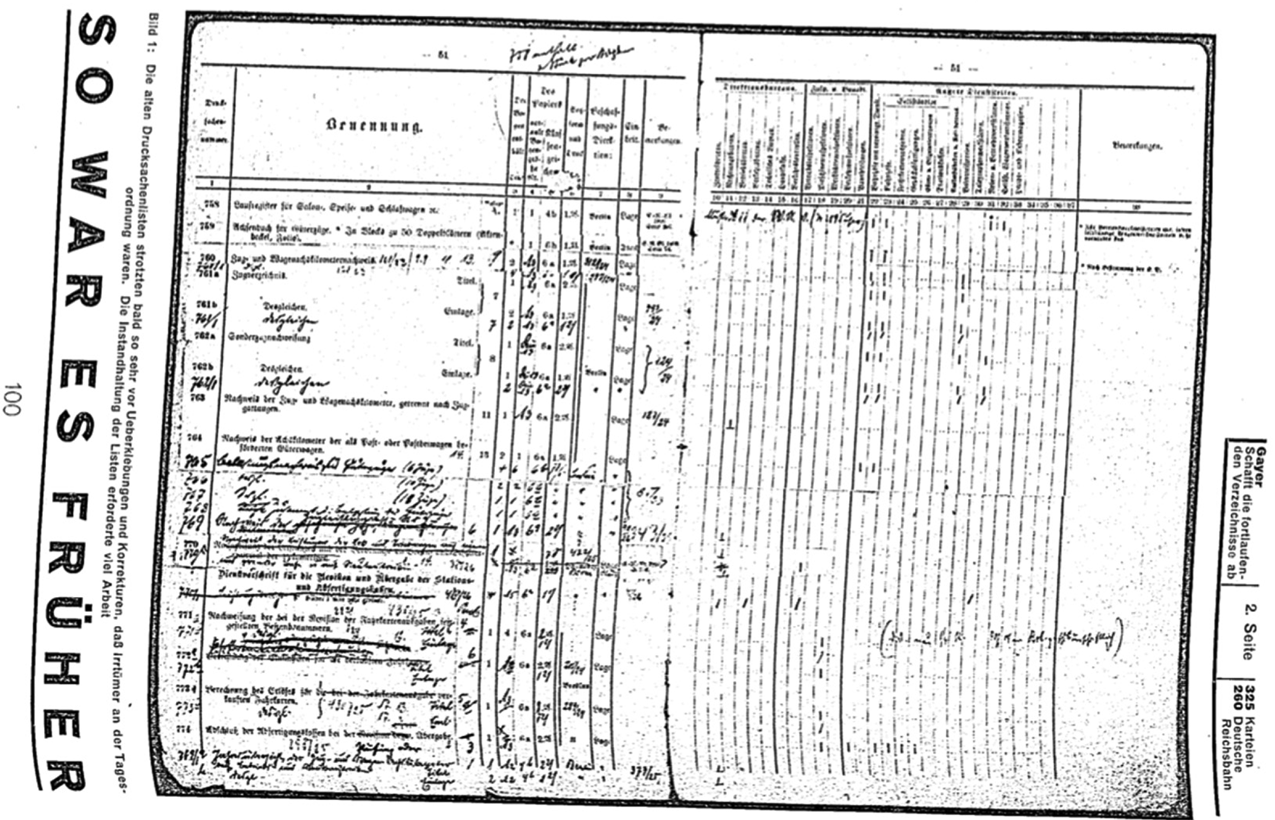
The emergence of big business, which dealt with both myriad suppliers and a mass consuming public, depended on the development of technologies for filing papers in a way that would permit the rapid, efficient retrieval of large numbers of individual documents. The key elements of this system were file cards and loose-leaf forms (which had emerged through the disaggregation of the bound, chronologically ordered register that had been the basic mechanism for coordinating the flow of information within large organizations through the nineteenth century and beyond), new mechanisms (interlayering, tabs, notches, riders, setbacks, indentations) for increasing both the amount of information that could be stored and the number of criteria that could be used to classify, file, and retrieve this information, staggered-tab filing systems (binders, vertical files, filing cabinets, the Rolodex) that allowed a rapid overview of and access to information, and the novel design and disposition of bureaucratic space itself. Even though the text is not easily read, figure 1, which is taken from a 1927 article in the Journal of Organization entitled “Abolish the bound registry—Introduce the card file!,” is still worth a thousand words. The chaos of insertions, deletions, corrections, new information pasted on top of old, and the resulting lack of clarity epitomized the irrationalities and inefficiencies of older office practices that relied on bound ledgers or registries. This was to be contrasted with the clarity with which the individual fields were defined, the cleanliness of the storage medium, and the overall order and efficiency promised by the card file, which allowed the user to rapidly survey the whole of the knowledge contained therein.Footnote 70
“Abolish the bound registry—Introduce the card file!” — The Call for modernization of information processing technologies.

Aly and Roth cite at length a plan submitted in November 1934 by Freiburg attorney Erwin Cuntz.Footnote 71 This plan called for the erection of a skyscraper-sized building that would house a national population registry. The proposed building was, as Aly and Roth correctly note, nothing other than a hand-operated memory device for a national database, which would permit the direct, individual addressing of each of the 60 million cards that it was intended to hold.
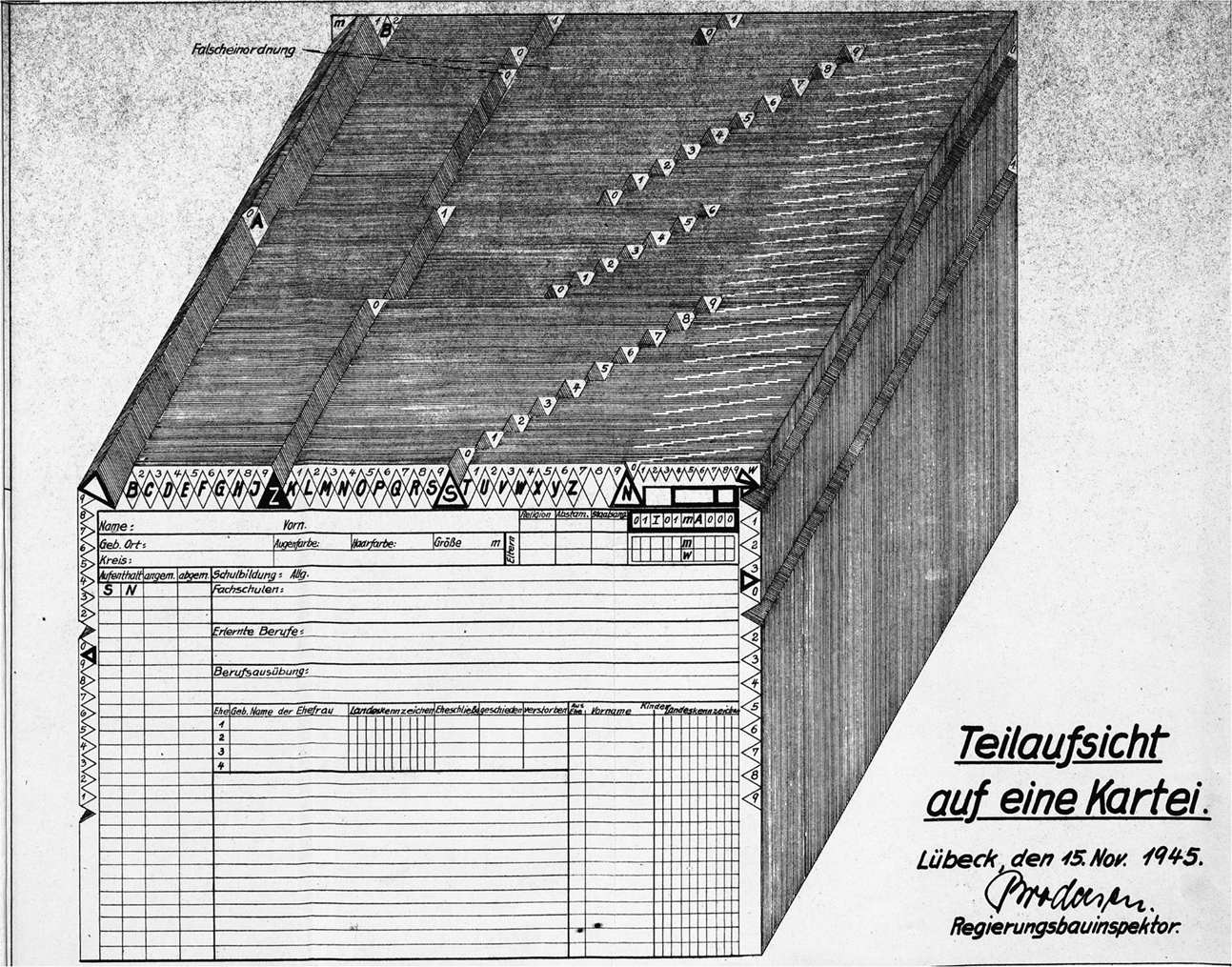
This, however, was not the only such proposal. In January 1944, Hans Brodersen, a building inspector in the north German town of Rendsburg, submitted a forty-five-page plan—replete with extensive blueprints—for the construction of a universal national registry (a Volks-Universalkartei).Footnote 72 The registry, as Brodersen envisioned it, would serve a number of different purposes that collectively capture the multiple functions of surveillance in modern society. It would make civil and commercial life more secure by making fraud (Schwindel) and identity theft (falsche Legitimation) impossible. Because property could be indelibly marked with the person's identity number, it would make theft unprofitable. It would permit the detailed surveillance of each individual and the recording of “every notable occurrence in the birth, life, and death of the community (Volkskörper),” though Brodersen did not elaborate on who would be recording such information or for what purposes. It would serve as an information bureau for both public agencies and, in a more limited manner, the general public. It would make the work of the police and the courts more efficient. And it would obviate the need for periodic censuses. Brodersen, however, viewed the registry more as a tool for the moral education—or, in Foucauldian terms, an apparatus for the disciplining—of the population than as a technology of racial exclusion: the mere awareness of the existence of the registry would, he explained, reinforce the conscience of those persons who might otherwise be tempted to pursue a life of crime and work in a “silent” and “uncanny” manner to guide them back onto the straight and narrow path.
What is of greatest interest here is the design of the registry itself, the density with which information was to be encoded on the registry cards, and the techniques employed to process changes of residence and monitor the accuracy of this process. The complex system of notches, setback tabs, and colors, as shown in figure 2, was to be used to encode the person's national ID number. This number, which could be directly read from the physical features of the card, facilitated easy access to the information recorded on the front of the card. The person's current residence, death, or emigration, as well as the loss of his or her identification documents, could all be recorded on the card, which would remain in the file as a check on fraudulent uses of the person's identification number. The registry, which was to be maintained at the national, regional, and local levels, also contained a built-in control mechanism because it would be immediately evident from the physical alignment of the notches and tabs if any card were filed incorrectly. In all of these respects, Brodersen's proposal represented the state of the art with regard to information processing in the age of paper.
The use of notches, setback tabs, and colors to encode, store, and retrieve information - the state of the art in card-based information processing technology.

However, there was one additional problem that had to be solved: that of the logical and physical accessibility of each of the 60 million cards to be contained in this registry. Like Cuntz, Brodersen called for the construction of a special building-sized filing cabinet cum memory device to permit the precise matching of physical location to logical address. But while Cuntz called for a twenty-five-story building with twelve rooms per floor, Brodersen thought more horizontally. He envisioned a four-story building with one room—which was subdivided into sections for males and females and which contained a specified number of file cabinets designed to hold a standardized number of file cards—for each day of the month. Each floor would be dedicated to persons whose dates of birth fell within the successive quarters of the year.
Proposals such as those by Cuntz and Brodersen provided workable solutions to the problem of processing the huge amount of information that would flow through such a registry. Although the Nazis had been keenly interested in creating a national population registration system, however, they showed little interest in creating a national population registry. Because registry information was overwhelmingly generated and used at the local level, where it was often communicated orally, officials argued that the cost and effort involved in sending information to and from a distant national registry far outweighed the potential benefits of such a mechanism.Footnote 73 However, they could have been so indifferent to the creation of a national registry only if they were confident that the entire population was being monitored by the decentralized system of local registries. Herein lay the importance of both the 1936 creation of a national police force and the universal backward reporting system established by the Reich Population Registration Ordinance.
The National Registry: Mobilizing (Wo)Manpower and Reconstituting the Nation
The modernization of the population registries was one of the first steps toward mobilizing the population for war, yet the highly mediated nature of the link and the paucity of surviving archival material make it difficult to explicitly document this connection. The situation is quite different for the Volkskartei, or National Registry, where the connections between registration and wartime manpower planning were more direct.Footnote 74
Initially, the primary purpose of the National Registry was to provide an empirical basis for military manpower planning by identifying those previously untapped sources of (primarily female) labor that could be mobilized for the war economy and collecting new kinds of information, which would enable the state to superintend and control the individual members of this population in ways that had heretofore been impossible.Footnote 75 By the end of 1936, the Labor Ministry had issued work books to some 22 million workers. This de facto census of the factory working population collected information on the education, work history, and special skills of the workers, which permitted the rational deployment of this manpower in case of war, while the books provided a means of registering and superintending the workers themselves.
A sizeable segment of the population was not, however, covered by either the labor administration or the military, and the precise size, gender and age composition, skill sets, and work experience of this group remained a matter of speculation. Not only were women exempt (or excluded) from military registration, but many of them remained invisible to the labor administration because they worked in the home, the family business, or in occupations where labor books were not required. Moreover, although the population registries enabled officials to establish the identity and locality of the population, information on women and children could only be assembled in laborious, indirect ways because they were listed under the head of the household rather than as individuals in their own right. Even if they had been listed individually in the population registries, however, these registries did not contain information on the education or work experience that might reveal how these persons could best be deployed for industrial service.
The August 1936 announcement by the military of its own manpower requirements, the evaporation of existing labor reserves across 1937–1938, and the growing uncertainty as to whether sufficient reserves remained to meet these military manpower needs without reducing arms production focused military attention on this gap in the state's knowledge of its population. This problem, however, did not become acute until after the March 1938 annexation of Austria, when the military high command began to make more concrete plans for the deployment of the entire population in case of war.Footnote 76 Although the proposed registry was supported by both the high command and Himmler, the labor ministry feared that it represented an attempt to seize control of labor registration and deployment, and ministry officials tried to torpedo the plan by arguing that the registry would be rendered superfluous by their own plan to extend labor books to the entire population.Footnote 77
The National Registry could function only in tandem with the population registries, and it was impossible to move beyond the planning stage until the population registration system itself was reformed in the spring of 1938.Footnote 78 The registry was then piloted in the Potsdam district in September/October 1938.Footnote 79 Göring announced the decision to implement the registry on a nationwide basis at the November 18, 1938 meeting of the Reich Defense Council.Footnote 80 The decrees that provided the legal basis for the registry were issued in January and February 1939, and the actual registration of the population was finally set for August 1939.Footnote 81 Overall responsibility for the registry lay in the hands of Daluege.
The National Registry, which was conceived as a supplement to the alphabetically organized population registries, disaggregated the household into its individual members and then reconstituted the population on the basis of age cohort. The registry, which was to include information on all citizens between the ages of five and seventy, collected information concerning the person's occupation and education, whether or not the person had been issued a labor book (and, if so, its number), experience abroad and knowledge of foreign languages, special industrial, technical, or scientific knowledge and skills, the ability to operate a motorcycle, motor vehicle, or airplane, and dates of service in the armed forces or the Reich Labor Service. With the exception of those relating to military service, the same questions were posed of women, whose special skills were expected to lie in the areas of office work and home economics.
In addition to targeting invisible labor reserves and collecting new kinds of information, the registry also made it possible for the state to access individual members of the population in ways that the population registries could not. It was laborious and time consuming to sort through the population registries, which were organized alphabetically or by street address, to produce the lists of age-based cohorts required by the military, the Reich Labor Service, primary schools, and the party youth organizations. Such information was, however, crucial to the war effort. As Frick had written in June 1937, “The mobilization of broad masses of the Volk for military purposes can only be efficiently accomplished if those age cohorts liable for national service have as a precaution already been registered as completely as possible and their data recorded on cards in a way that also provides information on the degree of possible uses of the individual persons.”Footnote 82 The National Registry greatly simplified the process of compiling the lists that were so important to Frick, and, after the registration of the invisible labor reserve, this was the second main purpose of the registry.Footnote 83
State power depends not just on the collection of information, but on the ability to process it as well, and the ability to sort the National Registry on the basis of both age and the various pieces of information stored there enhanced the ability of the state to directly control these individuals.Footnote 84 The top of the card was divided into fourteen columns, and color-coded metal tabs, which corresponded to specific pieces of information, were to be attached at the top of specified columns. The cards could then be sorted by running a thin metal rod through the relevant tabs. Cards for Jews were to be marked with a “J” in a designated place and a black metal tab placed over the far-right column. The January 1942 decision to simplify the administration of the registry by no longer requiring that blue tabs be placed on the cards of those adults who did not have a labor book could only have meant that, by that point, the registry had fulfilled this aspect of its original purpose.Footnote 85
The efforts to ensure the complete registration of the population soon acquired a dynamic of their own and gave the registry a surveillance function that gradually became as important as, if not more important than, its original registration and disaggregation functions. The decree establishing the registry required population registry officials to check whether a corresponding National Registry card existed every time a person registered his or her arrival or departure. If there was no National Registry card for the person, one was to be filled out; if there was, a corresponding annotation was to be made in the population registry so that the check would not have to be repeated in the future. Updates from the civil and population registries also provided additional controls on the completeness and currency of the local National Registry. In addition, after the outbreak of the war, the government made a big push to introduce a uniform, more secure ID card for the entire population. These cards were always issued in duplicate, with the second copy to be held together with the person's National Registry card. In this way, the receipt of an ID card for a person who did not have a corresponding National Registry card would trigger the creation of such a card. National Registry cards were supposed to follow every individual as he or she moved from place to place. When the person departed, his or her National Registry card was placed in a separate holding file, and, when officials received notice where the person had actually settled, they were to forward the card to the proper authorities. Ultimately, the hope was that these measures would establish what the official commentary called an “automatic control” of the completeness of the National Registry.Footnote 86
The exchange of information with the labor offices proved to be more complicated and controversial than originally anticipated. When the National Registry was first being planned, Göring had expected that local registry and labor offices would cooperate closely and that the labor ministry would drop its plan to extend the existing labor book obligation to the entire adult population.Footnote 87 Neither the police nor the labor administration were willing to back down from their demands, however; nor were they able to force the other to do so. The resulting decision to proceed with the partially overlapping registration of the population by the two agencies reflected both the polyarchic nature of the regime and the limits on information integration in the age of paper.Footnote 88
Nor was the relationship between the National Registry and the population registries ever entirely clear. Even though most of the information needed to keep the former up to date came from registration of changes of residence, the maintenance of two closely related registries by the same local police officials entailed a large amount of redundant record keeping. According to the official commentary, the main reason why the two registries were not consolidated at the outset was to avoid further disrupting the functioning of the population registries, which had themselves just been reformed.Footnote 89 It is not, however, clear how the two paper-based registration systems—each of which was based on a different logic and rationale—could have been consolidated.
By 1941, as more and more of the previously invisible labor reserves were brought within the ambit of the labor administration and the military, the main value of the National Registry was increasingly found in its surveillance function and the cross-checks with other registries. At the same time, though, it became increasingly difficult to justify the continued operation of both the population registries and the National Registry, and in August 1942 the first steps were taken to simplify the administration of the latter.
In early 1943, Martin Bormann, the director of the party chancellery, called for the discontinuation of the National Registry. The registry, Bormann argued, did not include data on membership in the party and its mass organizations, and the information that it did contain on occupational history and skills was of limited value in comparison with that held by the labor administration; the coupling of the National Registry with the population registries was both redundant and incomplete; the registry was superfluous for military and labor service conscription; it could not be used to organize rationing because it did not include the very young and the very old; and the many gaps meant that, even when it was used for its original purpose of identifying age cohorts for military, labor, and party youth service, extensive additional inquiries were necessary.Footnote 90
Daluege and Himmler conceded these limitations, but drew very different conclusions from them. The inability to collect information on the men engaged in military or labor service when the National Registry was set up in August 1939 was unimportant, Daluege argued, because these men were already under the supervision of the organizations in which they were serving. More important, Daluege insisted that these contingent difficulties in no way altered the original rationale for the introduction of the National Registry. Not only did the disaggregation of the household and the attendant registration of the local population by age cohort provide ready access to information that could only be culled in a laborious and time-consuming manner from the population registries, but the registry also served an invaluable surveillance and control function. As Himmler explained, the National Registry was “the simplest means for registration and for the verification of registration” (emphasis added). The complaint by local officials that they did not need the registry for their own work reflected, he maintained, a limited understanding of its purpose and function. “The primary advantage of the National Registry lies,” he insisted, “in the fact that the person's card automatically follows them to their new residence whenever they move. Without this mechanism registration authorities would be more or less hopeless in the face of frequent wartime changes of residence.”Footnote 91 In this respect, the National Registry with its traveling cards represented a hybrid between a centralized, national registry and a decentralized registry system, whose operation was supervised by state authorities.
The question of party membership figured so prominently in this debate because some party district governors had begun to establish their own registries of party members. Aside from information relating to party membership, however, these registries were virtually identical with the National Registry. The problem was that the reliance on these so-called Gaukarteien set in motion a downward spiral in which a reduction in the frequency and intensity with which the National Registry was consulted diminished the comprehensiveness and currency of the information contained therein and thus made it even more tempting for the party district governors to rely on their own registries. In contrast, however, Daluege and Himmler believed that the intermeshing of the National Registry with other registries could sustain a virtuous circle, which would lead to the progressive perfection of the former.
By this point, the deteriorating military situation was beginning to take its toll on the domestic administration. The gradual breakdown of the backward reporting system toward the end of 1942 meant that National Registry cards were no longer being forwarded in a timely manner, if at all. In April 1943, local officials were ordered to move the local National Registry files to locations where they would be safe from air attacks, and in July Himmler suspended the operation of the National Registry for the duration.Footnote 92 This decision, however, did not mean that the Nazi leadership had abandoned its goal of the total registration of the population. Himmler and Bormann agreed that once the war had been brought to a successful conclusion, a new general registration system would have to be established, though they disagreed as to whether the National Registry could serve as the basis for such a system.Footnote 93
It is by no means clear how any general registration system could have solved or evaded the problems inherent in, or projected upon, the National Registry. The main problem was that the information needed by the security agencies, the military, and the labor administration—as well as by the architects of the final solution—was not contained in the population registries or any other single registry. But even if it had been, the population registries were organized alphabetically, and these paper files could not have easily been sorted according to criteria other than name or linked together in the manner of later integrated information systems. As a result, separate registries dedicated to collecting the information needed for specific purposes remained the best solution to the problem of large-scale information management in the age of paper. However, every attempt to compensate for the limitations of the individual registries by using each registry as a check on the completeness and accuracy of all of the others entangled the population in an increasingly fine-meshed network of mutually verifying registries, which, in the medium run, made state population surveillance more intense and more effective.
The maintenance of these diverse registries was labor intensive, and officials relied on ideological fervor and coercion to ensure that this population identification, information, and control system functioned as it should.Footnote 94 However, the shift in the fortunes of war after the Soviet victory at Stalingrad and the successful allied invasion of Sicily and the Italian mainland in the summer and fall of 1943 undermined both the calculus underlying this commitment of resources and the ability of the Nazi state to ensure the continued functioning of this complex bureaucratic apparatus. The suspension of the National Registry was part of the larger process by which the home front degenerated into war and terror. From this point onward, the defense of the homeland supplanted the fantasies of security technocrats, whose limitations and failures had, in the interim, become amply clear, as the driving force behind the development of population technology.Footnote 95 As the war entered its final stages, what was urgently needed, it seemed, was not so much detailed personal information as warm bodies to serve on the eastern front and to build the tanks that were to be deployed there in a last-ditch attempt to reverse the tides of war.
This shift in priorities brought about two innovations that would in modified form play a central role in the debates on privacy and population surveillance from the 1960s to the 1980s: an experiment with the automation of the population registration system and, in conjunction with this, the proposed introduction of a national population enumeration system. These technologies proved to be less than a panacea for the problems of population control and manpower management, however, and during the war they never advanced beyond the pilot stage. Moreover, at the time Germany was no more advanced than other countries in the use of punched cards and identification numbers for population surveillance, and it is difficult to conclude that there is an essential connection between the administrative power they generated and the despotic uses to which they could be put.Footnote 96
The administrative power of the state also depended on being able to establish the identity of persons within the national territory and to control movement across the country's borders. However, the war ministry proposal to introduce a more secure, mandatory national identification card (the Kennkarte) foundered on the resistance of other ministries and the exigencies of war, and the national government would not succeed in establishing a monopoly on the means of identification until after 1945.Footnote 97 On the other hand, the story of both new visa requirements and attempts in the late 1930s to establish a central aliens registry represent little more than historical footnotes when seen in relation to the massive transborder movement of soldiers, Jews, ethnic Germans, forced laborers, and prisoners of war as a result of forces that had little to do with the bureaucratic routines of a peacetime border regime.
Conclusion
As the preceding pages have shown, the evolution of the German population registration system between 1842 and 1945 increased in a variety of ways the administrative power of the state over its population. Even under the Nazis, however, this power was not unbounded. On the one hand, it could be weakened by opposition from other state actors, and, in comparison to the imperious demands of the military and the security apparatus, civilian officials showed themselves to be sensitive to the limits of state control. On the other hand, this power was limited—and indirectly enhanced—by the continued reliance on paper as the medium of storage and transmission.
After the end of the war, occupation authorities revoked those laws that were regarded as distinct products of Nazi ideology. The Reich Population Registration Ordinance did not fall under this ban, however, and both the military administration and West German officials quickly showed themselves to be more interested in rebuilding the population registration system and extending the ID card requirements instituted since 1938 than in rolling them back. In the early years of the Federal Republic, this gave rise to a lively debate over the relative importance of the security and welfare functions of the registries, the fate and form of the national ID card, the role of population surveillance in a democratic society, and the use of personal information as a medium of social governance in the welfare state. The question of the informational and administrative power of the population registries would be taken up again at the end of the 1960s, when computers and integrated data processing made it possible for the federal government to envision a territorial population information system, which would combine decentralized registration, centralized databases, electronic backward reporting, and the verification at a distance of individual identity. Although privacy had never emerged as an explicit problem in relation to the population registries before 1945, at the turn of the 1970s it became the basic concept for theorizing the problems raised by the new information technologies and contesting the new forms of informational and administrative power that they generated.Footnote 98