Objects in museums are living entities. They embody layers of meaning, and they are deeply connected to the past, present, and future of Indigenous communities. Every engagement with objects in museum cases or in collection rooms should begin with this core recognition.
—Amy LonetreeThe stories of native survivance are instances of natural motion, and transmotion, a visionary resistance to cultural dominance, the practices of monotheism, policies of federal reservations, and the heavy loads of industrial conversions.
—Gerald VizenorIn 1880 a Sičangu Lakota (Brulé Sioux) man named Wapostangi (Brown Hat) created a unique record of his people with a timeline that goes back to 901 AD. He signed it with the pen name Battiste Good. Epic in scope, the Battiste Good Wintercount illuminates ancient Indigenous American pictographic and oral narrative traditions. It is one of the most famous extant wintercounts, a genre of Plains pictographic tribal histories. Good's narrative is inscribed in a small leather-bound book given to him by Assistant United States Army Surgeon William Corbusier. It was completed at the recently established Rosebud Indian Reservation and sent to retired Captain Garrick Mallery at the newly created Bureau of American Ethnology.
This was a watershed period in North America. The United States appropriated the Black Hills of South Dakota in 1877. Reconstruction ended the same year. The country passed the Chinese Exclusion Act in 1882. Five years later, the General Allotment Act broke up recently established reservations, privatized the land, and imposed heteropatriarchal family structures on Native communities (Piatote). These developments reflected a national recommitment to white supremacy in the aftermath of the Civil War. Some Native communities found themselves enclosed in what amounted to concentration camps, sometimes without adequate food supplies.Footnote 1 Many children were removed as “hostages for tribal good behavior” and taken to residential boarding schools far from their homelands (R. H. Pratt 202). The purpose of these schools was to break the generational transmission of Native cultures and alienate the children from their tribal communities. The architect of this program was also a veteran of the Plains wars who eventually attained the rank of general. Richard Henry Pratt believed he could “kill the Indian” through cultural reprogramming and subsequent assimilation and thus “save the man” from the unfolding genocide (46).
Indigenous pictography had become a subject of great interest to American soldiers who collected samples from battle and massacre sites. During the nineteenth century, settlers brought paper, colored pencils, watercolor, muslin, notebooks, and accounting ledgers to the Plains. Collectors created a new market for pictographic narratives, still prized today by museums and private collectors of “Americana.” Tribal histories like the Battiste Good Wintercount were often painted on buffalo hide or muslin. The genre is closely related to “ledger art,” so called because bookkeeping ledgers were increasingly used in lieu of buffalo hide. The Battiste Good Wintercount is well known to ethnographers, historians, and museum curators. Yet few literary scholars know Good's work, even though it challenges colonial mythologies by suggesting that L/N/Dakota history begins in 901 AD.
That possibility motivated this essay. Classic scholarship on writing and literacy casts precolonial North America as a kind of literary terra nullius and imagines the hemisphere as largely devoid of historical and literary records before the arrival of Europeans. Such ideas have been remarkably persistent, even though colonial agents as early as the sixteenth century reported numerous encounters with Indigenous hieroglyphics and other textual forms. In the nineteenth century, white scholars created evolutionary histories of writing that mapped onto racial schemas with alphabetic script and Europeans at the apex. Such histories often represented Indigenous literacies as “pre-writing” from inferior cultures.Footnote 2 Good's timeline challenges such stereotypes. If it is correct, it would recast our understanding of Indigenous literatures in North America.
Robert Warrior argues that Native peoples are no “latecomers to the feast of modern literacy and literature” and that nonfiction is “the oldest and most robust type of modern writing that Native people in North America have produced as they have sought literate means through which to engage themselves and others in a discourse on the possibilities of a Native future” (xx). This essay reads the 1880 Battiste Good Wintercount as a work of creative nonfiction that partakes in “an important intellectual tradition” with ancient roots (Warrior xiii). There is evidence that Native peoples in North America recorded narratives graphically even earlier than 901 AD. Locating Good's work in the context of ancient American literatures illuminates a philological history of how his ancestors transmitted narratives across a variety of old and new media. This essay evaluates his timeline and contributes a new interpretation of this epic narrative, which is not only about the past but also about the future.
Marked by the process of assimilation into the colonial archive in Washington, DC, Good's book is what I call a textual conflict zone: a material space where distinct literacies come into contact and conflict in a rhetorical space marked by asymmetrical power relations (Brander Rasmussen 81).Footnote 3 It was solicited by colonial agents and shaped by their requests and editorial erasures. It is adapted to European media like the bound book, and its imagined audience is not the Sičangu Lakota but colonial authorities and other wasiču (whites). However, this is not a narrative of defeat or submission. Good brings the oral and graphic narrative traditions of the Plains into dialogue with settler forms like books, archives, Arabic numeracy, and alphabetic script in order to transform the terms of communication with settlers and imagine “the possibilities of a Native future” (Warrior xx). The Battiste Good Wintercount has been recently digitized and is freely accessible to anyone with Internet access. It now stands poised to speak to a new generation of readers on its own terms. This essay compares the original manuscript with Mallery's edited versions to reveal how Good turns the request for a detribalized collectible into an opportunity to unleash a fierce hail of “word arrows” on the center of settler power: Washington, DC (Vizenor).
Good led a band, or tiospaye, from the James River and had experienced the violent transition to reservation life firsthand. He was present when Red Cloud signed the Treaty of Fort Laramie in 1868 and depicted the event as a handshake between himself and General William Harney. The treaty guaranteed government protection against increasing white encroachment in return for land concessions. These concessions were made under significant duress. Thirty-eight Dakota men were hanged at Mankato, Minnesota, in 1862 for resisting the invasion of their homelands. Christopher Pexa argues that this “genocidal campaign of ethnic cleansing … constituted a historical rupture for the Dakhóta” (33). The infamous massacre at Sand Creek happened just south of Fort Laramie two years later. In 1874, George Armstrong Custer led an expedition into the Black Hills and a gold rush followed. Two years later, war broke out between the United States government and the Lakota, who were joined by their Cheyenne and Arapaho allies. The United States prevailed and appropriated the land in 1877.
The Battiste Good Wintercount was created three years later as the homelands of the Oceti Sacowin were partitioned, their territory greatly diminished, and the people forced onto reservations. According to Pexa, the “exterminatory industries” that arose around these ethnic cleansing campaigns “created the discursive backdrop” for letters written by Native prisoners of war (43). The Sičangu Lakota were deported to the Rosebud agency, where William J. Cleveland, the translator of Good's explications, served as an Episcopal missionary. Corbusier traveled the area soliciting copies of such tribal histories for the national archives. Good explicated the manuscript orally through a translator before Corbusier sent it and notes to Mallery.Footnote 4
Mallery became interested in Indigenous literacies while stationed briefly at Fort Rice in the Dakotas. A Yale College graduate, he served in the military during and after the Civil War. At Fort Rice, Mallery observed and began to study what he called “gesture signs,” also known as Plains Indian Sign Language, or Hand Talk (Mallery, Collection). Mallery retired in 1879 and began working for the Bureau of Ethnology, established that year by an act of Congress. In his first scholarly publication, he translated wówapi waniyetu as “calendar” (Mallery, “Calendar”). In 1893, he coined the enduring term wintercount in his magnum opus, Picture-Writing of the American Indians.
Waniyetu does indeed mean winter, known as the time of stories. The term wówapi can refer to many kinds of graphic and visual representation, like books, letters, graphic narratives, flags, and posters.Footnote 5 The root, wówa, challenges ethnocentric, binary distinctions between writing and image, alphabetic and graphic narrative. Many other Native languages, from Mayan to Ojibmowin to Mohegan, challenge this distinction so crucial in scholarship on writing (Mignolo; Brooks, Common Pot; Fitzgerald; Erdrich). Inspired by contemporary Indigenous decolonization and language-revitalization efforts, this essay uses the theoretically rich Lakota term wówapi to loosen Mallery's interpretive hold on Battiste Good's landmark text.
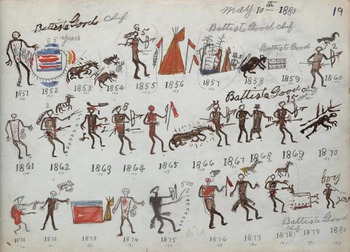
The notebook's small size belies the significance of the work within its pages. Opening the book reveals that Corbusier ensured his place in history by inscribing the inside cover. His inscription reminds us that the manuscript must be read with a kind of decolonizing double-consciousness that takes account of how it is colonized by Mallery, and how it seeks “literate means through which to engage … in a discourse on the possibilities of a Native future” as it travels through time and space (Warrior xx). The facing page is spectacular. It is a brief timeline containing pictographic figures similar to other wówapi waniyetu in the Smithsonian collection (fig. 1). This page begins in the year 1851, when the Lakota signed the first Treaty of Fort Laramie (the second pictograph represents blankets and other annuities guaranteed by the treaty).
From Battiste Good Wintercount. This is the first page the reader sees when opening the book, even though it is marked page 19.

The final pictograph of a boy with a pen in his hand can be read as a devastating defeat that brings about the end of Lakota history and subsequent assimilation into the settler nation. It can also be read in the exact opposite way. Good's son Night Hawk (“boy”) continued his wówapi. The boarding school generations made English and alphabetic script their own as a new wave of pan-Indian resistance heralded the twentieth century. Even today, Native artists, activists, and educators continue to adapt old stories—and literacies—to new media to make sovereign tribal futures possible.
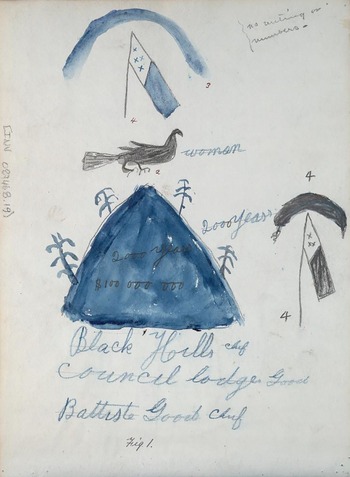
The observant reader might notice the handwritten “19” in the top right corner of the page. It is written in ink, and its “9” bears no resemblance to Good's characteristic way of writing “9,” which can be witnessed elsewhere on the page. Like similar sketchbooks solicited by R. H. Pratt from Kiowa and Cheyenne prisoners in Fort Marion, Florida, Good's graphic narrative seems to start from the back. Page “1” is second to last, followed by an unnumbered page with large pictographs representing, among other things, the Black Hills (fig. 2). This “last” page is unnumbered, but it is marked “Fig 1” by someone else who has also provided numbers that seem to indicate a reading direction. For clarity of discussion, I will refer to it as page 0.
Last page of the Battiste Good Wintercount. It does not have a proper page number and is called page 0 in this discussion. Following Mallery, most published versions make this the first page, sometimes resequencing the entire manuscript, although it is unclear if Good intended it to be the beginning or the end of his narrative.

According to the notes, page 0 is vision narrative (Greene and Thornton 292). Such narratives were an important genre for men on the Plains in the nineteenth and early twentieth centuries, the most famous example being the one told by Heháka Sápa, or Black Elk (Neihardt and Black Elk). Visions were also represented on drums and shields. Corbusier's notes explain that this page refers to a personal experience from 1856 in which Good “cried, and cried, and cried” in the Black Hills, presumably for a vision. It is widely considered a preface or introduction. According to the notes, a bird named Eagle-Woman appeared to tell Good that God had divided the earth in four parts, “one of which, containing the Black Hills, he gave to the Dakotas” (Greene and Thornton 292). Eagle-Woman's message is one of peace, in which she claims her womanhood as a source of authority and forbids bloodshed (293).Footnote 6 Given the name of the bird, it is possible that the chain of explication, translation, and transcription obscures a reference to a historical peace activist named Eagle Woman. She was present when the Treaty of Fort Laramie was signed. According to the tribal historian Ladonna Brave Bull Allard, she later became the only woman to sign a treaty with the United States.
The size and location of the pictographs on this page organize the reading experience. For example, the pictograph that represents the Black Hills draws the eye first because it is the largest image and is located at the center of the page. This device grounds the narrative in the land and the landscape in ways that contemporary Indigenous American literary scholars like Lisa Brooks (Common Pot) and Sean Teuton, among many others, have argued remain a defining characteristic of Native American literature to the present day (see also Wyss and Fitzgerald). Alphabetic words, like Black Hills and woman, modify pictographs like the hill at the center and the bird above it. On the pictograph representing the Black Hills, Good has written “2000 years” and “$100,000,000.” The amount may function as an abstraction to indicate the immense value of the area to the Oceti Sacowin, who have never ceded their claims to the Black Hills.Footnote 7 Good labels the hills “council house,” implicitly comparing it with DC as a governing center of the tribal nation. On the right of the pictograph, Good repeats “2000 years,” indicating the importance of this number. Unfortunately, the collector's notes fail to explain what it means in relation to the Black Hills and Good's narrative.Footnote 8
On the left is a catalog code marking the manuscript's entry into the colonial archive. Good's alphabetic words, like woman and Black Hills, have been crossed out with a pencil. In the top right corner appear the words “no writing or numbers.” These are likely notations from Mallery, who was doing research and gathering materials for his Picture-Writing of the American Indians. The handwriting matches the handwriting on Mallery's personal correspondence elsewhere. Such materials further illuminate Mallery's intents. In a letter to R. H. Pratt, a fellow reformer and the founder of the Carlisle Industrial Indian School, Mallery explains, “[T]he main part of my work is the collection and collation into a vocabulary of all authentic signs (including signals made at a distance) with their description and also that of specially associated facial expressions, represented in language so clear, when possible, giving illustrations when necessary, that they can be reproduced by the reader” (Letter; my emphasis). R. H. Pratt does not explain by what measure he determines a sign to be “authentic” given his limited knowledge of the subject.
According to the notes, the second page (reading from back to front) concerns a foundational event in the history of the Oceti Sacowin: the coming of White Buffalo Calf Woman and the White Buffalo Calf Pipe. Ptesanwin, as she is called in the Lakota language, brought the sacred pipe, taught the people seven ceremonies, gave them four different varieties of maize, and led them to a large buffalo herd and a time of abundance. This page is marked “1” in the top right corner in Good's hand. It is followed by seventeen pages numbered sequentially from back to front, also in Good's hand. According to the collector's notes, this page records “a cycle of thirty years from the year 901 to 930,” while subsequent pages recount seventy-year intervals.
Seven is, along with four, a significant number reflected in numerous social and narrative structures including the Seven Council Fires (sacowin means seven). Gordon Brotherston argues that the convention of representing a seventy-year lifetime by a circle can be found as far south as Tenochtitlan, now Mexico City, and is “numerically underpinned by the counting-stick tradition, where finishing off one stick and beginning another means the completion of seventy years” (112). He explains that “Calendar Sticks painted and incised with abstract designs economically convey considerable spans of time in this culture; and the practice as such serves to affirm its links with the Plains, where similar sticks complement the pictographic Winter Counts, and with southern Appalachia, where their use is also attested” (110). Brotherston adds that one “Santee [Dakota] Sioux” calendar stick “covered a thousand-year span,” which would mean the Dakota had historical records dating back to what Europeans call the Middle Ages (110). According to Mallery, Good consulted elders in order to create the section from 901 to 1700. If this consultation included elder explication of sticks, this part of the text evinces significant literary innovation as the transliteration of an ancient genre of wówapi, the calendar sticks, into a more recent genre, namely the waniyetu wówapi Mallery requests.Footnote 9
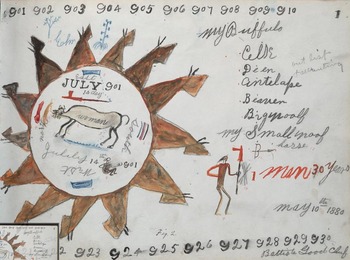
In another layer of complexity and innovation, Good then adapts that literary history to the format of the European book, which imposes a chronology, narrative structure, and visual logic different from sticks and hide. However, it is also possible the sticks function as Indigenous sources of authority known to Corbusier and Mallery to authenticate Good's potentially controversial timeline. The timeline suggests that this page is a historical record from 901 to 930 AD. This is a stunning possibility that scholars of writing and literature have yet to reckon with despite anthropological knowledge of wooden records reputedly covering “a thousand-year span” (Brotherston 110). The European timeline seems to have been Good's idea, because Mallery expressed annoyance at this attempt to correlate Lakota and wasiču history. Perhaps it didn't seem “authentic” to him because it reflected European, rather than Indigenous, notions of time. Mallery removed the timeline when he published a heavily edited version of Good's 1880 original thirteen years later and called it a wintercount (fig. 3).
Second-to-last page of the Battiste Good Wintercount. Good's time line starts with the year 901 on this page. It ends in 1880 on page 5 (see fig. 1). Mallery removed the list on the right, and other evidence of alphabetic and numerical literacy, when he included this page in his own publications. Subsequent publications of the Battiste Good Wintercount often replicate Mallery's edits.

A singular figure outside the circle on each page of the early section, present until 1700 and the transition to singular pictographs, may represent Good himself or the concept of a storyteller, knowledge keeper, or historian. A small squatting or seated figure inside the circle makes the gesture sign for pipe, according to the notes. Sign language, or “hand talk,” was a lingua franca on the Plains and of special interest to Mallery.Footnote 10 These two figures are linked in the oral narrative by Good to the first encounter with White Buffalo Calf Woman, who brought the sacred pipe (Greene and Thornton 293). The story is represented inside the circle. The four directions are marked in English. At the center is an image of a white buffalo with the English word woman written in alphabetic letters inside its body. The sacred pipe is above, connected to a blue square (the sky?) by a squiggly blue line that signifies the sacred nature of the smoke. In the space between the sky and the blue square is a large “July 901.” Below the buffalo cow is written “July 14, 901.” According to the collector's notes dictated by Good, White Buffalo Calf Woman appeared in July. The repetition of the date 14 July suggests that it must be important to Good. Perhaps it correlates with some of the ceremonies given to the Oceti Sacowin by Ptesanwi, like the Sundance.Footnote 11 The annual Sundance was the largest and most important ceremony among the Lakota and many other Plains peoples until it was outlawed by the United States government in 1904. Hence, this could be read as a defense of Indigenous spiritual practices reviled by missionaries.Footnote 12
Contemporary L/N/Dakota still tell the story of White Buffalo Calf Woman in a range of media.Footnote 13 A figure of great historical and spiritual significance, she came to the Oceti Sacowin Oyate during a time of famine two thousand years ago bringing buffalo, corn, and the sacred pipe. The Sičangu elder Victor Douville explicates the story on YouTube in his capacity as a professor at Sinte Glenske University. In the video, accessible to Lakota and nonnative youth alike, Douville reconnects the graphic and oral records separated by Mallery. According to Douville, the milk dripping from White Buffalo Calf Woman's udders represents the corn she brought the people. Although Good paints the corn blue, Douville notes that the corn came in one of four colors—white, yellow, black, red—or a combination of colors. This variety indicates healthy diversity and a history of agriculture, travel, and trade. Four is a sacred number and the colors of the corn correspond to the colors of the medicine wheel. The reference to corn places the story in the tradition of what Brooks calls a ubiquitous Corn Mother narrative that traveled up through North America in ancient times (“Corn”).
As Brotherston and Brooks (“Corn”) argue, Indigenous literary cultures and repertoires interacted in many regions over a long period of time as people—and corn—moved along trade and migration routes. Networks of exchange connected “towns from the northeast coast of Wabanaki to the Southwest of greater Mexico and beyond” (Brooks, “Corn” 391). Oral narratives, symbolic language, and iconographic conventions moved along these ancient American networks in what is called the “Mississippian Iconographic Interaction Sphere” (396). In “Corn and Her Story Traveled,” Brooks builds on Brotherston to further map these “intellectual trade routes” (Warrior 181–85) from the birthplace of corn in Quiché country to the great metropolis of Cahokia in what is now St. Louis. Roads and rivers connected Cahokia to the west, north, east, and northeast. Ancient Corn Woman stories still live in the oral tradition and also play an important role in contemporary Native literature, like Leslie Marmon Silko's Ceremony. Although they have not been adequately explained yet, there are numerous “corn” pictographs in Good's narrative, sometimes taken to refer to agricultural tribes like the Mandan and Arikara.
Good's epic and polygraphic narrative, with its intertextual references to pictographic sticks, its circular seventy-year cycles, and the post-1700 traditional “wintercount” format, reflects this history of cultural exchange along “intellectual trade routes” (see Brokaw, “Indigenous American Polygraphy”). Before the Seven Council Fires of the Sioux Nation moved across the Mississippi and onto the Plains, they lived relatively close to the Ojibwe, who displaced them from what is now Minnesota. According to their migration story, the Ojibwe originally came from the East Coast but migrated westward to settle in the upper Midwest long before Europeans arrived. The Ojibwe maintain sacred pictographic scrolls to record what Gerald Vizenor calls “picto-myths” (qtd. in Rader 301; see also Blaeser).Footnote 14 The fact that the sign for heaven in Good's vision narrative is the same as the sign for heaven in the Anishinaabe writer George Copway's The Traditional History and Characteristic Sketches of the Ojibway Nation (1851) suggests a connection between Lakota and Anishinaabe iconographies. Both groups share prophesies about the historical importance of “the Seventh Generation,” or “Seventh Fire,” as a time of Indigenous recovery and restoration. Sometimes known as the Prophesy of Crazy Horse, the story is strikingly similar to a section of the Anishinaabe migration story called the Seventh Fire. Both narratives foretell futures of tribal revitalization.
Migration narratives constitute an important genre in precolonial Indigenous literatures across North America. For example, the Aztecs recorded their own migration a millennium ago from the American southwest to Tenochtitlan. Scholars have studied this foundational narrative extensively. Red and black ink, so important in Aztec literacy practices as recorded by Bernardino de Sahagun in the early sixteenth century, are also significant colors in Good's wówapi and in many other records from the Plains. Among the seventeenth-century Powhatan, Iroquois, and Huron, red and black ink also dominated literary expression (Round 12–13; Lopenzina 55). The Penobscot writer Joseph Nicolar links the ancient emergence of pictographic writing on the East Coast to genealogy. Eventually, this writing system was elaborated so that messages could be carved on trees for others to read, indicating a high degree of iterability and general literacy. Nicolar describes a few pictographs but doesn't provide any further information.
In the early colonial era, the Jesuits described the “usage of writing on birch bark” among their Iroquois and Huron converts as “ancient” (Lopenzina 61). Animal skins were also used in the East among groups like the Cree, Montagnais, and Naskapi just as they were on the Plains among groups like the Lakota, Cheyenne, and Kiowa (56–64). Drew Lopenzina notes that hieroglyphic writing on Naskapi caribou skin was linked to hunting and drumming and recorded dreams or visions that conferred power on the hunter (56). On the Plains, drum and shield designs were also an important genre. Good's reference to petroglyphs suggest a broad mediascape (Cohen and Glover). The 1880 Battiste Good Wintercount translates into a new medium (and retells for a new time) Indigenous texts and oral traditions traceable back to time immemorial.
The number 901 can be read as a pictograph expressing a concept, like time immemorial, rather than sound. “July 14, 901” seems very specific, however, and it is repeated. Perhaps it is intended as a claim to historical fact established in consultation with knowledgeable elders. According to the Lakota, the contemporary keeper of the pipe is the twenty-seventh generation of a straight line of keepers who preserve the oral tradition including the words spoken by White Buffalo Calf Woman when she first came. Although generation is an imprecise term, we can use the seventy-year “stick” cycles referred to by Brotherston. If we multiply seventy by twenty-seven and add forty (since the young man was thirty when he met her), we arrive at 1,930. Making allowances for variations in how long each of the twenty-seven pipe keepers lived, that is very close to the number Good repeats twice on page 0: two thousand. If Good means to communicate that White Buffalo Calf Woman arrived two thousand years ago, what does the repetition of 901 signify? It may be a reference to ancient graphic records like calendar sticks—perhaps his people had knowledge of the thousand-year-old Dakota calendar stick Brotherston mentions. Maybe the narrative is attempting to stake a documentary claim to possession of the Black Hills as an ancient homeland.
It is also possible that the date alludes ironically to 4 July, Independence Day, when the original thirteen former British colonies constituted themselves into a nation. Perhaps Good is suggesting that his people became a nation in 901. In Our History Is the Future: Standing Rock versus the Dakota Access Pipeline, and the Long Tradition of Indigenous Resistance, Nick Estes argues that the second page in Good's manuscript records a foundational and ancient compact between humans and animals. Estes calls White Buffalo Calf Woman “the most significant historical figure in Oceti Sakowin history” and argues that she “established not only the basis of customary and ceremonial laws of humans, but also how humans would exist in correct relations to Pte Oyate (Buffalo Nation) and the nonhuman world.” According to Estes, the animals listed alphabetically on the right represent signatories: “the various animal nations the White Buffalo Calf Woman brought into formal relations with the Oceti Sakowin: elk, deer, antelope, buffalo, beaver, and wolves” (83).Footnote 15
If this compact is roughly a thousand years old, it would be contemporaneous with the founding document of the Haudenosaunee Confederacy, the Hiawatha Belt in which is recorded the Great Law of Peace (“Hiawatha Belt”). The Haudenosaunee maintain a number of wampum belts that serve as documentary evidence of treaties made with Europeans and Americans. According to the Onondaga, “The Hiawatha Belt is extremely old. … [W]e had this belt long before the French, Dutch and English explorers made their way to our lands” (“Hiawatha Belt”). Scholars have offered various dates for the founding of the Confederacy, the earliest being 1142 (Mann and Fields). We can therefore also read Good's narrative in relation to a tradition of constitutional records ranging from the Popul Vuh to the Hiawatha Belt to the Constitution of the White Earth Nation (Brooks, “Constitution” 49). In a gynocentric contestation of heteropatriarchal structures of authority imposed by the United States in boarding schools and the Allotment Act, Good's opening pages center women and their authority (Allen; Piatote).Footnote 16 Good thus employs, in Mishuana Goeman's elegant phrasing, “traditional and new tribal stories as a means of continuation or what Gerald Vizenor aptly calls stories of survivance” at a moment of great historical crisis (3).
Mallery made significant editorial changes to Good's wówapi that continue to shape its reception even in the present. In his notes, he complained about the timeline and the linking of “Dakota-devices” with European literacy and numeracy. Perhaps that violated his demand for “authentic” signs of Indigenous culture. Mallery erased Good's timeline and many of Good's alphabetic and numerical annotations when he included an edited reproduction in Picture-Writing of the American Indians. Such editorial interventions attempt to relegate Good's wówapi to the realm of ethnographic collections: mute, illegible, outside historical and literary time, denying the agency Lonetree describes and the contemporaneity that Good's use of Euro-American “letters and numbers” seems intended to establish (Good 1).Footnote 17
The request for “no writing or numbers” on page 0, and the erasure of Good's alphabetic and numerical annotations, suggests that Mallery was motivated by what Renato Rosaldo has called “imperialist nostalgia.” Rosaldo argues that “agents of colonialism—officials, constabulary officers, missionaries, and other figures from whom anthropologists ritually dissociate themselves—often display nostalgia for the colonized culture as it was ‘traditionally’” or what he calls “a mourning for what one has destroyed (when they first encountered it). The peculiarity of their yearning, of course, is that agents of colonialism long for the very forms of life they intentionally altered or destroyed” (107). Like R. H. Pratt, Mallery made a great career out of his collection of Plains “wintercounts.” The two men are responsible for two of the major archives of “ledger art” from the Plains.
As Jean O'Brien has argued, the project of modernity predicated itself on the exclusion of Native American peoples, epistemologies, histories, and literatures. The trope of vanishing American Indians has been elaborated for centuries in literature, history, scholarship, and popular culture as part of the displacement that attended the establishment of European settler nations like the United States. It is significant, then, that Good opens the book with a preface that comments on his own time. It reflects a desire to seize the opportunity to address settlers and intervene in debates about the Black Hills, Indigenous rights, and settler violence.
Mallery vigorously undercut such efforts. The retired general was a contemporary of Senator Henry Dawes, the author of the devastating General Allotment Act. Along with R. H. Pratt, these men represent what we might call reform colonialism. Reformers saw themselves as the benevolent alternative to officials like Minnesota governor Alexander Ramsey, who argued that “the Sioux Indians of Minnesota must be exterminated or driven forever beyond” state boundaries (12). But reform colonialists agreed on the necessity of the genocidal project per se: Indians had to disappear as distinct peoples and become detribalized subjects of the expanding United States. Mallery's status as an expert was predicated on the displacement of Native peoples, and he apparently had no interest in communicating with Good as a fellow intellectual. He disparaged Good's English-language annotations as “presumptuous emendations” reflecting Good's “meddlesome vanity” (qtd. in DeMallie and Parks 1071).Footnote 18 Presumptuous indeed, Good turns the request for a mute ethnographic object into an opportunity to position himself and the D/N/Lakota peoples as keepers of a different, but equally ancient and important, system of knowledge and literacy.
The world order that Mallery, R. H. Pratt, and Dawes helped usher in has turned out to be unsustainable and a danger to all beings on earth. The “heavy industrial conversions” to which Vizenor refers in the opening epigraph include forced entry into industrial time and extractive economies. Fossil-fuel-related climate change is now a significant threat to global peace and to human and other-than-human survival. In 1994, the first United Nations climate treaty, entitled the United Nations Framework Convention on Climate Change, went into effect. In 2016, the Oceti Sacowin rose up to prevent the Dakota Access Pipeline, designed to transport crude oil from the Bakken Formation to the Mexican Gulf, from going through their territory. They called it the “Black Snake” and represented it as such in wówapi like digital posters and memes, elucidating at the same time the ways in which linguistic metaphor and pictographic image can converge.
Pictographic references featured prominently in the NoDAPL movement's social media posts—yoking together past and present, pictography and digital media. The founder of the Sacred Stone Camp, Ladonna Brave Heart Bull, “dedicated her life to interpreting the Lakota Winter-counts” (“#StandingRockSyllabus”). Winona LaDuke, who was also at Standing Rock, uses Ojibwe script on her Facebook profile. At LaDuke's request, the artist Michael Horse created a poster of the 2014 Cowboys and Indians Alliance demonstration at the White House in Washington, DC, against the Enbridge 3 / Keystone XL pipeline. The poster, or wówapi, is titled “Death of the Black Snake” and recalls the tradition of Plains ledger art. These examples seem to be part of a larger resurgence of Indigenous literacies and narrative forms.
The hooplike “tie-snake” biting its tail is, like the circle, an image meaningful in many Indigenous American traditions as part of a philosophy of “balanced opposition” (Brooks, “Corn” 402). Jace Weaver notes that “besides the Lakota/Dakota, tribes as diverse as the Dene, Wintu, Chiricaua Apache, Hopi, and Zuñi have prophesies of catastrophic collapse linked to environmental devastation” (14). The former NASA climate scientist James Hansen warned in a New York Times editorial that extraction of the Canadian tar sands could spell “game over for the climate.” The Oceti Sacowin were joined by an unprecedented number of Indigenous and non-Indigenous peoples and organizations from around the world.
Many saw the struggle as the fulfillment of Crazy Horse's Seventh Generation Prophesy:
Upon suffering beyond suffering, the Red Nation shall rise again and it shall be a blessing for a sick world. A world filled with broken promises, selfishness, and separations. A world longing for light again. I see a time of seven generations when all the colors of mankind will gather under the sacred Tree of Life and the whole Earth will become one circle again. In that day, there will be those among the Lakota who will carry knowledge and understanding of unity among all living things, and the young white ones will come to those of my people and ask for this wisdom. (“Seventh Generation”)
Like Douville, the contemporary keeper of the sacred pipe bundle has also explicated the story of White Buffalo Calf Woman on YouTube. Arvol Lookinghorse emphasizes that it is not only a history but also a prophesy. Since 1994 a white buffalo calf has been born every year in North America. These births indicate the approach of a period of great change when humanity will be prompted to work together in unprecedented ways—or perish. The separation of past and present, history and prophecy, oral and graphic narrative reflects European conceptions of time, literacy, and genre that are not universal. In literary studies, deep structures of coloniality and white supremacy continue to organize our discipline through ethnocentric conceptions of literacy, genre, period, and time.
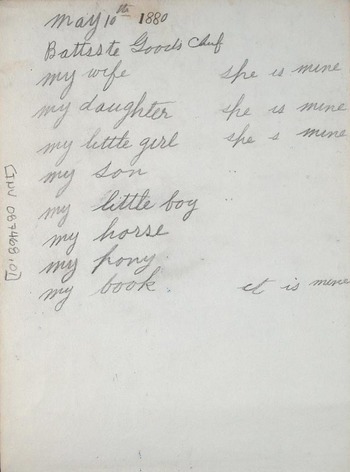
The recent digitization of Good's manuscript moves the narrative into “new media” yet again and makes the entire book, photographed and digitized from the front cover to the back, accessible to a wide audience. This reveals crucial omissions—or erasures—in all other copies except for the original and its digitized twin. Between pages 19 and 18 is an unnumbered page that has been omitted from all published print versions. It is the second page readers encounter when they open the book from the front. Dated 10 May 1880, it is written entirely in alphabetic script with a pencil by Good's hand. This page requires no knowledge of pictography or Lakota culture. It is easy to read. Yet, it has been omitted from all published versions starting with Mallery's (fig. 4).
Second page of the Battiste Good Wintercount reading from the front. Mallery removed this page when he edited the manuscript. It remains without a page number or catalog code. The list resembles similar lists on many of the “time line” pages, all of which Mallery removed (see fig. 3). Nick Estes argues that this list represents an ancient compact or treaty. Its purpose in the narrative is unclear; perhaps it is an assertion of sovereignty. Subsequent published editions replicated Mallery's erasure of this page, but it can be viewed on the Smithsonian website at www.si.edu/object/archives/components/sova-naa-ms2372-ref1137.

At first, the simple list resembles a dictation exercise. Good had learned to write English at the school on the Rosebud reservation. Likely, he had written out lists like this to practice alphabetic script. However, this particular list is deeply subversive. Instead of subjection and submission, it asserts possession. A similar list, of animals like buffalo, elk, and horse, appears on the right side of every page of the narrative from page 1 (reading from the back) to page 12. Estes interprets the list of animals in relation to the social order introduced by White Buffalo Calf woman. These are all animals that the Lakota hunted so perhaps the list represents an assertion of Aboriginal treaty rights as well.
Mallery erased these lists entirely in his reproductions with significant consequences for the interpretation of Good's text. Until recently, the full text could only be viewed by those with access to the original in the archive. Even when the alphabetic list is restored to pages 1–12, as in Candace Greene and Russel Thornton's 2007 publication The Year the Stars Fell, the colonial myopia created by Mallery persists. Estes is the first scholar to comment on the list and offer an interpretation of its meaning. He doesn't comment on the word “my” that starts the list each time, starting with “my buffalo,” but it seems obvious that it is meant to be read as a statement of possession. The words “my” and “mine” are repeated twenty-six times in the twenty-page notebook. On pages 2–12, the list of animals is framed above and below by an image of a drawn bow. On page 9, squiggly lines (representing the sacred or ceremonial) emerge from the tips of the arrows drawn across the bows above and below the list of animals. Battiste Good's “transgressive adoptions” (Pexa 33) cede nothing and consent to nothing. Like Vizenor a century later, Good responds to Mallery's request for simulations of “tragic victimry” with a narrative vision of survivance and word arrows as potent as new media pictographs like #landback.
Around the world, climate change is prompting urgent discussions of viable alternatives to extractive economies. Indigenous Peoples now have a permanent forum at the United Nations. A Pueblo woman, Deborah Haaland, is Secretary of the Interior of the United States. The Dakota Access Pipeline has been defeated and the fight against the Enbridge 3 Pipeline continues. Indigenous activists are circulating hashtags like #landback as they struggle to protect land and water. New media terms like NDN reclaim the pictographic mode as a form of decolonization. While it is premature, and possibly misguided, to theorize a resurgence of Indigenous literacies parallel to language revitalization, Plains pictography has been reclaimed by contemporary Native artists and activists. Emil Her Many Horses curated a powerful exhibition on traditional and contemporary Plains pictography at the National Museum of the American Indian in New York City in 2016. In Native communities, street signs with Indigenous scripts are becoming more common as a general language-revitalization movement gains traction (Davis). The Cherokee have worked with Facebook and Unicode to develop a digitized version of the script invented by Sequoya in 1821 to represent the Cherokee language. N. Scott Momaday consulted with elders and cites the “Settan Wintercount” in his 1969 book The Way to Rainy Mountain, cowritten with Al Momaday, a contemporary take on the ancient migration narrative genre.
At the first Convocation of American Indian Scholars, held at Princeton University in 1970, Momaday foregrounded the importance of Indigenous stories and forms of expression. Calling it “imperative that the Indian defines himself,” Momaday saw language (spoken and graphic) as the primary archive, “the repository of his whole knowledge and his best chance for survival” (61). By way of example, Momaday tells a story about a Kiowa arrowmaker whose survival is tied to the Kiowa language. “It is worth considering,” Momaday asserts, “that he survives in our own time, and that he has survived over a period of untold generations” (62). Like Momaday's groundbreaking narrative, Good's 1880 wówapi emerged out of ancient oral and polygraphic Indigenous literary traditions that remain relevant for Native leaders, writers, and artists, “articulating critique, creating alternative visions, and producing anti-colonial imaginaries” (Piatote 173). Good's work remains vital as it invites readers to reject relations of domination and extraction in order to imagine sustainable, ergo anticolonial, futures together. Our survival may depend on it.