


Preliminary
In his History of the English Organ, Stephen Bicknell describes the instrument at the beginning of the nineteenth century:
Though the English church organ of 1800 had developed from the combined French and Dutch influences of the late seventeenth century, throughout the eighteenth century it had remained isolated from the rest of Europe … The English organ had perhaps never been noted for its cosmopolitan outlook, but at this period its insularity … was especially startling …
Turning to the characteristic features of English organs at this period, he continues,
The tonal palette was narrow, [organs] lacked all but the most rudimentary pedals, [and] they retained an eccentrically long compass for the keyboards … But they were, in their way, very sophisticated: mechanically orderly and accomplished, well made and very carefully voiced, and with a relaxed fitness for their musical purpose … Footnote 1
Bicknell makes his point well: both in musical ambition and in physical development the Georgian organ was modest by comparison with its European cousins. Yet its idiosyncratic specification and gentle voicing (‘these were perhaps amongst the quietest organs in the world’)Footnote 2 were directly related to the organ's musical function and to the repertoire that was performed on it. Whether in church, concert room, pleasure garden or aristocratic music salon the English organ was valued as much for its ability to play in ensemble with singers and instrumentalists as for its potential as a solo instrument. A degree of refinement was called for that was alien to German and French organs, for which solo performance played a more critical role. Lacking the massive pedal divisions of the first and the sensuous tonalities of the second, the English organ offered less scope for display.
As in other organ cultures, conventions of registration governed the use of the stops. It was the custom to draw the stopped diapason with every combination of stops, and with all the solo registers apart from the flute 4′. ‘Diapasons’ (the open and stopped 8′s drawn together) provided the foundation of any chorus registration and formed an admired tonal effect in their own right, as exemplified by the many diapason movements that introduce solo or fugal voluntaries. Solo registers (trumpet, hautboy, cremona, French horn, vox humana, flute, cornet) remained popular throughout the Georgian era, though the more high-minded players and critics had begun to tire of them by 1800.Footnote 3 Few organs had more than 20 stops, so once the essential chorus registers had been provided there was limited scope for introducing variety and novelty.
Convention also determined the way the organ was used in the church service. There were normally three voluntaries: a short introductory voluntary played as the minister entered; a more extended ‘middle’ voluntary (between the psalms and the first lesson) which, at various times, might be a solo voluntary, a keyboard transcription of a vocal or choral piece (Handel, for example) with appropriate textual associations, or an improvisation; and a final voluntary in which, after a few introductory chords on the ‘diapasons’, the organist might show off ‘the full power and effects of the instrument’.Footnote 4 The organist also accompanied the singing of the metrical psalms and (later) hymns. An accomplished player knew how to develop the harmonies to support and encourage the singers,Footnote 5 and how to choose stops for congregations of various sizes. According to John Marsh (1791), the Great chorus up to the fifteenth 2′ was adequate for smaller gatherings, while the addition of the mixtures catered for a ‘common’ (i.e. average) congregation; in a large church with a choir of charity children, ‘the Trumpet serves to qualify the shrillness of the Children's Voices’, and as a last resort (‘when the Church is much crowded, or the Voices exceedingly numerous’) the clarion 4′ could be added.Footnote 6 As well as accompanying the singing, the organist was required first to ‘give out’ the tune in a short introductory improvisation, clearly sounding the melody on the Great cornet or Swell trumpet, and to play brief interludes between the verses: John Marsh recommended a cantabile style, ‘though now and then for variety's sake, a neat flourish, or point taken upon full Organ may not be improper’.Footnote 7 A nineteenth-century writer recalled hearing Thomas Parratt (1793–1862), father of Sir Walter, ‘giving out’ the tune at Huddersfield Parish Church whilst he was organist there; after the announcement of the hymn, Parratt
turns to the keys, and after a bar or two of prelude on the choir organ, which heightens expectation, sends down the length of the church on the swell trumpet, clear and strong, the melody of Sir George Smart's fine tune, ‘Wiltshire’.Footnote 8
Parratt was an accomplished player, but in the hands of self-important or incompetent organists, these performance opportunities could be misused, and this probably explains why both practices fell into desuetude during the nineteenth century.
The use of the organ in the cathedral service was rather different. There was no introductory voluntary at this period, though there might be a middle voluntary, and perhaps a concluding voluntary on Sundays and at festivals. In some cathedrals, a metrical psalm was sung on Sundays, either at the beginning of the service or before the sermon.Footnote 9 However, the principal role of the organist was to accompany the cathedral choir. This included the chanting of the psalms (something of a challenge in the days before pointed psalters),Footnote 10 and the performance of canticles and anthems, many of which retained the form of an alternation between ‘verses’ sung by a soloist or group of soloists, and ‘full’ passages sung by the whole choir; the convention was to accompany the former on the Choir Organ and the latter on the Great or ‘Full’ Organ, as it was often still known. The provision of a separate wooden case for the Choir gave a focus to the sound with the result that a single stop, or at most two, was sufficient to accompany the verses; the Great could be similarly sparingly used, the fuller tone of the ‘diapasons’, principal, twelfth and fifteenth being more than adequate to the task of supporting the full choir.Footnote 11 Frequently, the organist played from an outline score or figured bass, filling out the accompaniment and introducing ornamentation as he went along.
Seated at the keys of the Georgian organ (the term ‘console’ was only adopted during the nineteenth century),Footnote 12 the player had ready access to the stop knobs rising in columns to the left and right of the keyboards. Although there was no absolute consistency, the Great was normally at the treble end, with the Swell (above) and Choir (beneath) at the bass end.Footnote 13 By 1800, organ-builders were beginning to provide the drawstops of church organs with engraved ivory shields, a practice that had begun rather earlier in chamber organs, but many older instruments still had paper labels to identify the stops. Pedals remained a rarity – they were not needed in the performance of the light accompaniments to cathedral anthems and services or the thinly-scored English solo voluntaries of the eighteenth century – and where they existed, they were unlikely to have a compass of more than a single octave, GG–G;Footnote 14 in most organs there would be nothing beneath the key desk apart from perhaps a pedal to silence the chorus registers (the ‘shifting movement’) and the Swell pedal. This was the wooden lever that allowed the organist to raise and lower the sliding front to the Swell box, causing the sound to increase or diminish.
To an organist from elsewhere in Europe, the most unexpected feature would be the keyboards themselves, with their long compasses (Great and Choir) commencing in the bass at GG, FF or occasionally CC 16′. By contrast, the Swell keys stopped short at middle c, or the g or f below; attention was drawn to this by the blank piece of wood let into the space where the bass of the Swell keyboard might otherwise have been.
English organists had learned to exploit these long compasses. Jonas Blewitt (1794) wrote that music ‘written or adapted for the Great Organ should be constituted for as many parts as can be conveniently managed by the hands; and, where single notes only are marked in the Bass, the Octaves should be used as much as possible’.Footnote 15 This technique seems to have been particularly favoured when accompanying congregational singing. Lacking pedals, the organist needed to reinforce the bass, and did so by filling out the harmonies with the left hand; even when pedals had become common, 50 years later, organists continued to play chords in five, six or seven parts,Footnote 16 and it was probably only the appearance of the standard Victorian hymn books with tunes harmonized in four parts that finally put paid to the practice. Others felt that the long compasses were particularly apt for choral accompaniment. As late as the 1880s, Sir George Elvey, formerly Organist of St George's Chapel, Windsor bemoaned their passing:
Probably I stand alone, but I prefer the old G or F organs (as St George's used to be); they are, in my opinion, more suitable for Church music. Gibbons in F, that service of services, on my old instrument, where every stop went down to F, will not be forgotten by me, and possibly by others.Footnote 17
Elvey does not say why he preferred the long-compass organ; could it be that he believed pedal pipes (in part, the cause of its demise) were unsuitable for accompanying the relatively small cathedral choirs of the mid-nineteenth century? He may also have felt that the lighter voicing of Georgian organ-builders like Samuel Green was more suited to the task. If so, he was swimming against the tide.
The interaction between changing performance practice, compositional novelty, liturgical imperative, musical fashion and technical innovation is a complex process in which it is sometimes difficult to distinguish cause and effect. In the case of the organ, this was never more so than in the nineteenth century. The focus in what follows will be upon the ways in which developments in organ design facilitated changes in the ways players and composers approached and exploited the instrument during this period. It is a vast subject, and the author hopes that this paper will encourage others to explore aspects of it in greater depth.
Envisaging new possibilities
On 10 July 1832, the youthful Samuel Sebastian Wesley was appointed Organist of Hereford Cathedral;Footnote 18 in the following September, the Chapter commissioned J.C. Bishop, the London organ-builder, to undertake various improvements to the Cathedral organ. It is a reasonable assumption that Bishop's schedule of work reflects Wesley's priorities as a player.
The Chapter record lists the following:Footnote 19
• a new Swell from tenor c to f3;
• completion of Great and Choir compasses, GG–f3;
• alterations to the Choir action to allow the installation of a 2-octave pedal board, C–c1;
• addition of a Swell to Great coupler;
• replacement of the Great twelfth, octave twelfth, tierce and sesquialtera with new pipes;
• replacement of the Great cornet with a clarabella and the Choir vox humana with a cremona;
• three new sets of keys (ivory and ebony);
• ‘a spring reservoir for regulating supply of air to bellows’.
Two months later (November 1832) it was agreed to install double pedal pipes (16′) utilising the existing octave of unisons (8′), ‘with soundboards movements and a sufficient supply of wind’, at an additional cost of £75.Footnote 20
Wesley's aspirations for the Hereford organ would have been shared by many organists of the period, but they also reflect his own preoccupations. The Cathedral organ dated from the late-seventeenth century.Footnote 21 The keyboard compasses were (unusually) from AA to d3 (Great and Choir), and c1–d3 (Swell); there was an octave of pedals (GG, AA–F♯) with 8′ pipes. The tonal scheme, with mutations on the Great, and a vox humana on the Choir, was still firmly rooted in the eighteenth century. Wesley and Bishop proposed to modernize the instrument.
James Chapman Bishop is now recognized as a significant innovator.Footnote 22 He pioneered concussion bellows (and other measures to secure a reliable wind supply), composition pedals to allow the player to change the stops expeditiously, the development of an independent Pedal Organ, and the introduction of tonal novelties including reeds with closed shallots. All had implications for performance practice by making the organ a more flexible and varied musical instrument. Wesley would have known his work at St James, Bermondsey (1829), where there was a 2-octave (GG–g), 3-stop Pedal Organ and an unusually large Swell, and this would have been recommendation enough to seek his assistance in modernizing the Hereford organ.
The completed stop-list was as follows:

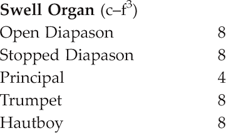
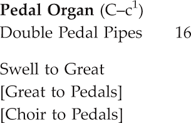
A number of details remain unclear, most importantly whether the Swell had a complete set of keys with GG–B permanently coupled to the Choir: known as a ‘Choir bass’, this would have gone some way towards addressing the musical limitations of the short-compass Swell. It is also not certain whether Bishop provided pedal couplers: in some organs the pedals were coupled permanently to the Great.
Bishop's work at Hereford reveals some of the preoccupations of organ players and builders in the earlier years of the nineteenth century. Long compasses remained the norm (there were some attempts to make them even longer, with keyboards commencing at FF, EE and CC), but interest began to grow in the application of pedals, not, initially, the north European practice of an independent Pedal division sustaining its own musical line, but as an accessory to the long-compass keyboards. Pedals could hold down a pedal point whilst the hands ranged freely over the keyboards,Footnote 23 contribute to the clusters of chords demanded of congregational accompaniment, or (once pedal pipes were available) increase the power of the instrument. They were a novel effect in their own right.
In due course, and as interest in Bach's organ music grew, composers and players began to explore the contribution an independent pedal might make: a brief trio in a voluntary by William Russell (1805) is one of the earliest examples,Footnote 24 and his second set of voluntaries (1812) shows how quickly he began to exploit the possibilities of the pedal as part of the musical texture;Footnote 25 but in general this development was hindered by the inconsistencies of pedal compasses, pitch and dimensions.Footnote 26 Wesley's plan at Hereford was an early example of a two-octave, C-compass pedal, with ‘German’ pedals (i.e. full length keys on which toe and heel could be used) and a full-compass set of double pedal pipes; it was one of very few examples outside London.Footnote 27
The tonal changes made by Wesley and Bishop also point to the future. Organ-builders were keen to replicate the new orchestral sonorities and make their instruments more ‘expressive’; there was also a shift of taste in the direction of smoothness and opacity. The latter probably accounts for Bishop's experiments with reed voicing which paved the way for the close-toned registers favoured by later Victorian builders. His substitution of a clarabella (an open wooden flute of melodic character)Footnote 28 for the cornet was part of an attempt to modernize the ethos of the Hereford organ, as was the removal of the vox humana in favour of a cremona. The Great upperwork – perhaps surviving from the 1686 Harris organ – was probably replaced for the same reason: there are other examples from this period of early chorus registers being rejected because the generous scales were thought to compromise the blend of the diapason chorus.Footnote 29
Surprisingly, Bishop did not install composition pedals at Hereford. He claimed their invention in 1809, though the earliest known example dates from 1820, and they remained throughout the nineteenth century the most widely-deployed registration aid: a critical tool in making the organ a more flexible musical instrument.Footnote 30 But he did undertake improvements to the winding, including his concussion bellows (‘spring reservoir’) to minimise unsteadiness in the supply, and a new bellows to feed the wind-hungry pedal pipes.
By the end of 1832, Wesley had at his disposal an instrument that reflected (at least in part) the priorities of a new generation of church composers. He proceeded to put it to good use in two innovative works: ‘The Wilderness’ received its first performance at the re-opening of the organ on 8 November 1832, and ‘Blessed be the God and Father’ on Easter Day, 1834.Footnote 31 Commenting on the former in his definitive biography of Wesley, Peter Horton writes:
the heady mixture of German romantic harmony, Bachian diatonic dissonance, and solid English diatonicism immediately proclaims a new and potent voice, able to marry something of the excitement of the theatre with the age-old forms of church music … Footnote 32
Wesley's use of the organ was critical to this recognition of ‘a new and potent voice’. Precise registrations are given, both in the 1834 manuscript at Hereford, and (with some minor variants) in the later printed editions.Footnote 33 They are evidence that the composer was striving after new effects. However, with adequate preparation, all the stop changes could be managed by hand, and the tonal resources are used economically to provide a commentary on the emotional movement and pictorial imagery of the text. Traditional registrations such as ‘diapasons’ appear (for example, in the organ introduction to the bass solo, ‘Say to them’), and ‘Full Organ’ – a descending arpeggio – leads into the decisive, ‘And a highway shall be there’. Less conventional is the extensive use made of the Swell – mainly above tenor c because of the short compass – including the charming effect of the descending 6–3 chords accompanying ‘For in the wilderness shall waters break out’, as noted by Horton,Footnote 34 and the succeeding piano passage on Full Swell, with crescendo and diminuendo. The semi-orchestral use of the oboe to increase the intensity of the solo bass announcement in the opening bars (‘The wilderness and the solitary place shall be glad of them’) was a favourite Wesley device, and the frequent interplay between Choir flutes and a Swell reed or reeds is undeniably orchestral in inspiration.
Equally significant is Wesley's use of the pedals. At the first performance of ‘The Wilderness’ the double pedal pipes had not yet been installed (the order was placed the same day).Footnote 35 But the composer's intentions were clear: extensive use is made of the pedals throughout the piece, duplicating the manual bass, sustaining a pedal point, or playing a more independent role. Sections of the 1834 manuscript are written on three staves, notably the second movement (the bass solo, ‘Say to them of a fearful heart’), and the fourth and fifth movements (‘For in the wilderness’; ‘And a highway shall be there’). The former is particularly remarkable for the date: with the right hand on the Great keys (‘Diapasons’), and the left on ‘Swell Reeds’ [1834], the organist plays a demanding pedal line consisting largely of busy groups of staccato quavers plying up and down the pedal board: all in all, convincing testimony to the young Wesley's command of the pedals. In the 1834 manuscript the registration is ‘Pedals. G.O. and double pipes’; by 1853, it had become ‘Choir and Double Pipes’ – possibly evidence that the Hereford pedals were still permanently coupled to the Great.
‘Blessed be the God and Father’ includes similar examples of orchestral colouring. When the organ enters (thrillingly) at the end of the opening unaccompanied verse, it is on the Great diapasons with Full Swell coupled – a registration that was to become ubiquitous in Victorian church music. Keeping the notes high in the range (because of the short-compass Swell), Wesley specifies a crescendo, thus achieving a true coup de theatre. There is another later: the famous Full Organ chord with the dominant seventh that introduces the concluding movement. Earlier, the new Clarabella comes into its own, the right hand playing on the Great keys while the left hand plays a contrasting Swell reed – a piquant registration for the six-bar introduction to the allegretto ‘Love one another’.
Wesley was a true original, and his use of the organ in the accompaniments to these early anthems opened up new possibilities which innovations in organ design would eventually allow composers to exploit more comprehensively. For the moment, he was punished for his audacity when ‘The Wilderness’ was dismissed as ‘a clever thing, but not Cathedral Music’, by one of the judges in the competition for the Gresham Prize Medal; another described ‘the introduction of novelty, variety, contrast, expression, originality, etc.’., as inimical to the true character of church music.Footnote 36 In the following decade, similar resistance was offered to attempts to ‘modernize’ English organs – some of it (ironically) from Wesley himself, who, on matters of keyboard compass and temperament remained, throughout his life, a conservative.Footnote 37
The Hereford organist was not alone in wanting to explore a style of accompaniment that owed something to contemporary orchestral textures and colours, and exploiting the expressive powers of the instrument. William Gatens, commenting on Thomas Attwood Walmisley's large-scale anthem, ‘The Lord shall comfort Zion’ (1840), writes, ‘As for orchestral effects in the accompaniment, the organ part looks throughout like a keyboard reduction of an orchestral score’.Footnote 38 He makes a similar observation about ‘If the Lord himself’ (c. 1840?) with its short but dramatic organ introduction in G minor: the right hand plays sustained chords on Full Swell against quavers in the left hand on the Great diapasons; a crescendo is marked, culminating in a sforzando chord with ‘Full’ Pedal followed by the entry of the unison men's voices. Some of the writing is pianistic, and dynamic contrasts are fully exploited. Later, Walmisley composed his well-known Evening Service in D minor (1855); Gatens rightly draws attention to its consciously archaic features but seems less appreciative of the composer's skill in blending these with a more contemporary sensibility reflected in the orchestral treatment of parts of the organ accompaniment – for example, the Swell reed in the left hand briefly played against the voices at ‘throughout all generations’ (bars 58 to 62), and followed by the Full Organ entry in octaves. Such dynamic contrasts are part of a romantic musical vocabulary; some could only be accomplished with the assistance of composition pedals.
Both as composers and performers, Wesley and Walmisley represent the progressive outlook of the 1830s and 1840s. Their work encompassed a novel interest in orchestral sonorities, the use of pedals and pedal pipes, and the potential expressiveness of larger and more sophisticated Swells. At the same time, the organs they played (whilst susceptible to development) still imposed many physical limitations on these ambitions. Despite their awakening interest in the Bach repertoire, the Hereford organist and the Cambridge professor remained essentially conservative figures. It would be left to others to adopt more radical measures.
A German interlude
In July 1845, the London music publishers Coventry and Hollier announced the imminent publication of ‘Six Grand Sonatas for the Organ’ composed by Felix Mendelssohn Bartholdy. In fact, the title had still to be agreed. Charles Coventry had originally requested a set of ‘voluntaries’. Mendelssohn was uncomfortable with the term, and for a time, referred to the pieces as ‘studies’; the advertisement in the Musical World described them as ‘Mendelssohn's school of organ-playing’, but the composer ultimately rejected that, too.Footnote 39 In the event, the title was irrelevant: Coventry and Hollier were onto a good thing. As the publishers’ prospectus put it:
The masterly performances of the above highly-gifted Musical Genius [i.e. Mendelssohn], on the noble Organ in the Town-Hall at Birmingham, as well as on other large Organs in the Metropolis, were such as to excite the admiration and delight of all the competent judges who were so fortunate as to hear him: and to induce a wish, on the part of the Musical Public in general, and of English Organists in particular, that he would publish some of his own Compositions for that ‘King of Instruments’, …
With a special view, therefore, to the gratification of the numerous admirers of Felix Mendelssohn Bartholdy, Messrs. Coventry and Hollier have prevailed upon him to write the ‘Six Grand Sonatas’ … as specimens of what the Composer considers his own peculiar style of performance on the Organ.Footnote 40
Mendelssohn's influence on English organ playing and design has been discussed elsewhere, most recently by William A. Little in his comprehensive survey, Mendelssohn and the Organ (2010) and David Yearsley in Bach's Feet (2012).Footnote 41 The celebrity that Mendelssohn enjoyed on his visits to England between 1829 and 1846, and the exposure that his public performances gave both to the organ music of J.S. Bach and the German approach to the use of the organ – most especially, the pedals – contributed decisively to the success of the reform movement that was already underway. In the short space of eight years (1838–46),Footnote 42 an influential group of London organists succeeded in displacing the English long-compass organ, with its truncated pedals and all-too-predictable stop-list, and replacing it with a new ‘German System’ instrument with C-compasses, an independent Pedal, sub-unison and mutation stops, and a palette of colourful ‘fancy’ stops.Footnote 43 The organist (Dr) Henry John Gauntlett (1805–76), and the organ-builder William Hill (1789–1870) were key figures. Both were part of Mendelssohn's London circle, and it was probably Gauntlett who wrote a piece in the Musical World in 1838 describing the impression that the German's public performances had made:
The instruments he performed on seemed to assume a new character; the pedale appeared with a more grand and imposing tone, and the manuals more brilliant and harmonious. This explanation may be offered. Mendelssohn introduced Bach to the English, as an organ composer … Footnote 44
No doubt the writer was correct in attributing the effect in part to Bach, but the sheer novelty of seeing a player perform on the pedals in the German manner was a revelation to an English audience. In a letter to his mother, Mendelssohn described his reception when he played at a concert hall in London in June 1842:
I played in Exeter Hall before three thousand people, who shouted hurrahs and waved their handkerchiefs, and stamped with their feet till the hall resounded with the uproar.Footnote 45
This was not a normal reaction: the spectators (the term is apt) were simply astounded by the sight of Mendelssohn's feet flying over the pedals.
Mendelssohn became a powerful advocate for the ‘German System’ organs pioneered by Hill and Gauntlett. A typical example (though constructed after Mendelssohn's death, and when Gauntlett was no longer actively involved with Hill) was the instrument for St Mary-at-Hill in the City of London (1848).
There is (at least) a tenuous link between the St Mary-at-Hill organ and the Mendelssohn sonatas, and possibly a more substantial one. In 1852, Edmund Chipp became organist of the church. He was one of Gauntlett's circle, and also one of the first English organists to play the sonatas publicly.Footnote 46 In May 1847, he performed the third sonata for Mendelssohn in the Hanover Square Rooms, receiving an appreciative testimonial.Footnote 47 On 13 December 1848, he included all six sonatas – played from memory – in a recital in Hill's workshop;Footnote 48 the organ is unidentified, but there is circumstantial evidence that it was the St Mary-at-Hill instrument, then nearing completion and waiting for a major programme of repairs to the church to be finished before it could be installed.Footnote 49
A comparison of the Hereford and London organs reveals the radical changes that had taken place in the matter of a few years. Gone are the long manual compasses, the rudimentary Pedal division, and the tiny Swell. In their place is a type of instrument with C compasses, two fully developed manual choruses, and a small but adequate Pedal capable of sustaining an independent line in a complex contrapuntal structure which would be recognizable throughout northern and central Europe. Colour stops (some with German nomenclature) of a type familiar to organists in central Europe since the mid-eighteenth century are included, and the expressive potential of the instrument is enhanced by the enclosure of the second manual division in a large swell box with venetian shutters.
Like the sonatas themselves, Hill's organ was a subtle union of classical form and romantic sensibility. With only three composition pedals, the instrument remained comparatively inflexible, but although the individual movements are often sharply distinguished from one another in mood and dynamic level, Mendelssohn's sonatas do not demand rapid changes of registration.
Sonata 1, for example, includes extensive passages of dialogue between the two manual divisions registered with contrasting dynamics. The arresting opening chords lead into a lengthy exposition on Full Organ in which the pedals are fully deployed before the opening phrase of the four-part chorale is played mezzo piano on the secondary chorus; the dialogue between the two manual divisions continues, accommodating at one point a rising chromatic scale in the pedals which demonstrates convincingly one of the possibilities of ‘German’ pedals. The second movement (‘Adagio’) is a lyrical conversation, with a pianissimo registration, between the two manual divisions, not unlike one of the ‘Lieder ohne Worte’; here, the pedal plays only a subsidiary part. Striking dynamic contrasts return in the ‘Andante recitativo’, before the wonderful F-major ‘Allegro assai vivace’, with its rapid arpeggio passages, and a pedal line doing all that a German pedal might be expected to do, including descending scale passages, and pedal points that provide a firm foundation as the hands weave their way towards the virtuosic semi-quaver arpeggios that presage the decisive final chords.Footnote 50
It is easy to see how Hill's organ in St Mary-at-Hill would have accommodated the demands of the Mendelssohn sonatas. (There are suggestive affinities with the Stumm organs in Frankfurt and Kronberg on which Mendelssohn gave early informal performances of the sonatas.)Footnote 51 The Great chorus, supported by the Pedal, offered a choice of fortissimo registrations for the opening movements of sonatas 1, 3 and 4, or the concluding movements of 1, 2 and 5. The novel flute and string registers introduced by Hill after 1840 provided registrations for the contrasting movements in Sonata 1, and for other trio and andante movements; when a more prominent solo voice was required (for example, in the first movement of Sonata 2) the krum horn or hautboy were available. Although Mendelssohn's registration tips were minimal,Footnote 52 his intentions were clear enough to anyone acquainted with German organs and Bach's organ music.
That was the point. Following Mendelssohn's Bach-evangelism, and the pioneering performances of the first English Bach players (S.S. Wesley, Gauntlett, Elizabeth Stirling, George Cooper, and Josiah Pittman among them), English musicians had a much clearer understanding of German performance practice and its implications for organ design: they had no longer to rely on travellers’ tales. As Yearsley puts it:
The transformation of English organ culture required a new concept of what it was to be an organist, and Mendelssohn was a symbol of that metamorphosis.Footnote 53
At the same time, Mendelssohn as a composer had equipped the English with a vocabulary and musical aesthetic which were to have far-reaching consequences; their influence is clearly discerned in the organ and church music of organist-composers such as Henry Smart, John Stainer and Edmund Chipp; it was still affecting the imagination of minor composers in the first half of the twentieth century.
Synthesis
The rapid evolution of English organ design in the 1830s and 1840s was a tribute to the enterprise of a small coterie of organists and organ-builders, but it posed significant technical challenges that could only be solved by experimentation and innovation. It also required agreement amongst the players about performance issues. When Elizabeth Stirling (one of the first London organists to play Bach publicly) attempted a pedal fugue at her audition for St Luke's, Chelsea, following John Goss's move to St Paul's Cathedral in 1838, she found herself defeated:
Miss Sterling [sic] had not conceived it necessary to put a saw in her bag, as an accompaniment to Sebastian Bach; but it so happened that the stool was about four or five inches too high, and the moment an attempt was made to pedal a passage, the performer found herself falling from the seat … Footnote 54
Goss, according to the correspondent, ‘only used the lower octave, and that only with one foot’.Footnote 55 Twenty years later, E.J. Hopkins wrote, ‘For the Pedal-board there is in England, at present, no fixed width; which is a circumstance much to be regretted’.Footnote 56 Flat pedal boards with parallel keys were the norm throughout the 1850s and 1860s, but the dimensions, form, compass and alignment of the pedals remained matters of contention for many years.Footnote 57
The layout of the drawstop jambs was another pressing issue. Not only was it a question of accommodating more stops: as performance practice evolved, and an increasingly orchestral approach demanded more frequent changes of registration, the stops needed to be easily accessible. Simply expanding the standard Georgian layout was not an option. Hopkins again:
the Stops of each department should … be placed where they can be combined or changed with the least difficulty to the performer. With a view to the attainment of this end, it is important to bear in mind the two following facts: (1) that, as a rule, the left hand can be more easily spared for a moment than the right; and (2) that the Great Organ Stops are more frequently brought under the control of the feet of the performer by means of Composition Pedals than those of any other department.Footnote 58
Hopkins’ objective was difficult to achieve, as early photographs of Hill's vast organ in Birmingham Town Hall (reconstructed 1842–45) with 80 stops,Footnote 59 and Gray & Davison's instrument in Boston Centenary Chapel, Lincolnshire (1850) with 48 stops, reveal: tall columns of stops (Boston) and clumps of large stop-heads (Birmingham)Footnote 60 set in jambs at 90 degrees to the keyboards must have hampered hand registration. Hopkins had further suggestions to make about layout:
as the numerous delicate shades and varieties of tone are produced from [the Swell and Choir] chiefly – leaving the Great Organ for the broad contrasts – the left side appears the most proper one whereon to place their Draw-Stops.Footnote 61
the Pedal couplers should, whenever practicable, be ranged on the left-hand side, to facilitate the making of those quick changes from one Manual to another that are so constantly required in accompanying the Musical Service, as well as in Solo-playing.Footnote 62
When the Draw-Stops are numerous, they are frequently arranged in triple instead of double rows. The plan is a good one, as it prevents the tiers becoming inordinately long, and, therefore, keeps the upper Draw-Stops more within reach.Footnote 63
Various other ploys were tried to keep the drawstops ‘more within reach’, including splayed or angled jambs (1853),Footnote 64 horizontal stop layouts (1848),Footnote 65 sloping or terraced jambs in the French manner (1856),Footnote 66 and over-hanging keys.Footnote 67 Composition pedals also increased the player's control. By 1860, large church organs were commonly equipped with three or four pedals to the Great, and two or three to the Swell; later, builders added Pedal stops to the Great compositions. The registrations were conventional, usually consisting of a progression from piano to fortissimo, with all stops being drawn by the final pedal.
Whilst satisfying the aspirations of players for instruments which could capture the flexibility and colour of the new orchestral repertoire and also accommodate the demands of Bach and the German organ school, the fundamental challenge for organ-builders in the 1850s was to overcome the mechanical deficiencies of the first tranche of ‘monster’ organs such as York Minster (1833) and Birmingham Town Hall (1834). James Stimpson, who played the Birmingham instrument between 1842 and 1886, complained to a correspondent, ‘at home I have a huge pedal organ of fifteen stops, to throw out which requires the force of a steam engine, while to draw them in is worse still’.Footnote 68 Mechanical intractability was often a problem with the largest instruments. Dr Camidge of York Minster commented that the key resistance there was ‘sufficient to paralyse the efforts of most men’,Footnote 69 and Mendelssohn complained about the heavy touch of the pedal keys at Birmingham (‘I am sure that I admired your organist very much who was able to play a Fugue on them’).Footnote 70 It was only when the Englishman, Charles Barker, took out a French patent on his pneumatic lever in 1839 that a solution came into sight.Footnote 71 Over the next 40 years, pneumatic technology transformed the construction of large organs and had a powerful influence on performance practice:Footnote 72 first, pneumatic levers, and then (after 1870) tubular-pneumatic action reduced the resistance of keys and pedals enabling players to develop a more pianistic technique, and second, pneumatic actions permitted the development of new accessories such as thumb pistons (Henry Willis, 1851) which allowed organists to make speedy registration changes,Footnote 73 although, because of their cost, pistons were usually only found in concert instruments and the largest church organs before the 1890s.
Returning to the earlier part of the period, Gray & Davison's organ for Magdalen College, Oxford (1855), is a good example of a progressive church instrument from the post-Mendelssohn years:
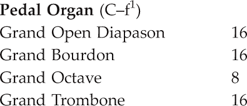
The drawstops were arranged in two columns to either side of the keys, with Great and Swell to the right, and Choir, Pedal, Couplers and (probably) Solo to the left (clearly somebody had not read Hopkins’ advice). The Great composition pedals drew the following stops:
1. Open Diapason, Open Diapason, Stopped Diapason
2. [Add] Principal, Flute, Twelfth, Fifteenth
3. [Add] Sesquialtra, Mixture
4. [Add] Trumpet
To judge by surviving evidence in the Gray & Davison and Walker shop books, such a sequence was typical of the period, though later, some preferred to hold back the mixtures to come on with the reeds.Footnote 74 Unfortunately, the Swell compositions were not recorded; they may have been similar to those in Gray & Davison's organ for the Great Exhibition (1851), in which the first pedal brought on the stopped diapason and cornopean, and the second the Full Swell.Footnote 75 (More typical of the period was a registration of Swell diapasons and principal with an oboe or hautboy on the first Swell composition pedal.)
The Magdalen organ reveals a synthesis of English, German and French influences. The proportions of the Georgian organ are still discernible in the Great chorus and the relatively small Choir Organ – the latter still located in a separate case to fulfil its function as a choir accompaniment. However, the keyboard compasses now commence at C 8′ (including the Swell Organ), there is an independent C-compass Pedal with four stops, and the Great and Swell have 16′ choruses – though the Great only achieves this through sub-octave couplers from the Choir or Swell (a compromise on which Henry Smart was severe).Footnote 76 The organ was also tuned to equal temperament. These may be described as ‘German’ features. French influence is apparent in the adoption of increasing pressure for the Great (the use of a higher wind pressure to boost the treble), the application of pneumatic levers to the Great key action and couplers, the introduction of sub and super octave couplers, and the provision of a Swell tremulant. The grandiloquent re-naming of the Great as the ‘Grand Organ’ and the Pedal stops as also ‘Grand’, and the inclusion of a variety of novelty registers – among them a horizontal reed on high pressure, French harmonic flutes, German strings, and an English clarionet flute, piccolo, keraulophon and corno di bassetto – confirms the growing influence of the new concert organs such as Gray & Davison's instrument for Glasgow City Hall (1853).
How was such an instrument used in a church context? John Stainer was appointed organist of Magdalen in 1860 on the recommendation of Sir Frederick A. Gore Ouseley. A contemporary recollection of Stainer's choral accompaniment suggests a new approach in which full advantage was taken of the novel flexibility and tonal resources of the organ:
With bowed head and closed eyes he would on the soft stops seem gently to unfold the theme of the coming anthem, working out and expanding its ramifications with exquisite delicacy, then coming to the end … he would conclude, and glide into the anthem. It is most difficult to describe his accompaniment of the Psalms. The chant first simply played through, say, on the choir organ, would then become a wonderfully harmonized interpretation of the words, no brilliant dashing execution; but if I may call it an inverted and dispersed harmony on the solo or choir organ, no two verses alike, but sustaining and truly accompanying the choir, ending with a cathedral custom on which he always prided himself – viz., the introduction of the lower pedal notes in the verse before the Gloria Patri.Footnote 77
Part of the effect was created by varying the harmonies, but it seems that Stainer also varied the registrations according to the sentiment of the words.
Further evidence for developments in performance practice can be found in anthems and services of the period. The year after Stainer was appointed to Magdalen, Ouseley published the first volume of his Special Anthems for Certain Seasons and Festivals of the United Church of England and Ireland (1861). A second volume followed in 1866,Footnote 78 and Stainer contributed to each. Ouseley's collection was intended, as the title implies, to equip a Church that was recovering a sense of its liturgical patrimony with the repertoire it needed to mark the festivals and seasons appropriately. It is therefore a barometer of change in the worship of the English Church. But these two volumes also provide useful ‘snapshots’ of musical change, not least the extent to which the role of the organ in accompaniment had (or had not) changed since the early days of Wesley and Walmisley. A perhaps surprising number of the anthems reflect a conservative approach to structure, harmony, use of the pedals, doubling of the voices by the organ, and registration; the old convention of alternating verses sung by soloists, groups of soloists, or sides with ‘Full’ passages prevails in the majority of anthems in Ouseley's collection, but there are some more innovative pieces. Hopkins’ ‘Try me, O God’, for example, has a properly delineated pedal part,Footnote 79 and Charles Steggall's ‘God came from Teman’ begins with an organ introduction of 23 bars, succeeded by an accompaniment with demanding pedal passages.Footnote 80 George Macfarren's confirmation anthem, ‘Wherewithal shall a young man cleanse his way?’, also has a demanding organ introduction.Footnote 81 Interestingly, Ouseley himself is one of the most prescriptive when it comes to choice of stops. In ‘Awake thou that sleepest’, the organ accompanies a sombre passage, ‘The grave cannot praise thee, death cannot celebrate thee’, with four-part chords on ‘Diapasons’ supported by ‘32 and 16 only’ on the Pedal. His baptismal anthem, ‘And there was a pure river’ (1853), is similarly specific; the organ part is scored on three staves, and includes passages for ‘Choir Stop Diapason & Dulciana’, with ‘Bourdon 16 only or with Pyramidon’,Footnote 82 and (later) a bold four-part choral recitative accompanied on Full Organ with reeds. It is therefore disappointing to find few registrations in Stainer's ‘exceptional, bold and original’Footnote 83 anthem, ‘I saw the Lord’, composed in 1858 for St Michael's College, Tenbury, but included in Ouseley's second volume.Footnote 84 The organ accompaniment is in part independent of the voices, and is clearly intended to provide a dramatic commentary on Isaiah's text; the score is peppered with dynamic markings, crescendi and diminuendi, and invites an imaginative approach from the organist, but we can only speculate how Stainer realized this on the Magdalen organ.
Few of the accompaniments to these anthems are set out on three staves (Hopkins, Steggall and sometimes Ouseley are exceptions), and older composers such as Goss and George Elvey include the occasional bass note below C – a feature also of Goss's ‘The Wilderness’ (1861), in which the composer offers minimal guidance as to how the pedals are to be deployed. But even Goss was, by the 1860s, making bolder use of the tonal resources of the organ. In a multi-sectioned, narrative anthem like ‘The Wilderness’, he took advantage of the dramatic possibilities of sharply contrasting dynamics, and in verse sections and recitatives where the accompaniments were necessarily fuller and more independent, the organ might initiate changes of harmonic direction or indulge in discreet word-painting. Composers were also establishing new conventions for the use of particular registrations: ‘Full Swell’, for example, with 8′ and possibly 4′ reeds and a mixture, was coming to be associated with moments of praise and awe, as in the Sanctus (‘Glory be to thee’) and Magnificat (‘holy is his name’) of Hopkins in F (1852).
Ouseley's collection, together with other contemporary anthems and services, provides evidence of a change of style and a greater freedom in using the organ accompaniment to express sentiment and feeling. There were obvious parallels here with the opera house and the concert hall, which did not commend themselves to all observers, including some composers, who were concerned that a dangerous secularity was finding its way into churches and cathedrals.Footnote 85 Stainer himself expressed a fear ‘lest a too plentiful use of that descriptive and sentimental colouring which we derive from the modern ‘romantic style’ should tempt our church composers into striving after picturesque and dramatic effects not consistent with the dignity or repose of worship’.Footnote 86 Yet by the mid-1860s the church service itself was changing rapidly. In 1863–64, the Choir and Musical Record published accounts by ‘A young man from the country’ of services in London. They had essentially the same structure as those of 50 years earlier, but the aesthetic and musical settings he encountered in some of the most ‘advanced’ metropolitan churches were startlingly different from those of the Georgian church.
At St Matthias, Stoke Newington, Morning Prayer began with a surpliced choir singing the Veni Creator (‘Come, Holy Ghost’) in procession to plainsong. The sentences and penitential introduction (intoned by the priest) followed, and then Tallis’ responses. Psalms and canticles were sung to plainsong with organ accompaniment, as was the Athanasian Creed. One older custom that survived did not please the censorious observer:
The prelude to the anthem was too long not to be distracting, and it was distressing because we knew it was but a prelude to something else. Now that we have nearly got rid of the ‘tweedle dee’ which aforetime revelled betwixt verse and verse of the hymn, by all means banish its twin sister ‘toodle doo’ before the anthem.
After the anthem, an organ voluntary prepared the way for the Communion Service, which began with a choir introit and included Merbecke's setting of the Nicene Creed. Following the sermon, non-communicants departed, although ‘quite a large congregation’ remained to receive the Sacrament at the ‘fully choral’ Holy Communion.Footnote 87
Had the ‘young man’ ventured north to St Pancras Parish Church, a different experience would have awaited him. Some years later, William Spark recalled attending a service there with Henry Smart presiding at the organ. It commenced with ‘a beautiful, impressive, extemporaneous voluntary, in E-flat, on Gray & Davison's fine-toned organ’. (Smart was by then blind but it is likely that his service-playing had always been mainly improvisation.) The service was entirely congregational: the versicles and responses were said, ‘led by a clerk … in tones loud and clear’, as were the psalms. However, the entire congregation (‘upwards of 2000 persons’) sang the canticles to chant ‘with a heartiness and exactness deeply religious and impressive’ – accompanied, of course, by the organ. Smart still maintained the practice of improvising ‘givings-out’ of hymn tunes to Spark's delight:
The manner in which Dr. Dyke's [sic] tune to the Trinity Hymn, ‘Holy, holy, holy!’ was given out, is a thing to be remembered – our modern organists can't do it; at least but few of them. Both the singing of this and the grand hymn, ‘Nun danket alles Gott’ … as well as the organ accompaniment, cannot easily be erased from the memory.
The service concluded with an extempore voluntary (‘a masterpiece of skill and true musical feeling’).Footnote 88
Henry Smart was by then a somewhat old-fashioned figure, but these two vignettes nonetheless capture two types of Anglican liturgy from the period: first, the aesthetic, Anglo-Catholic model, in which a trained choir performed a choral service, often to plainsong, sometimes with mass settings and motets from continental Catholic composers such as Haydn, Mozart, Schubert, Hummel or Gounod,Footnote 89 and then second, the Low Church model, in which congregational hymnody predominated, and any choir took a strictly subordinate role. The third model – probably more widespread than either of the others – was an adaptation of the cathedral model in which a robed choir sang parts of the service on its own, accompanied by the organ; this might be restricted to an anthem, or might on occasion include responses, psalms sung to Anglican chant, and canticles. This mixed economy amounted to a ‘Victorian settlement’, as Temperley terms it,Footnote 90 of the controversies about parochial music stirred by the Evangelical and Tractarian movements.
The role of the organ was therefore radically different from that described by Marsh and Blewitt in the 1790s, or even Warren and Done in the 1840s. The publication of collections of hymns (notably, Hymns Ancient and Modern in 1861) provided congregations with a new repertoire and organists with a new responsibility for accompanying these often emotionally charged settings. The ‘givings out’ and interludes associated with the old metrical psalms disappeared,Footnote 91 and composition pedals came into their own as players changed registration from verse to verse. Organists were still required to perform voluntaries at the beginning and end of the service (there is little evidence of the middle voluntary after 1860). According to Curwen, it was ‘the vulgar notion’ that ‘the opening one should be as soft, and the closing one as loud, as possible’; ‘such a habit’, he wrote, was ‘in the worst taste’, and he encouraged players to have two or three contrasting final voluntaries to hand so as to match the ‘spirit’ of the sermon.Footnote 92 In many town churches, a major part of the organist's duties now consisted of accompaniments for a robed choir seated in the chancel. Temperley has assembled evidence for the growth of church choirs in London between 1858 and 1882, which reveals that more than 50 per cent of Anglican churches had a surpliced choir by the 1880s.Footnote 93 Such choirs varied greatly in their musical aspirations and abilities, but in the most ambitious establishments, the role of the parish organist now had stronger affinities with that of the cathedral organist than ever before, as he or she was called upon to accompany canticle, settings, anthems and psalms sung to Anglican chant.
Between 1830 and 1870, the English church organ was subjected to an unprecedented variety of influences – musical, technological, liturgical and architectural – that transformed its character. Players discovered the music of Bach and Mendelssohn; they (or some of them) also cultivated a vast repertoire of transcriptions drawn from choral, vocal and orchestral scores. Composers became bolder at incorporating secular techniques, forms and styles into church music. By increasing the mechanical flexibility of organs and greatly extending their tonal resources, the builders rose to the challenge and developed an instrument that could make its own unique contribution to the new aesthetic. A comparison, for example, of settings of the Te Deum by E.J. Hopkins (1852), Henry Smart (1868), and C.V. Stanford (1879) is telling: Hopkins in F is still in the conventional verse form, with the organ largely duplicating the voices, though with specific registrations ‘illustrating’ the text; Smart in F, though including some antiphonal sections (Decani and Cantoris) and unison passages, has an accompaniment which is harmonically more interesting, and links the different sections of text; Stanford in B-flat is through-composed, with an accompaniment of ‘quasi-orchestral character’,Footnote 94 lending coherence to the whole and supporting the evolving musical narrative. Further examples of the changing musical landscape are anthems such as Sullivan's ‘Sing, O Heavens’ and Barnby's ‘King all glorious’ (both 1869): they reveal how rapidly earlier styles – represented, in their different ways, by Wesley and Ouseley – were being superseded, and how few inhibitions composers of the new school had about importing a secular ethos into the church sphere. In the same way, Henry Willis would establish himself during the 1870s as the leading builder of cathedral organs, producing a new type of instrument in which the application of technology gave players a novel degree of control over the mechanics of the organ and offered them a tonal palette that reflected the characteristics of the modern orchestra. In both its liturgical use and its repertoire, the English church organ of c. 1870 was a very different instrument from its 1830's predecessor: it had come to express the prevailing High Victorian aesthetic.


