Coagulase-negative staphylococci (CNS) were the most frequently isolated group of mastitis pathogens in all recently conducted prevalence studies (Pitkälä et al. Reference Pitkälä, Haveri, Pyörälä, Myllys and Honkanen-Buzalski2004; Tenhagen et al. Reference Tenhagen, Koster, Wallmann and Heuwieser2006; Bradley et al. Reference Bradley, Leach, Breen, Green and Green2007; Piepers et al. Reference Piepers, De Meulemeester, De Kruif, Opsomer, Barkema and De Vliegher2007; Sampimon et al. Reference Sampimon, Barkema, Berends, Sol and Lam2009a). The level of the bulk milk somatic cell count (SCC), however, is mainly determined by intramammary infection (IMI) with contagious pathogens such as Staphylococcus aureus and Streptococcus agalactiae (Djabri et al. Reference Djabri, Bareille, Beaudeau and Seegers2002). Coagulase-negative staphylococci as well as Corynebacterium bovis are historically considered of limited importance in udder health, and thus are classified as minor pathogens. Coagulase-negative staphylococci generally lead to a mild form of mastitis (Jarp, Reference Jarp1991) most frequently only causing subclinical mastitis (Taponen et al. Reference Taponen, Simojoki, Haveri, Larsen and Pyörälä2006). In a Finnish challenge experiment, Staph. chromogenes caused clinical mastitis but the clinical signs were 10–100 times less severe than in cows experimentally infected with Escherichia coli (Simojoki et al. Reference Simojoki, Orro, Taponen and Pyörälä2009).
The influence of CNS on SCC is generally considered as mild. Using field data, Schukken et al. (Reference Schukken, Wilson, Welcome, Tikofsky and Gonzalez2003) found that mean SCC in healthy quarters was 60 000 cells/ml or less, while mean SCC in CNS-infected quarters can be as high as 600 000 cells/ml (Taponen et al. Reference Taponen, Koort, Björkroth, Saloniemi and Pyörälä2007). On average, quarter SCC of natural CNS IMI ranged from 200 000 to 600 000 cells/ml (Boddie et al. Reference Boddie, Nickerson, Owens and Watts1987; Chaffer et al. Reference Chaffer, Leitner, Winkler, Glickman, Krifucks, Ezra and Saran1999) whereas SCC of quarters infected with Staph. aureus ranged from 357 000 to 3 200 000 cells/ml (Djabri et al. Reference Djabri, Bareille, Beaudeau and Seegers2002; Taponen et al. Reference Taponen, Koort, Björkroth, Saloniemi and Pyörälä2007). Thus, the effect of CNS on SCC is smaller than the effect of major pathogens. At cow-level CNS can contribute to a significantly higher SCC compared with culture-negative cows (Gillespie et al. Reference Gillespie, Headrick, Boonyayatra and Oliver2009). In another study from USA, cows infected with CNS had a cow level SCC between 0·5 and 1 linear score points higher than culture-negative cows. In that same study, in dairy farms with a bulk milk SCC (BMSCC) <200 000 cells/ml, the contribution of CNS-infected cows to BMSCC, based on composite milk samples, was quantified at 17·9% (Schukken et al. Reference Schukken, González, Tikofsky, Schulte, Santisteban, Welcome, Bennett, Zurakowski and Zadoks2009), suggesting a more important role of CNS in low-BMSCC herds than in herds with a higher BMSCC.
Over the years BMSCC and the prevalence of major pathogen IMI has decreased, while the prevalence of CNS IMI is still very important (Sampimon et al. Reference Sampimon, Barkema, Berends, Sol and Lam2009a). Associations between CNS IMI and quarter SCC, cow SCC and BMSCC, however, have rarely been studied.
The aim of this study was to quantify the effect of CNS IMI on quarter-level and cow-level SCC, and on BMSCC, and to compare the effect of CNS IMI on SCC in different BMSCC cohorts in Dutch dairy herds.
Materials and Methods
Dataset 1
Data were obtained from a prevalence study (April 2003–September 2004) in The Netherlands (Sampimon et al. Reference Sampimon, Barkema, Berends, Sol and Lam2009a). Briefly, 49 randomly selected herds, stratified by province (12 provinces) participated in the study. The number of herds per province was proportional to the total number of herds per province. All high-SCC cows and heifers (HSCC), based on the currently used cut-off levels by the Dutch DHI programme, were included. A cow was defined as HSCC when SCC ⩾250 000 cells/ml and a heifer when SCC ⩾150 000 cells/ml. Cows and heifers with an SCC below these cut-offs were defined as low-SCC (LSCC). Of the LSCC cows and heifers, 25% were randomly selected for inclusion. A total of 4220 quarter milk samples of 1072 cows were collected within 10 d after DHI test-day by trained personnel of the GD Animal Health Service (GD) in Deventer, The Netherlands. Quarter milk samples were split and SCC was determined using a Fossomatic cell counter (Foss Electric, Hillerød, Denmark). Quarters with an SCC ⩾200 000 cells/ml were defined as high-SCC quarters, based on a practical threshold under field conditions (Schukken et al. Reference Schukken, Wilson, Welcome, Tikofsky and Gonzalez2003).
Bulk milk SCC was measured once, approximately 2 weeks before sampling of the individual cows in Dataset 1. Farms were divided into three BMSCC categories: 1) <150 000 cells/ml: low-BMSCC (19 farms), 2) 150 000 to 250 000 cells/ml: medium-BMSCC (17 farms) and 3) ⩾250 000 cells/ml: high-BMSCC (13 farms).
Dataset 2
Data were obtained from a randomized therapeutic field trial (van den Borne et al. Reference Borne, Schaik, Lam and Nielen2009). Briefly, 39 dairy herds with >50 lactating cows and with an average incidence of >10% new HSCC cows per DHI test-day in the year before the start of the study were selected. Cows with a test-day SCC ⩾250 000 cells/ml following two consecutive SCC <250 000 cells/ml were included in the study. The same criteria were used for heifers using a SCC threshold of 150 000 cells/ml. These cows and heifers were defined as new-HSCC. Cows could enrol only once and were excluded if they 1) had teat injuries, 2) received antimicrobial treatment in the last 30 d pre enrolment, or 3) were expected to be culled or dried off in the next 60 d. A total of 8329 milk samples of 2113 cows were collected within 10 d after DHI test-day by trained personnel of the GD. Measurement of SCC was carried out as described for Dataset 1.
Bacteriological definitions
In both datasets bacteriological culturing was carried out according to slightly modified NMC protocols (Harmon et al. Reference Harmon, Eberhart, Jasper, Langlois and Wilson1990). An inoculum of 0·01 ml of milk was spread on a 6% sheep blood agar plate and on Edward's medium (Biotrading, The Netherlands). Edward's medium was used for selective isolation of streptococci combined with morphology, haemolytic properties, CAMP reaction and hydrolysis of aesculin. All plates were incubated at 37°C and examined after 24 and 48 h. Isolates of staphylococci showing α, α and β, or β haemolysis were presumptively identified as Staph. aureus. Coagulase-negative staphylococci were distinguished from Staph. aureus using Slidex Staph Plus (bioMérieux, France) agglutination test. A milk sample was considered culture-positive when ⩾100 cfu/ml of a major pathogen (i.e. Staph. aureus, Streptococcus uberis, Str. agalactiae, Str. dysgalactiae and Esch. coli) or ⩾500 cfu/ml of a minor pathogen (i.e. CNS, Bacillus spp. and Corynebacterium bovis) were cultured. Quarters were defined as culture-negative if no growth occurred after 48 h of bacteriological culture. Milk samples that were culture-positive for more than two bacterial species were considered to be contaminated (Sampimon et al. Reference Sampimon, Barkema, Berends, Sol and Lam2009a).
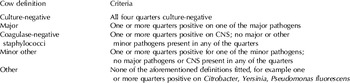
Infectious status at cow level was defined based on culture results at quarter level, as is described in Table 1. In Dataset 1, pathogen-specific IMI prevalence and 95% confidence intervals were calculated on quarter- and cow-level for the HSCC and LSCC groups separately. To determine the herd-level prevalence, the number of sampled LSCC animals was adjusted for the total number of LSCC animals per herd.
Definitions of bacteriological status at cow level, based on quarter sample culture results

Statistical analysis
Differences in prevalence of IMI between LSCC and HSCC cows and between different BMSCC cohorts were evaluated using the GENMOD procedure with a binomial distribution using SAS (SAS version 9.1.3, SAS Institute Inc., Cary NC, USA). Pathogen-specific IMI was included in the analyses as a dependent variable, while BMSCC cohort or LSCC/HSCC cow was included as an independent variable. Furthermore, cow-level corrections were made when analyses were at quarter level, while herd level corrections were made when analyses were at cow level, because of clustered data. Statistical significance was defined at P<0·05.
Somatic cell count at quarter and cow level were normalized using a natural logarithmic transformation and were presented as the geometric mean. Cow-level SCC was measured in samples collected at the DHI test-day for the DHI programme. Differences in SCC between cow- and quarter-level pathogen-specific IMI were analysed using linear mixed models in SAS (SAS version 9.1.3). In these analyses the natural logarithm of SCC on quarter- or cow-level was included as dependent variable, and the pathogen-specific IMI-species was included as the independent variable. In addition to pathogen-specific IMI, corrections were made for parity, days in milk and milk yield. To correct for correlated data of quarters within cows within herds (Barkema et al. Reference Barkema, Schukken, Lam, Galligan, Beiboer and Brand1997), cow number and herd number were included as random variables in the analyses at quarter level, while herd number was included as random variable in the cow-level analyses.
Results
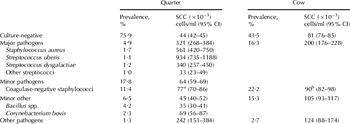
Overall quarter-level prevalence of CNS IMI in Dataset 1 was 11·4% (Table 2), being the most frequently isolated group of pathogens. Geometric quarter mean SCC of CNS-positive quarters was 77 000 cells/ml and was higher than SCC of culture-negative quarters and quarters infected with other streptococci and Bacillus spp., but lower than quarters infected with the major pathogens Staph. aureus, Str. uberis and Str. dysgalactiae.
Estimated quarter- and cow-level prevalence of mastitis pathogens (%) and their geometric mean somatic cell count in 10 125 quarters in 2570 cows of 49 randomly selected dairy herds

a Different (P<0·05) from quarters that were culture-negative, or were infected with major pathogens or Bacillus spp.
b Different (P<0·05) from cows that were culture-negative or that were infected with major pathogens
In Dataset 1 the prevalence of cows with CNS IMI in one or more quarters while no major or other pathogens were present in any of the quarters, was 22·2% (Table 2), being the most frequently isolated species. Average cow-level SCC of CNS-positive cows was 90 000 cells/ml, which was higher than SCC of cows that were culture-negative in all quarters and lower than SCC of cows with major pathogen IMI in one or more quarters.
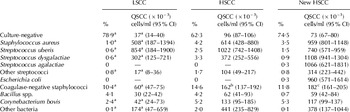
Quarter-level prevalence of all pathogens was higher in HSCC cows (P<0·05) than in LSCC cows (Table 3). Somatic cell count of quarters infected with the same pathogen was lower in LSCC cows than in HSCC cows, as was the case for culture-negative quarters (Table 3). In HSCC cows, quarter SCC of CNS-positive quarters (162 000 cells/ml) was higher than in culture-negative samples (96 000 cells/ml). In Dataset 2, quarter-level prevalence of CNS in new-HSCC cows was 11·8%, which was 4·5% higher than new IMI with major pathogens.
Quarter-level prevalence (%) and geometric mean quarter somatic cell count (QSCC) of mastitis pathogens of cows with low somatic cell count (LSCC), with high somatic cell count (HSCC) (Dataset 1) and with new HSCC (Dataset 2)

a Different (P<0·05) from HSCC
b Different (P<0·05) from culture-negative, other streptococci, C. bovis, Bacillus spp., Staph. aureus, Str. uberis, Str. dysgalactiae and other bacteria
c Different (P <0·05) from culture-negative, other streptococci, C. bovis, Bacillus spp., Staph. aureus, Str. uberis, Str. dysgalactiae, Esch. coli and Str. agalactiae
In Dataset 1, 121 (21·9%) of the 553 HSCC cows had a CNS IMI, without major pathogens present in any of the other quarters while 197 (35·6%) were positive for major pathogens (Table 4). Geometric mean SCC of CNS-positive cows was 392 000 cells/ml, which was lower than SCC of cows with a major pathogen IMI (614 000 cells/ml) and did not differ from culture-negative cows. In Dataset 2 the CNS prevalence among new HSCC cows was higher than the prevalence of cows positive on major pathogens, 27·6 and 24·0% respectively.
Cow-level prevalence (%) and geometric mean cow-level somatic cell count (CSCC) in two datasets of quarter level intramammary infections in high somatic cell count cows (HSCC) (Dataset 1) and new HSCC cows (Dataset 2)

a Different from quarters infected with major pathogens in the same dataset (P<0·05)
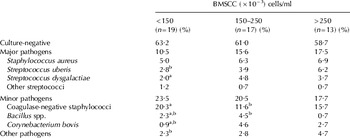
Analysis of data from quarters with high SCC (⩾200 000 cells/ml) revealed that the prevalence of CNS IMI was higher in herds with a low BMSCC (<150 000 cells/ml) compared with herds with a higher BMSCC (Table 5). Major pathogens were more prevalent in herds with a high BMSCC. Streptococcus dysgalactiae IMI were found more often in herds with medium BMSCC than in herds with low BMSCC, while Str. uberis IMI was more prevalent in herds with high BMSCC compared with herds with low BMSCC. Although prevalence of Staph. aureus IMI increased numerically with increasing BMSCC, no significant differences in prevalence of Staph. aureus IMI were observed between the three BMSCC categories.
Estimated quarter-level prevalence (%) of intramammary infection with mastitis pathogens in quarters with somatic cell count ⩾200 000 cells/ml in three bulk milk somatic cell count (BMSCC) cohorts (Dataset 1)

a Different (P<0·05) from BMSCC 150 000–250 000 cells/ml
b Different (P<0·05) from BMSCC >250 000 cells/ml
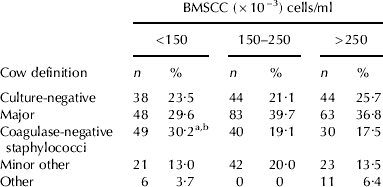
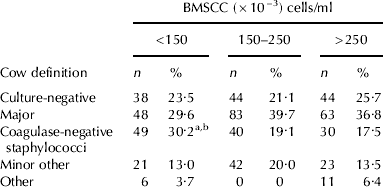
In Dataset 1 the cow-level prevalence of CNS IMI in HSCC cows and heifers was compared between BMSCC cohorts and was higher in low BMSCC herds (<150 000 cells/ml) compared with medium- and high-BMSCC herds (Table 6). Differences in cow-level prevalence of major pathogen IMI were not significant between BMSCC cohorts.
Cow-level prevalence (%) of quarter level intramammary infections in high somatic cell count cows and heifers in 49 herds, in three bulk milk somatic cell count (BMSCC) cohorts
a Different (P<0·05) from BMSCC 150–250
b Different (P<0·05) from BMSCC >250
Discussion
The effect of CNS IMI on SCC at quarter-, cow- and bulk milk-level has not been evaluated in many studies. Recently, Schukken et al. (Reference Schukken, González, Tikofsky, Schulte, Santisteban, Welcome, Bennett, Zurakowski and Zadoks2009) evaluated the effect of major pathogens and CNS IMI on milk production and cow-level SCC. In that study, 4200 herds were included that submitted milk samples to a service laboratory. Part of these herds had a BMSCC >750 000 cells/ml and were obliged to send in milk samples, others were problem based or were part of udder health programmes. Thus, these data are not fully comparable with our prospective collected datasets. Additionally, Schukken et al. (Reference Schukken, González, Tikofsky, Schulte, Santisteban, Welcome, Bennett, Zurakowski and Zadoks2009) used composite milk samples which can lead to an underestimation of the prevalence of bacteria (Lam et al. Reference Lam, van Wuijckhuise, Franken, Morselt, Hartman and Schukken1996). Coagulase-negative staphylococci are the most frequently isolated group of organisms in almost all mastitis surveys (Makovec & Ruegg, Reference Makovec and Ruegg2003; Pitkälä et al. Reference Pitkälä, Haveri, Pyörälä, Myllys and Honkanen-Buzalski2004; Tenhagen et al. Reference Tenhagen, Koster, Wallmann and Heuwieser2006; Bradley et al. Reference Bradley, Leach, Breen, Green and Green2007; Piepers et al. Reference Piepers, De Meulemeester, De Kruif, Opsomer, Barkema and De Vliegher2007; Sampimon et al. Reference Sampimon, Barkema, Berends, Sol and Lam2009a; Schukken et al. Reference Schukken, González, Tikofsky, Schulte, Santisteban, Welcome, Bennett, Zurakowski and Zadoks2009). In both our datasets, the quarter-level prevalence of CNS IMI was higher than the prevalence of Staph. aureus IMI, almost 10-times and 3-times respectively in Dataset 1 and 2. It is not clear whether CNS IMI always results in inflammation. In this study, SCC of CNS-positive quarters in LSCC, HSCC and in the new-HSCC group were significantly higher than culture-negative quarters and thus contributes to a higher cow-SCC. In LSCC cows CNS seem to be relatively more important than in HSCC cows which can partly be explained by a higher prevalence of major pathogens in HSCC cows (Table 3).
Quarter prevalence of the other major pathogens Str. uberis and Str. dysgalactiae IMI were also slightly higher in Dataset 1 than in Dataset 2 but the prevalence of culture-negative quarters was higher in Dataset 2. In both datasets cows and heifers with an SCC above established cut-off levels were sampled. In Dataset 1, however, all cows and heifers with a high SCC were sampled regardless of chronicity, while in Dataset 2 only cows and heifers with their first increased SCC were sampled. This may explain the higher prevalence of mastitis pathogen IMI in Dataset 1 and the higher prevalence of culture-negative samples in Dataset 2.
In the literature, SCC of CNS-infected quarters is described as mild and approximately 2–3-times the level of culture-negative samples (Honkanen-Buzalski Reference Honkanen-Buzalski1990; Djabri et al. Reference Djabri, Bareille, Beaudeau and Seegers2002). In the study of Rainard et al. (Reference Rainard, Ducelliez and Poutrel1990) 20% of the CNS-positive quarters had an SCC below 200 000 cells/ml, 42% between 200 000 and 500 000 cells/ml, and 38% >500 000 cells/ml. We found a slightly smaller but also significant effect: 77 000 v. 44 000 cells/ml. This effect was also found in the subgroups: LSCC, HSCC and new-HSCC cows and may indicate that SCC differs between random CNS-positive cows and cows CNS-positive with a high SCC that are sampled to be sent to a service laboratory. Coagulase-negative staphylococci IMI apparently lead to an increase in SCC which is smaller than quarters infected with major pathogens such as Staph. aureus, 138 000 v. 357 000 cells/ml (Djabri et al. Reference Djabri, Bareille, Beaudeau and Seegers2002). Differences in the effect of CNS IMI on quarter SCC can be explained by the probable differences in CNS species occurring in different countries (Zadoks & Watts, Reference Zadoks and Watts2009). Significant differences in SCC between CNS species have been described (Sampimon et al. Reference Sampimon, Barkema, Berends, Sol and Lam2009b). For example in that study Staph. haemolyticus infected quarters had an average SCC of 67 000 cells/ml, while the average SCC of Staph. xylosus infected quarters was 400 000 cells/ml. To evaluate the contribution of the most important CNS species to SCC, larger studies are needed. Another explanation of the effect of CNS IMI on quarter SCC could be that quarters subclinically infected with CNS have more lesions than culture-negative samples, but milder and less extended compared with coagulase-positive staphylococci (Stabenfeldt & Spencer, Reference Stabenfeldt and Spencer1966). In HSCC cows, also culture-negative quarters are found, which can partly be explained by shedding patterns of bacteria, as has been described for Staph. aureus (Sears et al. Reference Sears, Smith, English, Herer and Gonzalez1990). Hypothetically, CNS found in non-shedding, Staph. aureus infected quarters lead to false-positive interpretations while this is overseen in Staph. aureus-positive quarters. However, CNS IMI in quarters of HSCC cows have higher SCC than culture-negative quarters in HSCC cows, indicating that CNS themselves do have an effect. At the cow-level, SCC measured in composite samples was not different between CNS-positive cows and culture-negative cows. Both SCC levels were >200 000 cells/ml indicating an inflammatory response. In both datasets SCC was significantly lower in CNS-positive cows compared with cows positive for major pathogens (Table 4). It is hard to find an explanation in our study for this phenomenon at cow level. The shedding pattern described for Staph. aureus (Sears et al. Reference Sears, Smith, English, Herer and Gonzalez1990) may explain why HSCC cows are sometimes culture-negative.
In our study, the distribution of CNS-positive quarters with a SCC >200 000 cells/ml, indicated as quarters with IMI (Schukken et al. Reference Schukken, Wilson, Welcome, Tikofsky and Gonzalez2003), were more often found in dairy herds with a BMSCC <200 000 cells/ml compared with herds with a higher BMSCC. This is in agreement with the large study of Schukken et al. (Reference Schukken, González, Tikofsky, Schulte, Santisteban, Welcome, Bennett, Zurakowski and Zadoks2009) where CNS prevalence was higher in dairy herds with a low BMSCC. This distribution was in our study also found at cow level; CNS-positive cows were significantly more prevalent in dairy herds with a low BMSCC compared with medium and high BMSCC, 30, 19 and 18%, respectively. This indicates that CNS-positive cows are relatively more important in dairy herds with a low BMSCC than in dairy herds with high BMSCC. This may be of interest for dairy farmers who deliver milk to dairy processors that provide a bonus based on low BMSCC. Although the increase of SCC caused by CNS is lower than the effect of major pathogens, for these farms CNS IMI can have a significant effect and ought to be a point of attention in udder health management. To improve udder health management in these herds, risk factors that increased the prevalence of CNS IMI were studied. Surprisingly CNS IMI were not specifically associated with milking technique and milking machine but were more associated with environmental factors such as housing of dry cows, pasturing, source of drinking water and proportion of stalls contaminated with milk (Sampimon et al. Reference Sampimon, Barkema, Berends, Sol and Lam2009b). Because these risk factors are not included in the much used five-point programme (Neave et al. Reference Neave, Dodd, Kingwill and Westgarth1969), this may explain that with decreasing BMSCC, CNS become more important. The more environmental CNS species probably have an increased importance in herds with lower BMSCC (White et al. Reference White, Harmon, Matos and Langlois1989; Matos et al. Reference Matos, White, Harmon and Langlois1991).
Conclusions
A substantial part of existing and new high-SCC cows and heifers is associated with CNS IMI. Quarters positive on CNS had a higher SCC than culture-negative quarters but a lower SCC than quarters positive for major pathogens. Cows or heifers infected with CNS had lower SCC compared with IMI with major pathogens. Prevalence of CNS IMI is relatively higher in dairy farms with BMSCC <150 000 cells/ml compared with herds with higher BMSCC.
This study is part of the five-year mastitis programme of the Dutch Udder Health Centre and was financially supported by the Dutch Dairy Board.