INTRODUCTION
In the north-east Pacific research has identified three genetically, morphologically and ecologically distinct ecotypes of killer whale, Orcinus orca: the mammal-eating ‘transient’ type, the fish-eating ‘resident’ type and the less well-studied ‘offshore’ type (Ford et al., Reference Ford, Ellis and Balcomb2000). The behavioural differences between the resident and transient types have been well documented, and include differences in sociality and vocal behaviour, where there are vocal differences between ecotypes, and even pods, that are referred to as different dialects (Ford & Fisher, Reference Ford, Fisher and Payne1983). For example, the mammal-eating transients typically hunt in small silent groups, whereas the group size of the fish-eating residents is highly variable and they vocalize at high rates across a range of contexts (Morton, Reference Morton, Hammond, Mizroch and Donovan1990; Baird & Dill, Reference Baird and Dill1996; Barrett-Lennard et al., Reference Barrett-Lennard, Ford and Heise1996; Baird & Whitehead, Reference Baird and Whitehead2000; Deecke et al., Reference Deecke, Ford and Slater2005; Saulitis et al., Reference Saulitis, Matkin and Fay2005). These behaviours have presumably evolved in response to the hearing ability and the potential evasive behaviour of their prey (Baird et al., Reference Baird, Abrams and Dill1992; Deecke et al., Reference Deecke, Slater and Ford2002). Most small marine mammals have an auditory range that overlaps with the frequency range of killer whale calls (Foote & Nystuen, Reference Foote and Nystuen2008) and can thus detect killer whale calls and respond with evasive behaviour, which in the case of pinnipeds includes being able to escape predation by diving to the bottom, hauling-out or moving to the shallows (Deecke et al., Reference Deecke, Slater and Ford2002; Womble et al., Reference Womble, Gende and Blundell2007). The mammal-eating transient whales have apparently responded by developing stealthy hunting strategies, restricting the use of sounds that could alert potential prey animals (Morton, Reference Morton, Hammond, Mizroch and Donovan1990; Barrett-Lennard et al., Reference Barrett-Lennard, Ford and Heise1996, Deecke et al., Reference Deecke, Ford and Slater2005; Saulitis et al., Reference Saulitis, Matkin and Fay2005).
Killer whales in the north-east Atlantic occur seasonally in areas concurrent with large fish stocks such as herring, Clupea harengus, and mackerel, Scomber scombrus, which are major prey items for the whales (Similä et al., Reference Similä, Holst and Christensen1996; Foote et al., Reference Foote, Similä, Vikingsson and Stevick2010). However, north-east Atlantic killer whales have also been observed to hunt and consume harbour seals, Phoca vitulina, (Bolt et al., Reference Bolt, Harvey, Mandleberg and Foote2009; Foote et al., Reference Foote, Similä, Vikingsson and Stevick2010; Deecke et al., Reference Deecke, Nykänen, Foote and Janik2011). An investigation using museum specimens found that all adult specimens genetically identified as belonging to the lineages known to feed on herring and mackerel had worn teeth (Foote et al., Reference Foote, Newton, Piertney, Willerslev and Gilbert2009), suggesting some shared component of the diet or a common foraging method that causes this wear, possibly linked to suction feeding on small individual prey items like herring or mackerel. However, the δ15 nitrogen values from tooth or bone samples indicated that there was large inter-individual variability in the long-term trophic level they were feeding at (Foote et al., Reference Foote, Newton, Piertney, Willerslev and Gilbert2009). Stomach contents of some individuals with higher δ15N values included mammalian prey such as harbour porpoise and harbour seal (Foote et al., Reference Foote, Newton, Piertney, Willerslev and Gilbert2009). Additionally, killer whale groups observed hunting seals around the Shetland Isles are loosely linked by association with groups observed feeding on herring off Iceland and Shetland (Foote et al., Reference Foote, Similä, Vikingsson and Stevick2010; Beck et al., Reference Beck, Kuningas, Esteban-Pavo and Foote2012). Therefore Foote et al. (Reference Foote, Newton, Piertney, Willerslev and Gilbert2009) hypothesized that these ‘type 1’ north-east Atlantic lineages appear to be generalist, but that the proportion of different prey items in the diet would vary between individuals, e.g. some groups may just eat herring, others may eat both herring and mammals.
The foraging strategies described to date for north-east Atlantic killer whales appear to be specialized rather than opportunistic (e.g. Similä & Ugarte, Reference Similä and Ugarte1993; Similä, Reference Similä1997a; Simon et al., Reference Simon, McGregor and Ugarte2007; Deecke et al., Reference Deecke, Nykänen, Foote and Janik2011) and killer whales hunting seals around Shetland are behaviourally similar to the north-east Pacific mammal-eating transient type in their low vocal rates and small group sizes (Deecke et al., Reference Deecke, Nykänen, Foote and Janik2011; Beck et al., Reference Beck, Kuningas, Esteban-Pavo and Foote2012). Therefore, the hypothesis that some groups are preying upon herring and seals would suggest that groups are switching between two specialist strategies. However, until now no published observations of identified individuals switching between fish and mammal prey have been reported for the north-east Atlantic.
Here we provide the first direct observations of photo-identified individuals feeding on both herring and seals. We further investigate prey switching by using the responsiveness of mammalian prey species as a proxy for the level of perceived risk of predation from killer whales previously observed feeding on herring. Playback experiments have proven a powerful tool for determining sensitivity and assessment of a predatory threat by the responsiveness of the prey (e.g. Doksæter et al., Reference Doksæter, Godø, Handegard, Kvadsheim, Lam, Donovan and Miller2009; McComb et al., Reference McComb, Shannon, Durant, Sayialel, Slotow, Poole and Moss2011). Wild harbour seals in the North Pacific have been shown to selectively habituate to familiar harmless fish-eating killer whales (Deecke et al., Reference Deecke, Slater and Ford2002). We therefore describe observations of the reactions of free-ranging harbour seals to playback of recorded Norwegian herring-eating killer whale vocalizations, in an area where predation on seals has been reported.
MATERIALS AND METHODS
Photo-identification and field observations
Photo-identification studies of killer whales were initiated in Norway in 1983 (Lyrholm, Reference Lyrholm1988), and by the authors in 1987 (Bisther & Vongraven, Reference Bisther and Vongraven2001). Most fieldwork since then has been conducted in areas where herring concentrate on wintering grounds and during spawning in the spring. The whales occur in cohesive groups or ‘pods’, all consisting of adult males and females with young, and a matrilineal social system has been suggested (Bigg et al., Reference Bigg, Olesiuk, Ellis, Ford, Balcomb, Hammond, Mizroch and Donovan1990; Similä, Reference Similä1997b). Areas with known occurrences of killer whales were visited yearly, and individuals encountered were photographed and identified and grouped into pods, following the methodology of Bigg (Bigg, Reference Bigg1982; Bigg et al., Reference Bigg, Olesiuk, Ellis, Ford, Balcomb, Hammond, Mizroch and Donovan1990). The pods were catalogued sequentially by letter, with all designations preceded by the letter N or K to indicate northern Norwegian (N) or southern Norwegian (K) origin. Reports on observations of special interest obtained through an acquired network of observers were duly noted and quality assessed. Identified whales were catalogued, and in the period 1987–1996 a total of 605 individuals were identified (Bisther & Vongraven, Reference Bisther and Vongraven2001).
The playback sequence
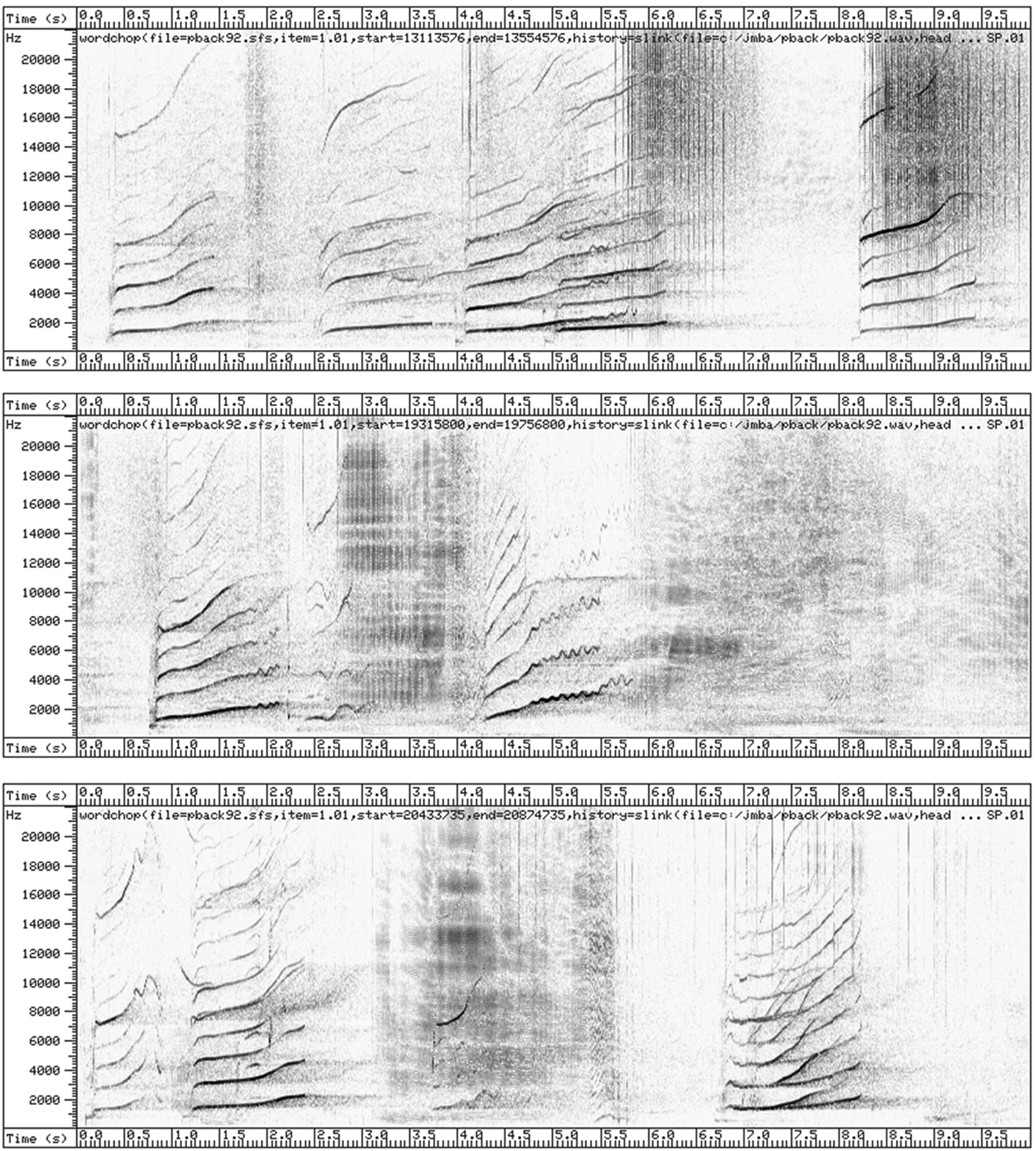
The sequence was recorded from a group of about 15 killer whales, with whales from NE and NU pods present, which are known herring eaters. The whales were slowly travelling in Tømmeråsfjord in northern Norway, a small fjord, part of the Tysfjord fjord system. There were several groups of whales within a few miles in the fjord at the time. In the fjord were also large numbers of wintering herring, a presence documented by echo sounders and a large number of fishing vessels, as well as direct observations of whales feeding on herring near the surface the same day, and for a prior period of five weeks in the same area. The playback sequence contained echolocation clicks and pulsed calls, and was not atypical compared to other analysed vocalizations of Norwegian killer whales (Figure 1; Bisther, Reference Bisther1991). Both the NE and NU whales were seen feeding on herring earlier the same day.
Spectrograms showing pulsed calls and click trains from Norwegian herring-eating killer whales in three 10 s clips of the 9 min sequence played back to Norwegian harbour seals. The recording was made in Tømmeråsfjord in Tysfjord on 16 November 1992.

The playback experiments
Playback experiments were conducted using 5–25 min sequences of killer whale pulsed calls and echolocation clicks transmitted from an omnidirectional University Sound UW-30 Diatran loudspeaker, placed ~2–3 m under water, connected to a 100 W amplifier at a range of 100–200 m from the study animals. The frequency range was 0–10 kHz and the source level was 129 dB (reference pressure 1 µPa at 1 m) which is at the lower range of the source level of free-ranging killer whale calls (Miller, Reference Miller2006). The subjects of the first set of playback experiments were two harbour seals fitted with acoustic depth, speed and heart rate transmitters, as part of behavioural studies of seals in Froan, Norway, in June 1993 and at Finnøy, Norway, in July 1996 (see Bjørge et al., Reference Bjørge, Thompson, Hammond, Fedak, Bryant, Aarefjord, Roen, Olsen, Blix and Walløe1995 and Thompson et al., Reference Thompson, Sjoberg, Bryant, Lovell and Bjorge1998, and map in Figure 2 for all locations), one harbour seal in each of the two locations. Froan is an archipelago on the mid-coast of Norway, and it is situated just north of the Møre region where the Norwegian spring-spawning herring stock have spawned every spring for many decades, and consequently where Norwegian killer whales normally can be found at this time of year (Bisther & Vongraven, Reference Bisther, Vongraven, Blix and Walløe1995; Similä et al., Reference Similä, Holst and Christensen1996). Finnøy, which is the northern part of a larger island called Harøy, is situated on the coast ~20–30 miles off the main herring spawning area. These herring spawning grounds are located 350 miles (Froan) and 450 miles (Finnøy) south of where the sequences were recorded, but whales from both NE and NU have been identified in these southern areas at this time of year. The two harbour seals would, therefore, likely have been exposed annually to the calls of herring-eating killer whales.
The instrumented seals were exposed to 5–6 min ‘bursts’ of underwater playback of sounds of killer whales after days and weeks of tracking. Seals were monitored between 45 and 120 min after the playback trials. Their reactions were recorded as deviations from previous tracking data.
The second set of playback experiments were conducted at haul-out sites at Froan in June 1993, similar to the experiment conducted by Deecke et al. (Reference Deecke, Slater and Ford2002) in the Pacific. The reaction of seals at the haul-out sites were assessed by recording the distributions of seal sightings before and during playback trials. A bottom mounted UW-speaker, mounted 24–48 h prior to the experiments, was used to transmit sounds under water 100–200 m from two harbour seal haul-out sites. The distribution of visible seals was recorded from a land-based, hidden position during 10 s scans at 1 min intervals.
RESULTS
Field observations
A total of 605 killer whales were photo-identified at the Norwegian coast between 62°35′N and 68°33′N during the period 1987–1996. The actual number of pods is not known, but at least 30 different pods reside seasonally in the coastal waters of Norway. Within this study, photo-identified killer whales were observed to feed on herring 102 times, and to feed on, or harass, mammals seven times (Table 1), three times by the authors. Episodes of feeding on herring were most often characterized by the whales encircling a ball of herring close to the surface and stunning the fish with underwater tail slaps; a strategy known as carousel feeding (Similä & Ugarte, Reference Similä and Ugarte1993). During this feeding behaviour, which typically involves large groups of whales, herring swim bladders, scales and debilitated fish can be observed at and near the surface (Similä & Ugarte, Reference Similä and Ugarte1993; Simon et al., Reference Simon, McGregor and Ugarte2007).
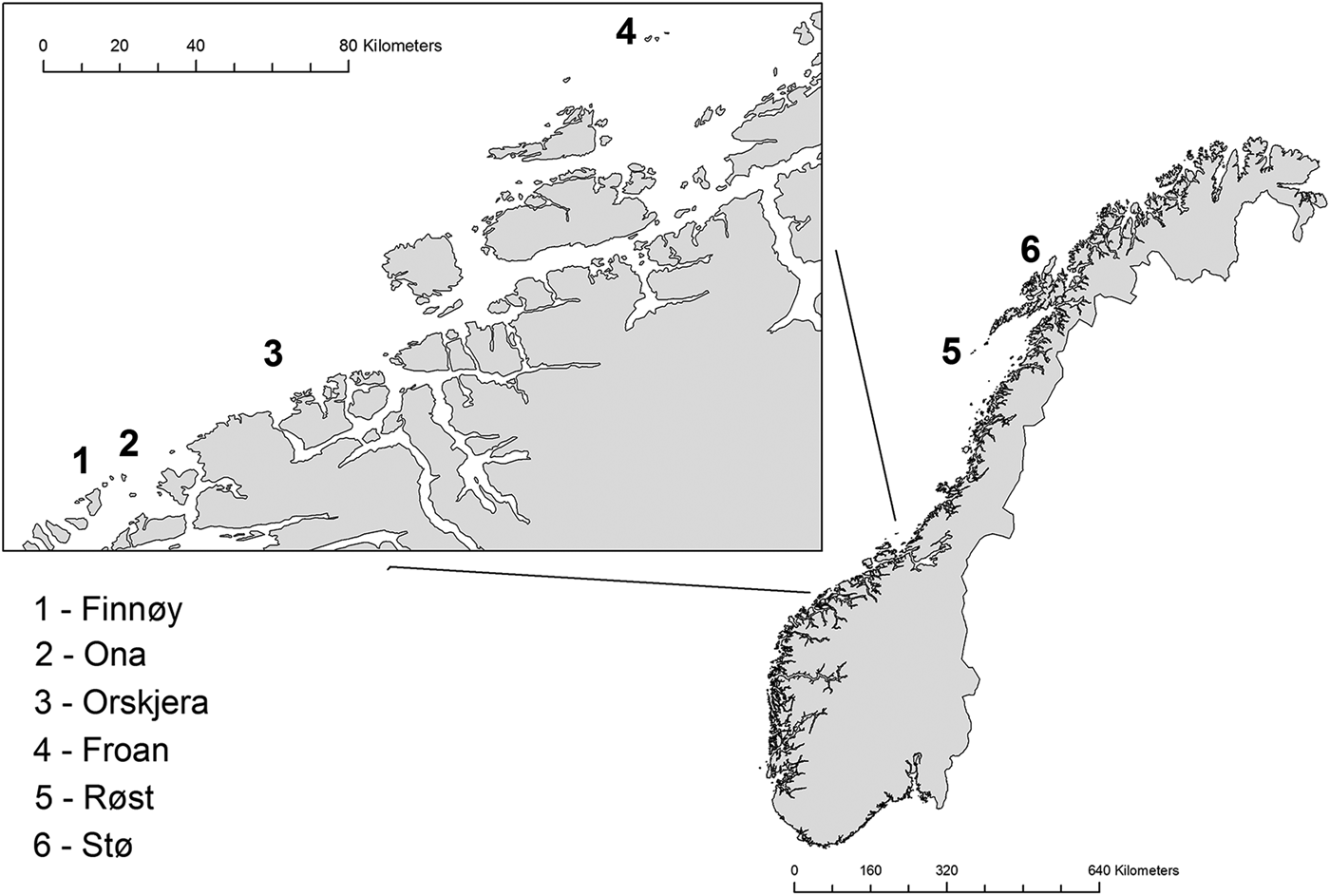
Documented observations of interactions between identified killer whales and mammals in Norwegian coastal waters. Locations are shown in map in Figure 2.
In April 1988, five killer whales were photo-identified from video prints and observed at Orskjera (see map, Figure 2) chasing harbour seals around a seal colony for 10 min. No kills were observed. When the whales left the area, several seals were observed swimming in the water close to the shore (N. Aukan, personal communication). In October 1990, four whales were photo-identified and observed feeding on fresh blubber in Froan (see map, Figure 2), which is the main breeding area for grey seals along the Norwegian coast, at the peak time for presence of grey seal pups (unpublished data). Five whales were encountered and photo-identified in March 1991 while first feeding on herring with a larger group of whales 5 miles from land, then breaking off from the larger group, swimming directly towards land, and finally seen swimming close to land towards some small skerries at Ona (see map, Figure 2) where seals were hauled out and in the water. One whale surfaced with a harbour seal in its mouth, but the whales continued to move slowly and it is not known if the seal was eaten. Four harbour seals were observed in the water, looking at the whales, but none hauled-out. No acoustic recordings exist from this encounter. Figure 3 shows an example of a Norwegian killer whale attacking a harbour seal in Stø in Vesterålen, Norway, in May 2011.
A Norwegian killer whale attacking a harbour seal at Stø, in Vesterålen, northern Norway, in May 2011. This killer whale was not positively identified due to lack of good quality close-up images (photograph: Dieter Schwab).
Photo-identification data collected during encounters of killer whales interacting with seals were compared with the catalogue of killer whales photo-identified while feeding on herring (see Table 1; Bisther & Vongraven, Reference Bisther and Vongraven1994, Reference Bisther, Vongraven, Blix and Walløe1995 and unpublished data; Similä et al., Reference Similä, Holst and Christensen1996). In all three cases in this study the whales were identified as members of KI pod. Eleven whales were identified as members of KI pod between 1988 and 1992, and two of the whales were seen on all three occasions, while two others were seen on two of the three occasions. This pod was also identified twice in 1991 while in a larger group of whales feeding on herring, among them whales from NW pod, a known herring-eating group of whales. If all the pods observed feeding on herring were also feeding upon seals, and there was an equal chance of encountering each pod, then it would be highly unlikely to observe the same pod interacting with seals on all of three different occasions, given that there are 31 pods of Norwegian killer whales identified (Kuningas et al., in press). These observations indicate that the identified KI pod whales are to some degree specialized in feeding on seals, that it is a stable group of whales, and that the foraging strategy of these whales, to feed on mammals, may persist for several years. Identified Norwegian killer whales were observed interacting with seals on two other occasions by other researchers and professional photographers, at Røst and Stø (see map, Figure 2), but none of these whales were matched with any of the KI pod whales (see Table 1). One group of 15 individuals observed trying to catch a harbour seal in June 1993 at Røst in northern Norway (see map, Figure 2) was identified as NØ pod; a known herring-eating group from the photo-identification catalogue (Similä et al., Reference Similä, Holst and Christensen1996). Another group killed a harbour seal in July 1988 at Orskjera (see map, Figure 2), but no individuals were matched to either NØ- or KI pods (Tony Holm, personal communication). Thus the killer whale population off Norway appears to contain more than one group feeding on mammals. Included in the study are also two recent observations of killer whales chasing harbour seals outside Stø in Vesterålen, northern Norway (see map, Figure 2), one in June 2010 and the other in May 2011 (Figure 3). Close-up photographs from the first of these events fail to identify known individuals.
Playbacks
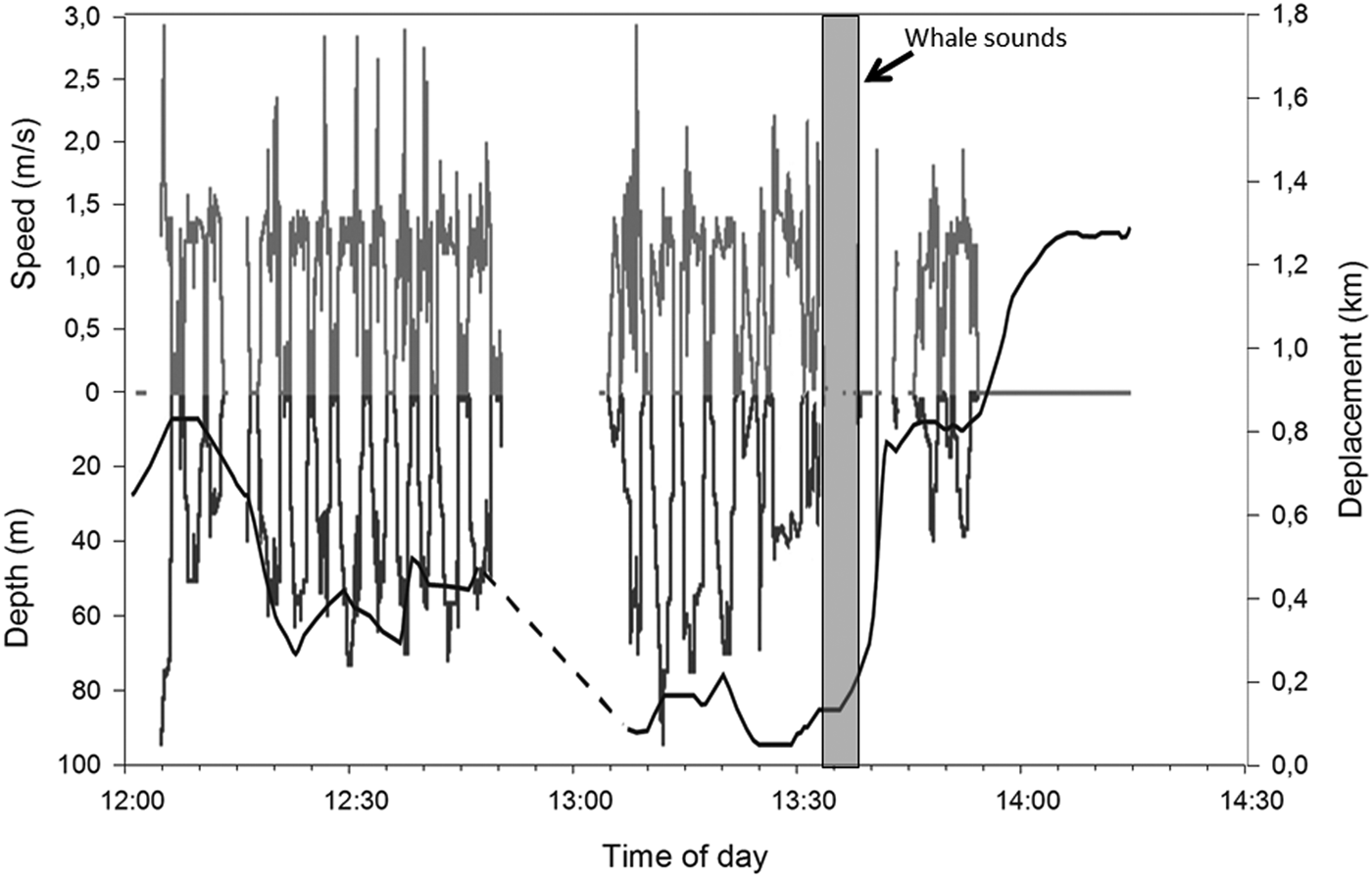
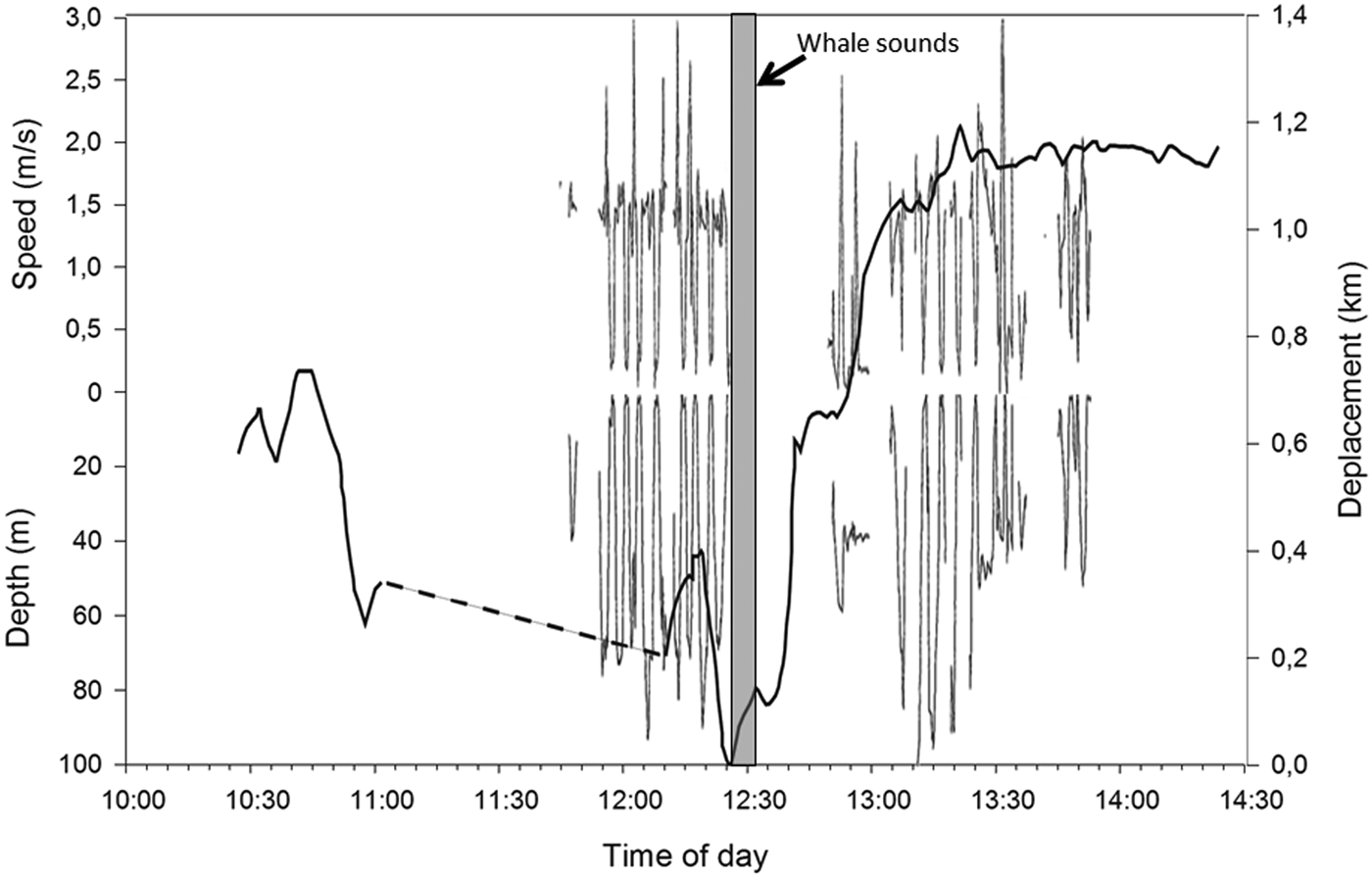
The results of the playback experiments provided further insights into whether Norwegian harbour seals perceive Norwegian herring-eating killer whales to be a predatory threat. The instrumented harbour seals, Pv1 (Froan) and Pv2 (Finnøy) were exposed to the killer whale sounds when swimming in open water. They reacted to the onset of the sounds, abandoning their foraging behaviour and swimming away from the source (Figures 4 & 5). Both seals swam directly towards the nearest shallow, breaking water, 700 m and 150 m away for seal Pv1 (Figure 4) and Pv2 (Figure 5), respectively. In trial one, the seal Pv1 continued another 500 m to the next shelter area with shallow water, where ten other seals arrived within 15 minutes of the playback. Immediately after the onset of the sounds swim speed was not recorded for seal Pv2. This was interpreted as the swim speed being too high to allow the acoustic speed transmitters/recorders to function properly (D. Thompson, personal communication). A similar lack of tracking data occurred for seal Pv1 in the first minutes after the exposure ended. The seal was then observed to swim in high speed, but without porpoising through the water. Diving patterns were recorded from Pv1 after about 5 min. The post-exposure dive behaviour initially contrasted with records of undisturbed diving, containing no usual transit or foraging dive profiles (Figure 4). Heart rate was recorded from Pv2 before and just after the playback trial. A profound, but short-lived, bradycardia coincided with the playback (D. Thompson, personal communication).
Response in swim speed, dive depth and displacement, of a harbour seal before and directly after being exposed for calls from Norwegian herring-eating killer whales at Froan, Norway, in June 1993. The dotted line in the deplacement curve is due to lack of data.
Response in swim speed, dive depth and displacement, of a harbour seal before and directly after being exposed for calls from Norwegian herring-eating killer whales at Finnøy, Norway, in July 1996. The 20 min period after onset of whale sounds without recordings of swim speed and dive depth were due to the seal moving too fast to allow data recording (D. Thompson, personal communication). The dotted line in the deplacement curve is due to lack of data.
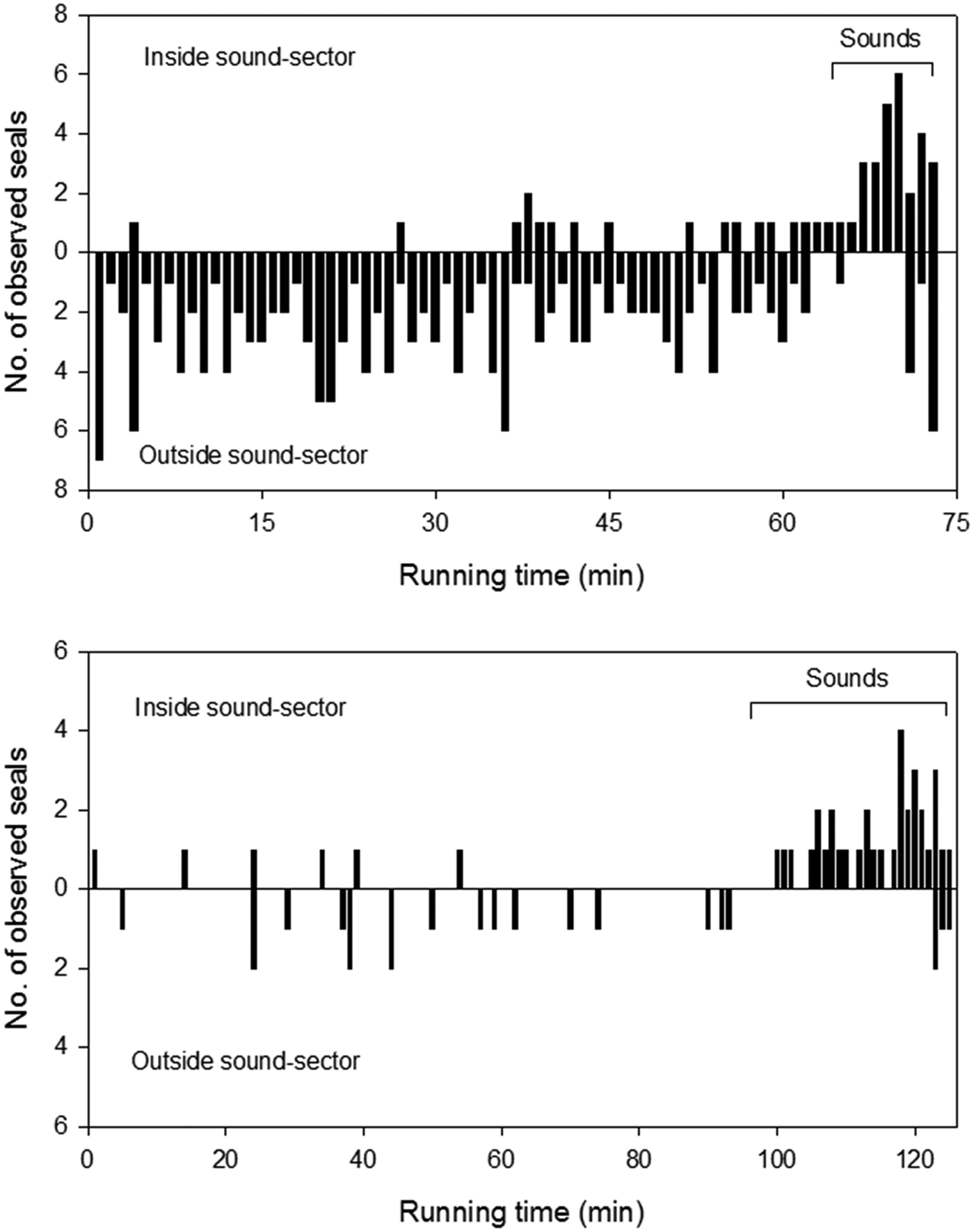
During the visual observations of harbour seals at haul-out sites, all but one of the seals were in the water because of the high tide. The number of seal sightings in an area of approximately 100 × 100 m around the UW-speaker before and during the playback of whale sounds is shown in Figure 6. A total of 210 seal positions were recorded during 75 min of observation at Hestværet, Froan. One seal dived as the sound began, and all other observable seals initially moved into the kelp. After 1.5 min of the commencement of the playback experiment, the sightings rate in the study area started to increase, rising from 0.3 to 4.6 seals min−1. A total of 57 seal positions were recorded during 125 min at Edøya, Froan, and the seals showed similar reactions when exposed to the sounds; after 3 min the number of visible seals inside the sector increased from 0.1 to 1.2 seals min−1. The seals were observed during 2.5 h on a previous day, without any sound exposure and at the same tidal level, and the presence of the observers did not cause any concentrations of seals within the sound sector.
Behavioural response of harbour seals at two haul-out sites in Froan, Norway, Hestværet (top) and Edøya (bottom), before and during playback of sounds from herring-eating Norwegian killer whales. Sound-sector refers to an area at the core of the haul-out site where the UW speakers were located. The number of visible seals in the water was counted each minute.
Table 2 summarizes the playback experiments, and the responses of harbour seals to vocalizations of Norwegian herring-eating killer whales.
Summary of play-back experiments with killer whale sounds on harbour seals off the Norwegian coast. ‘Open water’ refers to seals cruising around, away from known haul-out sites in the areas.
DISCUSSION
These visual observations are the first reports of confirmed prey switching between fish and mammalian prey for north-east Atlantic killer whales. Previous work had used two proxies of long-term feeding behaviour—tooth wear and δ15nitrogen stable isotope values—to suggest that there was a broad niche width in the so-called ‘type 1’ north-east Atlantic killer whale lineages, and that this was due to individual differences in the diet (Foote et al., Reference Foote, Newton, Piertney, Willerslev and Gilbert2009). Our observations of repeated interactions with seals by a single pod of known herring-eating killer whales support this degree of specialization, but at a group level. Similar findings have been reported in Shetland of site-faithful groups, which are linked by association to herring-eating groups, hunting seals (Foote et al., Reference Foote, Similä, Vikingsson and Stevick2010; Beck et al., Reference Beck, Kuningas, Esteban-Pavo and Foote2012). The group size of KI pod while hunting seals was also similar to the mean of five individuals found for Shetland (Beck et al., Reference Beck, Kuningas, Esteban-Pavo and Foote2012), and to the group size of transient killer whales in the Pacific north-east when hunting harbour seals (Dahlheim & White, Reference Dahlheim and White2010).
The response of Norwegian harbour seals to playback experiments of Norwegian herring-eating killer whale calls was to rapidly move to shallow water when exposed to the sounds in open water, and to stay in the kelp when exposed at the haul-out site. This response by the instrumented harbour seals in open water to playbacks of killer whale sounds is similar to that described for an instrumented harbour seal in the Alaskan Pacific in the presence of a group of three transient killer whales (Womble et al., Reference Womble, Gende and Blundell2007). That seal appeared to be the target of an attack by the killer whales and responded by diving and not resurfacing for 13 minutes as it travelled 0.65 km to shallow water (Womble et al., Reference Womble, Gende and Blundell2007). Our experimental set up did not include any control protocol, i.e. exposing harbour seals to a control sound while swimming in open water, as our study had to be aborted due to harsh weather conditions. Our observations of the responses of the harbour seals at haul-out sites to playback of killer whale calls contrasted with the results of similar playback experiments to harbour seals in the Pacific (Deecke et al., Reference Deecke, Slater and Ford2002). In that study the number of harbour seals observed at the surface at a haul-out site declined after playbacks of mammal-eating transient killer whale calls or unfamiliar fish-eating calls, but showed no significant change to playbacks of familiar local fish-eating killer whale calls. The response of the Norwegian harbour seals to the playbacks of Norwegian herring-eating killer whale calls would suggest that they do perceive these calls as an indication of a predatory threat. Even though their response did not immediately seem to be advantageous, there still could be a functional response: to hide in shallow water is a better option than to run when killer whales seem to be nearby. Causes of the differences between the response by harbour seals observed here and by Womble et al. (Reference Womble, Gende and Blundell2007) with that of Deecke et al. (Reference Deecke, Slater and Ford2002) could include innate population-level differences in flight response or environmental differences. For example, if the haul-out sites in the Deecke et al. (Reference Deecke, Slater and Ford2002) study were adjacent to deep water, then harbour seals at the surface might be accessible to killer whales even if they move close to the shore, and so seals may dive to the bottom instead.
The level of responsiveness of prey species should be optimized based on the trade-offs between predation risk and energy gain (Frid et al., Reference Frid, Dill, Thorne and Blundell2007; Wirsing et al., Reference Wirsing, Heithaus and Dill2007). The responsiveness by Norwegian harbour seals to herring-eating killer whale calls could indicate that harbour seals perceive all killer whale calls as a cue for a predation risk. Prey switching by at least some killer whale pods could mean harbour seals are therefore not able to use killer whale dialects as an indicator of diet and habituate to the calls of those that are consistently feeding on herring. It could also reflect the increased difficulty of the discrimination task for Norwegian harbour seals compared with the Pacific harbour seals in the study by Deecke et al. (Reference Deecke, Slater and Ford2002). The Norwegian herring-eating population (~600 individuals; Kuningas et al., Reference Kuningas, Similä and Hammond2007) is approximately an order of magnitude larger than the small fish-eating southern resident population (<90 individuals; Ford et al., Reference Ford, Ellis and Balcomb2000) that Deecke et al. (Reference Deecke, Slater and Ford2002) suggested the local seals had become habituated to. The southern resident population in the Pacific north-west has just three distinct call type repertoires (Ford et al., Reference Ford1991), which have been shown to remain stable over three decades (Foote et al., Reference Foote, Osborne and Hoelzel2008). The large number of pods in the Norwegian herring-eating community would have a much larger number of call type repertoires to discriminate amongst (e.g. Bisther, Reference Bisther1991; Strager, Reference Strager1995). The combination of such a large discriminatory task and the risk of killer whales switching from fish to mammalian prey may select against habituation as a successful strategy to increase foraging time by Norwegian harbour seals. Deecke et al. (Reference Deecke, Slater and Ford2002) suggested that harbour seals appeared to have a general predator image that can be modified to exclude harmless stimuli by selective habituation.
It has been suggested that the fitness of foraging specialist killer whale ecotypes would be greater than that of a generalist that simultaneously searched for both prey types (Baird et al., Reference Baird, Abrams and Dill1992). If the behavioural responses of seals to killer whale sounds suggested in this study are representative, they might partly explain the presence of Norwegian killer whale pods specialized in foraging on mammals. The active space of killer whale calls can reach up to 16 km (Miller, Reference Miller2006). Our results indicate a behavioural response by Norwegian harbour seals that could reduce the likelihood of a successful attack by vocalizing killer whales. A recent study found that killer whales around the Shetland Isles that are linked by association to those hunting herring around Iceland (Foote et al., Reference Foote, Similä, Vikingsson and Stevick2010; Beck et al., Reference Beck, Kuningas, Esteban-Pavo and Foote2012) hunted in almost complete silence, much like mammal-eating killer whales in the Pacific (Deecke et al., Reference Deecke, Nykänen, Foote and Janik2011). Such a foraging tactic contrasts with the high vocalization rate of killer whales feeding on herring (Bisther, Reference Bisther1991; Strager, Reference Strager1995; Simon et al., Reference Simon, McGregor and Ugarte2007; Deecke et al., Reference Deecke, Nykänen, Foote and Janik2011), possibly excluding opportunistic feeding on mammals. However, these specialized foraging strategies are dependent upon plastic phenotypic traits, such as social structure and vocal behaviour, and, theoretically, switching back and forth between specialized foraging strategies may allow for generalism (Baird et al., Reference Baird, Abrams and Dill1992; Abrams, Reference Abrams2006).
ACKNOWLEDGEMENTS
Many should be thanked, but as the study materials and experiments are almost two decades old, we thank none and forget none. Nevertheless, sincere thanks to Andy Foote for inspiring us to dig into old material once more, without his advice and motivation this would probably not have happened. We are deeply grateful to Dave Thompson, Arne Bjørge and Mikael Sjöberg for allowing us to use their instrumented seals for the experiment, and to Volker Ratmeyer at the Centre for Marine Environmental Sciences, University of Bremen, for some vital and last minute assistance with the signal processing procedure. Finally, thanks to two anonymous referees for improving the manuscript.
FINANCIAL SUPPORT
This study was to a large extent funded by the Marine Mammal Research Programme of the Norwegian Fisheries Research Council, one of the predecessors to the Norwegian Research Council, operating in the period 1972–1993.