The Anglican Discipleship Turn
The Anglican Communion has placed discipleship at the center of its common life for a decade. ACC-16 declared a Season of Intentional Discipleship and Disciple-Making in 2016; the 2022 Lambeth Conference called Anglicans to ‘learn and learn again’ the loving, liberating and life-giving way of Jesus; and the Communion’s subsequent Phase 3 resources proposed the Five Marks of Mission as a rule of life.Footnote 1 The institutional trajectory has now moved into Vision36. Adopted by ACC-19 in 2026, it joins the deepening of wholehearted discipleship to an ambition to plant or revitalize one million churches and Christian communities by 2036.Footnote 2
Read together, this trajectory responds to an urgent ecclesial problem: nominal affiliation cannot sustain Christian witness, while church growth without disciple formation risks reproducing nominalism at a greater scale. The official materials articulate a practical theology of discipleship: they ground formation in Baptism and participation in Christ, describe conversion as whole-life transformation, locate formation in Scripture, prayer, worship, repentance, service, witness and reconciliation and present the Spirit as the power of renewal. Yet, these commitments remain distributed across documents rather than synthesized within a coherent developmental account of the person. What kind of human being is being formed? How do interior transformation, ecclesial belonging, moral action and mission belong together? What distorts their relation, and what constitutes their mature integration? The Five Marks name practices through which Anglican mission becomes visible, while Vision36 sets a horizon of ecclesial multiplication. Neither instrument is designed to answer those prior questions. If growth is to mean more than multiplication, however, the Communion requires an account of what is growing toward maturity.
This essay supplies that account through Christian anthropology, specifically the doctrine of imago Dei. Its thesis can be stated simply: because human beings are created in the image and likeness of God, they cannot be fulfilled apart from living into the full potential of that image. Augustine captures this in the opening of the Confessions: ‘You have made us for Yourself, and our heart is restless until it rests in You’.Footnote 3 This restlessness is not a design flaw; it is the homing beacon of the imago Dei. Implanted at creation, wounded by the Fall, healed by Christ and applied by the indwelling Spirit, the image is the locus of discipleship: the disciple’s lived expression of the imago Dei through following Christ, embodying his teaching and participating in his divine life. Its endpoint is the formation of the disciple as Anthropos – the fully integrated human person in whom intellect, spirituality and communion have been brought to mature unity through the Spirit.
The argument is Augustinian in foundation and Anglican in address. The next section examines the Communion’s recent discipleship texts and locates their anthropological lacuna. The two that follow trace the imago Dei through creation, distortion, restoration in Christ and the indwelling Spirit. The fourth extends Augustine’s analogical categories into three dispositions and two dynamics, culminating in the Anthropos. The fifth returns the framework to Anglican formation and Vision36, and a brief conclusion follows.
The Anthropological Lacuna
The Great Commission (Mt 28:18–20) joins going, baptizing and teaching obedience to Christ’s commands, grounded in his abiding presence.Footnote 4 , Footnote 5 , Footnote 6 Discipleship is therefore commonly defined as following a teacher’s instruction and emulating the teacher’s life.Footnote 7 Yet, the biblical texture is richer: the Synoptic mathētēs accompanies Jesus; Pauline imitation participates in a cruciform pattern; and Johannine ‘abiding’ names mutual indwelling.Footnote 8 These registers require an account of the person being called, transformed and sent.
Recent literature often leaves its anthropology implicit. Johnson identifies theology as discipleship; Moody and Graham emphasize practical and ecclesial structures; and Bonhoeffer develops costly grace and cruciform obedience, but none systematizes the disciple as a person under formation.Footnote 9 , Footnote 10 , Footnote 11 Anglican scholarship clarifies the ecclesial and sacramental shape: Jordan and McClain describe Eucharistic and embodied conformity to Christ; Bullimore joins communion with Christ to communion with one another; and Littleton retrieves baptismal equality within the missio Dei.Footnote 12 , Footnote 13 , Footnote 14 , Footnote 15
Together these accounts establish that discipleship is Baptismal, Eucharistic, embodied, corporate and socially enacted. The Communion’s official materials make closely related claims. The 2016 Intentional Discipleship and Disciple-Making guide defines discipleship as the ‘total God-ward transformation’ of persons and communities in every aspect of life. It speaks explicitly of true humanity, participation in the divine life, identity, belonging, belief, behavior and internal coherence. Prayer and Scripture nourish a personal relation with Christ; the Spirit empowers service; and the whole life becomes witness. Its survey of the Instruments of Communion further identifies Baptism as the foundation of Christian identity and ministry and treats lifelong formation, teaching, Scripture, common worship, stewardship and mission as the vocation of the whole people of God.Footnote 16
The Five Marks translate this vocation into a concise grammar of public practice. Because the mission of the Church is the mission of Christ, proclamation, teaching and nurture, loving service, social transformation and care for creation belong to a single participation in God’s redemptive work.Footnote 17 The 2023 Lambeth Call gathers that grammar within ‘disciplined and whole-of-life discipleship’. A disciple is a learner in mind, body and spirit; the baptized turn to Christ, repent, reject evil and learn within households, small groups, congregations and dioceses. The Call accordingly proposes the Five Marks not merely as tasks but as a rule of life.Footnote 18 Vision36 inherits this sequence. Its resolution joins wholehearted discipleship and the planting or revitalization of one million healthy communities ‘in order to share in the calling and sanctification of the body of Christ’.Footnote 19
Read together, these documents articulate a substantial theology of discipleship with the elements of a theological anthropology. The disciple is baptized into Christ, transformed in the whole self, nourished by Word and sacrament, empowered by the Spirit, incorporated into a community and sent in service and witness. The lacuna is not theological grounding but integration: the documents do not assemble these elements into a developmental architecture of the person. The documents name the sources, practices and fruits of formation but do not specify how intellect, spiritual receptivity and communion develop together; how sin disorders their relation; how Christ and the Spirit restore it; or what mature integration across the whole person means. Nor do they provide a theological criterion by which numerical, institutional and formational growth can be distinguished. The present argument begins from the documents’ own strongest claims and asks how they cohere anthropologically. These texts are ecclesial interventions, not failed systematic treatises or step-by-step manuals: their purpose is to orient, summon and mobilize the Communion. The constructive task below takes up that summons by asking how their theological and practical commitments belong together in the person under formation.
Major Christian traditions offer anthropological accounts through Eastern theōsis, Reformed union with Christ, Thomistic reflection on the imago Dei and personalism.Footnote 20 Augustine stands within several Western streams,Footnote 21 and Anglican divinity receives that inheritance through Hooker, the Articles, common prayer and its sacramental-formative tradition.Footnote 22 Eastern theōsis remains a parallel witness rather than an Augustinian heir.
Developing this Augustinian root into formational dispositions can therefore relate the Communion’s sacramental and missional commitments without reducing discipleship to inward spirituality or outward activity. Yet, that development must not treat one Western genealogy as culturally exhaustive. Kwok Pui-lan’s account of a polycentric Anglican Communion cautions against identifying catholicity with a single cultural form,Footnote 23 while Simon Chan’s grassroots Asian theology insists that theology is an ecclesial labor in which theologians interpret the lived faith of God’s people in conversation with the historic tradition.Footnote 24 Together they require a framework stable enough for Communion-wide discernment and open enough to be received, corrected and embodied in particular churches. The Five Marks locate Anglican mission within God’s redemptive work; the framework below asks how persons and communities are formed to embody that vocation.
The Imago Dei
Christian anthropology studies humanity in reference to creation by God: human nature and purpose and humanity’s relations to God, neighbor and creation.Footnote 25 , Footnote 26 Its norm is Christ, the ‘ideal of true humanity’.Footnote 27 Human fulfillment therefore exceeds external emulation; it requires incorporation into Christ, participation in the life that conforms the person to him (Jn 6:56). This incorporation is the substance of discipleship. God forms humanity from dust and breathes into it the breath of life (Gen 2:7) and names humanity as created in the divine image and likeness (Gen 1:26). The imago Dei thus locates humanity within creation while establishing its distinctive relation to God, other persons and the created order.Footnote 28
Creation in the image of God implies that human beings have a supernatural orientation toward the sacred and share a common human nature.Footnote 29 It also has an irreducibly social scope. John Samuel Pobee describes humanity in the image as homo socialis: created for love, dignity, rationality and community, yet possessing integrity and freedom within that community.Footnote 30 His claim does more than append sociability to an otherwise individual account. Personhood is constituted in relation without being absorbed by the group; dignity and freedom belong within the community and also judge its failures. Mercy Amba Oduyoye sharpens that judgment from African women’s experience: community cannot be romanticized where belonging is secured through hierarchy or the suppression of agency. Its proper Christian form is tested by dignity, reciprocity, mutuality and partnership.Footnote 31 Communion is therefore neither collective absorption nor the association of self-sufficient individuals, but differentiated life together before God. Humanity was created to enjoy intimate union with God and is therefore constitutively unable to find rest in created things apart from communion with the Creator.Footnote 32 Augustine names this directly: ‘You have made us for Yourself, and our heart is restless until it rests in You’ (Confessions 1.1.1). The human creature is restless by structure, and the structure points toward God. The same union carries through to relations with other humans and with creation, in forms appropriate to each: dominion over creation entails stewardship; union with others entails responsibility and love. These are not external moral demands but expressions of the kind of being a human is.
By observation, however, humanity does not in fact live this purpose. Sin distorts the imago Dei and disrupts the proper order of relationships. But distortion is not eradication; the doctrine of the Fall does not teach that the image is destroyed but that it is wounded. Its restoration is therefore not creatio ex nihilo a second time, but healing, conformation and fulfillment – a work accomplished in Christ and applied by the Spirit.
Distortion and Restoration
If discipleship is to be grounded anthropologically, the bridge from a fallen humanity to a humanity capable of disciple-formation must be specified. That bridge runs through the work of Christ before it reaches the indwelling of the Spirit. By Genesis 3 the unity between God and the human creature is disrupted by sin, even unto death (Gen 3:19; Rom 6:23). But death of the flesh is the lesser part; it is death of the spirit that more damages the human relation to God: ‘You were dead through the trespasses and sins’ (Eph 2:1). Spiritual death is the turning away from God and toward an inordinate affection for self and creature. Augustine gives this disorder its classic formulation: ‘love of self, reaching even to contempt of God’, stands opposed to ‘love of God, reaching even to contempt of self’ (City of God 14.28).Footnote 33
The Christian answer to this condition begins and ends with Christ, who is the perfect, unmarred image of God.Footnote 34 ‘He is the image of the invisible God, the firstborn of all creation… all things have been created through him and for him’ (Col 1:15–16). The Pauline logic ties Christ’s perfect image-bearing to the disciple’s destiny: those whom God foreknew he predestined ‘to be conformed to the image of his Son, in order that he might be the firstborn within a large family’ (Rom 8:29). Christ’s incarnation, life, death and resurrection are not merely a model offered for imitation; they are the actual work by which the distorted image is healed and the human person made capable of communion with God. The form of that restoration is kenotic. Where sin grasps at autonomy, Christ, though in the form of God, does not exploit equality with God but empties himself, takes the form of a slave and becomes obedient unto death (Phil 2:6–8). This kenōsis is not the destruction of personhood but its Christological truth: freedom fulfilled as self-giving love. The disciple does not merely copy that pattern from outside but participates in Christ’s death and risen life. The Lambeth Call’s baptismal language of turning to Christ, repenting and rejecting evil therefore has a kenotic grammar: the false self’s grasping is relinquished so that life may be received anew in Christ.
Christian traditions describe that appropriation through distinct grammars: Reformed union with Christ, Eastern Orthodox theōsis and Augustinian accounts of sanctifying grace and Trinitarian indwelling. They converge in affirming the Spirit’s work of conforming the person to Christ and incorporating the disciple into divine life.Footnote 35 The framework below speaks from a Western Augustinian register. Discipleship is not moral imitation alone but participation in the One who is the image; its personal locus is the indwelling Spirit.
The outpouring of the Holy Spirit at Pentecost (Acts 2:2–4) fulfills Christ’s promise: ‘The Advocate, the Holy Spirit, whom the Father will send in my name, will teach you everything’ (Jn 14:26). Paul names the consequence: ‘Your body is a temple of the Holy Spirit within you, which you have from God, and you are not your own’ (1 Cor 6:19). The indwelling of the Spirit is God within. This patterns the creation account, in which God creates humanity by breathing his Spirit into dust. Only God can fully know and love God; with the Spirit within, the human person is transformed such that knowing and loving God become possible – not by the unaided capacity of the creature but by the indwelling presence of the Creator.Footnote 36
Meconi names the Augustinian shape of this indwelling: ‘The sanctifying indwelling of God is a role particularly reserved for the Holy Spirit… It is only through the Spirit that the Father and Son come to abide in their created temples’.Footnote 37 Christologically: Jesus is the perfect and archetypal imago Dei, but in him we see that human being itself ‘involves manifesting God’s own glorious presence through the indwelling power of the Spirit’.Footnote 38 The Spirit’s indwelling therefore restores the imago Dei, enabling the human person to become fully human by becoming more Christ-like. The Communion’s repeated language of Spirit-empowered whole-life transformation is thus not an additional theme alongside Baptism and discipleship; it names the agent by whom baptismal participation becomes a formed life. The natural dispositions implanted at creation are brought to perfection by this indwelling. The framework that follows names those dispositions and the way they mature under the Spirit’s work.
A Formation Framework
If discipleship is the lived expression of the imago Dei under the indwelling of the Spirit, then disciple formation must attend to the specific dispositions of the human person through which that image is realized in life and to the dynamics by which those dispositions mature and integrate. The framework offered here has three structural elements: three dispositions, two dynamics by which they are formed and integrated and one Anthropos in whom they culminate. The three dispositions are love of Truth, expressed as intellect; love of God, expressed as spirituality; and love of Neighbor, expressed as communion. The two dynamics and the Anthropos are taken up below.
The triad’s primary defense is theological. It extends Augustine’s analogical project without claiming to reproduce one text. Across De Trinitate Augustine tests several analogies – amans/quod amatur/amor, mens/notitia/amor and memoria/intelligentia/voluntas – while acknowledging that no creaturely image captures divine reality.Footnote 39 Within that constructive tradition, the framework draws on three central categories to name dispositions of the disciple: Intellect (intellectus), Spirituality (memoria) and Communion (voluntas/amor).Footnote 40
The correspondences are functional: intellectus seeks Truth; memoria holds the divine presence; and voluntas/amor enacts love as communion. Their developmental phases go beyond Augustine’s simultaneous triads and are a constructive proposal for formation, not a strict reading of De Trinitate.
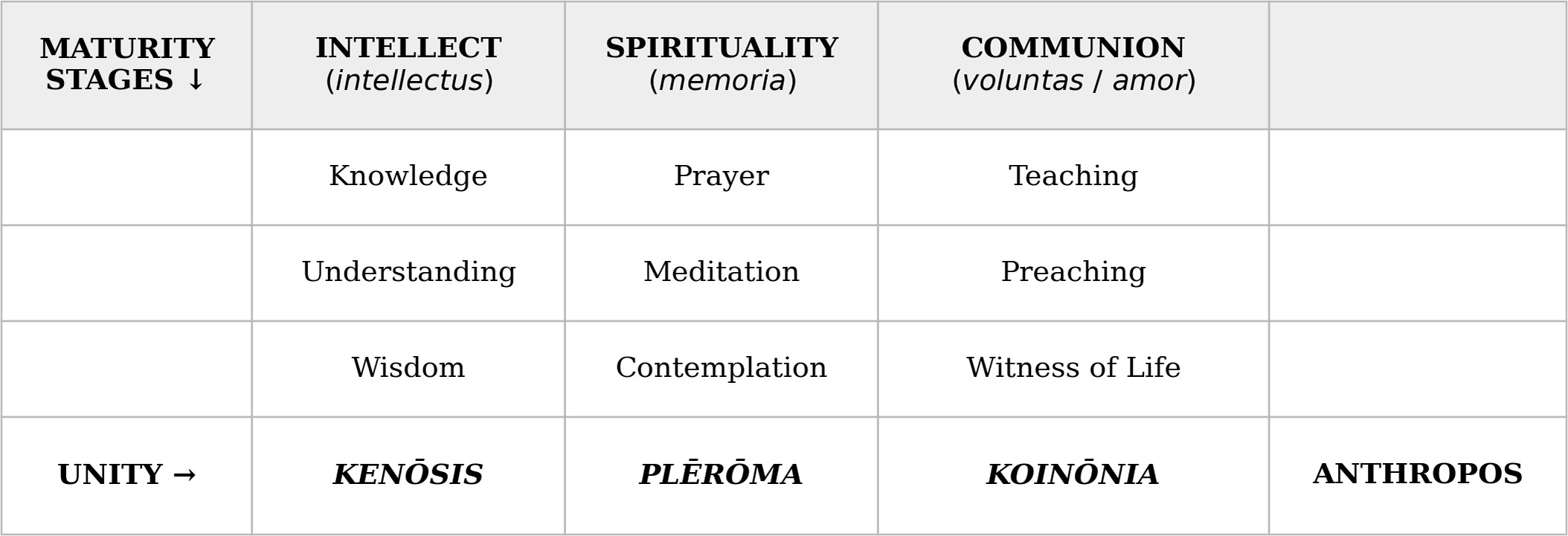
With those points, the framework can be presented (Figure 1):
Three dispositions (intellectus, memoria, voluntas/amor), two formative dynamics (maturity, unity) and their culmination in the Anthropos.

The central columns name the dispositions. The vertical arrow marks maturity within each; the horizontal arrow marks unity, their mutual integration rather than three parallel ladders. The bolded row names their integrated telos; at the right, both dynamics converge in the Anthropos. The dispositions are developed first, then the dynamics and their culmination.
Three Dispositions
Intellect: Knowledge, Understanding, Wisdom
By intellect (intellectus), I mean the love of Truth that sustains curiosity about the Word of God, not primarily academic production. To accept the name ‘disciple’ is to commit to learning, because one cannot honor Christ, serve God’s people, or grow in unity with God without coming to know him better.Footnote 41
The phases within this disposition can be named simply. Knowledge is what the catechumen and the early disciple acquire: the facts of salvation history, the contours of Scripture, the events of Christ’s life and the doctrines of the creeds. Understanding is what those facts come to mean as the disciple lives with them: the recognition of pattern, of theological coherence, of the disciple’s own calling within the larger story. Wisdom, in the biblical sense, is more than the accumulation of knowledge and understanding; it is the disposition formed by both, in which the disciple comes to know not only the truth about God but also the God who is Truth.
Crucially, this intellectual ascent is not an exercise in academic pride. In the Augustinian schema, the ultimate realization of wisdom is the recognition that the human creature is mere dust apart from the divine breath (Gen 2:7). The intellect, having sought God to the limit of its capacity, learns that the next motion is not further cognitive grasping but kenotic humility. The telos of intellect is therefore kenōsis : the self-emptying that true wisdom demands.Footnote 42 As Christ ‘did not regard equality with God as something to be exploited, but emptied himself, taking the form of a slave’ (Phil 2:6–7), so the mind, brought low by wisdom, crucifies its own pride so that it may no longer be the self that lives, but Christ who lives within (Gal 2:19–20). This is not the death of the mind but its proper ordering so that what fills it may be God.
Spirituality: Prayer, Meditation, Contemplation
As the intellect is emptied of pride, the soul’s interior capacity to hold the divine presence – what Augustine names memoria – matures. The phases are familiar from spiritual theology. Prayer receives and speaks the Church’s given forms. Meditation is the disciple’s practiced reflection on Christ and the mysteries of faith. Contemplation is receptive rather than productive: the action of grace drawing the disciple toward holiness.
The telos of spirituality is plērōma : the fullness of God indwelling the disciple, the indwelling of the Spirit brought to fulfillment and unity with God.Footnote 43 This perfectly mirrors the classic Augustinian battle between pride and grace: the human soul cannot be filled by God until it is completely emptied of self. Through kenōsis the disciple reaches plērōma: only when one empties oneself of self can the Spirit fill one completely. The intellect, properly formed, ends in self-emptying; the spirit, properly opened, ends in being filled. They are not separate paths for the academic and the mystic, but two sides of a single, integrated Augustinian movement of the soul.Footnote 44
Communion: Teaching, Preaching, Witness of Life
But interior filling cannot be the final word, for Jesus commands not only love of God with all one’s heart and mind and soul and strength but also love of neighbor as oneself. The third disposition names the form the soul’s love takes when ordered outward toward the neighbor, what Augustine, in his analogical project, locates in the soul’s voluntas/amor. It is the structural overflow of a life conformed to Truth and indwelt by the Spirit – the form their integration takes in relation to other persons.Footnote 45
The phases within this disposition build on the same architecture. Teaching is the first phase: the communication of what one knows, ordered by what one prays. It requires the integrity of knowledge and the discipline of prayer; without both, teaching becomes either rote or sentimental. Preaching here names the public articulation of faith by any baptized disciple; it includes ministry to a congregation but is not limited either to ordained ministry or to the homiletic moment. It requires more: a deep understanding of purpose and a meditative power such that the disciple’s words carry the weight of considered conviction. Witness of life is the phase in which teaching and preaching have become so integrated with one’s being that the life itself evangelizes – the living is already an instruction, the presence is already a proclamation.
The telos of communion is koinōnia : the participation, fellowship and communion that obtains among Christians and between Christians and God.Footnote 46 Communion is the active disposition that issues in shared life – the Church understood not as a structure into which disciples are conscripted but as the body into which disciples are gathered by the Spirit through Christ. The claim here concerns the order of the disciple’s formation, not the ontological priority of the Church: it is through Christ’s call that individuals are gathered into the Church, and it is by the indwelling Spirit that they are constituted as the Body of Christ.Footnote 47
Teaching, preaching and witness are therefore developmental expressions of communion, not substitutes for it. Koinōnia names their mature form: the shared life in which truth spoken and grace received become participation with God and neighbor. Pobee’s homo socialis corroborates this social reach while guarding differentiated personhood. Communion excludes coercion, manipulation and the reduction of the neighbor to a target of evangelization because the neighbor retains dignity, agency and a particular vocation within the body.
That distinction also prevents the framework from mistaking one cultural expression for maturity itself. Kwok’s polycentric account of Anglicanism shows why common prayer and theology must be embodied through distinct histories, languages and cultures. The same Christological telos may therefore correct isolated autonomy in one setting and coercive conformity in another. Neither nation, ethnicity, culture, nor Anglican boundary exhausts communion in Christ. The witness of a transformed life is an offer of shared life, not an imposition of sameness. The integrated triad – kenōsis + plērōma + koinōnia – names the integrated telos toward which the person is ordered.Footnote 48
Two Dynamics and the Anthropos
The three dispositions are only half of the framework. Their formation depends on two distinct dynamics by which the dispositions mature and integrate, and both dynamics culminate in a single endpoint: the formation of the disciple as a coherent, integrated human person – what the New Testament names, in its most pointed anthropological idiom, the Anthropos.Footnote 49 The first dynamic is maturity: within each disposition, the disciple moves through phases (knowledge → understanding → wisdom; prayer → meditation → contemplation; teaching → preaching → witness). This is the vertical dynamic in the framework chart – growth from the catechumen’s beginning through the saint’s integration. The second dynamic is unity: the three dispositions mutually inform and condition one another at every phase. Knowledge supports prayer; prayer deepens knowledge; both order one’s teaching. Wisdom presupposes contemplation, which presupposes the integrity of one’s witness. Growth in any one disposition draws the others along, and failure in one drags the others down. A wise person who does not pray is not yet wise; a contemplative who cannot teach has not yet contemplated; a witness whose life is unformed by Truth is not yet a witness.
Both dynamics converge on the Anthropos, which Paul names with notable precision. In Ephesians 4:13 he describes the goal of the church’s ministry as the attainment of ‘the unity of the faith and of the knowledge of the Son of God, to maturity, to the measure of the full stature [plērōma] of Christ’ – a single verse joining unity, maturity and plērōma as the structural elements of disciple-formation. Ephesians 4:24 names the disciple as the kainos anthrōpos, ‘created according to the likeness of God’; Colossians 3:10 names the same renewal ‘according to the image of its creator’; Colossians 1:28 expresses the pastoral aspiration to ‘present everyone mature [teleios] in Christ’; and 1 Corinthians 15:45–49 names Christ as the heavenly Anthropos in whose image the believer is being formed. The terms vary; the referent is one. The Anthropos is the disciple in whom the imago Dei, distorted by the Fall and healed in Christ, has come to its full maturation and integration.
Read in this light, the framework presents a single integrated argument. The bolded telos row – kenōsis, plērōma, koinōnia – is not three separate destinations but the integrated terminus of both dynamics: inseparable aspects of a single transformed human being, the product of a developmental process patient under the indwelling Spirit. This structure recovers something essential about Augustine’s own anthropology. His analysis of the imago Dei is not merely diagnostic but teleological: the image is renewed (renovatio imaginis) through participation in Christ, so that the homo interior is increasingly conformed to the perfect Anthropos who is Christ himself, the second Adam.Footnote 50 The framework offered here gives that Augustinian vision a pedagogically tractable form: three dispositions, two dynamics and one integrated Anthropos.
Implications for Formation
If the framework is approximately right, several implications follow. First, formation is developmental, not uniform. Disciples develop unevenly along both dynamics. A person may possess intellectual wisdom but remain at the initial prayer phase of spirituality or may exhibit deep contemplation alongside elementary teaching. Along the unity dynamic, the dispositions may be developed individually but not yet integrated into a single coherent self. The formation director’s task is to recognize where the disciple is along each dynamic and to attend to whichever movement – maturation or integration – requires the next pastoral step. At diocesan level, the map can guide the review of catechetical curricula, clergy formation and congregational support; within parishes, it can structure catechumenal reflection, spiritual direction and periodic communal discernment without reducing formation to a checklist.
Second, formation is ecclesial, not solitary. The disciple’s internal transformation must be tested, integrated and held accountable within corporate liturgical life, spiritual direction and pastoral counseling. No private formation, however earnest, can substitute for the corporate life in which the three dispositions are integrated under the indwelling Spirit. Nor can a culturally abstract instrument substitute for ecclesial discernment: following Chan, the map must be interpreted cooperatively by worshipping communities, pastors and theologians as lived faith is brought into conversation with the historic tradition. Third, formation is responsive, not coercive. Because communion is the natural overflow of an interior life filled by grace, treating mission or evangelization as a forced metric misforms the soul. Disciples are not conscripted into mission; they are formed such that mission is the air they breathe. Fourth, formation is ongoing. Short of the eschaton, the framework remains a frame for discernment, not a curriculum to complete. Even in the saints, the integrated telos of kenōsis, plērōma and koinōnia comes into view only in creaturely measure.Footnote 51
Anglican formation gives this framework a concrete ecclesial grammar. In the Episcopal Church’s Baptismal Covenant, the baptized commit themselves to the apostles’ teaching and fellowship, the breaking of bread and the prayers, resistance of evil and return to the Lord, proclamation of the Good News, service of Christ in all persons and the pursuit of justice and peace.Footnote 52 Other provincial rites articulate the same pattern differently. A Prayer Book for Australia, for example, calls the baptized and confirmed to study Scripture, participate in the Church and Holy Communion, pray regularly, share Christ’s reconciling hope by word and example, love and honor their neighbors and work for peace and justice, all in the strength of the Spirit.Footnote 53 These are not yet measures, but they identify observable practices from which locally appropriate indicators can be developed. The Lambeth Call similarly locates formation in the baptismal turn to Christ and in communities that learn together; the 2016 guide calls the whole people of God into Spirit-given ministry. The framework relates these practices developmentally: teaching and learning form intellect; prayer and sacrament cultivate spiritual receptivity; proclamation, service, justice and reconciliation enact communion. Repentance is the kenotic movement by which every disposition remains open to correction.
The Five Marks identify the public practices of that life: to tell, teach, tend, transform and treasure. The framework identifies the interior, ecclesial and developmental formation by which they become a rule of life rather than a list of tasks. Intellect makes proclamation and teaching answerable to Truth; spirituality prevents service and advocacy from becoming self-authorizing activity; communion orders all five Marks toward participation rather than institutional acquisition. Conversely, the Marks keep intellect and spirituality from closing in upon themselves by directing the disciple toward neighbor, society and creation. The relation is reciprocal: the documents articulate a baptismal, pneumatological, ecclesial and missional vision; the anthropology explains its integration in persons and communities under formation.
Vision36 makes the distinction among kinds of growth urgent. Orlando E. Costas argued that healthy church growth must be considered in numerical, organic, conceptual and incarnational dimensions: expansion in number, the development of communal structures, growth in understanding the faith and engagement in the life and suffering of the surrounding world.Footnote 54 Vision36’s numerical aim belongs within its wider call to wholehearted discipleship; numbers alone, however, cannot establish whether that discipleship is maturing. The present framework adds a specifically formational criterion: growth is authentically Christian insofar as persons and communities mature toward the integrated Anthropos through kenōsis, plērōma and koinōnia. Church planting without such formation risks reproducing the nominalism the Season of Intentional Discipleship was created to overcome. Formation without mission, however, withholds from the world the communion toward which formation tends. Vision36 requires multiplication ordered to maturity and maturity overflowing into mission.
Existing research confirms both the possibility and the difficulty of such assessment. Benson, Donahue and Erickson’s Faith Maturity Scale operationalizes an integrated faith through measurable dimensions, while NCLS Research evaluates congregational vitality through nine core qualities and attendance measures.Footnote 55 These approaches demonstrate that theological constructs can inform empirical instruments; they also show that measures embody prior definitions of maturity and require validation for the populations in which they are used.
The framework offered here is a normative theological construct, not yet a validated assessment instrument. Its task is to ground the theology and specify the architecture that later measures would test. Operationalizing it requires item construction, qualitative inquiry, psychometric testing and cross-provincial validation – a research program too large to execute responsibly within this constructive article. Two companion studies now in development take up the work deferred here: one examines the theological-psychological dynamics by which the dispositions become integrated or disordered; the other develops and tests measures of maturity and unity across ecclesial contexts. The present question is prior: what formation is ordered toward, and how do its elements belong together in the person?
Conclusion
The Anglican Communion’s decade-long turn toward intentional discipleship has now entered a consequential new phase. Lambeth called Anglicans to learn and learn again the way of Jesus through prayer, Word, sacrament and the Five Marks of Mission. Vision36 joins that call to an ambitious program of disciple-making and church planting. The constructive question arising from these commitments is what kind of human and ecclesial formation enables them to become a genuinely Jesus-shaped way of life.
On the Augustinian-anthropological account developed here, discipleship is the lived expression of the imago Dei, wounded by the Fall, healed by Christ and brought toward perfection by the indwelling Spirit. Extending Augustine’s analogical project yields three integrated dispositions – intellect, spirituality and communion – formed through the dynamics of maturity and unity and ordered toward the Anthropos. Their integrated telos, kenōsis, plērōma and koinōnia, names a disciple emptied of self, filled by God and gathered with others into a life that becomes a witness.
This framework does not supply grounding that the Communion’s texts lack. It organizes their baptismal, Eucharistic, pneumatological, ecclesial and missional commitments within one account of formation and thereby makes their theological coherence more visible. It also gives pastors, catechists, formation directors, diocesan leaders and theological educators a map for discernment: what is maturing, where integration remains incomplete and what formative work should come next. For Vision36, it offers a theological criterion for interpreting growth. A million communities constitute Christian growth only insofar as persons are being conformed to Christ and drawn into communion for the world. Numbers may report expansion; they cannot by themselves report discipleship.
Pastoral testing, ecumenical refinement and empirical validation across provincial contexts remain further tasks. Its principal claim is clear: the Communion’s future depends upon mature, integrated disciples. An Augustinian anthropology identifies both the person being formed and the divine life toward which formation tends.