1. Introduction
The Ordovician period was a remarkable time in Earth’s history owing to the climate change and great biodiversification, ending with the massive biotic extinction (Sheehan, Reference Sheehan2001; Algeo et al. Reference Algeo, Pedro, Marenco and Saltzman2016 and references therein). Late Ordovician sedimentary environments and marine ecosystems were strongly influenced by climatically driven eustatic changes, reported on the sea-level curve of Baltoscandia and North America (see Ross & Ross, Reference Ross, Ross, Webby and Laurie1992; Dronov & Holmer, Reference Dronov and Holmer1999; Harris et al. Reference Harris, Sheehan, Ainsaar, Hints, Männik, Nõlvak and Rubel2004; Nielsen, Reference Nielsen, Webby, Paris, Drosser and Persival2004; Dronov et al. Reference Dronov, Ainsaar, Kaljo, Meidla, Saadre, Einasto, Gutiérrez-Marco, Rábano and Garcia-Bellido2011). A profound environmental change related to a shift from an icehouse to greenhouse climate through the Ordovician/Silurian (O/S) boundary is recognized worldwide (Page et al. Reference Page, Zalasiewicz, Williams, Popov, Williams, Haywood, Gregory and Schmidt2007; Munnecke et al. Reference Munnecke, Calner, Harper and Servais2010; Melchin et al. Reference Melchin, Mitchell, Holmden and Štorch2013). The Late Ordovician eustatic signature is even preserved in tectonically active settings, such as the Welsh Basin on the northern margin of Avalonia (James, Reference James2013) or the Trenton Shelf and Lexington Platform on the southeastern margin of Laurentia (Brett et al. Reference Brett, Mclaughlin, Cornell and Baird2004).
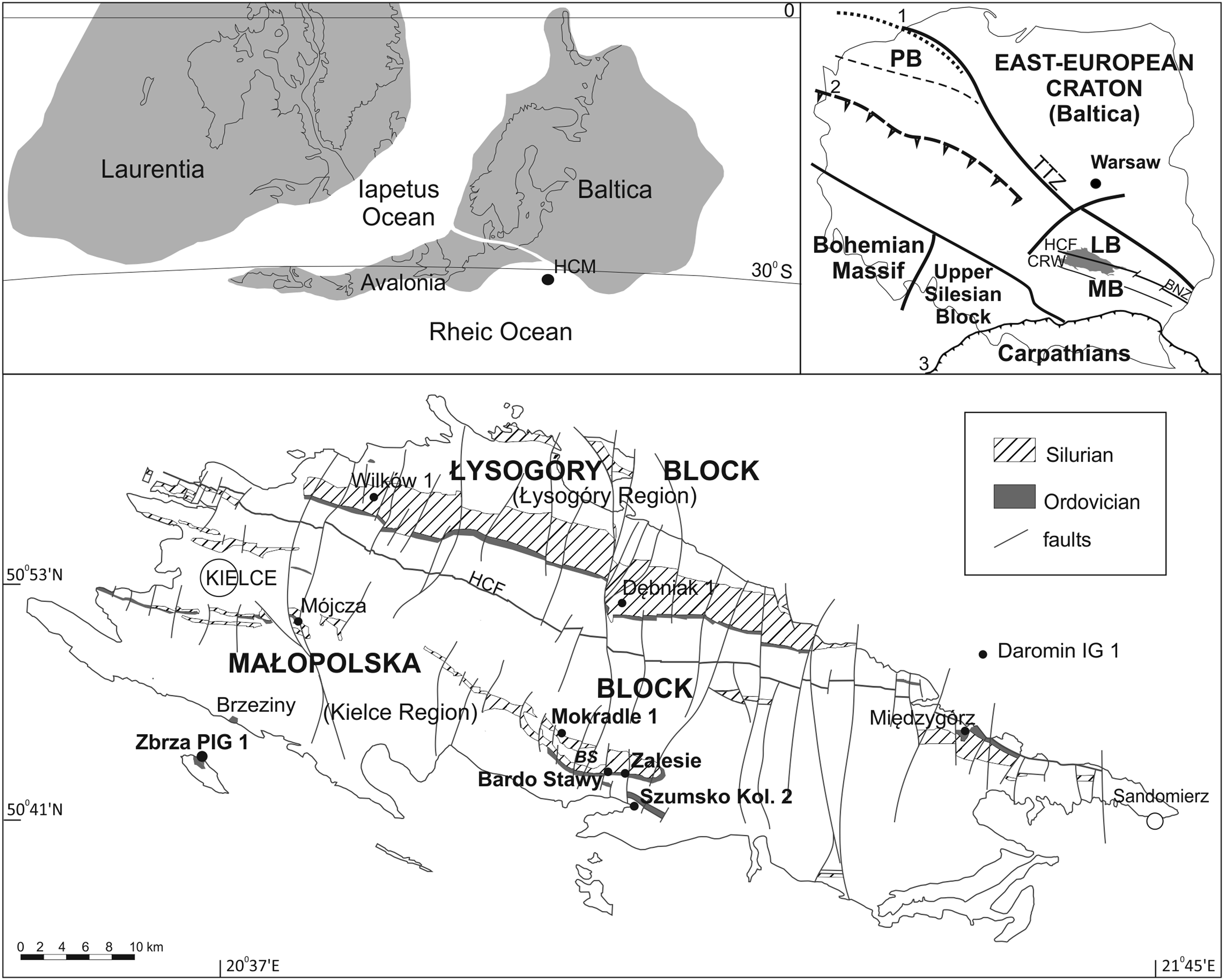
This paper provides insight into the Late Ordovician to earliest Silurian evolution of sedimentary environments along the southern margin of the Holy Cross Mountains (HCM) in SE Poland (Fig. 1) and their relation to global sea-level changes and local tectonic activity. During the considered time span, this area was a part of the SW periphery of Baltica (see Section 3), and was located southeastward of the collision zone with Avalonia (Fig. 1). Thus, the tectonic instability in the basement of the HCM and global eustatic changes appear to interplay with the temporal and spatial distribution of sedimentary facies in this area.
Location of studied outcrops and drilling cores in the Holy Cross Mountains (palaeogeography after Cocks & Torsvik, Reference Cocks and Torsvik2005). LB – Łysogóry Block; MB – Małopolska Block; PB – Pomorze Block; BS – the Bardo Syncline; HCF – Holy Cross Fault; CRW – Chmielnik–Ryszkowa Wola Fault Zone; TTZ Teisseyre–Tornquist Tectonic Zone; BNZ – Biłgoraj–Narol Zone; 1 – Caledonian front; 2 – Variscan front; 3 – Alpine front.

Previous studies of the Upper Ordovician and lower Silurian sedimentary succession in the southern HCM concentrated chiefly on stratigraphic aspects (Kielan, Reference Kielan1959; Tomczyk, Reference Tomczyk1962; Tomczyk & Turnau-Morawska, Reference Tomczyk and Turnau-Morawska1964; Temple, Reference Temple1965; Deczkowski & Tomczyk, Reference Deczkowski and Tomczyk1969; Bednarczyk, Reference Bednarczyk1971, Reference Bednarczyk and Źakowa1981; Dzik et al. Reference Dzik, Olempska and Pisera1994; Masiak et al. Reference Masiak, Podhalańska and Stempień-Sałek2003) and to a lesser extent on sedimentary and environmental conditions (Dzik et al. Reference Dzik, Olempska and Pisera1994; Trela, Reference Trela2005; Kremer & Kaźmierczak, Reference Kremer and Kaźmierczak2005; Trela & Szczepanik, Reference Trela and Szczepanik2009). Basic data on the redox conditions during latest Ordovician to earliest Silurian time in the southern HCM have been discussed by Bauersachs et al. (Reference Bauersachs, Kremer, Schouten and Sinninghe Damsté2009), Mustafa et al. (Reference Mustafa, Sephton, Watson, Spathopoulos and Krzywiec2015) and Smolarek et al. (Reference Smolarek, Marynowski, Trela, Kujawski and Simoneit2017). However, there is no complete analysis of the Upper Ordovician and lowest Silurian facies architecture in the studied area and its relation to local tectonic activity and global eustatic events.
2. Materials and methods
Results presented in this paper include the sedimentological studies conducted on three boreholes (the Zbrza PIG 1, Szumsko Kolonia 2, Mokradle 1) and outcrops (Zbrza, Zalesie and Bardo Stawy) situated along the southern margin of the HCM (Fig. 1). They provide a continuous sedimentary succession of the Upper Ordovician and lowermost Silurian (Rhuddanian) in the HCM. As this region is highly faulted, special attention was paid to the recognition of tectonic contacts between individual units.
The cored wells and outcrops were described at the centimetre scale for the lithologic and sedimentological features. The observations concentrated chiefly on grain size, rock colour, sedimentary structures, degree of bioturbation and reaction with HCl. They were supplemented by the examination of selected samples (50 thin-sections) using standard microscopic techniques to recognize petrographic and diagenetic features, and the microfabric of the studied rocks. On the basis of these studies, eight lithofacies have been distinguished in the studied area (see Section 4).
3. Geological background
3.a. Geological setting and palaeogeography
The HCM area consists of two regions (traditionally called the Kielce and Łysogóry regions) that are parts of two large tectonic units of SE Poland, that is, the Małopolska and Łysogóry blocks separated by the Holy Cross Fault (Fig. 1; Dadlez et al. Reference Dadlez, Kowalczewski and Znosko1994). Żelaźniewicz et al. (Reference Żelaźniewicz, Aleksandrowski, Buła, Karnkowski, Konon, Oszczypko, Ślączka, Żaba and Żytko2011) termed these two regions the Łysogóry Fold Belt in the north and the Kielce Fold Belt in the south, the latter separated from the Małopolska Block by the Chmielnik–Ryszkowa Wola Fault Zone (Fig. 1). Dadlez et al. (Reference Dadlez, Kowalczewski and Znosko1994) considered the Łysogóry Block to be a part of the passive margin of Baltica, while the Małopolska Block was a proximal terrane detached from this palaeocontinent and accreted to it again. According to Belka et al. (Reference Belka, Valverde-Vaquero, Dörr, Ahrendt, Wemmer, Franke, Schäfer, Winchester, Pharaoh and Verniers2002 and references therein), both of these tectonic units have a peri-Gondwanan provenance and were transported to the margin of Baltica between Ediacaran and Cambrian time. The latest geophysical data indicate that the Łysogóry Block has a cratonic crust similar to the neighbouring East European Platform and therefore is considered to be a proximal terrane of Baltica (Narkiewicz & Petecki, Reference Narkiewicz and Petecki2017 and references therein). Moreover, based on deep seismic sounding, Malinowski et al. (Reference Malinowski, Żelaźniewicz, Grad, Guterch and Janik2005) postulated a similarity between the crustal structure of the Małopolska Block and the East European Platform. However, in light of recently interpreted geophysical data, the Małopolska Block has been assumed to be an exotic terrane derived from the peri-Gondwanan Cadomian belt (see Narkiewicz & Petecki, Reference Narkiewicz and Petecki2017 and references therein). This is supported by the presence of detrital zircons with 0.7–0.53 Ga ages in the Cambrian succession of the HCM, which according to Żelaźniewicz et al. (Reference Żelaźniewicz, Oberc-Dziedzic and Slama2020) indicate that in early Cambrian time this area (both the Kielce and Łysogóry units) received detrital clastic material from the peri-Gondwanan fragments of the Cadomian orogen. The docking time of the Małopolska Block with Baltica is a matter of years-long discussions that consider its tectonic transport during (1) late Ediacaran to Cambrian time, (2) late Silurian to earliest Devonian time or (3) late Carboniferous time (Lewandowski, Reference Lewandowski1993; Dadlez et al. Reference Dadlez, Kowalczewski and Znosko1994; Belka et al. Reference Belka, Valverde-Vaquero, Dörr, Ahrendt, Wemmer, Franke, Schäfer, Winchester, Pharaoh and Verniers2002; Nawrocki et al. Reference Nawrocki, Dunlap, Pecskay, Krzemiński, Żylińska, Fanning, Kozłowski, Salwa, Szczepanik and Trela2007; Narkiewicz & Petecki, Reference Narkiewicz and Petecki2017 and references therein). Żelaźniewicz et al. (Reference Żelaźniewicz, Oberc-Dziedzic and Slama2020) postulated that the Cambrian succession of the HCM was deposited in a narrow, fault-controlled and fast-subsiding shallow shelf basin developed over the thinned Baltica margin, located between the Małopolska Block and the East European Platform. It is noteworthy that palaeomagnetic data from the southern HCM (the Kielce Region) clearly indicate that the Małopolska Block was situated close to Baltica before Middle Ordovician time (Schätz et al. Reference Schätz, Zwing, Tait, Belka, Soffel and Bachtadse2006). Furthermore, its close palaeogeographic connection with Baltica in early Palaeozoic time is assumed by Cocks (Reference Cocks, Winchester, Pharaoh and Verniers2002) on the basis of palaeontological data. However, it is noteworthy that the Middle and Upper Ordovician conodont, ostracod and mollusc assemblages from the HCM contain specimens with Gondwanan affinities (Dzik et al. Reference Dzik, Olempska and Pisera1994; Dzik, Reference Dzik2020). Therefore, Dzik (Reference Dzik2020) concluded that the Małopolska Block was isolated in Middle Ordovician time from Baltica and separated from it by the relatively wide Tornquist Sea. This discrepancy with the palaeomagnetic data of Schätz et al. (Reference Schätz, Zwing, Tait, Belka, Soffel and Bachtadse2006) may be explained by considering the Middle to Late Ordovician oceanic circulation in the southern hemisphere (see Pohl et al. Reference Pohl, Nardin, Vandenbroucke and Donnadieu2016) that might have contributed to the migration of Gondwanan fauna to the HCM area. Furthermore, it should be remembered that in early Late Ordovician time, the Tornquist Sea was relatively narrow owing to the migration of Avalonia toward Baltica (Cocks & Torsvik, Reference Cocks and Torsvik2005). Taking into account the palaeomagnetic, deep seismic sounding and palaeontological data, it can be assumed that in Late Ordovician time the Małopolska Block was located on the SW periphery of Baltica, but was separated from this palaeocontinent by a relatively deep but narrow shelf basin (preserved in the Łysogóry Block and its eastern continuation in the Biłgoraj–Narol zone; Fig. 1).
3.b. Regional stratigraphy
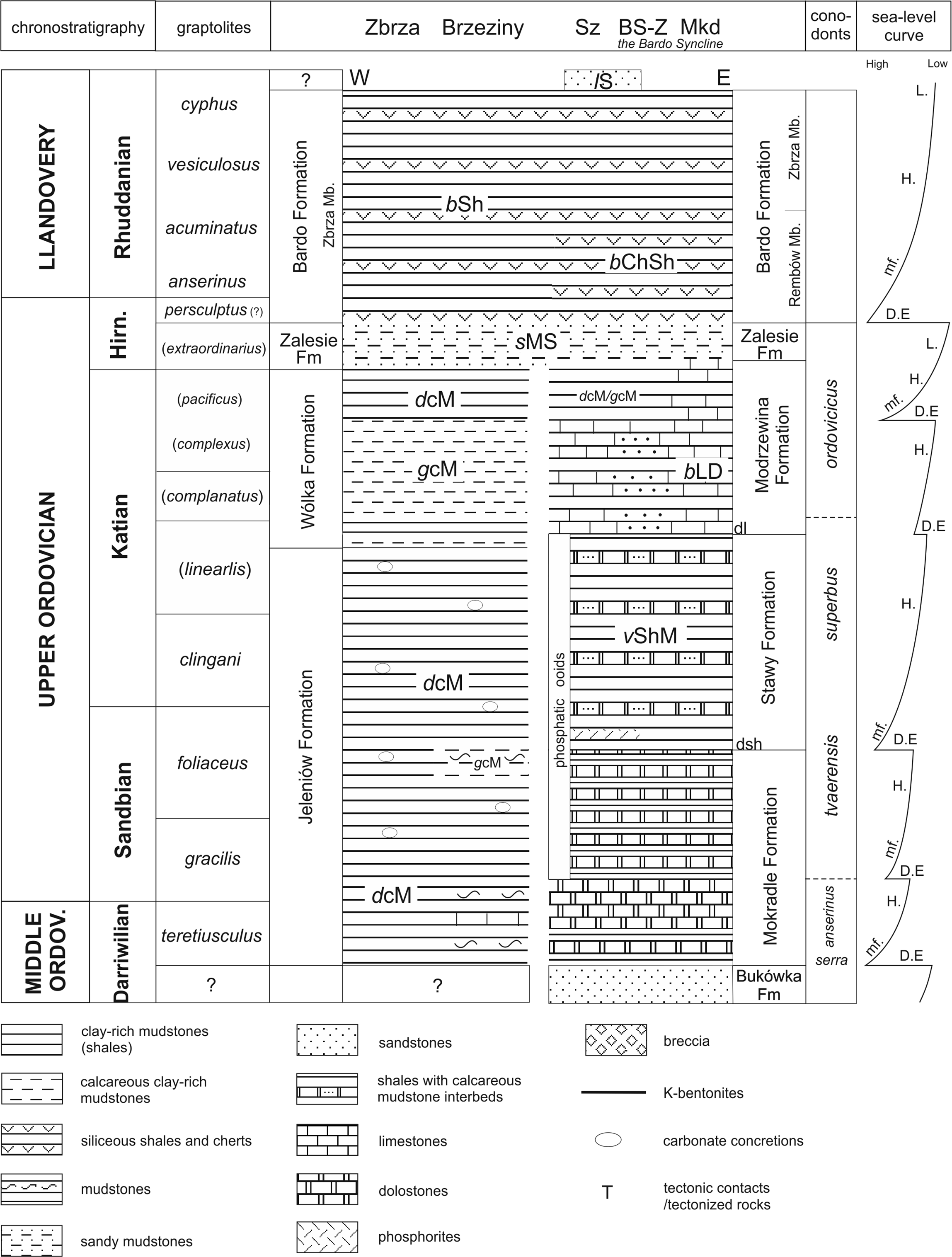
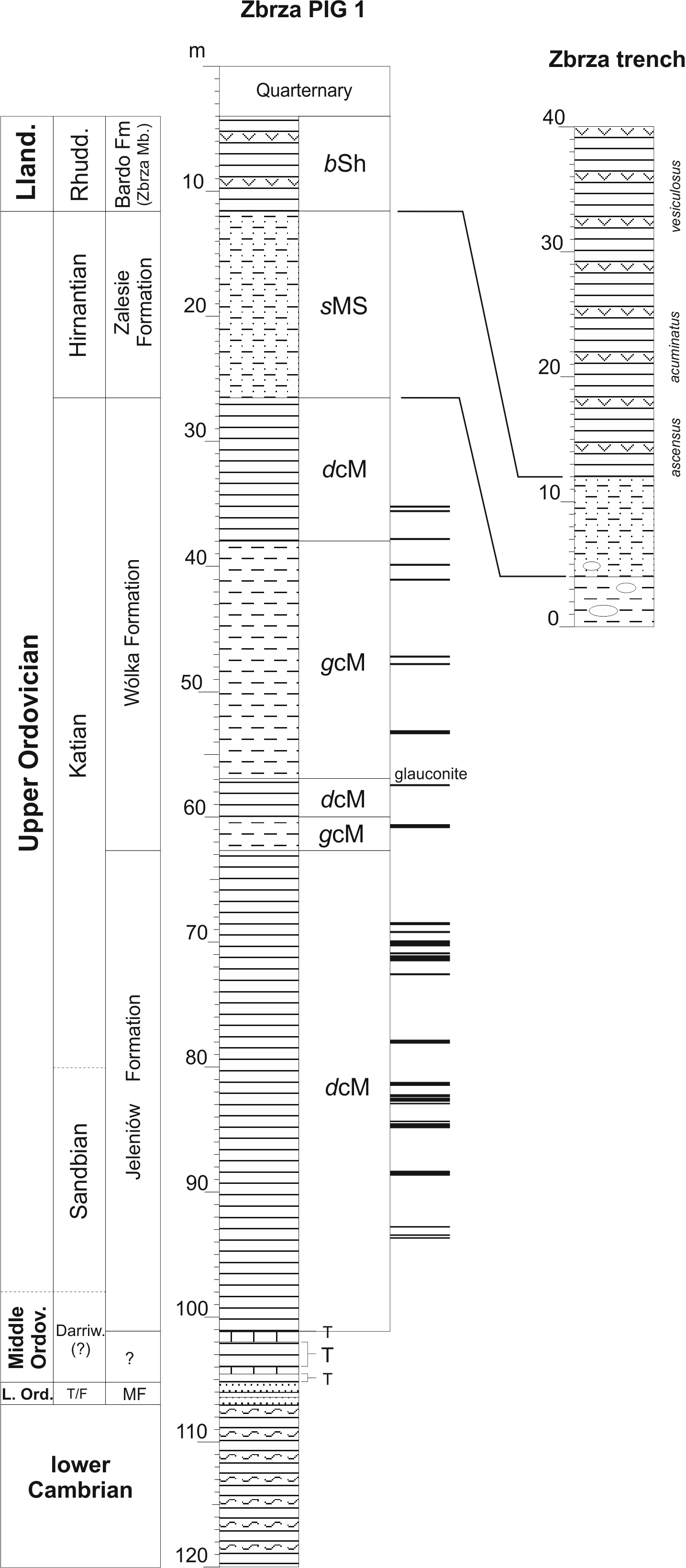
The Upper Ordovician sedimentary record in the southern HCM shows a conspicuous lithofacies change manifested by the predominance of mudrocks in the SW (Zbrza) part of this area that grade north- and eastward into carbonates (Mójcza) and mixed carbonates/shales (the Bardo syncline and Szumsko), respectively (Fig. 2). The Upper Ordovician mudrocks in Zbrza form an up to 100 m thick succession, which is underlain by the Middle Ordovician carbonates and shales resting on the upper Tremadocian glauconitic sandstones (Deczkowski & Tomczyk, Reference Deczkowski and Tomczyk1969). However, the Upper/Middle/Lower Ordovician boundaries in the studied Zbrza PIG 1 well are obscured by a local tectonic episode that is responsible for a significant reduction of the Middle Ordovician part of the section. In the northward located Brzeziny area, the Upper Ordovician mudrocks rest on the uppermost Darriwilian mixed shale/carbonate/mudstone unit yielding graptolites of the teretiusculus Biozone (Tomczyk & Turnau-Morawska, Reference Tomczyk and Turnau-Morawska1964). The Sandbian (or even the uppermost Darriwilian) to lower Katian part of the mudrock succession is made up of dark grey claystones and clay-rich mudstones of the Jeleniów Formation (Figs 2, 3) dated by graptolites of the gracilis, multidens (= foliaceus) and clingani biozones (Deczkowski & Tomczyk, Reference Deczkowski and Tomczyk1969). The overlying Wólka Formation consists of middle to upper Katian calcareous clay-rich mudstones and marls (Figs 2, 3), which in the type area (the northern HCM) yielded the trilobites Eodindymene pulchra and Staurocephalus clavifrons (Kielan, Reference Kielan1959).
Stratigraphic and lithofacies scheme for the Upper Ordovician and Rhuddanian, and sea-level curve in the southern Holy Cross Mountains. Graptolite biozones after Tomczyk & Turnau-Morawska (Reference Tomczyk and Turnau-Morawska1964), Deczkowski & Tomczyk (Reference Deczkowski and Tomczyk1969), Bednarczyk & Tomczyk (Reference Bednarczyk, Tomczyk and Źakowa1981) and Masiak et al. (Reference Masiak, Podhalańska and Stempień-Sałek2003); the graptolite biozones not documented in the studied area are in brackets. Conodont biozones after Dzik et al. (Reference Dzik, Olempska and Pisera1994) and Dzik (Reference Dzik, Dzik, Linnemann and Heuse1999, Reference Dzik2020). Sz – Szumsko; BS-Z – Bardo Stawy–Zalesie; Mkd – Mokradle. Lithofacies: dcM – dark clay-rich mudstones; gcM – greenish-grey clay-rich mudstones and marls; sMS – sand-rich mudstones; vShM – grey to variegated shales and mudstones; bLD – bioclastic limestones and dolostones; bChSh – black radiolarian cherts; bSh – black siliceous shales; lS – laminated sandstones. D.E – drowning event; mf. – maximum flooding zone; H. – highstand interval; L. – lowstand interval; dsh – dark shales; dl – dark limestones.

Stratigraphy and facies of the Upper Ordovician and Rhuddanian sedimentary succession in the Zbrza area. T/F – Tremadocian/Floian; MF – Międzygórz Formation. Key as in Figure 2.

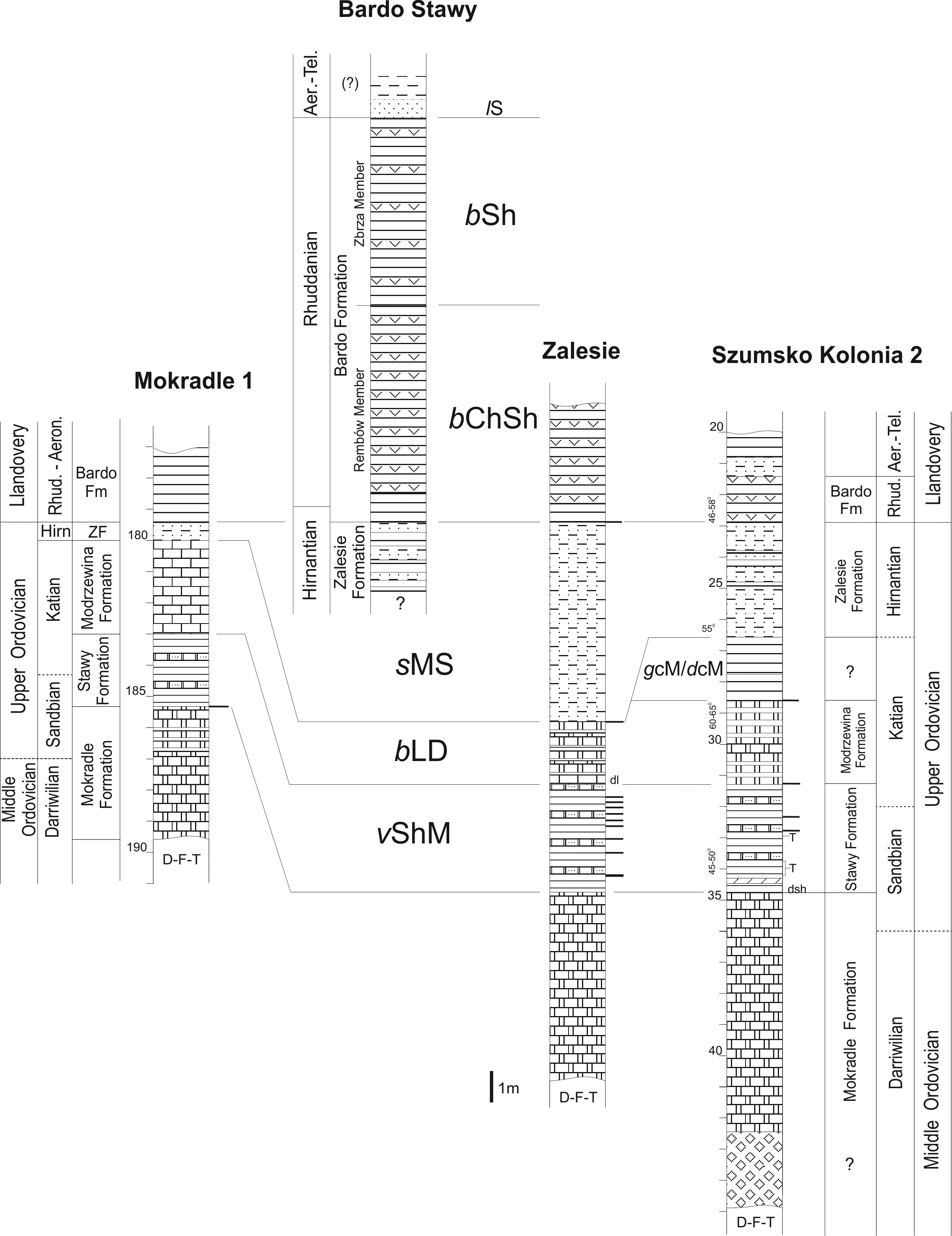
The Upper Ordovician succession located northward of Zbrza is represented by condensed limestones of the Mójcza Formation (Fig. 2), up to 10 m thick (Trela, Reference Trela2006). They were deposited on the submarine swell (the Mójcza carbonate platform) adjacent to the deep-water Zbrza basin (Trela, Reference Trela2005). In the Bardo syncline, the Upper Ordovician is made up of a mixed carbonate/shale succession, up to 15 m thick (Figs 2, 4). The transition from the Middle to Upper Ordovician is within dolostones of the Mokradle Formation (Trela, Reference Trela2006) dated by conodonts of the serra to tvaerensis biozones (Dzik, Reference Dzik, Dzik, Linnemann and Heuse1999). They are overlain by the upper Sandbian to lower Katian Stawy Formation (Trela, Reference Trela2006), represented by grey to green/red shales with thin intercalations of calcareous mudstones and dolostones (Figs 2, 4). The middle/upper Katian stratigraphic interval is made up of the Modrzewina Formation (Figs 2, 4), which is an up to 3 m thick carbonate unit (Trela, Reference Trela2006). Its base is within the conodont superbus Biozone (Dzik, Reference Dzik, Dzik, Linnemann and Heuse1999), while the upper part appears to extend into the lowermost Hirnantian, as is evidenced by Eostropheodonta hirnantensis brachiopod specimens (Bednarczyk, Reference Bednarczyk1971).
Stratigraphic distribution and correlation of the Upper Ordovician and Rhuddanian sedimentary facies in the Zalesie–Szumsko area. Rhud. – Rhuddanian; Aer.-Tel. – Aeronian–Telychian; D – Dappingian; F – Floian; T – Tremadocian, persc – persculptus. Key as in Figure 2.

The uppermost Ordovician along the entire southern HCM (Zbrza, Bardo Stawy, Zalesie and Szumsko) is represented by the Zalesie Formation (Fig. 2) composed of calcareous mudstones, sandy mudstones and sandstones intercalated with shales (Trela, Reference Trela2006). The base of this unit is dated by Mucronaspis trilobites (Kielan, Reference Kielan1959) and brachiopods of the Hirnantia Fauna (Temple, Reference Temple1965). Moreover, the mudstones of the Zalesie Formation yielded an Upper Ordovician acritarch assemblage mixed with Cambrian and Lower Ordovician taxa, accompanied by a Frankea specimen that is indicative of the Middle Ordovician of peri-Gondwana (Trela & Szczepanik, Reference Trela and Szczepanik2009).
There is stratigraphic continuity across the O/S boundary in the southern HCM (Bednarczyk & Tomczyk, Reference Bednarczyk, Tomczyk and Źakowa1981; Masiak et al. Reference Masiak, Podhalańska and Stempień-Sałek2003; Trela, Reference Trela2006; Podhalańska & Trela, Reference Podhalańska and Trela2007), in contrast to the north- and eastward located sites (Mójcza and Międzygórz) that feature a huge stratigraphic gap including the uppermost Ordovician up to the middle Wenlock (Tomczyk, Reference Tomczyk1954; Tomczykowa & Tomczyk, Reference Tomczykowa, Tomczyk and Źakowa1981). The lower Silurian rocks in the studied outcrops and boreholes are represented by the Rhuddanian black bedded cherts and siliceous shales of the Bardo Formation (Trela & Salwa, Reference Trela and Salwa2007; Fig. 2). They form a 12 to 28 m thick succession dated by graptolites of the ?persculptus to cyphus biozones (Bednarczyk & Tomczyk, Reference Bednarczyk, Tomczyk and Źakowa1981; Masiak et al. Reference Masiak, Podhalańska and Stempień-Sałek2003). Bedded cherts crop out in Bardo Stawy and Zalesie where, together with the basal dark and brown laminated shales (˜80 cm), they form the Rembów Member (Figs 2, 4), which is within the persculptus to acuminatus graptolite biozones (Masiak et al. Reference Masiak, Podhalańska and Stempień-Sałek2003). The siliceous shales are referred to as the Zbrza Member, and in Bardo Stawy they are within the vesiculosus–cyphus graptolite biozones, while in Zbrza they encompass the entire Rhuddanian stage (Trela & Salwa, Reference Trela and Salwa2007) up to the triangulatus Biozone of the lower Aeronian (Tomczykowa & Tomczyk, Reference Tomczykowa, Tomczyk and Źakowa1981).
4. Lithofacies: description, spatial distribution and stratigraphic framework
4.a. Sandbian and Katian lithofacies in the Zbrza area
The Sandbian and Katian sedimentary record in the Zbrza area is made up of a 74 m thick mudrock succession, which has been divided into two lithofacies, that is (1) dark clay-rich mudstones, and (2) greenish-grey clay-rich mudstones and marls (Figs 2, 3).
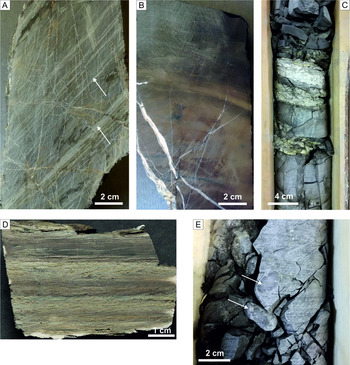
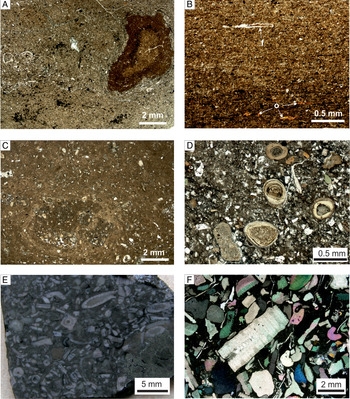
Dark clay-rich mudstones. This lithofacies comprises dark grey, macroscopically homogeneous claystones and clayey mudstones; however, discrete sub-millimetre lamination is preserved in some horizons. Locally, very thin siltstone laminae occur in this facies, largely in its lowermost part (Fig. 5a). The non-laminated intervals reveal a bioturbational mottling (Fig. 5b), which is mostly confined to the sub-millimetre scale. Thin K-bentonites (0.5–8 cm) form conspicuous intercalations (Fig. 5c) in this apparently monotonous lithofacies (Trela et al. Reference Trela, Bąk and Pańczyk2018). In some cases, volcanic ash was mixed with fine-grained sediment and therefore some mudstones are tuffaceous (Fig. 5d). Moreover, small carbonate and phosphate nodules occur in this lithofacies as oval concretions, up to 3 mm in diameter (Fig. 5e). At the microscale, the claystones/mudstones show the presence of pyrite, detrital quartz silt (rarely sand), fragmented calcitic skeletal material, organic matter particles and aggregates, rare mica flakes and single phosphate-iron oncoids (Fig. 6a). All these components float in a clay/muddy matrix revealing a flocculated microfabric, which locally is mixed with authigenic calcite and siliceous (cryptocrystalline silica to microquartz) cements. Pyrite is largely represented by framboids, which are less than 10 μm in diameter; however, numerous grains ranging between 2 and 6 μm occur as well. In some cases, the fine-grained framboids form larger lenses and irregular aggregates. The organic matter occurs as disseminated angular fragments, lamalginite-like structures and larger wispy organomineralic aggregates (Fig. 6b). The latter components are compacted, show diffuse outlines and contain clay-size material and pyrite. Locally, the coarser particles (quartz silt, carbonate skeletal material, pyrite and organic flakes) enhance the microlamination. Moreover, distinctive benthic agglutinated foraminifera tests are randomly distributed in the muddy matrix. They occur as compacted and flattened spheres, up to 600 μm in length and up to 60 μm thick, made up of micron-sized quartz grains (Fig. 6b). Dark clay-rich mudstones predominate in the Sandbian and lower Katian intervals of the Jeleniów Formation (˜45 m thick) and in the uppermost Katian part of the Wólka Formation (Fig. 3).
(a) The lower Sandbian dark grey mudstone of the Jeleniów Formation with thin siltstone laminae (arrows); Zbrza PIG 1 well. (b) Bioturbational mottling of calcareous clay-rich mudstone of the Jeleniów Formation; note also discrete bioturbation of the dark grey mudstone; Zbrza PIG 1 well. (c) K-bentonite beds in dark grey mudstone of the Jeleniów Formation; Zbrza PIG 1 well. (d) Katian tuffaceous mudstone; Zbrza PIG 1 well. (e) Carbonate/phosphate nodules (arrows) in Katian dark grey mudstone; Zbrza PIG 1 well.

(a) Photomicrograph of Sandbian clay-rich mudstone with scattered quartz silt, pyrite aggregates and skeletal remains; note phosphate-iron oncoid; Zbrza PIG 1 well, PPL. (b) Photomicrograph of Sandbian clay-rich mudstone with compacted agglutinated foraminifera test (f) and organomineralic particles (o); Zbrza PIG 1 well, PPL. (c) The Sandbian phosphorite with numerous phosphate ooids scattered in the pristine phosphatic sediment; the Stawy Formation in the Szumsko Kol. 2 well (depth 34.4 m), PPL. (d) The lower Katian calcareous mudstone with phosphate ooids of the Stawy Formation in the Szumsko Kolonia 2 well (depth 32.1 m), PPL. (e, f) The upper Katian/Hirnantian echinoderm-rich packstone; the Modrzewina Formation in the Mokradle 1 well (f, XPL).

Greenish-grey clay-rich mudstones and marls. The mudstones and marls of this lithofacies are largely massive; however, in places they show subtle bioturbational mottling responsible for the destruction of primary sedimentary features. In a few cases, distinctive trace fossils represented by small Chondrites are also preserved. Locally, greenish mudstones are intercalated with subordinate glauconite-rich and marly limestone thin beds. Additionally, tiny carbonate concretions, up to 2 cm in diameter, occur in some intervals. Common intercalations in this lithofacies are K-bentonites preserved as millimetre-thick laminae and thin beds. In addition, an increased amount of pyroclastic material is noted in tuffaceous mudstones. Greenish-grey clay-rich mudstones and marls are the dominant lithofacies in the middle to upper Katian Wólka Formation (Fig. 3).
4.b. Upper Sandbian and Katian lithofacies in the Bardo–Zalesie–Szumsko area
The upper Sandbian and Katian sedimentary record in the Bardo Syncline consists of an up to 10 m thick interval of mudrocks and carbonates, grouped into two distinctive lithofacies: (1) grey and variegated shales and mudstones, and (2) bioclastic limestones and dolostones.
Grey and variegated shales and mudstones. This lithofacies is largely made up of calcareous shales, up to 4 m thick, showing an upward colour change, from grey to greenish and red. In the Szumsko Kolonia 2 well, the base of this lithofacies is delineated by dark grey shales overlain by a thin phosphorite bed with numerous phosphate ooids and pyritized skeletal remnants (Figs 4, 6c). Grey and greenish shales are intercalated with thin beds of calcareous mudstones and silt-rich marls, while red shales are interbedded with K-bentonites reaching up to a few centimetres in thickness (Fig. 4). Mudstone and marl interbeds contain numerous phosphatic ooids, bioclasts (mostly echinoderm sclerites), subordinate glauconite grains as well as carbonate and mudstone clasts (Fig. 6d). These particles are randomly scattered in the muddy and marly matrix revealing various amounts of calcite and dolomite cements. Phosphatic ooids show various states of preservation, including oval forms with regular coatings to crushed and deformed particles. Grey and variegated shales and mudstones form the upper Sandbian/lower Katian Stawy Formation (Fig. 2), which rests on the Mokradle Formation intercalated in the upper part with thin shale beds (Figs 2, 4).
Bioclastic limestones and dolostones. This lithofacies consists of thin- to medium-bedded, greenish-grey limestones and dolostones, up to 3 m thick, intercalated with thin shale interbeds (Fig. 4). Limestones referred to as echinoderm floatstones and skeletal wackestones consist of crinoids, brachiopods, bryozoans and subordinate limestone clasts (Fig. 6e, f). In Zalesie and Szumsko, the limestones are dolomitized; however, a primary microfabric with patches of echinoderm and ostracod bioclasts is locally preserved. This lithofacies forms the middle/upper Katian Modrzewina Formation (Trela, Reference Trela2006), which in the Mokradle 1 well is predominantly limestones, while in Zalesie and Szumsko it is largely dolomitic (Fig. 4). In Zalesie, the base of this unit is delineated by a thin dark horizon consisting of a dark brown limestone bed and overlying black clay (Dzik, Reference Dzik, Dzik, Linnemann and Heuse1999).
4.c. Hirnantian sand-rich mudstone lithofacies
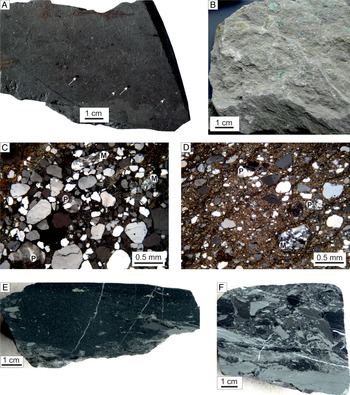
This lithofacies consists of grey to greenish sandy mudstones and sandstones intercalated with greenish-grey shales and calcareous mudstones, which form the Zalesie Formation, reported both in the northern and southern HCM (Trela, Reference Trela2006). Mudstone and sandstone beds are massive with scattered small pebbles and large quartz grains (Fig. 7a, b), and reveal either sharp non-erosive or gradual contacts with fine-grained rocks. Their frequency in the lithofacies varies significantly between the studied localities. In the Szumsko Kolonia 2 and Zbrza PIG 1 wells, sandy mudstones and sandstones are the predominant lithologies, reaching 3 and 15 m in thickness, respectively. In turn, in Bardo Stawy and Zalesie, they co-occur with shales and marls, and are predominant in the upper part of this lithofacies. The main component (up to 70 %) of the mudstones and sandstones is poorly sorted, subangular to rounded quartz grains ranging in diameter from 0.05 to 1.5 mm (subordinately even 2–3 mm), which are represented both by mono- and polycrystalline grains (Fig. 7c, d). The latter grains show features indicative of plutonic igneous and metamorphic rocks, such as straight and sutured boundaries between individual crystals characterized by various sizes and shapes. The monocrystalline quartz grains are predominantly nonundulatory; however, some of them reveal sweeping extinction. The proportion of quartz grains to muddy matrix varies within a single bed (or even thin-section) resulting in a complex microfabric changing from a mud-supported to a quartz grain-rich sandy framework. The subordinate detrital fraction includes glauconite grains, mica flakes, minor feldspars and microcrystalline cherts, accessory heavy minerals and tiny mudstone intraclasts. In petrographic terms, both the sandy mudstones and sandstones are referred to as texturally immature quartz (or mixed quartz-lithic) wackes.
(a, b) Hirnantian massive sandy mudstones with (a) scattered tiny claystone clasts and quartz grains (white arrows and dotted arrows, respectively), and (b) large glauconite-rich clasts; the Zalesie Formation in the Szumsko Kolonia 2 well. (c, d) Photomicrographs of (c) Hirnantian sandstone from Zbrza and (d) sandy mudstone from the Szumsko Kolonia 2 well consisting of badly sorted quartz grains; note polycrystalline quartz grains of magmatic (P) and metamorphic origin (M), XPL. (e, f) Hirnantian sandstone with (e) deformed and augen-shaped mudstone clasts and irregular clots, and (f) massive accumulation of distorted mudstone clasts and lumps with scattered large quartz grains; the Zalesie Formation in the Wilków 1 well of the northern HCM.

The sand-rich mudstones and poorly sorted sandstones of the Zalesie Formation were also recognized in the northern HCM (Trela, Reference Trela2006, Reference Trela and Trela2015). They occur in 3 to 6 m thick intervals as beds, pockets and lenses intercalating with calcareous mudstones and marls. Their framework consists of poorly sorted quartz grains with isolated large quartz (2–3 mm) of plutonic and metamorphic origin. A distinctive component of some sandstone beds is plastically deformed and augen-shaped mudstone clasts ranging from 0.5 to 4 cm in size, and irregular clastic clots (see Fig. 7e). Some beds exhibit soft sediment deformation highlighted by the accumulation of distorted mudstone/sandstone clasts within clotted sediment accompanied by augen clasts and rare large quartz grains (see Fig. 7f). All these features have been recognized in the Hirnantian diamictites deposited on the shelf of SW Baltica by icebergs derived from Gondwana that eroded the substrate sediment (Porębski et al. Reference Porębski, Anczkiewicz, Paszkowski, Skompski, Kędzior, Mazur, Szczepański, Buniak and Mikołajewski2019).
4.d. Rhuddanian lithofacies along the southern margin of the HCM
The southern margin of the HCM provides insight into the O/S boundary and Rhuddanian sedimentary record that can be grouped into three lithofacies types, that is (1) black radiolarian cherts, (2) black siliceous shales, and (3) laminated sandstones.
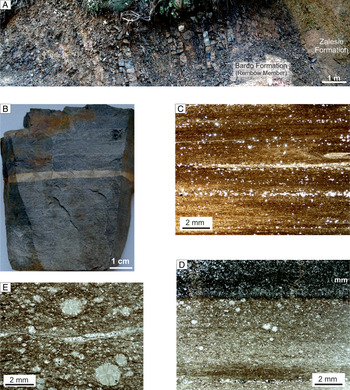
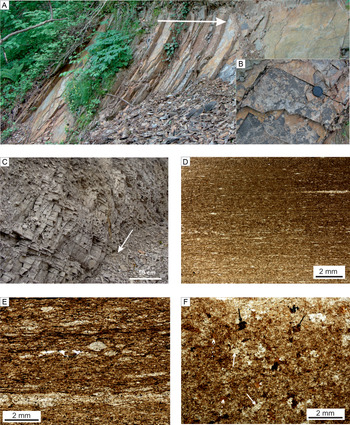
Black radiolarian cherts. This lithofacies occurs as thin-bedded cherts (Fig. 8a, b) intercalated with dark siliceous shales, which form the up to 6 m thick Rembów Member within the lower part of the Rhuddanian Bardo Formation (Figs 2, 4). Its base is made up of laminated shales (˜80 cm thick) consisting of mixed organic matter and siliceous cement, accompanied by organomineral and pyrite aggregates, mica flakes, quartz silt and scattered acritarch and chitinozoan specimens (Figs 4, 8c). At the microscale, the shale lamination is enhanced by single-grain quartz laminae, as well as lances and distorted laminae of partially devitrified volcanic ash (Fig. 8c). Chert beds are black and reveal more or less regular, sub-millimetric horizontal lamination. They are referred to as a mixture of cryptocrystalline quartz, organic matter, numerous radiolarian ghosts filled by the microcrystalline chalcedony or microquartz (Fig. 8d, e) and pyrite grains (framboidal and euhedral), accompanied by rare chitinozoans and scolecodonts (Kremer, Reference Kremer2005). The organic matter within the chert beds occurs as tiny fibres, amorphous aggregates and clusters of very small globular bodies (1.5–3.5 μm in diameter) interpreted as degraded coccoid cyanobacteria of benthic microbial mats (Kremer & Kaźmierczak, Reference Kremer and Kaźmierczak2005). Distinctive features of the chert beds are white massive laminae (up to 10 cm long) and lenses (up to 0.8 mm thick) (Fig. 8b). They consist of microcrystalline chalcedony, organic matter, degraded acanthomorphic acritarchs, graptolites, chitinozoans, radiolarians and phosphate sediment (Kremer, Reference Kremer2005).
(a) The Ordovician/Silurian boundary in Bardo Stawy showing a continuous but rapid transition from Hirnantian mudstones of the Zalesie Formation to Rhuddanian black radiolarian cherts of the Bardo Formation (the Rembów Member). (b) Rhuddanian black radiolarian chert bed with white lamina; the Rembów Member in Bardo Stawy. (c) Photomicrograph of organic-rich shales with devitrified lamina (arrow), and quartz grains scattered in the muddy background and forming discrete lamina; the lowermost Bardo Formation (the basal laminated shales) in Bardo Stawy. (d, e) Photomicrographs of Rhuddanian black chert from Bardo Stawy showing radiolarian tests filled by chalcedonic and microcrystalline quartz (e); note degraded organic-rich microbial mat (mm) at the top of (d) and detrital quartz grains in the lower part. XPL.

Black siliceous shales are the predominant lithofacies of the Zbrza Member ranging in thickness from 6 to 28 m. They are discretely laminated on a sub-millimetric scale and in some cases divided into 1–3 mm thick slates (Fig. 9a, b, c). At the microscale, rare diminutive burrowings occur within a single lamina. The siliceous shales are described as a mixture of organic matter, clay minerals and cryptocrystalline silica cement with dispersed tiny mica flakes, framboidal to euhedral pyrite no more than 15 μm in diameter, and rare fine-grained quartz silt. The organic matter is mostly degraded, although fibre-like laminae of various lengths (Fig. 9d, e) and subglobular structures are also preserved; the latter are similar to remnants of benthic coccoid cyanobacteria (see Kremer & Kaźmierczak, Reference Kremer and Kaźmierczak2005). The pyrite grains form both aggregates and discontinuous microlaminae, usually occurring together with the organic matter. The shales reveal numerous laminae and lenses of devitrified volcanic ash, which emphasize a lenticular-laminated microfabric (Fig. 9d). In Bardo Stawy, the tephra laminae are partially bioturbated, and in places they are preserved as irregular concentrations on the bedding planes (Fig. 9b). Some small pyroclastic lenses appear to be eroded and transported clasts (Fig. 9e, f; cf. Schieber et al. Reference Schieber, Southard and Schimmelmann2010), while discontinuous laminae and longer lenses can be interpreted as compacted tephra ripples (Fig. 9d). The stratigraphic position of this lithofacies is diachronic between Zbrza and Bardo Stawy, that is, in the first locality it covers the entire Rhuddanian, while in the latter it is limited to the upper part of this stage (Podhalańska & Trela, Reference Podhalańska and Trela2007; Trela & Salwa, Reference Trela and Salwa2007).
(a–c) Rhuddanian siliceous shales in (a, b) Bardo Stawy and (c) Zbrza; note bioturbated K-bentonite lamina in (b); arrows indicate the bottom of sections; diameter of camera lens cap = 7 cm (d, e) Photomicrographs of Rhuddanian siliceous shales from Zbrza showing lenses of devitrified volcanic ash; note also thin tuffitic lamina at the base of (e); PPL. (f) Photomicrograph of bedding-parallel thin-section through siliceous shales illustrated in (e); note volcanic ash clasts (white arrows), fragments of graptolites (black arrows) and organomineralic aggregates (white dotted arrows); PPL.

Laminated sandstones. The top boundary of the Bardo Formation in Bardo Stawy is delineated by a thin sandstone unit manifesting a significant sedimentary change in the southern HCM. It is thin bedded, horizontally laminated and displays overall sharp boundaries (Fig. 4). The basal part of this lithofacies is delineated by a thin tuffaceous sandstone bed with tiny black shale clasts. In petrographic terms, these sandstones are referred to as texturally mature and moderately sorted subarkosic arenites consisting of rounded to sub-rounded quartz grains accompanied by feldspar, muscovite and accessory glauconite grains (Kozłowski et al. Reference Kozłowski, Domańska-Siuda and Nawrocki2014). Quartz grains are represented both by monocrystalline and polycrystalline forms.
5. Evolution of the sedimentary environments
5.a. Late Ordovician (Sandbian–Hirnantian)
The temporal and spatial distribution of the Upper Ordovician lithofacies in the southern HCM indicates that since latest Darriwilian time the Zbrza area was a part of a relatively deep marine basin (Fig. 10), which to the north was adjacent to an uplifted submarine area (the Mójcza carbonate platform/swell). The Zbrza basin was produced in response to block faulting in the basement responsible for the differentiation of basin bathymetry and facies layout. An increase in tectonic subsidence combined with the latest Darriwilian sea-level rise produced an accommodation space for the deposition of dark grey clay-rich mudstones of the Jeleniów Formation. The beginning of their deposition and maximum drowning (Fig. 2) can be roughly referred to the Baltoscandian Furudal highstand (see Nielsen, Reference Nielsen, Webby, Paris, Drosser and Persival2004). There are no clear sedimentary features of bottom current activity in this lithofacies; therefore, it seems that its deposition took place largely through suspension fall out. This is supported by the scattered distribution of fine quartz silt and organomineralic aggregates in the muddy background, suggesting increased pulses of suspension settlement of discrete particles. However, the presence of subordinate quartz silt microlaminae allows the assumption that traction transport could have operated at the sea floor, but the primary depositional fabric might have been overprinted by diminutive bioturbating infauna. The sedimentary data (organic matter, organomineralic aggregates and tiny pyrite framboids) indicate that the bottom waters of the Zbrza basin were poorly ventilated and at least oxygen depleted until middle Katian time. However, the occurrence of benthic agglutinated foraminifera and tiny burrowing organisms suggests a short-term increase in oxygen levels at the sediment–water interface. Intermittent oxic conditions in mostly anoxic/dysoxic bottom waters also dominated in the northern HCM during the same time span (Trela, Reference Trela2007, Reference Trela2016; Zhang et al. Reference Zhang, Trela, Jiang, Nielsen and Shen2011).
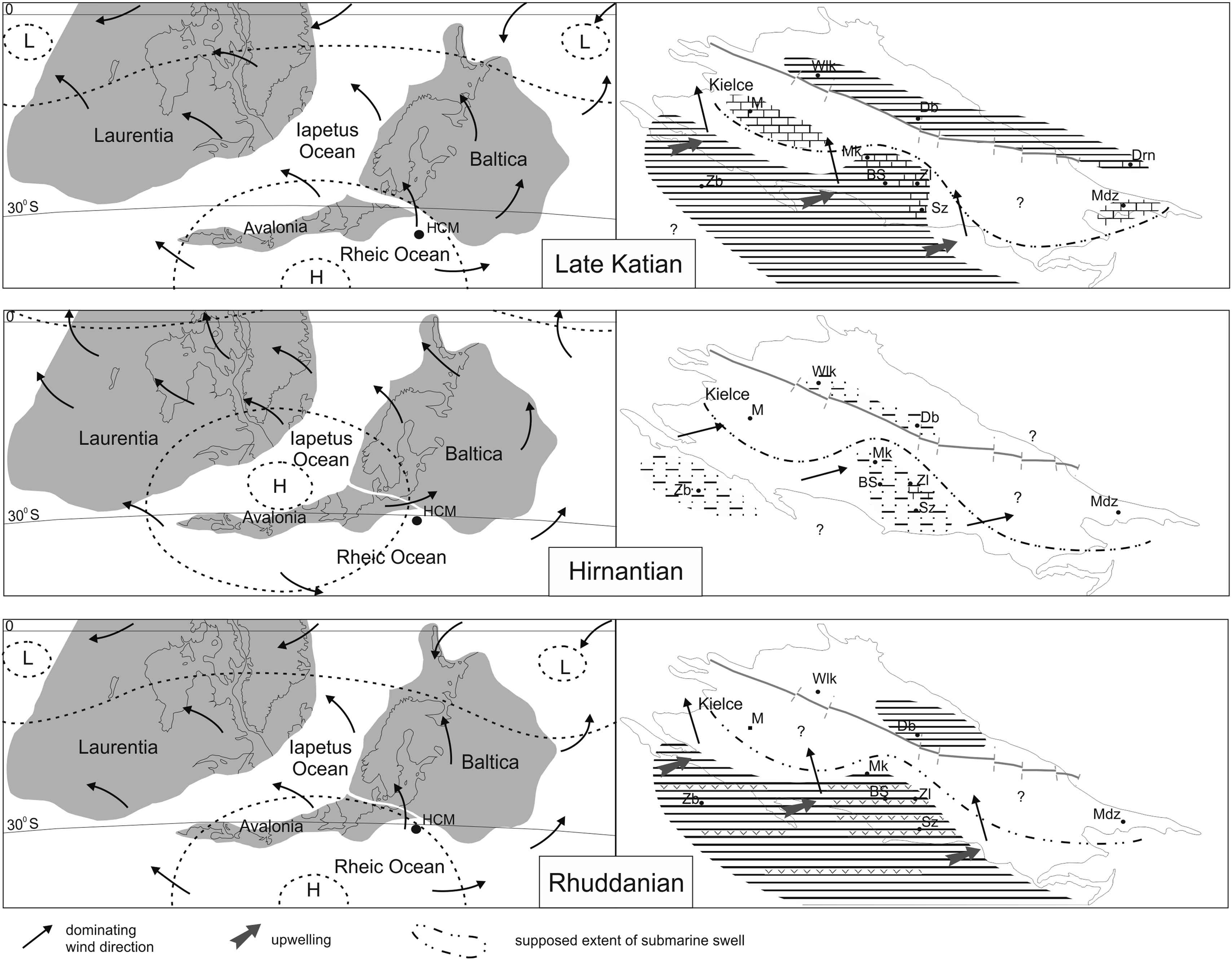
Distribution of lithofacies in the Holy Cross Mountains from late Katian to Rhuddanian time, and inferred general atmospheric circulation (after Parrish, Reference Parrish1982); palaeogeography after (Cocks & Torsvik, Reference Cocks and Torsvik2005). H – high pressure; L – low pressure; HCM – Holy Cross Mountains; BS – Bardo Stawy; M – Mójcza; Mdz – Międzygórz; Mk – Mokradle; Sz – Szumsko; Zb – Zbrza; Zl – Zalesie; Wlk – Wilków; Db – Dębniak; Drn – Daromin. Key as in Figure 2.

A higher rate of tectonic subsidence in the Zalesie–Szumsko area during early Sandbian time is manifested by increasing shale intercalations in dolostones of the Mokradle Formation, which can be related to a local short-term drowning event and subsequent highstand interval (Fig. 2). A local shallowing in the southern HCM is also recorded by intercalations of sandy mudstones and limestones in the upper foliaceus Biozone of the Jeleniów shales in the Brzeziny area (see Tomczyk & Turnau-Morawska, Reference Tomczyk and Turnau-Morawska1964). In late Sandbian time, the accommodation space increased again and outpaced the sediment supply, as can be inferred from the occurrence of grey to variegated shales and mudstones of the Stawy Formation that represent starving phase in the basin evolution (Fig. 2). The late Sandbian drowning event is preserved in the Szumsko Kolonia 2 borehole as basal dark shales overlain by a phosphorite bed coeval with the maximum flooding zone (Figs 2, 4). The colour change (grey through greenish to red) in the Stawy Formation appears to reflect a redox cycle progressing from dysoxic to oxic conditions driven by decreasing delivery of organic carbon to the sediment that facilitated preservation of ferric ions in the upper red shales (e.g. at Zalesie). The late Sandbian deepening in the Zalesie–Szumsko basin is roughly coeval with drowning recognized in Baltoscandia (the Keila drowning event in Nielsen, Reference Nielsen, Webby, Paris, Drosser and Persival2004; VII sequence in Dronov et al. Reference Dronov, Ainsaar, Kaljo, Meidla, Saadre, Einasto, Gutiérrez-Marco, Rábano and Garcia-Bellido2011). Thin mudstone and marly dolostone interbeds with mixed siliciclastic, bioclastic and phosphatic material in the Stawy Formation indicate that weak storm currents operated intermittently in this predominantly lower energy setting. Repeated periods of sediment starvation and rapid deposition facilitated the preservation of volcanic ash that forms thin K-bentonite beds. In the Zbrza basin, they form distinctive horizons related to increased delivery of pyroclastic material by westerlies from the Avalonian volcanoes (Trela et al. Reference Trela, Bąk and Pańczyk2018).
In middle Katian time, the redox conditions changed definitely in the Zbrza basin owing to persistent oxygenation of the bottom waters consistent with a climatically driven increase in thermohaline circulation in Late Ordovician time (Page et al. Reference Page, Zalasiewicz, Williams, Popov, Williams, Haywood, Gregory and Schmidt2007; Trela, Reference Trela2007). This major change in redox conditions is manifested by greenish-grey clay-rich mudstones and marls of the Wólka Formation that can be correlated with the Grimsøya Regressive Event in Baltoscandia (Nielsen, Reference Nielsen, Webby, Paris, Drosser and Persival2004; see also the base of sequence XI in Dronov et al. Reference Dronov, Ainsaar, Kaljo, Meidla, Saadre, Einasto, Gutiérrez-Marco, Rábano and Garcia-Bellido2011). As in the northern HCM, the Wólka mudstones show a variable bioturbation rate, resulting locally in their complete homogenization (see Trela, Reference Trela2007). However, a thin interval of grey mudstones in the lower part of this succession appears to represent a short-lived deepening (Figs 2, 3) that can be correlated with the late Linearis drowning event in Baltoscandia (see Nielsen, Reference Nielsen, Webby, Paris, Drosser and Persival2004). The sediment starvation during its maximum phase facilitated concentration of glauconite grains and the early diagenetic growth of carbonate concretions (Fig. 3). In the Bardo basin, this drowning event may be represented by dark limestones at the base of the Mokradle Formation (Figs 2, 4) overlain by bioclastic limestones and dolostones deposited during the sea-level highstand. Densely packed echinoderm floatstones and skeletal wackestones in the Mokradle Formation were probably redeposited from the adjacent Mójcza swell during storm events. The Eostropheodonta brachiopod specimen in the limestones of this formation reported by Bednarczyk (Reference Bednarczyk1971) allows the assumption that locally the carbonate deposition would have continued until earliest Hirnantian time.
Dark clay-rich mudstones in the uppermost part of the Wólka Formation (Fig. 3) indicate a return to oxygen deficiency in the Zbrza basin, which can be correlated with the late Katian transgression consistent with the pacificus graptolite Zone (Finney et al. Reference Finney, Berry and Cooper2007), coeval with the XII sequence of Dronov et al. (Reference Dronov, Ainsaar, Kaljo, Meidla, Saadre, Einasto, Gutiérrez-Marco, Rábano and Garcia-Bellido2011). This unit was analysed for biomarker data and pyrite framboid diameters that together with elevated total organic carbon (TOC) provide evidence for an intermittent euxinic water column (Smolarek et al. Reference Smolarek, Marynowski, Trela, Kujawski and Simoneit2017). The lack of significant grain-size variation with the underlying greenish-grey clayey mudstones indicates that a change in benthic redox conditions in the Zbrza basin was produced by an increased supply of organic carbon. Similar upper Katian organic carbon-rich fine-grained siliciclastic rocks in the Welsh basin are associated with short-lived coastal upwelling and increased surface organic productivity (Challands et al. Reference Challands, Armstrong, Maloney, Davies, Wilson and Owen2009). Given the palaeogeographic location of Baltica during late Katian time (see Cocks & Torsvik, Reference Cocks and Torsvik2005) and global atmospheric circulation models (see Parrish, Reference Parrish1982), it can be assumed that the HCM area (as a part of SW peri-Baltica) was influenced by a subtropical high-pressure cell and related SE trade winds (Fig. 10), as with the Welsh basin (Challands et al. Reference Challands, Armstrong, Maloney, Davies, Wilson and Owen2009). The dominant wind direction would have produced a net water flow to the west or southwest and upwelling along the southern margin of the Mójcza swell (Fig. 10), facilitating increased organic productivity in the Zbrza basin. Greenish mudstones with dark/black laminae underlying the Hirnantian sand-rich mudstones in the Szumsko Kolonia 2 well (Fig. 4) appear to have been produced by the same late Katian sea-level rise and intermittent oxygen deficiency in the shallow-water setting.
The topmost part of the Ordovician succession both in the southern and northern HCM is made up of sand-rich mudstone lithofacies of the Zalesie Formation, referred to the Hirnantian glacioeustatic regressive event (Trela & Szczepanik, Reference Trela and Szczepanik2009). Sandstones and sandy mudstones of this lithofacies have been interpreted as products of gravity flows eroding the bottom deposit and incorporating it as clasts into the accumulated sediment (Trela & Szczepanik, Reference Trela and Szczepanik2009). The poor sorting, variable grain roundness, changes in microfabric (mud to quartz silt/sand supported) and dispersed intraclasts suggest mixed sources of components as well as sediment reworking and redeposition. The occurrence of isolated mudstone/marl clasts and large quartz grains scattered in the muddy/sandy groundmass – especially those revealing small-scale soft sediment deformation below them – may suggest that the sandstones and mudstones of the Zalesie Formation, like similar diamictites in the East European Platform, were deposited by icebergs migrating from Gondwana to the SW margin of Baltica (see Porębski et al. Reference Porębski, Anczkiewicz, Paszkowski, Skompski, Kędzior, Mazur, Szczepański, Buniak and Mikołajewski2019). It is noteworthy that in terms of grain composition, texture and thickness, the Zalesie Formation is similar to the peri-Gondwanan glaciomarine diamictites of the Sirman Formation in Bulgaria (Chatalov, Reference Chatalov2017). Therefore, icebergs appear to be an alternative explanation for the occurrence of the Middle Ordovician Frankea specimen in the Hirnantian acritarch assemblage, in contrast to its redeposition from the Baltica/Avalonia collision zone postulated by Trela & Szczepanik (Reference Trela and Szczepanik2009). However, it should be remembered that the latest Ordovician was a time of tectonic instability along the SW margin of Baltica brought about by its collision with Avalonia. Thus, the distribution of detrital sediment forming the Zalesie Formation might have been modified by weak gravity flows induced by the regional seismic activity.
5.b. Early Silurian (Rhuddanian)
The graptolite biostratigraphy of the overlying Bardo Formation provides evidence of continuous deposition across the O/S boundary in the southern margin of the HCM. The light brown shales at the base of this unit (the persculptus Biozone) correspond to the post-glacial flooding documented in the northern HCM by the organic-poor interval (Trela et al. Reference Trela, Podhalańska, Smolarek and Marynowski2016). Stratigraphic data and sedimentological features indicate that the ascensus–acuminatus black bedded cherts of the Bardo Formation were deposited under anoxic and sediment-starved conditions during the maximum transgression. The expansion of bottom anoxia is supported by the geochemical data (Mustafa et al. Reference Mustafa, Sephton, Watson, Spathopoulos and Krzywiec2015; Smolarek et al. Reference Smolarek, Marynowski, Trela, Kujawski and Simoneit2017) and lack of benthic fauna.
The distribution of Silurian shales in the southern HCM was strongly dependent on the basin topography characterized by the presence of the Mójcza swell (Fig. 10), which was subjected to block faulting in Late Ordovician time (Trela, Reference Trela2005). The stratigraphic and facies data clearly indicate that since the Hirnantian to middle Wenlock time span, this uplifted structure was devoid of deposition (Tomczykowa & Tomczyk, Reference Tomczykowa, Tomczyk and Źakowa1981; Trela et al. Reference Trela, Podhalańska, Smolarek and Marynowski2016). In Rhuddanian time, upwelling induced by the SE trade winds along its southern margin (Fig. 10; Trela & Salwa, Reference Trela and Salwa2007) influenced the sedimentary and palaeoecological conditions in the adjacent Zbrza basin, as in late Katian time. The bottom of this basin was colonized by benthic coccoid cyanobacteria that preferred the anoxygenic photosynthetic system (Kremer & Kaźmierczak, Reference Kremer and Kaźmierczak2005). The cited authors postulated that bacterial sulphate reduction of the cyanobacterial biomass participated in emission of hydrogen sulfide above the mat surface, contributing to dysoxic or even temporarily anoxic conditions in the bottom waters. Upwelling and vertical mixing are important driving forces behind the redistribution of nutrients from anoxic bottom waters to the photic zone (Piper & Calvert, Reference Piper and Calvert2009). In anoxic conditions, most of the remineralized phosphate is released and diffused out of the sediment, increasing nutrient inventories and primary production in the shallow sub-surface waters (Van Cappellen & Ingall, Reference Van Cappellen and Ingall1994). Thus, the upwelling-induced vertical mixing appears to be a driving force behind large blooms preserved as light chalcedonic laminae/lenses in cherts of the Rembów Member (Kremer, Reference Kremer2005) and the massive occurrence of radiolarians. However, the presence of volcanic ash in the Rhuddanian shales allows the assumption that increased delivery of pyroclastic material might have contributed to the radiolarian bloom. The chert–shale couplets in the Rembów Member appear to reflect the fluctuation of primary productivity in the surface water. However, bedded cherts may also originate from diagenetic migration of SiO2 in slowly accumulating pelagic settings (Murray et al. Reference Murray, Jones and Buchholtz Ten Brink1992). Rare and poorly preserved radiolarians in chert beds support an early diagenetic origin of silica derived from the dissolution of radiolarian opaline tests (cf. Schieber et al. Reference Schieber, Krinsley and Riciputi2000). According to Kremer et al. (Reference Kremer, Kaźmierczak and Bąbel2014), increased delivery and settlement of radiolarians contributed to the early diagenetic silicification of microbial mats due to pH changes driven by the coupled biomass degradation and bacteriolysis within the mat.
During late Rhuddanian time (the vesiculosus–cyphus biozones) the post-glacial transgression approached a highstand, and redox conditions in the southern HCM basins changed into dysoxic bottom waters favourable to weak bioturbation by the soft-bodied fauna operating at the sediment–water interface. Sedimentary conditions were intermittently affected by currents that left ripples migrating over the bottom or eroded water-rich substrate (volcanic ash, muds), as can be inferred from the occurrence of tephra clasts. A relatively thin sandstone unit above the cyphus graptolite shales in Bardo Stawy reveals features of storm-related traction transport produced during a short-term sea-level lowstand (Trela & Salwa, Reference Trela and Salwa2007).
6. Conclusions
The Upper Ordovician to Rhuddanian facies pattern in the southern HCM displays a conspicuous switch of depositional environments, which can be referred to the combined interaction of climatically driven sea-level changes and local tectonic activity. An increase in tectonic subsidence in late Darriwilian/Sandbian time produced a relatively deep-water marine basin in the SW part of the HCM (the Zbrza area) characterized by intermittent benthic oxygen deficiency recorded by monotonous dark clay-rich mudstones of the Jeleniów Formation. The base of this facies can be correlated with the late Darriwilian worldwide transgression, while the rest of this sedimentary succession appears to have developed during the highstand sea-level conditions. In middle Katian time, the redox conditions in the Zbrza basin changed from oxygen-depleted to predominantly oxic bottom waters, which can be inferred from the predominance of greenish-grey clay-rich mudstones of the Wólka Formation. This redox shift is consistent with the worldwide palaeoceanographic change driven by the Late Ordovician climate cooling. However, a short-lived drowning event is postulated at the base of this unit, and it appears to be coeval with the Linearis drowning event in Baltoscandia. The oxygen deficient conditions in the Zbrza basin returned in late Katian time as a redox and sedimentary response to the pre-Hirnantian transgression and upwelling-driven increase in organic productivity (Smolarek et al. Reference Smolarek, Marynowski, Trela, Kujawski and Simoneit2017). A similar scheme of sea-level changes can be traced in the eastern, shallower part of the basin (the Zalesie–Szumsko area), but in the Sandbian part of the Ordovician section it is supplemented by short-lived drowning events related to local tectonic activity (the lower gracilis graptolite Biozone) and the Keila drowning event (the upper foliaceus graptolite biozone), respectively. The best sedimentary responses to global climate and sea-level changes in the studied area are clearly seen at the O/S boundary. The Hirnantian sand-rich mudstones, noted across the entire HCM, are strictly connected with the end-Ordovician glacioeustatic sea-level fall. They are overlain by the Rhuddanian black cherts and shales representing the post-glacial transgressive to highstand sediments developed under anoxic to dysoxic bottom waters. Their depositional setting was influenced by upwelling induced by the SE trade winds (Trela & Salwa, Reference Trela and Salwa2007).
Acknowledgements
The research was supported by Polish Geological Institute – NRI, project no 62.9012.1912.00.0. I thank Jerzy Dzik and anonymous reviewer for their helpful comments on the manuscript.