Effective emergency responses among hospitals and other health care providers result from multiple contributing factors: solid emergency planning, ongoing training of personnel, institutional support and capabilities, advance stockpiling, and implementation of crisis standards of care stemming from the influx of patients.1 Acute care facilities routinely handle surges of patients following local emergencies (eg, fires, multivehicle crashes, acts of gun violence, chemical explosions, and foodborne illness). Although localized emergencies present difficult challenges, hospital emergency departments have become proficient at addressing them through experience and ongoing preparedness training.
Prolonged emergencies affecting larger numbers of individuals, such as the 2009 H1N1 influenza outbreak, present more daunting challenges. These events involve sustained surges of greater scope and magnitude, often spanning entire regions.Reference Hick, Barbera and Kelen2 Hospitals and other health care providers may quickly become overwhelmed as hundreds or thousands of individuals seek rapid medical evaluation or treatment for days or weeks.Reference Devereaux, Dichter and Christian3 In response, governments at all levels may declare states of emergency, disasters, or public health emergencies,4 changing the legal environment within which public health authorities and hospitals respond. These types of emergencies require significant and sustained coordination of personnel, services, and supplies among hospitals and other providers to ensure adequate patient care across regions.Reference Barnett, Taylor, Hodge and Links5 Coordination during major emergencies is key, but some hospitals and other health care entities lack structural principles to guide critical allocation decisions. Without advance agreement on principles of coordination, real-time allocations of scarce resources (eg, personnel, supplies, space) to treat burgeoning numbers of patients may be compromised.
To assist hospitals and other health care entities, the authors (and others) as members of the Preparedness and Catastrophic Event Response (PACER) consortium at the Johns Hopkins University developed a model Memorandum of Understanding (MOU) that incorporates essential principles about how to allocate scarce resources among providers across regions.6 Our model MOU seeks to align regional hospitals through advance agreements on procedures of mutual aid that reflect modern principles of emergency preparedness and changing legal norms in declared emergencies. In combination with other preparedness activities, the model MOU, which can be modified by hospitals depending on their needs and preferences, creates options for collaboration without significant legal obligations.
MULTIPLE LEVELS OF HOSPITAL EMERGENCY PREPAREDNESS
Hospitals and other health care providers require additional resources or outside assistance to respond to and recover from large-scale emergencies and disasters. Many hospital planners foresee these needs and regularly assess their capacity to respond under what can be described as 4 major levels of hospital preparedness and response.Reference Hick, Barbera and Kelen2 At the base level are mass casualty events (eg, train collisions, building collapses, commercial fires) that are managed within a hospital's emergency department without significant stress on additional resources available at the same hospital.Reference Hick, Chipman and Loppnow7 Reference Hogan, Waeckerle, Dire and Lillibridge8 These events usually require only small deviations from normal operating procedures, use internal resources, and rely on existing emergency department planning and exercises. A second level of hospital emergency planning and response involves disaster events (eg, the September 11, 2001, terrorist attacks, the 2004 Madrid train bombings) that require routine situational preparedness throughout a receiving hospital. In these cases, patient surge requires a hospital-wide response beyond the emergency department.Reference Gutierrez De Ceballos, Turégano Fuentes, Perez Diaz, Sanz Sanchez, Martin Llorente and Guerro Sanz9 Reference Cairns, Stiffler, Price, Peck and Meyer10 Physical space outside the emergency department may be needed. Noncritical patients may be discharged and elective surgeries canceled. Use of hospital supplies, equipment, and personnel is widespread. Personnel may function outside their usual focus and training. Responses rely on hospital-wide planning and exercises, with a focus on interdepartmental interactions and cooperation.Reference Kirschenbaum, Keene, O’Neill, Westfal and Astiz11 Because these initial 2 levels are largely handled internally, there may be little need to refer to MOUs to coordinate additional resources from other hospitals or health care systems.
When disasters or emergencies escalate to level 3, which involves significant increases in patient surge capacity and needs for extensive resources within a specific region, response efforts become more complex.Reference Hick, Barbera and Kelen2 Hospital incident command systems must expand beyond routine management, which requires clear understanding and articulation of the management hierarchy and job responsibilities. Management and legal questions arise concerning human resources and compensation, equipment and supplies, and physical space. Liability issues arise among varied partners. Hospitals operated in conjunction with various health care facilities through large corporations may garner valuable support from other facilities within their system. After Hurricane Katrina in 2005, many hospitals that were unable to obtain local assistance turned to their corporate partners for personnel, medical supplies, and evacuation helicopters.Reference Schultz, Koenig and Lewis12 Even within unified health corporations, however, components of these entities may have separate legal standing and distinct concerns, warranting the use of preexisting MOUs.
Level 4 events are of sufficient magnitude that resources are needed from external sources.Reference Hick, Barbera and Kelen2 Disaster events requiring regional coordination may arise from a large-scale event that affects a significant area (eg, regional spread of H1N1) or a serious event that impedes the ability of a single hospital to function (eg, mass infection, major natural disaster). In the latter case, such as in the aftermath of Hurricane Katrina, local hospitals may be unable to continue operations and require evacuation. To effectively manage overwhelming surges in patients, infusions of additional resources from multiple public and private sector entities are essential. Numerous perceived and actual constraints associated with acquiring, using, and coordinating these resources arise. MOUs between health care entities can clarify legal responsibilities, relationships, management hierarchies, and other key parts of level 4 responses. Hospitals, however, must not rely on exclusive or limited partnerships with health care providers that may not be able to effectively respond. For example, before Hurricane Katrina almost all New Orleans hospitals and extended care facilities executed MOUs with the same 2 medical transportation companies for assistance with emergency evacuations. These companies had only enough vehicles to assist 1 or 2 hospitals simultaneously. When nearly every hospital in the region required evacuation because of the flooding of New Orleans, the companies were unable to meet the region's needs.13
LEGAL CHALLENGES CONCERNING ALLOCATION OF SCARCE RESOURCES IN DECLARED EMERGENCIES
In nonemergencies, existing laws and policies offer reasonable guidance on the legality of various decisions and actions in allocating scarce resources. However, in declared states of emergency, disasters, or public health emergencies, the legal environment changes.13 Emergency declarations trigger an array of special powers that are designed to facilitate response efforts through public and private sectors. Depending on the level and type of emergency declared, emergency laws offer government and the private sector flexible powers to respond, encourage response efforts by limiting liability,Reference Hodge and Anderson14 Reference Hoffman, Goodman and Stier15 and help support crisis standards of care1 Reference Rosenbaum, Harty and Sheer16 and alterations to professional scopes of practice.17 Although they are a critical component of disaster responses, emergency laws do not always facilitate best practices in the allocation of scarce resources. Framed in broad language, shaped by political realities, and subject to fluctuations on the front lines, emergency laws tend to offer a menu of legal powers and options but often no definitive guidance about how to use them. Through what is known as legal triage,13 hospital administrators, emergency planners, public health practitioners, and their legal counsel must prioritize legal issues and solutions in real time to facilitate legitimate public health responses during declared states of emergency.13
Paramount legal issues confronting hospitals and health care providers during emergencies involve the allocation of resources. In addition to significant logistical challenges, a thicket of laws potentially impede the transfer of personnel and supplies between hospitals and other acute care providers. Some of these impediments may be rooted in inviolable constitutional norms such as prohibitions against discrimination based on race, ethnicity, religion, sex, and other human characteristics. For example, the transfer of essential medical resources such as ventilators or vaccines between institutions that serve different populations or the failure of emergency planners to consider the needs of people with disabilities under their care implicate federal nondiscrimination laws.Reference Hodge, Garcia, Anderson and Kaufman18 Emergency guidance from the Federal Emergency Management Agency recognizes the importance of nondiscrimination concepts.Reference Campbell, Gilyard, Sinclair, Sternberg and Kailes19 Whether health care workers can be forced to report to duty during emergencies20 or pressured into working at another hospital implicate long-standing constitutional principles (eg, freedom from forced labor,Reference Coleman and Reis21 due process22), contractual obligations, and unresolved queries as to what constitutes undue coercion by employers. Other issues surface through contracts governing relationships between employers and employees.
In nonemergencies, legal principles and resulting restrictions are reflected in hospital operating procedures. During emergencies, when normal procedures are disrupted and novel challenges arise, resolution of these legal issues can be profound.23 Few of these legal obstacles are intractable (although some continue to elicit considerable scholarly and practical discussion).Reference Quigley24 With thorough planning and careful drafting, MOUs can incorporate operational language to obviate or significantly minimize almost any legal impediment to the allocation (and reallocation) of scarce medical personnel and resources.
EXISTING MOUS ADDRESSING ALLOCATION STRATEGIES
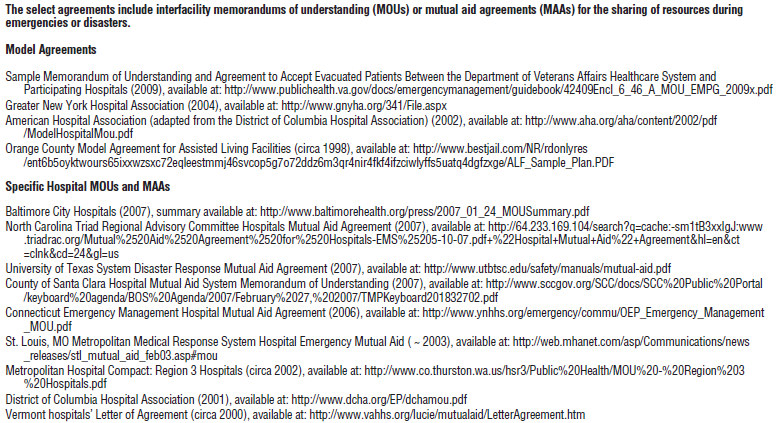
Among the many legal tools available to hospitals to guide their allocation decisions in emergencies, MOUs offer entities the advance opportunity to craft and agree to terms of collaboration (instead of waiting until an emergency is declared). Many hospitals across the nation have already executed MOUs, mutual aid agreements, and other interhospital agreements on local and regional bases to guide their collaborative efforts. As part of this project, we assessed an array of agreements among hospitals and other health care entities (eg, nursing facilities, ambulance providers), located through searches of available, online materials.Reference Kass, Otto, O’Brien and Minson25 Table 1 lists select agreements we found as part of this research, including model MOUs and mutual aid agreements and samples of actual agreements within specific hospital systems nationally.
Select Agreements Among Health Entities Regarding Resource Sharing During Emergencies

Collectively we found that these select documents present meaningful options and paths to facilitate collaboration on resource allocation among health care providers, including several principles and organizational elements featured and referenced in our model MOU.26 We also identified several weaknesses in the scope, purpose, content, and design of the existing documents. None of the select documents we reviewed tend to reflect modern legal principles during declared emergencies despite the fact that most of the documents are meant to guide legal decisions in such emergencies. The documents attempt to inform legal decisions about how to allocate scarce resources on the assumption that national, state, and local laws and policies do not change during emergencies.Reference Kass, Otto, O’Brien and Minson25 As noted above, this is a misperception because legal standards on which the principles of these existing MOUs rely may be altered, waived, or bypassed in real-time emergencies. The potential for confusion among hospitals is compounded by the legalistic language set forth in several MOUs we reviewed. Some of these documents read more like binding contracts among executing parties instead of mutual principles of understanding. Legal contracts may help bind parties to allocation strategies, but burdensome, legalistic language may not provide clear guidance to help administrators decide how to allocate resources during emergencies. As a result, some MOUs lack relevance and utility in a legal environment that changes once governments declare states of emergency.
Furthermore, few of the documents we reviewed conform to emergency management principles espoused in the Department of Homeland Security National Incident Management System (NIMS)26 and other national emergency management protocols. There are practical explanations for this finding. Some documents that we reviewed, for example, predate modern NIMS standards. In other cases, however, NIMS concepts seemed to have been overlooked (even though NIMS requires participating hospitals to consider MOUs to encourage collaboration), which, as we explain below, may lead to substantial oversights.
DISTINGUISHING CONTRACTUAL REQUIREMENTS AND STATEMENTS OF MUTUAL AGREEMENT
One of the sharpest areas of divergence among existing MOUs that we reviewed concerns the degree to which they are framed as contractually binding agreements. Some MOUs embrace a contractual approach. Other documents, such as our model MOU, are intentionally worded so as not to be construed as binding contracts among executing parties. Our goal in drafting the MOU was to create a nonbinding agreement that hospitals could enter into without requiring them to adhere to specific responsibilities. This is an important distinction particularly because of the potential legal significance of these 2 approaches. In business and real estate settings, the term MOU often denotes agreements that seek to bind parties to specific actions. In the emergency preparedness arena, MOUs typically refer to compacts or agreements among states and foreign countries to help formalize cooperative plans to address emerging threats (eg, the International Emergency Management Assistance MOU between 6 New England states and 5 Canadian provinces27 28). In this context, the legal meaning of MOU lacks the formality or recognition of binding contracts, because states cannot lawfully contract with other states or foreign governments in the absence of Congressional approval.Reference Stier and Goodman29 Outside the context of interstate compacts, however, MOUs may constitute contractually binding agreements. In fact, a court can determine that a contractual relationship exists based on almost any written or oral exchange that meets 3 criteria: an offer (eg, to provide a service, resource, or goods), an acceptance of the offer (consistent with a meeting of the minds of the person/entity doing the offering and the acceptor), and some exchange of value (known legally as “consideration”).30
Some MOUs we examined resemble formal binding contracts in their tenor and constituent parts and are thus more likely to be interpreted as contracts by courts. Other MOUs (and our own model [section 1.26]) consciously avoid any of the legal indicators (eg, the stipulation of exchanged consideration) or stylistic hallmarks of contracts (eg, signature lines, “whereas” clauses). MOUs resembling contracts often include clauses that attempt to dissolve liability between the signatories for specific acts or failures to act. Although subject to some uncertainty, these exculpatory clauses are generally upheld by courts as long as they reasonably reflect the intent of all of the partiesReference Franklin and Rabin31; however, we found no reported judicial cases that discuss the enforceability of these provisions or MOUs generally in the context of hospital mutual aid.
Hospital administrators may prefer framing MOUs as noncontracts. They may be concerned that contractually binding MOUs necessitate specific actions and impose potential liability at a time when flexibility in allocating resources is needed. Whether these concerns are legally or empirically valid is difficult to assess. Framing MOUs as noncontractually binding agreements offers participating hospitals greater opportunities to align and collaborate during emergencies without the legal rigidity of contractual requirements. States may choose to regulate the scope or use of MOUs among hospitals through the issuance or implementation of emergency laws or policies. The tendency may be, however, to respect the voluntary choices among parties through MOUs provided their decisions do not impede emergency response efforts. The obvious downside of nonbinding, unregulated MOUs is that they do not actually require participating hospitals to allocate their resources to benefit another hospital in a specific region.
MODEL MOU BETWEEN HOSPITALS DURING DECLARED EMERGENCIES
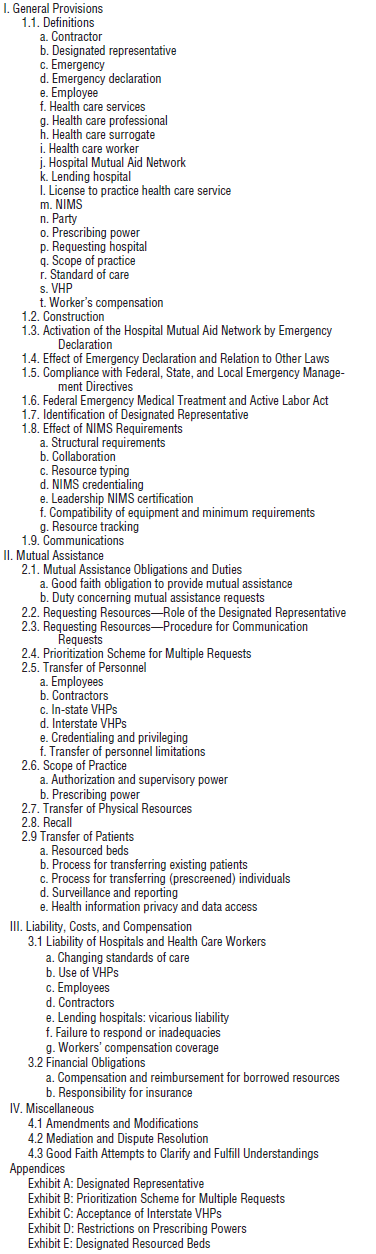
After assessing the strengths and weaknesses of existing MOUs and other documents that guide allocation strategies, we set out to draft a model MOU for consideration by hospitals and other health entities within a regional health care system. We sought to infuse new ideas and simpler drafting into a nonlegalistic model document based in part on existing documents. Our objective was to craft meaningful, understandable guidance on key issues of collaboration during declared emergencies involving significant surges in hospital patients. An invaluable first step was the development of an initial blueprint of a model MOU.6 This blueprint was vetted by PACER colleagues and select preparedness experts from hospitals, additional health care entities, public health authorities, and emergency management agencies. Comments were considered and incorporated into a final outline that served as a guide for drafting the MOU. A draft of the model MOU was recirculated to these reviewers and others for additional comments before its completion. The final model MOU offers a comprehensive approach to facilitate mutual assistance among hospitals within a regional health care system (Table 2).6 It specifically addresses key issues including the following:
Organization of PACER Model MOU Between Hospitals During Declared Emergencies

-
• Activation of a hospital mutual aid network through a governmental emergency declaration
-
• The impact of emergency laws on the implementation of resource sharing, including the federal Emergency Medical Treatment and Active Labor Act32 (42 USC § 1395dd; which typically requires hospitals to screen and stabilize individuals who request emergency treatment before the patient is transferred)
-
• The effect of NIMS27 requirements
-
• Procedures for requesting resources, sharing personnel, and transferring patients
-
• Liability, costs, and compensation related to resource sharing6
Although extensive, there are several limitations to the model MOU. As noted above, it is not intended to formally bind parties via contract. Participating hospitals have no legal obligation to adhere to its principles or procedures in declared emergencies, but rather are incentivized into mutual collaboration. The model MOU recognizes the effect of changing laws and policies in declared emergencies, but at the same time, its language is not tailored to emergency laws in any particular jurisdiction. Hospitals may seek to revise the model MOU to incorporate their specific jurisdiction's emergency laws. Even though the model sets forth core guidance on multiple key areas of mutual assistance, it does not attempt to specify steps of collaboration, which are inherently tied to institutional preferences and practices.
Incorporation of NIMS Principles
Compliance with NIMS standards is a core component of the model MOU. NIMS is a set of protocols that organizes how government, nongovernment, and private sector agencies prepare for and respond to incidents that threaten harm to people or property.27 In essence, these protocols provide a template on which local and regional actors can structure collaborative emergency preparedness and emergency management efforts. Although commonly associated with fire departments, emergency management departments, and emergency operations centers, the application of NIMS to hospitals and other health care providers is substantial and continuously developing. For these reasons, integration of NIMS principles is an essential feature of the model MOU. However, precise guidance as to how to comply with NIMS is not elucidated for 2 reasons: (1.) NIMS standards and compliance requirements consistently change; and (2.) existing legal mechanisms may already require hospitals that receive federal funds through the Department of Homeland Security to comply.27
NIMS requirements promote the development of organizational structures capable of efficiently marshalling and deploying resources during exigent and chaotic circumstances. NIMS compliance ensures that hospitals have an incident command system capable of facilitating rapid communications between hospitals, government officials, and other actors in the community.27 These systems must identify individuals who are authorized to communicate on behalf of the entity concerning transfers of resources and other issues. As incorporated into mutual aid processes including the model MOU, NIMS-required command structures streamline communications and reduce redundancy.33
Even with carefully drawn lines of communication and authority, mutual aid and emergency management efforts can be frustrated by the difficulty of articulating needed resources rapidly and accurately under exigent circumstances. Emergencies frequently require a staggering array of health-related objects (eg, hand ventilators) and basic supplies (eg, beds, blankets, food). Communications concerning resources are further challenged by the diverse backgrounds of individuals who are involved in emergency response efforts; a specific resource may have one meaning to a hospital worker and an entirely different one to a public health practitioner or emergency manager. NIMS protocols address this issue through what is known as resource typing, which is an effort to standardize the definition of all potential resources.27 Resource typing ensures that a hospital that requests resources receives what it intended. The model MOU recommends that participating entities follow NIMS resource-typing protocols to describe available resources using category, kind, components, metrics, and type data.27
Transferring Patients, Personnel, and Supplies
A central objective of emergency mutual aid is to facilitate the efficient transfer of patients, personnel, and supplies within a local or regional network of hospitals to best promote and protect the health of the public. Transferring patients raises substantial logistical, legal, and ethical considerations. During a declared emergency, legal constraints on the transfer of patients (such as that required by the Emergency Medical Treatment and Active Labor Act33) may be waived (subject to federal Department of Health and Human Services' approvals of requests from state or local governments or hospitals) to provide hospital administrators with more flexibility to move patients to other facilities in accordance with their medical needs and best interests. For logistical purposes, the model MOU requires hospitals to communicate transfer requests in terms of resourced beds rather than base numbers of patients.34 For example, a receiving hospital (also potentially dealing with the underlying incident) may have the capacity to handle an influx of geriatric oncology patients, but not acute care burn victims. Our model encourages parties to define these resourced beds in advance of an emergency consistent with local needs and individualized capacities of the parties. After taking reasonable steps to obtain patient consent before transfer, hospitals must notify the patient's next of kin of the details of a patient's transfer. To determine whether the transfer of patients is appropriate, the MOU requires hospitals to find that patients cannot receive adequate care at the hospital and that the potential harm from the transfer does not outweigh the potential harm from not being transferred.35
In an emergency, perhaps no resource is more valuable than medical personnel and health care workers. Transferring hospital personnel, however, can be complicated by the varying employment or volunteer status of medical personnel. The model MOU addresses the transfer of employees, independent contractors, and volunteer health professionals, and provides guidance and procedures that help to ensure their availability during emergencies.36 Pursuant to the model MOU, a hospital that lends medical personnel is responsible for ensuring that transferred personnel are appropriately credentialed and privileged. Parties are also required to clarify supervisory powers and incorporate guidance on prescribing powers of various health care practitioners (which can be important when practitioners come from other jurisdictions).37
Transfers of physical resources, as with the transfer of patients and personnel, can be muddled by multiple or circular requests within a network of hospitals. Moreover, rapid transfers of medical resources can undermine the organization and sustainability of response efforts and surge capacity without adequate tracking of the flow and levels of essential resources. The model MOU encourages hospitals to use a prioritization scheme and rely on designated representatives for communicating mutual aid requests and confirmations.38
Liability, Costs, and Compensation
Concerns surrounding liability, costs, and compensation are pervasive in the health care sector. Although some providers and hospitals may dispense with these concerns during emergencies, advance principles of agreement in the model MOU help ensure a fair allocation of costs and exposure to liability to facilitate mutual aid. Significant limits of personal and entity liability during emergencies are reflected in new and emerging statutory enactments of emergency and other laws.Reference Hodge and Anderson14 Public hospitals, for example, may be entitled to some liability protections pursuant to principles of sovereign immunity that apply to their governmental operators.Reference Hodge and Anderson14 Private hospitals, however, do not benefit from such protections. To the extent that liability risks remain for public or private hospitals, the model MOU attempts to apportion potential liability risks among lending hospitals, receiving hospitals, and employees to encourage mutual aid transfers. It states that the receiving hospital bears most of the liability exposure for the actions of transferred personnel except in instances of gross, willful, or wanton misconduct or when a lending hospital fails to appropriately credential a transferred employee.39 Furthermore, because the model MOU does not attempt to impose binding obligations on the parties, there is no legal obligation for any hospital to accept patients or provide personnel or supplies.40
Hospitals that choose to lend their personnel or other resources are entitled to reimbursement through requesting hospitals.41 Reimbursement for services rendered include salaries of the transferred personnel at their normal pay rate as if those personnel were being paid by the lending hospital.42 Some hospitals may find other compensation arrangements easier to administer or more reflective of local practices and can memorialize these choices in their MOUs.
CONCLUSIONS
Mutual aid among hospitals is an essential component of emergency preparedness and response during large-scale emergencies, which can be effectively promoted and organized through well-drafted and executed MOUs. These agreements can facilitate transfers of patients, personnel, and supplies through processes that are rapid, robust, and organizationally efficient; apportion exposure to liability in ways that encourage, rather than dispel, assistance between geographically proximate hospitals; and foster productive collaboration on multiple emergency preparedness fronts.
The model MOU attempts to incorporate the best features of numerous, existing mutual aid agreements identified in our limited survey with modern principles of legal and general emergency preparedness. It provides a menu of optional provisions within a structured approach to organizing and coordinating mutual aid among hospitals during declared emergencies affecting the public's health (when aid is needed most). Although subject to revision, refinements, and clarification among potential users, the model MOU seeks to provide a consistent approach to coordinating mutual aid among hospitals to not only improve their ability to provide critical patient care but also to protect their institutional standing and individual practitioners' reputations and careers in the aftermath of disasters.
Author Disclosures:
The author reports no conflicts of interest.
Acknowledgment: The authors acknowledge the contributions of Aubrey Joy Corcoran, JD, MPH, Aaron Stemplewicz, and Christopher Stringham for their research, editing, and formatting assistance.