Introduction
Taxonomic and phylogenetic studies are essential to achieve a better understanding of the ecology, epidemiology and evolution processes of parasitic nematodes (Jacquiet et al., Reference Jacquiet, Humbert, Comes, Cabaret, Thiam and Cheikh1995; Poulin, Reference Poulin1998; Grenfell et al., Reference Grenfell, Amos, Arneberg, Bjornstad, Greenman, Harwood, Lanfranchi, McLean, Norman, Read, Skorping, Hudson, Rizzoli, Grenfell, Heesterbeek and Dobson2002; Cabaret, Reference Cabaret2003; Mejía-Madrid et al., Reference Mejía-Madrid, Choudhury and de León2007). The development of specific molecular tools is useful for recognizing species and studying processes such as transmission and evolution of host specificity. Moreover, studies on cospeciation between parasites and hosts certainly provide insight into parasite evolution (Criscione et al., Reference Criscione, Poulin and Blouin2005). Specifically, molecular approaches allow the reconstruction of evolutionary relationships between parasites, individual hosts and geographic locations (Archie et al., Reference Archie, Luikart and Ezenwa2008). In addition, genetic characterization is important for accurate diagnosis and effective control, when considering the anthelmintic resistance in nematode populations (Gasser et al., Reference Gasser, Bott, Chilton, Hunt and Beveridge2008).
Trichostrongyloidea nematodes are characterized by large population sizes and high genetic variability, and, in several cases, different genetic lineages, cryptic species and species complexes have been identified (Anderson et al., Reference Anderson, Blouin and Beech1998; Blouin, Reference Blouin2002; Leignel et al., Reference Leignel, Cabaret and Humbert2002; Grillo et al., Reference Grillo, Jackson, Cabaret and Gilleard2007). Haemonchus contortus is known among Trichostrongyloidea as one of the major pathogens of small ruminants (Gibbs & Herd, Reference Gibbs and Herd1986; O'Connor et al., Reference O'Connor, Walkden-Brown and Kahn2006) with a worldwide distribution. Its pathogenic effect stimulated studies such as vaccine development, drug target identification and mechanisms of anthelmintic resistance (Redman et al., Reference Redman, Packard, Grillo, Smith, Jackson and Gilleard2008); thus, its genetic characterization may give important insight into these issues. Indeed, this nematode is typical of tropical and subtropical areas, where economic losses can be very high (Achi et al., Reference Achi, Zinsstag, Yao, Yeo, Dorchies and Jacquiet2003), although an increasing occurrence has been reported recently in the cold temperate zone (Jackson & Coop, Reference Jackson and Coop2000; Hoste et al., Reference Hoste, Chartier and Le Frileux2002; Waller et al., Reference Waller, Rudby-Martin, Ljungström and Rydzik2004; van Dijk et al., Reference van Dijk, David, Baird and Morgan2008) with positive flocks up to latitudes above 65°N (Lindqvist et al., Reference Lindqvist, Ljungström, Nilsson and Waller2001). In this context, the genetic characterization of H. contortus appears crucial considering its presence in several wild host species, both bovids and cervids, from different geographical areas (Lavín et al., Reference Lavín, Marco, Rossi, Meneguz and Viñas1997; Rehbein et al., Reference Rehbein, Lutz, Visser and Winter2000; Zaffaroni et al., Reference Zaffaroni, Manfredi, Citterio, Sala, Piccolo and Lanfranchi2000; Nettles et al., Reference Nettles, Quist, Lopez, Wilmers, Frank, Roberts, Chitwood and Davidson2002; Sharhuu & Sharkhuu, Reference Sharhuu and Sharkhuu2004; Taylor et al., Reference Taylor, Boomker, Krecek, Skinner and Watermeyer2005).
A recent phylogenetic study on Haemonchus spp. has focused attention on wild animals sympatric with livestock, defining the influence of the anthropogenic factors and different environment host–parasite interactions (Hoberg et al., Reference Hoberg, Lichtenfels and Gibbons2004). This influence becomes even more significant in ecosystems influenced by the human movement of livestock and free ranging of wild species (Blouin et al., Reference Blouin, Yowell, Courtney and Dame1995; Giudici et al., Reference Giudici, Cabaret and Durette-Desset1999; Hunt et al., Reference Hunt, Knox, Le Jambre, McNally and Anderson2008).
In this regard, the Alps represent a significant model of livestock–wildlife interaction due to the traditional husbandry of moving herds and flocks to summer pastures. Moreover, in some alpine areas, H. contortus has been found extensively in wild ruminants (Zaffaroni et al., Reference Zaffaroni, Manfredi, Citterio, Sala, Piccolo and Lanfranchi2000).
In particular, studies on wild animals (Bentousi & Cabaret, Reference Bentousi and Cabaret1999; Braisher et al., Reference Braisher, Gemmell, Grenfell and Amos2004) identified different host specificity, local adaptation or other factors, which in turn could influence nematode spreading, interspecific transmission and management. The study of parasite population genetics (Criscione et al., Reference Criscione, Poulin and Blouin2005; Troell et al., Reference Troell, Engström, Morrison, Mattsson and Höglund2006) has recently been supported by the development of a variety of molecular marker analyses. For example, mitochondrial DNA (mtDNA) has provided valuable information on population genetic structure in nematode parasites of livestock and wild hosts (Johnson et al., Reference Johnson, Webster, Adam, Buckland, Dawson and Keller2006). In fact, mtDNA is considered a potential genetic marker in phylogeny, population and evolutionary studies for a wide variety of animal taxa due to its maternal inheritance, its haploid nature and the fact that its effective population size is one-quarter of that of the nuclear DNA.
However, the nuclear genes internal transcribed spacers 1 and 2 (ITS-1 and -2) were also considered as potential markers in phylogenetic analyses of nematodes in order to confirm the species identity and to assess the presence/absence of cryptic parasite species (Hoste et al., Reference Hoste, Chilton, Beveridge and Gasser1998; Zarlenga et al., Reference Zarlenga, Barry Chute, Gasbarre and Boyd2001). Moreover, due to their high levels of polymorphism, microsatellites are genetic markers suitable for genotyping nematode species (Grillo et al., Reference Grillo, Jackson and Gilleard2006; Hunt et al., Reference Hunt, Knox, Le Jambre, McNally and Anderson2008; Redman et al., Reference Redman, Packard, Grillo, Smith, Jackson and Gilleard2008).
In the present work, a fragment of the gene coding for mitochondrial reduced nicotinamide-adenine dinucleotide (NADH) dehydrogenase subunit 4 (nd4 gene), the ITS (1 and 2) and microsatellites were chosen to test whether the genetic diversity between isolates of H. contortus reflects their host species origin (wild vs. domestic ruminants) and their spatial origin in comparison to different areas in the Alps.
Materials and methods
Specimens of H. contortus and study areas
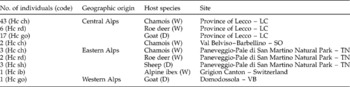
The total dataset was composed of 78 individual H. contortus collected in five ruminant species: chamois (Rupicapra r. rupicapra), roe deer (Capreolus capreolus), alpine ibex (Capra ibex ibex), goat (Capra hircus) and sheep (Ovis aries) (table 1).
Composition and origin of adult male samples of Haemonchus contortus examined genetically in this study.

D, domestic host; W, wild host.
Samples from wild host species were collected from individuals shot during the regular hunting season, while those from domestic goats and sheep were collected from individuals slaughtered on a regular basis.
In particular, 66 parasite specimens collected from chamois, roe deer and sympatric goats were collected from the main study area where a health-monitoring plan on wild ungulates carried out since 1998 has shown that helminth communities are strongly characterized by H. contortus (Citterio et al., Reference Citterio, Caslini, Milani, Sala, Ferrari and Lanfranchi2006). This study area is characterized by 253 km2 of mountainous territory, ranging from 500 to 2000 m above sea-level with a temperate sub-continental climate, described in detail previously (Citterio et al., Reference Citterio, Luzzago, Sala, Sironi, Gatti, Gaffuri and Lanfranchi2003). From late spring to early autumn, cattle sheep and goats share the pastures with chamois and roe deer. Furthermore, in past years, red deer (Cervus elaphus) has been colonizing the area.
In order to evaluate possible host specificity, 12 other out-groups were used for comparison. These 12 specimens were obtained from other study areas in the western, central and eastern Italian Alps and Swiss Alps (respectively, Domodossola – VB; Val Belviso-Barbellino – SO; Paneveggio-Pale di San Martino Natural Park – TN; Grigion Canton – Switzerland) and other host species (O. aries and Capra ibex ibex).
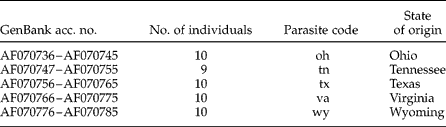
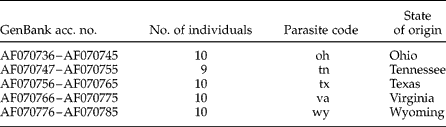
Furthermore, 49 GenBank nd4 sequences of H. contortus parasites from sheep in the USA were included in the phylogenetic analysis. Geographic locations and accession numbers for each of these sequences are reported in table 2.
GenBank nd4 sequences of Haemonchus contortus parasites from the USA used in the phylogenetic analysis.
Source: H. contortus barber pole worm from sheep (domestic host).
Individual male adult worms were collected from defrosted abomasa previously removed in the field and stored at − 20°C until examination. Individual worms were collected by washing the defrosted abomasum with Tris 10 mm solution and identified according to MAFF (1986). The anterior part of each worm was cut off and placed individually in 90% ethanol before DNA extraction. The posterior part of the worm was also preserved in 90% ethanol for any further morphological analysis.
DNA extraction and sequence analysis
Genomic DNA was extracted from 78 individual worms by incubation in 200 ng/μl proteinase K (Sigma Aldrich, St Louis, Missouri, USA) for 3 h at 56°C. A portion of the nd4 mitochondrial gene (399 base pairs) was amplified using the following primers: MT7 F 5′AAG(GT)CTTT(GA)GC(GACT)GC(CT)TATTCTTC3′ (universal nematode degenerate primer; T.J.C. Anderson, unpublished) and HcND4-R5′ AGAAACTGAGAT(AC)GTTTCC3′ (degenerate primer designed for this study). Amplification was performed in a final volume of 10 μl with a final concentration of: 1 × buffer (10 mm Tris–HCl (pH 8.3), 50 mm KCl and 1.5 mm MgCl2), 0.2 mm of each deoxynucleoside triphosphate, 1.6 pmol of each primer, 0.5 U of Taq polymerase (Eppendorf, Hamburg, Germany) and 2 μl of DNA sample. For the nd4 fragment, the polymerase chain reaction (PCR) conditions in an automated thermocycler (Biorad, Hercules, California, USA) were the following: initial denaturation at 94°C for 2 min, followed by 35 cycles of denaturation at 94°C for 30 s, annealing at 50°C for 30 s and extension at 65°C for 1 min 30 s with a final elongation at 62°C for 2 min. PCR products were gel purified using the QIAquickTM Gel Extraction Kit (Qiagen, Hilden, Germany) according to the manufacturer's protocols, resuspended in 30 μl deionized water and sequenced with PCR primers using ABI technology (ABI Prism 310 DNA sequencer, Applied Biosystems, Foster City, California, USA). Partial nd4 mitochondrial sequences were obtained for each sample (399 bp).
A subset of nucleotide sequence data was deposited in the EMBL data library under the accession numbers: AJ429770–AJ429809. These sequences were compared with the 49 GenBank sequences from H. contortus parasites of sheep in the USA (http://www.ncbi.nlm.nih.gov/blast; accession numbers: AF070736–AF070785). Sequences were aligned unambiguously without gaps with Clustal X (Thompson et al., Reference Thompson, Gibson, Jeanmougin and Higgins1997); manual introduction of gaps in the alignment was not necessary. The alignment was used for phylogenetic analyses performed using the program MEGA 3.1 (Kumar et al., Reference Kumar, Tamura and Nei2004). Trees were generated using neighbour-joining and maximum parsimony methods.
Analysis of molecular variance (AMOVA) was conducted using the Arlequin software version 3.11 (Excoffier, Reference Excoffier, Laval and Schneider2007) to evaluate genetic variance between and within isolates, and between groups of isolates. The AMOVA analysis was performed considering different grouping parameters: domestic vs. wildlife, between host species and between sampling areas.
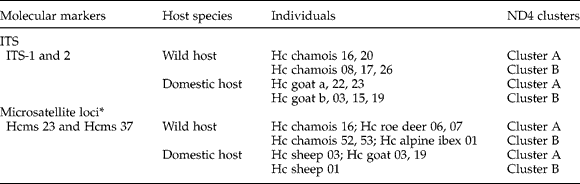
On the basis of the results on ND4, two subsets of 12 and 10 isolates were examined, respectively, for ITS (1 and 2) and microsatellites. These two subsets were chosen in order to analyse the maximum amount of genetic diversity and based on DNA availability (see table 3).
Subset of Haemonchus contortus isolates examined genetically by different molecular markers on the basis of the ND4 analysis.
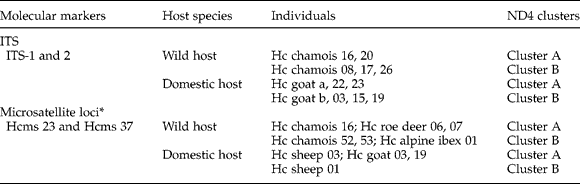
* Otsen et al. (Reference Otsen, Plas, Lenstra, Roos and Hoekstra2000).
The ribosomal DNA sequences were amplified using primers 241modF (5′GTCGTAACAAGGTTTCCGTAG3′) and 242modR (5′AACCCTGAACCAGACGTAC3′) (modified by Zarlenga et al., Reference Zarlenga, Hoberg, Stringfellow and Lichtenfels1998) for the ITS-1 fragment, and NC1F (5′ACGTCTGGTTCAGGGTTGTT3′) and NC2R (5′TTAGTTTCTTTTCCTCCGCT3′) (Stevenson et al., Reference Stevenson, Chilton and Gasser1995) for the ITS-2 fragment. For the ITS-1 and -2 fragments, the PCR conditions in an automated thermocycler (Biorad) were the following: initial denaturation at 94°C for 4 min followed by 35 cycles of denaturation at 94°C for 1 min, annealing at 55°C for 1 min and extension at 72°C for 2 min with a final elongation at 72°C for 7 min.
For amplification of microsatellites, the isolates were examined using published amplification conditions and primer pairs corresponding to sequences of H. contortus microsatellites Hcms 23 and Hcms 37, as reported by Otsen et al. (Reference Otsen, Plas, Lenstra, Roos and Hoekstra2000).
A subset of nucleotide sequence data for ITS-2 and microsatellites was deposited in the EMBL data library under the accession numbers FN432335–FN432339.
Results and discussion
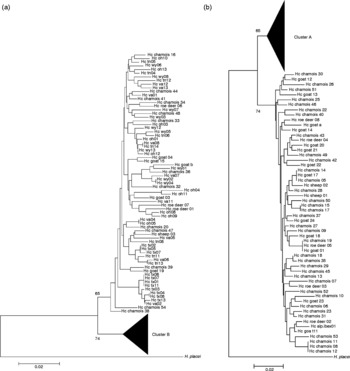
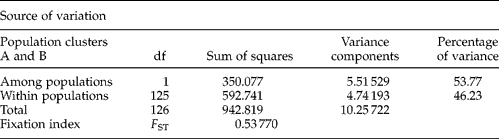
Phylogenetic analyses on the nd4 sequence alignment performed with neighbour-joining and maximum parsimony methods yielded trees with similar topologies, showing a subdivision of the H. contortus isolates into two main clusters (A and B, see fig. 1), both including isolates from different host species and from different areas. AMOVA confirmed the presence of these two clusters and evidenced high variability between cluster A and cluster B (table 4).
Phylogenetic tree based on partial mitochondrial NADH dehydrogenase subunit 4 (nd4) gene sequences (399 bp), showing a subdivision of the Haemonchus contortus isolates into two main clusters A and B, zooming on the cluster A sequences in (a) and on the cluster B sequences in (b). Accession numbers and codes for USA sequences – see (a) – are reported in table 2. The tree was generated using MEGA (neighbour joining; Kimura correction). Numbers adjacent to each node represent the bootstrap percentages (1000 repetitions). Haemonchus placei (accession number X78812) was included as an out-group.

AMOVA of two main clusters A vs. B using partial nd4 sequences of Haemonchus contortus.
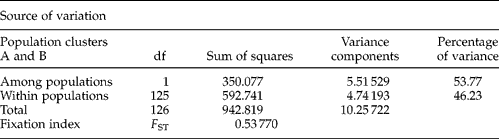
Significance tests (1023 permutations). P value = 0.00000 ± 0.00000.
Further analyses did not identify significant grouping between wild host vs. domestic, clusters from different geographic areas or from each different animal host species (data not shown).
Sequences obtained from sheep parasites from the USA show limited variability and are all grouped in cluster A. These data agree with the hypothesis of Blouin et al. (Reference Blouin, Yowell, Courtney and Dame1995), who, using mitochondrial markers, suggested the presence of one single population in H. contortus in the USA. The clustering of samples from the Alps with those from North America and the limited genetic variation in samples from America could indicate that these originated from European populations.
The average nucleotide difference between H. contortus individuals of cluster A is around 2.6%, while the average difference in cluster B is 3%. When considering the entire population analysed, the average difference between individuals is 4%. This average value is higher than the value estimated by Blouin et al. (Reference Blouin, Yowell, Courtney and Dame1997) on the USA population (2.6%), using the same mitochondrial marker.
Our results suggest that the higher variability observed in alpine sequences is due to several host-related factors such as: (1) they derive from different ruminant species; (2) they come from areas where the various receptive populations share pastures in summer–early autumn time when H. contortus transmission risk is at its highest, with the possibility of feral sheep and goats all year round; (3) the absence of anthelmintic selection pressure and consequent potential population bottlenecks that arrive in intensively managed flocks; (4) they derive from areas where transhumance is common husbandry, which implies host mobility and parasite gene flow.
Indeed, the relationship between a high degree of genetic diversity and animal husbandry has been reported in other trichostrongylid nematodes. In particular, the nucleotide diversity of mtDNA nd4 sequences is reported as tenfold higher in H. contortus, Teladorsagia circumcincta and Mazamostrongylus odocoilei, compared with Heterorhabditis marelatus (Grillo et al., Reference Grillo, Jackson, Cabaret and Gilleard2007). The authors compared the genetic variability of T. circumcincta populations from Europe and the USA and ascribed the lack of population sub-structuring in North America to a large effective size and a high degree of gene flow. This gene flow is probably due to frequent human-mediated movements of hosts, leading to the relative homogenization of parasite populations. Moreover, the gene flow between populations of nematode parasites is of practical importance considering that the migration of parasites may be mediated by livestock movements (Hunt et al., Reference Hunt, Knox, Le Jambre, McNally and Anderson2008). We hypothesize here that the situation in the alpine context (i.e. various types of breeding, different breeds and host species, feral animals, political and climatic barriers) is more open and fluid than in North America, where management practices are essentially closed and host variety is lower.
The analyses on nuclear genes confirm the species identity of adult males of H. contortus, and the hypothesis that one single Haemonchus species is moving between the domestic and wild populations examined.
In agreement with Stevenson et al. (Reference Stevenson, Chilton and Gasser1995), the ITS-2 partial alignment (228 bp) was obtained by aligning the sequences in table 5. This alignment (not shown) indicates interspecific variability between H. contortus and Haemonchus placei by the same number and type of base exchanges as reported in Stevenson et al. (Reference Stevenson, Chilton and Gasser1995) (transitions between purines G/A in three different positions: 22, 202 and 216). Moreover, one sequence for both (wild and domestic) host species was selected for comparison with ITS-2 GenBank sequences, confirming that H. contortus species from wild and domestic animals is the same.
GenBank ITS-2 sequences selected to compare the interspecific variability among two Haemonchus species.

D, domestic host; W, wild host.
The nucleotide sequences for second ITS region (ITS-2) of H. contortus and H. placei were used to the alignment (228 bp).
Regarding subdivision of the H. contortus populations based on mtDNA sequences, the results on ITS-1 and -2 did not reflect the two ND4-based clusters and instead showed very high levels of identity between isolates. In fact, phylogenetic analyses indicate very low levels of variation in ITS-2 (0.5–1.8% of the differences at a genus level) and complete identity for ITS-1 (data not shown). In addition, our results appear to be consistent with a higher sensitivity of mitochondrial genes in respect to ITS in detecting variability in small numbers of individuals (Vilas et al., Reference Vilas, Criscione and Blouin2005). A possible explanation is the smaller effective population size of mtDNA compared with nuclear genes.
Microsatellite markers having high levels of polymorphism have been used to investigate genetic divergence. We thus chose two microsatellites previously proven to be useful for population studies in H. contortus (Otsen et al., Reference Otsen, Plas, Lenstra, Roos and Hoekstra2000). These were sequenced for a subset of ten samples representative of the genetic diversity within each of the two main clusters. For both microsatellites, the ten sequences obtained were identical in the repeated region. These microsatellite loci, which were selected because they were the ones that better discriminated between the four populations analysed by Otsen et al. (Reference Otsen, Plas, Lenstra, Roos and Hoekstra2000), appear monomorphic with respect to the samples examined in our study.
The complete identity of all samples for these microsatellite markers could depend on the small numbers of individuals analysed and/or on the fact that the dataset effectively belongs to one single H. contortus population. Further investigations with other microsatellite loci are needed to assess further variation.
We can formulate two hypotheses from the analyses presented. The first assumes that there is no reproductive isolation between the two groups. Therefore, the two clusters could represent the trace of an ancestral polymorphism at geographic level between parasitic populations that then went back to a sympatric state. In fact, domestic and wild ruminant populations have had cycles of numerical and geographic expansion/reduction, caused, among other factors, by the spread and contraction of agriculture and breeding. Moreover, in the Alps, wild ruminants suffered a dramatic contraction, mostly until the first half of the 20th century, and, subsequently, a change in land use due to a drastic decline of traditional activities led to an increase in their populations (Pedrotti et al., Reference Pedrotti, Dupré, Preatoni and Toso2001). Therefore, it could be assumed that the helminth communities have followed the dynamics of the populations of the hosts.
Alternatively, the groups A and B, detected by mitochondrial data, could represent two different populations of H. contortus, separated by a partial reproductive isolation. The presence of genetically isolated groups could derive from various factors, such as different host specificity, and/or various adaptations to the environmental conditions (as in the case of T. circumcincta; Gasnier & Cabaret, Reference Gasnier and Cabaret1998; Hoberg et al., Reference Hoberg, Lichtenfels and Gibbons2004) as foreseen by models of sympatric speciation. However, our results show a lack of correlation between mitochondrial clusters and host species, and do not support the hypothesis that this differentiation might represent an incipient speciation.
The results reported here support the possible cross-infection between domestic and wild ruminants, highlighting the importance of defining the respective role of hosts in the epidemiology of H. contortus in the Alps. In particular, sheep and goats, due to their low economic profit in this context, experience reduced parasite control. Thus, considering the high H. contortus egg production, high pasture contamination can occur. A high risk of infection for the wild hosts may then follow when they graze the pastures grazed by livestock. Nevertheless, the transmission from wild host to domestic host cannot be excluded, including the probability that the parasite transmission could be bidirectional.
In conclusion, our study shows that the life cycles of H. contortus are not distinct (or isolated) between domestic and wild ruminants, suggesting that cross-transmission between them may occur in the Alps. To identify the principal reservoir role, further investigations to define the role of domestic and wild hosts are warranted (Haydon et al., Reference Haydon, Cleaveland, Taylor and Laurenson2002).
Acknowledgements
We thank Provincia of Lecco and Comprensori Alpini di Caccia ‘Alpi lecchesi’ & ‘Prealpi lecchesi’; Hunting Reserve Val Belviso-Barbellino, SO; Paneveggio-Pale di San Martino Natural Park, TN; and Jagd- und Fischerei inspektorat des Kantons Graubünden, Switzerland. Experimental laboratory work was supported by a MIUR-COFIN 2004 grant to P.L. We also thank D. Sassera for help in editing the manuscript.