


1 Obscured generalisations and the theory of opacity
Phonological generalisations can be partially obscured by their interactions with other phonological generalisations. In Optimality Theory (henceforth OT; Prince & Smolensky Reference Prince and Smolensky1993), the generalisations are expressed by ranked constraints, and a given constraint ℂ's generalisation is obscured in some environment E when ℂ is outranked by another constraint that conflicts with ℂ in environment E. In rule-based serialism (henceforth SPE; Chomsky & Halle Reference Chomsky and Morris1968), the generalisations are expressed by ordered rewrite rules, and a given rule ℝ's generalisation is obscured in some environment E when ℝ is ordered before another rule that rewrites any of the information crucially referenced by ℝ in environment E.Footnote 1
Because generalisations are expressed by different types of objects and their interactions in the two frameworks – constraints and ranking in OT, rules and ordering in SPE – different types of generalisation obscurity are possible in each framework. There is some overlap, but some attested types of obscured generalisations cannot be expressed with rules and ordering alone, which is a problem for SPE, and other attested types cannot be expressed with constraints and ranking alone, which is a problem for OT.
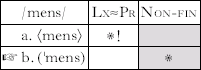
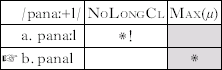
Obscured generalisations of the type that is problematic for SPE constitute some of the original motivation for OT. In their discussion of blocking (‘do something except when’) effects, Prince & Smolensky (Reference Prince and Smolensky1993) discuss how final syllable extrametricality is assigned in Latin except when the domain of stress assignment is monosyllabic. In SPE, this blocking effect can only be stated as an arbitrary exception to a rule of extrametricality assignment, unrelated to other aspects of prosodic structure.Footnote 2 By contrast, in OT the blocking effect follows from the ranking of two independently motivated constraints: Lx≈Pr, requiring that every lexical word be prosodified and thus stressed, ranked above Non-finality, requiring that final syllables not be parsed in (the head of) the head foot. This blocking interaction is shown in (1).
(1) Blocking of extrametricality by monosyllables in Latin

Obscured generalisations of the type that is problematic for OT have received pointed attention in more recent work, much of it as a negative response to the emergence of OT. This work typically makes specific reference to Kiparsky's (Reference Kiparsky and Dingwall1971: 621–622, 1973:79) surface diagnostics for obscured rule (=opaque process) generalisations, reproduced in (2). The substantive hypothesis behind Kiparsky's work in this area was that opaque generalisations are harder to learn than other, transparent generalisations. This was meant to explain Kiparsky's observation that there are examples of opacity that tend to become transparent over time for no apparent reason other than the opacity of the diachronically prior stages.Footnote 3
(2) A process ℙ of the form A→B / C_D is opaque to the extent that there are surface representations of the form:
a. A in the environment C_D [= non-surface-true/underapplication opacity], or;
b. B derived by ℙ in environments other than C_D [= non-surfaceapparent/overapplication opacity].Footnote 4
The terms in brackets are due to McCarthy (Reference McCarthy1999). If there are surface instances of A in the environment C_D, as in (2a), then the generalisation expressed by ℙ – that A should always become B in the environment C_D – is not true of the surface; hence ‘non-surface-true’. It's as if ℙ had not applied everywhere it should; hence ‘underapplication’. If there are surface instances of B derived by ℙ that occur in environments other than C_D, as in (2b), then the generalisation expressed by ℙ – that A should become B only in the environment C_D – is not apparent from the surface; hence ‘non-surface-apparent’. It's as if ℙ had applied in places where it shouldn't; hence ‘overapplication’.
In SPE, opacity of both types arises from a rule ℚ ordered after the rule corresponding to the process ℙ. Underapplication (2a) typically corresponds to counterfeeding rule orders, where ℚ creates strings to which ℙ could apply (ℚ potentially feeds ℙ), but because ℙ is ordered before ℚ, the generalisation expressed by ℙ is not true of the surface strings of the language. Likewise, overapplication (2b) typically corresponds to counterbleeding rule orders, where ℚ destroys strings to which ℙ could apply (ℚ potentially bleeds ℙ), but because ℙ is ordered before ℚ, the generalisation expressed by ℙ is true of the surface strings of the language but the reasons for ℙ's application are not apparent from those surface strings.
Recent work has focused almost exclusively on how opacity is a formal problem for OT, the prevailing view being that opaque generalisations as defined in (2) are an established natural class of phenomena with a complete and unified analysis only within SPE.Footnote 5 Virtually absent from this discussion is research probing the diagnostics in (2) themselves, with the aim of gathering examples that unexpectedly match or do not match those diagnostics. The research reported in this article aims to fill this gap.
My first goal is to demonstrate that at least four distinct types of overapplication opacity as defined in (2b) are attested, three in addition to counterbleeding. Two of these three additional types of overapplication opacity are of particular interest precisely because they involve feeding orders in an SPE analysis, and feeding orders are prototypically transparent. To the best of my knowledge, none of these additional cases has been properly described and classified in previous work.
My second goal is to examine how these cases can be analysed in SPE and in OT. The results of this examination challenge the prevailing view noted above. As it turns out, the essential tools of both frameworks (rules and ordering in SPE, constraints and ranking in OT) each have strengths and weaknesses when it comes to the analysis of overapplication opacity. This work thus builds on and refines some results of McCarthy (Reference McCarthy1999), where it was shown that not all examples of opacity as defined in (2) are problematic for OT. McCarthy (Reference McCarthy1999: 332) summarises the situation for OT ‘[as it] is currently understood’ with respect to the analysis of opacity as follows:
Unless further refinements are introduced, OT cannot contend successfully with any non-surface-apparent generalisations [overapplication, (2b)] nor with a residue of non-surface-true generalisations [underapplication, (2a)].
I argue that this conclusion is justified only to the extent that overapplication opacity consists solely of interactions that involve what in an OT analysis would be a gratuitous violation of a faithfulness constraint. Counterbleeding, as discussed by McCarthy and reviewed in §3 below, is a case of this type. So is the first new type of overapplication opacity that I introduce in this article, the type which I call self-destructive feeding and which is discussed in §4. Both counterbleeding and self-destructive feeding submit to relatively simple SPE analyses involving a specific order between two rules, while a successful OT analysis of either case requires the kinds of ‘further refinements’ noted by McCarthy.
The second type of overapplication opacity presented here is what I call non-gratuitous feeding, discussed in §5. As the name suggests, an OT analysis of non-gratuitous feeding is possible because it does not involve a gratuitous faithfulness violation. Indeed, standardly accepted analyses of typical examples of non-gratuitous feeding independently minimised the role of serial derivations in favour of representational constraint satisfaction in the 1980s and early 1990s, even before the advent of OT.
The third type of overapplication opacity uncovered in this article, cross-derivational feeding, is discussed in §6. This is perhaps the most interesting type, because a successful analysis of it involves an unprecedented type of global interaction: a feeding relationship across separate potential derivations of the same form. This global interaction is similar though not identical to the type found in conspiracies, which are notoriously problematic for SPE (Kisseberth Reference Kisseberth1970) and not at all a problem for OT (Pater Reference Pater, Kager, Hulst and Zonneveld1999, McCarthy Reference McCarthy2002). Not surprisingly, then, an OT analysis of cross-derivational feeding is straightforward, and in this case it is SPE that requires further refinements in order to contend successfully with it.
A particularly informative class of process interactions, which I call concealed free rides, is discussed in §7. I show that the SPE analysis of this subset of the more general class of ‘free rides’ (Zwicky Reference Zwicky1970) is a special case of self-destructive feeding. Unlike the type of self-destructive feeding discussed in §4, however, a straightforward analysis of a concealed free ride is possible in OT – and, as it turns out, that analysis is another example of cross-derivational feeding. What makes concealed free rides even more interesting is how they differ from both self-destructive feeding and cross-derivational feeding: somewhat counterintuitively, neither process involved in a concealed free ride is opaque by either clause of the definition of opacity in (2). While this result appears to expose a flaw in the definition of opacity, I suggest instead that it reveals the limits of our current understanding of the substantive coherence of opaque generalisations, where more empirical work desperately needs to be done.
The discussion proceeds as follows. I briefly review in §2 the difference between the cases of underapplication that are unproblematic for OT and the ‘residue’ of underapplication that presents a problem for the theory. This is followed in §§3–7 by discussion of each of the process interactions described above, and §8 summarises and concludes.
2 Underapplication/counterfeeding
The ‘residue’ of underapplication opacity that is not directly amenable to analysis in OT is what McCarthy (Reference McCarthy1999) calls counterfeeding-on-environment, as opposed to the type of underapplication opacity that is unproblematic in OT, counterfeeding-on-focus.Footnote 6 McCarthy's analysis of Bedouin Arabic furnishes examples of both types of underapplication opacity, as shown in (3).Footnote 7
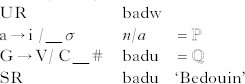
(3) Two types of underapplication opacity in Bedouin Arabic (McCarthy Reference McCarthy1999)
a. counterfeeding-on-focus
b. counterfeeding-on-environment
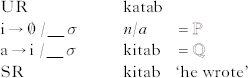
Without repeating too much of McCarthy's discussion, the distinction between these two examples amounts to the following. In the counterfeeding-on focus case in (3a), otherwise known as a chain shift, if the two rules involved were ordered such that ℚ precedes and thus feeds ℙ then both rules would apply to the same segment. What is necessary in an OT analysis, then, is to establish that  ≻i≻a in the relevant context (≻=‘is more harmonic than’), and for the otherwise predicted transitivity of the a→i→ chain to be broken by a faithfulness constraint against the ‘fell swoop’ change a→ (see Orgun Reference Orgun1995, Kirchner Reference Kirchner1996, Gnanadesikan Reference Gnanadesikan1997 and Moreton & Smolensky Reference Moreton and Paul2002 for relevant proposals).
In the counterfeeding-on-environment case in (3b), on the other hand, if ℚ precedes and feeds ℙ then both rules would again apply, but this time not to the same segment. ℚ instead crucially provides an environment in which ℙ could apply. The problem for an OT analysis in this case is that, in order to break the transitivity of the adw→adu→idu chain, there would need to be a very complex faithfulness constraint against the ‘fell swoop’ change adw→idu, crucially involving more than just one segment. Such a complex constraint could be devised in the relatively unrestricted version of the theory of local constraint conjunction discussed by Moreton & Smolensky (Reference Moreton and Paul2002) ; see McCarthy (Reference McCarthy1999: 366) for discussion.Footnote 8
In SPE, both cases submit to exactly the same analysis. The difference between them amounts to nothing more significant than the difference in the logical relationships between the strings acted on by the rules: both rules affect the same element in the counterfeeding-on-focus case in (3a), and one rule affects the context of application of the other in the counterfeeding-on-environment case in (3b). The consequences of the difference between (3a) and (3b) are thus only made clear by the attempt to analyse both cases in OT. This subclassification of underapplication opacity thus allows for a deeper understanding of opaque generalisations and of each theory's contribution to that understanding. For example, it may be that all cases of underapplication opacity indeed behave in the same basic way, as reflected in the SPE analysis, or it may be that counterfeeding-on-focus and counterfeeding-on-environment behave differently in specific, identifiable ways, as seems to be the case for OT.
Coincidentally, a striking demonstration of the utility of this subclassification approach can be found in the work that led to the important shift from Kiparsky's (Reference Kiparsky, Bach and Harms1968: 200) original hypothesis that ‘rules tend to shift into the order which allows their fullest utilization in the grammar’, which favours feeding and counterbleeding orders, to Kiparsky's (Reference Kiparsky and Dingwall1971: 623) opacity hypothesis that ‘rules tend to be ordered so as to become maximally transparent’, which favours (certain) feeding and bleeding orders. As originally noted by Kenstowicz & Kisseberth (Reference Kenstowicz, Kisseberth and Kisseberth1971), there exist two different types of bleeding order: one in which a rule ℙ bleeds another rule ℚ because ℙ crucially changes the segment that ℚ would have applied to (which we might call ‘bleeding-on-focus’) and another in which a rule ℙ bleeds another rule ℚ because ℙ changes the environment that would have conditioned ℚ (‘bleeding-on-environment’). Kenstowicz & Kisseberth provide evidence that examples of bleeding-on-environment are natural and diachronically stable, and argue that all of Kiparsky's (Reference Kiparsky, Bach and Harms1968) evidence for favouring counterbleeding comes from examples of bleeding-on-focus. Kiparsky (Reference Kiparsky and Dingwall1971) thus abandoned the original ‘fullest utilisation’ hypothesis, accounting for his previous examples as discussed in Footnote note 3 above, and for the markedness of counterbleeding orders elsewhere with the definition of overapplication opacity in (2b).
The subclassification approach is taken throughout this article in demonstrating the existence of several distinguishable types of overapplication opacity as defined in (2b), and to examine the implications of their analysis in SPE and OT. We begin with the one well-known type of example, counterbleeding.
3 Counterbleeding
Counterbleeding rule interactions are the only cases of overapplication opacity discussed as such in the relevant literature. McCarthy's (Reference McCarthy1999) Yokuts example involves the counterbleeding interaction between long vowel lowering and closed syllable shortening shown in (4).
(4) Counterbleeding in Yokuts (McCarthy Reference McCarthy1999)

The long vowel lowering rule ℙ overapplies in this derivation: because the subsequent application of the closed syllable shortening rule ℚ shortens the lowered vowel, the motivation for lowering in the first place is not apparent on the surface. If the order between the two rules were switched, only closed syllable shortening ℚ would apply, bleeding long vowel lowering ℙ, and /ʔiliː+l/ would surface as *[ʔilil].
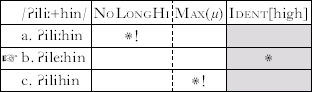
The OT analysis of each of the independent processes is straightforward. Long vowel lowering is due a markedness constraint against long high vowels, call it NoLongHigh, ranked above a faithfulness constraint against lowering the high vowel, Ident[high]. Since shortening would also satisfy NoLongHigh, a faithfulness constraint against shortening, Max(μ), must also be ranked above Ident[high].
(5) Long vowel lowering = ℙ
Closed syllable shortening, on the other hand, is due to a markedness constraint against long vowels in closed syllables, call it NoLongClosed, ranked above Max(μ). Since lowering would in this case not be a way to satisfy NoLongClosed, the fact that Max(μ) is ranked above Ident[high] is irrelevant.
(6) Closed syllable shortening = ℚ
The problem for OT is the counterbleeding interaction between the two processes illustrated in (4). Both processes apply – that is, both faithfulness constraints are violated – but the application of only one of them is all that is strictly necessary to satisfy the two markedness constraints. Specifically, shortening in a closed syllable alone (that is, violation of Max(μ)) would satisfy NoLongHigh as well as NoLongClosed. The additional application of long vowel lowering – more specifically, the additional violation of Ident[high] – appears to be gratuitous in this case. This is shown in (7) (the intended optimal candidate is indicated with ☜).
(7) Failure of counterbleeding in OT
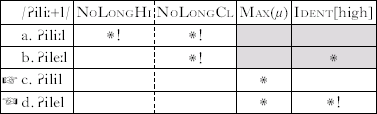
The faithful candidate in (7a) incurs fatal violations of both markedness constraints. The lowering candidate in (7b) successfully fends off violation of NoLongHigh but not of NoLongClosed. Since the shortening candidate in (7c) takes care of both markedness violations, application of both lowering and shortening in the actual output (7d) is unnecessary. There is no reason for lowering to overapply here.
A rather direct way to address this problem in OT is to devise a complex constraint that specifically penalises the shortening-only candidate in (7c) – e.g. a constraint against shortened high vowels – and to have it dominate Ident[high]. Local conjunction (Smolensky Reference Smolensky1993, Reference Smolensky1995, Reference Smolensky1997) provides the means for such a constraint, which would be a conjunction of markedness and faithfulness: NoHigh&Max(μ). (Such local conjunctions were originally employed by Łubowicz 2002 in the analysis of derived environment effects, and later by Ito & Mester (Reference Ito, Mester, Féry and Vijver2003) in the analysis of counterbleeding and certain mutual bleeding interactions that are otherwise problematic for OT.) This solution is shown in (8).
(8) Local conjunction solution to counterbleeding in OT
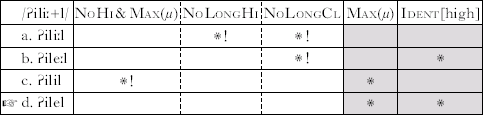
There are two main drawbacks to the local conjunction solution just sketched. The first is the invocation of a questionable constraint, NoHigh, as the markedness conjunct of the local conjunction. The second, more serious drawback is that this solution establishes no direct connection between the independent lowering and shortening processes: neither of them requires or makes use of the local conjunction. The SPE solution, by contrast, establishes the connection directly via ordering of the two rules. Now, neither of the processes on its own makes use of ordering either – precisely because each process is embodied in a single rule – but there's a clear sense in which the OT solution in (8) requires local conjunction in addition to constraints and ranking, whereas the SPE analysis in (4) only requires rules and ordering.
Another, more representationally oriented solution, turbidity (Goldrick & Smolensky Reference Goldrick and Paul1999, Goldrick Reference Goldrick2000), would involve positing a distinction between ‘projected’ and ‘pronounced’ vowel length. In this solution, shortening is crucially the result of projecting but not pronouncing the second mora of a long vowel, in violation of a constraint requiring mora pronunciation, Pron(μ), rather than Max(μ). In addition, the NoHighLong constraint must penalise high vowels with two projected moras regardless of whether they are both pronounced (NoProjLongHigh), and the NoLongClosed constraint must penalise long vowels in closed syllables only if both moras are pronounced (NoPronLongClosed). In this case, the connection between lowering and shortening is indirectly mediated via the hidden projected-but-not-pronounced moras, underlined in (9).
(9) Turbidity solution to counterbleeding in OT
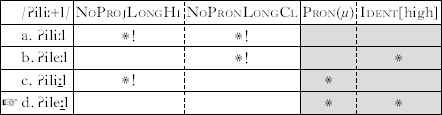
The benefit of this solution over the local conjunction solution in (8) is that in (9), the closed syllable shortening process on its own also makes use of the hidden projected-but-not-pronounced moras necessary for the counterbleeding interaction with long vowel lowering. But of course, an analysis of closed syllable shortening on its own is possible without any of this hidden structure, as in the unadorned OT analysis of closed syllable shortening in (7); in other words, the only actual motivation for the projection/pronunciation distinction is to account for the counterbleeding interaction. Again, there's a clear sense in which the OT solution in (9) requires turbid representations in addition to constraints and ranking, whereas the SPE analysis in (4) only requires rules and ordering.
4 Self-destructive feeding
Kiparsky (Reference Kiparsky and Dingwall1971: 612) claims that ‘the unmarked status of feeding order is not subject to any serious doubt’, meaning that feeding orders clearly involve full utilisation of rules (following the Kiparsky Reference Kiparsky, Bach and Harms1968 theory of rule-order markedness) and that they are clearly transparent (following the Kiparsky Reference Kiparsky and Dingwall1971, Reference Kiparsky and Fujimura1973 theory of rule-order markedness). Interestingly, there are some types of overapplication opacity that involve feeding rule orders, so feeding orders are not so clearly transparent after all. One such type of overapplication is what I call self-destructive feeding, an example of which is shown in (10).Footnote 9
(10) Self-destructive feeding in Turkish (Sprouse Reference Sprouse1997)

In Turkish, the vowel-epenthesis rule ℙ sows the seeds of its own non-surface-apparentness by applying even between word-final consonant clusters where the first, stem-final consonant of the cluster is a /k/ (or a velar stop more generally, depending on details of the analysis that are not germane here). The result of vowel epenthesis places the stem-final /k/ in the crucial intervocalic position that causes it to undergo the velar stop deletion rule ℚ. This now-deleted /k/ was of course a crucial part of the environment for the prior vowel-epenthesis rule ℙ, which has thus overapplied. This is thus technically speaking a case of self-destructive feeding-on-environment (the significance of which I return to in §7.3 below.)
A reviewer asks for evidence that the relevant vowel is epenthetic rather than underlying here; under this alternative analysis, note that a vowel-deletion rule would be necessary to account for e.g. /baba+in/→[baban] ‘your father’.Footnote 10Lees (Reference Lees1961: 37–38) and Yavaş (Reference Yavaş1980: 74ff) both favour an epenthesis analysis in the case of final clusters in loanwords, and epenthetic vowels in Turkish generally are indeed high, but this does not in principle preclude a deletion analysis of the alternating possessive morpheme at hand. However, there is another rule in Turkish that self-destructively feeds velar stop deletion: a rule that deletes the continuants /s/ (of the 3rd person singular possessive suffix) and /j/ (of the dative suffix) after consonants. The self-destructive feeding interaction between the two rules is shown in (11).
(11) More self-destructive feeding in Turkish (Kenstowicz & Kisseberth 1979)

In this case, the continuant-deletion rule ℙ sows the seeds of its own non-surface-apparentness by applying even after a stem-final /k/. The result of continuant deletion places the stem-final /k/ in the crucial intervocalic position that causes it to undergo the velar stop deletion rule ℚ. This now deleted /k/ was of course a crucial part of the environment for the prior continuant deletion rule ℙ, which has thus overapplied. Now, unlike vowel epenthesis, the alternation between continuants and their absence cannot possibly submit to an alternative analysis, because the choice between hypothetically epenthetic [s] and [j] would not be predictable (except perhaps as an arbitrary function of the suffix).
Because self-destructive feeding involves overapplication, and because feeding interactions are prototypically transparent, self-destructive feeding is easy to misidentify as counterbleeding; see, for example, Moreton & Smolensky (Reference Moreton and Paul2002: 315) and Potts & Pullum (Reference Potts and Pullum2002: 384–385), who both misidentify the case in (10) in exactly this way. But it can't be a case of counterbleeding, because the opposite order of the relevant rules does not result in a bleeding interaction. The velar stop is not yet intervocalic before application of velar stop deletion (=ℚ) under the ℚ-before-ℙ order, and so ℚ would simply not apply – leaving ℙ to apply alone, resulting in *[bebekin] in (10) or *[ajakɯ] in (11). The generalisation expressed by ℚ in these hypothetical ℚ-before-ℙ orders would thus be non-surface-true; in other words, the relevant derivations would exhibit counterfeeding-on-environment opacity rather than bleeding.
Again, the OT analysis of each of the independent processes is straightforward.Footnote 11 Suppose vowel epenthesis is due to a markedness constraint against tautosyllabic consonant clusters, NoComplex, ranked above a faithfulness constraint against vowel epenthesis, Dep(V). Since consonant deletion is in principle an alternative to vowel epenthesis that would also satisfy NoComplex, a faithfulness constraint against consonant deletion, Max(C), must also be ranked above Dep(V). This is shown in (12).
(12) Vowel epenthesis = ℙ
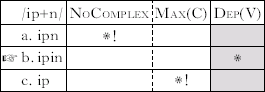
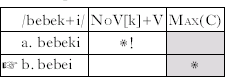
Velar stop deletion, on the other hand, is due to a markedness constraint against morpheme-final intervocalic velar stops, NoV[k]+V, ranked above Max(C). Since vowel epenthesis would in this case not be an alternative way to satisfy NoV[k]+V, the fact that Max(C) is ranked above Dep(V) is irrelevant.
(13) Velar stop deletion = ℚ
The (failed) attempt at an OT analysis of the self-destructive feeding interaction between these two processes, shown in (14), further clarifies how different it is from counterbleeding.
(14) Failure of self-destructive feeding in OT
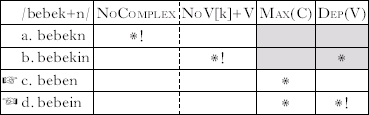
The crucial difference is evident from the faithful candidate in (14a), which violates only one of the two markedness constraints: NoComplex, but not NoV[k]+V. Compare this with the corresponding faithful candidate in the failed attempt at a counterbleeding analysis in (7) above, which violates both of the two markedness constraints, NoLongHigh and NoLongClosed.
The candidate with vowel epenthesis alone in (14b) is the one that introduces the crucial NoV[k]+V violation, requiring velar stop deletion. But velar stop deletion alone, as in (14c), would be sufficient to satisfy both markedness constraints; the additional violation of Dep(V) in the actual output in (14d) is gratuitous, in the same way that the violation is Ident[high] is gratuitous in the corresponding actual output candidate in the failed counterbleeding analysis in (7). It is that gratuitous faithfulness violation that led McCarthy (Reference McCarthy1999: 358) to conclude that ‘counterbleeding interaction leads to non-surface-apparentness [=overapplication; EB], which is invariably problematic for OT's output orientation’. The case of self-destructive feeding shows that gratuitous faithfulness violations result not only from counterbleeding, and that it is exactly this aspect of both types of overapplication that presents a problem for OT.
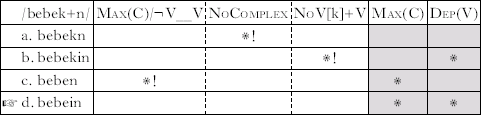
Not surprisingly, potential solutions to the self-destructive feeding problem for OT are somewhat similar to those for counterbleeding. For example, one could devise a complex constraint that penalises the optimal candidate in (14c) and that dominates Dep(V), but in this case it would have to be a constraint that specifically penalises deletion of a consonant in non-intervocalic contexts (Max(C)/¬V—V), something that is even more questionable than the local conjunction invoked for counterbleeding in (8) and which is required specifically for the analysis of opacity in addition to constraints and ranking.
(15) Complex constraint solution to self-destructive feeding in OT
Another possible solution involves turbidity. Under this analysis, velar stop deletion would be the result of projecting but not pronouncing the velar stop (or its root node); this violates a constraint requiring consonant pronunciation, Pron(C), rather than Max(C). In addition, the NoComplex constraint would need to penalise projected consonant clusters regardless of whether either of the consonants in the cluster is pronounced (NoProjComplex), and the NoV[k]+V constraint would need to penalise intervocalic velar stops only if they are pronounced (NoPronV[k]+V). This solution is shown in (16).
(16) Turbidity solution to self-destructive feeding in OT
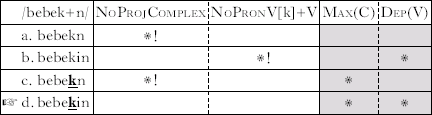
This solution has exactly the same advantages as the turbidity solution to counterbleeding (9), and is also subject to exactly the same criticisms levelled against that solution. The velar stop deletion process on its own also makes use of the hidden projected-but-not-pronounced consonants necessary for the self-destructive feeding interaction with vowel epenthesis, but an analysis of deletion is possible without this hidden structure, as in (13); the only motivation for turbidity is to account for the self-destructive feeding interaction. Yet again, the OT solution in (16) requires turbid representations in addition to constraints and ranking, whereas the SPE analysis in (10) only requires rules and ordering.
Counterbleeding and self-destructive feeding are both examples of overapplication opacity and both involve what appears on the surface to be unmotivated process application or gratuitous faithfulness violation. However, it is not the case that all examples fitting the definition of overapplication opacity in (2b) involve gratuitous faithfulness violations, and such cases are amenable to analysis in OT.
5 Non-gratuitous feeding
We turn now to another, perhaps more familiar type of pattern, but one which as far as I know has not been previously diagnosed as one that fits the definition of overapplication opacity in (2b).Footnote 12 In Classical Arabic, a vowel-copy epenthesis rule ℙ crucially feeds a glottal stop epenthesis rule ℚ. Because the appearance of ℙ's motivating environment is crucially altered by ℚ, the application of ℙ is non-surface-apparent – but crucially not gratuitous, which is why I call this a case of non-gratuitous feeding.
(17) Non-gratuitous feeding in Classical Arabic (McCarthy Reference McCarthy1999)

One could object, at least in the case of this particular example, that the apparently opaque interaction involved is just an artefact of the representationally linear statements of these rules. It is well established in phonological theory that epenthesis processes like those illustrated in (17) are to be analysed in terms of syllables and syllabification, and such non-linear analyses may not involve any opaque interaction between the two processes. However, careful consideration of what a successful version of such an alternative non-linear analysis must involve shows either that the opaque interaction is simply shifted onto other rules or that the right analysis of the facts should involve constraints and not rules in the first place.
One alternative is to assume that vowel-copy epenthesis applies in order to syllabify otherwise unsyllabifiable consonants, and that syllabification applies persistently. The derivation of the relevant Classical Arabic form under this alternative is shown in (18), with syllabification indicated by parentheses.
(18) Non-gratuitous feeding in Classical Arabic with persistent syllabification
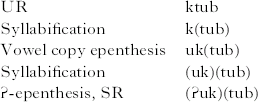
The first pass of syllabification identifies the word-initial consonant as unsyllabifiable. Then, a copy vowel is epenthesised before this crucially unsyllabified consonant; this is followed by a reapplication of syllabification, which syllabifies the erstwhile word-initial consonant as a coda of the syllable headed by the epenthetic vowel. Notice that the environment motivating vowel-copy epenthesis is already gone at this point in the derivation; in other words, vowel-copy epenthesis still overapplies, but this time it is due to the persistent reapplication of syllabification and regardless of whether there is a glottal stop epenthesis rule. This is because the motivation for vowel-copy epenthesis in (18) is to make the first consonant of a word-initial cluster syllabifiable; that consonant is subsequently syllabified, rendering the motivation for vowel-copy epenthesis non-apparent on the surface. In fact, it can be said that all ‘repair rules’ are opaque in this same way: a repair takes a representation that meets some condition relevant to the surface truth of some other generalisation and returns a representation that no longer meets that condition, obscuring the motivation for the repair in the first place. In the case at hand, it is the surface truth of persistent syllabification that is relevant – the underlying representation contains an unsyllabifiable consonant – and vowel-copy epenthesis applies non-surface-apparently in order to make the consonant syllabifiable.
Another non-linear alternative would be one in which epenthesis is a by-product of the imposition of a syllabic template (Itô Reference Itô1989). This gets rid of the whole issue of ordering between the two epenthesis processes, because they can now be analysed as simultaneous responses to syllabic template imposition: the word-initial consonant is associated with the coda of the syllabic template, the nucleus and onset of which are simultaneously filled by the relevant epenthetic segments. This is shown in (19).
(19) Non-gratuitous feeding in Classical Arabic with syllabic template imposition

It is worth reflecting on the success of non-linear analyses like the one in (19) and the import of this success for SPE and OT. The reason this type of analysis succeeds in getting rid of the whole issue of ordering between rules is because it relies instead on the idea that an output condition – a template – must be satisfied. This type of analysis is in all relevant respects the precursor of a typical OT analysis, where input–output disparities (=violations of faithfulness constraints, like those violated by epenthetic segments) are responses to well-formedness conditions (=markedness constraints, like those responsible for syllabification and syllabic structure). A syllabic template is, in essence, a constraint to be satisfied.
Indeed, the OT analysis of this sort of example is very straightforward. Vowel-copy epenthesis is due to the ranking of NoComplex over Dep(V), and glottal stop epenthesis is due to the ranking of Onset over Dep(C). So long as NoComplex also dominates Dep(C), then an input with an initial consonant cluster will undergo both epentheses, as shown by the tableau in (20).
(20) Non-gratuitous feeding in OT
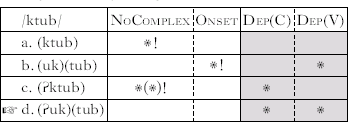
The optimal candidate [(ʔuk)(tub)] in (20d) is favoured over the fully faithful candidate [(ktub)] in (20a), because NoComplex dominates both Dep(C) and Dep(V). The optimal candidate in (20d) is also favoured over the candidate with only vowel-copy epenthesis, [(uk)(tub)] in (20b), because Onset dominates Dep(C). Note that the candidate with only glottal stop epenthesis, [(ʔktub)] in (20c), is harmonically bounded by the fully faithful candidate in (20a), either because of the violation of Dep(C) alone or because of both Dep(C) and NoComplex, depending on whether NoComplex distinguishes initial CCCV from CCV (hence the parenthesised asterisk in the NoComplex column for (20c)).
Note in particular the parallels between the constraint-violation profiles in (20) and those for either of the solutions to self-destructive feeding in (15) and (16), particularly with the turbidity solution in (16). The reason non-gratuitous feeding works in OT is because the markedness constraint responsible for process ℙ (here NoComplex, responsible for vowel-copy epenthesis) penalises not only the faithful candidate (20a) but also the candidate that undergoes only process ℚ (glottal stop epenthesis, (20c)). This is what both solutions to self-destructive feeding attempt to achieve; the turbidity solution in (16) does it by redefining the constraints and candidates themselves – in a relatively ad hoc but nevertheless effective manner – such that the candidates have roughly the same constraint-violation profiles as their corresponding candidates in the case of non-gratuitous feeding (20). (The complex constraint solution to self-destructive feeding in (15) achieves the same result, but with a separate, ad hoc complex constraint.)
Now consider the counterfeeding interaction that is predicted to be possible given the SPE rules in (17). If glottal stop epenthesis were to be ordered before vowel-copy epenthesis, only underlyingly vowel-initial words would undergo glottal stop epenthesis and these words would thus be distinguished from underlyingly consonant cluster-initial words, which would undergo vowel-copy epenthesis only. In other words, glottal stop epenthesis would underapply, given this order of the rules; the generalisation expressed by glottal stop epenthesis – that no words begin with vowels – would be non-surface-true.
The most straightforward OT analysis of this hypothetical case would be the kind discussed in relation to counterfeeding-on-environment in (3b). The crucial violation of Onset in those surface forms where glottal stop epenthesis underapplies would be due to the higher rank of both NoComplex and the local conjunction of the two faithfulness constraints (Dep(C)&Dep(V)), violated by the application of both epentheses to the same form (or, more specifically, adjacent to each other). Again, we are faced with a situation in which SPE predicts both rule orders to be on more or less equal grammatical footing, while OT predicts a non-gratuitous feeding interaction to be the consequence of a particular ranking among simple constraints, the re-ranking of which cannot by itself describe a counterfeeding interaction.
6 Cross-derivational feeding
6.1 Epenthesis and assimilation in Lithuanian
In Baković (Reference Baković2005) I argued for a rather unusual kind of process interaction in a set of prefix alternations in Lithuanian, resulting in a very different sort of overapplication opacity. The relevant facts are as presented in (21) and (22). (All Lithuanian examples cited here are drawn from Dambriūnas et al. (Reference Dambriūnas, Klimas and Schmalstieg1966), Kenstowicz & Kisseberth (Reference Kenstowicz, Kisseberth and Kisseberth1971), Kenstowicz (Reference Kenstowicz1972), Mathiassen (Reference Mathiassen1996) and Ambrazas (Reference Ambrazas1997) ; very special thanks are due to Solveiga Armoskaite for helpful elucidation and amplification of the data set.)
One process is assimilation: the consonant of each of the distinct verbal prefixes /at/ and /ap/ assimilates to an adjacent stem-initial consonant in terms of voicing and palatalisation.Footnote 13
(21) Lithuanian voicing and palatalisation assimilation

The other process is epenthesis: if the initial consonant of a stem is identical to the prefix-final consonant or differs from it only in terms of voicing or palatalisation (or both), /at/ and /ap/ surface as [atʲi] and [apʲi] respectively (with automatic palatalisation before the epenthetic [i]; see Footnote note 13).
(22) Lithuanian vowel epenthesis

It is of course possible to describe the relevant Lithuanian facts with a conventional SPE derivation. We can take as our starting point the analysis discussed in textbook form by Odden (Reference Odden2005: 113–115). Odden offers the two rules in (23). (Odden's transcriptions and discussion of assimilation do not include palatalisation, and I follow suit in my discussion of Odden's analysis except where noted otherwise.)
(23) Rules for Lithuanian epenthesis and assimilation (Odden 2005)
a. Epenthesis
b. Assimilation
obstruent→voiced_voiced obstruent
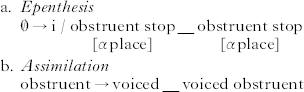
Note that epenthesis is stated to apply between homorganic obstruent stops – effectively, between consonants that differ at most in voicing (and, in the full analysis, palatalisation as well). By ordering epenthesis before assimilation, as Odden does, we have a bleeding-on-environment interaction between the two rules. A relevant example is derived in (24). Epenthesis applies first between the homorganic obstruent stops. Since these stops differ in voicing, this earlier application of epenthesis crucially bleeds the later assimilation rule by destroying the context necessary for the application of assimilation.
(24) Epenthesis must precede and bleed assimilation

Crucially missing in this descriptively satisfactory analysis, however, is a successful explanation of the fact that the assimilation rule is bled in precisely those contexts where it would otherwise create pairs of completely identical adjacent consonants. The paragraph just before Odden's statement of the epenthesis rule (unintentionally) reveals precisely this teleological weakness of the analysis: ‘Lithuanian does not allow sequences of identical consonants, so to prevent such a result, an epenthetic vowel is inserted between homorganic obstruent stops’ (Odden Reference Odden2005: 115).
An anonymous reviewer asks whether a feature-geometric representation would help to express the homorganicity requirement on the epenthesis rule in (23a).Footnote 14 Identity could be required on adjacent Place (or C-Place) nodes, which reside on a tier distinct from laryngeal features like voicing and secondary articulations like palatalisation. There are two significant problems with this idea. First, standard models of feature geometry house the features most likely to be involved in palatalisation under the relevant Place node, leaving little justification for this reviewer's suggestion that it is ‘generally assumed [that] palatalisation is represented under V-Place, in which case it will be independent of specifications for primary place of articulation (on C-Place)’. In Clements & Hume's (Reference Clements and Hume1995: 292) model, for example, V-Place is (indirectly) dominated by C-Place; an identity requirement on C-Place would thus entail identity of V-Place as well. Similarly, in the model proposed by Halle et al. (Reference Halle, Vaux and Wolfe2000: 389), Place dominates the Tongue Body and Tongue Blade nodes which between them include all of the features ([back], [anterior], [coronal], etc.) that are most likely to be involved in palatalisation (see also Halle Reference Halle1995: 2). Again, requiring identity on Place entails requiring identity on these nodes and all of their dependent features.
Second, and more importantly, my point here and in Baković (Reference Baković2005) is not that a homorganicity requirement is representationally inexpressible, it's that such a requirement fails to relate this requirement to anything else about the grammar of Lithuanian. The question is why certain features are ignored in the determination of identity for the purposes of epenthesis; my proposed answer is that it is because of the interaction of epenthesis with assimilation. The feature-geometric answer suggested by the reviewer is that it is because C-Place is an independent node in the representation of a segment, and that epenthesis (or any process) can require identity of any node. (And if not any node, then the question becomes: which nodes?) But even if a C-Place node that includes all and only the right features can be motivated independently – and as noted in the paragraph immediately above, this is certainly not the generally accepted view – it remains a complete accident that, in Lithuanian, identity for the purposes of epenthesis is required for the node that just so happens to exclude just those features that independently assimilate.Footnote 15
In sum, the epenthesis rule as stated in (23a) misses the generalisation that voicing is ignored not as an arbitrary function of the rule, but specifically due to its interaction with the assimilation rule in (23b). The epenthesis rule should instead be stated such that it applies between adjacent identical consonants only. The fact that an epenthetic vowel also surfaces between relevant near-identical consonants – that is, the fact that epenthesis overapplies in the (2b) sense – must somehow follow from some interaction between epenthesis and assimilation. In SPE, the only possible interaction is rule ordering, but, as shown in (25), the right result cannot be reached with either of the two possible orders between epenthesis (stated so as to apply between adjacent identical consonants only) and assimilation (still stated as in (23b)).
(25) Possible ordered interactions between epenthesis and assimilation
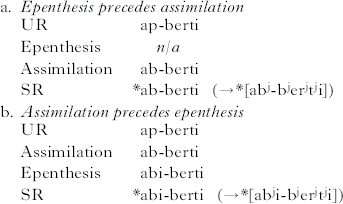
The reason this analysis fails is because the SPE derivation of a form proceeds one step at a time, with each rule taking as its input the representation that is the output of the immediately preceding rule in the order (or the underlying representation, in the case of the very first rule). Some work in the SPE framework, most notably by Kiparsky (Reference Kiparsky and Fujimura1973), attempted to restrict the possibilities of ‘looking back’ to some earlier point in the derivation (e.g. blocking in non-derived environments) and for ‘looking forward’ to some later point in the derivation (e.g. blocking of the immediate output of a rule). But the problem in the present case is neither one of looking back nor one of looking forward, but rather one of looking over to a counterfactual result along a separate, parallel derivational path. An attempt to represent what this analysis of Lithuanian would have to look like is given in annotated form in (26), clarifying the term that I choose to use for this type of pattern: cross-derivational feeding.
(26) Cross-derivational feeding in Lithuanian
ℚ=assimilation counterfactually applies, resulting in disallowed adjacent identical consonants
ℙ=epenthesis overapplies between near-identical consonants, resulting in surface representation
ℱ=cross-derivational feeding relationship
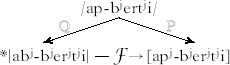
Rule ℚ applies in a counterfactual derivational step, the output of which is, as a result, subject to rule ℙ. Rather than ℚ directly feeding ℙ, however, ℙ alone applies along a separate, actual derivational path. This economically renders both ℙ and ℚ surface-true; however, ℙ overapplies because the motivation for its application was the counterfactual application of ℚ.Footnote 16 This type of example, which is technically a case of cross-derivational feeding-on-environment (see §7.3), is problematic for SPE because it involves the crucial feeding relation ℱ across parallel derivations, one of them counterfactual. Like looking back and looking forward, the problem presented by cross-derivational feeding-on-environment is one of globality, and as discussed in §§6.2–§6.3 below, this type of global interaction has a straightforward analysis in OT.
Interestingly, the standard bleeding-on-environment analysis of Lithuanian assimilation and epenthesis in (24) formed a crucial part of Kenstowicz & Kisseberth's (Reference Kenstowicz, Kisseberth and Kisseberth1971) challenge to Kiparsky's (1968) hypothesis that was noted at the end of §2. Kiparsky's hypothesis was that ‘rules tend to shift into the order which allows their fullest utilization in the grammar', one consequence of this hypothesis being that bleeding orders are ‘marked’ and are expected to become ‘unmarked’ counterbleeding orders over time. What Kenstowicz & Kisseberth argue is that bleeding-on-environment order, as in the SPE analysis of Lithuanian in (23), is unmarked and diachronically stable, and that it is instead the opposite, counterbleeding-on-environment order that is marked (and probably unattested; see §6.4 below).
Kiparsky (Reference Kiparsky and Dingwall1971) replied to this challenge with the opacity hypothesis, which reverses the markedness relation between bleeding and counterbleeding rule orders. But, as I have argued above, the real interaction between assimilation and epenthesis in Lithuanian actually involves overapplication opacity. To the extent that my argument is correct, and to the extent that the claim that the Lithuanian pattern is unmarked is also correct, the consequences for the theory of opacity are obvious: the hypothesis that all opaque generalisations as defined in (2) are hard to learn is at best too strong. (I return to this issue in §7.3 below.)
6.2 Analysis of cross-derivational feeding in OT
In OT, the derivation of a form is computed by generating and comparing multiple complete derivations (=output candidates) of that form in parallel, typically all but one of which are counterfactual (=non-optimal). This fundamentally different property of OT allows for the kind of global interaction that is needed in order to properly account for examples of cross-derivational feeding. The different derivations involved in cross-derivational feeding are simply competing output candidates in the OT analysis, and correct adjudication of the conflict between them in the crucial set of near-identity cases falls out from the ranking that is independently required for the analysis of each of the two processes in other cases.
The core constraints necessary for the analysis of the Lithuanian pattern are as given in (27). I ignore here certain necessary but contextually irrelevant refinements of the analysis: the direction of assimilation, for example. I also ignore the automatic palatalisation of the prefix consonant before the epenthetic high front vowel, and assimilation elsewhere in the word, in the assessment of candidates.
- (27)
Constraints for analysis of the Lithuanian pattern (Baković Reference Baković2005)
a. Agree[voi], violated by adjacent obstruents that differ in voicing.
Agree[pal], violated by adjacent consonants that differ in palatalisation.
b. Ident[voi], violated by changes in voicing from input to output.
Ident[pal], violated by changes in palatalisation from input to output.
c. NoGem, violated by adjacent identical consonants (geminates).
d. Dep[V], violated by vowel epenthesis.
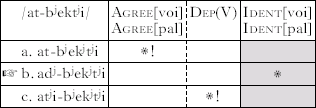
Assimilation between adjacent consonants differing in voicing or palatalisation requires that each Agree[x] constraint dominate its corresponding Ident[x] constraint, as shown in collapsed form in (28) for [adʲ-bʲekʲtʲi] ‘to run up’. Note that since vowel epenthesis is in principle an alternative to assimilation that would also satisfy both Agree[x] constraints, Dep(V) must also be ranked above both Ident[x] constraints.
(28) Assimilation between adjacent disagreeing consonants
In order to enforce epenthesis between adjacent identical consonants, NoGem must dominate Dep(V). The necessity of this ranking is illustrated in the tableau in (29), with the conflict between the fully faithful candidate [ap-putʲi] in (29a) losing to the candidate with epenthesis, [apʲi-putʲi] ‘to grow rotten’ in (29b).
(29) Epenthesis between adjacent identical consonants
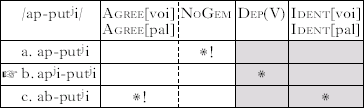
In this case, a change in voicing as in [ab-putʲi] in (29c) would in principle also be an alternative way to satisfy NoGem. Because it was shown in (28) above that Dep(V) must be ranked above both Ident[x] constraints, this candidate must be suboptimal due to the Agree[x] constraints dominating Dep(V).
Given the ranking in (29), epenthesis in the case of adjacent near-identical consonants is automatically expected. This is shown in (30). The crucial suboptimal candidate in which assimilation applies but epenthesis does not is shown in (30b); this candidate fatally violates NoGem, the markedness constraint otherwise responsible for epenthesis between completely identical consonants. Remaining faithful as in (30a) is of course not an option, because that violates one or both of the Agree[x] constraints otherwise responsible for assimilation. The only remaining option is epenthesis, the optimal candidate in (30c), [apʲi-bʲerʲtʲi] ‘to strew all over’.
(30) Epenthesis, not assimilation
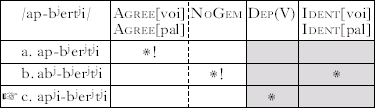
This is a completely straightforward OT analysis that properly describes the right generalisation about the distribution of the epenthetic vowel in Lithuanian. Other examples of cross-derivational feeding-on-environment that I am currently aware of also involve interactions between consonantal assimilation processes and epenthesis to avoid adjacent identical consonants, as in Lithuanian; perhaps the most familiar example is the case of inflectional suffix allomorphy in English (see Baković Reference Baković2005). As I show in §7 further below, there also exist cases of cross-derivational feeding-on-focus.
6.3 The crucial role of globality
Cross-derivational feeding requires an unprecedented type of global mechanism, one in which the consequences of a crucially counterfactual derivational path – that is, a mapping from an underlying representation to a distinct representation that does not actually surface in the language – must be considered in order to properly define the conditions necessary for a separate derivational path from the underlying representation to the actual surface representation. These separate derivational paths, one actual and one counterfactual, are equally necessary in order for the correct generalisation to be expressed.
In the OT analysis detailed in §6.2, the endpoints of these two derivational paths simply constitute two of the competing candidate outputs derived from the underlying representation, one optimal and the other suboptimal. The choice between these two candidates is correctly and automatically made by the rankings independently responsible for each of the interacting processes (assimilation and epenthesis).
The success of this OT analysis is not at all surprising, given that global interactions of several kinds succumb naturally to unified explanation in OT in ways that have not been possible in other frameworks of process interaction.Footnote 17 In this section I discuss how cross-derivational feeding fits into a larger typology of global interactions involving blocking (‘do something except when’), a relatively simple case of which was already noted in §1. A more complex class of blocking patterns, conspiracies (following Kisseberth Reference Kisseberth1970), is discussed by Pater (Reference Pater, Kager, Hulst and Zonneveld1999) and McCarthy (Reference McCarthy2002: 95ff). Cross-derivational feeding is essentially a special case of a conspiracy in the typology of blocking patterns, as described in (31).Footnote 18
(31) Typology of blocking patterns

Consider this typology in terms of counterfactual derivations, as described and schematically represented in (32). Note that the schematic representations allow the closer relationship between conspiracies and cross-derivational feeding to stand out particularly clearly.
(32) Typology of blocking patterns in terms of counterfactual derivations

The blocked counterfactual path in each case is the failed mapping /X/→*|Y|, and the actual path is /X/→[X] in the case of simple blocking and /X/→[Z] in the case of conspiracies, including cross-derivational feeding. The difference between cross-derivational feeding and other types of conspiracies concerns the relationship between the counterfactual and actual outputs: there is a feeding relationship between *|Y| and [Z] in the case of cross-derivational feeding, as indicated by the horizontal ℱ arrow, and no such relationship in the case of other types of conspiracies.
In OT, these different blocking patterns result from particular rankings of constraints that lead to the choice of X over Y in the case of simple blocking, and to the choice of Z over (both X and) Y in the case of a conspiracy, including cross-derivational feeding. This is shown in the ranking schemas in (33), where  is a markedness constraint,
 is a faithfulness constraint and ℂ is either of these. Subscripts denote what is penalised by each constraint; ‘Y/…’ indicates the contextual restriction on the markedness or faithfulness of (a change to) Y that must exist in order for the blocking of /X/→*|Y| to be evident.
(33) Basic constraint ranking schemas for blocking patterns
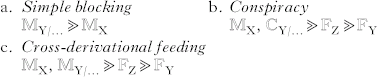
An example of the simple blocking schema in (33a) was already illustrated by the blocking of extrametricality in Latin monosyllables in (1). In that particular case, the markedness constraint X otherwise responsible for the blocked process of extrametricality is Non-finality, and the markedness constraint Y/… doing the blocking is Lx≈Pr, requiring that words be prosodified and stressed.
The cross-derivational feeding schema in (33c) is of course just a special case of the conspiracy schema in (33b); the unspecified ℂY/… is simply further specified as being a markedness constraint (Y/…) in the case of cross-derivational feeding. The relevant tableau from the Lithuanian analysis is (30), where there are two markedness constraints X otherwise responsible for the blocked assimilation processes (Agree[voi], Agree[pal]). The markedness constraint Y/… causing assimilation to be blocked is NoGem, the faithfulness constraint Z penalising the optimal candidate with epenthesis is Dep(V), and the faithfulness constraints Y penalising the blocked assimilation candidate are the Ident[x] constraints.
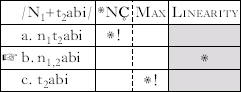
In other examples of conspiracies, the unspecified constraint ℂY/… is a faithfulness constraint (Y/…), as exemplified by Pater's (Reference Pater, Kager, Hulst and Zonneveld1999) analysis of the pattern of nasal+voiceless obstruent avoidance in Si-Luyana. Nasal+voiceless stop sequences are avoided via coalescence of the nasal and stop, satisfying a markedness constraint against nasal+voiceless obstruent sequences (*N ) and violating the faithfulness constraint Linearity; this justifies the ranking *N
 Linearity (=XY). Deletion could have also been employed to satisfy *N, justifying the ranking MaxLinearity (=ZY), as shown in (34) for [nabi] ‘prince’.
(34) Conspiracy I:
coalescence of nasal+voiceless stop sequences in Si-Luyana
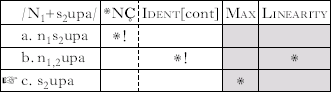
*N also penalises nasal+voiceless fricative sequences, but coalescence in these cases would further violate the faithfulness constraint Ident[cont]. Here deletion occurs instead, violating Max and justifying the ranking *N, Ident[cont]Max (=X, Y/…Z). This is shown in (35) for [supa] ‘soap’.
(35) Conspiracy II:
deletion in nasal+voiceless fricative sequences in Si-Luyana
An important distinction between the analysis of cross-derivational feeding in (30) and that of other types of conspiracies in (35) is whether optimal derivations of the form /Y/→[Z] are otherwise predicted to exist. In the case of cross-derivational feeding, such derivations are necessarily optimal. In Lithuanian, for example, NoGem enforces epenthesis even when assimilation is not relevant (e.g. in /ap-putʲi/→[apʲi-putʲi] ‘to grow rotten’), because it dominates Dep(V). In the case of other conspiracies, by constrast, /Y/→[Z] derivations are not necessarily expected to be optimal. In Si-Luyana, for example, deletion of the nasal is not necessarily expected unless coalescence of the nasal with a voiceless fricative is at stake, since it is only the possibility of coalescence that invokes the blocking constraint Ident[cont]. This is not to say that deletion of a nasal cannot be otherwise motivated, of course; what is relevant here are the necessary expectations from the ranking schemas in (33): cross-derivational feeding requires other independently motivated /Y/→[Z] mappings; other types of conspiracies do not.
Examples discussed in the literature under the banner of ‘conspiracies’ tend to be of the type that fit McCarthy's (Reference McCarthy2002) slogan ‘homogeneity of target, heterogeneity of process’ – examples in which the avoidance of a single marked configuration (or set of related configurations) is responsible for more than one underlying–surface disparity. This is also true, to an extent, of cross-derivational feeding: in Lithuanian, the avoidance of disagreeing clusters is responsible for assimilation and, in certain cases, for epenthesis as well. In the case of epenthesis, however, this responsibility is crucially shared with the avoidance of another marked configuration: adjacent identical consonants, which are specifically in danger of resulting from assimilation. The conspiracy in this case thus involves the simultaneous avoidance of both marked configurations with one of two underlying–surface disparities: assimilation when only disagreement is at stake, and epenthesis when adjacent identical consonants are (also) at stake.
In his discussion of conspiracies and their relation to opacity, Kiparsky (Reference Kiparsky and Fujimura1973: 80–81) concludes:
Two rules A and B may be defined as belonging to a ‘conspiracy’ if both are [surface-true], and a change in (or loss of) A would render B [non-surface-true]. … The explanation of conspiracies is thereby reduced to the theory of opacity. The fact that languages tend to have conspiracies follows from the more general fact that languages tend to have transparent rules.
The results of this section suggest a more nuanced conclusion: conspiracies lead to increased surface truth, and this can happen at the expense of surface apparentness – though perhaps only of the kind that does not involve unnecessary rule application or gratuitous faithfulness violation. This appears to be true for cross-derivational feeding and also for non-gratuitous feeding, as discussed with respect to (18) in §5.
In sum, OT's facility with cross-derivational feeding follows from the global properties of the theory, and SPE's difficulty with this type of pattern follows from its lack of such properties. This fact has potential consequences for refinements of OT such as those by Wilson (Reference Wilson2000) and by McCarthy (Reference McCarthy2007), both of which significantly affect OT's predictions of globality. Aspects of either or both proposals may turn out to be necessary in some form, and they have the added benefit of being able to describe some of the types of opacity discussed in this article that are otherwise problematic for OT. In assessing these proposals, however, the positive aspects of globality noted in this section must be kept firmly in mind.
6.4 More on gratuitous faithfulness violations
Consider again the analysis of cross-derivational feeding in Lithuanian in (30), repeated as (36) but with another candidate added in (36d), one in which there is both assimilation and epenthesis.
(36) Cross-derivational feeding: Lithuanian prefixes, based on (30)
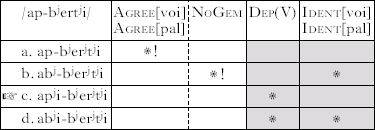
It would of course be problematic for OT if (36d) were the actual output in Lithuanian, because this candidate is harmonically bounded by the optimal candidate in (36c): the additional faithfulness violation incurred by (36d) in the Ident[x] column is gratuitous. Indeed, because the standard SPE analysis of Lithuanian involves bleeding – recall Odden's (Reference Odden2005) rules in (23) and the derivation in (24) – a simple reordering of the rules under such an analysis results in (36d) and would be a case of counterbleeding.
(37) Lithuanian bleeding (based on (24)) and anti-Lithuanian counterbleeding
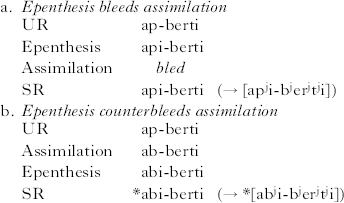
But note that the codicil on epenthesis that is necessary under the bleeding order of rules in (37a), specifying that the flanking consonants may ‘differ at most in voicing (and palatalisation)’, would no longer be motivated under the opposite ordering of the rules in (37b). This is because the prior application of assimilation would in all relevant cases guarantee that the flanking consonants agree in voicing (and palatalisation). So, the result in (37b) is due to a self-destructive feeding interaction: assimilation provides the necessary environment for the subsequent application of epenthesis, which destroys the context that made the application of assimilation possible in the first place. (This is reflected in the constraint-violation profiles of the candidates in (36); compare counterbleeding in (7) and self-destructive feeding in (14).)
This kind of interaction between assimilation and epenthesis appears to be completely unattested, as originally suggested by Kenstowicz & Kisseberth (Reference Kenstowicz, Kisseberth and Kisseberth1971). The one apparent counterexample to this claim that is known to me comes from New Julfa Armenian (Vaux Reference Vaux1998, Odden Reference Odden2005). Since epenthesis in this case applies regardless of featural (dis)agreement, this is a standard counterbleeding interaction.
(38) Epenthesis and assimilation in New Julfa Armenian

Vaux writes (1998:216, emphasis added): ‘since intervening -ə- but not full vowels are transparent to [assimilation], we can say that the rule applies before epenthesis, which produces all schwas in the New Julfa dialect’. While this is technically true, the facts simply do not justify such an analysis. Even if all predictable information must be absent from underlying representations – see Orgun (Reference Orgun2000: 141) on this point, specifically with regard to the analysis of schwa epenthesis in Armenian – the predictability of the distribution of schwa only allows assimilation to be ordered before epenthesis. Vaux presents no specific argument for this ordering analysis, empirical or otherwise; a more plausible alternative is implicit in Vaux's own proposed statement of the rule specifying that schwa is transparent to assimilation.
Support for the schwa-transparency analysis comes from the urban Utrecht dialect of Dutch, which has regressive voicing assimilation across non-epenthetic schwa (van Oostendorp Reference Oostendorp, Taeldeman and van Oostendorp2002, personal communication). As shown in (39), the masculine definite determiner /də/ is devoiced before stem-initial voiceless obstruents and the infinitival marker /tə/ is voiced before stem-initial voiced obstruents (39a); the underlying distinction between these two inflectional morphemes surfaces before stem-initial sonorants (39b).
(39) Assimilation across schwa in urban Utrecht Dutch
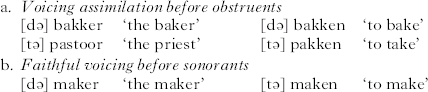
Assimilation of laryngeal features across reduced vowels should not be surprising, given the likely articulatory configuration involved: the gestures of consonants flanking a reduced vowel no doubt overlap more than they do when flanking a full vowel, if they overlap in the latter case at all. If the sense of consonantal adjacency relevant to assimilation is (or at least can be) defined in terms of (degree of) gestural overlap, then the New Julfa Armenian and urban Utrecht Dutch patterns above are expected.Footnote 19
The ordering solution suggested by Vaux (Reference Vaux1998) entails the possibility of a counterbleeding interaction between epenthesis and assimilation: a pattern in which epenthetic vowels are distributionally distinguishable from otherwise identical underlying vowels (e.g. with evidence from morphophonological alternations), and in which assimilation applies only across the epenthetic vowels. This hypothetical pattern, unattested to the best of my knowledge, would be impossible to replicate in OT except by brute force.Footnote 20 To the extent that the type of pattern considered in this subsection is indeed unattested, OT has a clear advantage over SPE, in which the analysis of this unattested pattern is as straightforward as any other.
7 Concealed free rides
7.1 Gliding and deletion in Cibaeño Dominican Spanish
The final type of process interaction involving obscured generalisations that I examine in this article are what I call concealed free rides. Concealed free rides are of interest here for a couple of reasons. First, there are two reasonable ways to analyse a concealed free ride: (i) in terms of self-destructive feeding, which is possible in SPE but not in OT, or (ii) in terms of cross-derivational feeding, which is possible in OT but not in SPE. Second, the types of obscured generalisations that arise from concealed free rides turn out not to be classifiable as opaque according to the standard definition of opacity in (2).
Consider the following example from the Cibaeño variety of Spanish, spoken in the north-central region of El Cibao in the Dominican Republic (Golibart Reference Golibart1976, Guitart Reference Guitart, Contreras and Klausenburger1981).Footnote 21 In Cibaeño, there is a process of liquid gliding whereby the liquids /r/ and /l/ become the palatal glide [j] word-internally before consonants (40a) and word-finally in a stressed syllable (40b). (Guitart Reference Guitart, Contreras and Klausenburger1981 argues that the context of liquid gliding is not, despite appearances, reducible to syllable-final position. I simply adopt Guitart's position in that follows, as the issue does not affect the point being made here.)
(40) Liquid gliding in Cibaeño
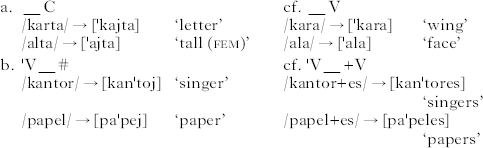
Word-final liquids in unstressed monosyllabic words also glide, but only before consonant-initial words: compare el mes [ejˈmes] ‘the month’ with el año [eˈlaɲo] ‘the year’. Guitart (Reference Guitart, Contreras and Klausenburger1981: 227) reduces this to the word-internal preconsonantal vs. prevocalic cases in (40a). Guitart argues that the relevant unstressed monosyllables are all determiners and prepositions with a plausible analysis as proclitics, and so the final liquids of these morphemes is word-internal in the relevant cases (/el+mes/→[ejˈmes], /el+aɲo/→[eˈlaɲo]) and thus conforms to the word-internal preconsonantal vs. prevocalic distinction.
Some underlying liquids in the relevant positions delete instead of surfacing as glides. Golibart (Reference Golibart1976) and Guitart (Reference Guitart, Contreras and Klausenburger1981) demonstrate that deletion in these cases is motivated by either one or both of two independent conditions, one phonotactic and the other prosodic. Consider first the phonotactically motivated case. Preconsonantal or word-final liquids after /i/ delete instead of surfacing as glides, as would otherwise be expected given the liquid-gliding rule. But surface sequences of a high vowel and homorganic glide ([ij ji uw wu]) are independently excluded in Spanish, a phonotactic fact that can be reasonably attributed to an independent glide-deletion rule. Golibart (Reference Golibart1976) and Guitart (Reference Guitart, Contreras and Klausenburger1981) thus analyse liquid deletion as a two-step process: liquid gliding feeds the glide-deletion rule. This is shown in (41).
(41) Liquid gliding feeds phonotactically motivated glide deletion
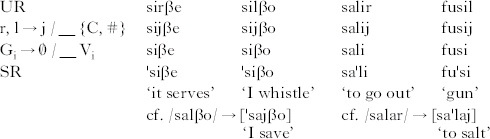
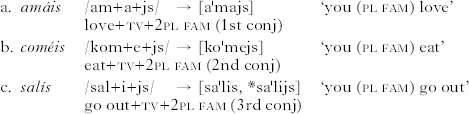
The independent motivation for this glide-deletion rule is, as noted above, the systematic absence in Spanish of high vowel and homorganic glide sequences like [ij]. There is no further evidence for the rule in Cibaeño, but Guitart (Reference Guitart, Contreras and Klausenburger1981: 224), following Golibart (Reference Golibart1976: 51–54), suggests that 2nd person plural familiar verb forms, found exclusively in Peninsular varieties of Spanish, provide some external motivation for the rule. The suffix (or suffixal complex) that instantiates this morphosyntactic feature set is [j]-initial after 1st (42a) and 2nd (42b) conjugation verbs, which are marked by the theme vowels /a/ and /e/ respectively. 3rd conjugation verbs (42c) are marked by the theme vowel /i/, and the underlying sequence /…i+j…/ arguably undergoes the phonotactically motivated glide-deletion rule in (41) to surface as [i].
(42) 2nd person plural verb forms (tv=verb conjugation theme vowel)
Now consider prosodically motivated deletion. When a word with non-final stress ends underlyingly with a liquid – the residue of the prosodic contexts classified by the liquid-gliding context in (40b) – there is again deletion rather than a surface glide. Stems ending in closed unstressed syllables are generally considered exceptional in analyses of Spanish stress (see e.g. Harris Reference Harris1995), but glide-final stems are unexceptionally stressed on the final syllable. As Guitart (Reference Guitart, Contreras and Klausenburger1981: 225) puts it, ‘in Spanish in general there are absolutely no polysyllabic words ending in unstressed vowel plus glide’.Footnote 22 Guitart attributes the absence of these words to a prosodically motivated deletion rule, summarising its statement as follows: ‘delete [y] ([j]) at the end of a polysyllabic word whenever it is preceded by an unstressed vowel’. Guitart's formal statement of the rule is in essential respects equivalent to the rule stated in (43). Like the phonotactically motivated rule, this prosodically motivated glide-deletion rule is crucially fed by liquid gliding.
(43) Liquid gliding feeds prosodically motivated glide deletion
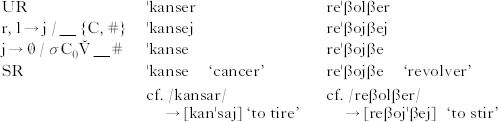
Note that the only independent motivation for this prosodically motivated glide-deletion rule is the systematic absence of glide-final polysyllabic words with non-final stress in Spanish; there is no further evidence for it, even of the external type given for phonotactically motivated glide deletion in (42).
The Cibaeño pattern just described is an example of a concealed free ride. More generally, free rides are so named because they can be analysed in SPE terms as follows (see Zwicky Reference Zwicky1970). Suppose an analysis of some phonological pattern involves input–output mappings of the form /X/→[Z], and that these mappings can be broken down into two serially ordered derivational steps, /X/→|Y|→[Z]. If the |Y|→[Z] step is independently motivated in some way – most convincingly, but not necessarily, by other observed mappings of the form /Y/→[Z] – then the process responsible for the /X/→|Y| step can ‘take a free ride’ on the independently motivated process responsible for the |Y|→[Z] step.Footnote 23
In the Cibaeño example, liquid gliding takes a free ride on glide deletion, resulting in derivations of the form /r l/→| j |→. (I refer to the two glide-deletion rules together simply as ‘glide deletion’ in much of what follows.) The reason I call it a concealed free ride is because glide deletion completely conceals the result of liquid gliding. This concealment makes the SPE analysis of a concealed free ride, as illustrated by the derivations in (41) and (43), remarkably similar to the analysis of self-destructive feeding in Turkish discussed in §4: the | j |→ step taken by glide deletion destroys the result of the serially prior /r l/→| j | step taken by liquid gliding, but of course the result of liquid gliding was necessary to motivate the destructive application of glide deletion in the first place. One might think, then, that the analysis of a concealed free ride is problematic for OT for the same reasons that self-destructive feeding is.
But the interaction between the rules involved in a concealed free ride can also be understood in cross-derivational feeding terms, much like the interaction between assimilation and epenthesis in Lithuanian discussed in §6. The essence of a cross-derivational feeding analysis of the Cibaeño example can be summarised as follows. Preconsonantal and word-final liquids become palatal glides unless either (i) the result would be a phonotactically impermissible sequence (*[ij]) or (ii) the result would be a prosodically impermissible form (*σC [j]#). In these two classes of cases, preconsonantal and word-final liquids delete instead; this is because if they were to counterfactually become glides, they would be subject to glide deletion anyway. A schematic representation of this cross-derivational feeding interaction is given in (44).
(44) Cross-derivational feeding in Cibaeño
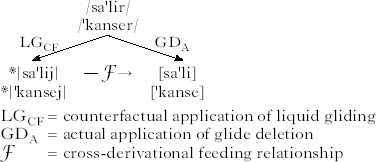
Deletion is a thus a back-up strategy to gliding under this analysis: liquids delete whenever gliding would otherwise be blocked. This makes the OT analysis of a concealed free ride straightforward.
7.2 Analysis of concealed free rides in OT
Both gliding and deletion are possible responses to a markedness constraint against preconsonantal or word-final liquids, here simply abbreviated No[r,l]{C,#}. Those responses are regulated by particular faithfulness constraints ranked below No[r,l]{C,#}; in order to ensure that gliding as opposed to deletion is the default response, Max(C) must be ranked above any and all Ident[x] constraints, where x is a feature that distinguishes the liquids /r l/ from the glide /j/. To keep things simple, I assume that liquids and glides are primarily distinguished by the feature [±consonantal] and I refer to the relevant set of Ident[x] constraints as Ident[cons]. The preference for gliding over deletion is realised in examples where the phonotactic and prosodic conditions are not at stake, as shown in (45).
(45) Gliding by default
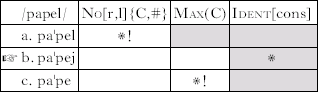
The phonotactic constraint responsible for the lack of sequences of high vowels and homorganic glides is abbreviated here NoViGi. When NoViGi is at stake, the preference for gliding is subverted and there is deletion instead, so long as NoViGi is ranked together with No[r,l]{C,#} above Max(C).
(46) Deletion under phonotactic duress
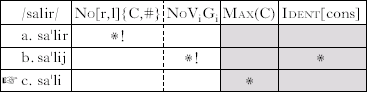
Likewise, when the prosodic constraint responsible for the lack of polysyllabic glide-final words with non-final stress is at stake, the preference for gliding is again subverted and there is deletion instead. This prosodic constraint is abbreviated here as No-σC[j]# (probably a constraint on quantity-sensitivity, activated by independent considerations that ensure the heaviness of word-final syllables ending in glides).
(47) Deletion under prosodic duress
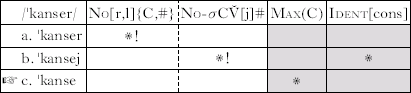
The rankings in (46) and (47) are clear instances of the basic constraint-ranking schema for cross-derivational feeding (33c), repeated below as (48). The markedness constraint X is No[r,l]{C,#}, otherwise responsible for liquid gliding; the markedness constraint Y/… causing gliding to be blocked is NoViGi in (46) and No-σC[j]# in (47), the faithfulness constraint Z penalising the optimal candidate with deletion is Max(C) and the faithfulness constraint Y penalising the blocked gliding candidate is Ident[cons].
(48) Cross-derivational feeding ranking schema

This cross-derivational feeding analysis of the fate of Cibaeño liquids in glide-deletion contexts makes sense of the fact that deletion is a response to independent constraints in the language that conflict with the preferred liquid-gliding strategy. Of course, the prediction of this analysis is that deletion should be independently observable given an appropriate context; i.e. a glide arising after a homorganic high vowel (recall (42)), or one arising finally in a form with non-final stress. This is not necessarily so of the self-destructive feeding analysis in (41) and (43), where the liquid-gliding rule could in principle be preceded by rules that make changes other than deletion that also lead to conformity with the relevant phonotactic and prosodic conditions; e.g. a rule shifting stress to the final syllable in glide-final words.
It is perhaps relevant that glide-final loanwords with non-final stress in the source language are produced with final stress in Spanish; e.g. [komˈboj]<English ˈconvoy. This could be taken as evidence for the stress-shift rule just mentioned in the actual phonological grammar of Spanish, preceding liquid gliding in Cibaeño and coincidentally having the same motivation as the glide-deletion rule in (43). Whether this is the right approach to loanword phonology is a question far beyond the scope of this article; the more relevant problem for this analysis lies behind the motivation for stress shift and glide deletion: the lack of an effective description of – much less an explanation for – the teleological unity of these rules.
7.3 Concealed free rides and opacity
Given the similarities between concealed free rides and self-destructive feeding on the one hand and cross-derivational feeding on the other, a concealed free ride might be expected to involve overapplication opacity. It is the first process in a self-destructive feeding interaction that overapplies, and this corresponds to liquid gliding in the SPE analysis of the concealed free ride in Cibaeño. By contrast, it is the actually applying process that overapplies in the case of cross-derivational feeding, and this corresponds to glide deletion in Cibaeño. Does this mean that both processes express opaque generalisations due to their interaction with each other? The matter turns out to be more complicated than one might think.
On the one hand, it is clearly the case that each of the two processes expresses a generalisation that is obscured by its interaction with the other. Liquid gliding turns liquids into glides, but this transformation is obscured by the fact that some of those glides-from-liquids are subsequently deleted. Similarly, glide deletion deletes glides, but this is obscured by the fact that some glides come from underlying liquids, which glide deletion also deletes. There is a clear intuitive sense in which glide deletion can be thought to overapply, then: glide deletion appears to delete more than just glides. Conversely, liquid gliding is obscured, but it is pretty clear that it doesn't overapply: it doesn't appear to apply to more than just liquids, nor does it result in glides in contexts other than those stated by the rule.
In fact, neither process can be classified as opaque in either of the two senses of the term according to Kiparsky's definition of opacity in (2). First of all, liquid gliding does not overapply in the (2b) sense: there are no surface instances of glides derived by liquid gliding that occur in environments other than preconsonantally or word-finally. Liquid gliding also does not underapply in the (2a) sense: there are also no surface instances of liquids that occur preconsonantally or word-finally. Likewise, glide deletion clearly does not underapply according to the definition in (2a), because there are no surface instances of glides in either of the two deletion environments (and recall that the surface truth of this fact is the primary motivation for both types of glide deletion in the first place). It proves to be somewhat trickier to square the definition of overapplication in (2b) with a deletion rule: what constitutes a surface instance of B when B is , the absence of a segment? Even assuming that there is a way to refer to ‘deleted segments’, however, glide deletion does not overapply according to the definition in (2b), because there are no instances of deleted segments derived by glide deletion in environments other than those in the two deletion environments.Footnote 24
The interaction between the processes involved in a concealed free ride is thus, somewhat counterintuitively, a transparent one according to the standard definition of opacity. The source of this puzzle appears to be the formal distinction that we have encountered several times throughout this article: the concealed free ride in Cibaeño involves feeding-on-focus, while the self-destructive feeding and cross-derivational feeding examples discussed in §4 and §6 both involve feeding-on-environment. The diagnostic for overapplication in (2b) is defined in such a way that only a disruption of the environment of a process ℙ can mean that ℙ has overapplied, which thus excludes on-focus interactions.
It might be asked what consequences this result has for the theory of opacity, and the answer is unclear. The definition of opacity in (2) simply identifies surface diagnostics for opaque generalisations, and so the definition itself could in principle just be modified to accommodate concealed free rides if there were reason to believe that concealed free rides must involve opacity. But recall that the theory of opacity is based on the substantive assumption that opaque generalisations are harder to learn than transparent ones; given that it is unknown whether the obscured generalisations involved in concealed free rides are easier or harder to learn than other generalisations, it is unclear whether they should be considered opaque.
Now recall that Kiparsky's original evidence for the psychological reality of the opacity of a particular (type of) rule order was more or less the extent to which such an order could be shown to be diachronically unstable. If, for example, an innovating dialect appears to require the inverse of an inherited order between two rules, this could be an indication that the inherited order is opaque while its innovated inverse is transparent. However, note that the inverse of a concealed free ride would be a case of counterfeeding, and thus a genuine case of (underapplication) opacity. In a putative innovative subdialect of Cibaeño, glide deletion would not delete those instances of glides derived by the now later-ordered liquid-gliding rule, rendering glide deletion non-surface-true. If a concealed free ride indeed involves opacity, then, it cannot be diagnosed by some diachronic tendency for the rules involved to be reordered.
8 Summary and concluding remarks
I hope to have shown in this article that overapplication opacity is more diverse than formerly thought, and that three previously overlooked types of overapplication opacity have implications for the description of opaque generalisations both with ranked constraints in OT and with ordered rules in SPE.
Overapplication opacity is generally thought to be due only to counterbleeding interactions in an SPE analysis (§3), but two of the overlooked types of overapplication opacity are due to straightforward feeding interactions; this fact by itself is somewhat surprising, since feeding interactions are generally thought to be transparent. Self-destructive feeding-on-environment (§4) is similar to counterbleeding in that application of just the second of the two rules would be sufficient to satisfy the apparent requirements of both; that is, to ensure that the generalisations expressed by both rules are surface-true. Application of both rules is thus excessive, involving a gratuitous violation of faithfulness that makes an OT analysis difficult. Non-gratuitous feeding (§5) is different: application of both rules is necessary to make them both surface-true, even though application of the first rule is rendered non-surface-apparent by application of the second. This difference is what makes non-gratuitous feeding amenable to simple analysis in OT.
Although the example of cross-derivational feeding-on-environment in Lithuanian (§6) fits the definition of overapplication opacity, an analysis in terms of rule ordering in SPE is simply not possible unless the crucial relationship argued here to exist between the rules involved is blatantly disregarded. Thus, while SPE has for some time been argued to be uniquely capable of describing all types of opaque generalisations, cross-derivational feeding-on-environment is a clear case of an opaque generalisation that is not describable in terms of rule ordering. In order to describe such an opaque generalisation properly, SPE would need to be supplemented with what amounts to candidate output comparison in OT: parallel derivations, including counterfactual ones that crucially influence the actual one. This is thus a case overapplication opacity that can only be described in terms of OT.
Concealed free rides (§7) constitute a particularly interesting class of process interactions in the present context. For one thing, analyses of concealed free rides are possible both in SPE and in OT; it is a self-destructive feeding-on-focus interaction in the former and a cross-derivational feeding-on-focus interaction in the latter. The feeding-on-focus part appears to be what makes an analysis in both frameworks possible; compare self-destructive feeding-on-environment (§4), which is only analysable in SPE, and cross-derivational feeding-on-environment (§6), which is only analysable in OT. Another remarkable aspect of concealed free rides is that they involve no overapplication or underapplication according to the standard definition of opacity in (2). This result is somewhat counterintuitive, but it is unclear whether it warrants any modification to the definition of opacity. We simply don't know whether concealed free rides, or indeed many of the cases discussed in this article, are hard to learn. There is no other context for the definition of opacity other than the hypothesis that opaque generalisations are hard to learn; more case-by-case empirical work is needed to confirm or disconfirm this substantive hypothesis.
Two major implications of this paper can be summarised as follows. The definition of opacity identifies opaque generalisations, not only those that SPE predicts. Examples of generalisations that are opaque by this definition should thus challenge our a priori notions of what the better framework of analysis is. Likewise, the purpose of the theory of opacity is to account for the ways in which opaque generalisations are hard to learn and so apparent examples of opaque generalisations should challenge our a priori notions of what it means for a generalisation to be opaque or hard to learn in the first place.



