




No CrossRef data available.
Article contents
Kawasaki disease complicated by cerebral infarction
Published online by Cambridge University Press: 18 April 2005
Abstract
An 8-month-old boy presented with right hemiplegia of sudden onset after 20 days of Kawasaki disease, which was not initially treated by gamma globulin. Cranial X-ray computed tomography confirmed cerebral infarction as the cause of the right hemiplegia. In subsequent weeks, he developed multiple thromboses in coronary aneurysms. He successfully underwent intracoronary thrombolysis using tissue plasminogen activator without haemorrhagic complications. Cerebral infarction as a complication of Kawasaki disease is rare, and is a difficult clinical situation to manage.
Information
- Type
- Brief Report
- Information
- Copyright
- © 2003 Cambridge University Press
Although patients with Kawasaki disease still suffer frequently from coronary aneurysms and thromboses,1 it is rare that they suffer overt neurological complications.2 There were only a limited number of reports of overt cerebral infarction caused by Kawasaki disease.3, 4 We describe an infant with Kawasaki disease who presented with cerebral infarction and developed multiple thromboses in the coronary arterial aneurysms. These coronary thromboses jeopardized his life, and were treated by intracoronary thrombolysis using tissue plasminogen activator without haemorrhagic complications. The association of cerebral infarction and coronary arterial thrombosis can create a clinically difficult situation because of the great risk of cerebral bleeding.5
Case Report
An 8-month-old boy presented to us with right hemiplegia of sudden onset after 20 days of febrile illness. Careful history taking unmasked that he was suffering from Kawasaki disease, with 5 of the 6 diagnostic criterions fulfilled. Neither aspirin nor gamma globulin had been given to him because a local physician had treated him with a tentative diagnosis of measles. Cranial X-ray computed tomography at presentation showed an area of low density from the left anterior to parietal lobe, suggesting cerebral infarction as the cause of the hemiplegia. An electrocardiogram showed QS pattern on V1 to V4 of precordial leads, and an echocardiogram showed bilateral coronary arterial aneurysms, with complete thrombosis in the left anterior descending artery. Because he was still febrile on admission, he was placed on oral aspirin, an infusion of gamma globulin, and continuous infusion of heparin. Within 3 days after admission, his general condition improved, and he was placed on oral warfarin. After 28 days of illness, an echocardiogram showed a thrombus in the right coronary aneurysm, this thrombus having got bigger, with an increasing risk of acute occlusion of the right coronary artery. Because there was a great risk of bleeding from the site of cerebral infarction, he could not be placed on systemic thrombolytic treatment. So he underwent intracoronary thrombolysis using tissue plasminogen activator rather than a simple intravenous infusion. Through a catheter placed in the coronary artery, we administered 3 × 10⁴U/kg of tissue plasminogen activator twice over 10 minutes for each coronary artery (Fig. 1). A cranial X-ray computed tomography next day revealed an area of high density replacing the low density area, suggesting oozing from the site of infarction (Fig. 2a). Follow-up echocardiograms showed partial resolution of the thromboses in the right coronary artery, and recanalization of the left anterior descending artery. After 38 days of illness, a regular echocardiogram showed sudden complete occlusion of left circumflex artery, and he required 2 more courses of intracoronary thrombolysis on the 38th and 43rd days of illness, using 4 to 5 × 10⁴U/kg of tissue plasminogen activator. Following these events, he never had any cardiac signs, or symptoms of coronary ischemia. The last cranial X-ray computed tomography, at 50 days of illness, revealed an area of profound low density at the initial site of low density, suggesting infarction but no haemorrhagic complications of tissue plasminogen activator (Fig. 2b). The thrombus in the right coronary artery had resolved, but those in the left circumflex artery have never resolved, despite intracoronary thrombolysis. He was discharged with oral aspirin, warfarin, and calcium channel blockade. In the outpatient clinic, the amount of warfarin was controlled to keep international ratio of prothrombin time between 2.0 and 3.0, and he was followed up with regular echocardiograms. He has shown gradual improvement in his right hemiplegia.

Figure 1. The right coronary angiogram shows a series of giant aneurysms and intracoronary thrombus (white arrow). Through a catheter in the coronary artery, 3 × 10⁴U/kg of tissue plasminogen activator were administered twice over 10 minutes.

Figure 2. The changes in the cranial X-ray computed tomography after intracoronary thrombolysis using tissue plasminogen activator. Panel (a): Next day after the intracoronary thrombolysis. A high density area has replaced the low density area (white arrowhead), suggesting oozing from the site of infarction. Panel (b): At 50 days of illness, a profound low density area has replaced the high density area that was seen at the initial site of low density. Panel (c): the left internal carotid arteriogram shows obstruction of the part of the left middle cerebral artery (white arrowhead) with irregularity of the vascular wall.
To search for the etiology of his cerebral infarction, he underwent bilateral carotid arteriograms when he underwent the second cardiac catheterization. This showed complete obstruction of the part of the left middle cerebral artery, with irregularity of the cerebral vascular wall suggesting thrombosis as a possible etiology of his cerebral infarction, rather than an embolism (Fig. 2c).
Discussion
We describe an infant with Kawasaki disease who presented with cerebral infarction and developed multiple thromboses in the coronary arterial aneurysms. Although transient facial palsy has been known as an apparent neurological complication of Kawasaki disease, it is very rare that the patient with Kawasaki disease shows other global neurological abnormalities.2–4 After widespread recognition of the importance of early diagnosis of Kawasaki disease, and the introduction of infusions of gamma globulin as a standard treatment, according to our literature search, not only has the incidence of coronary arterial aneurysms decreased, but also reports of neurological complications of Kawasaki disease have almost disappeared. In this specific patient, based on the carotid arteriogram, we consider thrombotic arteritis or thrombosis in the cerebral aneurysm as a cause of cerebral infarction rather than embolism. In fact, he never had any signs or symptoms of cardiac compromise leading to the formation of the thrombus in the heart, although he had had cardiac infarction caused by thrombosis of the left anterior descending artery. This case highlights the importance of early diagnosis and treatment of this disease. Early treatment with gamma globulin should have alleviated his systemic vasculitis, including that involving the cerebral arteries.
The combination of cerebral infarction with cardiac infarction made this patient difficult to manage. There was great risk of haemorrhagic infarction of the brain if he had been placed on aggressive systemic thrombolytic treatment.5 To reduce the risk of haemorrhagic complication after thrombolytic treatment, intracoronary thrombolysis was considered as an acceptable topical treatment to resolve the coronary thrombus that jeopardized his life. There have been increasing numbers of successful reports of intracoronary thrombolysis using tissue plasminogen activator in patients with Kawasaki disease without haemorrhagic complications.6, 7 In fact, in this patient, some of his coronary thromboses resolved, and he did not suffer any significant haemorrhagic complication of the brain after this treatment, although there was some oozing from infarcted cerebral tissue.
In conclusion, we emphasize the importance of early diagnosis of Kawasaki disease. Treatment with gamma globulin and intracoronary thrombolysis can be one of the options for management of this difficult situation.
Acknowledgement
We thank Dr Julien I.E. Hoffman, Professor of Pediatrics, University of California, San Francisco, for his kind assistance with the manuscript.
References
Terasawa K, Ichinose E, Matsusaki T, Kato H. Neurological complication in Kawasaki disease. Brain Dev 1983; 5: 371–437.Google Scholar
Fujiwara S, Yamano T, Hattori M, Fujiseki Y, Shimada M. Asymptomatic cerebral infarction in Kawasaki disease. Pediatr Neurol 1992; 8: 235–236.Google Scholar
Lapointe JS, Nugent RA, Graeb DA, Robertson WD. Cererbral infarction and regression of widespread aneurysms in Kawasaki's disease: case report. Pediatr Radiol 1984; 14: 1–5.Google Scholar
Gurwitz JH, Gore JM, Goldberg RJ, et al. Risk for intracranial hemorrhage after tissue plasminogen activator treatment for acute myocardial infarction. Participants in the National Registry of Myocardial Infarction 2. Ann Intern Med 1998; 129: 597–604.Google Scholar
Tsubata S, Ichida F, Hamamichi Y, Miyazaki A, Hashimoto I, Okada T. Successful thrombolytic therapy using tissue-type plasminogen activator in Kawasaki disease. Pediatr Cardiol 1995; 16: 186–189.Google Scholar
Chandwaney RH, Stathopoulos T, Sunew J, McPherson D, Davidson CJ. Adjunctive therapies in the cath lab. Successful thrombolysis using the combination of tissue plasminogen activator and abciximab in an adult with Kawasaki's disease. J Invasive Cardiol 2001; 13: 651–653.Google Scholar

The right coronary angiogram shows a series of giant aneurysms and intracoronary thrombus (white arrow). Through a catheter in the coronary artery, 3 × 10⁴U/kg of tissue plasminogen activator were administered twice over 10 minutes.
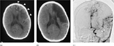
The changes in the cranial X-ray computed tomography after intracoronary thrombolysis using tissue plasminogen activator. Panel (a): Next day after the intracoronary thrombolysis. A high density area has replaced the low density area (white arrowhead), suggesting oozing from the site of infarction. Panel (b): At 50 days of illness, a profound low density area has replaced the high density area that was seen at the initial site of low density. Panel (c): the left internal carotid arteriogram shows obstruction of the part of the left middle cerebral artery (white arrowhead) with irregularity of the vascular wall.
 You have
Access
- 21
- Cited by