


Introduction
Emerging adulthood has been recognized as a critical developmental period requiring specific clinical attention (Babajide et al., Reference Babajide, Ortin, Wei, Mufson and Duarte2020; Gilmer et al., Reference Gilmer, Ojeda, Fawley-King, Larson and Garcia2012; Manteuffel et al., Reference Manteuffel, Stephens, Sondheimer and Fisher2008; Ojeda et al., Reference Ojeda, Hiller, Hurst, Jones, McMenamin, Burgdorf and Gilmer2016; Wilens and Rosenbaum, Reference Wilens and Rosenbaum2013). Transition-aged youth (TAY; 17–25 years) face developmentally unique demands, including identity formation, shifting relationships, growing independence, and entry into post-secondary or the workforce (Babajide et al., Reference Babajide, Ortin, Wei, Mufson and Duarte2020; Khetarpal et al., Reference Khetarpal, Auster, Miller and Goldstein2022; MacKinnon and Coleman, Reference MacKinnon and Coleman2016). Furthermore, TAY often experience these stressors whilst still undergoing cognitive maturation (Wilens and Rosenbaum, Reference Wilens and Rosenbaum2013), increasing vulnerability to mental health concerns.
Previous research suggests TAY are more likely to experience mental health disorders than any other age group (Pearson et al., Reference Pearson, Janz and Ali2013), with estimates of upwards of 75% of mental health disorders having an initial onset prior to age 25 (Kessler et al., Reference Kessler, Berglund, Demler, Jin, Merikangas and Walters2005; Lyng et al., Reference Lyng, Swales, Hastings, Millar and Duffy2020). Anxiety disorders are particularly prevalent, with onset often occurring in late adolescence or young adulthood (e.g. Babajide et al., Reference Babajide, Ortin, Wei, Mufson and Duarte2020; Copeland et al., Reference Copeland, Angold, Shanahan and Castello2014). Obsessive-compulsive disorder (OCD) shows a bimodal age of onset, with one peak in late childhood or early adolescence and another in young adulthood (Del Casale et al., Reference Del Casale, Sorice, Padovano, Simmaco, Ferracuti, Lamis, Rapinesi, Sani, Girardi, Kotzalidis and Pompili2019), with an average age of onset at 19.5 years old (Ruscio et al., Reference Ruscio, Stein, Chiu and Kessler2010).
Although TAY are frequently referred for psychological services (Pettit et al., Reference Pettit, Qureshi, Lee, Byng, Gibson, Stirzaker and Henley2017), they are less likely to initiate treatment, more likely to drop out of treatment, and may face barriers to seeking treatment, including negative beliefs or stigma about mental health disorders and treatment (Babajide et al., Reference Babajide, Ortin, Wei, Mufson and Duarte2020; Lyng et al., Reference Lyng, Swales, Hastings, Millar and Duffy2020; Saunders et al., Reference Saunders, Suh, Buckman, John, El Baou, Pilling, Lewis, Stott, Krebs and Stringaris2025; van Doeselaar et al., Reference van Doeselaar, Klimstra, Denissen, Branje and Meeus2018). This is concerning given the elevated risk of self‑harm and suicide among untreated youth (Simon and Savarino, Reference Simon and Savarino2007). Given the prevalence of mental health concerns in this population, developmentally appropriate interventions addressing the unique demands on TAY may be needed. Despite high need, most publicly available adult programs remain undifferentiated by age, creating a ‘transition cliff’ in services (Babajide et al., Reference Babajide, Ortin, Wei, Mufson and Duarte2020; Ojeda et al., Reference Ojeda, Hiller, Hurst, Jones, McMenamin, Burgdorf and Gilmer2016; Osgood et al., Reference Osgood, Foster and Courtney2010). Emerging evidence suggests age‑specific interventions can improve outcomes, as shown in dialectical behavior therapy for TAY with borderline personality disorder (Lyng et al., Reference Lyng, Swales, Hastings, Millar and Duffy2020) and psychotherapy for depression in college student populations (Cuijpers et al., Reference Cuijpers, Karyotaki, Reijnders and Huibers2018). However, research on age‑related differences in anxiety treatment remains limited and a meaningful first step is to investigate how well mainstream adult therapies help TAY. Disorder-specific group CBT protocols are well established for adolescents and adults with anxiety and related disorders (Hofmann and Smits, Reference Hofmann and Smits2008; Kendall et al., Reference Kendall, Ney, Maxwell, Lehrbach, Jakubovic, McKnight and Friedman2023; Otte, Reference Otte2011; Sigurvinsdóttir et al., Reference Sigurvinsdóttir, Jensínudóttir, Baldvinsdóttir, Smárason and Skarphedinsson2020; Wisman et al., Reference Wisman, Emmelkamp, Dekker and Christ2023), yet their effectiveness for emerging adulthood remains uncertain, as this group is often subsumed under older, working-age adults in outcome studies (i.e. 26 years old, and older), leaving the unique response patterns of TAY insufficiently explored.
Assessing treatment responses among TAY in adult-centric services can establish a baseline of effectiveness in mixed-age contexts and clarify when age-specific services are warranted. A previous examination on TAY outcomes in mixed-age contexts (Saunders et al., Reference Saunders, Suh, Buckman, John, El Baou, Pilling, Lewis, Stott, Krebs and Stringaris2025) reported poorer outcomes for TAY with mood and anxiety disorders receiving general adult first-line interventions, including low intensity (e.g. guided self-help) and high intensity (e.g. individual CBT), compared with adults. For example, TAY were more likely to cancel sessions, drop out of treatment, and show less symptom improvement for mood and anxiety symptoms, underscoring the need for further investigation (Saunders et al., Reference Saunders, Suh, Buckman, John, El Baou, Pilling, Lewis, Stott, Krebs and Stringaris2025).
The present study examines whether treatment outcomes differ between TAY and adults following disorder-specific, but not age-specific, group CBT for anxiety and related disorders. In particular, the present study focuses on social anxiety disorder (SAD), generalized anxiety disorder (GAD), and OCD, as these are among the most prevalent and impairing in TAY (Guimarães et al., Reference Guimarães, D’Angelo, Brouillette, Souza, da Silva, Mondin, Pedrotti Moreira, Kapczinski, de Azevedo Cardoso and Jansen2023; Kessler et al., Reference Kessler, Berglund, Demler, Jin, Merikangas and Walters2005; Mondin et al., Reference Mondin, Konradt, Cardoso, Quevedo, Jansen, Mattos, Pinheiro and Silva2013; Salari et al., Reference Salari, Heidarian, Hassanabadi, Babajani, Abdoli, Aminian and Mohammadi2024), have strong empirical support for CBT efficacy (Carpenter et al., Reference Carpenter, Andrews, Witcraft, Powers, Smits and Hofmann2018; Cuijpers et al., Reference Cuijpers, Harrer, Miguel, Ciharova, Papola, Basic, Botella, Cristea, de Ponti, Donker, Driessen, Franco, Gómez-Gómez, Hamblen, Jiménez-Orenga, Karyotaki, Keshen, Linardon, Motrico, Matbouriahi and Furukawa2025), and are particularly amenable to group-based CBT (Barkowski et al., Reference Barkowski, Schwartze, Strauss, Burlingame, Barth and Rosendahl2016; Malivoire et al., Reference Malivoire, Stewart, Cameron, Rowa and McCabe2024; Pozza and Detorre, Reference Pozza and Dèttore2017; Sigurvinsdóttir et al., Reference Sigurvinsdóttir, Jensínudóttir, Baldvinsdóttir, Smárason and Skarphedinsson2020). Outcomes were assessed using domain-specific measures of symptom change, as well as indices of group processes, such as cohesion, attendance, and drop-out rates to determine whether significant differences emerged between TAY and adults completing mixed-aged, disorder-specific CBT groups.
Method
Participants
Participants in the present study were out-patients seen at a tertiary care anxiety and related disorders clinic in a public teaching hospital in Hamilton, Ontario. Individuals were eligible to access care within the program if they were aged 17 or over. Participants consented to the inclusion of their demographic and clinical information in a research database. Participants were included in this study if they were (1) between the ages of 17 and 65; (2) had a diagnosis of a current Diagnostic and Statistical Manual of Mental Disorders (DSM-5) of GAD, SAD, or OCD; (3) were able to read and write in English; and (4) participated in one of the available disorder-specific CBT groups for disorders seen at the clinic. Exclusion criteria included other clinical issues that would interfere with group treatment for anxiety and related disorders (e.g. active suicidality, active self-harm, significant substance use, cognitive impairment). The final sample included 844 participants.
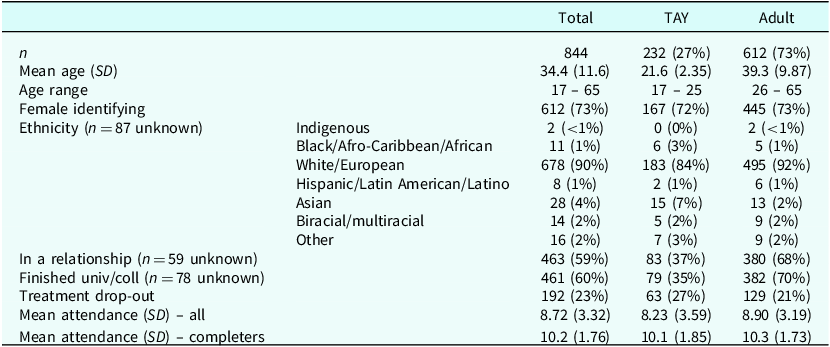
For the purpose of this study, participant data were separated into two groups based on age: (1) transition-aged youth (TAY; aged 17–25), n=232; and (2) adults (age 26–65 for GAD and OCD; 26–61 for SAD), n=612. See Table 1 for a summary of demographic variables and sample characteristics. All participants were seeking treatment for and had a diagnosis of a DSM-5 anxiety and related disorder, including SAD, GAD, and OCD. Diagnoses were either determined via a semi-structured psychodiagnostic interview using the Diagnostic Assessment Research Tool (DART; McCabe et al., Reference McCabe, Milosevic, Rowa, Shnaider, Pawluk and Antony2017; 50%), or psychiatric consultation (40%). The source of diagnosis for the remaining 10% was unknown (e.g. were assessed at another clinic at the hospital; had a previously established diagnosis), although diagnoses from other sources were only used by the clinic when they were recent and reputable (e.g. documented in a consultation note from a mental health clinician attached to the referral form). The majority (65.4%) of participants in the full sample had at least two diagnoses.
TAY analysis – results tables

Table 1. Long description
The table presents demographic variables and sample characteristics of participants seeking treatment for anxiety and related disorders, divided into two age groups: transition-aged youth (TAY) and adults. The table has 15 rows and 3 columns. The columns are labeled Total, TAY, and Adult. The rows include various demographic variables such as n, Mean age (SD), Age range, Female identifying, Ethnicity, In a relationship, Finished univ/coll, Treatment drop-out, Mean attendance (SD) – all, and Mean attendance (SD) – completers. Each row provides data for the total sample, TAY group, and Adult group. For example, the total number of participants is 844, with 232 in the TAY group and 612 in the Adult group. The mean age for the total sample is 34.4 (SD 11.6), with TAY having a mean age of 21.6 (SD 2.35) and Adults having a mean age of 39.3 (SD 9.87). The table also includes data on ethnicity, relationship status, education level, treatment drop-out rates, and mean attendance at sessions.
Baseline demographics and attendance summaries, by total and TAY/adult. Female identifying group includes cisgender and transgender females.
Group CBT treatment
Treatment consisted of manualized disorder-specific group CBT protocols for either SAD, GAD, or OCD. Treatment groups were not differentiated by age and thus each group consisted of participants from a broad age range (aged 17–65). All group manuals used in the present study were developed within our program from current widely used protocols.
The CBT for SAD Group was a manualized treatment protocol based on the work of Antony and Swinson (Reference Antony and Swinson2008) and Heimberg and Becker (Reference Heimberg and Becker2002) focusing on the following treatment components: (1) psychoeducation on SAD; (2) cognitive restructuring; (3) in-session and between-session situational exposures; (4) reduction of safety behaviours; (5) social skills review; and (6) relapse prevention.
The CBT for GAD Group was a manualized treatment protocol based on the work of Borkovec and Costello (Reference Borkovec and Costello1993), Dugas and Robichaud (Reference Dugas and Robichaud2007), and Wells (Reference Wells2009) and included the following treatment components: (1) psychoeducation on worry and GAD; (2) worry monitoring and cognitive restructuring strategies (e.g. examining the evidence for and against worries); (3) challenging of positive beliefs about worry; (4) problem solving training; (5) behavioral experiments designed to expose clients to uncertainty and to challenge their beliefs about worry; (6) progressive muscle relaxation training; and (7) relapse prevention.
Finally, the CBT for OCD Group was a manualized protocol based on the work of Foa and Franklin (Reference Foa, Franklin and Barlow2001), Foa et al. (Reference Foa, Yadin and Lichner2012), Steketee (Reference Steketee1993), and Wilhelm and Steketee (Reference Wilhelm and Steketee2006) consisting of: (1) psychoeducation on OCD; (2) monitoring OCD symptoms; (3) building an exposure hierarchy and conducting both in-session and between-session exposures with response prevention; (4) several additional techniques from contemporary cognitive therapy, including the responsibility pie, cumulative probability, and thought-action-fusion experiments; and (5) relapse prevention.
All disorder specific groups typically consisted of up to 12 patients and included 12 weekly 2-hour sessions facilitated by two therapists, with at least one experienced clinician (e.g. social worker, psychologist) as well as another clinician and/or clinical learner (e.g. psychology resident or practicum student). Groups were administered either face-to-face (in-person) or via videoconference following the onset of the COVID-19 pandemic. Videoconference sessions were provided in real-time and were identical to in-person groups with respect to size, length and number of sessions, and group material presented. Importantly, recent research from our clinic, indicates that treatment outcomes (face-to-face vs videoconference) were largely comparable across the CBT groups included in this study, with only the GAD group demonstrating slightly greater symptom improvement in the face-to-face format with a small effect size (d=0.20) (Milosevic et al., Reference Milosevic, Cameron, Milanovic, McCabe and Rowa2021).
Measures
Psychodiagnostic
The Diagnostic Assessment Research Tool (DART; McCabe et al., Reference McCabe, Milosevic, Rowa, Shnaider, Pawluk and Antony2017) was used to determine current diagnoses among participants who received a psychodiagnostic consultation. The DART is an open access semi-structured diagnostic interview for assessing DSM-5 mental disorders. Initial psychometric data indicate that the DART has good to excellent construct validity and good convergent and discriminant validity (Schneider et al., Reference Schneider, Pawluk, Milosevic, Shnaider, Rowa, Antony, Musielak and McCabe2021).
Group specific self-report symptom measures
Initial symptom severity and symptom change over the course of participation in group CBT were assessed with widely used disorder-specific self-report symptom measures with strong psychometric properties administered at pre- and post-treatment. The Social Phobia Inventory (SPIN; Connor et al., Reference Connor, Davidson, Churchill, Sherwood, Foa and Weisler2000; Antony et al., Reference Antony, Coons, McCabe, Ashbaugh and Swinson2006) is a 17-item measure, used to assess severity of social anxiety symptoms in the SAD groups (Cronbach’s alpha [α] for the total sample in this study was .89 and .94 for the TAY and Adult groups, respectively). The Generalized Anxiety Disorder Assessment (GAD-7) is a 7-item instrument that is used to measure the severity of GAD (Spitzer et al., Reference Spitzer, Kroenke, Williams and Löwe2006; Cronbach’s α=.87, .92). The Penn State Worry Questionnaire (PSWQ; Meyer et al., Reference Meyer, Miller, Metzger and Borkovec1990; Stober and Bittencourt, Reference Stober and Bittencourt1998), is a 15-item measure adapted for weekly assessment of worry, used to assess severity of problematic worry in the GAD groups (Cronbach’s α=.89, .93). The self-report Yale-Brown Obsessive-Compulsive Scale (Y-BOCS) is a 10-item scale pertaining to obsessions and compulsions on a 5-point Likert scale and was used to assess the severity of OCD symptoms in the OCD group (Goodman et al., Reference Goodman, Price, Rasmussen, Mazure, Fleischmann, Hill, Heninger and Charney1989; Cronbach’s α=.80, .93).
Across group measures
The Depression, Anxiety, and Stress Scales-21 (DASS-21; Lovibond and Lovibond, Reference Lovibond and Lovibond1995), was administered at pre- and post-treatment to assess change in symptoms of depression, anxiety, and stress combined across groups in the total sample. The DASS-21 is made up of three 7-item scales assessing depression, anxious arousal, and stress (tension/negative affect), and has strong psychometric properties (Antony et al., Reference Antony, Bieling, Cox, Enns and Swinson1998). Internal consistency of the DASS in the current sample was high (α=.92). The Group Cohesion Scale-Revised (GCS-R; Treadwell et al., Reference Treadwell, Lavertue, Kumar and Veeraraghavan2001) was administered at session 5 and at post-treatment to assess participants’ perceived level of cohesion with the group (i.e. interaction and communication, member retention, vulnerability among group members and consistency between group and individual goals). The GCS-R has good psychometric properties (Treadwell et al., Reference Treadwell, Lavertue, Kumar and Veeraraghavan2001). The internal consistency in the current sample was moderate (α=.63).
Attendance and drop-out
Attendance was collected weekly by group therapists on an attendance record. Drop-out was defined as attending less than eight sessions and failing to attend at least one of the final three sessions.
Procedures
The Hamilton Integrated Research Ethics Board approved all procedures used in the present study (HIREB #11019). Participants completed the DART assessment or received a psychiatric consultation upon entry to the program and were subsequently referred to a disorder-specific CBT group based on their principal area of concern. Groups were facilitated between September 2018 and January 2023. Participants completed self-report measures electronically via a browser-based data collection software (Research Electronic Data Capture) and were emailed a link with a specified time period to complete the measures (i.e. within two weeks of pre- and post-treatment for all symptom measures, and within 24 hours for the measure of group cohesion).
Statistical analyses
All analyses were performed in R v.4.3.3 (R Core Team, 2024). Categorical predictors (age group, anxiety group, and female identification) were coded with sum-to-zero contrasts to facilitate interpretation of main effects in the presence of interaction terms, with contrasts of the binary factors of age group and female identification coded such that model estimates can be interpreted as between-group differences (rather than as comparisons to the grand mean, which was the case for the 3-level anxiety group factor).
Session drop-out data, with drop-outs classified as those who attended less than eight sessions and did not attend at least the last three sessions, were analyzed with a logistic regression including age group, anxiety group, female gender identity, and interactions with age group as predictors. Separate ordinal logistic (proportional odds) regression models for attendance data were constructed for the whole dataset (including those that dropped out and those that completed), and for the completers only. Such ordinal models were used due to the negative skew in the attendance data, as well as the relatively small number of potential outcomes, and were fitted using the polr function from the MASS package (v.7.3-60.0.1; Venables and Ripley, Reference Venables and Ripley2002). These initially included the same set of predictors as the drop-out model; however, female identification and the interactions were removed to satisfy the proportional odds assumption as assessed using the Brant test (brant package v.0.3-0; Schlegel and Steenbergen, Reference Schlegel and Steenbergen2020; Brant, Reference Brant1990).
Pre/post-treatment models were fitted for each outcome measure separately and using the whole dataset for measures taken across anxiety groups (DASS, GCS), and using the respective datasets for disorder-specific measures (GAD-7, PSWQ, SPIN, Y-BOCS). We used linear mixed effects (hierarchical) models for these data to account for repeated measurements within individuals across time using the lmer function (lme4 package v.1.1-35.1; Bates et al., Reference Bates, Maechler, Bolker and Walker2015). The full dataset models included time, age group, anxiety group, and female identification as predictors, as well as interactions of all other predictors with age group, and the interaction of time with anxiety group. A three-way interaction among time, age group, and anxiety group was also initially included, but it was not significant in any model and was removed. Subject was included as a random intercept to account for repeated measures. Within-anxiety group models were fitted with the same set of predictors except the anxiety group. Residual diagnostics plots were produced using simulation methods from the DHARMa package (v.0.4.6; Hartig, Reference Hartig2022) in order to assess model fit and assumptions. Deviations from residual normality and homoscedasticity were detected in the DASS-D and DASS-A models, but inspection of the residual plots showed the deviations to be relatively minor. The residual diagnostic issues in these models were eliminated with a square-root transformation on the outcomes, but there appeared to be no substantive effect on the model estimates or significance compared with the untransformed results, and so the latter are reported for ease of interpretation. Two significant outliers were detected in the DASS-D model and were removed from that analysis.
Significance of model terms was determined with type III likelihood ratio tests for logistic regressions, and type III Wald tests for linear mixed effects models, all using the analysis of variance (ANOVA) function (car package v.3.1-2; Fox and Weisberg, Reference Fox and Weisberg2019). Multi-collinearity was assessed using the vif function from the car package and was found to be well within the accepted range (VIFs all <2) for all models. Post-hoc pairwise comparisons of estimated marginal means and trends among anxiety groups was performed with the emmeans package using proportional weights and the Tukey adjustment of p-values and CIs for multiple comparisons (v.1.10.0; Lenth, Reference Lenth2024). Finally, as fewer individuals responded to questionnaires post-treatment compared with pre-treatment, we assessed for a potential bias in respondents at post-treatment by comparing scores on our included scales at pre-treatment among those that did vs did not provide data post-treatment. We detected no differences in scores at pre-treatment among these groups except with GCS, where individuals that provided responses at post tended to have higher group cohesion at mid-treatment (estimated difference = 2.75 (SE=0.86), p=0.0015); however, this effect was not significantly different among age groups (estimated interaction effect = 2.77 (SE=1.97), p=0.16).
Results
Attendance and drop-out
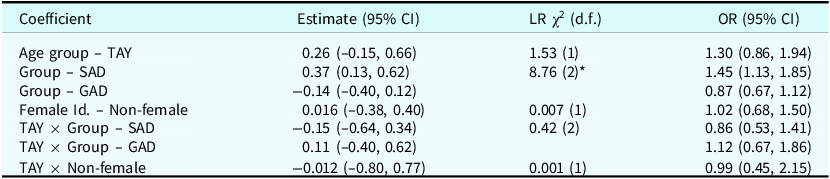
We did not detect a significant effect of age group on the probability of dropping out of treatment (Table 2), but there was a main effect of anxiety group on dropout (see Table S1 in the Supplementary material), with individuals in the SAD group being significantly more likely to drop out than individuals in either the GAD (OR=1.76, 95% CI=[1.13, 2.75], p<0.01) or OCD (OR=1.91, 95% CI=[1.08, 3.37], p<0.05) groups. When looking at the full set of attendance data (completers and drop-outs), TAY individuals had marginally lower attendance compared with adults, although this difference was not significant (i.e. TAY were marginally less likely to have a higher attendance level on the ordinal scale compared with adults; Table 3, left); however, similar to the dropout results, individuals in the SAD group had lower attendance compared with GAD (OR=0.60, 95% CI=[0.43, 0.84], p<0.01) and OCD (OR=0.50, 95% CI=[0.33, 0.75], p<0.001) (see Table S2 in the Supplementary material). These effects were generally lessened when looking at completers only (Table 3, right), where the SAD group was no longer significantly different from the GAD group.
Results from logistic regression with drop-out as outcome

Estimates and CIs provided on the original logit scale and odds-ratio (OR) scale. Type III LRT significance indicated as: *p<0.05.
Results from ordinal logistic regressions with attendance as outcome

Separate models fit for all participants (including drop-outs and completers) and among completers only. Due to relatively few completers with 8 or fewer sessions attended, these are collapsed into a single category for the completers only model. Estimates and CIs provided on the original logit scale and odds-ratio (OR) scale. Type III LRT significance indicated as: *p<0.05, **p<0.001. Italics indicate p < 0.10.
Group cohesion
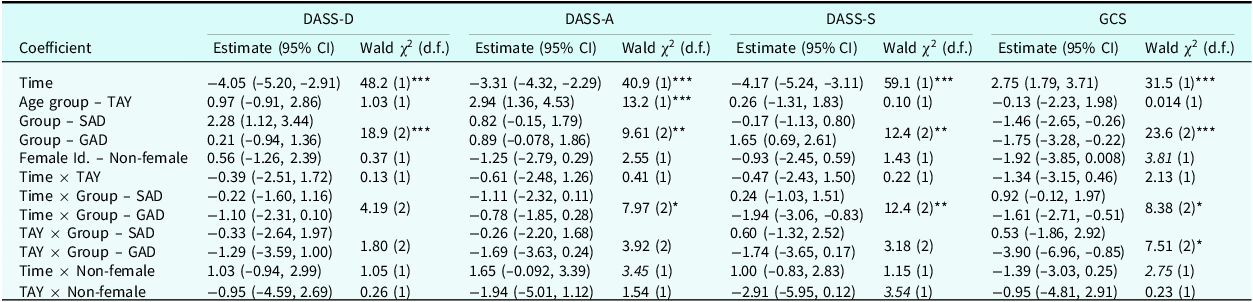
We observed an increase in group cohesion from mid- to post-treatment (see Time coefficient in Table 4). We did not detect any difference in change in group cohesion over time among age groups (see Time × TAY coefficient in Table 4). Looking at the 95% confidence intervals for our estimates of these interaction effects, our confidence that the difference in group cohesion improvement among the age groups is at most only modest, especially compared with the overall improvement observed over time.
Results from hierarchical linear (mixed) models with cross-group measures as outcomes

Table 4. Long description
The table presents results from hierarchical linear mixed models with cross-group measures as outcomes. It includes estimates, 95% confidence intervals, and Wald chi-square values for various coefficients related to group cohesion measures (DASS-D, DASS-A, DASS-S, and GCS). The table has 12 rows and 12 columns. Column headers include Coefficient, Estimate (95% CI), and Wald chi-square (d.f.) for each of the four measures. Row labels include Time, Age group - TAY, Group - SAD, Group - GAD, Female id. - Non-female, and various interaction terms. Each row provides specific estimates and statistical values for the different conditions and interactions. Notable trends include significant estimates for Time across all measures, indicating an increase in group cohesion from mid- to post-treatment. The interaction effects among age groups show modest differences compared to the overall improvement observed over time.
Type III Wald test significance indicated as: *p<0.05, **p<0.01, ***p<0.001. Italics indicate p < 0.10.
Group cohesion was lower in both the SAD (estimate = –3.95, 95% CI=[–6.16, –1.74], p<0.001) and GAD (estimate = –3.13, 95% CI=[−5.56, −0.69], p<0.01) groups compared with the OCD group. Group cohesion also improved more in the SAD group compared with the GAD group (estimate = 2.54, 95% CI=[0.31, 4.76], p<0.05). These group cohesion differences among the anxiety groups also varied across ages; holding time constant, the difference in group cohesion between the GAD and OCD groups was much more apparent in the TAY group (estimate = −8.60, 95% CI=[−14.3, −2.93], p<0.01) compared with the adult group where the difference was no longer significant (estimate = −1.32, 95% CI=[−3.96, 1.33], p=0.47).
Across group measures
Age group
We observed a significant reduction in depression, anxiety, and stress symptoms as measured by the three DASS-21 subscales from pre- to post-treatment (see Time coefficients in Table 4). We detected a significant main effect of age group in DASS anxiety, with TAY individuals tending to score higher than adults, but we did not detect any differences in change in symptoms over time among age groups (see Time × TAY coefficients in Table 4). Looking again at the 95% confidence intervals for our estimates of these interaction effects, it is clear that we have good confidence that the difference in symptom improvement among the age groups is likely close to 0 and is at most only modest, especially compared with the overall improvement observed over time.
Anxiety group
We did, however, observe significant effects among anxiety groups including differences in symptom improvement over treatment. All three groups improved in their DASS depression scores to a similar degree, but both the SAD (estimate = 5.26, 95% CI=[2.74, 7.78], p<0.001) and GAD (estimate = 3.43, 95% CI=[1.13, 5.73], p<0.01) groups scored significantly higher than the OCD group. The OCD group reported lower baseline scores on the DASS-Anxiety subscale (see Fig. S1 and Table S3 in the Supplementary material) compared with the other two groups. Relatedly, the OCD group improved in their DASS anxiety scores less than either the SAD (estimate = −3.00, 95% CI=[−5.75, −0.24], p<0.05) or GAD (estimate = −2.67, 95% CI=[−5.14, −0.20], p<0.05) groups. The GAD group had higher scores on the DASS-Stress scale compared with the OCD or SAD groups at baseline (see Fig. S2 and Table S3 in the Supplementary materail). Relatedly, the OCD group improved less than the GAD group (estimate = −3.65, 95% CI=[−6.24, −1.06], p<0.01) on the DASS-Stress scale.
Group specific measures
For a descriptive summary of group-specific measures, sorted by age group and anxiety group, see Table S4 in the Supplementary material. Within the GAD group, we observed a significant reduction in scores on the GAD-7 and PSWQ from pre- to post-treatment (see Time coefficient in Table 5). Similarly, within the SAD group, we observed a significant reduction in scores on the SPIN from pre- to post-treatment and within the OCD group we saw a significant reduction in scores on the Y-BOCS from pre- to post-treatment (see Time coefficients in Table 5). However, we did not detect any significant difference in change in symptoms over time among age groups in the GAD, SAD, or OCD groups (Time × TAY coefficients in Table 5). As with the across-group measures, the 95% confidence intervals show that we have good confidence that the difference in symptom improvement among the age groups is at most only modest compared with the overall improvement.
Results from hierarchical linear (mixed) models with group-specific measures as outcomes

Table 5. Long description
The table presents results from hierarchical linear models with group-specific measures as outcomes. It includes estimates, 95% confidence intervals, and Wald chi-square values for different coefficients across various anxiety groups: GAD, SAD, and OCD. The table is divided into columns for GAD-7, PSWQ, SPIN, and Y-BOCS measures. Each row represents different coefficients such as Time, Age group, Female, Time x TAY, Time x Non-female, and TAY x Non-female. The table has 7 rows and 12 columns. Row 1: Coefficient, GAD-7 Estimate (95% CI), GAD-7 Wald chi-square (d.f.), PSWQ Estimate (95% CI), PSWQ Wald chi-square (d.f.), SPIN Estimate (95% CI), SPIN Wald chi-square (d.f.), Y-BOCS Estimate (95% CI), Y-BOCS Wald chi-square (d.f.). Row 2: Time, -3.76 (-4.76, -2.75), 53.6 (1)***, -11.5 (-13.9, -8.88), 82.6 (1)***, -14.1 (-16.6, -11.7), 127.4 (1)***, -5.53 (-7.08, -3.99), 49.0 (1)***. Row 3: Age group TAY, 0.015 (-1.43, 1.46), 0.0004 (1), 0.96 (-2.76, 4.68), 0.25 (1), 0.21 (-2.80, 3.22), 0.19 (1), 0.26 (-2.01, 2.52), 0.049 (1). Row 4: Female Id. Non-female, -0.84 (-2.28, 0.60), 1.32 (1), -3.68 (-7.40, 0.039), 3.76 (1), -2.33 (-5.34, 0.68), 2.30 (1), -1.38 (-3.63, 0.88), 1.44 (1). Row 5: Time x TAY, 0.0082 (-1.83, 1.85), 0.0001 (1), 0.62 (-3.93, 5.18), 0.072 (1), -0.61 (-5.10, 3.89), 0.070 (1), -1.22 (-4.20, 1.77), 0.64 (1). Row 6: Time x Non-female, 2.35 (0.79, 3.91), 8.70 (1)***, 4.26 (0.42, 8.11), 4.72 (1)*, -0.66 (-5.42, 4.10), 0.074 (1), 0.98 (-1.77, 3.73), 0.49 (1). Row 7: TAY x Non-female, -0.80 (-3.68, 2.07), 0.30 (1), -2.52 (-9.95, 4.91), 0.44 (1), 2.47 (-3.54, 8.48), 0.65 (1), 0.54 (-3.95, 5.04), 0.056 (1).
Type III Wald test significance indicated as: *p < 0.05, **p < 0.01, ***p < 0.001. Italics indicate p < 0.10.
Incidentally, we did find a significant difference in change in symptoms over time between gender identities in the GAD group, with female identifying participants reporting a greater rate of improvement on the PSWQ and GAD-7 than non-female identifying participants (estimate = 2.35, 95% CI=[0.79, 3.91], p<0.01). However, this can be attributed to the female-identifying group starting with higher levels of anxiety at pre-treatment (see Figs S3 and S4 in the Supplementary material). This effect was not found in the SAD or OCD groups.
Discussion
This preliminary study compared treatment outcomes for TAY and adults receiving disorder-specific group CBT for anxiety and related disorders in a tertiary hospital setting. Despite presenting with more severe anxiety symptoms at baseline (i.e. on the DASS Anxiety subscale), TAY demonstrated significant improvements comparable with adults across disorder-specific outcome measures (i.e. SPIN, GAD-7, Y-BOCS) and general symptoms (i.e. DASS-21), as well as no significant differences between age groups in terms of group cohesion, attendance, and drop-out. These findings suggest that mixed-aged CBT groups for SAD, GAD, and OCD are effective in reducing symptoms for both TAY and adults. These results are encouraging for providers working with this population, given that many TAY access mental health care within the adult mental healthcare system and these results provide greater confidence in the efficacy of mixed-age disorder-specific CBT groups. Although TAY showed marginally lower attendance and participants with SAD were more likely to discontinue treatment across both age groups, overall engagement (i.e. attendance, treatment completion) was similar once youth accessed care. This contrasts with prior literature reporting poorer outcomes and higher drop-out among TAY (Babajide et al., Reference Babajide, Ortin, Wei, Mufson and Duarte2020; Lyng et al., Reference Lyng, Swales, Hastings, Millar and Duffy2020; Saunders et al., Reference Saunders, Suh, Buckman, John, El Baou, Pilling, Lewis, Stott, Krebs and Stringaris2025), and may reflect differences in setting, severity, or treatment modality. For example, in tertiary care, group-based CBT may be particularly beneficial for TAY relative to self-guided or individual formats.
These findings align with meta-analyses showing minimal associations between age and treatment prognosis in depression (Buckman et al., Reference Buckman, Saunders, Stott, Arundell, O’Driscoll, Davies and Pilling2021; Cuijpers et al., Reference Cuijpers, Karyotaki, Reijnders and Huibers2018), although differences in student vs hospital populations highlight the need for further study of TAY in clinical settings, particularly for anxiety and related disorders. The smaller proportion of youth in the current sample also underscores potential barriers earlier in the care pathway, prior to enrolment in disorder-specific group treatment, such as symptom severity, support systems, or structural access challenges. As a result, it is possible that TAY enrolled in the present study may represent a more motivated or better-resourced subset of this age group, and the current findings may not fully capture the engagement patterns of the TAY population experiencing anxiety and related disorders.
Future research should examine whether age-specific adaptations could further enhance outcomes. Prior work suggests that developmentally tailored services improve participation, retention, and treatment gains (Gilmer et al., Reference Gilmer, Ojeda, Fawley-King, Larson and Garcia2012; Lyng et al., Reference Lyng, Swales, Hastings, Millar and Duffy2020). Offering treatment alongside developmentally similar peers may normalize experiences, reduce stigma, and strengthen group cohesion, particularly in SAD groups where drop-out risk is higher (Chowdhury and Khandoker, Reference Chowdhury and Khandoker2023). Additional youth-centered strategies, such as tailoring language, examples, and materials, may optimize engagement. Beyond programming, further study is needed to explore other factors influencing TAY participation in mental health treatment more broadly, including social anxiety around peer interactions (Guyer et al., Reference Guyer, Lau, McClure-Tone, Parrish, Shiffrin, Reynolds, Chen, Blair, Leibenluft, Fox, Ernst, Pine and Nelson2008; Pickering et al., Reference Pickering, Hadwin and Kovshoff2020) and differences in developmental level. Additionally, although research has found cross-cultural similarities in criteria perceived to indicate a transition to adulthood, it has also found cross-cultural variations in responsibilities or expectations that determine whether individuals perceive themselves as adults (i.e. culturally specific conceptions of adulthood; Nelson and Luster, Reference Nelson, Luster and Arnett2015; Skirbekk et al., Reference Skirbekk, Tamnes, Júlíusson, Jugessur and von Soest2025). Youth perceptions of their relationships with same-age peers may certainly impact interest and engagement in youth-specific services. Overall, more research is required to identify and address the diverse factors shaping treatment engagement and outcomes among youth.
Limitations
This preliminary study has several limitations. First, the sample was drawn from a tertiary care setting, likely reflecting individuals with more severe and chronic anxiety presentations compared with post-secondary or community populations. Without assessment of prior treatment history, it is also unclear how previous therapeutic experiences may have influenced outcomes. The high rate of co-morbidity (i.e. nearly two-thirds of participants) also limits generalizability to populations with lower symptom severity. Unfortunately, information regarding additional or secondary diagnoses was not available for all study participants and as such we were unable to investigate the impact of co-morbidity on the study findings.
Second, consistent with prior research (Babajide et al., Reference Babajide, Ortin, Wei, Mufson and Duarte2020; Lyng et al., Reference Lyng, Swales, Hastings, Millar and Duffy2020), a noticeably smaller proportion of TAY enrolled relative to adults, despite the higher estimated prevalence of anxiety and related disorders in this age group. While the adult group spans a broader age range (26+), which naturally increases the pool of potential participants, the expectation would still be that more TAY would be represented given the elevated prevalence of anxiety and related disorders in this age period. This discrepancy may reflect ongoing barriers to care and suggests that the TAY included here represent a subset more able or willing to access adult-focused tertiary services, limiting representativeness.
Third, the sample lacked diversity, being predominantly white and female. This restricted intersectional analysis and prevented examination of potential differences across racialized, sexual, or gender minority youth. Other unmeasured confounding variables may also have influenced results. Additionally, multiple test comparisons increase the risk of type I error, and findings such as higher cohesion in the adult GAD group should be interpreted cautiously. Finally, as a naturalistic study, there was no control condition, and not all patients consented to research, raising questions about representativeness. Therapist-level factors (e.g. adherence, training, competence) were not measured, and no short- or long-term follow-up was conducted, leaving the durability of treatment gains uncertain.
Conclusion
This preliminary study suggests that TAY and adults with severe anxiety and related disorders respond equivalently to disorder-specific group CBT in a tertiary hospital setting. Both groups demonstrated similar significant improvements in symptoms and group cohesion, with attendance, and drop-out rates being comparable across groups, suggesting that treatment is effective for both adults and TAY. Given that TAY remain critically underserved and less likely to access care, further research is needed to examine whether age-specific adaptations could enhance short- and long-term outcomes and increase engagement and treatment uptake among this population.
Key practice points
-
(1) This study found that transition-age youth (TAY) responded to mixed-age, disorder-specific CBT groups as effectively as adults, with comparable improvements in symptoms, attendance, and cohesion.
-
(2) While current standards of care appear effective, age-specific adaptations may further enhance engagement and reduce drop-out, particularly for socially anxious youth.
-
(3) More research is needed to explore barriers to care and the potential added benefits of developmentally tailored services for TAY
Supplementary material
To view supplementary material for this article, please visit https://doi.org/10.1017/S1754470X26100749
Data availability statement
The anonymous datasets generated during and/or analyzed during the current study can be made available from the corresponding author upon reasonable request.
Acknowledgements
None.
Author contributions
Taylor Hatchard: Conceptualization-Lead, Formal analysis-Equal, Methodology-Equal, Project administration-Lead, Supervision-Equal, Writing - original draft-Lead, Writing - review & editing-Equal; Jenna E. Boyd: Conceptualization-Equal, Formal analysis-Lead, Methodology-Equal, Project administration-Equal, Writing - review & editing-Equal; Christina Mutschler: Writing - original draft-Equal, Writing - review & editing-Equal; Jennifer Hewitt: Conceptualization-Equal, Writing - original draft-Equal, Writing - review & editing-Equal; Andrew M. Scott: Data curation-Equal, Formal analysis-Equal, Writing - review & editing-Equal; Jennifer Ip: Project administration-Equal, Writing - original draft-Equal, Writing - review & editing-Equal; Karen Rowa: Writing - original draft-Equal, Writing - review & editing-Equal; Sabrina K. Syan: Formal analysis-Equal, Writing - original draft-Equal; Ashleigh Elcock: Data curation-Lead; Randi E. McCabe: Conceptualization-Equal, Supervision-Equal, Writing - original draft-Equal, Writing - review & editing-Equal.
Financial support
None.
Competing interests
The authors declare none.
Ethical standards
The research presented has conformed to the Declaration of Helsinki. The Hamilton Integrated Research Ethics Board approved all procedures used in the present study (HIREB #11019) and all participants provided informed consent.




 Open access


Comments
No Comments have been published for this article.