Introduction
The level of biological fitness of a community can be assessed by means of its fertility and mortality models, because the degree of genetic transmission throughout generations depends on the success of female reproduction and the survival probability of their offspring until reproductive age (Lasker & Kaplan, Reference Lasker and Kaplan1995). The evolutionary forces of humans, contrary to those of all other species, are usually strongly conditioned by their socio-cultural peculiarity. Cuba, and more especially its capital (Havana), represents a very interesting community from the point of view of evolutionary dynamics. This population, similar to Western developed countries, is characterized by low fertility and mortality, as a consequence of health facility development and birth control. However, Havana's population has an elevated level of induced miscarriages (Gran, Reference Gran2005), which makes its biological fitness different from the pattern observed in the most Western countries. The practice of abortion, considered to be a method of birth control, increases pre-reproductive mortality, thus reducing significantly genetic transmission success.
The usual method of analysis of the biological fitness level in human populations from demographic data was proposed by Crow (Reference Crow1958). His ‘index of action opportunity of natural selection’, regarding mortality and fertility patterns, measures biological fitness: the lower the Crow index, the greater the biological fitness.
From the results obtained in several populations where Crow's index was analysed, three general evolutionary models can be distinguished regarding the position of a community in relation to the demographic transition process (Luna & Moral, Reference Luna and Moral1990). In developing populations, such as isolated indigenous communities where the demographic transition is just beginning, biological fitness is determined by their high fertility but limited by their high mortality (Crow, Reference Crow1966; Neel & Chagnon, Reference Neel and Chagnon1968; Johnston & Kensinger, Reference Johnston and Kensinger1971; Halberstein & Crawford, Reference Halberstein and Crawford1972). Technologically well-developed populations, where the demographic transition has ended, show a biological fitness even lower than that of developing populations and a higher action opportunity of natural selection, because pre-reproductive mortality and fertility have drastically reduced as a consequence of improvement in health facilities and high use of birth control (Sphuler, Reference Sphuler and Schull1963; Crow, Reference Crow1966; Jacquard, Reference Jacquard1974; Tyzzer, Reference Tyzzer1974; Cavalli-Sforza & Bodmer, Reference Cavalli-Sforza and Bodmer1981). Finally, rural communities in developed countries show a significant reduction in mortality as a consequence of national health programmes, but have maintained their ancestral cultural pattern of fertility characterized by a large number of offspring (Tarskaia et al., Reference Tarskaia, Elchinova, Varzar and Shabrova2002). These societies have experienced the demographic transition, their biological fitness level is high since gene transmission is assured by both high fertility and low mortality, and their action opportunity of natural selection is significantly the lowest of the three types of populations (Crow, Reference Crow1966; Bernis, Reference Bernis1974; Fuster, Reference Fuster1982; Torrejon & Bertranpetit, Reference Torrejon and Bertranpetit1987; Luna & Moral, Reference Luna and Moral1990).
The Cuban population showed a peculiar and dynamic demography following the Cuban revolution in 1959. Thus, infant mortality decreased continuously to its current level of fewer than 10 deaths per 1000 births, and fertility underwent a large decrease from 1965, after a temporary recovery between 1959 and 1965. As a consequence generation replacement has not been assured since 1978 (Alfonso, Reference Alfonso2006). Havana, and specifically the municipality of Plaza de la Revolución, is characterized by its demographic peculiarity. This urban population has experienced the biggest decline in fertility in the country; it has a high index of induced abortion; and is the most aged community because of its remarkable proportion of citizens older than 65 years (Pagola et al., Reference Pagola, Mendoza and Rendueles2008). The aim of this research is to assess from demographic data the biological fitness of the urban community of Plaza de la Revolución, to determine whether this community shows the same evolutionary pattern as that observed in developed countries where the demographic transition has ended, and to observe the degree of reduction of its biological fitness by its elevated induced abortion index.
Methods
The demographic data used in this study were obtained from personal interviews carried out between March 2007 and October 2008. It is a transversal and retrospective study, in which a sample of 1200 women aged between 55 and 64 years, resident in Plaza de la Revolución, Havana, and born between 1942 and 1953, were interviewed. All subjects had exceeded the reproductive age (15–49 years in Cuba) and their families were complete without the possibility of having more offspring. The reproductive history of each woman was reconstructed, as well as the mortality characteristics and survival of their offspring.
Since the adaptability level of a population increases as natural selection action decreases, a way to assess the biological fitness of a community is through the method proposed by Crow (Reference Crow1958), whose index of total selection (I) is obtained from mortality and fertility patterns. Thus, when a population has high fertility and low pre-reproductive mortality, individuals more easily transmit genes throughout generations, biological fitness is higher and the action opportunity of natural selection is lower.
The Crow index consists of two demographic parameters:
(1) The index of selection potential due to differential postnatal mortality (I m) is calculated from the probability of death during the first 15 years of life post-delivery (P d) and the probability of surviving from the same reproductive period (P s), through the expression:
I m=P d/P s.
(2) The index of selection potential due to differential fertility (I f) is established from the variance of the number of living newborns (V f) and the average number of newborns (X), by means of the formula:
I f=V f/X 2.
From these two parameters, the index of total selection is obtained by the expression:
I=I m+(1/P s)I f.
Since embryonic mortality can be high in those developing communities in which health conditions are deficient, and in developed societies where induced miscarriages can be frequent, this index was corrected according to the method of Johnston & Kensinger (Reference Johnston and Kensinger1971). Thus, the corrected index evaluates the effect of early mortality on biological fitness since all deaths prior to reproductive age are considered. Accordingly, the effect of mortality on biological fitness is separated regarding prenatal and postnatal deaths, and the index of total selection (I) can be calculated by means of three components:
(1) The index of selection potential due to differential prenatal mortality (I me) is estimated from the proportion of embryos and fetuses that die (P b) and those that survive delivery (1–P b), through the expression:
I me=(1–P b)/P b.
(2) The index of selection potential due to differential postnatal mortality (I mc), which corresponds to deaths occurring between delivery and reproductive age, is the same as the one defined by Crow (I mc=I m).
(3) The index of selection potential due to differential fertility (I f) is also explained by the Crow method.
The index of potential selection corrected (I′), considering all the pre-reproductive period from embryonic stages until the 15th birthday, can be calculated through the expression:
I′=I me+(1/P b)I mc+(1/P bP s)I f,
where P bP s is the probability of survival from early embryonic stages until reproductive age.
However, due to the high frequency of miscarriages in this urban Cuban population as a result of induced abortions, the corrected index was calculated in two cases: (a) I tc with all the miscarriages obtained from the sample (spontaneous and induced miscarriages), and (b) I ce with data referring to spontaneous miscarriages only. Thus, the comparison of both indexes reveals the impact of the reproductive behaviour of induced abortion on the biological fitness of an urban population of Cuba.
Results
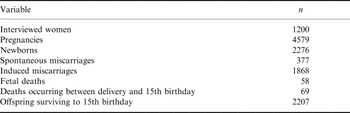
Table 1 shows the frequencies of deaths and offspring survival of 1200 interviewed women until various ages of pre-reproductive life, as well as their absolute fertility frequencies. More than half (0.518) of the conception products died before attaining reproductive age, with more than 40% of pregnancies ending in induced miscarriage (0.408).
Fertility, deaths and survival of offspring to various ages of pre-reproductive life of interviewed women

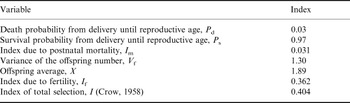
Table 2 includes the three indexes of action opportunity of natural selection (Crow, Reference Crow1958): index of total selection (I); potential selection due to differential fertility (I f); and potential selection due to differential mortality (I m). The necessary demographic parameters in order to obtain these indexes are also shown. A notable characteristic of this urban community of Havana is that the index of natural selection due to fertility (I f) is eleven times higher than the index due to mortality (I m), and the relative contribution to the index of total selection (I) is 92.37%.
Fertility and mortality variables related to Crow's index of natural selection

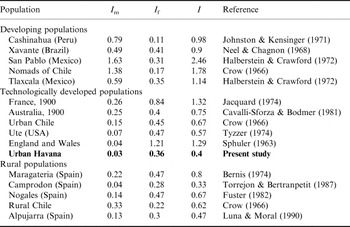
The indexes of action opportunity of natural selection (Crow, Reference Crow1958) in several populations are shows in Table 3. As in most other developed populations, fertility contributes more than mortality to the total selection index. The index due to postnatal mortality is low in all the compared populations because of the high probability of a newborn surviving to reproductive age.
Crow's index of natural selection in several populations

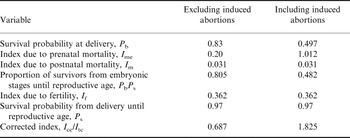
The corrected index proposed by Johnston & Kensinger (Reference Johnston and Kensinger1971), which includes prenatal deaths, is shown in Table 4. Due to the high contribution of induced abortions to the biological fitness of this urban population, the analysis was carried out including and excluding induced miscarriages in order to show the influence of induced miscarriages on biological fitness. Thus, when induced abortions are taken into account, the probability of newborns, as well as children, surviving until reproductive age clearly decreases. The biological fitness therefore reduces significantly since the corrected index is 2.65 times higher than when only natural miscarriages are considered.
Corrected index of natural selection (Johnston & Kensinger, Reference Johnston and Kensinger1971) and its parameters, excluding and including induced abortions

Discussion
Similar to other developed populations, most of the pre-reproductive deaths reported in this Cuban sample occurred during the embryonic stage and the lowest proportion took place after delivery (Table 1). This could have two possible main causes: the legalization of the practice of abortion since 1965 and the decrease in infant and child mortality due to health improvement.
The potential selection index due to differential fertility shown in Table 2 (0.362) is similar to that of other present day urban communities (Kurbatova & Privalova, Reference Kurbatova, Yu and Privalova2005). The potential selection index due to differential mortality shows a very low value (0.031), which approaches the lowest level of human population variability, from 0.01 to 1.78 (Puzyrev et al., Reference Puzyrev, Erdynieva, Kucher and Nazarenko1999).
The evolutionary model by natural selection of Plaza de la Revolución corresponds to that observed in populations of developed countries where the demographic transition has ended (Luna & Moral, Reference Luna and Moral1990). Of the countries compared, the index of total selection is lowest in the developed countries (Table 3). This model is the result of the particular behaviour of mortality and fertility at present. Postnatal deaths are very low in the studied population (0.03) and the fertility of these women is low because of increased birth control through the use of contraception methods (75.2%). This behaviour reduces the average family size but increases the variance of offspring number (Table 2), making possible the action of natural selection through low fertility, as in other developed communities. The other two evolutionary models correspond to:
(a) Developing communities that have not yet begun the demographic transition, with high fertility because they do not practise birth control methods, and with high mortality because of poor health facilities: these populations have a low biological fitness due to high mortality. In most South American countries the opportunity of natural selection acts by means of higher mortality (Sánchez, Reference Sánchez1989), suggesting that these countries are included within this evolutionary pattern.
(b) Rural populations of developed countries that are experiencing the demographic transition, with a substantial reduction in infant mortality because of public health programmes, and with high fertility as a result of the persistence of the cultural pattern defined by a large number of offspring (Tarskaia et al., Reference Tarskaia, Elchinova, Varzar and Shabrova2002). Hence, action of natural selection is significantly obstructed in comparison with the other models. These communities show a higher biological fitness, since gene transmission is assured by both high fertility and low mortality.
When all pre-reproductive mortality, including prenatal deaths, is considered (Table 4), biological fitness decreases and the corrected indexes increase because the mortality during the embryonic stages is high, especially when the reproductive behaviour of birth control is based on induced miscarriages. This practice increases total pre-reproductive mortality and reduces women's fertility (Luna, Reference Luna1984). Then, prenatal mortality contributes to the corrected index (I tc=1.825) with 55.45%, the postnatal mortality contribution is only 3.40%, and the rest (41.15%) is due to differential fertility. These results can be explained by socio-cultural factors, as observed in many other human populations (Hed, Reference Hed1987), such as the development of health facilities after the revolution of 1959, decreasing infant and child mortality and the legalization of abortion.
In conclusion, although Plaza de la Revolución is a population clearly included within the evolutionary model corresponding to developed communities, characterized by a high level of health and birth control, and with the demographic transition finished, it differs from other developed populations when prenatal mortality is taken into account. A new evolutionary pattern can be defined as a result of important reproductive behaviours such as the practice of induced miscarriages, representing nearly half of pregnancies. Its current biological fitness is defined by a low postnatal mortality, due to the development of health facilities, and a low fertility rate, due to the frequent use of contraceptives, and is characterized especially by a high frequency of abortions, which results in high prenatal mortality and low fertility.
Acknowledgments
This paper was supported by the project CGL2006-02978 of the Spanish ‘Ministerio de Ciencia y Tecnología’. Thanks are expressed to Erik Lundin for reviewing the manuscript.