
I. INTRODUCTION
Membrane technology has a huge potential in different applications, including petrochemicals, pharmaceutical and food and beverages industries, and water and wastewater treatment. Membrane-based processes such as microfiltration (MF), ultrafiltration (UF), nanofiltration, membrane distillation, and reverse osmosis are extensively used for desalination, and water and wastewater treatment. One of the widely used membrane materials is poly (vinylidene fluoride) (PVDF). PVDF is a highly inert and pure thermoplastic fluoropolymer made by the polymerization of vinylidene difluoride. It possesses high thermal and mechanical stability and excellent chemical and ultraviolet resistance. Reference Liu, Hashim, Liu, Abed and Li1,Reference Gao, Yu and Li2 Furthermore, PVDF has good thermodynamic affinity with various polymers such as hexafluoropropylene, Reference Lalia, Guillen-Burrieza, Arafat and Hashaikeh3 chlorotrifluoroethylene, Reference Sousa, Kundu, Gören, Silva, Liu, Costa and Lanceros-Mendez4 and methyl methacrylate. Reference Liu, Hashim, Liu, Abed and Li1 Therefore, it is commonly utilized in various membrane applications such as MF, UF, membrane distillation (MD), and membrane contactors. Reference Thomas, Guillen-Burrieza and Arafat5–Reference Mavukkandy, Bilad, Giwa, Hasan and Arafat7 It is also an appropriate candidate in bioseparation and biomedical applications due to the low level of extractables present in it. Reference Hu, Li, Zhang, Li and Xu8,Reference Wang, Xiong, Luo, Choo, Yuan, Tan and Choong9 It also has applications in cell encapsulation, drug delivery, water softening, electronic devices, and sensors. Reference Mika10
Like all other separation processes, membrane technologies suffer from their own limitations, most notably selectivity issues and rapid fouling. The lack of selectivity results from poor and/or less specific interactions with surface functional groups. Membrane fouling occurs due to the deposition of various substances on the membrane surface and/or inside the porous structure of the membrane. Morphology and surface chemistry, thus, determine the performance of polymeric membranes. Therefore, fine-tuning of membranes is required to use them in target-specific applications. There are various physical and/or chemical modifications used in achieving the required functionalization of membranes. Physical modification usually involves the introduction of various nanomaterials such as carbon nanotubes, Reference Lin, Wang, Ko, Chen, Chang, Tung and Lee11 titanium dioxide, Reference Razmjou, Arifin, Dong, Mansouri and Chen12 aluminum oxide, Reference Dong, Xiao, Li, Wang and Guo13 and metal organic frameworks Reference Ahmadi Feijani, Tavasoli and Mahdavi14 into the polymeric membrane matrix. On the other hand, chemical methods involve adsorption, Reference Hu, Li, Zhang, Li and Xu8 coating, Reference Nishigochi, Ishigami, Maruyama, Hao, Ohmukai, Iwasaki and Matsuyama15,Reference Mangindaan, Yared, Kurniawan, Sheu and Wang16 graft polymerization, and alteration of the membrane materials. Reference Gao, Yu and Li2,Reference Brewis, Mathieson, Sutherland, Cayless and Dahm17 Because of the inert nature of PVDF membranes, most of the chemical modification methods require the initial activation of the membrane surface. One such approach is the hydroxylation of the PVDF membrane surface so as to utilize the resulting hydroxyl groups as anchorage points for the covalent immobilization of chemical moieties. Plasma irradiation, Reference Razmjou, Arifin, Dong, Mansouri and Chen12,Reference Efome, Baghbanzadeh, Rana, Matsuura and Lan18 gamma and X-ray irradiation, Reference Abdel-Hady, El-Toony and Abdel-Hamed19,Reference Li, Deng, Ji, Yu, Xie, Li and Lu20 electron beam radiation, Reference Liu, Zhu and Xu21 and ozone methods Reference Arslantas, Sinirlioglu, Eren, Muftuoglu and Bozkurt22,Reference Meng, Chen, Huang, Du and Zhang23 were studied for hydroxyl groups generation followed by modification of PVDF membranes. However, the above-mentioned methods were not highly efficient in the generation of OH groups on prefabricated membranes. Reference Liu, Hashim, Liu, Abed and Li1,Reference Sun, Liu, Chu and Dong24 Chemical treatment of PVDF membranes with acidic or basic solutions was reported to enhance their hydrophilicity/wettability. Reference Mathieson, Brewis, Sutherland and Cayless25–Reference Dias and McCarthy29 However, this requires long acid/alkali treatments (∼12–48 h) under severe conditions. There are reports indicating that PVDF suffers from degradation upon treatment with a strong base such as sodium hydroxide (NaOH). Reference Awanis Hashim, Liu and Li30 Generally, during the alkali-treatment of PVDF, the use of high concentrations (up to 12 M) of the alkali medium has been reported. Reference Brewis, Mathieson, Sutherland, Cayless and Dahm17,Reference Rabuni, Nik Sulaiman, Aroua and Hashim31–Reference Ross, Watts, Hill and Morrissey33 Moreover, prolonged exposure (up to 48 h) was used or phase transfer catalyst was used to complete the reaction. Reference Brewis, Mathieson, Sutherland, Cayless and Dahm17,Reference Rabuni, Nik Sulaiman, Aroua and Hashim31–Reference Ross, Watts, Hill and Morrissey33 The high NaOH concentration, prolonged exposure, and the elevated temperature during the reaction all promote PVDF degradation. Furthermore, intensive treatment with alkali followed by sulfuric acid degrades the nonwoven support (NWS) of the flat-sheet membrane. Reference Nguyen-Tri, El Aidani, Leborgne, Pham and Vu-Khanh34 Therefore, it is crucial to achieve a suitable protocol for membrane modification using alkaline media without compromising the PVDF itself. There is a dearth of literature on PVDF membranes treatment under mild condition (short treatment period and low concentrations of alkaline solution) and the impact of such treatment on the material properties and membrane performance.
In this study, we propose an efficient protocol for hydroxyl group functionalization of PVDF membranes by activating the PVDF polymer prior to membrane formation. Mild reaction conditions were selected to maintain membrane integrity. The method involves a two-step, nonaqueous chemical modification including dehydrofluorination of the pristine PVDF polymer followed by a hydroxylation step using H2SO4.
II. EXPERIMENTAL SECTION
A. Materials
The polymer, solvent, and nonsolvent used to make the membranes were PVDF (HSV900, Arkema, Philadelphia, Pennsylvania; MW 92840 Da), dimethylacetamide (DMAc; Sigma-Aldrich, St. Louis, Missouri; ≥99.5%), and deionized water (Elix, Millipore, Darmstadt, Germany), respectively. Sulfuric acid (95–97%), methanol (98%), and potassium hydroxide (≥85%) were purchased from Sigma-Aldrich. All the chemicals were used as received.
B. PVDF polymer modification and membrane fabrication
In this study, pristine (unmodified) and activated (modified) membranes were fabricated through the immersion precipitation method. Initially, for the pristine membrane, PVDF powder (10 g) was dissolved in DMAc (90 g) by stirring for 24 h to obtain a 10% (wt/wt) polymeric dope solution. The dope solution was kept idle for 24 h for degassing and homogenization. For the modified PVDF polymer, the dope solution was prepared following the same protocol as that for pristine membrane. However, a dehydrofluorination step was performed on the polymer before preparing the dope. Initially, this was attempted by mixing the PVDF powder (10 g) with 30% NaOH solution (aqueous) followed by concentrated H2SO4 treatment. However, this protocol was unsuccessful due to reasons discussed in Sec. III.A. Therefore, the dehydrofluorination step was performed by mixing the PVDF powder (10 g) with 5 wt% KOH in methanol (100 mL) for 5 or 30 min at room temperature. The PVDF powder was then separated from the solution by centrifugation, decantation, and subsequent washing (5 times) with pure methanol to remove excess KOH solution, followed by drying at 70 °C for 24 h prior to further treatment. The resulting PVDF powder was then treated with 98% H2SO4 (50 mL) at 80 °C for 12 h to complete the second step of modification (the hydroxylation step). The suspension was then centrifuged, decanted, and washed with methanol (these three steps were repeated three times in the respective order) and dried at 80 °C for 24 h. All the above-mentioned steps except the centrifugation and decantation were replicated in the case of noncentrifuged samples (herein referred to as “NC”). Flat-sheet membranes were then formed by casting the polymer dope on a NWS (Novatexx 2483, Freudenberg-Filter, Kaiserlautern, Germany) using a thin film applicator (3580 Elcometer), with a solution gap of 250 µm at 24 °C. The cast films were then immersed for 1 h in a coagulation bath containing deionized water. The resultant membranes were then dried at room temperature for 24 h.
C. Membrane characterization
1. Contact angle, critical surface tension, surface-free-energy, and work of adhesion
Pristine and modified PVDF membranes were characterized to determine their apparent contact angle (CA) with water. Static (sessile drop) and dynamic CAs were measured at room temperature using a goniometer (Krüss Easy Drop Analyzer, Krüss GmbH, Hamburg, Germany) and deionized water (15 MΩ cm) as the wetting liquid. The CA values were calculated from Krüss Easy Drop Analyzer software with an accuracy of ±0.5°. The measurements of static CA were repeated 20–30 times (mean accuracy ±3%) with results reported as the average value.
For critical surface tension (γcr), the Zisman and Owens–Wendt theories were implemented. Reference Owens and Wendt35–Reference Zisman37 For that, the following testing liquids were used during the static CA mode of measurements at 20 °C: water (γ = 72.7 mN/m), glycerol (γ = 63.4 mN/m), 1-methyl-2-pyrrolidone (γ = 40.8 mN/m), N,N-dimethylformamide (γ = 37.1 mN/m), xylene (γ = 30.1 mN/m), toluene (γ = 28.5 mN/m), tetrahydrofuran (γ = 27.4 mN/m), n-dodecane (γ = 25.4 mN/m), cyclohexane (γ = 25.2 mN/m), and hexane (γ = 18.5 mN/m). On the basis of the obtained CA values of these liquids, the wettability behavior of the membrane samples was investigated.
For surface-free-energy (SFE) determination, several approaches were considered. The most general methodology involves CA measurements of various solvents with different polarity and SFE. Reference Owens and Wendt35,Reference Soliveri, Pifferi, Annunziata, Rimoldi, Aina, Cerrato, Falciola, Cappelletti and Meroni38 In the present work, the Owens–Wendt methodology was implemented for the evaluation of SFE. According to the Owens–Wendt theory, SFE is composed of two parts: dispersive and polar components. Reference Owens and Wendt35,Reference Chibowski39,Reference Chibowski, Jurak, Holysz and Szczes40 The dispersive component of SFE is related to the dispersive interactions due to the temporary differences in electron density among the molecules. Reference Soliveri, Pifferi, Annunziata, Rimoldi, Aina, Cerrato, Falciola, Cappelletti and Meroni38 The resulting electron anisotropy generates dipoles that further induce momentary dipoles in nearby molecules. It should be pointed out that dispersive interaction is generally weak and known as London forces. Reference Owens and Wendt35,Reference Chibowski39,Reference Chibowski, Jurak, Holysz and Szczes40 The polar component, on the other hand, is due to interactions associated with hydrogen, polar, induction (Debye), and acid–base forces. Reference Owens and Wendt35,Reference Soliveri, Pifferi, Annunziata, Rimoldi, Aina, Cerrato, Falciola, Cappelletti and Meroni38–Reference Chibowski, Jurak, Holysz and Szczes40 It occurs in molecules possessing permanent dipole moment. These molecules possess stable inequity in the electron density because of moderate electronegativities of the bonding partners, having concurrently asymmetrical geometry (e.g., water). In the case of more hydrophobic surfaces, lower contribution of polar interaction will be observed. Reference Owens and Wendt35,Reference Chibowski39,Reference Chibowski, Jurak, Holysz and Szczes40
Work of adhesion (W adh) is another important parameter related to the physicochemistry of modified membranes that reflect their wetting process. Reference Zhu, Guo and Liu41 The value of W adh is the equivalent energy released in the process of wetting. Reference Heydari, Thormann, Järn, Tyrode and Claesson42 This parameter is valuable in the evaluation of processes such as hydrophobic or hydrophilic coating, Reference Hu, Li, Zhang, Li and Xu8,Reference Wang, Xiong, Luo, Choo, Yuan, Tan and Choong9,Reference Nishigochi, Ishigami, Maruyama, Hao, Ohmukai, Iwasaki and Matsuyama15,Reference Efome, Baghbanzadeh, Rana, Matsuura and Lan18,Reference Sun, Liu, Chu and Dong24,Reference Heydari, Thormann, Järn, Tyrode and Claesson42–Reference Zheng, Gu, Huo and Luo44 bonding, dispersion, etc. Reference Mangindaan, Yared, Kurniawan, Sheu and Wang16,Reference Sun, Liu, Chu and Dong24 In our work, W adh was calculated from the CA values measured for water and glycerol, using the Owens–Wendt method. Reference Kujawa, Cerneaux, Kujawski, Bryjak and Kujawski45
2. Scanning electron microscopy
Imaging of the membranes was performed using a scanning electron microscope (SEM; Quanta FEG 250 SEM, FEI, Hillsboro, Oregon). Prior to the analyses, samples were sputtered with a 100-Å layer of gold–palladium to create conductive surfaces and achieve higher quality images.
3. Atomic force microscopy
Atomic force microscopy (AFM; Asylum Research MFP 30™ Standalone AFM with ARC 2™ Controller, Oxford Instruments Asylum Research, Inc., Goleta, California) was implemented for surface analysis (topography and phase analysis) of the investigated membranes. Tip scanning mode was used for determining surface roughness. The root mean squared (RMS) roughness was used as a parameter describing the heterogeneity of the samples. The surface roughness parameter was expressed as a RMS average of height deviations taken from the mean data plane. This parameter was obtained on the basis of the built-in mathematical algorithm in the Gwyddion 2.45 software (freeware version; Czech Metrology Institute, Brno, Czech Republic). All membranes (with a scan size area of 5 × 5 µm2) were tested at least five times, and an average value was calculated (accuracy ±4%).
4. Attenuated total reflectance–Fourier transform infrared and Raman spectroscopy
Attenuated total reflectance (ATR)–Fourier transform infrared (FTIR) spectroscope (Bruker Vertex 80v ATR-FTIR apparatus, Bruker Optik, GmbH, Ettlingen, Germany) was utilized to obtain the FTIR spectra of the membrane samples.
The Raman spectra were collected using the Raman spectroscope (Witec Alpha 300 RAS, Witec, Ulm, Germany). The 532-nm laser line was chosen. The spectra were gathered with an integration time of 2 s and accumulation equal to 50.
5. Thermogravimetric analysis–mass spectrometer and differential scanning calorimetry
The thermal stability of both pristine and modified membranes was assessed by applying a thermogravimetric analysis (TGA) method coupled with mass spectrometer (MS) (TGA NETZSCH STA 449 F3 Jupiter with MS QMS 403D Aëolos, NETZSCH, Selb, Germany).
A differential scanning calorimetry analyzer (DSC 4000, Perkin Elmer, Waltham, Massachusetts) was used for examining the melting point of modified samples. The measurements were done under the ambient condition of nitrogen with a heating rate of 10 °C/min starting from 80 °C. The flow velocity of gas was 20 mL/min.
6. Pore size and gas permeability
The mean and maximum (bubble point) pore sizes of the membranes were determined using a capillary flow porometer (Porous Materials Inc., Ithaca, New York). The “wet up/calc dry” flow method was used where the sample was initially wetted with a low surface tension wetting liquid (Galwick™, Porous Materials Inc., Ithaca, New York) and subsequently placed in a sealed chamber through which gas (dry air) flows. Gas permeability of the membranes was also measured using the same equipment. In this case, the sample was sealed in the chamber such that gas flows through the sample only in the direction in which permeability is to be determined. The detailed procedure can be found elsewhere. Reference Thomas, Guillen-Burrieza and Arafat5
III. RESULTS AND DISCUSSION
A. Membrane fabrication
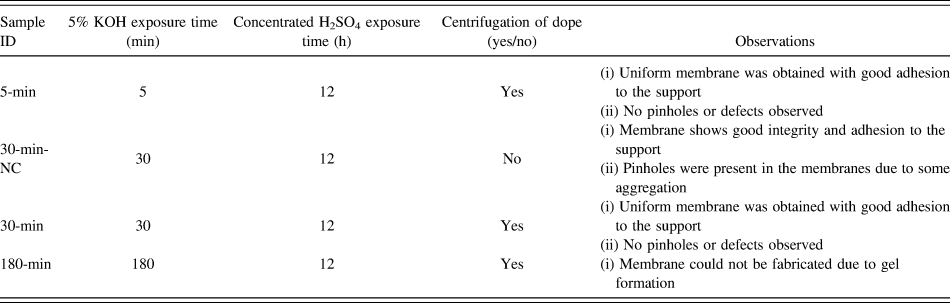
Initially, modification of PVDF polymer using an aqueous 30% NaOH solution followed by concentrated H2SO4 treatment was attempted. However, this protocol failed to achieve a homogenous membrane surface. Aggregation and formation of crystals were observed during the initial steps of treatment. This was due to the hydrophobic nature of the PVDF polymer, which made the treatment with aqueous NaOH solution ineffective. The limited access of reagents in the aqueous media led to a highly anisotropic modification, influencing the properties of the fabricated membranes. Therefore, the polymer was instead subjected to a nonaqueous treatment using a low concentration (5 wt%) of KOH in methanol. Various attempts were made to choose the best exposure time of polymer to the KOH solution, and it is found that 5- and 30-min treatments with KOH followed by centrifugation resulted in better membranes. Impacts of exposure time along with other treatment conditions are presented in Table I.
Observations during attempts for PVDF modification using various reaction conditions.

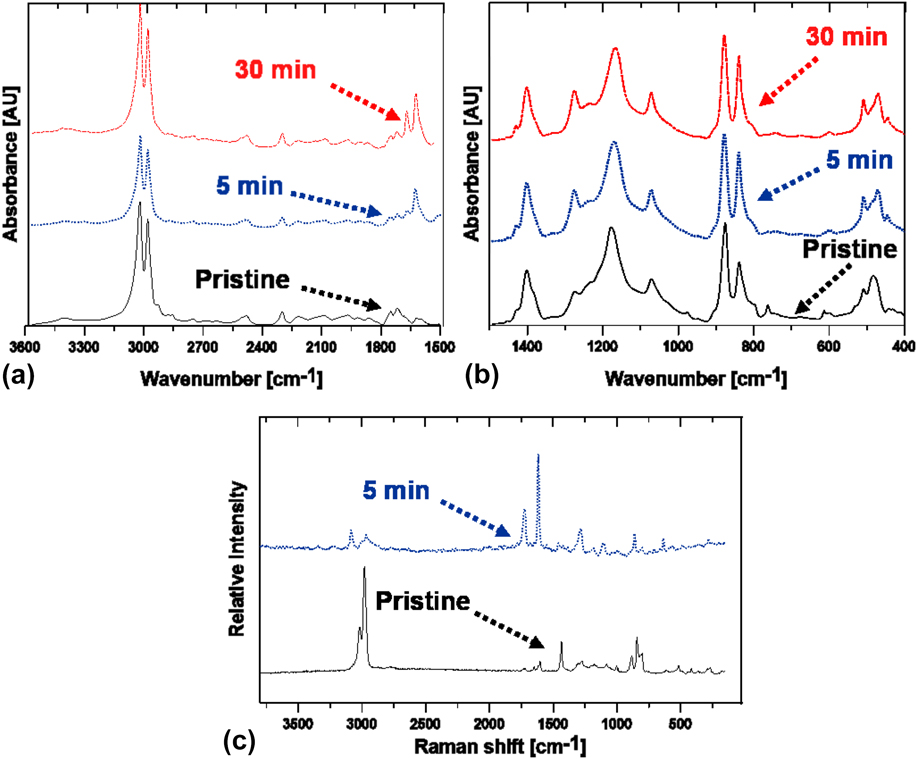
Upon the synthesis of modified membranes, two modes of FTIR spectroscopy (thin film and ATR) were applied to assess the chemical composition of pristine and modified PVDF membranes. Spectra from both configurations are presented in Fig. 1. For the thin film FTIR analysis, thin films of the membranes were prepared by mechanical pressing to clearly visualize the frequencies between 1500 and 3500 cm−1. As seen from the thin film FTIR spectra in Fig. 1(a), dehydrofluorination (the first step of the alkali treatment) resulted in the creation of peaks in the range of 1550–1650 cm−1 assigned to the double bonds (C=C) and in the range of 1700–1800 cm−1 assigned for carbonyl (C=O) bonds. This clearly illustrates the progress of the proposed reaction. OH absorption band can be observed as a weak wide signal between 3300 and 3500 cm−1. It should be noted that although Fourier transform infrared spectroscopy could be used to extract various information about the chemical and structural properties of the membranes, it is not very surface sensitive because of its large penetration depth. Reference Rana and Matsuura46
(a) Thin film FTIR spectra for PVDF membranes made from pristine and modified polymer (5 and 30 min), (b) ATR-FTIR spectra for pristine and modified samples (5 and 30 min). (c) Raman spectra of PVDF membranes made from pristine and 5-min modified membranes.
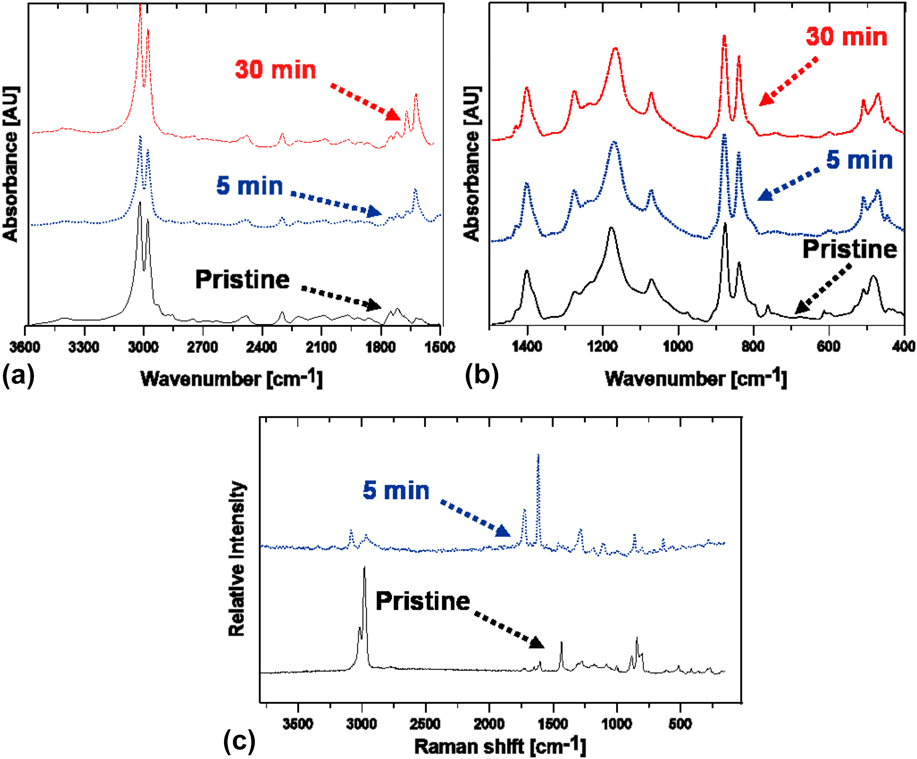
In the case of ATR-FTIR, the limit of infrared penetration is generally less than 1 μm, and hence it can provide information on the top layer of the membrane. Crystalline phases (α and β) of the PVDF membrane were determined from the ATR-FTIR spectra since the bands at 764 cm−1 and 840 cm−1 are characteristics of α and β phases, respectively. Reference Ozkazanc and Guney47 Applying the Beer–Lambert law, crystallinity degree of α and β phases on the membrane surface were determined by comparing peak absorbances at 764 and 840 cm−1. Although the pristine sample showed the characteristics of both α and β phases (with an α:β phase ratio of 0.4), the modified samples showed only the characteristic of β phase, as indicated by the presence of a strong peak at 836 cm−1 [Fig. 1(b)]. This may be attributed to the creation of better oriented, well-packed PVDF structure of CH2–CF2 dipoles (TTT conformation) on the surface. Reference Liu, Lu and Wu48 A CF2 rocking band was observed in 5-min and 30-min samples at 441 and 445 cm−1, respectively. Red shifts of ∼10 cm−1 were recorded for these samples at 480 cm−1, which can be assigned to CF2 deformation. The new frequencies (471 and 470 cm−1) are assigned to 5 and 30 min, respectively. These frequencies are also related to the formation of β phase of the polymer. Red shifts were observed in the CF2 symmetric stretching as well with 1177, 1169, and 1164 cm−1 assigned to pristine, 5 and 30 min, respectively. Further analysis of the data presented in Figs. 1(a) and 1(b) shows that polymer modification caused significant changes in the dactyloscopic region of the spectra. A reduction in the intensity of the α phase characteristic peaks at 762, 796, and 974 cm−1 can be observed for the modified membranes. On the other hand, peaks at 841, 1274, and 1403 cm−1, which are correlated to β phase, became more intense, showing a clear phase change during the alkali modification process.
The Raman spectra were also recorded for pristine and 5-min membranes and are represented in Fig. 1(c). It is worth noting that the Raman spectra also support the hypothesis of phase change due to modification. A characteristic peak for α phase at 801 cm−1, present in the pristine membrane, has almost disappeared in the 5-min treated sample. On the other hand, the characteristic peaks for β phase were recorded at 839 and 856 cm−1 for the pristine and 5 min membranes, respectively. Raman spectrum for 30-min treated membrane could not be recorded even after using several laser sources with different intensities. This might be due to the presence of OH groups on the polymer surface preventing the Raman detection of broad, low-intensity bands of hydrous species. Reference Shilton, Prokhorov, Gordeyev, Nikolaeva, Dunkin, Smith and Pashinin49–Reference Nasdala, Beran, Libowitzky and Wolf51 The challenge is the wide occurrence of luminescence phenomena in the visible range. Reference Nasdala, Beran, Libowitzky and Wolf51
B. Effect of PVDF activation on membrane surface properties
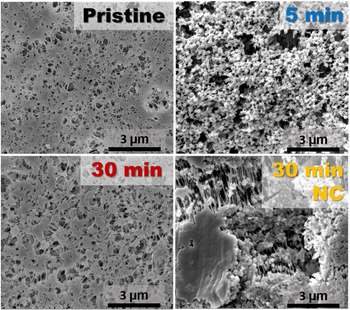
The changes in the membrane morphology caused by the alkali treatment are clearly observed in the SEM images presented in Fig. 2. The pristine membrane was characterized by uniform structure with small pores, whereas the modified membranes showed enlarged pores and heterogeneous morphology. These changes in the structure are ascribed to the aggregation and initial nucleation of the polymer chains. The implementation of centrifugation to the experimental protocol had a crucial effect on obtaining uniform membrane. The presence of aggregates on the noncentrifuged (30-min-NC) samples is clearly visible in the SEM micrographs shown in Fig. 2. On the contrary, a homogeneous membrane was achieved in the case of the 30-min treatment with centrifugation.
SEM images of membranes prepared from pristine and modified PVDF (5, 30, and 30 min NC).

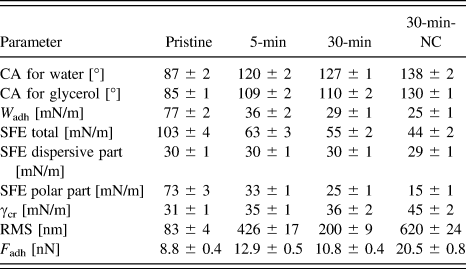
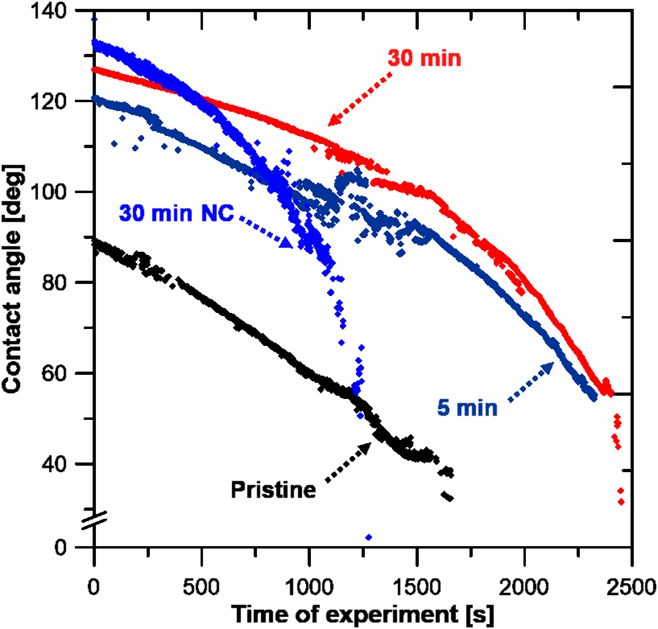
As the data in Table II shows, it can be stated that the modification process has an impact on the material and physicochemical properties of the membranes. The modification resulted in the formation of membranes with higher CA than the pristine membrane. After a short treatment time (5 min) with KOH, the CA increased from 87 to 120°, whereas with a prolonged treatment (30 min), it increased further to 127° (Table II). This trend is counter intuitive, taking into consideration the generation of the hydrophilic hydroxyl groups on the membrane surface. This anomaly is due to the fact that in addition to intrinsic hydrophilicity, the apparent CA value is also influenced by surface roughness, morphology, and critical surface tension. Reference Liu, Hashim, Liu, Abed and Li1,Reference Meng, Chen, Huang, Du and Zhang23,Reference Kujawa, Cerneaux, Koter and Kujawski43,Reference Kujawa, Cerneaux, Kujawski, Bryjak and Kujawski45 Hence, CA measurement alone is not a holistic parameter, when changes in physicochemistry of the modified surfaces are considered. The 30-min NC sample was characterized by a high roughness (620 nm) and CA (138°) as opposed to the 30-min sample (Table II). Moreover, the SFE value for 30-min NC was ∼25% higher than that of the 30-min treated membrane. The contribution of polar interaction was reduced significantly from 73 mN/m for pristine membrane to 25 and 15 mN/m for 30-min and 30-min-NC samples, respectively. To have a wider spectrum of information and holistic characterization of the samples, further analyses such as W adh and roughness (RMS) of the surfaces were also conducted.
Characterization of membranes prepared from pristine and modified PVDF.

The changes in physicochemistry became more noticeable when SFE and W adh were taken into account (Table II). It can be seen that SFE values decreased with the increase in surface hydrophobicity. For example, comparing membranes from pristine PVDF and 30-min modified one, the CA value increased. It was also noticed that the dispersive components for all samples were comparable, whereas the polar component reduced drastically. W adh also changed significantly upon PVDF modification, with values of 77, 36, and 29 mN/m for pristine, 5 and 30 min, respectively. This reduction can be ascribed to the increase in CA values, decrease of SFE, and creation of so-called lyophilic conditions Reference Xiu, Zhu, Hess and Wong52 as a result of modification. It indicates the formation of more hydrophobic and highly wetting-resistant membrane surfaces. At the same time, the overall SFE was reduced almost by half from 103 to 55 mN/m.
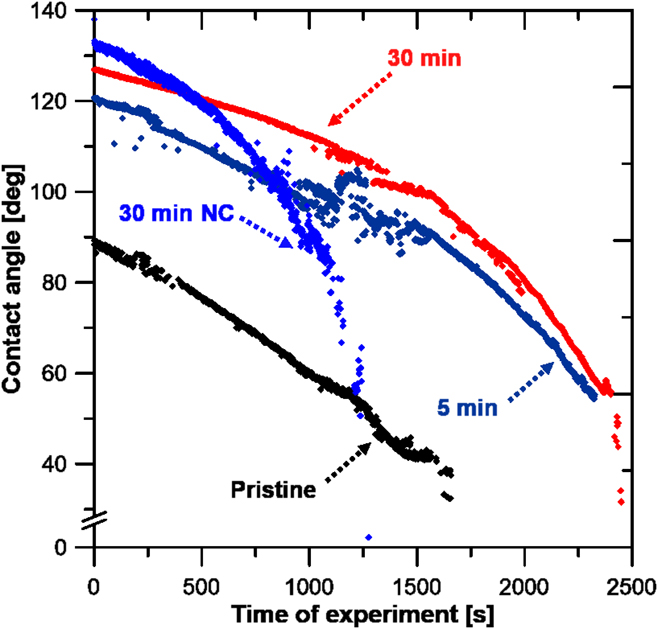
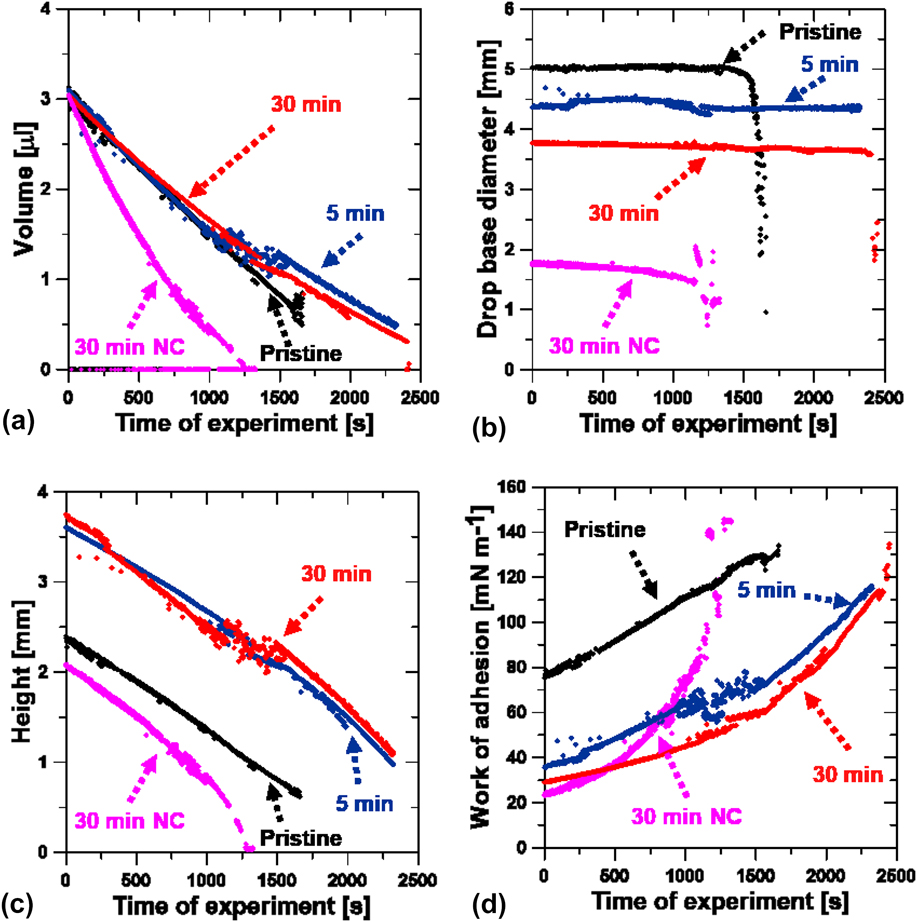
The membranes’ wetting behavior was analyzed by measuring the CA as a function of time (Fig. 3). It can be seen that all the plots possessed comparable curvature. The kinetics of liquid evaporation was also determined from Fig. 4. For the pristine and 5-min modified samples, water evaporation was described by a zeroth-order kinetic reaction. However, for 30-min treated sample, a pseudo–zeroth-order kinetic was noticed. All the membranes were characterized by constant rates of evaporation which were 0.0324, 0.0231, and 0.0145 mol dm−3 s−1 for the pristine, 5 min, and 30 min membranes, respectively. Considering the dynamic CA (DCA) data, it is possible to state that the application of centrifugation has an important effect on the mechanism of surface wettability. Comparing the 30 and 30-min-NC samples, it is clear that despite the higher hydrophobicity level of 30-min-NC membrane (138°), its resistance to wetting is small.
The evolution of CA during dynamic measurements for pristine and modified (5, 30, and 30 min NC) samples.
The evolution of (a) volume, (b) drop base diameter, (c) height, and (d) W adh, during dynamic measurements for pristine, 5-min, 30-min, and 30-min-NC samples.
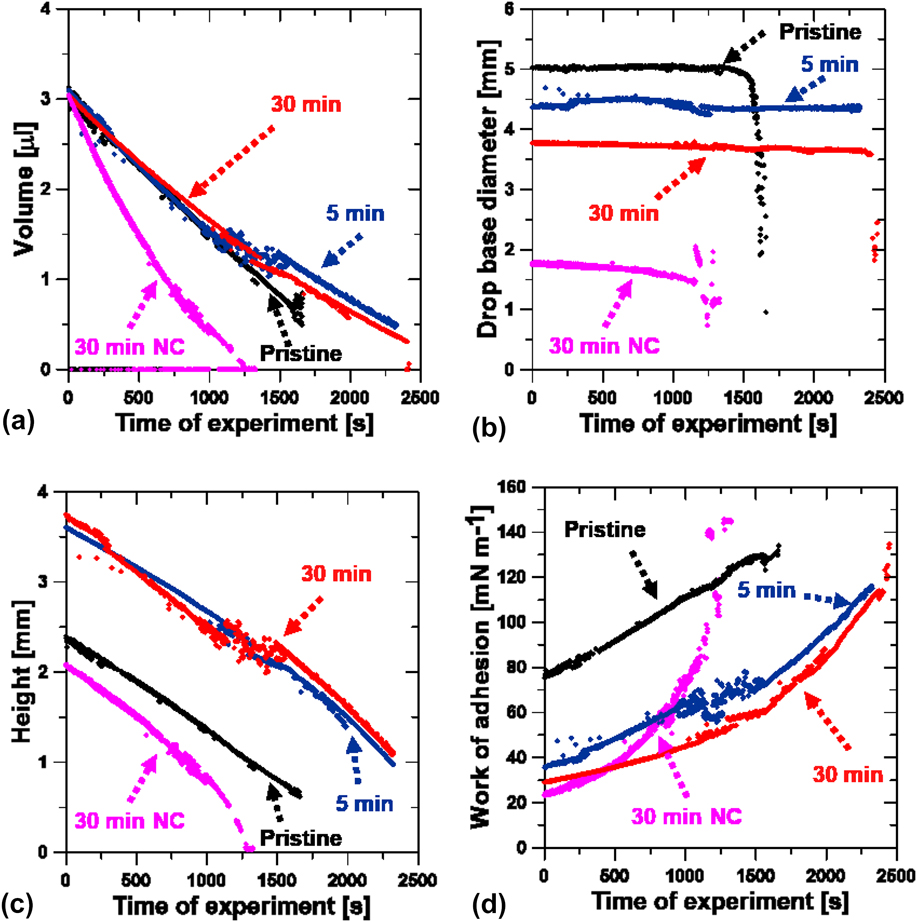
Water resistance is a critical feature for the application of membranes in certain separation processes such as membrane distillation and pervaporation. Therefore, it is essential to determine the influence of polymer functionalization on water resistance of the modified PVDF membranes. DCA and spreading pressure (S) were thus determined to assess the influence of modification on membrane wettability. The following parameters were examined during the DCA evaluation: volume, base diameter, and height of the drop along with the W adh as a function of time (Figs. 3 and 4). On the basis of the obtained parameters, the mechanism of surface wetting was determined.
It can be seen that the drop volume [Fig. 4(a)] and height [Fig. 4(c)] decreased uniformly with time. However, Fig. 4(b) shows that the drop diameter remained almost constant throughout the experiment, suggesting the occurrence of water evaporation rather than membrane wetting. Reference Heydari, Thormann, Järn, Tyrode and Claesson42,Reference Bertola53 Thus, the surfaces of both pristine and modified membranes (5 and 30 min) were not wetted by the testing liquid. This is also proved by the calculation of S, which is developed based on the works of adhesion and cohesion. Reference Kujawa, Rozicka, Cerneaux and Kujawski54 The measured values of spreading pressure were −68.9, −109.2, and −116.6 mN/m for pristine, 5 min, and 30 min, respectively. The negative values of S indicate a wetting resistance. Reference Chibowski, Jurak, Holysz and Szczes40 Furthermore, in the case of 30-min NC, the volume and height of the testing liquid changed nonlinearly [Figs. 4(a) and 4(c)], indicating the occurrence of both evaporation and wetting. Thus, after the alkali modification process (including centrifugation step), the membrane surface became more resistant to wetting by different liquids (Table II—critical surface tension). This is crucial in potential applications of such membranes, for instance in the MD process, where hydrophobicity and high wetting resistance is required.
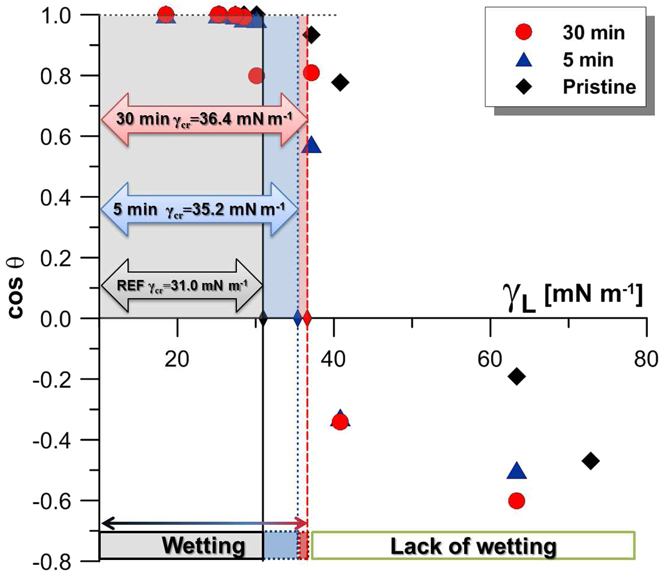
From a practical point of view, it is important to define and analyze water repellence and material wettability of the surfaces, and critical surface tension (γcr) is very useful in doing so. Values of critical surface tension (γcr) for all investigated samples were calculated based on the Zisman method. Reference Walsh55 An increase in γcr was noticed as an effect of modification (Table II and Fig. 5). This observation is ascribed to the fact that more hydroxyl groups were created on the membrane surface which was treated for a longer time (30 min). Comparing the 30 and 30-min-NC samples, a step increase of 25% in critical surface tension (γcr) was observed (Table II). It indicates that the centrifugation, in our case, enhanced the wetting resistance of the membranes.
Zisman plots for pristine, 5-min, and 30-min membranes.

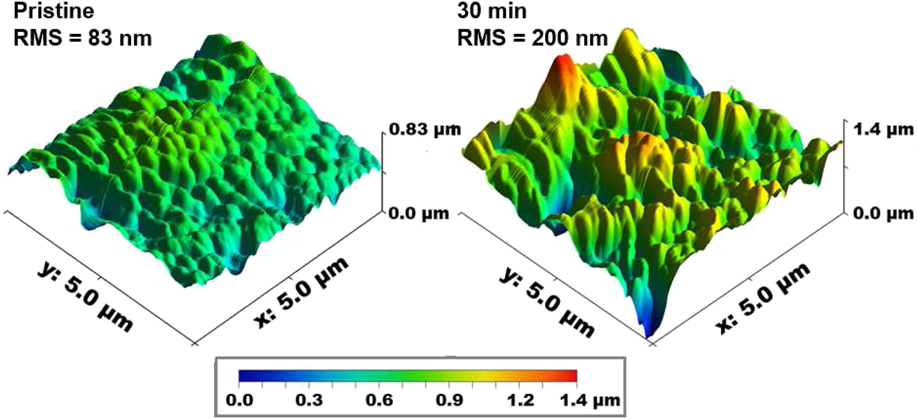
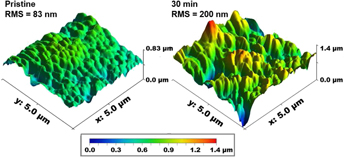
In Fig. 6, the AFM topography images of pristine and 30-min samples are presented. It can be seen that the RMS values calculated from these images, increased from 83.3 nm for pristine to 200 nm for 30-min treated membrane, indicating the impact of modification on the roughness of the membranes.
AFM topography of the pristine and 30-min samples.

The AFM technique was also applied to determine the adhesion force (F adh). On the basis of the F adh (Table II), it can be pointed out that modification has a noticeable impact on F adh. Samples characterized by smaller F adh values also had lower hydrophobicity and smoother surface (Table II). This observation is associated with the fact that friction forces are controlled by the surface interactions under low contact pressures, Reference Bhushan, Cichomski, Hoque, DeRose, Hoffmann and Mathieu56,Reference Kujawa and Kujawski57 where adhesion plays the main role. The presence of adhesive forces has origin in chemical covalent bonding, electrostatic, van der Waals forces, and capillary forces between two contacting surfaces. Reference Bhushan, Cichomski, Hoque, DeRose, Hoffmann and Mathieu56,Reference Kujawa and Kujawski57 The determined values of F adh for all investigated samples were in the range of 8.8–20.5 nN. As a result of modification, an increase of F adh of 1.2–2.3 times was noticed. The value of F adh is directly related to the roughness of the sample, with higher F adh values resulting from a rougher membrane (Table II). This phenomenon can be explained by stronger adhesion on more heterogenic surfaces due to the extended contact with membrane surface. From the results presented above, it is clear that the developed PVDF modification processes have a pronounced influence on the physicochemistry (CA, SFE, γcr, and W adh) and on the morphology (RMS) of the PVDF membranes.
C. Effect of PVDF activation on the membrane structure
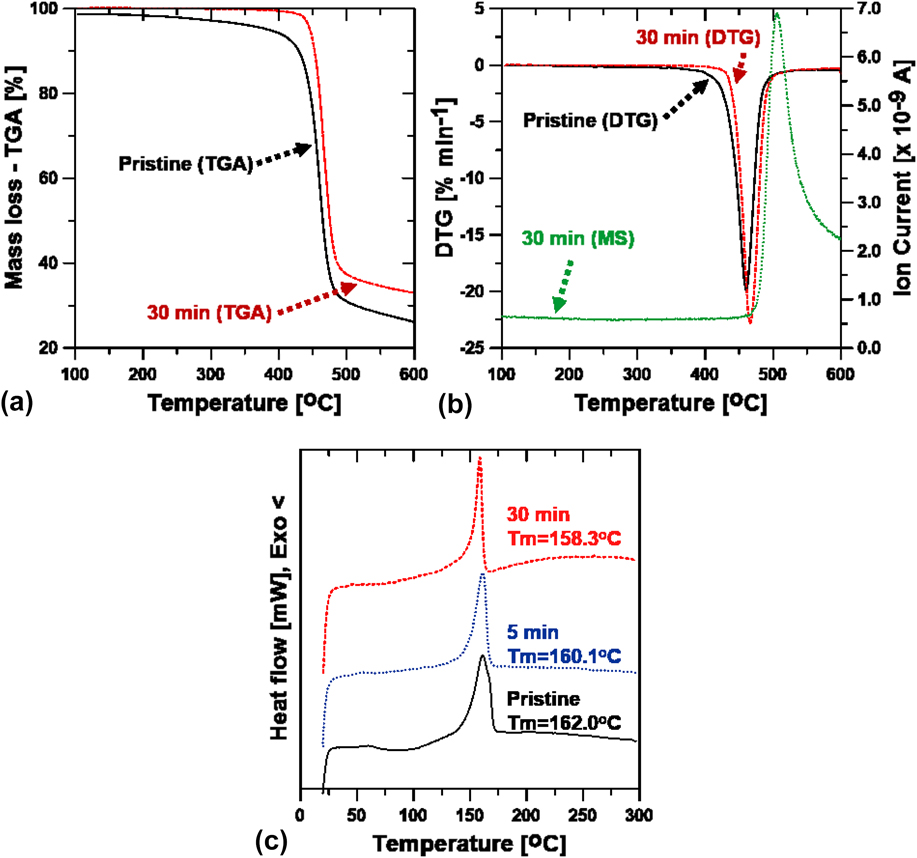
An effect of PVDF membrane modification on the membrane structure and morphology was also observed. From the TGA (Fig. 7), it can be seen that all membrane samples possessed an excellent thermal stability, although the decomposition temperature had changed significantly due to the modification [Fig. 7(a)]. For example, the decomposition temperature for the pristine sample was 420 °C, but increased to 450 °C after treatment for 30 min. The maximum observed peaks on the derivative thermogravimetric (DTG) curves were detected at 460 °C and 467 °C for nonmodified and treated PVDF samples, respectively [Fig. 7(b)]. This observation may be attributed to the intermolecular interaction in the polymeric chains due to the presence of OH groups. The achieved data are consistent with the literature related to one-step treatment with alkali media. Reference Sui, Wang and Gao58,Reference Shen and Lua59 The efficiency of the alkali treatment was evaluated further by mass spectroscopy. Monitoring of ions possessing mass value equal to 19 [H3O+], which are related to the decomposition of the hydroxyl groups, is presented in Fig. 7(b). The presence of strong peak (6.9 × 10⁻⁹ A) at 506 °C is related to the water formed upon dehydration of the polymer chain carrying OH groups in the modified PVDF surface.
(a) TGA curves for pristine and modified 30-min samples, (b) DTG curves for pristine and modified 30-min samples and MS spectrum of modified 30-min sample, (c) DSC curves for pristine and modified (5, 30-min) samples.
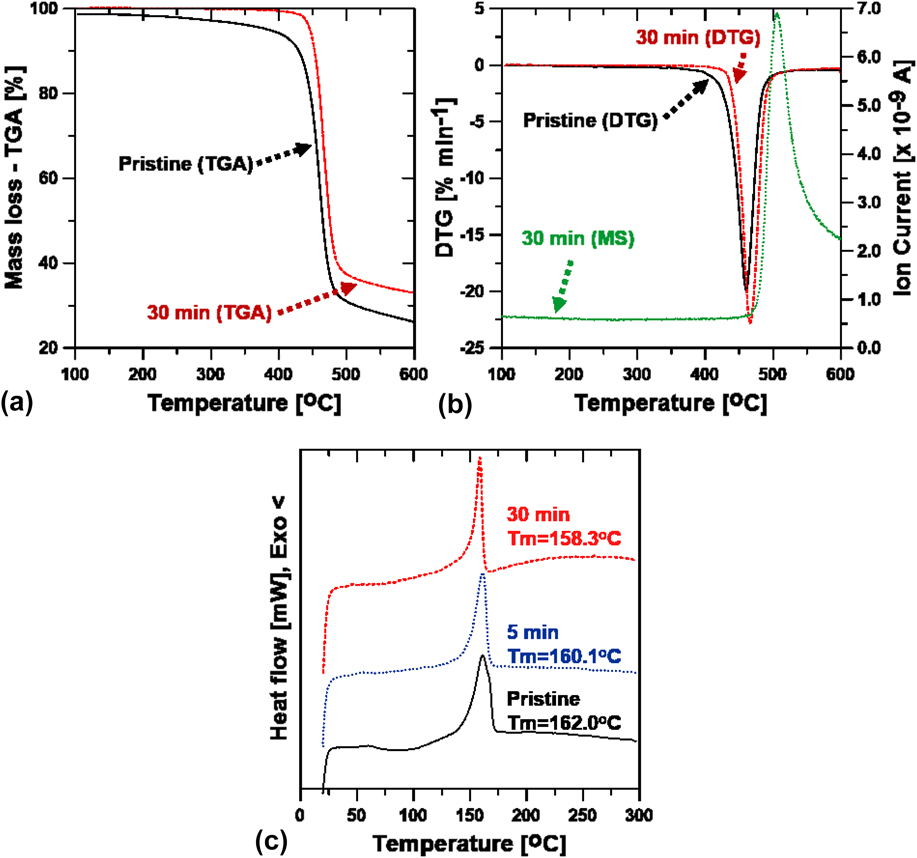
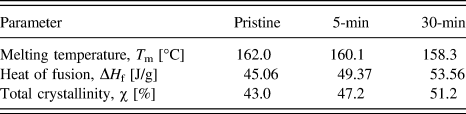
DSC results for pristine, 5 min, and 30 min membranes are shown in Fig. 7(c). A reduction of melting temperature (T m) was observed after modification. This diminution of T m was an effect of OH formation. A similar observation was documented in the case of C=C bond generation. Reference Liu, Lu and Wu48,Reference Sui, Wang and Gao58 In addition, increased values of heat of fusion (ΔH f) and crystallinity (χ) were also detected (Table III). After 5 min of modification, about 10% increase was observed for both ΔH f and χ. For the longer treatment time (30 min), the difference between the pristine and modified samples was equal to 19% for both parameters. These observations were associated with the formation of a more organized structure. Namely, the symmetrical structure of the main chain created (i.e., hydroxyl groups formation). The modification condition (i.e., application of KOH in the first step), alters the previous degree of polymer net order and creates a more ordered structure. The modification time has a clear influence on the chemistry of the PVDF investigated samples (Table III).
Heat of fusion (ΔH f) and total crystallinity (χ) of pristine and modified PVDF membranes.

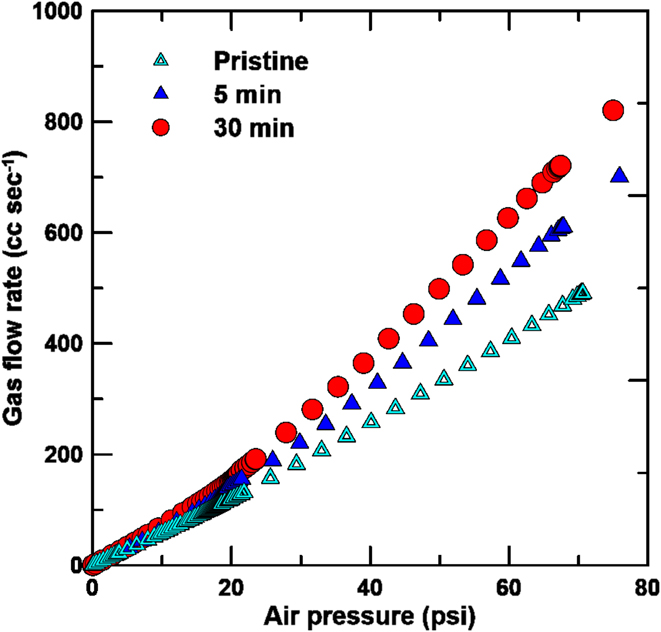
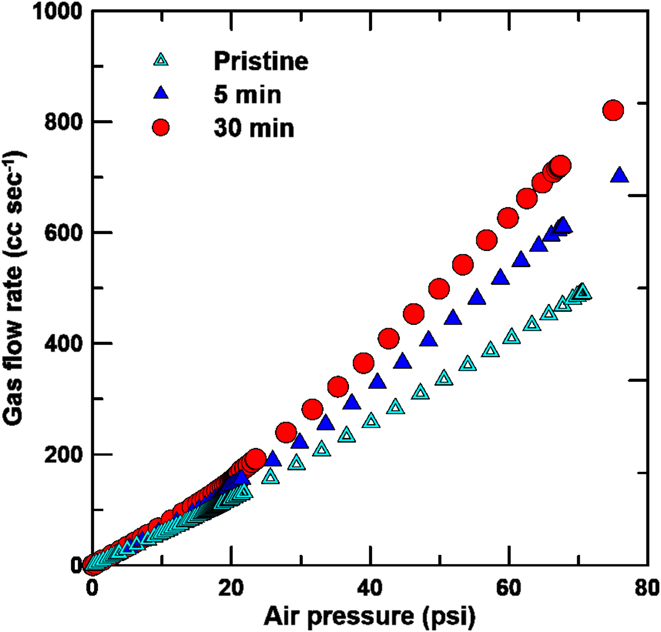
From the pore size results, it can be stated that the modification process has impacts on the membrane morphology. The pristine membrane had a mean pore size and bubble point of 0.09 and 0.40 μm, respectively. After modification, a more open structure was attained. This observation was also supported by the SEM images (Fig. 2). After 5 min of treatment, an increase of both bubble point and mean flow pore size was observed. The mean flow pore size and bubble point became 0.15 and 0.42 μm, accordingly. On the other hand, the 30-min membrane had a mean flow pore size and bubble point of 0.17 and 0.39 μm, respectively. Due to the aggregation of polymer dope encountered in the 30-min-NC membrane, the bubble point was 14.04 μm which is rather high, prohibiting its use as a MF membrane. A similar trend was observed for gas permeability of the membranes as well, with air permeability in the order of 30 min > 5 min > pristine samples (Fig. 8).
Gas permeability of the membranes prepared from pristine and modified PVDF (5 min, and 30 min).
IV. PERSPECTIVES
One of the most essential features in membrane distillation is to have a membrane with well-controlled properties. The final performance of the process is a straight consequence of the physicochemical and structural properties of the used membranes. The efficiency of the membrane distillation process is intrinsically affected by several factors, e.g., porosity, pore size distribution, mean pore size, thickness, and geometry. Additionally, the membrane used in the membrane distillation process has to be highly hydrophobic and porous, possessing excellent chemical resistance to feed solutions as well as good thermal stability. Therefore, the successful outcome of this process is reasonably predicted based on the membrane capability to interface two media as well as to pose high resistance to liquid intrusion in the pores with high volumetric mass transfers.
Taking into account all the above-mentioned requirements, it can be stated that PVDF membranes comply with the general requirements of MD membranes. The main limitations are related to the inert character of PVDF material, which makes its further modification/functionalization difficult. However in the current work, we show a new frontier to influence this inertness and chemically activate the membrane. The prepared PVDF membranes are hydrophobic, porous, and characterized by good thermal and mechanical stability as well as elevated resistance to wetting. The modification via covalent bonding is more effective and stable than physical modification of the polymeric material, for example, by introducing inorganic nanoparticles to the polymeric matrix. Moreover, the polymeric membranes are active to further modification. As a result, the prepared PVDF membrane could be used in membrane distillation processes. This application will be the focus of our further research. Furthermore, due to the presence of reactive hydroxyl groups on the surface, further membrane modifications are also possible. The potential modifications on PVDF polymer can show a broad spectrum of new applications using PVDF membranes. They can also lead to favorable properties such as enhanced fouling resistance.
V. CONCLUSIONS
A two-step protocol of alkali/acid treatment of PVDF polymer before use in membrane casting was proposed for tuning the properties of PVDF membranes. The advantage of the established method was the possibility to manufacture a stable membrane with high temperature resistance, and very good resistance to wetting. The proposed method involves only a short exposure (up to 30 min) to a low concentration (5%) alkali (KOH) media to reduce polymer decomposition. Efficient functionalization was achieved. Centrifugation of the polymer dope after the modification and the alkali treatment duration had pronounced impact on the quality of the fabricated membranes and their surface wettability. A homogeneous membrane was achieved in the case of the alkali treated (30 min) and subsequently centrifuged sample. The proposed treatment method has a significant impact on the physicochemistry, morphology, and wettability of the membranes as reflected in their crystallinity, structure, DCA, SFE, and critical surface tension. Although the pristine membrane (without modification) showed the characteristics of both α and β phases (with an α:β phase ratio of 0.4), the modified sample showed only the characteristic of the β phase. Surface roughness and, consequently, the CA of the membrane were increased as an effect of the alkali treatment. On the other hand, W adh and SFE, especially the polar component of the latter, were reduced. The evaluated parameters indicate the formation of more hydrophobic and highly wetting-resistant membrane surfaces.
This modification protocol could be utilized in fine-tuning the properties of the PVDF membranes for various target-specific applications requiring low wettability, such as membrane distillation. This method can also be used in functionalizing PVDF membranes for other applications as well, by exploiting the presence of labile groups such as OH on the membrane surface.
ACKNOWLEDGMENTS
The authors acknowledge King Abdullah University of Science and Technology (KAUST), Saudi Arabia, for hosting the second author (Musthafa O. Mavukkandy) during the initial stage of his work in this study. The author Musthafa is also thankful to Dr. N.M. Srivatsa Bettahalli for helpful discussions.