INTRODUCTION
Palliation of psycho-existential suffering in terminally ill cancer patients is of great importance, because that suffering or its palliation is related to quality of life, a good death, depression, desire for a hastened death, hopelessness, and suicidal ideation (Nelson et al., Reference Nelson, Rosenfeld and Breitbart2002; McClain et al., Reference McClain, Rosenfeld and Breitbart2003). Many studies have explored effective strategies to alleviate psycho-existential suffering based on concepts including dignity or meaning (Breitbart et al., Reference Breitbart, Gibson and Poppito2004; Chochinov et al., Reference Chochinov, Hack and Hassard2005). Life review is an effective therapy for alleviation of psycho-existential suffering. Life review involves recalling one's entire life span, including both positive and negative events; it includes both an evaluative component and a therapeutic listener (Haight, Reference Haight1998). Life review has the potential for participants to find meaning in life, and previous studies have shown the efficacy of this therapy for depression, stress, increasing life satisfaction and psychological well-being, and reducing fatigue and isolation (Jones, Reference Jones2006). Most such studies have recommended a review of positive memories (Stinson & Kirk, Reference Stinson and Kirk2006), such as “favorite holidays.” Stinson (Reference Stinson2009) recommended a variety of themes (question items) in life review for elderly patients, and Chao et al. (Reference Chao, Chen and Liu2008) found that themes such as “Christmas,” “traveling,” and “education” were effective. These studies suggest that effective themes in life review for elderly people should focus on psychological issues such as depression and life-satisfaction.
Based on the lack of availability of therapy for terminally ill cancer patients, we developed a novel psychotherapy, the Short-Term Life Review (Ando et al., 2009). This therapy includes eight questions that stimulate reminiscence. The results were promising, as they showed a significant increase in the sense of meaning, as measured by the Functional Assessment of Chronic Illness Therapy-Spiritual (FACIT-Sp) scale (Peterman et al., Reference Peterman, Fitchett and Brady2002). Moreover, the efficacy of the Short-Term Life Review was shown in a randomized control study (Ando et al., Reference Ando, Morita and Akechi2010). However, the factors in narratives to questions in the Short-Term Life Review interviews of terminally ill cancer patients have not examined. Understanding of these factors will allow interviewers to obtain better responses from patients and promote or facilitate the interview. Moreover, the utility of the questions in the Short-Term Life Review for terminally ill cancer patients has not been tested. Therefore, this study examined factors in narratives to questions in that interview of these patients and the utilities of the questions.
PATIENTS AND METHODS
Participants
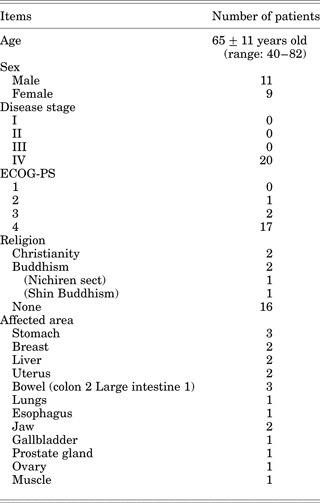
The participants were cancer patients from the Palliative Care Units (PCUs) of two general hospitals in Western Japan (Table 1). The inclusion criteria were (1) incurable cancer, with a PCU stay of between 2 and 4 weeks; (2) ability to communicate; and (3) age >20 years old. The exclusion criteria were (1) severe pain or physical symptoms evaluated by the primary doctor; (2) cognitive impairment such as dementia or consciousness disturbance; and (3) difficulty with family issues, such as problems regarding inheritance of property, conflicts about the patient's funeral among family members, and reconciliation of past problems between the patient and their family members. Regarding selection of participants, doctors and nurses in the two hospitals first introduced the research to patients who met the criteria for the study, and the therapist then explained the research in detail after the patient had shown an interest in participation. The study was approved by the ethical committee of St. Mary's Hospital and St. Mary's College.
Patient background

Outcome Measures
Following the model of our group, we chose the sense of meaning measured by the FACIT-Sp scale as the primary end point. The validity and reliability of the Japanese version of the FACIT-Sp is well established (Noguchi et al., Reference Noguchi, Ono and Morita2004). The FACIT-Sp consists of two domains, meaning of life and religious issues, but only the meaning of life domain was used, as an effect of the Short-Term Life Review on religious issues in 1 week was unlikely. The meaning of life domain includes eight items and is scored on a five-point scale (range, 0–4). The total range of the FACIT-Sp is 0 to 32, and high scores indicate an elevated sense of meaning of life or a peaceful state of mind. Performance status was measured by the Eastern Cooperative Oncology Group Performance Status Rating (ECOG PSR) scale (Oken, et al., 2004), which is a single-item rating of five activity levels from 0 (fully active) to 4 (completely disabled).
Interventions: Short-Term Life Review
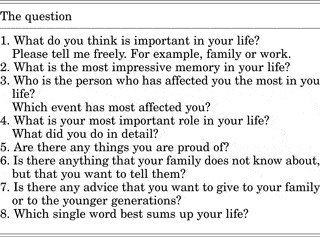
Patients reviewed their lives over two sessions with an interviewer who was trained to conduct the therapy. Each session lasted from 30 to 60 minutes with a 1-week interval between the first and second sessions. The following questions were prepared with reference to autobiography life-review therapy, in which subjects review their lives, along with themes in life and dignity therapy. In the first session, the patients were asked (Table 2): (1) What is the most important thing in your life and why? (2) What are the most vivid or impressive memories in your life? (3) In your life, what event or person affected you most? (4) What is the most important role you played in your life? (5) What are you proud of in your life? (6) Is there anything about yourself that you want to tell your family members? (7) What advice or words of guidance do you have for the important people in your life or for the younger generation?
The main questions in the Short-Term Life Review

The patient's narratives were recorded and the interview was transcribed verbatim. The therapist made a simple album including key words from the answer to each question, which were selected through a discussion between the patient and the therapist. Key words included both positive and negative elements of the interview. The therapist then pasted photos or drawings from books or magazines that were related to the patient's words or phrases, in order to make the album beautiful and memory provoking. In collage psychotherapy, a subject pastes the photos or drawings; however, this activity may be a cognitive burden to terminally ill cancer patients, and therefore the therapist made the album.
In the second session, the patient and therapist viewed the album together and agreed upon the contents. The therapist tried to encourage the patient to feel continuity of self from the past to the present, to accept life completion, and to be satisfied with their life. After the second session, the therapist presented the album to the patient. Because the therapist was not affiliated with the hospital, patients did not need to maintain a relationship with the therapist and were able to speak freely about their feelings about the album.
Procedure
A clinical psychologist conducted the Short-Term Life Review for ~30–60 minutes. Participants completed questionnaires pre- and post-intervention.
Statistical Analysis
A Wilcoxon signed rank test was performed on FACIT-Sp scores. To identify factors associated with spiritual well-being, we used the text-mining program Word Miner (Japan Information Processing Service, 2003; Ohsumi, Reference Ohsumi2006) to find specific words within text. Because we wanted to know the contents of the review that were associated with improvement of spiritual well-being, we examined the relationship between FACIT-Sp scores and content. Patient narratives were first divided into meaningful words or phrases, and words with the same meaning were combined: for example, both “mom” and “mother” were included as “mother” in the analysis. Articles or punctuation marks were deleted, leaving only meaningful words, which were referred to as “fragments.” A correspondence analysis was performed between fragments and FACIT-Sp scores, and a significance test following the correspondence analysis was conducted to find effective fragments (Ohsumi, Reference Ohsumi2006). In the current study, 345 fragments were chosen from the narratives of the 20 patients.
RESULTS
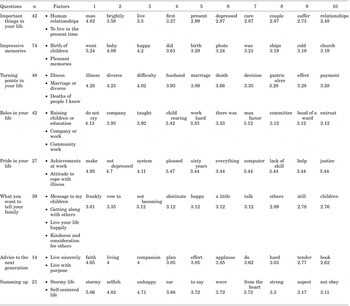
The mean FACIT-Sp score increased significantly from 17.2 ± 6.9 to 25.5 ± 4.9 after the intervention (p < 0.00). Of 34 patients, 20 completely answered the question items, and we analyzed their narratives. Responses to questions in the Short-Term Life Review were examined using correspondence analysis. The fragments found in the correspondence analysis and the results of the significance test are shown in Table 3. A high score in Table 3 indicates that a fragment that was effective (frequency) in the narrative. The most important fragments were tabulated after performance of the significance test. The followings are questions, fragments ranked highly, which were reduced as factors (summary): (1) “Important things in your life”: “human,” “live,” “family relationships,” and “the present”; reduced to “human relationships” and “to live in the present.” (2) “Impressive memories”: “baby,” “birth,” “pleasant,” “trips,” and “photographs”; reduced to “birth of children,” “pleasant memories.” (3) “Events or persons with effects on life”: “illness,” “divorce,” “marriage,” “death”; reduced to “illness,” “marriage or divorce.” (4) “Roles in your life”: “not crying,” “company,” “teaching,” and “raising children”; reduced to “company or work,” and “raising children or education.” (5) “Pride in your life”: “making,” “system,” “computer,” “not falling,” “sense of justice,” and “positive”; reduced to “achievements at work,” “attitude to cope with illness.” (6) "What you want to tell your family": “frankly,” “talking,” “others,” “children,” and “daughter”; reduced to “message to children,” and “getting along with others.” (7) “Advice for the next generation”: “sincerely,” “live,” “be kind,” and “others”; reduced to “to live sincerely,” and “consideration for others.” (8) “Summing up your life”: “stormy,” “wave,” “selfish,” “not obey”; reduced to “stormy life” and “self-centered life.”
Questions, the number of fragments that related to the question, fragments ranked highly from 1 to 10, and factors

The least number of fragments were found for “advice for the next generation” (14 fragments), “summing up your life (21 fragments),” “pride in your life" (27 fragments), and “what you want to tell your family (39 fragments).”
DISCUSSION
The fragments such as “human relationships” and “family relationships” in this study indicates the importance of these issues to Japanese people. Our previous study showed that patients with good human relationships have a high level of spiritual well-being (Ando et al., Reference Ando, Morita and Akechi2010) and this may be a key factor for quality of life. The importance of human relationships is also supported by finding by Miyashita et al. (Reference Miyashita, Sanjyo and Morita2007) and Murata and Morita (Reference Murata and Morita2006).
Impressive memories included “birth of children” and “pleasant memories” such as sharing time with familiar people on a trip. These fragments are examples of good questions given by Bohlmeijer et al. (Reference Bohlmeijer, Roemer and Cuijpers2007). As for utility, as patients often have too many memories, they sometimes have difficulty in choosing one. Therefore, it may be advantageous for the interviewer to propose some examples of the main events in a human life.
Turning points included “illness,” “marriage or divorce,” and “death of important people”; therefore, these mainly involved meeting or parting from people. Patients remembered their coping skills when they confronted these events and were able to use them for their current situation (Lee et al., Reference Lee, Cohe and Edgar2006); therefore, remembering how they confronted difficulties may be useful in the therapy. The utility of the question about turning points is in accord with previous studies (De Vries et al., Reference De Vries, Birren, Deutchman, Haight and Webster1995; Cappeliez & O'Rourke, Reference Cappeliez and O'Rourke2002), because of promotion of reflection and integration in a patient's life.
In discussing “roles” and “pride” in life, some patients felt that their roles at work in a company were important, and they were proud of their work. However, relatively few patients talked about their success in a company or in society, compared to those who discussed their role in “raising and educating children,” and their pride in this activity. We note that only a few of the patients in the study had been successful in commercial work, but some were proud of their achievements and the success of their company.
Regarding the utility of question about “pride,” many of the patients hesitated in answering the question on pride. This is because many Japanese people have difficulty with self-praise and use of the word “pride” is uncommon. These findings are similar to those found in a study of dignity therapy in Danish patients, who also found difficulty in answering the question on pride because of the unacceptability of self-praise (Houmann, Reference Houmann, Rydahl-Hansen and Chochinov2010).
When patients were asked about “what you want to tell to your family,” most items involved messages to their children. This was particularly true for younger patients. For example, a patient indicated that her daughter could not express her emotion and she did not want her daughter to be lonely after the patient's death. She told her daughter to ask others for help.
Regarding the utility of “what you want to tell your family,” questions on legacy in dignity therapy have been found to be suitable for Canadian or Australian patients (Chochinov et al., Reference Chochinov, Hack and Hassard2005); however, we thought that this kind of question would be unacceptable for Japanese patients as it might appear to be too directly confrontational of death. Therefore, we used moderate forms of the question in the present study, and this seemed to be suitable for Japanese patients. A similar tendency was found among Danish patients (Houmann, Reference Houmann, Rydahl-Hansen and Chochinov2010).
Regarding “advice to the next generation,” the patients indicated the importance of “living sincerely” and “consideration for others.” Therefore, Japanese patients thought that self-evaluation of their “way of life” and “living sincerely" were more important than social success, and felt that “getting along with others” was equally important. It might be influenced by oriental philosophies such as Buddhism or Confucianism.
As for the utility of the question of “advice to the next generation,” although participants had messages for their children, they had relatively little advice for the next generation, with the fewest number of fragments identified for this category. This may be because most Japanese patients do not believe they are worthy of giving advice, and therefore they hesitated in answering this question.
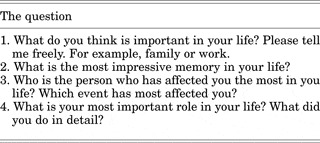
The number of fragments (Table 3) and state of patients' responses that they hesitated to give show that question items such as “pride,” “what you want to tell your family,” “advice to the next generation” and “summing up your life” could be secondary important question items when a shorter version of the Short-Term Life Review is required. And we propose simple questions in the Short-Term Life Review (Table 4).
The refined question items in the Short-Term Life Review

Clinical Implications
We could select question themes carefully. Terminally ill cancer patients can easily response and review “important thing in your life,” “impressive memories,” “turning points and “roles in your life.” And a short version of the Short-Term Life Review may be effective in elevating the spiritual well-being of patients.
Limitations
This study has several limitations. First, the generalizability may be limited because the intervention was performed by one therapist and at only two institutions. Second, the interviewer required clinical training to conduct this therapy; therefore an interviewer should have training to enhance the efficacy of the therapy.