Introduction
Emergency Medical Service (EMS) providers have a substantial impact on the triage, evacuation, and care of injured persons. The Pan American Health Organization defines a mass-casualty incident as “any single event that impacts negatively on a community causing a number of casualties that outstrips that community's ability to respond in a normal way.” 1 However, there are many variables to this definition, namely, the point at which a community can become overwhelmed by the number of casualties, the type of incident that occurred, the size of the pre-hospital workforce, the number of emergency departments and emergency staff available, and the amount of resources available at the time of the event. 1 While it is a challenge to prepare for every possible kind of mass-casualty eventuality, one approach to effective management during a catastrophic event includes training and preparation.Reference Baker 2
Jamaica is a developing Caribbean country that has an estimated population of 2.7 million persons. 3 It is the largest of the English-speaking Caribbean islands, and comprises an area of 4,441 square miles. The country's EMS system is developing gradually, and there is a need for a more direct relationship to the major hospitals. Since the early 1980s, the Government of Jamaica, with the help of foreign consultants, has endeavored to establish an island-wide system of the local EMS.Reference Richards 4 The government also trained a number of Emergency Physicians in the Doctor of Medicine specialty of Emergency Medicine. Some of these physicians are working in major hospitals locally and internationally. Furthermore, there is ongoing training of emergency medicine nurses as well as some of the prehospital EMS personnel.Reference Barnett, Segree and Matthews 5
The local EMS responded to an airplane crash that occurred in Kingston, Jamaica on December 22, 2009. Doctors at adjacent hospitals, along with the EMS personnel, were deployed to rescue and care for the victims. The two major hospitals in Kingston, The University Hospital of the West Indies (UHWI) and the Kingston Public Hospital (KPH), were involved in the care of the victims. Although this event did not result in mass casualties, the potential risks and dangers of such an event were evident.
The UHWI is the main teaching institution on the island. This 500-bed facility offers a wide range of subspecialty care, and functions as a Type A hospital with varying specialist groups and investigative modalities. The Emergency Medicine Division at UHWI sees approximately 60,000 patients each year. The KPH also is a Type A hospital. It is the largest public hospital in Jamaica, and its Accident and Emergency Department sees approximately 70,000 adult patients annually.
The objectives of this case report were to utilize this crash experience in order to further stimulate and educate first responders and other medical personnel, and to convey the need for disaster simulation exercises.
Case Report
Scene
At 10:22 pm on December 22, 2009, American Airlines Flight 331 from Miami, carrying 148 passengers and six crew members, overshot a runway while attempting to land in Kingston, Jamaica during a heavy rainstorm. It was reported that the Boeing airplane skidded across the runway at Norman Manley International Airport, and halted at the edge of the Caribbean Sea, with its nose only 10-15 feet away from the water. 6 There was no fire visible. The aircraft was prevented from going into the water by an upward sand embankment. Initially, responders received no information regarding the nature of the casualties.
Impact and Response
The closest hospital to the impact site is the KPH, located approximately 11 km from the airport; the UHWI hospital is located approximately 18 km from the site. The Director of Emergency, Disaster Management and Special Services at the Ministry of Health (MOH) immediately informed both the UHWI and KPH of the incident. Subsequently, the consultant on duty and the Director of Emergency Medicine Division at UHWI were informed. Communication among the MOH response team was facilitated by the Closed User Group cellular service. Arrangements were made to create bed space on the general medical and surgical wards, and the main operating theatre was alerted of the incident so that they could be accessed, if necessary. Also, the Radiology Department and hospital laboratories were informed of the incident, and were placed on standby.
The first responders, firemen and police, arrived at the scene almost immediately after notification of the crash and assisted all the passengers and crew off of the plane. Passengers and crew were walked along the beach away from the scene, and were subsequently bussed to the airport where an advanced medical post was set up. Interestingly, it was noted that a Jamaica Urban Transportation Company bus operator was one of the first persons to be on the scene as a passer-by, and took many passengers to the airport where they could be evaluated.
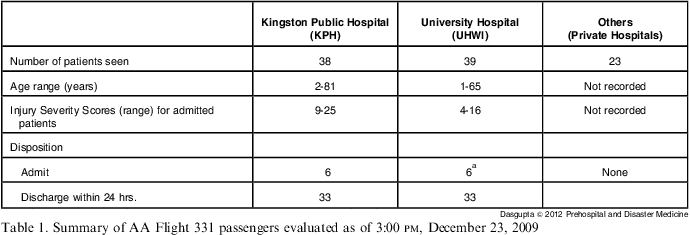
Transportation from the airport to the hospitals was provided by public and private ambulances along with assistance from others in the private sector. Rainy weather prevented the use of helicopter transportation. The injuries varied and ranged from simple fractures, abrasions and lacerations, to minor head injuries, and concussions. At approximately 4:00 am, a total of 92 passengers had been transported to hospitals; there were no reports of deaths or any life-threatening injuries. The majority of the patients had only minor injuries, and a significant number of patients were discharged within 24 hours. Injury Severity Scores (ISS) ranged between 4 and 25, and only five of the admitted patients had an ISS >15. By 3:00 pm on December 23 a total of 100 passengers had been evaluated at hospitals (Table 1). Only one patient seen at the private hospitals required suturing. Most of the patients evaluated at hospitals were discharged within 24 hours. There were no mortalities.
Summary of AA Flight 331 passengers evaluated as of 3:00 pm, December 23, 2009

aall crew members.
There were other “walking wounded” patients. It was later discovered that many passengers had left the scene once they had been accounted for, without receiving a full medical evaluation. Later that night and over the next few days, passengers from the crash who were not medically assessed on the night of the accident arrived at UHWI complaining of various minor injuries.
At each hospital, triage was performed at the entrance to the Emergency Department. A multi-disciplinary approach involving the general surgeons, anesthetists, and orthopedic surgeons was utilized. The patients’ names and diagnoses were recorded separately, and the list was given to the MOH. All 154 patients and crew were accounted for.
Discussion
Jamaica's EMS has been a partnership between the Jamaica Fire Brigade (JFB) and the MOH. Since the early 1980s, the Government of Jamaica, with the help of foreign consultants, has endeavored to establish an island-wide EMS system. The MOH provides some financial support, training, and technical organization, whereas the JFB supplies the personnel; both firemen and emergency medical technicians have been trained but only to the basic level. This association is common within the Caribbean as countries, such as Barbados and Trinidad, share common responsibilities. More advanced training that allows the use of invasive procedures and advanced life support techniques has not been possible until now as the laws of Jamaica currently preclude such activities by individuals other than licensed clinicians. Hopefully, with the appropriate legislation, more widespread expertise training and services can be offered in the future
Local agencies such as the Office of Disaster Preparedness and Emergency Management also assist in disaster preparations and responses. Within the wider region, the Caribbean Disaster Emergency Response Agency (CDERA) also plays a substantial role in responding to disasters and potential mass casualties within the Caribbean countries, of which Jamaica is a participating state. When a participating state requires such assistance, CDERA's main role is to formulate an immediate and coordinated response. 7 The disastrous 2010 earthquake in Haiti was one of CDERA's recent responses.
Several reports have been published with regards to the EMS response to plane crashes.Reference van Amerongen, Fine and Tunik 8 It is well established that optimal treatment depends on a properly and practically designed mass-casualty incident plan, good compliance of first responders, and a strong support system. This case report highlights the importance and significance of first responders. As mentioned earlier, one of the first individuals to reach the site of the incident was a passing bus driver, who played a large role in transporting many of the victims to the hospital. Providing first responder training to all police, firemen, and volunteers could have a favorable impact during similar catastrophes. Life-saving skills provided by a first responder may include controlling hemorrhage, applying splints, conducting a primary assessment, providing in-line stabilization and transport, and calling for more advanced medical assistance. Volunteer response teams or individuals can provide vital services in severe conditions. Preparedness activities and increasing the community's awareness of the potential for a disaster are paramount. Public education must be instituted and maintained.
Presently, the island of Jamaica is involved in education and training prehospital personnel in EMS. This service provides a direct link to early medical care, resuscitation, and the safe transportation of the right patient to the right place at the right time. Caribbean territories also have been developing this aspect of health care.Reference Barnett, Segree and Matthews 5 Data from Trinidad and Tobago have demonstrated a reduction in mortality from injuries after the implementation of the Pre-Hospital Trauma Life Support Course.Reference Ali, Adam, Gana and Williams 9 Considering that mass casualties are rare, there is little opportunity for real-time training and experience;Reference Born, Briggs and Ciraulo 10 simulated disaster training, therefore, must be utilized.
The preparation for and management of disasters and mass causalities benefit from a coordinated central dispatch system with a dedicated and appropriately trained staff. Locally, this is encouraged. The central dispatch system also may coordinate inter-hospital transfers and maintain radio and telephone contact between police, ambulances, hospitals, and the site of incident, thereby strengthening first responders, EMS, and physicians in hospitals.
Simulation exercises are a valuable method to assess the adequacy of the dispatch and response systems. The best way to accomplish this is to have a detailed institutional mass-casualty plan, to provide the appropriate training and to rehearse scenario-based events with all levels of staff. It is important that all staff participate in drills and simulations, as these are valuable tools for identifying gaps, determining remedies, and validating correct practices.
Ambulance transportation to the hospital also is a key component of prehospital care that requires further development locally. Outside of Kingston, Jamaica's capital, ambulance services are limited, and there are few private ambulance companies. Air-medical service is provided only by the Jamaica Defense Force, although there are a few private air ambulances in the country as well.
Proper triaging and preparation to receive victims from the site also were crucial components in this experience. At the UHWI, the triage officer was in constant communication with the Commanding Officer or the Hospital Director. Measures implemented included: (1) the establishment of unidirectional patient flow; ensuring the availability of adequate space for evaluation and treatment in the Emergency Department as well as the operating theatres and other adjoining facilities; (2) ensuring the availability of adequate medical and administrative staff; and (3) ensuring adequate security and crowd control.
Activities that likely contributed to the positive outcomes in this case include: (1) the communication cascade that operated along the appropriate channels and informed all concerned persons; (2) the fast response of the fire department and police; (3) the establishment of a working advanced medical post at the scene of the incident; (4) the inclusion of psychiatrists and social workers in the health team at the point of definitive care (UHWI and KPH); and (4) the proper preparation at the definitive care centers. It is well accepted that large-scale, functional disaster exercises are costly to plan and execute, as well as difficult to evaluate objectively.Reference Gryth, Rådestad and Nilsson 11 Using this experience, it also is recommended that more disaster simulation exercises should be conducted and that the exercises should include performance indicators (measureable tools/scales to assess skills and efficiencies of health care providers, instructors, and supervisors) which have been proven to be quite valuable in some studies.Reference Gryth, Rådestad and Nilsson 11
Conclusions
Overall, the UHWI and KPH Accident and Emergency Departments were equipped to handle an event of this magnitude. An effective EMS system is paramount to an effective response, and improvement in this system is required locally. Training for first responders and simulation exercises that include potential disaster scenarios, such as plane crashes, would help to ensure appropriate preparation and EMS response. Vigorous public education must be instituted and maintained.
Abbreviations
- AA:
-
American Airlines
- CDERA:
-
Caribbean Disaster Emergency Response Agency
- EMS:
-
Emergency Medical Services
- JFB:
-
Jamaica Fire Brigade
- KPH:
-
Kingston Public Hospital
- MOH:
-
Ministry of Health [Jamaica]
- UHWI:
-
University Hospital of the West Indies