Methicillin-resistant Staphylococcus aureus (MRSA) has been regarded as a significant healthcare-associated pathogen that can result in high morbidity and mortality. Reference Su, Chang, Yan, Tseng, Chien and Fang1 MRSA is easily transmissible in acute-care hospitals, and nosocomial outbreaks have been reported. Reference Matsumoto, Takeuchi and Uehara2 The nares could be a source for nosocomial MRSA transmission, and decolonization of nasal and cutaneous carriage has been found to be effective in preventing nosocomial transmission. Reference Simor3 Although guidelines for MRSA decolonization have included topical intranasal mupirocin together with whole-body bathing with an antiseptic, Reference Krishna and Gibb4 the emergence of mupirocin resistance has been associated with decolonization failure. Hence, antiseptic agents including octenidine dihydrochloride have been used as alternatives.
Octenidine dihydrochloride, a cationic biguanide with a broad antibacterial spectrum toward gram-positive bacteria including MRSA, is commonly used as an antiseptic for skin and mucosal wounds. Reference Hübner, Siebert and Kramer5 Intranasal application of octenidine together with universal antiseptic bathing has been shown to effectively reduce the prevalence and acquisition of MRSA colonization in extended-care facilities. Reference Chow, Hon, Tin, Zhang, Poh and Ang6,Reference Chow, Wong, Zhang, Poh and Ang7 Although a handful of studies on the use of intranasal octenidine coupled with octenidine bathing in the intensive care unit Reference Gastmeier, Kämpf, Behnke, Geffers and Schwab8 and burns unit Reference Baier, Ipaktchi and Schwab9 have demonstrated its effectiveness in the reduction of MRSA acquisition, their effectiveness in general wards in acute-care hospitals has yet to be evaluated. In this study, we assessed the effectiveness of topical intranasal octenidine, coupled with daily universal octenidine bathing, in reducing MRSA acquisition in a high MRSA-prevalence dermatology general ward of an acute-care hospital.
Methods
We conducted a quasi-experimental before-and-after study from August 1, 2016, to November 30, 2018, in the dermatology general ward at the Communicable Disease Centre at Tan Tock Seng Hospital in Singapore. We compared patients admitted during the baseline period (August 1, 2016, to September 30, 2017) with patients in the intervention period (November 1, 2017, to November 30, 2018), with October 2017 as the washout period. All hospitalized patients received daily octenidine baths regardless of MRSA status. During the intervention period, MRSA carriers additionally received intranasal octenidine gel (octenidine hydrochloride, Octenisan MD nasal gel, Schülke & Mayr GmbH, Germany) for 5 days after admission.
All patients admitted to the dermatology ward were included in the study, which was conducted as a quality improvement project. The ward comprised 22 single-bedded single-rooms where patients with more severe dermatological conditions (eg, extensive eczema and psoriasis, immunobullous diseases, and adverse drug eruptions) were lodged. Patients were routinely screened for MRSA on admission. Patients who had stayed for >24 hours in the ward were screened for MRSA at discharge. Screening swabs were obtained from the nares, axillae, and groin, and were cultured on selective chromogenic agar (MRSASelect, BioRad, France). Growth of mauve colonies was interpreted as positive, after 18–28 hours of incubation, and were referred to matrix-assisted laser desorption ionization time-of-flight (MALDI-TOF) mass spectrometry and cefoxitin disk-diffusion testing to confirm their microbial identity and level of methicillin resistance.
For data analysis, we first used appropriate descriptive statistics to summarize patient demographics, pre-existing comorbidities, prior stay in another ward during the same admission, length of stay in the dermatology ward, and MRSA prevalence on admission to the ward by the period of admission. Univariate analysis was carried out using the χ Reference Matsumoto, Takeuchi and Uehara2 test for categorical variables, and the t test or Mann-Whitney U test for continuous variables. We then constructed a multivariable logistic regression model, accounting for potential confounding, to assess the independent effect of admission during the intervention period on MRSA acquisition. We further performed interrupted time-series analysis with a multivariable modified Poisson regression model incorporating robust sandwich variance to assess for the rate of change in monthly MRSA acquisition risk (%) before and after the intervention. We included variables decided a priori as factors associated with MRSA colonization based on prior knowledge from literature review.
Results
In total, 802 patients were included, comprising 400 (49.9%) and 402 (50.1%) patients in the baseline and intervention periods. There was no difference in age, gender, race, prior stay (>1 day) in another ward during the same admission, and length of stay in the dermatology ward between the 2 groups (Table 1). Audits done also showed no difference in hand hygiene compliance rates among staff during the 2 periods (mean compliance rate 88.6% in baseline and 81.4% in intervention periods, P = .2750).
Univariable Analysis Comparing Characteristics of Patients Admitted to the Dermatology Ward During the Baseline and Intervention Periods, and Multivariable Logistic Regression Analysis to Access Independent Factors Associated With the Acquisition of MRSA Among the Patients Admitted During the Study Period Who Had Been Screened at Both Admission and Discharge

Note. MRSA, methicillin-resistant Staphylococcus aureus; aOR, adjusted odds ratio; CI, confidence interval. Significant P values of <.05 are shown in bold.
On admission, 62 of 391 (15.9%) and 47 of 398 (11.8%) of patients were found to be colonized with MRSA during the baseline and intervention periods, respectively. Among MRSA carriers detected on admission during the baseline and intervention periods, respectively, 6 of 62 (9.7%) and 10 of 47 (21.3%) screened negative for MRSA at discharge. We detected no difference in age, gender, race, comorbidity status, and length of stay in the ward between those who remained positive and those who were negative at discharge. Among non-MRSA carriers, the rates of MRSA acquisition in the ward were 14 of 329 (4.3%) and 8 of 351 (2.3%) during the baseline and intervention periods, respectively.
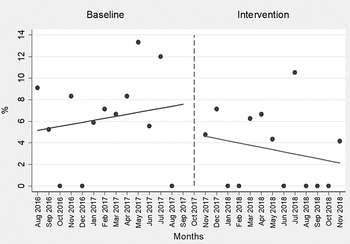
Of 680 patients, 478 patients who screened negative for MRSA on admission and underwent screening at discharge were included in the multivariable analysis to assess factors associated with MRSA acquisition. Patients admitted during the intervention period were 63% less likely than those admitted during the baseline period to acquire MRSA during their stay in the ward (aOR, 0.37; 95% CI, 0.14–0.98; P = .046). The length of stay in the ward was also independently associated with MRSA acquisition (aOR, 1.12; 95% CI, 1.05–1.18; P < .001) (Table 1). After adjusting for potential confounding, the rate of reduction in the monthly MRSA acquisition risk in the intervention period was significantly greater than the rate of change in the monthly MRSA acquisition risk in the baseline period (adjusted risk ratio [aRR], 0.82; 95% CI, 0.70–0.96; P =.013) (Fig. 1 and Supplementary Table 1 online).
Monthly acquisition risk (%) of methicillin-resistant Staphylococcus aureus during the baseline and intervention periods. Fitted lines drawn for each period were estimated from the multivariable modified Poisson regression analysis.

Discussion
Our findings add to the limited literature on the effectiveness of topical intranasal octenidine coupled with universal daily octenidine bathing in the reduction of MRSA acquisition in acute-care hospitals. Although 2 previous studies have reported its effectiveness in intensive and special care units, Reference Gastmeier, Kämpf, Behnke, Geffers and Schwab8,Reference Baier, Ipaktchi and Schwab9 we have further demonstrated its effectiveness in the dermatology general ward. We have shown that patients admitted to the ward during the intervention period when MRSA carriers additionally underwent a 5-day regimen of intranasal octenidine were 63% less likely to acquire MRSA during the ward stay than those admitted during the baseline period when only universal octenidine bathing was administered. As observed from previous studies, antiseptic bathing alone is inadequate for reducing MRSA acquisition in acute-care hospitals. Reference Harris, Le and Tambyah10 Although the nares are the most frequently colonized anatomic site and a major reservoir for MRSA, decolonization strategies commonly include universal antiseptic bathing but not nasal decolonization. With the wider availability of intranasal antiseptics, the inclusion of nasal decolonization in strategies to reduce nosocomial transmission of MRSA can be safely administered without the need for concern of mupirocin resistance. However, with the increasing and widespread use of octenidine products, the close surveillance of MRSA isolates for susceptibility to octenidine is pertinent.
The study’s strengths included the close monitoring by an epidemiologist, working in close collaboration with the attending physicians and nurse managers of the ward, to ensure adherence to the screening and intervention protocols. Furthermore, sample collection methods were standardized according to the hospital’s protocol and the identity of MRSA colonies confirmed with MALDI-TOF, rendering any potential misclassification of the outcome measure highly unlikely. Nonetheless, the study could be limited by the inability to adjust for unknown confounders that were not measured, although major risk factors for MRSA acquisition were identified a priori and adjusted for in the multivariable analysis. The study could have been limited by the substantial proportion (30%) of patients who were not screened at discharge and were not included in the multivariable analysis. However, any potential detection bias was likely to be biased towards the null, as a significantly higher proportion of patients was tested in the intervention period (262 of 351, 75%) than in the baseline period (216 of 329, 66%) (P = .010). Furthermore, we detected no significant difference in the age, gender, race, and comorbidity status between those who were and were not screened at discharge. As such, any potential selection bias was likely to be minimal.
In conclusion, topical intranasal octenidine, coupled with universal octenidine baths, can reduce MRSA acquisition in high MRSA-prevalence general dermatology wards in acute-care hospitals. Intranasal octenidine can be used in healthcare settings with high prevalence of mupirocin resistance for MRSA decolonization for the prevention of nosocomial transmission. Further studies should be conducted to validate the study’s findings and assess for applicability in cohorted wards in acute-care hospitals.
Supplementary material
To view supplementary material for this article, please visit https://doi.org/10.1017/ice.2021.300
Acknowledgments
We acknowledge the efforts of nurses from the dermatology ward for their dedication in adhering to infection prevention practices in their care of patients, including universal octenidine bathing and intranasal application of octenidine gel for MRSA-carriers.
Financial support
No financial support was provided relevant to this article.
Conflicts of interest
All authors report no conflicts of interest relevant to this article.