Introduction
Care work, especially paid care work, plays a crucial role in meeting care needs. However, there is a large gap between supply and increased demand for care work worldwide (İlkkaracan and Kim, Reference İlkkaracan and Kijong2019). Unpaid care work fills this gap to a great extent. Women all over the world, regardless of education, income, or a particular country’s level of development, in general undertake unpaid care work for dependent members within their household. Although some countries strive to reduce and redistribute the unpaid care burden, in both developed and developing countries, the time women spend providing in-home care services for other household members is significantly higher than that of men (Memiş et al., Reference Memiş, Öneş, Kızılırmak, Dedeoğlu and Adem2012). However, this gender gap is more intense in developing countries that are characterized by a patriarchal mindset and insufficient elderly, sick, and childcare services offered by the market and the state. Turkey fits this profile (İlkkaracan, Reference İlkkaracan2010).
Women’s care burden is a major obstacle for their labor market participation as wage earners. Globally, the fundamental reason given by women of working age for being outside the labor force was unpaid care work (41.6 percent) (ILO, 2018). As a result, women who are unable to participate in the labor market due to their unpaid care work burden are subjected to a form of economic penalty. For example, in Turkey, due to gender-based differences in labor market participation, 62.5 percent of women lack any source of regular personal income (Dayıoğlu and Başlevent, Reference Dayıoğlu, Cem, Dedeoğlu and Adem2012). An increase in women’s participation would potentially create a new source of income for the entire household resulting in a higher welfare level and therefore in the decrease of overall poverty. Also, according to various studies examining the effects of dissemination of care services on employment and economic development, investments in childcare services particularly increase women’s labor force participation more than the same amount of investment in the construction sector and cash transfer and result in an improvement in a country’s general economic development (Antonopoulos et al., Reference Antonopoulos, Kim, Masterson and Zacharias2010, 5; İlkkaracan et al., Reference İlkkaracan, Kim and Kaya2015, 45–7). A microeconomic simulation study, based on the analysis of forty-five developed countries, reveals that achieving the United Nations Sustainable Development Goals in the care economy would result in a total of 475 million jobs by 2030 (İlkkaracan and Kim, Reference İlkkaracan and Kijong2019). These reasons make it critical to analyze the factors that reduce women’s care burden and to create effective and informed policies for the expansion of care services.
Studies concentrating on the impact of women’s care burden on their labor force participation in Turkey generally focus on the existence of dependent household members, if any (Ayvaz-Kızılgöl, Reference Ayvaz-Kızılgöl2012, p. 99; Dayıoğlu and Kırdar, Reference Dayıoğlu and Murat2010, p. 36, Kılıç and Öztürk, Reference Kılıç and Selcen2014, p. 125; Kiren-Gürler and Üçdoğruk, Reference Kiren-Gürler and Şenay2007, p. 580–1). However, these studies do not take into account the use of formal and informal care services, which increase female labor force participation by reducing the time spent on caring for dependent household members. Pekkurnaz has examined the employment status and contraceptive preferences of women with young children in Turkey. However, the study has not focused on dependent adult care and informal childcare, and has used supply-side variables related to private and public formal childcare services at the province level (Pekkurnaz, Reference Pekkurnaz2019, p. 1). Other studies, using Turkish Statistical Institute (TurkStat) 2006 Time Use Survey (TUS) data, have investigated gender differences in the paid and unpaid work burden but have not analyzed specifically and separately the impact of intra-household care burdens on labor market participation. They have not also included questions about the elderly care burden (Memiş et al., Reference Memiş, Öneş, Kızılırmak, Dedeoğlu and Adem2012).
In examining the relationship between women’s care burden – both child and adult – and employment probability, this study has three significant new contributions to the literature on Turkey and fills an important research gap. First, it focuses on the time spent on the care of dependent household members (children, patients, the disabled, and the elderly) and evaluates women’s care burden in relation to formal and informal care services, enabling a more accurate measurement of the effects of women’s care burden on their employment prospects. Second, this study discusses women’s ability to participate in social life as a way to assess the impact of the patriarchal structure on women’s employment prospects. The third contribution is to investigate the effect of access to formal and informal care services on women’s employment status.
In this study, TurkStat TUS data are used. TurkStat has conducted two time-use surveys. The early one is in 2006 and the latest is in 2014–2015. The TUS data collected in 2014–2015 are used in this study as it includes questions both on child and elderly care, which has more detailed findings than that of TUS 2006 survey.
In the next section, I evaluate women’s intra-household care burden and labor force participation with the help of related literature. Then, I analyze the effects of the care burden on women’s employment probability via a logit model using the TUS data. Finally, I examine the relationship between access to childcare services and women’s employment status through descriptive analysis.
The most striking findings are that women who benefit from informal childcare services are approximately twenty-seven times, who benefit from formal childcare services are two times, and who benefit from informal adult care services are 2.6 times more likely to be employed than women who cannot benefit from any care services. The article also shows that a higher rate of women who receive childcare support are working in high-skilled (48.7 percent), full-time (91.7 percent), and regular waged jobs (85 percent) compared to women who do not receive care support (26.7 percent, 75 percent, and 49.5 percent, respectively).
Gender inequalities in care burden and women’s labor force participation
Although there have been significant changes in women’s role in the labor market in recent years, on average around the world women’s labor force participation rate has remained much lower than that of men (ILO, 2018, p. 5). As of 2019, the global labor force participation of women over the age of 15 was 47.1 percent, Footnote 1 while men’s was 74.2 percent. Footnote 2 Compared to the worldwide average, women’s labor force participation is very low in Turkey: as of 2019, it was 38.7 percent, while men’s was 78.2 percent. Footnote 3
In Turkey many factors, such as age, education, marital status, and household wealth influence this rate (see Ayvaz-Kızılgöl, Reference Ayvaz-Kızılgöl2012; Dayıoğlu and Kırdar, Reference Dayıoğlu and Murat2010; Kılıç and Öztürk, Reference Kılıç and Selcen2014; Kıral and Karlılar, Reference Kıral and Selin2017; Kiren-Gürler and Üçdoğruk, Reference Kiren-Gürler and Şenay2007). However, gender inequality in labor market participation in Turkey is mainly due to the patriarchal mindset (Sallan-Gül, Reference Sallan-Gül2005; Dedeoğlu, Reference Dedeoğlu2000) and consequently due to the intra-household care responsibilities attributed to women (Ecevit, Reference Ecevit, Toksöz and Makal2012).
Intra-household unpaid care consists of caring for dependent household members, such as children, the disabled, sick family members, and the elderly. In both developed and developing countries, women’s in-home unpaid work is more extensive than that of men. This discrepancy is typically more pronounced in low-income countries, where both the public care services and the income required to purchase care services are insufficient. Footnote 4 The increase in women’s unpaid work burden can sometimes take over the time allocated to paid work activities and reduce labor force participation. It may also lead to an increased burden in the form of the second shift: the unpaid workload of women doing paid work (Hochschild and Machung, Reference Hochschild and Anne2012). This is also known as the double burden (Acar-Savran and Demiryontan, Reference Acar-Savran and Nesrin2008).
According to the results of the 2014–2015 TUS, in Turkey women’s intra-household care burden (forty-three minutes) was reported to be half an hour longer per day than that of men (eleven minutes). Footnote 5 The unequal distribution of unpaid care work is a significant obstacle to women’s labor force participation and hence their economic freedom and power. Footnote 6
In Turkey, a few pioneer studies have examined intra-household time use via the 2006 TUS data. Memiş, Öneş, and Kızılırmak found that in Turkey, there is significant gender inequality in the distribution of paid and unpaid domestic work load, in each household type, such as single, married couple without children, and married couple with children (Memiş et al., Reference Memiş, Öneş, Kızılırmak, Dedeoğlu and Adem2012). They reported that unpaid housework and care work tend to increase in poorer households due to lack of disposable income (Umut et al., 2015). Furthermore, increased workload disproportionately fell on women in such households more than on men. Gündüz and İlkkaracan provided the first estimation of the market value of unpaid work in Turkey. According to their results, the total market value of childcare services corresponds to 3.3 percent of gross domestic product, revealing the importance of the childcare economy (Gündüz and İlkkaracan, Reference Gündüz and İpek2019).
In addition to these quantitative studies using TurkStat data, Ekiz-Gökmen investigated paid and unpaid work within households by applying a questionnaire to 182 married couples with children in the central district of Muğla, Turkey. She found that women spent an average of one hour fifty-one minutes and men spent forty-three minutes a day caring for dependent household members (Ekiz-Gökmen, Reference Ekiz-Gökmen2017).
Childcare is a significant part of women’s overall intra-household care burden and therefore strongly affects women’s labor force participation. A few studies have shown that women’s labor force participation rates decreases with marriage and particularly after having children (for instance, Çisel Ekiz-Gökmen, Reference Ekiz-Gökmen2016; Memiş et al., Reference Memiş, Öneş, Kızılırmak, Dedeoğlu and Adem2012; Paull, Reference Paull2006). Also, an increase in the number of children negatively influences women’s labor force participation (Dayıoğlu and Kırdar, Reference Dayıoğlu and Murat2010). A significant number of women who can participate in the labor market can only work in part-time or irregular jobs due to their care burden (Lichtenwalter, Reference Lichtenwalter2005).
Women’s care burden can be reduced by informal (close relatives, paid caregivers, etc.) and formal care services (nurseries, kindergartens, etc.). The related literature shows that the availability of childcare services increases women’s participation in the labor force (See Chevalier and Viitanen, Reference Chevalier and Viitanen2002; İlkkaracan, Reference İlkkaracan2012; İlkkaracan et al., Reference İlkkaracan, Kim and Kaya2015; İnce-Yenilmez, Reference İnce-Yenilmez2019; Martínez and Perticará, Reference Claudia and Marcela2017; Pekkurnaz, Reference Pekkurnaz2019). According to Organisation for Economic Co-operation and Development (OECD) data, a 1 percent decrease in the unpaid care burden of women worldwide increases labor force participation rates by 10 percent, when other variables are controlled for (OECD, 2018). The literature also shows that increases in childcare costs reduce women’s employment prospects (such as Heckman, Reference Heckman1974; Blau and Robins, Reference Blau and Robins1988; Ribar, Reference Ribar1995; Viitanen, Reference Viitanen2005).
In Turkey, the empirical studies on women’s labor force participation has been generally investigated through logit (such as Ayvaz-Kızılgöl, Reference Ayvaz-Kızılgöl2012) and probit estimation methods (such as Kılıç and Öztürk, Reference Kılıç and Selcen2014) by using household budget survey data for 2002–2008. There are also studies which analyze the data obtained from household labor force survey 2006 (such as Dayıoğlu and Kırdar, Reference Dayıoğlu and Murat2010), and through a field research for Adana Province (Kıral and Karlılar, Reference Kıral and Selin2017) utilizing a logit model. Apart from these studies, Pekkurnaz has used 2013 Turkey Demographic and Health Survey and the 2013–2014 Formal Education data set available at the website of the Ministry of National Education (MoNE) and analyzed it via a probit method (Pekkurnaz, Reference Pekkurnaz2019).
In empirical studies that examine factors affecting women’s labor force participation in Turkey, access to care services is not taken into account. These studies consider the presence of disabled and elderly individuals and the number of children in different age groups in households as indicators of the intra-household care burden. Kiren-Gürler and Üçdoğruk reported that an increase in the number of children in the household and related rise in the need for care work reduce women’s labor force participation (Kiren-Gürler and Üçdoğruk, Reference Kiren-Gürler and Şenay2007). According to Kılıç and Öztürk the presence of individuals older than sixty-five, persons with disabilities, and especially children under the age of 5 reduces the likelihood of labor force participation by women living in urban areas (Kılıç and Öztürk, Reference Kılıç and Selcen2014). Similarly, Dayıoğlu and Kırdar and Ayvaz-Kızılgöl found that the number of children negatively affects these women’s labor force participation (Dayıoğlu and Kırdar, Reference Dayıoğlu and Murat2010). In addition to the aforementioned studies, the results of Ekiz-Gökmen’s study indicate that the main reason why married women cannot participate in the labor force is child or patient care (Ekiz-Gökmen, Reference Ekiz-Gökmen2016). The results of Pekkurnaz’s study, focusing on the supply of care services, show that public provision of childcare and preschool services increase the probability of employment of women, but also show that a greater proportion of private providers in total childcare supply decreases the probability of being employed (Pekkurnaz, Reference Pekkurnaz2019).
Data and descriptive statistics
The TurkStat 2014–2015 TUS data set consists of four data sets: individual, household, daily, and household composition. Footnote 7 The scope of this study is 7,212 women in the TUS individual data set, aged fifteen to sixty-four, who are household head or wife of household head. Footnote 8 These women are representative of the 17,082,727 women in Turkey when weighed using the individual weight coefficient. I now briefly explain the variables used in the analysis.
Variables used in analysis and definition
Women’s employment rate was taken as the dependent variable. Within the scope of the study, women who are employed for an hour or more at a paid or unpaid job in return for a monetary or in-kind payment during the last week are considered as actively working. Women who have an active connection with an income-generating work activity are also considered as working. Although they have not worked actively during the prior week, women who have a workplace or a job but have been temporarily away from the said workplace are also considered to be employed. The dependent variable takes the value of one if a woman is employed and zero if not. The variables used in the study are summarized in Table 1.
Variables used in analysis

Source: TurkStat. Time Use Survey micro data set 2014–2015.
In analysis based on relevant literature, age, education level, marital status, general health condition and household head status are used as independent variables. In addition to these variables, the time women spent on child and adult care, access to formal and informal child/adult care services, and women’s level of participation in social life, whose effects on women’s employment have not yet been empirically tested in the national literature, are included in the model.
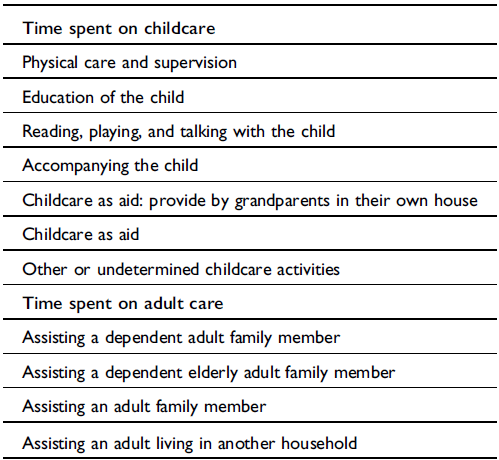
The study uses TUS daily micro data to determine the time women spent caring for dependent children and adults. Daily micro data include the activities of household members aged ten and over at ten-minute intervals.Footnote 9 To determine the time spent on childcare, I included the total of physical care and supervision, education of the child, reading and playing with the child, talking to the child, accompanying the child, childcare for one’s own child living in another household, and unspecified childcare activities. This analysis only includes the time spent by women with dependent children aged between 0 and 9. To determine the time spent for adult care, I accounted for the sum of the activities in assisting a dependent (disabled, sick, elderly) adult family member. Similarly, the time spent by women with dependent adults in their households for adult care was also included.
This study discusses whether women with dependent children aged between 0 and 9 benefit from day-care systems (such as nurseries, kindergartens, and study centers) as formal childcare services. This study also considers whether women with dependent-aged children receive childcare support by nonhousehold members (paid caregivers, grandmothers, etc., who do not live in the same house) as informal childcare support.
The TUS data set does not contain information about formal dependent adult care services. However, it considers whether any household members received assistance through informal adult care services outside the household for the care of those with disabilities, patients, or elderly people in the last four weeks.
The analysis also includes women’s ability to participate in social life as a way to assess the impact of the patriarchal structure on women’s employment prospects. Participation in social life refers to participation in at least one of the nonprofit occupational professional chambers, cooperatives, unions, political parties, sports clubs, or other social associations.
Among the independent variables included in the analysis the time women spent on dependent child and adult care are continuous variables. The remaining variables are categorical variables. The age variable has five categories: age1 (1 for 15–24 age old, 0 otherwise), age2 (1 for 25–34 age old, 0 otherwise), age3 (1 for 35–44 age old, 0 otherwise), age4 (1 for 45–54 age old, 0 otherwise), and age5 (1 for 55–64 age old, 0 otherwise). General health status variable has also five categories: health1 (1 if general health status is very good, 0 otherwise), health2 (1 if general health status is good, 0 otherwise), health3 (1 if general health status is middle, 0 otherwise), health4 (1 if general health status is bad, 0 otherwise), and health5 (1 if general health status is very bad, 0 otherwise).
Within the scope of the study, educational level (1 for high school degree or more, 0 otherwise), marital status (1 if married, 0 otherwise), whether being head of the household (1 for being head of the household, 0 for not), and whether participating in social life (1 if participating in social life, 0 if not) are also used as categorical independent variables.
To categorize childcare support for dependent-age children, six variables were created: formal childcare (1 if dependent-aged child receives – only – formal childcare support, 0 otherwise), informal childcare (1 if dependent-aged child receives – only – informal childcare support, 0 otherwise), both formal and informal childcare (1 if dependent-aged child receives both formal and informal childcare support, 0 otherwise), no childcare (1 if dependent-aged child does not receive either formal or informal care support, 0 otherwise), children aged 10 and above (1 for presence of children only aged 10 and above, 0 otherwise), and no child (1 if not having a child, 0 if having a child).
Informal adult care support is examined in three variable categories: informal adult care (1 if there is a dependent adult receiving informal adult care support, 0 otherwise), no informal adult care (1 if there is a dependent adult not receiving informal adult care support, 0 otherwise), and no dependent adult (1 if there is no dependent adult in household, 0 if there is).
In these categorical variables, I used women who are 15–24 years old, never married, divorced, or widowed; who have less than a high school degree; who are not a head of household; receive no childcare support and no adult care support; and do not participate in social life and who have bad health status as reference variables.
Descriptive statistics
Descriptive statistics for all variables are also shown in Table 1. Only 30.5 percent of women in the sample is employed. Footnote 10 Almost 53 percent of all women are 25 to 44 years old and 90 percent are married. Women account for 26 percent with high school or higher education level and 15.6 percent of women are household heads. Approximately 7 percent of women have poor (bad and very bad) health. Women’s participation in social life (9.8 percent) is quite low.
In the sample, 22 percent of women do not have children, while 38.5 percent has children aged 10 and over. The proportion of women with dependent age (0–9) children and at least one child who benefits from formal care services is 3.4 percent. The rate of those who benefit from informal services is only 2.3 percent. The proportion of women who benefit from neither formal nor informal care services is 33.3 percent while those benefiting from both is quite low (0.1 percent).
In addition, in almost 96 percent of households there is no dependent adult. Households with dependent adults also have low access (0.5 percent) to informal care. Women spend an average of ninety-seven minutes on childcare and forty-seven minutes on adult care daily.
Econometric analysis and results
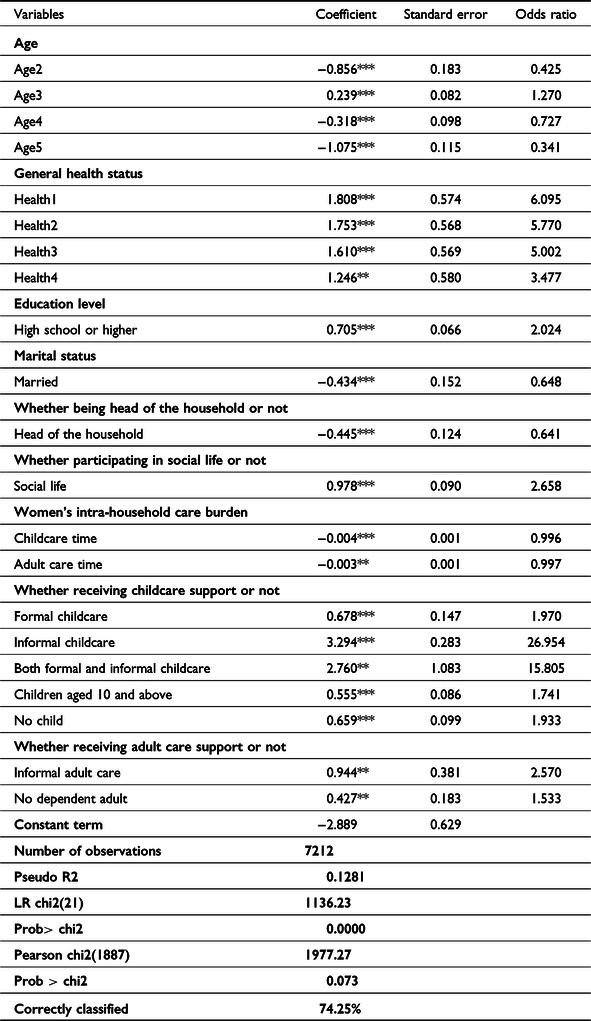
There are two basic hypotheses tested in econometric analysis. First, the time spent by women caring for a dependent household member reduces their employment probability. Second, having access to care services increases the employment probability of women. I employ a logistic regression model to investigate the effects of women’s unpaid care burden on their employment probabilities, by using the STATA9 statistical software program. Estimation results are presented in Table 2. I also include in the table the odds ratios that were used during interpretation of the coefficients in the logit model. Footnote 11
Logistic regression results

Note: ***, **, denote statistical significance at 1 and 5 percent levels, respectively.
The estimation results demonstrate that when compared to age1 (15–24 age old), age2 (25–34 age old) decreases the employment probability of women while age3 (35–44 age old) increases the employment probability, and age4 (45–54 age old) and age5 (55–64 age old) decreases the employment probability. In other words, the relationship between the increase in women’s age and employment probability was reversed according to different age groups. These estimation results are in accordance with the “M”-shaped relationshipFootnote 12 observed between women’s age groups and labor force participation in the related literature and also denote a strong link between marriage, childbearing, and female employment. Footnote 13
Women with a better health status (very good, good, moderate, and poor) are more likely to be employed compared to women with a very poor general health status. Estimation results also show that women with high school or higher education levels are approximately twice as likely to be employed compared to women with lower education levels. This finding reveals the importance of policies that encourage women to receive higher educational degrees.
Married women are less likely to be employed than unmarried women, demonstrating that household responsibilities are disproportionately distributed and married women are discouraged from labor market activities.
The results show that women who are household heads are less likely to be employed than those who are not. This finding is in conflict with the expectations that women in female-headed households are breadwinners and show higher participation in paid employment. According to the findings of the study, 30 percent of women who are household heads are widows and 64 percent of widows are 55 years old and above. These findings illustrate that women can be the heads of households only after the death of their spouses – except for cases of divorce – and since the death of a spouse generally occurs after a certain age, widowed heads of households are likely to be above the established working age and therefore less likely to be employed, and widowed women can benefit from their spouse’s and widow’s pensions.
The estimation results show that participation in social life has a significant effect on women’s employment probability. This variable was included in the model as an indicator of the power of the patriarchal structure over women’s choices and freedom. Accordingly, women who participate in social activities are approximately 2.7 times more likely to be employed than women who do not.
The results demonstrate that as women spend more time on dependent child and adult care – in other words, as women’s intra-household care burden increases – the likelihood of women’s employment decreases. This finding reveals that policies aimed at reducing women’s intra-household care burden will lead to a significant welfare increase for individual households and the country as a whole, by increasing women’s employment. This finding also points to the necessity of reevaluating the existing system of provision of child and elderly care services in Turkey, since it seems to be reinforcing the intra-household care burden of women in its current state. The analysis results reveal the effect of expanding care services and facilitating access to care services on women’s employment.
Women with no children are approximately 1.9 times and women with children aged 10 and over are 1.7 times more likely to be employed compared to women with dependent children who cannot benefit from any – formal and informal – childcare services. This observation supports the related literature and shows that expanding and increasing accessibility to care services for women with dependent children under the age of 10 may be critical in increasing women’s employment.Footnote 14 Accordingly, women who benefit from formal care services for at least her one dependent-age child are approximately twice as likely to be employed than women who have a child of dependent age and cannot benefit from any – formal or informal – childcare services. The most striking finding is that women who benefit from informal care services for at least one dependent-age child are twenty-seven times more likely to be employed than women who cannot benefit from any childcare services. These results show that informal childcare services play a very important role in increasing women’s employment in Turkey.
Similarly, the absence of a dependent adult in the household increases the employment probability of women 1.5 times. If the dependent adult in the household benefits from informal care services, the employment probability of women is approximately 2.6 times higher than for those who do not benefit from such services. This finding affirms that the extension of care services will increase women’s employment.
In summary, the results of the analysis reveal that the increased time women spent on child and adult care reduces the probability of women’s employment. In addition, results point out that the probability of employment increases significantly when women transfer some of their care burden to formal and informal care services. In particular, the positive impact of informal childcare services on female employment is remarkable. However, the results do not demonstrate how access to care services and the type of care services used affect women’s employment status.
At this stage of the study, I will summarize access to and types of childcare services. Footnote 15 And then I will detail how employment status of women with dependent children changes according to whether they can benefit from formal and informal care services.
Access to, types of, and duration of childcare services
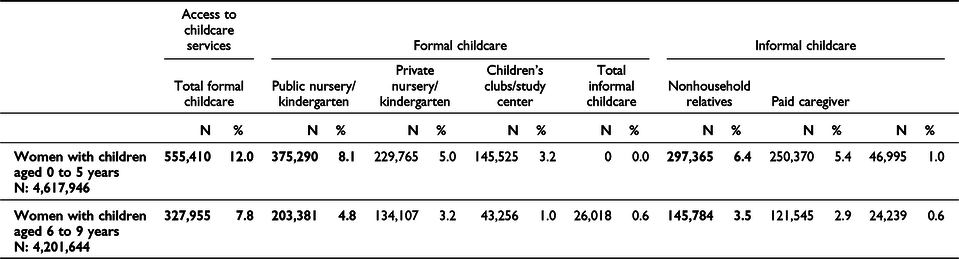
According to Table 3, only 12 percent (555,410) of women with children under age 6 (4,617,946) are eligible for childcare services in Turkey. This rate drops to 7.8 percent (327,955) for women with children aged 6–9 (4,201,644). The minimum use of childcare services reflects both traditional gender roles in Turkish society and the insufficiency of childcare services. Footnote 16 Women who cannot access care services for their children care for them at home, which has a significant impact on their employment.
Access to childcare services and types of care services

Note: Compiled from TUS 2014–2015 household composition micro data. These are weighted numbers. Since women may have more than one child in the same age group (0–5, 6–9) and benefit from different care supports, the sum of the number of women receiving and not receiving childcare services may exceed the total number of women.
Two types of childcare services are available: formal and informal. Formal care services, mainly in the form of early childhood care and preschool education (ECCPE) services, comprise three categories: nurseries and day-care centers for children in the 0—72 months group, kindergartens for children in the 36–68 months group, and nursery classes set up in primary schools for children between 57 and 68 months (İlkkaracan et al., Reference İlkkaracan, Kim and Kaya2015). While kindergartens and nursery classes provide preschool education, nurseries and day-care centers offer care in addition to education services.
In Turkey, MoNE is the main institution that provides ECCPE services. In addition to MoNE, private enterprises, public institutions, local administrations, trade unions, large-scale commercial enterprises, associations, and foundations can also open kindergartens, day-care centers, and nurseries. The Ministry of Family and Social Services is responsible for the establishment and supervision of private nurseries and day nurseries, but it does not open or run its own day-care centers. In addition to the public kindergartens and nursery classes that MoNE operates, it also has the authority to grant licenses and supervise other institutions to open private kindergartens and nursery classes.
In 2018–2019, Footnote 17 the enrollment rate in ECCPE services in Turkey was 39 percent for children between the ages of 3 and 5, 51 percent for children between 4 and 5, and 68 percent for 5 year olds (MoNe, 2019). There is no official data on the access to ECCPE services for children under the age of 3 (İlkkaracan et al., Reference İlkkaracan, Kim and Kaya2015). In Turkey, preschool education has a public-weighted structure and mainly serves 5-year-old children. Only 18 percent of ECCPE services are covered by private institutions (MoNE, 2019).
Table 3 shows that 8.1 percent of the women with children 0–5 years old and 4.8 percent of women with children aged 6–9 benefit from formal care services. Among those, 5 percent of women with 0–5-year-old children benefit from public nurseries and kindergartens, while the rate of those who benefit from private nurseries and kindergartens is relatively lower (3.2 percent). Similarly, among women with children aged 6–9, the rate of those who use public kindergartens (3.2 percent) is higher than those who use private ones (1 percent).
ECCPE services provide full-day or half-day options. Full-day childcare is usually offered by the private sector. Public ECCPE services are generally provided as a half-day dual arrangement or only as a single half-day. Compared to public schools that offer full-day care, private schools offer longer hours. On average, in public schools, the school day ends by 16.50 pm, while in private schools it ends by 18.00 pm, serving students more than an hour longer (World Bank, 2015). These working hours show that ECCPE services – especially the public component – is mainly for educational purposes, not childcare or improvement of female employment. Public nurseries and kindergartens offer approximately two fewer hours per day of service in the 0–5 age group compared to private nurseries and kindergartens (see Appendix 2).
There is also a significant price difference between public and private sector childcare services. Although there is no official charge for childcare services in the public sector, most public care centers receive contributions from parents for such expenses as food and transportation. As of 2015, parents make an average annual contribution of 1,029 TL per child to public ECCPE institutions, while the average annual price of private ECCPE institutions is 8,129 TL (İlkkaracan et al., Reference İlkkaracan, Kim and Kaya2015). In addition to the price differential, the number of private businesses that provide free childcare services to their employees is very low, because in Turkey establishing a childcare facility for children aged 0–6 is compulsory for the employer only in workplaces with more than 150 women employees. However, most businesses in Turkey are small and medium in size and they are not required to provide childcare services. Footnote 18 These situations, in particular, cause low-income households to have limited access to private ECCPE services.
Another form of formal care service is child clubs or study centers that provide care and protection for children over 6 years old within the scope of leisure activities after school. Footnote 19 As shown in Table 3, children who benefit (0.6 percent) are between the ages of 6 and 9. Footnote 20
Informal childcare services include paid care services (like babysitters) and unpaid childcare by, for example, grandmothers, older siblings, or other close relatives living inside or outside the same household. The number of grandmothers who provide regular care for their grandchildren is increasing in Turkey. This enables younger women to reduce the intra-household unpaid care burden. Can suggests in her article that these grandmothers’ solidarity with their daughter or daughter-in-law can be transformed into an instrument of the governments’ increasingly family-centered neoliberal social policy environment in Turkey (Can, Reference Can2019).
The TUS data set does not include informal unpaid care services from within the household. Footnote 21 For this reason, in the Table 3 it is briefly stated as nonhousehold relatives. The table shows that 6.4 percent of women with 0–5-year-old children and 3.5 percent of women with 6–9-year-old children benefit from informal care services.
The proportion of women who use informal paid care services is lower among women who have 0–5-year-old or 6–9-year-old children compared to nonhousehold relatives (5.4–1 percent for 0–5 years old; 2.9–0.6 percent for ages 6–9). This shows that family members and close relatives provide an important part of free informal care services.
Another remarkable point in Table 3 is that access to formal care services is more common than access to informal care services, regardless of age group. While 8.1 percent of women with 0–5-year-old children benefit from formal and 6.4 percent from informal care services, the rates in question are 4.8 percent and 3.5 percent among women with 6–9-year-old children. A large proportion of women with dependent children are unable to benefit from any childcare services, resulting in women caring for them.
Relationship between access to childcare services and women’s employment
Because of the lack of public ECCPE services, mostly involving 5-year-old children, and the high price of private childcare services, women in Turkey often withdraw from the labor market after having children (ILO, 2018). Women who continue working typically use informal care options, especially the unpaid care labor of women within the family.
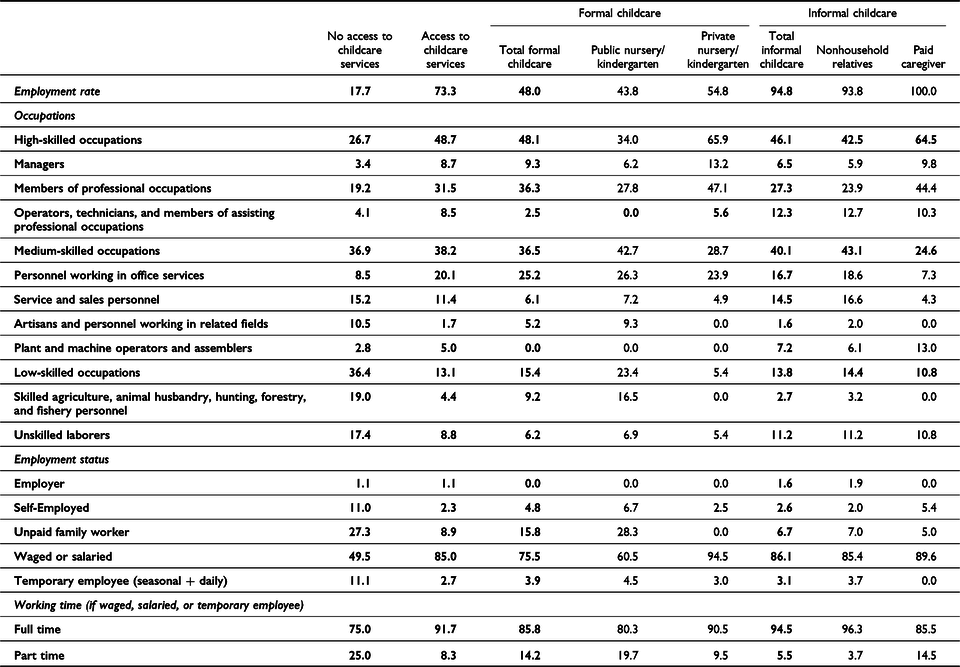
Table 4 shows the accessibility of childcare services for children aged 5 and under and women’s employment rates and employment status according to the type of care services they accessed. Footnote 22 Accordingly, the employment rate of women who do not have childcare (17.7 percent) is significantly lower than women who do (73.3 percent). This finding shows that there is a strong connection between access to childcare services and female employment.
Access to childcare services, employment rates, and employment status of women with children aged 0–5

Note: Compiled from TUS 2014–2015 household composition micro data.
Another remarkable point in the table is that almost all women (94.8 percent) who benefit from informal care are employed. As stated earlier, although access to formal care is more common, the employment rate of women who benefit from formal childcare services (48 percent) is lower than those who benefit from informal care support. This difference points to the insufficiency of formal care services in overcoming obstacles to women’s labor force participation. Public or private formal care options have also had different effects on women’s employment. The employment rate of women benefiting from private nurseries and kindergartens (54.8 percent) is higher than that of women benefiting from public nurseries and kindergartens (43.8 percent). The most important reason for this is that the duration of formal public care services provided on weekdays is not arranged to facilitate women’s labor force participation. In contrast, informal care services can be stretched out on weekdays to longer hours and can also offer services either on the weekends or full time (boarding caregiver). Supporting this finding, the average time women with a child of 0–5 years old (5.6 hours in public and 7.4 hours in private) benefits from formal services is less than the time they benefit from informal care services (nine hours) in one day. Footnote 23
However, in Turkey, Footnote 24 which has the longest working hours among OECD countries, neither public nor private childcare services meet the needs of working mothers. The World Bank’s study on the demand and supply of childcare services in Turkey shows that a very low proportion of childcare centers can meet the needs of full-time working mothers (World Bank, 2015).
Access to childcare services or the quality of support received affects women’s employment as well as their duties, responsibilities, status, and working time. According to International Labour Organization (ILO) classification, high-skilled occupations are managers, professionals, and technicians, and associate professionals whereas medium-skilled occupations are clerical support workers, services and sales workers, craft and related trades workers, and plant and machine operators. Low-skilled occupations include elementary occupations and skilled agricultural, forestry, and fishery workers (ILO, 2020). Considering the aforementioned classification, as can be seen in Table 4, a higher rate of women who receive childcare support are working in high-skilled occupations compared to women who do not receive care support (48.7 percent and 26.7 percent, respectively). A higher proportion of women who do not receive childcare support work in low-skilled occupations compared to women receiving care support (36.4 percent and 13.1 percent, respectively). These findings point to the relationship between access to childcare services and the quality of employment.
Interestingly, nearly half (47.1 percent) of women using private formal childcare services work in professional occupations. Moreover, the highest rate of women working as managers (13.2 percent) is found among women who receive care support from private nurseries and kindergartens. The high prices of private nurseries make these services accessible to women earning high income levels, such as managers and those in professional occupations, while it denies access to women with low incomes, such as agricultural workers. In addition, the extended hours in private nurseries and kindergartens enable women to work in these occupations, which usually include long working hours.
When the employment status of women with children aged 0–5 is examined, it is seen that employees at a regular waged job have the highest share of employment regardless of their access to childcare services. However, a higher proportion of women receiving childcare support work in waged or salaried jobs compared to women with no care support (85 percent and 49.5 percent, respectively). On the other hand, a higher rate of women who do not use childcare services are unpaid family workers and self-employed (27.3 percent and 11 percent, respectively) compared to women receiving care support (8.9 percent and 2.3 percent, respectively). Unpaid family workers and the self-employed are typically employed informally, work in vulnerable conditions, and earn a much lower income those in waged and salaried employment (ILO, 2020). In this sense, it is possible to say that women with no care support constitute a more vulnerable group of workers when compared to women with care support. Almost all women (94.5 percent) who benefit from private formal care services have regular waged jobs. This rate is 60.5 percent for women benefiting from public formal care services.
When evaluated in terms of working time, accessing childcare increases the rate of full-time work (from 75 percent to 91.7 percent). Part-time women workers who benefit from care services mostly benefit from public formal care services (19.7 percent). Formal public childcare services, the vast majority providing part-time services in Turkey, are not regulated from the perspective of increasing women’s employment. As can be seen from Table 4, the fact that the employment rate of women who benefit from public formal childcare services (43.8 percent) is lower than that of women who benefit from private formal childcare services (54.8 percent) and informal care services (94.8 percent) supports this situation.
In summary, the employment rate of women who benefit from childcare services (especially informal childcare) is much higher than those who do not. Also, women who have access to childcare services have a higher share in full-time, regular waged, and professional jobs. In this respect, it is possible to say that the employment status of women with access to childcare services is better than for women who do not.
Conclusion
In general, women’s responsibility in caring for dependent household members is a major obstacle to their labor force participation. As a result, women’s employment rates are lower in both developed and developing countries compared to men’s. However, the observed gender gap in the unpaid care burden and therefore in the employment rate is greater in developing countries that have a patriarchal mindset and inadequate child and elderly care and early childhood development services, such as Turkey.
According to the results of econometric analysis, the increase in the time spent by women on child and adult care decreases the likelihood of their employment. Analysis results also point out that access to formal and informal care services increases the possibility of women’s employment. However, access to childcare services in Turkey is quite low (12 percent for 0–5-year-old and 7.8 percent for 6–9-year-old children). Although formal childcare services are more widespread in Turkey than informal care services, the econometric analysis results show that informal services are more effective in increasing women’s employment. This is because formal care services, the vast majority of which are provided by public entities, have stricter limits on hours of service.
According to the descriptive analysis results, the employment rate of women who benefit from childcare services is higher than the employment rate of women who do not. Also, women who access to childcare services have a higher rate of working in full-time, regular waged, and professional jobs. A higher proportion of women who benefit from informal care services, in particular, work in full-time regular waged jobs compared to women who use formal care services.
In this sense, formal childcare services should be expanded to increase women’s employment and improve their employment status. In addition to expanding the childcare services sector, it is also important to provide care services that are easily accessible, with subsidized prices or even making them free of charge so that even the lowest socioeconomic group can benefit. Also, public childcare services need to be designed to include lower age groups and service hours need to be expanded so that women do not require another care service.
Expanding the formal childcare sector with these regulations and increasing the duration of the service not would only increase women’s labor force participation but would also serve to break the glass ceiling and improve their position in the labor market by ensuring women’s movement from part-time to full-time positions and from unskilled to skilled, professional jobs. Again, the widespread use of childcare services would address the second shift of working women.
Improving women’s employment status requires continuous efforts to tackle and eliminate the present gender gap (in particular in employment and wages) and to move away from the traditional family model based on a breadwinner father and caregiver mother to a more inclusive one in which both the father and mother can be earners and caregivers simultaneously. Footnote 25 This can only be achieved through the development of policies shaped by the concept of a welfare state that takes into account the needs of different groups.
activities included in measuring the time spent on caring for dependent child and adult

duration of childcare service received (day/hour)

Note: Compiled from TUS 2014–2015 household composition micro data.