It is well established that the more a mother talks to her child, the better the child's language will develop (Huttenlocher, Haight, Bryk, Seltzer, & Lyons, Reference Huttenlocher, Haight, Bryk, Seltzer and Lyons1991). Qualitative aspects of maternal speech such as sensitivity and self-repetition have also been found to be crucial for child language development (Baumwell, Tamis-LeMonda, & Bornstein, Reference Baumwell, Tamis-LeMonda and Bornstein1997; Hoff-Ginsberg, Reference Hoff-Ginsberg1986). Conversely, other studies suggest that children can influence the way their mother speaks to them, even in infancy (Bornstein, Tamis-LeMonda, Hahn, & Haynes, Reference Bornstein, Tamis-LeMonda, Hahn and Haynes2008; Smolak, Reference Smolak1987; Song, Spier, & Tamis-LeMonda, Reference Song, Spier and Tamis-LeMonda2014; Vernon-Feagans et al., Reference Vernon-Feagans, Pancsofar, Willoughby, Odom, Quade and Cox2008). For example, less distressed infants were found to have mothers who spoke more to them using more complex words and sentences (Vernon-Feagans et al., Reference Vernon-Feagans, Pancsofar, Willoughby, Odom, Quade and Cox2008). However, most studies to date have examined only one direction of this bidirectional association between maternal speech and child characteristics. Given the numerous methodological differences across studies, it remains unclear whether the aspects of maternal speech found to influence child language are themselves influenced by child characteristics. Yet, it is important to know whether children can influence their mother's speech in a way that is truly determinant for their own language development, or whether child influences on maternal speech have minimal consequences on later child language. Our objective was to investigate the bidirectional association between different aspects of maternal speech in infancy and child characteristics, including language.
The influence of maternal speech on child language
Several studies have examined how quantity of maternal speech influences child language. For instance, Huttenlocher et al. (Reference Huttenlocher, Haight, Bryk, Seltzer and Lyons1991) studied 22 children longitudinally between ages 1;2 and 2;2 as they engaged in daily activities with their mother. The authors found that the number of words produced by the mother when her child was 1;4 was associated with the child's growth in vocabulary size over time. This finding was later replicated with a similar study design in a larger sample of children (N = 63; Hoff & Naigles, Reference Hoff and Naigles2002). Consistent results also emerged in a large-scale study (N = 209) in which other measures of maternal speech and child language were used from 0;3 to 3;0: Duration of maternal speech was computed as children interacted with their mother during short periods of free play in a laboratory setting, and child language comprehension and production were assessed with standardised tasks (Lacroix, Pomerleau, Malcuit, Séguin, & Lamarre, Reference Lacroix, Pomerleau, Malcuit, Séguin and Lamarre2001). Results showed that duration of maternal speech at 0;6 and 1;6 was associated with later child language comprehension and production at 1;6, 2;0, 2;6, and 3;0.
Yet, there is a growing body of literature suggesting that not only quantity but also quality of maternal speech is important for child language. Formal aspects of maternal speech such as word diversity and sentence complexity were shown to be positively associated with child language (Huttenlocher, Vasilyeva, Cymerman, & Levine, Reference Huttenlocher, Vasilyeva, Cymerman and Levine2002; Huttenlocher, Waterfall, Vasilyeva, Vevea, & Hedges, Reference Huttenlocher, Waterfall, Vasilyeva, Vevea and Hedges2010). Pragmatic aspects of maternal speech, which focus on the contextual nature of speech, were also found to be important for child language (e.g., Golinkoff, Deniz Can, Soderstrom, & Hirsh-Pasek, Reference Golinkoff, Deniz Can, Soderstrom and Hirsh-Pasek2015; Hoff, Reference Hoff2006; Tamis-LeMonda, Kuchirko, & Song, Reference Tamis-LeMonda, Kuchirko and Song2014). These latter aspects of maternal speech are particularly interesting because several intervention programs targeting them are known to be effective to improve child language (Roberts & Kaiser, Reference Roberts and Kaiser2011).
Pragmatic aspects of maternal speech include sensitivity to the child's focus of attention. By talking about an object in which their child is interested, mothers can indeed facilitate their child's learning of the object's label. Tomasello and Farrar (Reference Tomasello and Farrar1986) were among the first to examine empirically such sensitivity in maternal speech in relation to child language (see also Nelson, Reference Nelson1973). Their study included 24 children aged 1;3 and their mothers as they interacted in a free-play session at home. The authors determined whether each reference to an object made by the mother followed the child's focus of attention (i.e., whether it was sensitive). They found that maternal speech that followed the child's focus of attention was associated with a larger productive vocabulary in the child as estimated by a parental questionnaire at 1;3 and 1;9. This association held only inside episodes of joint attention, that is, when both the child and the mother focused their attention on the same object.
Several other small-scale studies (Ns = 11–46) investigated the association between sensitivity in maternal speech and child language (e.g., Akhtar, Dunham, & Dunham, Reference Akhtar, Dunham and Dunham1991; Baumwell et al., Reference Baumwell, Tamis-LeMonda and Bornstein1997; McGillion et al., Reference McGillion, Herbert, Pine, Keren-Portnoy, Vihman and Matthews2013; Rollins, Reference Rollins2003; Tamis-LeMonda, Bornstein, & Baumwell, Reference Tamis-LeMonda, Bornstein and Baumwell2001). In these studies, sensitivity in maternal speech was measured between 0;9 and 1;1 during a free-play session at home or in a laboratory setting. Different aspects of maternal speech were considered as being sensitive: producing a contingent response to the child's behaviour, elaborating on an object on which the child was focusing his or her attention, directing the child's behaviour while following his or her focus of attention, and refocusing an unfocused child. Child language comprehension or production was measured between 0;9 and 2;6 with parental questionnaires or spontaneously from the free-play session; vocabulary or syntax was assessed. Similarly to Tomasello and Farrar (Reference Tomasello and Farrar1986), these studies showed that sensitivity in maternal speech was associated with later child language.
Another aspect of maternal speech that has received attention from the scientific community, although less than quantity and sensitivity, is self-repetition. By repeating themselves, and especially by repeating the same words in different utterances (e.g., Look at the keys; those are big keys), mothers could help their child isolate words in the speech stream. Hoff-Ginsberg (Reference Hoff-Ginsberg1986) studied 22 children and their mothers as they engaged in free play at home. Self-repetition, defined as the proportion of utterances that repeated a noun or a verb from the prior utterance, was measured at 2;2. It was found to be associated with growth in child productive syntax from 2;2 to 2;4 (see also Hoff-Ginsberg, Reference Hoff-Ginsberg1985).
Similar findings were also observed more recently with different measures of self-repetition in maternal speech and child language (Newman, Rowe, & Bernstein Ratner, Reference Newman, Rowe and Bernstein Ratner2016). A sample of 115 children aged 0;7 and their mothers were examined during a free-play session in a laboratory setting. Self-repetition in maternal speech was calculated by dividing the number of different words by the total number of words produced by the mother, a lower score thus corresponding to a higher proportion of self-repetition. Child productive vocabulary was assessed at 2;0 using a parental questionnaire. The authors found that more self-repetition in maternal speech at 0;7 predicted better child language at 2;0.
The influence of child characteristics on maternal speech
In parallel with the research showing that maternal speech influences child language, there is also some evidence suggesting that children could influence the way their mothers speak to them. For instance, in a large-scale study, 1,157 mothers were given a wordless picture-book and asked to interact with their seven-month-old child (Vernon-Feagans et al., Reference Vernon-Feagans, Pancsofar, Willoughby, Odom, Quade and Cox2008). Quantity of maternal speech was indexed by a factorial score that included the total amount of time spent interacting with the child and the number of different words used during that time. The child's general distress level, as measured by a parental questionnaire independently from the picture-book task, was found to predict quantity of maternal speech during the task.
Child characteristics could also influence the quality of maternal speech. Bornstein et al. (Reference Bornstein, Tamis-LeMonda, Hahn and Haynes2008) studied 40 children longitudinally at 0;10, 1;2, and 1;9 as they played at home with their mother. Children's behaviour as well as mothers’ speech were coded. At all ages, mothers were more likely to provide a sensitive (i.e., prompt, contingent, and appropriate) response if their child was bidding or looking at them than if their child was exploring, playing, or vocalising. Similarly, Smolak's (Reference Smolak1987) preliminary results (N = 8) indicated that a higher number of negative behaviours in the child at 0;10 was associated with more self-repetition in maternal speech at 1;2. Maternal self-repetition was calculated as the proportion of partial or full repetitions of the previous utterance produced during a free-play session at home or in a laboratory setting.
Another way of examining the influence of child characteristics on maternal speech is to conduct genetic analysis in twin populations (see Knopik, Neiderhiser, DeFries, & Plomin, Reference Knopik, Neiderhiser, DeFries and Plomin2016). This method has the advantage of distinguishing between child effects attributable to genetic factors and child effects confounded with environmental factors. In such analysis, monozygotic (MZ) twins, who share 100% of their genes, are compared to dizygotic (DZ) twins, who share 50% of their genes on average. If mothers speak in a more similar way to MZ twins than to DZ twins, it means that there is a genetic contribution of the twins to maternal speech. Indeed, the only difference between the two types of twins that could explain this difference in maternal speech is the higher proportion of shared genes in MZ twins. Such genetic contribution of the twins to maternal speech is an indication that maternal speech is influenced by child characteristics. Twin studies cannot inform as to which specific child characteristics are at play, however. As such, any child genetic characteristic could influence maternal speech. Such characteristics could be, for example, child temperament or social behaviour, as identified in prior studies on child effects on maternal speech (Bornstein et al., Reference Bornstein, Tamis-LeMonda, Hahn and Haynes2008; Smolak, Reference Smolak1987; Vernon-Feagans et al., Reference Vernon-Feagans, Pancsofar, Willoughby, Odom, Quade and Cox2008). Indeed, these child characteristics have been found to be associated with genetic factors in other studies (Goldsmith, Buss, & Lemery, Reference Goldsmith, Buss and Lemery1997; Robinson, Grozinger, & Whitfield, Reference Robinson, Grozinger and Whitfield2005).
The variance in maternal speech not explained by child genetic factors can be explained by child environmental factors. The extent to which mothers speak similarly to both of their twins, regardless of their type (MZ or DZ), indicates the influence of shared environment. By contrast, the extent to which mothers speak differently to both of their twins indicates the influence of unique environment and error. Although the influence of shared and unique environment is typically reported in twin studies, it has little significance in the study of parental behaviour (as opposed to the study of child behaviour). Indeed, an important contribution of child environmental factors to parental behaviour is likely to indicate an influence of parenting style, as the way parents act with their children represents an important part of these children's environment. In that sense, it does not inform much about the influence of child characteristics on parental behaviour.
DiLalla and Bishop (Reference DiLalla and Bishop1996) investigated the influence of child characteristics on maternal speech using a twin design. The study included 168 pairs of twins and their mothers. The families were examined at home when the twins were 0;7 and 0;9. At each time-point, the mothers were asked to interact with each of their twins to make them vocalise. The amount of time the mothers spent attempting to elicit vocalisations from each of their twins and acknowledging each of their twins’ vocalisations was calculated. Results of preliminary correlational analyses indicated that mothers of MZ twins spoke slightly more similarly to their twins than mothers of DZ twins (rs = .33–.70 for MZ twins and rs = .05–.65 for DZ twins). However, the authors did not use formal genetic analysis to test whether the proportion of variance in maternal speech that could be explained by genetic factors from the child was significant.
We are not aware of studies investigating the influence of child characteristics on maternal speech using formal genetic analysis. Yet, Deater-Deckard (Reference Deater-Deckard2000) performed such analysis in a study on maternal behaviour, including maternal sensitivity. In that study, 120 mothers interacted with each of their three-year-old twins during a free-play task and a structured play task at home. Maternal sensitivity was coded as the degree and immediacy with which mothers responded to their child during these tasks. The author found that mothers of MZ twins behaved more similarly with their children (r = .50) than mother of DZ twins (r = .21). Accordingly, formal genetic analyses revealed that 49% of the variance in maternal sensitivity could be explained by children's genetic characteristics. Furthermore, mothers’ behaviours were only modestly to moderately similar across their twins, regardless of their type, so unique environment and error were found to explain all the remaining variance in maternal sensitivity (51%).
The bidirectional association between maternal speech and child characteristics
In sum, prior research suggests that quantity of maternal speech as well as sensitivity and self-repetition in maternal speech influence child language development (e.g., Baumwell et al., Reference Baumwell, Tamis-LeMonda and Bornstein1997; Hoff-Ginsberg, Reference Hoff-Ginsberg1986; Huttenlocher et al., Reference Huttenlocher, Haight, Bryk, Seltzer and Lyons1991). Conversely, a few separate studies suggest that these aspects of maternal speech may be influenced by child characteristics (Bornstein et al., Reference Bornstein, Tamis-LeMonda, Hahn and Haynes2008; Smolak, Reference Smolak1987; Vernon-Feagans et al., Reference Vernon-Feagans, Pancsofar, Willoughby, Odom, Quade and Cox2008). Extant literature thus points to a bidirectional association between maternal speech and child characteristics, which would imply that child-influenced aspects of maternal speech are determinant for later child language. However, given the methodological differences across studies, it is premature to make such a conclusion. Indeed, it could be that the specific aspects of maternal speech found to be influenced by the child are distinct from the specific aspects of maternal speech found to be determinant for child language. For example, Bornstein et al. (Reference Bornstein, Tamis-LeMonda, Hahn and Haynes2008) found that between 0;10 and 1;9, children influence whether their mother responds in a “prompt”, “contingent”, and “appropriate” way to them (p. 869); however, we do not know whether this specific type of sensitive response at those ages is helpful for children's language development later on. What is needed are studies investigating both directions of the association between maternal speech and child characteristics using the same measures of maternal speech.
A few such studies have been conducted recently. For example, word diversity was examined in 47 mother–child dyads during their daily activities at home when children were 2;2, 2;6, 2;10, 3;2, 3;6, and 3;10 (Huttenlocher et al., Reference Huttenlocher, Waterfall, Vasilyeva, Vevea and Hedges2010). Results indicated that mothers’ earlier word diversity predicted their children's later word diversity and, conversely, that children's earlier word diversity predicted their mothers’ later word diversity. Similarly, word diversity was examined in 70 mothers as they interacted with their child during two free-play sessions at home (Song et al., Reference Song, Spier and Tamis-LeMonda2014). The first session occurred when children were 2;0 and the second when children were 3;0. Child language assessments included word diversity during the free-play sessions and a standardised measure of language comprehension at 3;0. Mothers’ word diversity at 2;0 was shown to be associated with their child's word diversity and language comprehension at 3;0, while children's word diversity and a measure of their cognitive development at 2;0 was shown to be associated with their mother's word diversity at 3;0. Comparable results were also found in a study investigating maternal elaboration during story-telling at 4;0 (N = 39; Schick, Melzi, & Obregón, Reference Schick, Melzi and Obregón2017). In that study, child language comprehension and production were measured with a standardised task at both 3;6 and 4;6. Child language at 3;6 predicted maternal elaboration at 4;0, which in turn predicted child language at 4;6.
Although these studies support a bidirectional association between maternal speech and child characteristics, several other aspects of maternal speech are yet to be explored, including sensitivity and self-repetition. Furthermore, these studies were all conducted in children aged 2;0 or older, so it remains unknown whether maternal speech that predicts later child language can be influenced by infant characteristics.
The present study
Our objective was to investigate the bidirectional association between different aspects of maternal speech in infancy (quantity, sensitivity, and self-repetition) and child characteristics, including language. Specifically, our first research question was whether these aspects of maternal speech in infancy influence later child language; our second research question was whether the aspects of maternal speech in infancy found to influence later child language are influenced by infant genetic characteristics. To answer our research questions, we followed a large cohort of twins and their mothers longitudinally. At 0;5, we coded maternal speech as mothers interacted with each of their twins. We also assessed twins’ language comprehension and production at 1;6, 2;6, and 5;2. This enabled us to test whether maternal speech had a longitudinal effect on child language. Studying twins also offered us a unique opportunity to estimate the influence of child genetic characteristics on maternal speech, excluding any confounded effect of the child's environment.
Method
Participants
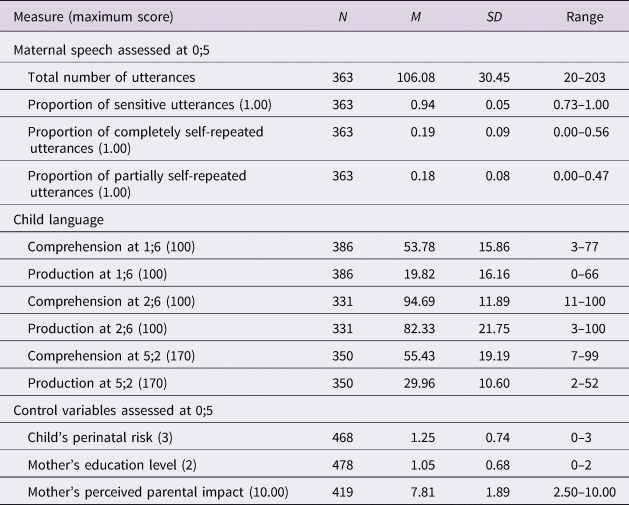
Participants came from the Quebec Newborn Twin Study. All parents of twins born in the greater Montréal area (Quebec, Canada) between 1995 and 1998 were approached to take part in that study. A sample of 662 pairs of twins and their parents were recruited and followed longitudinally (see Boivin et al., Reference Boivin, Brendgen, Dionne, Dubois, Pérusse, Robaey and Vitaro2013, for more details). In the present study, we included a random subsample of twins who completed a free-play task with their mother at 0;5 (SD = 0.76 months). For consistency purposes, we excluded twins whose mother did not speak French during the task (15%), for a final subsample of 514 twins. When their language was later assessed, the twins were 1;6 (SD = 0.81 months), 2;6 (SD = 0.78 months), and 5;2 (SD = 3.17 months). All ages included in the present study are corrected for gestation duration. Our sample included 202 monozygotic twins (44 male and 57 female pairs) and 308 dizygotic twins (39 male, 44 female, and 71 opposite-sex pairs). Zygosity was missing for four twins. The exact number of twins for each task is presented in Table 1. Missing data in maternal speech are due to the child crying during most of the free-play task (n = 13), incompleteness of the task (n = 21), or unavailability of the transcripts (n = 117).
Descriptive statistics of maternal speech, child language, and control variables

Note. N = number of twins.
Materials and procedure
Maternal speech
When the twins were 0;5, their mother completed a five-minute (M = 284.32 s, SD = 7.50 s) free-play task with each of them individually in a laboratory setting. During the task, the child was lying on a changing table and the mother was standing. The mother was asked to act as usual with her child. A basket of toys was made available to her. The task was videotaped so that maternal speech could later be coded. All coding was done manually.
First, the speech the mother produced during the free-play task was divided into utterances. Different utterances were separated by at least a one-second gap or a change in function (Bornstein et al., Reference Bornstein, Tal, Rahn, Galperín, Pêcheux, Lamour and Tamis-LeMonda1992). There were nine categories of functions: label an object, describe an object, describe an ongoing activity, establish a new activity, link an object or activity to existent knowledge, draw attention, question, give feedback, and express emotion (see Cantin, Reference Cantin2010, for more details). Function was not considered further in the present study. All irrelevant utterances (i.e., speech not addressed to the child) were excluded.
Second, each utterance was coded for sensitivity using five categories: contingent responses, that is, positive or neutral utterances following the child's activity (e.g., You love keys as the child puts keys into her mouth); restrictions, that is, negative utterances following the child's activity (e.g., Don't put the keys into your mouth as the child puts keys into her mouth); joint attention topics, that is, utterances about an activity shared between the mother and the child (e.g., Those are big keys as the child keeps playing with the keys); shifts of attention, that is, utterances directing the attention of the child to a new activity (e.g., Look at the keys as the child is playing with a rattle); and refocus, that is, utterances redirecting the attention of an unfocused child to an activity (e.g., Look at the keys as the child is crying).
The coding for sensitivity was exhaustive, such that all utterances were coded; it was also mutually exclusive, such that each utterance was coded as belonging to only one category. Following Baumwell et al. (Reference Baumwell, Tamis-LeMonda and Bornstein1997), contingent responses, joint attention topics, and refocus were considered as sensitive utterances, while restrictions were not. We also decided to consider shifts of attention as sensitive utterances but only when they happened outside an episode of supported joint attention. Indeed, considering the importance of joint attention for learning (Cleveland, Schug, & Striano, Reference Cleveland, Schug and Striano2007), we judged that creating an episode of supported joint attention when there was not already one could indicate sensitivity in the mother's behaviour. This is particularly true for young children, who might require more parental directiveness than older children (Pan, Imbens-Bailey, Winner, & Snow, Reference Pan, Imbens-Bailey, Winner and Snow1996). By contrast, creating a different episode of supported joint attention when there was already one requires the child to shift her focus without any added benefit. Thus, it was not considered as a sensitive behaviour from the mother (see also Tomasello & Farrar, Reference Tomasello and Farrar1986, for a differentiation of shifts of attention as a function of joint attention, and Shimpi & Huttenlocher, Reference Shimpi and Huttenlocher2007, for a consideration of shifts of attention as a positive behaviour under some circumstances).
An episode of supported joint attention was defined as an interaction initiated by the mother or the child in which both the mother and the child directed their attention (i.e., their look) to the same activity. For example, a mother could give a toy to her child and watch him play with it. The episode was interrupted when the mother or the child shifted their attention away from the activity for more than 3 seconds. This definition of supported joint attention was based on the definition of joint attention given by Tomasello and Farrar (Reference Tomasello and Farrar1986). However, in contrast with Tomasello and Farrar's definition, and in accordance with Adamson, Bakeman, and Deckner's (Reference Adamson, Bakeman and Deckner2004) definition of supported joint engagement, the child was not required to show signs of awareness of the episode, given that joint attention is emergent in five-month-olds (Cleveland et al., Reference Cleveland, Schug and Striano2007).
Third, each utterance was coded for the presence of self-repetition, independently from sensitivity. An utterance was considered as a self-repetition if it contained words, nonwords, or onomatopoeia from one of the two previous utterances. However, articles, pronouns (all but relative pronouns, such as qui ‘who’), and the auxiliary verbs avoir ‘have’ and être ‘be’ were not taken into account. Furthermore, to be considered a self-repetition, verbs had to be conjugated in the same tense and sound the same. For instance, Je joue ‘I play’ followed by Tu joues ‘You play’ would be considered as a self-repetition, whereas Je joue ‘I play’ followed by J'ai joué ‘I played’ or Je joue ‘I play’ followed by Nous jouons ‘We play’ would not. Finally, a self-repetition was coded as complete if it was identical to a previous utterance; otherwise, it was coded as partial (see Snow, Reference Snow1972).
Inter-rater reliability was calculated for each measure of maternal speech. The division of speech into utterances and the coding for sensitivity was done by two raters for 32 mothers (9% of the sample). The intra-class correlation was .97 for the total number of utterances and .98 for the number of sensitive utterances. For self-repetition, one of three raters coded the speech of each mother. There were no mean differences between the coders for the number of complete or partial self-repeated utterances (ps ⩾ .29).
Finally, following coding, quantity of maternal speech as well as sensitivity and self-repetition in maternal speech were computed. Quantity of maternal speech was the total number of utterances produced by the mother (e.g., Hoff & Naigles, Reference Hoff and Naigles2002). Sensitivity and self-repetition were computed as proportions (e.g., Baumwell et al., Reference Baumwell, Tamis-LeMonda and Bornstein1997; Hoff-Ginsberg, Reference Hoff-Ginsberg1986). As such, sensitivity in maternal speech was the number of sensitive utterances divided by the total number of utterances produced by the mother; complete and partial self-repetition in maternal speech was the number of completely and partially self-repeated utterances divided by the total number of utterances produced by the mother.
Child language
We assessed the twins’ vocabulary with a parental questionnaire at 1;6 and 2;6 and with a direct measure during a laboratory visit at 5;2. Both comprehension and production were assessed at each time-point, for a total of six child language measures. All measures were in French.
The parental questionnaire was inspired by the MacArthur Communicative Development Inventories, a well-validated measure of child language (Fenson et al., Reference Fenson, Dale, Reznick, Bates, Thal and Pethick1994). At the time we conducted the study, the official French-Canadian adaptation (Trudeau, Frank, & Poulin-Dubois, Reference Trudeau, Frank and Poulin-Dubois1997) was not yet available. Yet, as an indicator, this adaptation was also found to be a valid measure of child language (Boudreault, Cabirol, Trudeau, Poulin-Dubois, & Sutton, Reference Boudreault, Cabirol, Trudeau, Poulin-Dubois and Sutton2007). In the version of the questionnaire used in the present study, parents were asked to indicate, out of a list of 100, which words each of their twins could understand (comprehension) and say (production). The list of words was the same at 1;6 and 2;6. An interval of two weeks separated the completion of each of the twins’ questionnaire to minimise spurious inflation of the correlations between the twins. The total number of checked words for each of comprehension and production was used in the analyses.
The direct measure of vocabulary was the French-Canadian adaptation of the Peabody Picture Vocabulary Test (Dunn, Thériault-Whalen, & Dunn, Reference Dunn, Thériault-Whalen and Dunn1993), to which we added a production component. First, to assess production, the experimenter showed a picture and asked the participant to name it. Then, comprehension was assessed using the items previously missed. The experimenter said a word and asked the participant to show the corresponding picture out of four choices. There was a total of 170 items. For both production and comprehension, the test stopped after six errors out of eight items. A different experimenter tested each of the twins of a pair to minimise spurious inflation of the correlations between the twins. Score for production was the total number of correct answers given in the first part of the test. Score for comprehension was the total number of correct answers given in both parts of the test (i.e., the items that were produced correctly were assumed to be comprehended).
Control variables
Six variables were included as controls in answering our first research question to ensure that any association we found between maternal speech and child language was not solely due to confounds: child's age, sex, testing order, and perinatal risk, and mother's education level and perceived parental impact. Child's age and sex were included because of their well-known influence on child language (e.g., Fenson et al., Reference Fenson, Dale, Reznick, Bates, Thal and Pethick1994). Both variables were assessed as part of a self-administered sociodemographic questionnaire completed by the mother when her twins were 0;5. The twin for whom the mother completed the questionnaire first was designated as the first twin, and the other one was designated as the second twin. All subsequent measures followed this testing order. We controlled for this order given possible biases, especially for measures involving the mother (e.g., maternal speech, child's vocabulary at 1;6 and 2;6).
We included child's perinatal risk because of its established role in child language (Stanton-Chapman, Chapman, Bainbridge, & Scott, Reference Stanton-Chapman, Chapman, Bainbridge and Scott2002). A child's perinatal risk score was calculated based on three assessments: the Apgar score at 1 minute of life, standardised weight at birth corrected for gestation duration (M = 0, SD = 1), and the number of hospital days after birth. All three assessments came from medical records. An Apgar score lower than 7, a standardised weight lower than –0.50, and more than three hospital days were each given 1 point, for a total score ranging from 0 to 3, a higher score indicating greater risk.
Mother's education level was included as a control variable given its association with both maternal speech and child language (Hoff, Reference Hoff2003). It was assessed as part of a self-administered sociodemographic questionnaire completed by the mother when her twins were 0;5. No degree was scored as 0, a high school or technical degree was scored as 1, and a university degree was scored as 2.
We included mother's perceived parental impact as a control because it was found to be associated with child language (Geoffroy et al., Reference Geoffroy, Côté, Giguère, Dionne, Zelazo, Tremblay and Séguin2010). Mother's perceived parental impact was assessed with four items from the Parental Cognitions and Conduct Toward the Infant Scale (Boivin et al., Reference Boivin, Pérusse, Dionne, Saysset, Zoccolillo, Tarabulsy and Tremblay2005), a self-administered questionnaire on parenting completed by the mother for each of her twins when they were 0;5. All four items pertained to the mother's evaluation of the effect of her behaviour on the development of each of her children (e.g., “My behaviour has little effect on the personal development of my baby.”). Each item was answered on a Likert scale ranging from 0 (“Not at all what I think”) to 10 (“Exactly what I think”). Coding was reversed such that a higher score corresponded to greater perceived parental impact. We used the mean of the four items in our analyses.
Results
Preliminary analyses
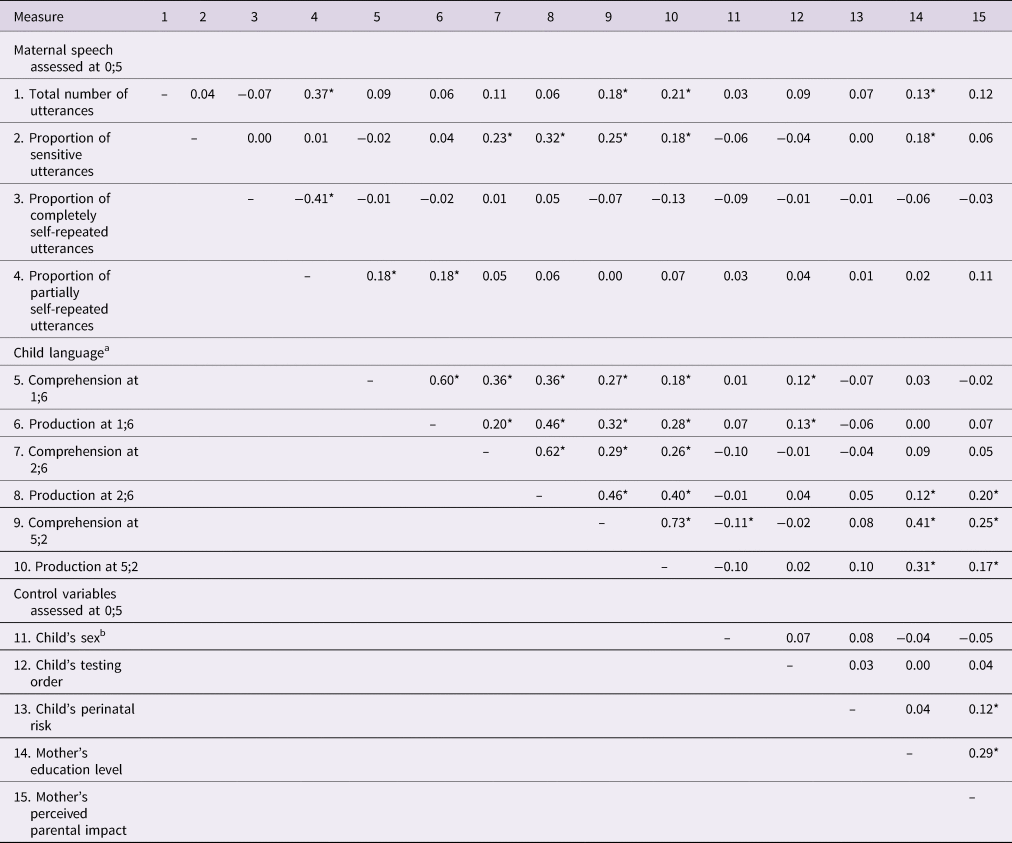
Preliminary analyses were computed in IBM SPSS Statistics 25. Descriptive statistics of the variables of maternal speech, child language, and control are presented in Table 1, and correlations between these variables are presented in Table 2. Quantity of maternal speech was associated with child language comprehension and production at 5;2, sensitivity in maternal speech with child language comprehension and production at 2;6 and 5;2, and partial self-repetition in maternal speech with child language comprehension and production at 1;6. The correlations were generally modest, ranging from .18 to .32. Since the proportion of completely self-repeated utterances and child's perinatal risk were not correlated with any of the child language measures, they were excluded from subsequent analyses.
Correlations between maternal speech, child language, and control variables

Notes. a Child language variables were regressed on age; b boys were coded as 0 and girls as 1; * p < .05.
Influence of maternal speech on child language
To determine whether maternal speech influences later child language, we performed path analyses in Mplus 7. Sensitivity in maternal speech and child language comprehension and production at 2;6 were negatively skewed. However, we used the MLR estimator, which is robust to non-normality, and the relations between our variables were generally linear, so we did not transform our data. To account for the dependency between twins from the same family, we used family as a cluster in our analyses.
We tested two separate models: one for child language comprehension and one for child language production. In each model, child language variables (vocabulary at 1;6, 2;6, and 5;2) were the dependent variables. These variables were first regressed on child's age. Then, the other control variables (child's sex, child's testing order, mother's education level, and mother's perceived parental impact) and maternal speech variables (quantity, sensitivity, and partial self-repetition) were entered into the model as independent variables. To account for the covariance between variables, correlations were included between all independent variables and between all dependent variables.
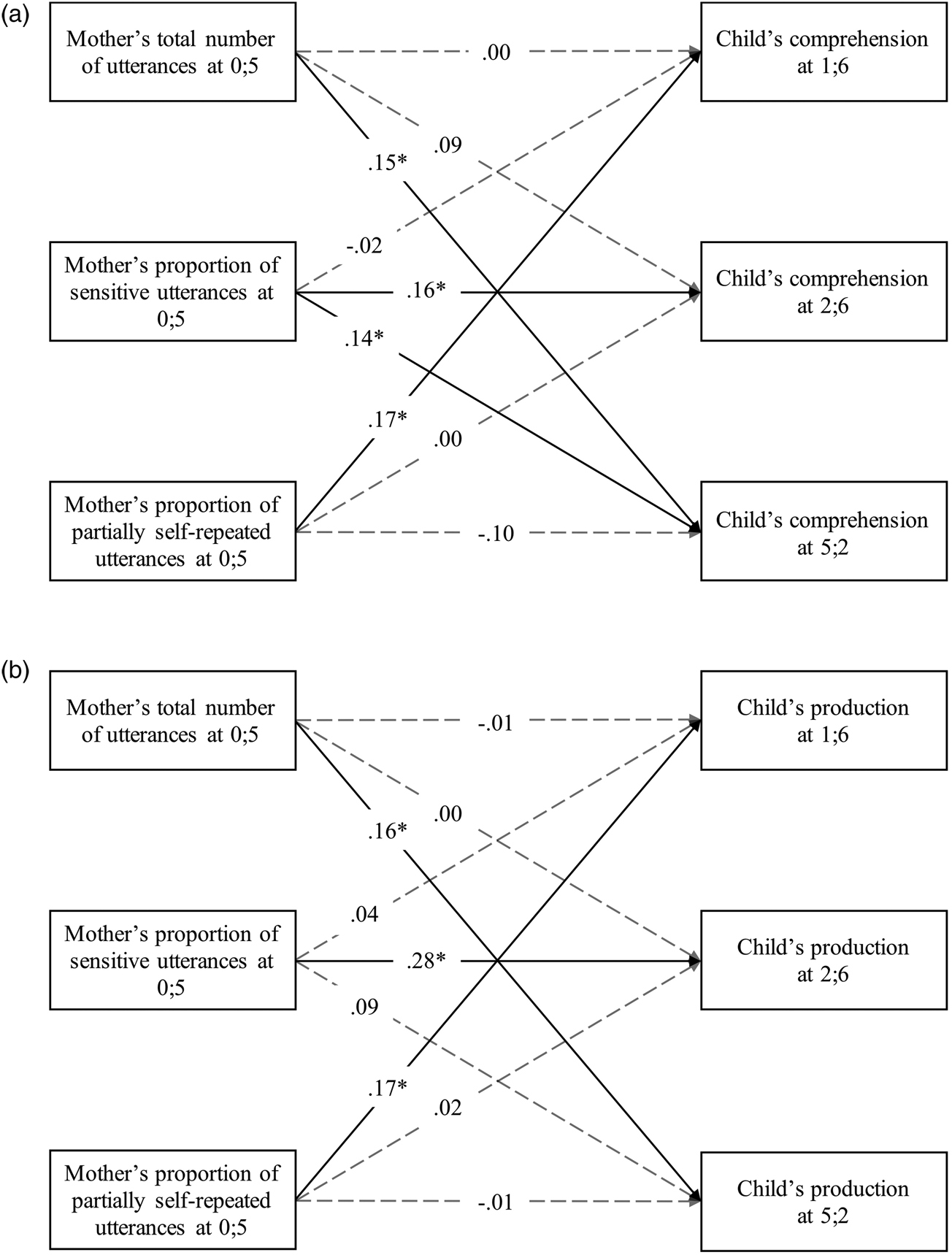
The summary of our path analyses is presented in Figure 1. Child language comprehension at 1;6 was predicted by partial self-repetition in maternal speech. At 2;6, it was predicted by sensitivity in maternal speech. Finally, child language comprehension at 5;2 was predicted by both quantity of maternal speech and sensitivity in maternal speech. The results for child language production were the same except that child language production at 5;2 was not predicted by sensitivity in maternal speech. Regarding controls, child's testing order predicted child language comprehension and production at 1;6 (ps ⩽ .001), mother's education level predicted child language comprehension and production at 5;2 (ps < .001), and mother's perceived parental impact predicted child language production at 2;6 (p = .005). Overall, the model for child language comprehension predicted 5%, 6%, and 21% of the variance at 1;6, 2;6, and 5;2, respectively; the model for child language production predicted 6%, 14%, and 13% of the variance at 1;6, 2;6, and 5;2, respectively.
Summary of the path analyses predicting child language comprehension (a) and production (b) from maternal speech. Standardised estimates are presented. Child language variables were regressed on age before being entered into the models. Additional controls of child's sex, child's testing order, mother's education level, and mother's perceived parental impact were entered. Correlations between all predictors (the maternal speech and control variables) and correlations between the child language variables were also included. * p < .05.

Influence of child characteristics on maternal speech
To determine whether maternal speech is influenced by child characteristics, we analysed our three measures of maternal speech with the ML estimator in Mplus 7 (the MLR estimator cannot be used for genetic analyses). Since sensitivity in maternal speech was negatively skewed, it was winsorised to normalise its distribution: All scores below the fifth percentile (n = 18) were replaced by the score at the fifth percentile (.85).
First, we computed intra-class correlations for MZ and DZ twins separately. Then, we computed univariate genetic analyses to estimate the proportion of variance in maternal speech that could be explained by genetic and environmental factors from the child. The results are presented in Table 3. For all three measures of maternal speech, the correlations between MZ twins were higher than the ones between DZ twins, indicating that maternal speech was more similar for MZ than DZ twins. The univariate genetic analyses revealed significant genetic contributions, indexing genetic child effects on maternal speech, for sensitivity and partial self-repetition in maternal speech but not for quantity of maternal speech. Child genetic factors explained more than a third of the variance in sensitivity and a quarter of the variance in self-repetition.
Intra-class correlations and summary of the univariate genetic models of maternal speech

Notes. ICC = intra-class correlation; MZ = monozygotic twins; DZ = dizygotic twins; A = child's genetic influence; C = child's shared environmental influence; E = child's unique environmental influence and error; Est. = unstandardised estimate; % = proportion of variance explained.
Furthermore, correlations were strong for quantity of maternal speech and partial self-repetition in maternal speech, indicating that maternal speech was similar for twins from the same family. Correlations were lower for sensitivity in maternal speech, indicating discrepancy between twins, especially among DZ twins. Accordingly, the univariate genetic analyses revealed significant shared environmental contributions for quantity of maternal speech and partial self-repetition in maternal speech but not for sensitivity in maternal speech. Child shared environmental factors explained almost three-quarters of the variance in quantity and a third of the variance in partial self-repetition. Finally, child unique environmental factors and error explained a significant proportion of variance in all three maternal speech variables.
Discussion
The objective of the present study was to investigate the bidirectional association between quantitative and qualitative aspects of maternal speech and child characteristics. First, we asked whether quantity of maternal speech as well as sensitivity and self-repetition in maternal speech influenced later child language. We found that each of these three aspects of maternal speech measured at 0;5 was associated with at least one measure of later child language. Specifically, quantity of maternal speech predicted comprehension and production at 5;2; sensitivity in maternal speech predicted comprehension and production at 2;6 and comprehension at 5;2; and partial self-repetition predicted comprehension and production at 1;6. Second, we asked whether quantity of maternal speech as well as sensitivity and self-repetition in maternal speech were influenced by infant characteristics. We found that, as early as 0;5, genetic factors from the child were associated with sensitivity and partial self-repetition in maternal speech. By contrast, quantity of maternal speech was associated to a greater extent with shared environmental factors from the child, indicating that mothers were highly similar with both their children. To our knowledge, our study is the first to show a bidirectional association between sensitivity and self-repetition in maternal speech in infancy and child characteristics, including language.
The influence of maternal speech on child language
Our finding that maternal speech influences child language is in accordance with several other studies. Indeed, many quantitative and qualitative aspects of maternal speech were shown to play a role in child language development (e.g., Golinkoff et al., Reference Golinkoff, Deniz Can, Soderstrom and Hirsh-Pasek2015; Hoff, Reference Hoff2006; Huttenlocher et al., Reference Huttenlocher, Haight, Bryk, Seltzer and Lyons1991, Reference Huttenlocher, Waterfall, Vasilyeva, Vevea and Hedges2010; Newman et al., Reference Newman, Rowe and Bernstein Ratner2016; Tamis-LeMonda et al., Reference Tamis-LeMonda, Kuchirko and Song2014). For instance, Rollins (Reference Rollins2003) found that nine-month-old infants whose mother produced more words, especially in sensitive utterances, went on developing better vocabulary comprehension at 1;0 and 1;6. By providing a language input that is abundant, rich, and adapted to their children's needs, mothers can help their children develop their language skills.
This influence of maternal speech on child language seems to be long-lasting, as we found effects from 0;5 to 5;2. One interpretation of this result is that the speech a mother addressed to her child at 0;5 had lasting effects on this child's language development until 5;2. Another interpretation is that maternal speech as we measured it at 0;5 is indicative of stable features of maternal speech, and that concurrent maternal speech is what influenced child language at 1;6, 2;6, and 5;2. This latter interpretation seems particularly plausible, given that maternal speech is relatively stable in the first years of life, as indicated by moderate to strong correlations across measures of quantity and word diversity from 0;3 to 3;0 (Lacroix et al., Reference Lacroix, Pomerleau, Malcuit, Séguin and Lamarre2001; Song et al., Reference Song, Spier and Tamis-LeMonda2014).
Another interesting finding we made was that different aspects of maternal speech were associated with child language outcomes at different ages: Self-repetition was associated with language at one, sensitivity with language at two, and quantity with language at five. Rowe (Reference Rowe2012) also found different influences of quantity and quality (i.e., diversity, sophistication, and decontextualisation) of maternal speech on child language at different ages. In her study, however, quantity of maternal speech was associated with earlier child language (2;6), and quality of maternal speech was associated with later child language (3;6 and 4;6). One explanation for this intriguing difference is that only our measure of later child language was similar to Rowe's measure (i.e., the Peabody Picture Vocabulary Test). As such, it might be that the association between quantity of maternal speech and child language is evident only when child language is measured directly and not when it is measured through parental questionnaires.
Regarding quality of maternal speech, our findings are consistent with the argument that sensitivity and partial self-repetition are important for language, particularly in early childhood. When an infant behaves with the intention to play with a toy and his mother is being sensitive to this intention by talking to him about the toy, it helps the infant learn the label of this specific toy, to which he is already devoting his attention (Tamis-LeMonda et al., Reference Tamis-LeMonda, Kuchirko and Song2014). By surrounding the toy's label by different words in different utterances (i.e., by using self-repetition), the mother can further help her child extract the label from her speech stream. Indeed, infants were shown to use surrounding speech sounds in order to learn new words (Saffran, Aslin, & Newport, Reference Saffran, Aslin and Newport1996). As the child gets older and knowledgeable of most of the words he hears, other cues in his environment (e.g., new words, more complex sentence structures) become more important to help him develop his language skills. As a case in point, Taumoepeau (Reference Taumoepeau2016) found that children's vocabulary growth from 2;0 to 4;6 could be predicted by their mothers’ use of expansion but not by their use of partial self-repetition from 1;3 to 4;6.
Aside from maternal speech, we also found that other maternal variables were associated with child language: education and perceived parental impact. The role of maternal education in child language is well known, and it can be explained, among other things, by the fact that more educated mothers use more complex language with their child than less educated mothers (Hoff, Reference Hoff2003). As for perceived parental impact, the identification of its role in child language is more novel (see also Geoffroy et al., Reference Geoffroy, Côté, Giguère, Dionne, Zelazo, Tremblay and Séguin2010, who found a correlation with vocabulary comprehension in kindergarten). Perceived parental impact has been suggested to influence child development through parental behaviours (Benasich & Brooks-Gunn, Reference Benasich and Brooks-Gunn1996). In other words, it could be that mothers who believe that they have an impact on their child's development behave in a manner that fosters their child's development, including their language development. Given that perceived parental impact explained individual differences in child language, but was not correlated with maternal speech in our study (see Table 2), the process by which it could influence child language should be given more attention in future studies.
The influence of child characteristics on maternal speech
Beyond these findings that maternal variables influence child language, our results also align with previous research showing that child characteristics influence qualitative aspects of maternal speech (Bornstein et al., Reference Bornstein, Tamis-LeMonda, Hahn and Haynes2008; Huttenlocher et al., Reference Huttenlocher, Waterfall, Vasilyeva, Vevea and Hedges2010; Smolak, Reference Smolak1987; Song et al., Reference Song, Spier and Tamis-LeMonda2014). In contrast with Vernon-Feagans et al. (Reference Vernon-Feagans, Pancsofar, Willoughby, Odom, Quade and Cox2008), however, we did not find that quantity of maternal speech was influenced by the child. This discrepancy could be due to the different methods we used to calculate quantity of maternal speech. Indeed, Vernon-Feagans et al. used a factorial score that included the duration of the interaction and the number of different words produced, whereas we counted the number of utterances produced. Using a method more similar to ours, Song et al. (Reference Song, Spier and Tamis-LeMonda2014) too did not find any effect of child language or cognitive skills on quantity of maternal speech. It is thus possible that the quantity of speech a mother addresses to her child is mostly dependent on factors specific to the mother herself, such as her parenting style or her tendency to talk a lot or little. This hypothesis is in accordance with our finding that variance in quantity of maternal speech was mostly explained by children's shared environmental factors.
Our results also extend our understanding of the association between child characteristics and maternal speech beyond what has been previously shown. Indeed, we demonstrated for the first time that child genetic characteristics influence maternal speech. This finding is important because it confirms that child effects on maternal speech do not solely reflect a cycle of environmental influences. For example, Bornstein et al. (Reference Bornstein, Tamis-LeMonda, Hahn and Haynes2008) found that mothers’ verbal sensitivity depended on their child's behaviour during an interaction. However, it could be that the child's behaviour depended on his mother's behaviour in the first place. By studying twins, we were able to demonstrate empirically that maternal speech rests on both genetic and environmental characteristics from the child.
Furthermore, we showed that children as young as 0;5 can influence their mother's speech. This finding parallels that of past studies suggesting that parenting in general is influenced by infant characteristics. For instance, Pridham, Chang, and Chiu (Reference Pridham, Chang and Chiu1994) found that child temperament predicted mothers’ parenting self-appraisal at 0;1 and 0;3. Overall, our findings combined with the prior literature suggest that infants who already fare better socially and cognitively behave in a manner that increases the quality of their mother's speech; by contrast, genetically disadvantaged infants might add to their misfortune by influencing their mothers’ speech negatively.
Given the design of our study, we cannot postulate precisely as to which characteristics of the child influence qualitative aspects of maternal speech. Yet, previous research indicates that several characteristics may be at play, such as temperament (Smolak, Reference Smolak1987), social behaviour (Bornstein et al., Reference Bornstein, Tamis-LeMonda, Hahn and Haynes2008), language skills (Huttenlocher et al., Reference Huttenlocher, Waterfall, Vasilyeva, Vevea and Hedges2010), and cognitive functions (Song et al., Reference Song, Spier and Tamis-LeMonda2014). Our more general approach probably encompasses many of these characteristics, which are all dependent on genetic factors to some extent (Dionne, Dale, Boivin, & Plomin, Reference Dionne, Dale, Boivin and Plomin2003; Goldsmith et al., Reference Goldsmith, Buss and Lemery1997; Petrill, Saudino, Wilkerson, & Plomin, Reference Petrill, Saudino, Wilkerson and Plomin2001; Robinson et al., Reference Robinson, Grozinger and Whitfield2005). However, since language comprehension and production are still very limited in five-month-olds, it is unlikely that children influenced their mother's speech with their own language in our study.
The bidirectional association between maternal speech and child characteristics
By examining both the influence of maternal speech on child language and the influence of child characteristics on maternal speech, we supported the hypothesis of a bidirectional association between qualitative aspects of maternal speech and child characteristics. In other words, we found that infants influence how much sensitivity and self-repetition their mothers use when they speak to them, which in turn influences the number of words the children can comprehend and produce later. This finding adds to the recent demonstration of a bidirectional association between other qualitative aspects of maternal speech (e.g., word diversity) and child characteristics in toddlers and preschoolers (Huttenlocher et al., Reference Huttenlocher, Waterfall, Vasilyeva, Vevea and Hedges2010; Schick et al., Reference Schick, Melzi and Obregón2017; Song et al., Reference Song, Spier and Tamis-LeMonda2014). It also extends prior studies that examined only one direction of the association between maternal speech and child characteristics (e.g., Baumwell et al., Reference Baumwell, Tamis-LeMonda and Bornstein1997; Vernon-Feagans et al., Reference Vernon-Feagans, Pancsofar, Willoughby, Odom, Quade and Cox2008) by confirming that some specific aspects of maternal speech that are influenced by child characteristics are important for child language development.
This evidence of a bidirectional association between maternal speech and child characteristics has potential practical implications. Indeed, mothers (and caregivers in general) might benefit from being made aware (a) of the influence their children can have on the speech they address to them and (b) of the influence of this speech on their children's language development. By understanding the effect that their children can have on them, mothers could adjust their speech more consciously; they might be particularly motivated to do so if they also understand the potential long-term impact of their speech on their children's development. Several intervention programs already exist to improve the language input parents offer to their children. These programs typically focus on aspects of parental speech such as quantity and sensitivity (Roberts & Kaiser, Reference Roberts and Kaiser2011). Considering our findings, it is possible that these programs could be improved by teaching parents about the benefits of partial self-repetition and about child effects on parental speech.
Limitations and conclusion
Our findings need to be considered alongside study limitations. First, we used a correlational design, which cannot confirm the direction of the associations we observed. Measuring maternal speech prior to child language and using genetic analysis on maternal speech were a first step in clarifying the direction of the associations. Yet, intervention studies aimed at improving child characteristics (e.g., cognitive functions) could further help determine the causal role of the child in maternal speech, while intervention studies aimed at improving maternal speech could further help determine the causal role of the mother in child language development (see Roberts & Kaiser, Reference Roberts and Kaiser2011).
Second, as we opted for well-established methods to measure child language at each age, the measures we used at 5;2 were different from the ones we used at 1;6 and 2;6. Using both questionnaires and direct measures of child language at all time-points would enable us to make more meaningful comparisons between ages. Furthermore, the official French-Canadian adaptation of the MacArthur Communicative Development Inventories (Trudeau et al., Reference Trudeau, Frank and Poulin-Dubois1997), which was not available at the time we conducted our study, could be used to measure child language in future studies. Indeed, with the version of the questionnaire we used, we were confronted with ceiling effects at 2;6, which reduced the likelihood of observing significant associations with maternal speech variables (although we did observe significant associations with sensitivity).
Third, given that this study is part of a larger study involving several aspects of the child's environment other than maternal speech, we assessed maternal speech only once at 0;5. A cross-lagged design with multiple measures of maternal speech and child characteristics over time (e.g., Song et al., Reference Song, Spier and Tamis-LeMonda2014) could provide an overview of the progression of these variables and help better understand how they interact as children get older.
In conclusion, our findings support a bidirectional association between maternal speech and child characteristics. Mothers who were more sensitive to their children's intentions and who repeated themselves more had children who understood and said more words later on. This sensitivity and self-repetition in mothers was partly determined by children's genetic factors. Intervention studies are needed to determine whether informing mothers of this bidirectional association could improve the quality of their speech and therefore facilitate the language development of their child.
Acknowledgements
This research was supported by grants from the Canadian Institutes of Health Research, the Social Sciences and Humanities Research Council of Canada, the Fonds de recherche du Québec – Société et culture, and the National Health Research and Development Program. We are also grateful to all families who participated in this study.