


Introduction
Centralised education vs emerging decentralised models
Governance in American education has long been characterised by tensions between local control, bureaucratic centralisation, and periodic movements towards market-orientated reform. The country has moved between local school district consolidation and expansions in federal involvement on the one hand and various choice movements as countervailing pressures on the other (Horn, Reference Horn2015; Smarick, Reference Smarick2022). Scholars have long recognised these tensions and questioned the assumptions driving centralisation. In 1991, Elinor Ostrom and Gina Davis outlined the problems with what they called the ‘centralized, bureaucratic model that overshadowed educational reform for more than fifty years’ at that time (Davis and Ostrom, Reference Davis and Ostrom1991). Over the past few decades, and especially in the wake of widespread school closures during COVID-19, these tensions have intensified as new schooling models such as microschools and hybrid schools have grown rapidly across many states. These models, which blend school-based instruction with home-based learning and rely heavily on family co-production (Alford, Reference Alford2014; Soares and Farias, Reference Soares and Farias2019; Wearne, Reference Wearne2020), do not fit neatly within existing governance categories that structure policy around districts, charters, private schools, and homeschooling. Their expansion raises fundamental questions about how authority, accountability, and decision-making are organised in contemporary education systems. These recent developments provide a useful setting in which to examine how polycentric governance arises, how it operates, and what it implies for institutional performance in the context of elementary and secondary (K–12) education.
Despite growing interest in these new school forms, the literature lacks a systematic analytical framework for comparing their governance arrangements with those of conventional schools. Polycentric governance, referring to a system in which multiple centres of decision-making authority operate with some degree of autonomy but function within an overarching set of rules and ability to make independent adjustments (Aligica and Tarko, Reference Aligica and Tarko2012; Ostrom et al., Reference Ostrom, Tiebout and Warren1961), has been central to Elinor Ostrom’s work on governance but has not been rigorously assessed in education policy discussions. The Institutional Analysis and Development (IAD) framework, which Elinor Ostrom (Reference Ostrom and Sabatier1999) designed in part to analyse polycentric arrangements, has been productively applied to natural resource commons, infrastructure, and metropolitan governance but has seen almost no application in elementary and secondary (K–12) education.
The question this paper asks is: What are the drivers of polycentric governance in American education? And more specifically: How do the institutional arrangements governing hybrid schools differ from those governing conventional public schools, and what do these differences reveal about the emergence of polycentric governance in American education? (‘Institutional arrangements” and governance arrangements’, in this paper mean the combination of physical conditions, actor relationships, rule systems, and accountability mechanisms that the IAD framework identifies as shaping governance outcomes). The paper explores this by applying Elinor Ostrom’s IAD framework to compare governance arrangements in conventional public schools with those found in hybrid schools. The comparison shows that hybrid schools exhibit characteristics of polycentric governance (multiple decision centres, overlapping authority, lower entry costs, and more direct family feedback) that conventional public schools largely do not and generates five propositions about how these institutional differences shape governance outcomes.
This paper makes three contributions to current debates in education policy. First, it introduces the IAD framework as a systematic tool for examining governance arrangements in schooling, extending its use beyond the natural resource and public administration domains where it is more commonly applied. The IAD allows comparison of governance arrangements that existing categorical analyses (district schools vs. charter schools vs. private schools – that is, analyses that classify schools by legal category rather than by their underlying governance arrangements) cannot accurately capture. Second, by comparing conventional public schools with the rapidly growing sector of hybrid schools, the paper identifies how emerging organisational forms redistribute decision-making authority, create alternative accountability relationships, and reconfigure the policy instruments available to state and district governments. The comparison reveals specific institutional mechanisms (co-production, regulatory pathway choice, and exit availability) that existing literature treats separately. Third, the analysis situates hybrid schools within broader policy discussions about decentralisation, school choice, and the diversification of educational provision. This comparative analysis generates a set of propositions about how polycentric governance operates in education; propositions that connect to broader debates about decentralisation and school choice and that future empirical work can test. The Schools as Institutions section of this paper will discuss the history of education policy from the 20th century to major reform efforts and developments in the 21st. The IAD section of this paper will discuss the IAD framework in relation to education policy and will provide an example of its use in the context of the conventional American public school model and an example of a hybrid school. The Economic Implications section of this paper discusses potential economic policy implications, and the final section provides suggestions for future research and a conclusion.
Schools as institutions
Theoretical framing
This paper is framed around three connected ideas: education as an institutional commons, institutional isomorphism in education, and the case for applying the IAD.
Schools as commons
First, schooling can, in some cases, be considered and analysed as an institutional common. While most hybrid schools are private, some are indirectly publicly funded through policies such as education savings accounts (ESAs) or tuition tax credit programmes. Whatever the funding source, these schools tend to be locally governed (as opposed to being a division of, and governed by, a local school district). Schooling can be viewed as a club good or as a common-pool resource when publicly funded but locally governed (Buchanan, Reference Buchanan1965). Schools are excludable (access is restricted by geography, admissions, or capacity) but rival in consumption, since shared resources such as teacher attention and per-pupil funding diminish as enrolment grows. The IAD framework clarifies how overlapping rules structure their governance dilemmas, as in other analyses of other club goods and local governments.
Paniagua and Rayamajhee (Reference Paniagua and Rayamajhee2022) specifically address the idea of applying the ideas of polycentric governance in new issue areas. Alongside governance models in other areas, several authors have begun to note K–12 education as a form of new commons (Hess, Reference Hess2008; Frischmann, Reference Frischmann, Lehr and Pupillo2009). Gyuris (Reference Gyuris2014) most specifically suggests that K–12 education may be seen as a kind of new commons and that the IAD is ‘a reasonable framework for the investigation of basic education’. Most particularly relevant to this study, Gyuris also describes an example of centralised governance of education and the way one country (Hungary) moved in a somewhat more decentralised direction over the course of the 20th century. U.S. education was also centralised (increasingly so) over the course of much of the 20th century but then began to decentralise in recent decades, as described below.
Institutional isomorphism
A substantial literature has examined why educational institutions tend towards similarity over time and under what conditions they diversify. Scott and Meyer (Reference Scott, Meyer, DiMaggio and Powell1991) argue that organisations in a given sector tend to converge through three mechanisms: legal and regulatory coercion, mimicry of perceived success, and shared professional networks and training. Tyack and Tobin (Reference Tyack and Tobin1994) describe a similarly persistent ‘grammar of schooling’: the age-graded classroom, the credit hour, the standardised assessment, and the state-credentialed teacher that has resisted reform efforts across more than a century of American education policy. Rowan (Reference Rowan and Meyer2006) sharpens this analysis by identifying the conditions under which isomorphism prevails versus when diversification occurs: when institutional environments are centralised and uniform and information about quality is scarce, isomorphism dominates; when environments are fragmented, market locations are heterogeneous, and information is available, producers form distinctive strategic groups and consumers make discriminating choices. Burke (Reference Burke2016, Reference Burke2023) extends this to the school choice context specifically, arguing that even ostensibly market-based reforms such as charter schools and teacher preparation programmes have themselves shown isomorphic tendencies. Berends (Reference Berends2015), reviewing two decades of charter school research, frames these dynamics in terms of institutional change: charter schools represent both a market response to dissatisfaction with conventional schooling and a change in the social organisation of schooling itself. Why and under what conditions new school forms might escape the isomorphic pressures the prior literature documents is a question this paper addresses by examining hybrid schools as a potential counterexample.
The case for the IAD
Rowan (Reference Rowan and Meyer2006) argues that institutional analyses of schools should look beyond governance alone but also include explorations of market exchanges as well. School systems often have multi-million-dollar contracts with vendors (textbook publishers, for example). In some cases, for-profit entities (such as charter school management organisations) may contract to run public schools. The IAD can capture both governance hierarchies and market-like interactions within a single analytical structure.
The empirical literature on school choice has examined achievement effects (Angrist et al., Reference Angrist, Pathak and Walters2013; Hanushek and Woessmann, Reference Hanushek and Woessmann2015), enrolment dynamics (Musaddiq et al., Reference Musaddiq, Stange, Bacher-Hicks and Goodman2022), and parental choice behaviour (Hastings and Weinstein, Reference Hastings and Weinstein2008), but these and similar analyses have focused on outcomes rather than on the institutional governance structures that shape those outcomes. The IAD framework offers tools for analysing the institutional features that the empirical literature has not directly engaged with.
Ostrom herself occasionally wrote about schools specifically. Davis and Ostrom (Reference Davis and Ostrom1991), for example, create a theoretical framework that explores the potential benefits and drawbacks of various possible policy arrangements, some of which have been tried in the years since that paper’s publication. Davis and Ostrom note some negative externalities that have been generated by centralised schooling (less innovation, higher compliance burdens, and reduced local governance). Wearne (Reference Wearne2025) has situated some of these recent developments along the lines Davis and Ostrom describe as well as some of the ways local communities can cooperate along lines envisioned by them to create positive externalities (co-production of social capital, local experimentation in schooling, and lower barriers to entry). The IAD framework has the ability to address the common nature of both conventional schooling and hybrid school models and also to clarify why conventional schools tend to have institutional isomorphism while hybrids do not.
Historical context
Centralisation movements
The scale and scope of centralisation in American schooling will be discussed below. Here it is worth describing schools’ historic inability to evolve due to their centralised governance structures. Aligica and Boettke (Reference Aligica and Boettke2009) write, contra central planning in general, that ‘what is needed is a set of institutions that allows individuals to act purposefully and make adjustments to the unintended consequences of those actions’ (p. 102). Centralised governance has shaped American schooling for over a century, beginning with school district consolidation.
School district consolidation
Conventional public schools are ‘locally’ governed in the sense that they are led by local public school boards, overseeing school districts of one or more schools. The number of school districts has decreased over time, leading to fewer boards overseeing larger districts. In 1920, 270,000 public school districts existed in the United States, serving fewer than 22 million students. By 2022, the number of districts had dropped to fewer than 13,500 while serving nearly 50 million students (Smarick, Reference Smarick2022). Davis and Ostrom (Reference Davis and Ostrom1991) starkly criticise these developments as based on faulty assumptions. The reasons for school district consolidations have been many: professionalising education (through more standardised teacher credentialing, for example), enabling economies of scale, streamlining the allocation and use of resources, among others. While there has been contention over time as to whether this consolidation saved money or improved student outcomes (ibid.), it is something Ostrom herself lamented. At the beginning of the No Child Left Behind era (discussed below), she wrote that, ‘considerable research…has provided contrary evidence to the implicit theory used by policy makers to support the school consolidation movement’ (Ostrom, Reference Ostrom2002). This research included improved test scores, higher educational attainment and local wages, and lower costs in decentralised systems, and Ostrom spoke hopefully about choice-based reforms which were just then becoming more popular (also discussed below).
Federal involvement and expansion
As the number of local school districts shrank over the course of the 20th century, top-down control from the states and the federal government grew. Federal involvement became much more entrenched with the passage of the Elementary and Secondary Education Act (ESEA) in 1965. The Act mostly operates through increased federal funding directed at low-income schools. The No Child Left Behind Act of 2001 was the reauthorisation of ESEA, rebranded and with new conditions. The concept of the bipartisan No Child Left Behind Act was simple: schools would receive increased federal funding and in exchange would be required to administer tests (chosen by the states) to students, and the results would be made public. The Every Student Succeeds Act (ESSA), the more recent authorisation of the law, did draw back from some of NCLB’s federal mandates and towards state-level control but cannot be said to be a move towards truly ‘local’ control of education.
As support for NCLB was declining, another top-down, but not technically federal, concept was gaining traction. The Common Core State Standards (CCSS), formally announced in 2008, were intended to ‘…provide a consistent, clear understanding of what students are expected to learn’, so that they would be ‘prepared for college and career success’ (CoreStandards.org, 2025). Rather than using federal mandates, as NCLB did, states would voluntarily adopt the CCSS and adapt their local curricula and tests to them. (States were not federally required to adopt the CCSS, but they were functionally forced to do so as adoption was a requirement to become eligible for the Race to the Top funding competition, a part of the federal recovery programme enacted following the 2008 financial crisis).
Decentralisation movements
School consolidation and federal regulation/encouragement are clearly top-down reform efforts, and school choice is more like a bottom-up effort. These efforts have contended with each other in the first quarter of the 21st century. Even as the number of schools and school systems was declining and federal involvement increasing, there were some moves to decentralise schooling in the later part of the 20th century. The first charter school laws were passed in the early 1990s. Somewhat ironically, Davis and Ostrom published their paper in (Reference Davis and Ostrom1991), describing the value in decentralised education systems, just as the concept of school choice was gaining practical momentum.
Charter schools, private school choice, homeschooling, and community crafted education
As federal requirements and federal encouragement grew, various forms of school choice were growing at the same time. The charter school sector grew to serve approximately 7 percent of U.S. students in 2023 (National Center for Education Statistics, 2023). Tuition tax credit and ESA programmes arose in the states to provide public funding for private choice. In 1996, around 10,000 students in parts of three states were participating in ESA, tax credit, or voucher programmes. As of 2025, more than 1.5 million students in 34 states were participating in 75 programmes (EdChoice, 2025). Homeschooling grew to reach 6 percent of U.S. children during the same period (Smith and Watson, Reference Smith and Watson2024). Built mostly on the various state homeschool laws, another form of unconventional schooling – community-crafted education – also began to grow as a sector. Some amount of the massive growth in homeschooling data consists of students participating in community-crafted hybrid or micro-schools.
‘Community crafted education’ encompasses various forms of microschools and hybrid schools (Wearne, Reference Wearne2024). While definitions vary, microschools are, simply, very small schools (Annable and Baxter, Reference Annable and Baxter2021; Tarnowski, Reference Tarnowski2022). Hybrid schools, in which students meet in brick-and-mortar buildings part of the week and are homeschooled the rest of the week, have also begun to grow as a sector (Wearne and Thompson, Reference Wearne and Thompson2025). These models first began to receive some noticeable attention in the 2000s (Horn, Reference Horn2015), but in practice some of these schools have been in existence since at least the early 1990s (Wearne and Thompson, Reference Wearne and Thompson2025). While it is difficult to track due to data limitations, some number of the student increase in homeschooling includes students in these schooling arrangements who are technically registered as homeschoolers. An increase in the social acceptability of homeschooling, improvements in technology, and a growing ecosystem of support (publishers, curriculum providers, etc.) helped spur a growth in varieties of community-crafted education during the 2010s (Wearne, Reference Wearne2020).
COVID-19
In March 2020, every school in the country was forced to close (Education Week, 2020). Most students were required to do some amount of online learning over the next year or more, and families were often not satisfied with the implementation or the results (Goulas and Pula, Reference Goulas and Pula2024). Some schools remained closed for significant periods, not reopening until fall of 2021, and some closed again in 2022 (Motter, Reference Motter2022). According to many, the pandemic ‘…caused an unprecedented shift away from the public education sector…’ (Musaddiq et al., Reference Musaddiq, Stange, Bacher-Hicks and Goodman2022 p. 11). Some students simply stopped doing school in any form – in person or online (Blume and Kohli, Reference Blume and Kohli2020). Community-crafted schools fared differently through COVID. Many hybrid schools report far less disruption during the COVID year(s) than their neighbouring conventional schools and note that their structure made them well-prepared to navigate COVID (Wearne, Reference Wearne2021). Many microschools started explicitly as responses by dissatisfied parents and teachers (Horn, Reference Horn2021), and since 2020, homeschooling and community-crafted education have seen significant growth. As of 2023, after hitting a peak amid COVID closures of over 11 percent in 2021, approximately 6 percent of American students were still noted as being engaged in some form of homeschooling in the U.S. (Smith and Watson, Reference Smith and Watson2024). Many of these students were fully homeschooled, but a number of them were certainly in microschools or hybrid schools but registered with their states as ‘homeschoolers’. Entrepreneurs tend to respond to provide services during pandemics (Storr et al, Reference Storr, Haeffele, Lofthouse and Hobson2022). Locally-focused entrepreneurs may be especially able to do so (Behr and Storr, Reference Behr and Storr2022), and this seems to be what occurred (and continues to occur) in the education sector in response to COVID.
The modern trajectory then was one of increased consolidation and centralisation from the early through the late 20th century, with some movement towards decentralisation beginning in the 1990s (or a bit earlier, if full-time homeschooling is considered). Built on the bases of homeschooling and charter schools, this decentralisation grew during the 2010s and took off in popularity following the onset of COVID-19. COVID lowered barriers to exit and fostered conditions for institutional innovation. This trajectory, from consolidation through federal centralisation to emerging decentralisation, has created an institutional landscape characterised by overlapping and sometimes competing rule systems rather than strict market or government control. The IAD framework provides the analytical tools to map these arrangements systematically.
School choice and institutional economics
The emergence of community-crafted schools as a distinct sector and of school choice in general suggests some inherent and growing decentralisation in American schooling. But decentralisation and polycentricity (as described above) are not quite the same thing. Polycentricity implies overlapping authority, not simply devolution of authority. In one of the few pieces to examine K–12 education in light of Ostrom’s work on this point, Strong (Reference Strong2020) argues that despite having some polycentric aspects (such as district-level governance), American K–12 education is still quite centralised in practice. Strong argues that, ‘A key advantage of polycentric systems is that they allow institutions to evolve according to different values and objectives and thus allow for the emergence of new institutions that attract those whose needs are more fully met by the newer institutions’ (p. 235). In spite of America’s system of district-focused schools, Strong argues that for a variety of reasons, the American K–12 structure as a whole is not polycentric in practice and does not allow these new institutions to emerge. The basic structure of schooling, for example, requires, among other aspects: age-graded schools, seat time requirements, standards for awarding credit of some kind, and an expectation of credentialed teachers and standardised assessments in some form. Strong suggests that these kinds of requirements and expectations are so ingrained, they hinder the creation of schools that could provide, for example: “(1) distinctive virtue cultures, (2) learning systems optimized for autodidacticism, and (3) radical variation in the time, pacing, or style of learning” (p. 236).
A question one might ask to counter Strong’s argument might be: ‘Under what feasible rule reforms could the conventional sector become meaningfully polycentric without the emergence of these new school models?’ One response is that American schooling’s recent history shows an ongoing inertia towards centralisation, even as communities show demand for decentralisation. This system will not accept such rule changes. In other words, Strong’s argument has proved extremely well-founded in practice – conventional American schools simply do tend to converge on many aspects. But Strong’s three items (forming distinctive virtue cultures, new forms of learning systems tailored to individual study, and variations in time and space use) are just the sorts of issues that the recent growth in homeschooling and especially the community-crafted education movement have emerged to address. These developments are also consistent with Rowan’s (Reference Rowan and Meyer2006) discussion of the reasons for convergence. Rowan writes, ‘…the more centralized and uniform are the institutional environments in which markets arise, and the less information about performance is available to consumers and managers, the more the market system will be characterized by isomorphism (other things being equal)’ (p. 29). This is a clear depiction of conventional American schooling. Rowan goes on to note that the more information is available about institution quality, ‘the more producers will form into distinctive strategic groups, consumers will make discriminating market choices, and diversification in form and outcomes will occur’ (p. 29). This is, in fact, what seems to be happening in the community-crafted education sector. With new actors coming to be involved in American K–12 schooling, new policy arrangements, and new expectations about evaluation and accountability, differences are becoming more apparent in how these new school models operate compared to conventional school models. Wearne (Reference Wearne2025) has discussed this evolution in light of the arguments made by Davis and Ostrom and Strong. Looking at the governance models of these new school models based on the aspects of polycentricity noted above (multiple decision centres, overlapping jurisdictions, some degree of autonomy, and the ability to make adjustments) enables an evaluation of whether these models are examples of a polycentric turn in education. Strong argues the conventional system is not polycentric; the emergence of hybrid schools may be changing this. The following sections test that proposition using the IAD.
The IAD
Overview of the institutional analysis and development framework
The IAD framework has been used to analyse fields as varied as electricity regulation (Kiesling, Reference Kiesling2025), data infrastructure policy (Filgueiras and Silva, Reference Filgueiras and Silva2022), and the selection of Paralympic athletes (Wattie et al., Reference Wattie, Dehghansai and Wagg2022). The following sections will apply the IAD framework to both conventional public schooling and one form of community-crafted education: hybrid schools. In the case of this paper, applying the IAD means mapping the components for each school type and using the structural comparison to identify where institutional arrangements diverge and what those divergences imply for governance outcomes.
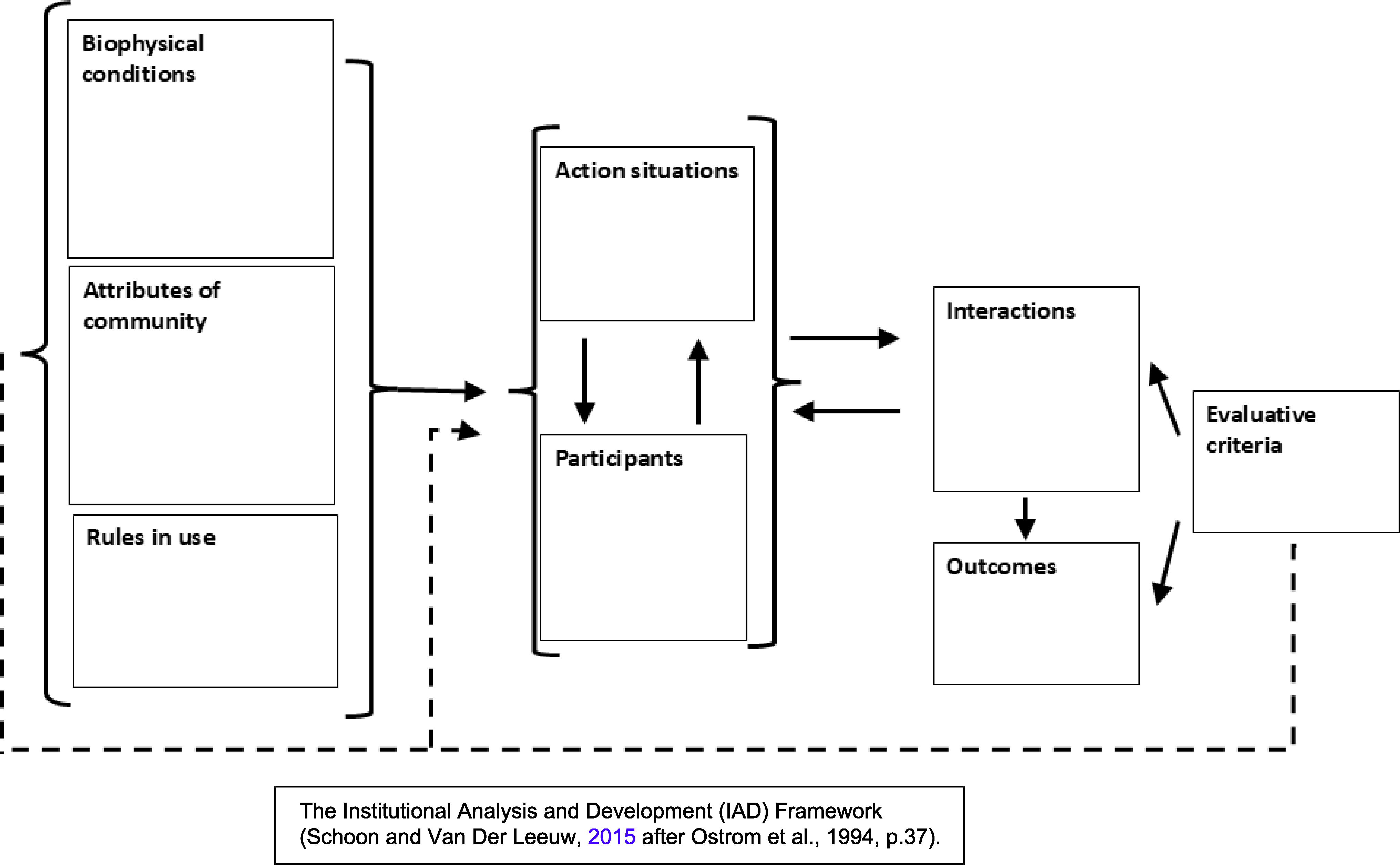
The IAD framework is a tool used to analyse the various aspects of different institutions and how groups can self-organise to solve collective action problems and manage common resources (Ostrom, Reference Ostrom2005). The IAD framework consists of a set of components involved in a group’s decision-making processes and results in a conceptual map describing the interactions and outcomes of the various components (McGinnis, Reference McGinnis2011). As described by Kiesling (Reference Kiesling2025, p. 538), those components include:
-
1. Physical Conditions: The physical characteristics of the system;
-
2. Community Attributes: The socioeconomic characteristics of the individuals involved, their cultural norms, and their mental models or shared understanding of the situation.
-
3. Rules in Use: The formal and informal rules that govern the behaviour of individuals within the action situation, including operational rules, collective-choice rules, and constitutional rules.
-
4. Action Situation: The core of the framework, where individuals interact, make decisions, and take actions based on the incentives and constraints imposed by the other components.
-
5. Interactions, Outcomes, and Evaluation: These are the patterns of interactions and the resulting outcomes, which can be evaluated in terms of various criteria specific to the circumstances.
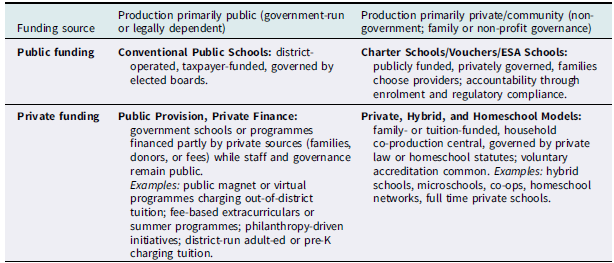
Before applying the IAD to conventional and hybrid schools, it is useful to situate schooling arrangements within a broader institutional space. Table 1 maps American schooling by its funding source and production authority, illustrating that few real-world systems are purely ‘public’ or purely ‘private’. The majority occupy the mixed cells, combining public finance with private governance, or public governance with partial private finance. This view reframes the education system not as a binary between markets and governments, but as a polycentric public economy governed by overlapping rules-in-use.
Funding sources and production authority in American schooling

Table 1. Long description
A table with two columns and five rows, detailing funding sources and production authority in American schooling. The columns are labeled ‘Funding source’ and ‘Production primarily private/community (non-government; family or non-profit governance)’. The rows are labeled ‘Public’, ‘Charter’, ‘Private’, ‘Private’, and ‘Private, Hybrid, and Homeschool Models’. The table lists different types of schools and their funding sources, including public funding, charter schools, private funding, and hybrid models. Each row provides specific details about the governance and funding of these schools.
This institutional complexity is the kind of setting for which Ostrom developed the IAD framework. Figure 1 provides a visual representation of the IAD framework, showing the relationships and directions of feedback and potential conflict.
IAD framework.

Comparative IAD analysis
The following section will present an analysis of the conventional school model compared to a typical hybrid school using the IAD framework.
Even given the evolution toward more decentralisation, approximately three quarters of American students still attend their zoned public school (Ritter, Reference Ritter2025). According to a 2025 RAND report, estimates suggest that between 750,000 and 2 million US students are enrolled in some form of microschools, of which hybrid schools are one type (Ohls et al., Reference Ohls, Covelli and Schweig2025). This would represent between 1.5 and 4 percent of US students, a number that the report notes is slightly larger than the number of U.S. students in K–12 Catholic schools.
In practice, the form of a hybrid school is often defined as a school in which:
-
1. Most or all of the curriculum is determined by the school, though parents may do varying amounts of instruction and grading; and
-
2. Students attend live classes fewer than five days per week in a physical building and are homeschooled the rest of the week (Wearne and Thompson, Reference Wearne and Thompson2025).
Typically, these schools meet either two or three days per week in typical classroom settings and with teachers, often uniforms, and so forth. The other days the students participate in some form of homeschooling. The students often (though not always) register with their state as homeschoolers. They may operate under this model as private schools, as groups of homeschoolers, as charter schools, or as programmes created by conventional public school systems. In practice, most are private entities, and their nature as “schools” or as homeschool settings is determined both by the state they are located in and the cultural decision by the school to operate as one or the other. Private hybrid school tuitions are typically lower than the tuitions at conventional private schools (due to employing mostly part-time teachers and renting space part-time), limiting their total funding.
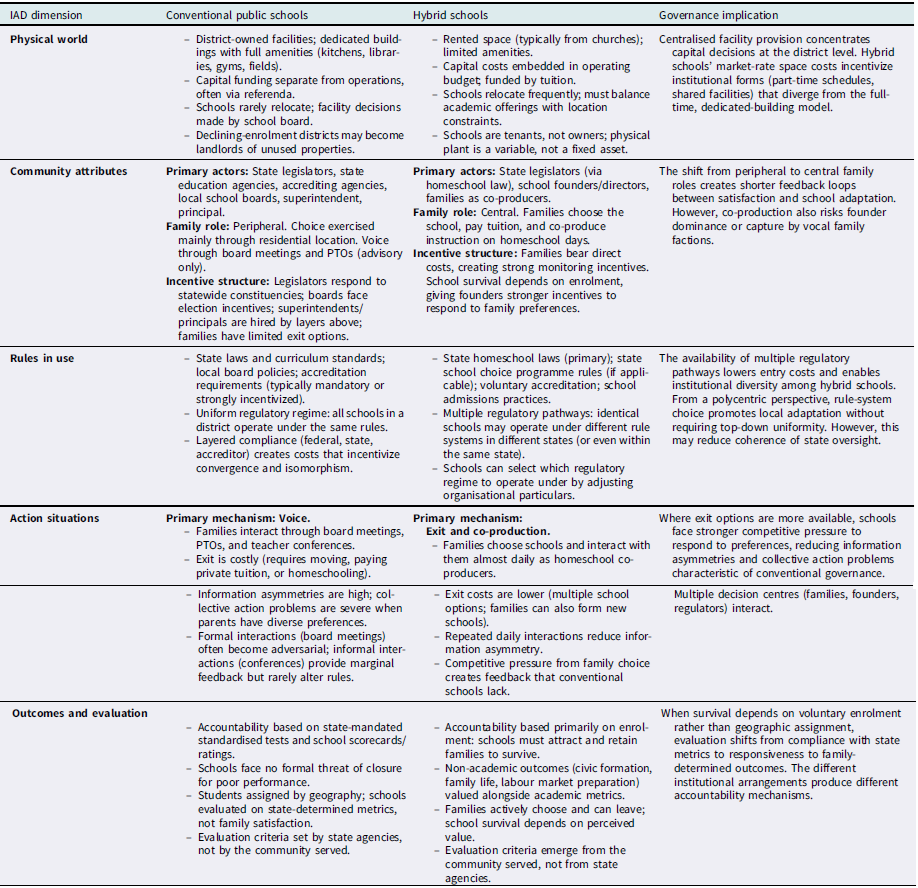
Table 2 summarises the comparative analysis across all five IAD dimensions; the following subsections develop the institutional logic and propositions for each.
Comparative IAD analysis: conventional public schools vs. Hybrid schools

Table 2. Long description
A table comparing conventional public schools and hybrid schools across various dimensions. The table has five rows and three columns. The columns are labeled ‘Conventional public schools’, ‘Hybrid schools’, and ‘Governance implication’. The rows are labeled ‘Physical world’, ‘Community attributes’, ‘Rules in use’, ‘Action situations’, and ‘Outcomes and evaluation’. Each cell contains detailed descriptions of the respective categories. For example, under ‘Physical world’, conventional public schools have district-owned facilities with full amenities, while hybrid schools rent space with limited amenities. The ‘Governance implication’ column discusses the centralized facility provision for conventional schools and the market-rate space costs for hybrid schools. Similar detailed comparisons are provided for community attributes, rules in use, action situations, and outcomes and evaluation.
While hybrid schools do appear to have more polycentric governance by nature, polycentric features also do exist within conventional public school systems. Districts vary across states. Within districts, individual schools have varying degrees of autonomy. Magnet schools, school-within-a-school programmes, and intra-district choice create some polycentric elements. Conventional schools also adapt (perhaps slowly, but potentially meaningfully) through board elections, principal turnover, and parent advocacy. The following comparisons focus on institutional mechanisms rather than relative quality.
Physical world
Conventional schools usually serve many more students (often thousands more) than hybrid schools. Physical amenities are often a selling point for these schools, including athletic and fine arts facilities and technology infrastructure, and these amenities are typically paid for through multi-million-dollar referenda or capital campaigns.
On the days they meet in person, a typical hybrid school might look superficially much like a conventional public school in many ways. Their institutional operations, however, are quite different. Hybrid schools often have to move from one rented space to another and carry their capital costs in their operating budgets.
The fact that conventional school capital decisions are made by boards through referenda concentrates authority at the district level. Individual schools have little autonomy over their physical environment. By contrast, hybrid schools’ dependence on market-rate rental space shapes their physical form. Part-time in-person schedules are a pedagogical choice but also an institutional response to a different cost structure.
Community attributes
In a conventional school setting, state legislators and agencies dominate, often directing local board decisions in practice through funding mechanisms. As conventional schools are typically comprehensive and must serve larger communities, they become, in many ways, less diverse from each other. Families can exercise voice through voting, through moving, or through some indirect local entities (parent–teacher organisations, for example).
Some of the same actors matter for community-crafted schools, but they matter in different ways. State education agencies, state legislators, and, in some areas, local school systems matter, mostly as they are tasked with overseeing state homeschool laws. Many of these schools are unaccredited. Family decisions matter much more in these schools in that the schools must be chosen by the families and in that many of them require substantial parent involvement once students are enrolled, especially in the case of hybrid schools, in which students are ‘homeschooled’ during some portion of the week.
The relative powers of the actors in conventional schools dilute parent voice and can lead to bureaucratic capture, along with a collective action problem in which diffuse stakeholders (various parents, with different needs and desires) struggle against entrenched interests. This institutional arrangement predicts that hybrid schools will likely be less susceptible to bureaucratic capture (families have much easier exit options), and so families gain prominence as co-producers, shifting power from various agencies to consumers. These schools may, however, be more susceptible to domination by individual founders, or, from the other direction, they may be more dominated by individual families’ preferences or by donors.
Rules in use
The actions of state education agencies, of state legislators, and of accrediting agencies, of course, drive the policies in individual conventional public schools, but in practice the ways they follow these rules are determined by actions of the local board and of their superintendent and local principal.
Rules around hybrid schools vary widely across states. Identical-looking hybrid schools may operate under very different arrangements in different states; in one state, the school may be considered a private school. In another, it may be required to operate as a collection of homeschoolers.
These layered rules for conventional schools (state laws, rules, and accreditation) create compliance costs, incentivising isomorphism as schools standardise to avoid sanctions or respond to incentives (such as adopting uniform curricula under Common Core, typically to gain access to more federal funding). In polycentric terms, this arrangement can stifle institutional diversity. In most cases, however, a potential hybrid school can select which system of rules it wants to fall under by adjusting the particulars of its model. Therefore, in most states the rules lower entry costs for providers, incentivising niche adaptations. From a polycentric governance perspective, this ability to choose which rule system to fall under promotes diversity by letting local rules evolve without top-down uniformity.
Action situations
To the extent conventional public schools remain the dominant model for assigning students to schools, and choice is limited to families wealthy enough to pay private tuitions or to choose the most-desirable public schools (by moving into those attendance zones), interactions will remain limited to school board and parent teacher organisation meetings and personal interactions with teachers and school administrators.
The action arena for the hybrid school includes participants with different roles, motivations, and relative strengths, compared to conventional schools. In this action arena, there are multiple actors and action situations taking place as well: parents, both making choices about their students’ schools and serving as homeschool parents for part of the week; the schools themselves and their boards/leadership, making admissions and curriculum decisions; the school director/principal, with much more control over the direction of the school; accreditors, if chosen or required, from a higher-level perspective; and state legislators, typically in the form of the state’s homeschool laws.
Formal interactions in conventional schools, like board meetings, often become adversarial games where parents (with limited exit options) resort to costly voice strategies, yielding minimal change due to information asymmetries (e.g., a community challenging curriculum via petitions, only to face delays from bureaucratic inertia). Informal interactions, such as teacher-parent conferences, provide marginal feedback but rarely alter rules. Families in these schools influence these schools in a variety of ways. They do so formally, through the choosing of the school. Family choices create more competitive pressure and provide feedback for schools to adapt to. They also do so informally, influencing the school as a part-time homeschool parent, dealing with the school with repeated interactions almost daily. The availability of exit, combined with the daily co-production relationship, transforms the dynamic between families and schools. Multiple decision centres (families, founders, regulators) interact with overlapping authority.
Outcomes and evaluation
Conventional public schools are ostensibly ‘held accountable’ based on state-mandated standardised tests. Some states now use star ratings or letter grades, which can incorporate tests as an input along with financial ratings or other items. But the schools themselves are generally under no formal threat of closure, no matter how poorly they perform (Gaskins, Reference Gaskins2023; Lake et al, Reference Lake, Pangelinan, Pillow and Pitts2023).
One form of evaluation, and therefore outcome for hybrid schools, is simply the choice parents are making to use these schools. Historically common forms of measuring success (standardised test scores and college enrolments, for example) seem to be less popular among these families, and the fact that these schools are often not designed to address such measures makes them difficult to evaluate consistently at all (Ohls et al., Reference Ohls, Covelli and Schweig2025). While some work has shown that hybrid school students do well academically after graduation (Herndon, Reference Herndon2019), such outcomes are less likely to be cited by hybrid families or by hybrid school leaders as meaningful indicators of success. The actual outcomes these schools seek are both practical (enrolments, needed for continued funding) and non-academic outcomes such as labour market outcomes, civic outcomes, and issues related to family life (Lee et al., Reference Lee, Thompson and Wearne2025).
Conventional schools’ reliance on standardised metrics externalises non-academic goals, which can lead to gaming behaviours such as narrowed curricula (as evidenced by the CCSS). And increasingly, as the school-age population declines in many school systems, even academic measures matter less to school boards, replaced by concerns about home values (Kogan, Reference Kogan2025). Conventional and hybrid schools face different incentives and measures of success: compliance with higher-level mandates versus voluntary enrolment and site-based evaluation criteria (which may or may not include academic goals). This is not a claim about relative performance but about the institutional mechanisms through which accountability operates.
The comparative analysis generates a set of propositions about how institutional arrangements shape governance outcomes in education. These propositions are derived from the IAD framework and represent claims that future research can evaluate.
-
Proposition 1 (P1): Where capital decisions are centralised at the district level, individual schools will have less organisational autonomy than schools that bear their own facility costs, leading to greater uniformity in physical form.
-
Proposition 2 (P2): When the family is moved to a more central decision-making role, feedback loops are shorter and implementation of or adjustments to policies are likely faster. Schools with greater autonomy, however, may be at risk of domination by the most vocal families or by founders.
-
Proposition 3 (P3): Where schools have the ability to choose among multiple regulatory pathways (in this case, as homeschoolers, as private schools, as charter schools, etc.), this lowers entry costs and enables institutional diversity across school types. The tradeoff is the loss of uniform accountability and information systems.
-
Proposition 4 (P4): Where exit options are available, schools face competitive pressure to respond to family preferences, reducing the information asymmetries and collective action costs that characterise governance under geographic assignment.
-
Proposition 5 (P5): When voluntary enrolment is a metric of success, rather than mandated metrics and geographic student assignment, schools’ incentives about who to focus on change: families or regulators. This is not a claim about relative performance, but about the mechanisms through which accountability operates.
Though beyond the scope of this paper, each of these propositions could plausibly be tested empirically:
-
P1 (centralised capital decisions and uniformity): could be tested by comparing physical and organisational variation across schools in districts with different capital decision processes or comparing public schools with hybrid schools serving similar populations.
-
P2 (family centrality and feedback loops): survey research on response time to family concerns, or a comparison of curricular adjustments in hybrid versus conventional schools.
-
P3 (regulatory pathway choice and institutional diversity): a cross-state comparison of organisational variation among hybrid schools in states with different rule structures, using state regulatory classifications and school choice policy indices as explanatory variables and measures of organisational form (schedule, governance type, and accreditation status) as outcomes.
-
P4 (exit options and competitive pressure): a comparison of school responsiveness in choice versus non-choice environments.
-
P5 (voluntary enrolment and accountability mechanisms): a comparison of how hybrid and conventional schools allocate effort across academic, civic, and family-life outcomes using enrolment and re-enrolment data alongside school-reported priorities.
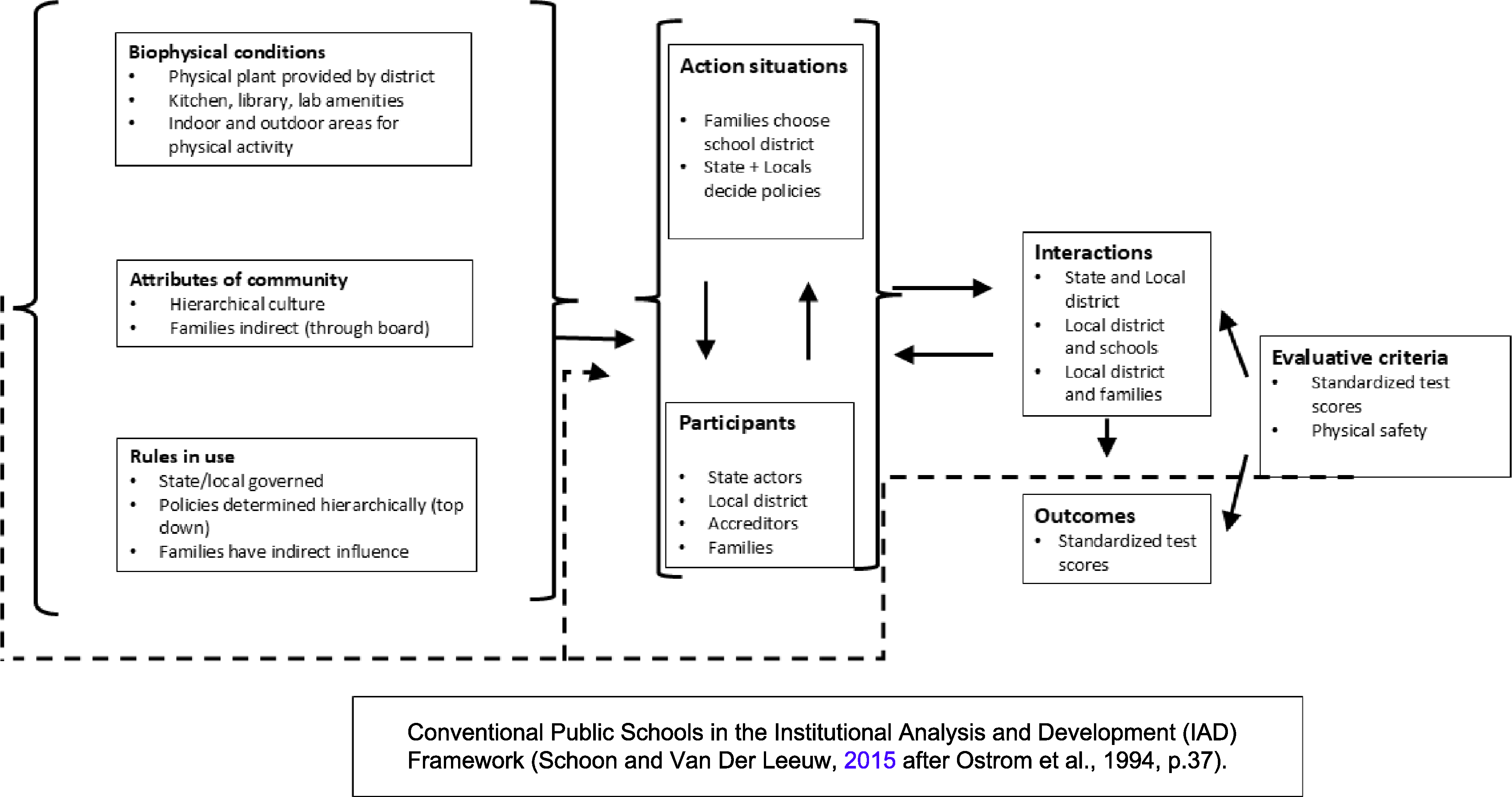
Conventional school IAD model
Figure 2 represents the conventional public school system using the IAD framework.
IAD model of conventional public schools.

Hybrid school IAD model
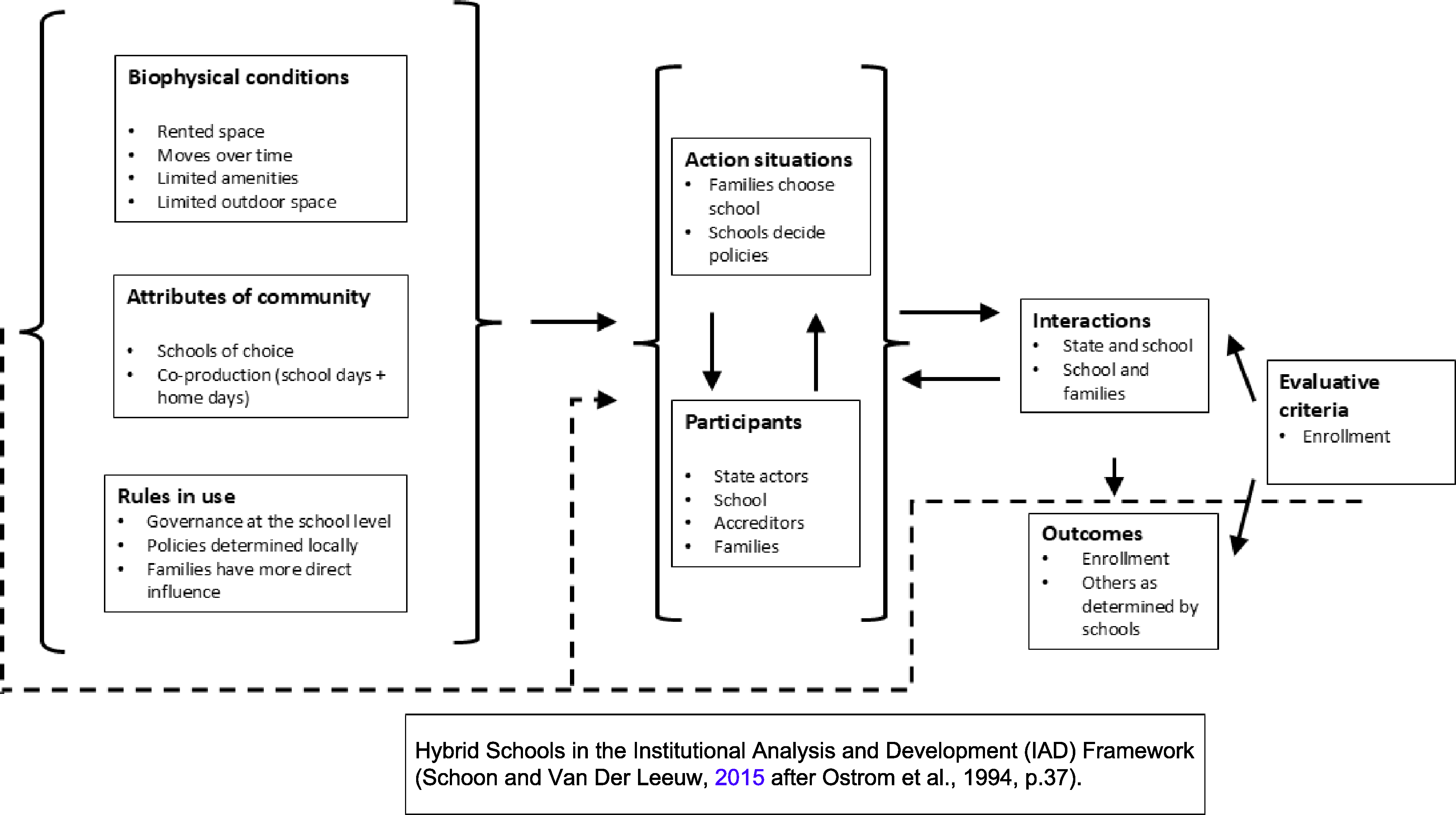
Figure 3 portrays the community-crafted school sector using the IAD framework. The major differences involve every section of the framework, with some (homeschool laws, the need to continually attract students, and the differences in physical plants) being larger than others (both models must account for state legislatures and accrediting agencies, for example).
IAD model of hybrid schools.

As noted above, conventional schools in America do have some polycentric aspects, though they may be muted and slow-moving. In the IAD model of hybrid schools, the rule structure reallocates control from bureaucratic agents (school boards, state agencies) to parents and founders. This reallocation creates a more direct link between satisfaction and organisational survival, reducing, for example, information asymmetry and collective action problems.
Economic implications
Elinor Ostrom’s work on polycentric governance is particularly relevant to community-crafted schooling (and especially hybrid schools), as it has meaningful explanatory value for these schools in terms of how they address governance issues with decentralised approaches. The propositions generated by the IAD analysis in particular are useful in identifying economic mechanisms and policy-relevant implications, as discussed below.
Demand side
The IAD analysis identified two institutional features that shape demand for hybrid schools. First, families choosing to shift from a peripheral to a central decision-making role (P2) means that hybrid schools serve families who are willing and able to co-produce education, bearing direct costs in both tuition and time on homeschool days. Families must have the capacity to manage part-time homeschooling, which favours households with schedule flexibility, educational confidence, and sufficient income to be available on home days. Second, the availability of voluntary enrolment as the primary accountability mechanism (P5) means that family satisfaction, rather than state-determined metrics, drives school responsiveness. These schools are founded for reasons including culture, curriculum, dissatisfaction with conventional schools and a variety of others (Wearne, Reference Wearne2020). Schools that depend on enrolment for survival face strong incentives to align their offerings with the outcomes families actually value, which, as noted above, increasingly include non-academic goals such as civic formation and family life (Lee et al., Reference Lee, Thompson and Wearne2025).
These demand-side dynamics have implications that the IAD framework helps to identify. The same institutional arrangements that create shorter feedback loops and higher reported satisfaction among participating families may also limit access for families without the resources to co-produce. The institutional rules that empower participating families simultaneously raise barriers for others. This asymmetry suggests that expanding ESA programmes or other tuition subsidies alone may not address the time and capacity costs that hybrid school co-production requires.
Supply side
On the supply side, the IAD identifies how these schooling arrangements lower entry costs (P3) by allowing schools to choose among a variety of regulatory environments and reduce their capital requirements (P1), but this also complicates how they are evaluated (P5). The pandemic, as noted above (Behr and Storr, Reference Behr and Storr2022), also created conditions for entrepreneurs to enter this space.
As Kiesling (Reference Kiesling2025) notes, ‘Ostrom’s body of work indicates that for good outcomes, rules have to fit their socio-ecological-technological environment. When technology changes, rules can and should change’. Writing about metropolitan governance in general, Ostrom herself writes,
‘While all institutions are subject to takeover by opportunistic individuals and to the potential for perverse dynamics, a political system that has multiple centers of power at differing scales provides more opportunity for citizens and their officials to innovate and to intervene so as to correct maldistributions of authority and outcomes’ (Ostrom, Reference Ostrom2000).
Here, Ostrom notes the potential downside of P2 (opportunistic individuals). And, to the extent uniform standards of success are defined and desired, these new school models do not provide such information. They manifest through entrepreneurial activity under diverse rule systems, and are not captured by uniform accountability standards; their success must be judged by measures other than state-mandated assessments or other metrics common to conventional schools.
Information and accountability costs
P3, P4, and P5 address asymmetric information and accountability. Hybrid schools create robust feedback loops between families, educators, and school leaders, allowing rapid adaptation to changing needs (e.g., curriculum adjustments based on parental input), unlike conventional schools, where feedback is filtered through bureaucratic layers. The IAD suggests that in practice this means that the collective action problems families face when dealing with conventional schools are less of a problem in hybrid schools. Change in conventional schools comes through voting in a new school board or asking a principal to change a local policy, both of which can take substantial time, potentially even longer than a particular student may attend a particular school. Following Hirschman’s (Reference Hirschman1970) framework, the key institutional contrast is between voice-based feedback (costly, slow, and filtered through bureaucratic layers) and exit-based feedback (lower cost and more direct). Hybrid school families have lower exit costs, and the schools’ direct engagement with families can more easily foster continuous improvement and accountability.
However, the lack of uniform accountability reporting and the lack of a clear definition of “success” noted in the previous subsection remain tradeoffs, ones that create challenges for both policymakers and researchers attempting to evaluate the sector, as discussed below.
Policy design implications and limitations
The propositions that follow from the IAD analysis suggest that conventional schools will face more physical (P1), curricular (P2), regulatory (P3) and evaluative uniformity (P5) and less competitive pressure (P4) compared to hybrid schools. They also suggest that hybrid schools do follow a more polycentric governance approach; they have more local autonomy and self-governance and are therefore likely to be more responsive to families and better able to experiment with different strategies to find what works best in their context. Ostrom’s work (2005) and the IAD suggest that the polycentric arrangements characteristic of hybrid schools may provide greater resilience, since schools operating under diverse rule systems (P3) with direct family feedback (P4) can adapt to local changes and challenges or crises (like pandemics) more efficiently than centralised systems.
Compared to conventional schools, however, hybrid schools may have additional barriers to entry for families in terms of charging tuition, requiring a family member to be at home part of the week (and the opportunity cost of foregone income that entails), and the need for families to have a higher capacity to gather information about the schools without a uniform accountability and reporting system.
This suggests at least two policy implications. First, ESA and choice programmes interact with hybrid school governance in ways policymakers have not fully addressed. As noted in the demand-side section, tuition subsidies alone do not address co-production barriers, and attaching compliance requirements to funding may undermine the regulatory flexibility that enables hybrid school diversity. On the supply side, while hybrid schools may often choose the regulatory framework they prefer (homeschool, private school, charter school, etc.), they do not fit neatly within existing policy definitions for any of them. Second, the absence of uniform information systems is a policy challenge, not just a theoretical tradeoff (Ohls et al., Reference Ohls, Covelli and Schweig2025). If the sector continues to grow, policymakers and researchers will need evaluation approaches that can accommodate institutional diversity rather than requiring all schools to report on identical metrics.
Theoretical implications
The IAD has been applied largely to natural resources, infrastructure, and metropolitan governance. This examination of hybrid schools extends the framework to a domain where co-production is a defining feature of the institutional arrangement. This makes education a particularly useful case for examining how co-production interacts with other IAD components. The application in this paper also demonstrates the IAD’s capacity to analyse institutional change over time; the emergence of hybrid schools as a sector represents an observable institutional shift. The existence and ubiquity of conventional schools enable a comparative structure, allowing the IAD to be used to generate testable propositions, which has been less common in IAD applications than purely descriptive analysis. For economic analysis specifically, the propositions identify institutional variables (entry/exit costs, regulatory pathway choices, and accountability structures) that future empirical work on school choice and student outcomes can incorporate as explanatory mechanisms rather than treating governance as a black box.
Conclusion
This paper demonstrates that the IAD framework is a useful analytical tool for examining education policy and governance, an issue area where it has not been applied. The comparison of conventional and hybrid school models reveals institutional differences that standard policy analysis (public vs private funding sources and public vs private production authority) obscures.
The analysis generated five propositions (P1–P5) about how institutional arrangements shape governance outcomes. Hybrid schools exhibit characteristics of polycentric governance (multiple centres of decision-making, overlapping jurisdictions, local autonomy, and the ability to self-adjust) that the conventional system largely does not. The analysis suggests that Strong (Reference Strong2020) is likely correct that the conventional school system is largely not polycentric but also that the emerging community-crafted education sector does have more of these features. Stated as an answer to the paper’s headline question, the drivers of polycentric governance in American education identified here are reduced capital requirements (P1), family demand for co-produced schooling (P2), regulatory pathway choice that lowers entry costs (P3), the availability of exit creating competitive pressure (P4), and enrolment-based accountability that shifts evaluation criteria to the community served (P5).
This analysis, however, is still conceptual and has several limitations. The propositions require future empirical testing. This paper focuses on a ‘typical’ hybrid school, but these models take on a variety of structures, varying on days of the week, size, homeschool/private/charter governance structures, and so forth. The tradeoffs noted regarding barriers to entry for families based on cost, time, and the difficulty of assessing quality are identified but also not empirically tested here. This paper is also U.S.-focused. Comparative international work extending the IAD to education governance in other national contexts (building on Gyuris, Reference Gyuris2014) would test whether the institutional dynamics identified here are specific to American regulatory environments or reflect more general patterns.
Future research should include empirical testing of the propositions (comparing family satisfaction across governance types, measuring institutional diversity across states with different rule structures, and attempting to address ‘quality’ or ‘success’). This paper, however, is able to show that Ostrom’s framework reframes education reform not as a contest between markets and governments but as an evolving search for effective rule systems in a polycentric public economy.

 Open access

