Introduction
Trauma exposure is frequent in general population, with 50% to 60% of people subjected to at least one traumatic event during their lifetime.Reference Atwoli, Stein and Koenen1
Survivors of traumatic events may experience a number of acute responses in the aftermath, such as feelings of sadness, anger, guilt, numbness, and sleep disturbances, ranging from a normal stress reaction to a clinically relevant post-traumatic syndrome.Reference Kessler2–Reference Bobo, Warner and Warner4 Considering the wide number of variables involved, there is no agreement on the role of predisposing, moderating, or protective factors, or even on the incidence of PTSD.Reference Wafa, Viprey and Magaud5 Thus, PTSD percentages range between 2% to 8% and 40% in the different studies conducted in a number of countries.Reference Galea, Ahern and Resnick6–Reference Mauri, Petracca and Miniati9 This finding has been accounted to discrepancies in studies’ methodology, such as recruitment procedure/assessments,Reference Reich, Lyons and Cai10–Reference Haagsma, Ringburg and van Lieshout13 small samples, and/or had high loss-to-follow-up rates for prospective studies.Reference Vranceanu, Hobfoll and Johnson12, Reference Landolt, Vollrath and Timm14–Reference El-Jawahri, Vandusen and Traeger19
There is also no agreement in the literature on the potential variables that may play a role as predictive factors for PTSD. The number of variables considered is increasing, and includes the type and the severity of traumatic events (war survivors, terroristic attacks, natural disaster, bomb explosion, fire, accidents, sexual assaults, etc.), the age the traumatic event occurred, the number of events, to be a witness vs to be a victim, premorbid temperamental/personality characteristics, comorbidity with other pre-existing psychiatric illnesses, low intelligence quotient, childhood or prior traumatic exposure, pre-existing mental health problem, substance abuse, specific features of the index trauma (perception of death threat, head trauma, intentional aggression), and, finally, post-traumatic psychosocial factors such as peri-traumatic dissociation, or low social support.Reference Forbes, Creamer and Phelps20–Reference Di Gangi, Gomez and Mendoza22
Moreover, such studies pointed out on the potential explanations for the high rates of comorbidity between PTSD and depression, entailing a number of hypotheses. A pre-existing depression could be a risk factor for PTSD or vice-versa, a diagnosis of PTSD could represent a risk factor for developing a subsequent depressive episode. As an alternative, PTSD and depression could share common risk factors and biological vulnerabilities. Finally, the high rates of comorbidity between the two disorders could be an artifact of how they are assessed.
From a more cognitive point of view, potential relationships between post-traumatic stress signs and symptoms, anxiety, depression, and a specific dimension, called intrusiveness, have been systematically explored starting from the Reynolds and Brewin’ study.Reference Reynolds and Brewin23 This research addressed the question of similarities and differences between intrusive memories in PTSD and in patients with depression.Reference Reynolds and Brewin23 According to the proposed model, depression is reinforced by an increased access to negative memories and a decreased access to positive memories.Reference Williams, Watts and MacLeod24 Evenly, PTSD is characterized by “repeated and unwanted accesses” to memories of a traumatic event.Reference Reynolds and Brewin23, Reference Kim, Park and Kim25 Consistently with DSM, the intrusive symptoms of PTSD are typical of anxiety disorders, rather than depressive disorders. PTSD is specifically characterized by the re-experiencing symptoms, such as nightmares or intrusive memories of the trauma, with a disturbing reactivity to trauma-related cues.Reference Reynolds and Brewin23 However, intrusive waking memories, nightmares, and physiological arousal are typical not only of PTSD, but also of depressive episodes, in responses to major life stressful events (including bereavement), with more than 86% of depressed patients describing repetitive intrusive memories.Reference Brewin, Hunter, Carroll and Tata26
Following this line of research, we aimed at exploring the potential relationships between PTSD, the presence of current depressive symptoms, and the dimension intrusiveness, in a sample of subjects who survived a railway crash in Italy occurred on June 29, 2009, at 11.48 p.m. Specifically, in the railway station of Viareggio (central Italy), a freight train carrying liquefied petroleum gas derailed and two of them exploded causing a fire. A whole street alongside the railway was destroyed in the explosion. Thirty-two people died (8 immediately at the time of explosion, while 24 after being hospitalized for physical trauma and burns), and 26 people were injured. The subsequent fires damaged a large area of Viareggio, and around 1000 residents were evacuated from their homes.
The Viareggio survivors’ sample had been already evaluated by our research group, with the aim to assess the presence/absence of PTSD, while focusing on the potential correlations between the risk of developing PTSD and the lifetime mood spectrum signs and symptoms, assessed with the Mood Spectrum Questionnaire in its Lifetime Version (MOODS-SR).Reference Miniati, Petracca and Carmassi27 A number of significant differences were detected in terms of MOODS-SR lifetime factors’ scores between subjects who developed PTSD and subjects who did not, thus enhancing the role of subsiding lifetime mood dysregulations as related with a higher risk to develop PTSD. However, we were also interested in mood signs and symptoms assessed as occurring during the last month, and not along lifetime perspective. Our hypothesis was that, when focusing the attention on the last month assessment, mood spectrum signs and symptoms could be helpful in identifying potential pathways for the onset of a full-blown PTSD, and for the occurrence of specific dimensions such as intrusiveness, that are common to both psychological/psychopathological depressive and post-traumatic realms. In order to explore this hypothesis, we decided to perform a path analysis.
Methods
Study participants
The study sample consisted of 111 subjects, 60 (54.1%) women and 51 (45.9%) men (mean age: 52.9 ± 15.8 years), evaluated 7 to 8 months after the exposure to the explosion of a train containing liquid gas near the Central Station of Viareggio (Italy). Subjects spontaneously referred to an outpatients’ psychiatric service dedicated to those who survived the rail crash.
Exclusion criteria were as follows: age below 18 years, inability to understand the assessment procedures, or to sign the informed consent. The Ethics Committee of the Azienda USL 12 of Viareggio (Italy) approved all recruitment and assessment procedures. Eligible subjects provided written informed consent after receiving a detailed description of the study and having an opportunity to ask questions, as described in detail elsewhere.Reference Mauri, Petracca and Miniati9
Instruments
Axis I disorders were assessed by the Semi-structured Clinical Interview from DSM-IV (SCID-I).Reference First, Spitzer and Gibbon28 Participants completed the following self-report measures: the Impact of Event Scale-Revised (IES-R)Reference Weiss, Marmar, Wilson and Keane29; the Trauma and Loss Spectrum-Self Report (TALS-SR)Reference Dell’Osso, Armani and Rucci30; the Life-time Mood Spectrum Self-Report (MOODS-SR-LT), and the Last Month version of the same instrument.Reference Dell’Osso, Carmassi and Rucci31
The IES-RReference Weiss, Marmar, Wilson and Keane29 is a 22-item scale measuring subjective stress following a traumatic event. It represents the revised version of IES, a 15-item scale measuring intrusive, avoidant, and hyper-arousal symptoms.Reference Horowitz, Wilner and Alvarez32 Participants were asked to rate the different statements on a scale ranging from “0” (not at all) to “4” (completely true). Psychometric properties of the IES, its reliability and validity are described in detail elsewhere.Reference Sundin and Horowitz33 A subscale exploring intrusive thoughts, nightmares, intrusive feelings and imagery, and dissociative-like re-experiencing represents the intrusive dimension.
The TALS-SR includes 116 items exploring a range of loss and/or traumatic events that the subjects may have experienced and the symptoms, behaviors, and personal characteristics that might represent manifestations and/or risk factors for the development of a stress-response syndrome. The instrument is organized into nine domains (loss events, grief reactions, potentially traumatic events, reaction to losses or upsetting events, re-experiencing, avoidance and numbing, maladaptive coping, arousal, and personal characteristics/risk factors). Each item response is coded in a dichotomous way (yes/no) and domain scores are obtained by counting the number of positive answers.
The MOODS-SR has been administered in two different versions: Lifetime and Last Month. The MOODS-SR Lifetime Version explores the overall spectrum of lifetime mood signs and symptoms, including manic and depressive features, rhythmicity, and vegetative functions in a lifetime perspective. It has a factor structure, identified and validated by an exploratory factor analysis,Reference Cassano, Benvenuti and Miniati34, Reference Cassano, Mula and Rucci35 including six factors for the lifetime depressive side (“Depressive Mood,” “Psychomotor Retardation,” “Suicidality,” “Drug/Illness related depression,” “Psychotic Features,” and “Neurovegetative Symptoms”), and factors on the manic side (“Psychomotor activation,” “Creativity,” “Mixed instability,” “Sociability/extraversion,” “Spirituality/mysticism,” “Mixed irritability,” “Inflated self-esteem,” “Euphoria,” and “Wastefulness/recklessness”).
The MOODS-SR Last Month (MOODS-SR-LM) version shares the same structure but it is focused on the mood spectrum manifestations occurring during the last month before the evaluation.
Statistical methods
All analyses were undertaken using SPSS version 25. Statistical significance was set a priori at P < .05, two-tailed.
Frequencies and percentages were presented for categorical data and measures of central tendency (means and medians) and of dispersion (standard deviation) were calculated for continuous data. Socio-demographic and clinical data were analyzed with descriptive statistics. Differences between individuals with PTSD and without PTSD were assessed using t-tests for normally distributed variables, or the Mann–Whitney U/Wilcoxon test for non-normally distributed variables. Categorical variables were analyzed via the χ 2 test.
We used AMOS version 21 (IBM Corp, 2012), for structural equation model-path analysis to examine both direct and indirect associations between the exposure to traumatic events, mood spectrum symptoms, and subjective stress following a traumatic event. According to the recommendations about the use of mediation models in cross-sectional samples,Reference Tate36 a time-ordered relationship among variables must be argued, such that the mediator must intervene in time between the predictor and outcome. The timing can be argued by the nature of the constructs. Given those, the TALS was investigating potential traumatic events occurred in lifetime, the MOODS-SR-LM was assessing mood symptoms during the last month, whereas the IES-R was assessing avoidant, intrusive, and arousal symptoms during the last week. As such, the MOOD-SR-LM can be positioned as a potential mediator because mood symptoms were intervening before intrusive, avoidant, and hyper-arousal symptoms emerged after exposing to traumas (although partially overlapping in time-frame). The path analysis started with a saturated model in which all variables were interrelated; nonsignificant path correlations/associations were gradually excluded until a good-fitting model was reached. A path diagram representation of the model was then drawn: straight single-headed arrows represented regression paths. Goodness of fit was reported using standard indices: the χ 2/df, the comparative fit index (CFI), the root mean square error of approximation (RMSEA). Rules of thumb for determining acceptable model fit were as follows: a χ 2/df value of 3 or below, a CFI value of 0.90 or above, and RMSEA values close to 0.05 or below. All path coefficients and correlations are reported as standardized estimates. Only one exploratory model was fitted with all the standard indices, thus we used the potential traumatic events (TALS’s variable) as input, the IES-R total score as an outcome, while the depressive symptoms (MOOD-SR-LM’s variable) were used as mediators’ factors.
Results
Demographic and clinical characteristics of the sample
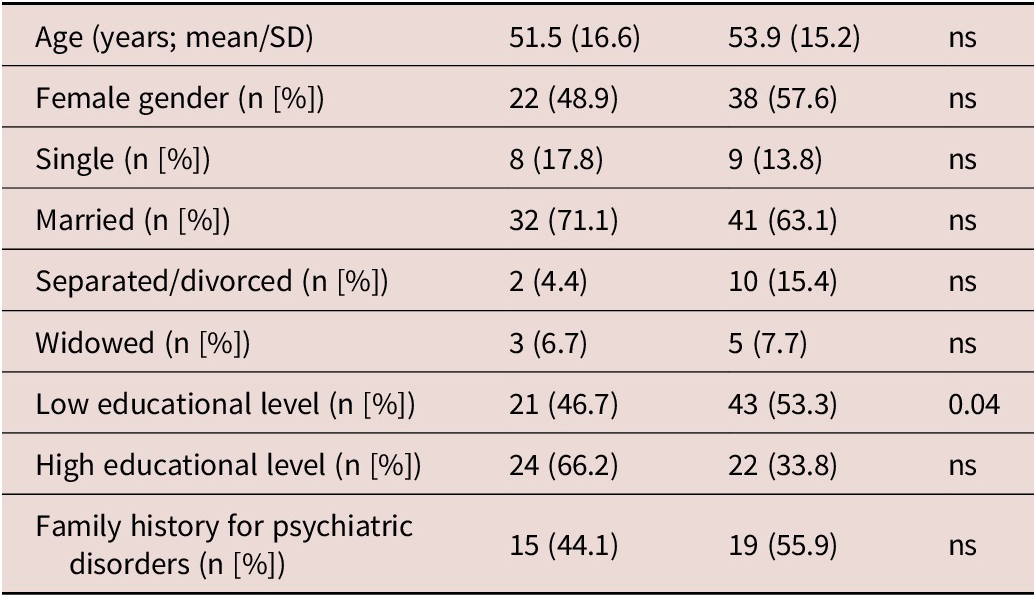
Sixty-six (59.4%) out of the total 111 subjects met SCID-IV criteria for PTSD.Reference First, Spitzer and Gibbon28 Demographic characteristics of the sample have been already described in detail elsewhere,Reference Miniati, Petracca and Carmassi27 and summarized in Table 1.
Demographic Characteristics of the Sample (n = 111).

Modified from Miniati et al. (2017).NS = Not Statistically Significant.
Path analysis
Based on the previous results, we selected only individuals who met the SCID-IV diagnosis criteria for PTSD (66 cases) and then we performed a path analysis to model the direct and indirect links between the exposure to potential traumatic events (Potential Traumatic Events score), depressive symptoms (Depressive Mood score), and arousal, avoidant, and intrusive symptoms (IES-R total score) (Figure 1). Indices of goodness of fit were as followed: χ 2/df = 0.2; P = .6; CFI = 1; and RMSEA = 0.0001 (Table 2).
Path analysis diagram: potential traumatic events and depressive symptoms to avoidant, intrusive, and arousal symptoms. Straight single-headed arrows represent regression paths and curved tow-headed arrows represent correlations. All path coefficients and correlations are reported as standardized estimates. Abbreviation: IES-R, Impact of Event Scale-Revised version.

Standardized Regression Coefficients, Critical Ratio (CR), P Value and Direct and Indirect Effects of Factors Related to the Model.

The term “on” is indicative of an association between two variables and the term vs (for versus) is indicative of a correlation between two variables.
Abbreviations: CR, critical ratio; IES-R, Impact of Event Scale-Revised version.
There was a significant path coefficient for direct effect of potential traumatic events on depressive symptoms (β = 0.25; P < .04) and from depressive symptoms to avoidant, intrusive, and arousal symptoms (β = 0.34; P < .003). An indirect effect was observed in this model: standardized value of potential traumatic events on avoidant, intrusive, and arousal symptoms was 0.86. The mediating factor of this indirect effect path was depressive symptoms. Potential traumatic events can explain 6.2% of the variance of depressive symptoms; 11.8% of the variance of intrusive, avoidant, and arousal symptoms was accounted for potential traumatic events and depressive symptoms (Table 3).
Model Fit of the Structural Model.

Abbreviations: AGFI, adjusted goodness of fit index; CFI, comparative fit index; GFI, goodness of fit index; NFI, normed fit index; PCFI, parsimony comparative of fit index; RMSEA, root mean square error of approximation; TLI, Tucker Lewis index.
Discussion
The present study investigated the relationship between PTSD, the presence of current depressive symptoms, as assessed with the MOODS-SR-LM (according to the spectrum model),Reference Cassano, Dell’Osso and Frank37–Reference Miniati, Benvenuti and Bologna41 and the level of intrusiveness, assessed with the IES-R. The current research represents a deepening of a previous study exploring the differences in the lifetime presence of mood signs and symptoms in subjects with and without a PTSD diagnosis along a longitudinal perspective.Reference Miniati, Petracca and Carmassi27 In our previous study, we explored pre-existing mood spectrum features potentially related to the risk of developing PTSD in a civil population exposed 7 to 8 months before a railway explosion. The results were that the MOODS-SR Lifetime “sociability/extraversion” factor, belonging to the manic side of the spectrum assessment, could differentiate subjects with and without PTSD in a logistic regression model, as a lifetime predictor of PTSD (odds ratio = 1.89, 95% confidence intervals 1.25-2.86). This finding was consistent with previous studies reporting the occurrence of manic/hypomanic or mixed symptoms among PTSD subjects.Reference Pollack, Simon and Fagiolini42
The MOODS-SR Last Month (MOODS-SR-LM) was administered to the same sample in a mutually exclusive way with the MOODS-SR Lifetime. In this case, we applied a path analysis to investigate both direct and indirect associations between the exposure to the traumatic event, the presence of cross-sectional mood spectrum symptoms (as reported during the last month), and intrusiveness following the traumatic event, in a more exploratory manner. We utilized the only exploratory model that fitted with all the standard indices; we used the potential traumatic events (TALS’s variable) as input, the IES-R total score as an outcome, and the depressive symptoms (MOOD-SR-LM’s variable) as mediators’ factors.
Our results suggested that potential traumatic events were associated with increased depressive symptoms and, to a similar extent, with increased avoidant, intrusive, and arousal symptoms, as assessed with the IES-R. Potential traumatic events showed both a significant direct effect on increasing depressive symptoms, together with an indirect effect on avoidant, intrusive, and arousal symptoms. Depressive symptoms were the mediating factor of this indirect effect. Giving that, depressive symptoms played a relevant role, increasing illness intrusiveness via a depression-to-PTSD pathway.
To the best of our knowledge, this is the first study exploring the specific mediating effects of mood spectrum signs and symptoms on the relationship between PTSD and intrusiveness, using a path analysis in a clinical sample of subjects exposed to the same isolated severe traumatic event, such as the train crash in Viareggio. Previously, other studies analyzed the potential relationships among traumatic events, PTSD and depression in groups of subjects exposed to completely different types of recurrent or chronic traumatic events, including student military veterans,Reference Shackelford, Smith and Farrell43 homeless women with mental illnesses,Reference Tinland, Boyer and Loubiere44 refugees and asylum seekers,Reference Thompson, Vidgen and Roberts45 or Korean fire fighters.Reference Kim, Dager and Jeong46
Other studies highlighted clinical similarities between PTSD and depression, as demonstrated in samples of inpatients with PTSD,Reference Green, Lindy and Grace47 community samples,Reference Davidson, Hughes and Blazer48 Vietnam veterans,Reference Davidson and Foa49 underground train drivers,Reference Too, Milner, Bugeja and McClure50 military members, veterans, and first responders (eg, police, fire, and paramedics) with probable PTSD,Reference Boyd, Protopopescu and O’Connor51 or survivors of a chemical warfare.Reference Hashemian, Khoshnood and Desai52 Taken as a whole, all these studies pointed out to the substantial symptoms’ overlap between the two disorders, to the impact on psychosocial and occupational levels, and to the low treatments’ response. Starting from a different perspective, the occurrence of depressive symptoms was recently investigated with a confirmatory factor analyses model, in a sample of active duty service members and veterans with PTSD.Reference Moring, Nason and Hale53 In this case, the “alterations in cognition and mood” and the “alterations in arousal and reactivity” subscales of PTSD Checklist-5 (PCL-5)Reference Wortmann, Jordan and Weathers54 together with the general distress factor, predicted depression at pretreatment and post-treatment observations.
Our study did not allow us to support one of these hypotheses over the others. Moreover, no systematic follow-up was carried out after the sample evaluation, and no information was available on the subsequent clinical outcomes. However, we were in line with previous observations highlighting the importance of examining what has been called the “numerous facets of psychopathology” in patients with PTSD, with a special attention to depressive signs and symptoms.Reference Kim, Park and Kim25
A recent study utilized the path analysis to understand the potential relationships among post-traumatic stress symptoms (PTSS), anxiety, depression, and illness intrusiveness, with some similarity with our study. However, the recruited patients were exposed to several different traumas, such as accidents, physical assaults, traumatic losses, sexual assaults, life-threatening illnesses, and natural disasters.Reference Kim, Park and Kim25 Anxiety, both independently and as part of an interrelated pathway with depression, was found to only partially mediate the relationships between PTSS and intrusiveness.
The role of intrusiveness both in PTSD and in depressed patients is still a controversial issue.Reference Birrer, Michael and Munsch55 Distressing, repetitive, and intrusive memories are not an exclusive hallmark of PTSD; they are common in depressed patients, even if differences and similarities of these images across the two conditions are far from being clarified.Reference Starr and Moulds56 For the first time, Reynolds and BrewinReference Reynolds and Brewin23 compared memory contents and their characteristics in matched samples of patients with PTSD and major depression. They found frequent intrusive memories in both samples with a higher frequency and a higher number of intrusions in patients with PTSD. In both groups (PTSD and depressed patients) memories were impressively described as highly stressful with no group differences with respect to the reported physical sensations, the re-experiencing of the traumatic event associated with the memories, or the average memories duration.
In our study, we did not address in a specific manner the open questions on similarities and differences between intrusiveness in patients with PTSD and depression. However, we could speculate that intrusiveness should be considered a trans-diagnostic dimension linking in a common pathway PTSD and depression.
We acknowledge that our finding suffers from several limitations. First, present study re-analyzed a sample already investigated,Reference Miniati, Petracca and Carmassi27 so that, the results of our analysis should not be interpreted as totally independent evidence from the previous ones. Second, due to the cross-sectional design of this study, the results of the path analytic models presented herein are associative in nature and do not permit any causal interpretations. Third, no information is available on the long-term outcomes of PTSD. Finally, participants in this study were referring to a psychiatric center specialized in trauma, and it is possible that subjects with the more severe forms of PTSD were over-represented. The sample was obtained from subjects who spontaneously referred to a psychiatric service dedicated to the rail crash survivors.
Conclusion
The present study added empirical evidence to the clinical significance of depressive signs and symptoms as a potential pathway to the occurrence of a PTSD, and to the relevance of intrusiveness as trans-diagnostic dimension. Hence, depressive signs and symptoms, even in the absence of a full-blown diagnosis of depressive episode, might serve as a valuable target for the therapeutic approach. Our finding represents an attempt to better define clinical phenotypes of patients that, presenting mood spectrum dysregulations, might deserve additional attention in future research on PTSD. We believe that further research is warranted to explore more in detail mechanisms and empirical weights of such mediation effects, and to evaluate the more appropriate clinical strategies to treat depression and to minimize intrusiveness in patients with PTSD.
Disclosure
The authors have nothing to disclose.