Introduction
Maternal employment has risen across industrialised countries in recent decades, with an increasing share of mothers entering or returning to paid work when children are pre-school age (OECD, 2007, 2011). This trend, which reflects changing social norms about gender roles, in turn linked to higher rates of educational attainment and more career-focused attitudes among women, has been supported and encouraged by policy for a number of reasons: as a way to reduce dependency ratios in the context of an ageing population; as a strategy for tackling child poverty, both in the immediate term and in the longer run as earnings rise; and as a way to reduce gender inequality (Lewis, Reference Lewis2009; HM Treasury, Reference Treasury1999; OECD, 2002). Research into the drivers of gender inequality over the life course underlines the negative impact of interruptions to women's employment histories after childbirth (e.g., Jacobsen and Levin, Reference Jacobsen and Levin1995; Waldfogel, Reference Waldfogel1997).
As a result, OECD governments have increasingly invested in childcare expansion and in childcare subsidies for working parents, usually combined with protected rights to paid parental leave covering some or all of the first year of life (OECD, 2011). Wage top-ups to working households through the tax system are also increasingly common (Bradshaw and Finch, Reference Bradshaw and Finch2002; Daly, Reference Daly2005) The UK has moved rapidly in this direction over the last two decades, with a raft of policies aimed at encouraging and supporting employment and shifting financial incentives to ‘make work pay’ for mothers of pre-schoolers as well as older children (Lewis, Reference Lewis, Scott, Dex and Joshi2008; Waldfogel, Reference Waldfogel2010).
Some UK policies, including longer maternity leave and rights to request flexible and part-time working, have benefited all working mothers (and often also fathers, at least in principle), but the bulk of childcare support and tax credit subsidies have been targeted at lower income households and lone parents (Brewer et al., Reference Brewer, Browne, Joyce and Sibieta2010). There has also been a shift towards greater coercion for parents who are benefit recipients to work, with a gradual lowering of the age at which a child stops providing an exemption from job search requirements (Kennedy, Reference Kennedy2010). In 2013, lone parents with a child aged between one and five were required to attend work-focused interviews, although they did not need to take further steps to find work.
Boosting maternal employment in lower income households makes considerable intuitive sense as a central plank in UK attempts to reduce child poverty in the short run (see Blair, Reference Blair and Walker1999), but it is less clear that the strategy is a promising solution as a means either to eradicate child poverty in the longer run or to reduce gender inequality across the life course. For this to be the case, the findings of research into employment gaps would need to apply to lower-skilled as well as higher-skilled women. In fact, the literature cited briefly above and explored in more detail below rarely distinguishes between the two, even though it is plausible that the cost of an employment gap will be smaller for those with lower skills. Wider evidence on low-paid workers indicates greater employment turnover and fewer wage gains over time than for workers in higher skilled jobs (e.g., Stewart and Swaffield, Reference Stewart, Swaffield, Asplund, Sloane and Theodossiou1998; McKnight, Reference McKnight2000; Card and DiNardo, Reference Card and DiNardo2002).
If a low-paid job is indeed an effective route to better employment outcomes in the future, then subsidising and encouraging – even requiring – low-paid work in these early years can be seen as important government action in the long-term interests of parents, their children and the taxpayer. If, on the other hand, it makes little difference – if parents move in and out of low-paid work and make little wage progression – this would challenge some of the key assumptions on which policy in this area has been based. Subsidising low-paid work and childcare may still make sense – because of the possible benefits of formal childcare, the impact of higher concurrent income, or the importance of working role models for children – but not because of the long-term impact on women's future pay and prospects.
This article seeks to further our knowledge about the relationship between low-paid work in the years after childbirth and mothers’ later employment outcomes by examining employment trajectories across a decade using data from the UK's longest-running household panel, the British Household Panel Survey (BHPS). By creating a pseudo-panel, it identifies 954 women whose trajectory we can follow for ten years after the birth of their youngest child. Using these trajectories, the article aims to answer two questions, with a focus on the differences between women who have high educational attainment at the time of the birth and those with low or no qualifications. First, how far do mothers’ employment patterns conform to what might be thought of as the conventional pathway – a unidirectional movement from full-time carer to paid employment? Second, how well does employment status in a child's pre-school years predict employment outcomes as the child reaches the end of primary school? Three main employment outcomes are considered – being in work, the hourly wage and job satisfaction.
Background and literature review
There is an extensive literature which examines the long-term impact that motherhood has on wages and employment status (see e.g., Waldfogel, Reference Waldfogel1997; Budig and England, Reference Budig and England2001, on the US; Waldfogel, Reference Waldfogel1995; Joshi et al., Reference Joshi, Paci and Waldfogel1998, on the UK; and comparative studies by Harkness and Waldfogel, Reference Harkness and Waldfogel2003; Sigle-Rushton and Waldfogel, Reference Sigle-Rushton and Waldfogel2007). All identify a large long-term cost to motherhood in terms of foregone earnings – a ‘family gap’ between the wages of mothers and non-mothers, which in turn is a key driver of the gender pay gap. The family gap is found to be comparatively large in the UK (Harkness and Waldfogel, Reference Harkness and Waldfogel2003; Sigle-Rushton and Waldfogel, Reference Sigle-Rushton and Waldfogel2007).
Most of these studies seek to identify the driving factors behind the family gap, asking how far lower wages can be explained by reduced labour market experience as the result of time spent at home with children, and how far by other factors, including a switch to lower status but more family-friendly jobs, a switch to part-time work, lower productivity at work as a result of family responsibilities, and employer discrimination. While differing on the size of the role attributable to particular factors, all find the lost years of experience to be a crucial component.
The clear policy implication is that one way to decrease the ‘family gap’ (and with it the gender pay gap) is to minimise the length of employment breaks and get mothers back into the labour market quickly. Further studies support this idea more directly. Jacobsen and Levin (Reference Jacobsen and Levin1995) suggest that breaks in employment for childcare have long-lasting effects on women's pay; while Waldfogel (Reference Waldfogel1998) and Joshi et al. (Reference Joshi, Paci and Waldfogel1998) find that women who maintain employment continuity after childbirth have higher pay than those who do not. A strategy which provides job-protected and part-paid maternity cover in the first year after childbirth followed by employment and childcare subsidies thereafter thus appear to make considerable sense, both for gender equality and for economic performance.
However, few of the studies cited above attempt to distinguish between women by skill level. They assume a uniform relationship between experience and pay, estimating the average penalty across all working mothers, even though the value of experience may be expected to be lower in jobs that require fewer skills. It is more than plausible that experience as a teacher, doctor or astronaut results in the accumulation of more human capital than experience as a cleaner or factory machinist, with lost years in the former professions therefore likely to be associated with a greater wage penalty. To put it more clearly, experience–earnings profiles may not be parallel for workers with different skill levels, and therefore it will be misleading to apply conclusions based on average returns to experience to any particular group.
Some recent studies do explore whether the family gap is different for women with different levels of qualifications. This research has tended to find a reduced gap for those with higher skills, with higher education acting as what Todd (Reference Todd2001) calls a ‘shock absorber’, insuring women against the earnings penalties associated with having children (see e.g., Budig and England (Reference Budig and England2001); Todd (Reference Todd2001); Anderson et al. (Reference Anderson, Binder and Krause2003)). Only Ellwood et al. (Reference Ellwood, Wilde and Batchelder2009) identify a much higher cost to motherhood for high-skilled than low-skilled women. However, the focus in all these studies is on the differences in that part of the gap which is not explained by experience (i.e., the part that may be due to the level of work effort or discrimination); experience is included as a single control variable, with a single coefficient for women of all skill levels.Footnote 1 This is a different question to the one at issue in this paper, which is about whether time out of the labour market is likely to have less impact on wages and other employment outcomes for women with fewer qualifications.
The wider literature on returns to experience for workers with different skill levels points to a lesser impact for the lower skilled. Examining cross-sectional data for the US in the 1990s, Card and DiNardo (Reference Card and DiNardo2002) find that experience–earnings profiles flattened over time for less-educated workers (men and women), and steepened for more highly educated women, resulting in a substantially flatter profile for women with less than twelve years of education compared to women with sixteen years. Using US longitudinal data, Heckman et al. (Reference Heckman, Lochner and Taber1998) and Gladden and Taber (Reference Gladden, Taber, Card and Blank2000) find slightly higher wage growth for more educated workers. Using German longitudinal data, Dustmann and Meghir (Reference Dustmann and Meghir2005) find positive returns to experience for skilled workers, and small and insignificant returns to unskilled workers after two years.
Another set of literature which examines wage growth for low-skilled workers or previous welfare recipients (without the comparison group of higher-skilled workers) also raises questions about likely gains to experience in the medium-term. In the UK, Stewart and Swaffield (Reference Stewart, Swaffield, Asplund, Sloane and Theodossiou1998) find limited mobility out of low pay using the BHPS, with considerably lower mobility for women. Using the New Earnings Survey, McKnight (Reference McKnight2000) similarly finds more upward mobility in earnings for men than women: mobility increased for women and declined for men in the two decades to 1997, but a considerable degree of persistence in low pay for women remained. Among lone parents, Harkness (Reference Harkness and Bell2006) finds that around half of those in the Families and Children Study who ever worked between 1999 and 2003 were permanently low-paid (their earnings never rose above two-thirds of the male median wage). Using the British Lone Parent Cohort, Stewart (Reference Stewart2009) also finds very limited wage progression over a longer period (six to twelve years), with more women moving into than out of low pay during the observation period.
Finally, another relevant group of studies explores stability in employment for low-skilled workers. The discussion above largely concentrates on how far those who remain in employment progress up the wage distribution. But we know that churning or cycling in and out of jobs is much more likely in the low-skilled labour market: that is, we cannot assume that women moving into work are likely to stay there thereafter. Stewart and Swaffield (Reference Stewart and Swaffield1999) and McKnight (Reference McKnight2000) both find that lower-paid workers in general have a less stable pattern of employment than higher-paid workers. Among lone parents in particular, research by Evans et al. (Reference Evans, Harkness and Arigoni Ortiz2004) found a similar rate of movement into paid work as for other non-employed people, but a rate of exit which was twice as high. Stewart (Reference Stewart2009) found considerable movement in and out of work for lone parents in the six to ten years after the birth of a youngest child.
This paper, part of the same larger research project as Stewart (Reference Stewart2009), extends that work using a different dataset, the BHPS. Focusing on the difference between women with lower and higher skill levels, it examines the extent of employment stability in the decade after the birth of a youngest child, and the association between employment stability and employment outcomes at the end of the decade. We start by exploring the BHPS and its advantages to the study.
Data
The BHPS is a longitudinal dataset that contains information from a sample of households interviewed annually since 1991, with seventeen waves available at the time of analysis (1991– 2007). All female respondents with a youngest child aged ten in any particular wave were included in the potential sample for this paper. As the BHPS collected full employment histories in the second year of the survey and fertility and occupational histories in the third year of the survey, this meant women could be included even when the youngest child reached ten in an early wave. The total sample was 954 women who had given birth to their youngest child between 1980 and 1997, with 1.4 per cent of births in 1980 and between 4.2 per cent and 7.5 per cent in each year thereafter. We focus on the youngest children to ensure that we can follow women for a decade in which their employment histories are uninterrupted by later births.
The need to pool women from different waves, with births stretching back into the 1980s, is a limitation of the analysis, but the BHPS also has a number of advantages for our purposes. First, we are able to compare women's outcomes at the same life stage; we have chosen the point between ten and eleven years after the birth of the youngest child.Footnote 2 Second, the detailed employment histories let us construct full monthly trajectories, capturing all employment transitions from the birth of the youngest child to age ten, except where interviews are missing. Third, the data allow us to look at differences in the experiences of mothers with lower and higher qualifications.
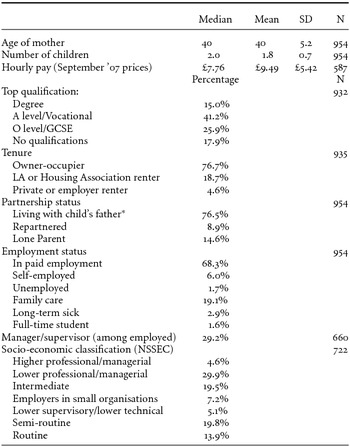
Table 1 presents some descriptive statistics for the mothers taken from the interview after their youngest child reached the age of ten. This is the point at which we have most information for the women – often we are building the earlier trajectory from the information in job and fertility histories. Of course, for some women this point will have been as early as 1991 and for others as late as 2007, meaning that women are facing different employment and wage conditions at what looks like the same point. To control for this as best we can, we adjust all wage data to September 2007 prices using the Average Earnings Index, and we include a set of year dummies in all the regression analyses later in the paper. Because of the pseudo-panel nature of the dataset, in which observations are taken from different waves of the BHPS, the numbers given here and in later descriptive statistics are not weighted.
Descriptive statistics: characteristics of BHPS mothers in the interview after their youngest child turns ten (1991–2007)

Note: Unweighted data. *More accurately, living with the same man as when the child was born.
Source: Author's calculations using waves 1–17 of the British Household Panel Survey (1991–2007).
The focus on pathways after the birth of the youngest child raises additional issues, as these pathways will clearly have been affected by employment and fertility histories prior to that birth. However, if we do not restrict the sample in this way, the analysis will be complicated by exits from the workforce on the birth of subsequent children. To control for prior history, we include variables in the regressions for the number of children and the years of potential and actual labour market experience.
To construct the employment pathways, we make use of the full BHPS employment histories to construct a monthly history for each woman, starting at the point of birth of the youngest child. In addition to the full occupational histories gathered in the third wave, work histories are recorded at each interview which capture any changes in employment status since the last wave. These stretch backwards to a fixed point, typically two years earlier. Thus, if a respondent misses more than one consecutive interview, part of the history will be missing. This was true of roughly 7 per cent (69) of our observations. In these cases, we assume no change in status in the missing months.
Skill levels are measured in the paper by the highest level of qualifications held. Unless otherwise indicated, qualifications are measured as soon as possible after the youngest child's birth; if the youngest was born before the first interview in 1991, skill levels are measured in 1991. Mothers with higher education, A-levels or vocational education are classified as ‘high-skilled’, while those with O-levels/GCSEs or no qualifications are classified as ‘low-skilled’.
Pathways from birth to ten
Figure 1 shows the changing share of women involved in paid work or other unpaid activity in the ten years after the birth of their youngest child. One month after the birth, 13 per cent of women are classified as on maternity leave and 21 per cent in paid employment, with 64 per cent as full-time family carers. The share of women who are full-time family carers falls steadily over the decade to reach 19 per cent at the youngest child's tenth birthday, and the share in paid work rises correspondingly. From around the child's third birthday, a majority of mothers are in paid employment. This suggests somewhat lower employment rates in our sample than in the UK as a whole in 2008, where 56 per cent of mothers with a child under three were in paid employment, along with 58 per cent of those with a child between three and five (OECD, 2012). This is as expected given that our sample includes children born between the early 1980s and the late 1990s.
Mothers’ employment status from birth of the youngest child to the child's tenth birthday Notes: Monthly data, unweighted. Total sample is 954 women; N for each month is between 938 and 953. Source: Author's calculations from waves 1–17 of the BHPS.

Throughout the ten years, 2 per cent of women in our sample are unemployed and around 1 per cent are in full-time education, while the share classified as long-term sick or disabled rises from 1 per cent to 3 per cent. One year after the birth, 1 per cent continue to classify themselves as on maternity leave, with three women maintaining this status until five years after the birth. As statutory maternity leave was only 29 weeks, even when the youngest babies in the sample were born in 1997, this indicates that a small number of women report themselves as on maternity leave when they are taking a career break, rather than making use of formal maternity leave rights.
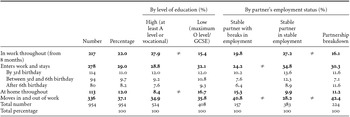
Figure 1 shows aggregate numbers for the sample as a whole and does not tell us about movement in and out of work for individual women. Table 2 shows the breakdown of pathways followed by individual women over the decade. We find that 22 per cent have entered or returned to work eight months after the birth and remain there at least until the child reaches ten. The break-off point of eight months was chosen to capture all women who are fully attached to the labour market and effectively take only maternity leave entitlement. Although the maximum statutory leave during the period was 29 weeks, women may have attached holiday or unpaid leave to their entitlement by agreement with employers. One third of the ‘in work throughout’ group were formally on maternity leave in the first month, down to 3 per cent in month seven. The few women who claim to be on maternity leave beyond this point are there for more than a year, suggesting a different interpretation of the term.
Employment trajectories over the ten years after the birth of a youngest child

Note: Unweighted data. Partnerships include both married and cohabiting partners. The ≠ sign indicates that the numbers on either side are significantly different to one another at the 99% confidence level.
Source: Author's calculations using waves 1–17 of the BHPS (1991–2007).
A further 29 per cent of our sample enter work at some point during the decade and remain there, roughly evenly split between those entering between eight months and the child's third birthday, between the third and sixth birthdays, and beyond the sixth birthday. Only 12 per cent of the sample remains at home throughout. Perhaps the most interesting group is the one-third of women who follow ‘in–out’ pathways, by which we mean they are observed making at least two transitions – for example, entering work and then leaving again. Remember that for all women this is the trajectory after the birth of the youngest child, so is not explained by later births.
Table 2 also shows how the pathways vary according to women's education level and their partner's employment status. ‘High-skilled’ mothers (those with at least A levels or vocational education) are nearly twice as likely to be in work throughout the period as ‘low-skilled’ mothers (those with maximum O level/GCSEs at the time of the birth), and only half as likely to be at home throughout. However, and perhaps contrary to expectations, the two groups of women are equally likely to follow an unstable pathway, moving in and out of work over time.
The last part of the table splits women by whether or not they have a partner in stable employment (including both married and cohabiting partners). The first two columns of this section of the table show women who stay with the same partner throughout the ten years. In the first column, the partner's own employment history is interrupted, while in the second column, the partner is employed throughout. The final column shows women who separate from the child's father (or, more accurately, the partner they were with when the child was born) during the course of the decade.Footnote 3 Women with a single partner who is himself in continuous employment are significantly less likely to move in and out of work over the decade than either of the other two groups. Higher instability among women whose partner has a broken employment history could perhaps indicate a compensatory response to a partner's job loss, but it appears to be the stable employment pathways that this group are less likely to follow, rather than the domestic route. It may be that couples share characteristics that make them more or less likely to be stably employed, and/or that employment instability reflects circumstances affecting the whole household, such as local employment opportunities or home moves. It is a finding which fits with literature that has identified a growing gap between ‘work-rich’ and ‘work-poor’ households (Berthoud, Reference Berthoud2007). The trajectories of mothers who experience partnership breakdown look similar to those with a partner with a broken employment history, with no significant differences between them.
To sum up, more than one in three of the mothers in our sample are observed moving in and out of paid work over the decade after the birth of their youngest child. Instability is equally common among high-skilled and low-skilled mothers, although high-skilled mothers are more likely than low-skilled to be in stable employment within eight months of the birth, and less likely to be home throughout the decade. Instability is lower for those with a stable partner who is himself in continuous employment: these women are more likely to be in stable employment themselves than those who experience partnership breakdown during the decade or those whose partner has employment interruptions. In the next section, we go on to explore how far the mothers’ employment trajectories are associated with their employment outcomes when the youngest child is ten.
Employment history and employment outcomes
Raw associations
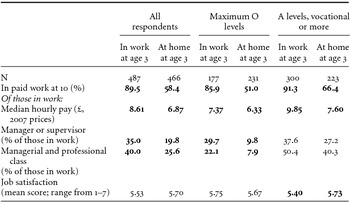
An examination of employment outcomes when the youngest child reaches ten shows big differences between those who were in work when their children were pre-school age and those who were not. Table 3 shows a series of labour market outcomes at child age ten split by labour market status at age three. Those who were in work when their youngest child was three are much more likely to be working when the child reaches ten than those who were not. Among those working, the former group are likely to have higher hourly pay and are more likely to be a manager or supervisor and to have higher occupational class as measured using the National Statistics Socio-Economic Classification (NS-SEC). Table 3 also shows that these differences exist within the two broad skill level groupings, with results for management and NS-SEC rather larger and more significant within the lower-skilled than the higher-skilled group. The only labour market outcome showing no significant difference overall is job satisfaction. For higher-skilled women only, there is a significant difference: women who were not in employment when their youngest child was three are on average more satisfied with their job seven years later than women who were also in paid work at the earlier point.
Employment outcomes when youngest child is ten, by employment status when youngest was three and by education

Notes: Bold type shows significant differences at the 99% confidence level between women working and not working when the youngest child was three years old (36 months). For hourly pay, the test was run on mean rather than median pay. ‘Managerial and professional class’ refers to the top two categories of the National Statistics Socio-Economic Classification.
Source: Author's calculations using waves 1–17 of the BHPS.
However, at least in part these differences reflect selection effects rather than causal relationships. Mothers who return to work when their children are young are likely to differ from mothers who stay at home in what Anderson et al. (Reference Anderson, Binder and Krause2003) (p. 279) calls ‘unobservable, wage-enhancing capital’; in particular, they are probably more committed to their careers. Duncan and Edwards (Reference Duncan and Edwards1999) highlight the systematic differences between social groups in their views and motivations towards combining motherhood and paid work, distinguishing between three main ideal types of ‘gendered moral rationalities’: ‘primarily mother’, ‘mother/worker integrated’ and ‘primarily worker’ (see also Hakim's, (Reference Hakim2000), work on preference theory). The jobs women go into may also be different for those who return early than for those who remain longer at home; women taking only maternity leave may be returning to a job where they have already established firm-specific skills which are not reflected in broad qualification levels.
How do we net out these factors in order to assess the impact of the decisions themselves? Examining changes in wages over time is difficult here because of the nature of the dataset: we rely on the BHPS employment histories to build a sample large enough for analysis, and this means we do not have good data on pay in previous jobs. Other datasets are better for this purpose, and in related work we look at growth in wages using the British Lone Parent Cohort and the Families and Children Study (see Stewart, Reference Stewart and Swaffield2009; Bastagli and Stewart, Reference Bastagli and Stewart2011). Here, we simply try to control for all the measurable factors likely to drive both the pathway and the later outcomes, to see whether we can identify an independent impact of the pathway. If there are unobserved confounding variables not captured by our controls, our estimated coefficients will be biased upwards.
Employment status
We focus on three employment outcomes at the point at which the youngest child is ten: whether or not a mother is in paid work, the hourly wage and job satisfaction. Outcomes are analysed using regression techniques, with the aim of controlling for all factors which are likely to drive both the employment trajectory and the outcome, to identify whether an association between trajectory and outcome remains which is not explained by these other factors. Thus, all the regressions control for educational qualifications at birth of youngest child, years of work experience prior to the birth, potential work experience (age), the number of children and whether or not the household were owner-occupiers at the time of the birth.Footnote 4 This last is intended to capture otherwise unobserved work commitment: those who have bought their own home may act differently as a result of the pressure of a mortgage, while the act of buying a property (and the fact that a bank was willing to put up the money) is also likely to be a reflection of pre-existing motivation. We also include a set of dummies for the year of birth of the youngest child to control for the fact that mothers are facing different employment conditions than each other when their children are the same age. In regressions for employment status at child age ten, we include partnership status (whether the mother experienced partnership breakdown and whether or not she repartnered), but for wage and job satisfaction regressions, we decided that these variables were most likely to influence later employment outcomes via their effects on employment trajectory rather than having an independent additional effect. (In practice, partnership status was in any case insignificant in all models except some job satisfaction models.)
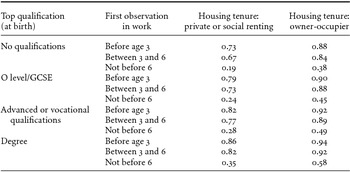
Table 4 shows predicted probabilities for employment status at child age ten, the results of logit regression. Predicted probabilities are presented for women with a number of alternative characteristics, dependent on the point at which they were first observed in work after the birth (regardless of the later trajectory). The characteristics which vary are educational background and housing tenure around the time of birth; these are the variables which showed up in the regressions as significantly associated with employment status at child age ten. Other variables are set as constant across all the groups: women are assumed to have two children, a partner in stable employment, be of average age and have average levels of work experience prior to birth.
Predicted probabilities for being in work when youngest child is ten

Notes: Binary logit regression. N = 909. R squared = 0.26. Year dummies included. All women are assumed to have two children, a stable partner throughout the decade, be of average age and have average levels of work experience prior to the birth. ‘First observation in work’ refers to just that, regardless of the later trajectory; that is, those who will subsequently leave employment again are also included.
Source: Author's calculations using waves 1–17 of the BHPS (1991–2007).
It is clear, first, that within each educational and tenure group the likelihood of employment at child age ten is greater for those who returned to work earlier. However, the differences between those observed entering work before their youngest child reached three and those entering work when the child was between three and six are generally not very large (in fact in all cases the 95 per cent confidence intervals overlap for these categories).
Second, the point of return is more strongly associated with later outcome for those with lower levels of qualifications and for those who do not own their homes. Among mothers who both have a degree and are owner-occupiers there is a negligible difference between the ‘before three’ group (94 per cent in employment at child age ten) and the ‘three to six’ group (92 per cent). Even among those still not observed in work by the sixth birthday, 58 per cent of mothers in this category will be working at the interview after the child turns ten. In contrast, for mothers with no qualifications and living in social housing or renting privately, being observed in work before child age three increases the probability of working at child age ten more than three-fold compared to a mother not observed working in the first five years (a probability of 73 per cent compared to 19 per cent). Note that mothers with a degree but living in rented accommodation look almost identical in their probability of working to mothers with no qualifications but living in owner-occupied housing.
What can we take from these results? One interpretation is that encouraging mothers into work relatively quickly after the birth of a child really is a sensible way to increase their probability of employment later on, and that this is particularly important for mothers with low or no qualifications, and for those who live in rented housing. An alternative interpretation is that within each qualification and tenure group the mothers who returned earlier are simply different from those who did not in ways that we still have not managed to control for, and that these results offer no more than a description of the underlying work motivation of women in different categories. The owner-occupier variable appears to be capturing some of these differences in motivation, but it is unlikely that it is successfully picking up all of it.
The most plausible (if rather unsatisfactory) answer is that the truth lies somewhere in the middle. Differences in probabilities will to some extent reflect differences between women, so we would be naïve to assume that a mother's probability of being in employment at child age ten would be increased as much as three-fold if she had only entered employment earlier. But at the same time the scale of these differences are unlikely to be explained entirely by differences in hidden characteristics. It is clearly likely that the act of working would increase the future likelihood of employment through familiarity, expanded networks and contacts and exposure to other work-orientated peers. If maternal employment as a child approaches secondary school age is itself an important policy goal, encouraging and facilitating employment in the earlier years may then be sensible, with particular reason to focus on women with few qualifications and on women living in rented housing. In the following sub-sections, we go on to look at the quality of work in these jobs at child age ten – how well they are paid and the job satisfaction they afford – and whether these indicators are associated with earlier pathways.
Wages
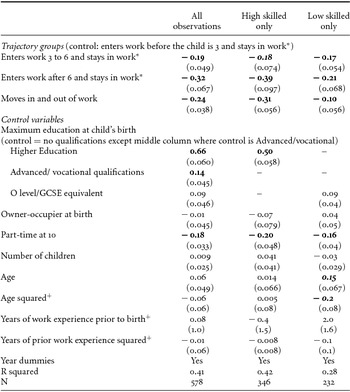
Table 5 shows the results of OLS regressions run to estimate the association between employment pathway after the birth and hourly wages a decade on. In these regressions, dummy variables were included to capture four pathways – returning to work by the child's third birthday and being observed consistently in work thereafter (the control group); returning after the third but before the sixth birthday; returning after the sixth birthday; and moving in and out of work over the decade. Regressions were run on the sample as a whole and then separately for women with higher qualifications (at least advanced or vocational) and those with low qualifications (maximum GCSE equivalent).
Regression results for log hourly wages when youngest child is ten (OLS)

Notes: Results of OLS regressions run with robust standard errors. Bold type indicates significance at the 1% level; bold and italics indicates significance at 5% level. Standard errors are given in brackets. Sample sizes are smaller than in previous tables as only women in employment when their child reaches ten are included. * By 3 years means by 36 months; 3–6 years means between 36 and 71 months; and after 6 means 72 months or more. +Coefficients and standard errors transposed up by 100.
Source: Author's calculations using waves 1–17 of the BHPS (1991–2007).
Because the regressions are run on the log of hourly wages, the coefficients can be approximately interpreted in percentage terms. Thus entering stable work between child age three and six is associated with an hourly wage 19 per cent lower than entering before three, while entering after five is associated with a reduction of 32 per cent. Moving in and out of employment over the decade appears to carry a penalty of 24 per cent. Note that these coefficients are relatively small in comparison to the benefits associated with higher education (wages 66 per cent higher) but are considerably larger than those associated with advanced or vocational qualifications (14 per cent). They are also larger than the 18 per cent penalty for part-time working.
The next question is whether this holds true for everyone, whatever their qualification levels. The size of the penalty attached to entering work between child age three and six, rather than before three, is similar for the two skill levels, as the second and third columns of Table 5 show. But the penalties attached to entering after six, and to an unstable trajectory, are larger and more significant for the more qualified group. Higher-skilled women, who enter paid work after child age six, have wages which are 39 per cent lower than those entering before child age three, while the associated penalty for lower-skilled women is 21 per cent. For those who move in and out of work, the difference is larger: 31 per cent for the higher-skilled group and 10 per cent (and insignificant) for those with only GCSEs or no qualifications.
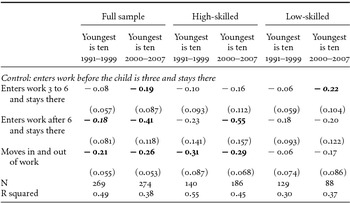
One possible explanation for the lower penalty associated with an unstable pathway or later return for the less qualified is that the introduction of the National Minimum Wage (NMW) in 1999 placed a floor on wages at the bottom of the distribution. If all jobs pay at least the NMW, and if employers make up for the cost of this in part by flattening wage-growth profiles for low-paid workers, the penalty for reduced experience or an unstable work record will be limited: a worker can leave the labour market confident that the job they return to will pay at least the minimum wage. To investigate this we run regressions separately for mothers whose youngest child reaches ten before 1999, and those whose work history includes at least one year post-1999 (the youngest child reaches ten in 2000 or later). If the NMW is having the anticipated effect, we would expect penalties for time out of work to be smaller in the later than the earlier period for the low-skilled group. As Table 6 shows, this pattern does not emerge from the data. Unfortunately, sample sizes are very low, but if anything, the penalties associated with time out of work and instability appear to have increased for the lower-skilled group since the introduction of the NMW.
Trajectory coefficients for pre-NMW and post-NMW samples

Notes: Results of OLS regressions run with robust standard errors. The same control variables as in Table 7 were included. Bold type indicates significance at the 1% level; bold and italics indicates significance at 5% level. T-statistics are given in brackets. Only women in employment when their youngest child reaches ten are included.
Source: Author's calculations using waves 1–17 of the BHPS (1991–2007).
Job satisfaction
Our third employment outcome, job satisfaction, was the only outcome to show no significant differences by earlier employment status in the raw associations presented in Table 3. It is perhaps of no surprise then that none of our trajectories turns out to be significant in the regression analysis. Job satisfaction does not appear to be explained by length of time or stability in work, or indeed by qualification levels. In fact, just two of the variables in the job satisfaction model were significant (both at the 5 per cent but not the 1 per cent level): higher-skilled mothers were found to have somewhat higher job satisfaction if they worked part-time, and lower-skilled mothers had lower job satisfaction if they were lone parents.
Conclusions
The first part of this paper examined the monthly employment histories of mothers in the decade after the birth of their youngest child, and identified a substantial level of employment instability. While 22 per cent of mothers in our sample are in paid work throughout the decade, entering or returning to employment by the time the child is eight months, and a further 29 per cent enter a job at some time over the course of the decade and remain in continuous employment thereafter, more than one in three mothers are observed moving in and out of paid work. Interestingly, instability is equally common among higher-skilled and lower-skilled mothers, although it is somewhat lower for those with a stable partner himself in continuous employment than for women who experience relationship breakdown or whose partner has a broken employment history.
The second part of the paper examined the association between mothers’ pathways during this decade and their employment status, wages and job satisfaction when the youngest child reaches ten. Despite employment instability, mothers who return to work sooner after the birth of their youngest child are much more likely to be observed in work when the child is ten, even after including all available control variables. This is true across skill levels, but an earlier return appears most important in predicting later employment for mothers who are more disadvantaged – those who have few or no qualifications and do not own their own homes.
When we examine wages, we also find a long-term effect of an early return, although here the impact is larger for higher-skilled than lower-skilled women. Among women with at least advanced or vocational qualifications, wages when the youngest child is ten are 39 per cent lower for those who returned to stable employment after the child turned six than for those who returned before the child's third birthday, and 31 per cent lower for those observed moving in and out of work over the period. For the lower-skilled group, the corresponding penalties are 21 per cent (returning after six compared to before three), and a statistically non-significant 10 per cent (moving in and out of work). Note that these estimates should be seen as upper bounds, both because the coefficients are almost certainly biased upwards by unobserved confounding variables (such as passion for one's job), and because of an endogeneity problem: women are more likely to remain in jobs which offer good prospects, so to some extent the wage trajectory will drive the employment pathway, as well as vice versa.
These findings are in keeping with human capital theory, which predicts that lost years of experience will matter more for more highly skilled workers. The findings are also consistent with the literature on wage growth, which has found lower returns to experience for lower-skilled than for higher-skilled workers (Heckman et al., Reference Heckman, Lochner and Taber1998; Gladden and Taber, Reference Gladden, Taber, Card and Blank2000; Dustmann and Meghir, Reference Dustmann and Meghir2005). However, the literature focusing specifically on maternal employment and the impact of employment breaks around childbirth has tended not to distinguish between mothers with higher and lower levels of qualifications (e.g. Waldfogel, Reference Waldfogel1998; Joshi et al., Reference Joshi, Paci and Waldfogel1998; Jacobsen and Levin, Reference Jacobsen and Levin1995). Our findings underline the importance of differentiated analysis: the average effects identified in much of the existing analysis of gender and family gaps disguise important heterogeneity.
In terms of policy, potential conclusions arise from both the findings on employment instability and from those on wage penalties. If unstable pathways are so common, it indicates the need for a stronger focus on employment sustainability, and it also carries implications for related policies which are based on the assumption that stable employment is standard. For example, the childcare element of Working Tax Credit (to be replaced under Universal Credit reforms) was payable only where all resident parents worked, so a mother or father moving out of a job would be likely to have to disrupt their child's care arrangements. Given the importance of continuity of care for child well-being and development, a subsidy paid directly to the provider or a demand-side payment which included non-working parents would be a better design.
The second set of policy conclusions regard the importance of both encouraging early maternal employment and facilitating employment stability. For higher-skilled mothers, the findings support the position of other studies that minimising employment breaks is very important to increasing women's earnings over the life course and reducing long-term gender inequality. For lower-skilled workers the findings can be interpreted in two ways. On the one hand, the penalties may be seen as fairly small in size, especially given that they represent an upper bound. We found no significant pay difference at child age ten between lower-skilled mothers who were in continuous employment from before their youngest child turned three and those who moved in and out of work over the decade. Furthermore, we found no significant correlation between trajectory and later job satisfaction for either high- or low-skilled women: that is, no evidence that women who go back early and stay in work end up doing something more interesting and fulfilling in the long run. Together, it could be argued that this is insufficient evidence to justify placing pressure on women to enter employment when their children are pre-school age in their own long-term best interests.
On the other hand, the penalties associated with returning later suggest that there are indeed positive pay-offs to going into a low paid job if employment is sustained. Given the other potential positives of maternal employment – immediate income gains, possible benefits of formal childcare, the provision of a working role-model for children, and some evidence that employment may reduce maternal depression, especially for lone parents who prefer to work (see Millar (Reference Millar2008)) – any small long-run pay-off could be argued to be a bonus.
Perhaps a fair conclusion is that there is evidence here in favour of supporting and facilitating paid work among mothers during the pre-school years: this seems to raise prospects of future employment and to carry a pay-off in higher future wages, for lower-skilled as well as higher-skilled women. But there is not sufficient evidence that a low-skilled job leads to sustained work or higher pay to justify coercing mothers who would rather be at home in this period – particularly in the absence of effective policies to foster sustainability and progression.
Acknowledgements
I am very grateful to the editors and the three anonymous reviewers for their comments and suggestions; to Abigail McKnight for comments on an earlier draft; and to Francesca Bastagli for useful discussions and advice on constructing the trajectories.