INTRODUCTION
Brazil provides a context rather different to the liberal democracies in which research on police legitimacy and legal compliance has thus far been concentrated, such as the United States (Reference Sunshine and TylerSunshine & Tyler, 2003), the UK (Reference Jackson, Bradford, Hough, Myhill, Quinton and TylerJackson et al., 2012), and Australia (Reference MurphyMurphy, 2021). A range of social problems combine in a possibly unique way in Brazil to shape the relationship between individuals and state authorities, especially the police: low levels of trust in public institutions (Reference FilgueirasFilgueiras, 2013); high crime rates and fear of crime (Reference Cardia, Castelo Branco, Cubas, Alves and HigaCardia et al., 2014); the role of organized crime (something which is a particular issue in our study site of São Paulo, see Reference Lessing and WillisLessing & Willis, 2019); police violence and a relatively high level of public support (at least among some sections of society) for some of this violence (Reference CaldeiraCaldeira, 2002). Brazil also stands somewhat apart from other Latin American countries in terms of crime, fear, and trust. According to the Americas Barometer Survey fielded in 2016 and 2017, Brazil ranked ninth of 28 countries in terms of victimization but third in fear of crime. There is also a widespread feeling of unsafety and lack of protection. The same survey found that almost a quarter of the respondents reported feeling that their neighborhood was “very unsafe,” and Brazilians had the least faith in their justice system, with almost 9 of 10 respondents reporting little to no confidence that the judiciary will punish the guilty.
In this paper, we present one of the first empirical assessments of police legitimacy and legal compliance in Brazil (cf. Reference OliveiraOliveira, 2021; Reference Trinkner, Rodrigues, Piccirillo, Gifford and GomesTrinkner et al., 2020 and Reference ZaneticZanetic, 2017). Drawing on data from two São Paulo-based surveys—one representative of eight neighborhoods chosen to reflect area-level diversity across the city, the other representative of the city population as a whole (see Appendix A in Data S1 for a description of the two surveys)—we test and extend procedural justice theory (Reference TylerPJT, Tyler, 2006a, Reference Tyler2006b) in a context in which the possibility of violence can be palpable even in relatively everyday police–citizen encounters (Reference Lima, Sinhoretto and BuenoLima et al., 2015). This is a city where people can fear both crime and police, where people may have instrumental and normative to both obey and disobey, and where popular legitimacy can combine with these factors to create a complex and sometimes ambivalent array of authority relations.
We find that the predictors of one component of legitimacy (the ascribed right to power) are consistent with work in settings like the US, UK, and Australia—that is, that a conceptualization of legitimation (the normative criteria that people use to judge the moral right to rule) based on procedural justice can be recovered even in a fearful, low trust policing environment like São Paulo. On this basis, “Western” values regarding the importance of fair process to legitimacy seem to translate to this particular city of the Global South. But contrary to prior work, we find that instrumental (coercive) and normative (consensual) police–citizen authority relations can be usefully framed along a single, coercive to consensual dimension (with ambivalent attitudes toward the police in the middle), not as the two distinct forms of authority relations traditionally conceived. Through our analysis of the composition, predictors, and potential consequences of legitimacy—and its link to compliance with the law—we examine which aspects of PJT translate in São Paulo. Highlighting points of similarity and difference in a high violence, high fear setting, we reveal the complex nature of authority relations in this major city of the Global South.
LITERATURE REVIEW
Scholars generally define popular police legitimacy (Reference TylerTyler, 2006a, Reference Tyler2006b; for discussion, see Reference Bottoms and TankebeBottoms & Tankebe, 2012; Reference Tyler, Jackson, Tankebe and LieblingTyler & Jackson, 2013; Reference Jackson, Gau, Shockley, Neal, PytlikZillig and BornsteinJackson & Gau, 2016; and Reference TrinknerTrinkner, 2019) along two connected lines: first, the belief that the institution is moral, just and proper (assent); and second the belief that the officers who wield its power are morally entitled to enforce the law, make decisions, and expect people to willingly comply with rules and orders (consent). Legitimacy is seen as an ongoing dialogue between power-holders and subordinates (Reference Bottoms and TankebeBottoms & Tankebe, 2012; cf. Reference Martin and BradfordMartin & Bradford, 2021). Through their day-to-day exercise of power (Oliveira et al., 2021), the object of legitimacy (police) continually makes claim to be just, proper and have the right to expect willing obedience and support, and those who are subject to that power continually assess and respond to those claims. Importantly, while citizens evaluate these claims according to locally specific normative expectations about how power should be exercised (Reference Huq, Jackson and TrinknerHuq et al., 2017; Reference JacksonJackson, 2018; Reference Jackson and BradfordJackson & Bradford, 2019), PJT predicts that procedural justice is central to creating and maintaining the perceived right to rule, that is, fair interpersonal treatment and decision-making are core normative expectations about the appropriate exercise of power. Legitimacy then motivates people to cooperate with the police and comply with the law because that's the right thing to do.
In contexts like the US and UK there is a good deal of evidence that procedural justice—the perceived fairness of legal procedures (Reference Tyler and HuoTyler & Huo, 2002; Reference Tyler and FaganTyler & Fagan, 2008)—is central to the process of legitimation (for an international review, see Reference JacksonJackson, 2018). When legal officials are seen and believed to make fair, balanced and accountable decisions and are seen and believed to treat people with respect, dignity, politeness and concern for their rights, this seems to help engender legitimacy in the eyes of those they police, serve and protect (Reference Trinkner and TylerTrinkner & Tyler, 2016; Reference TylerTyler, 2006a, Reference Tyler2006b; Reference Tyler and TrinknerTyler & Trinkner, 2017). Recent work is also beginning to highlight the role played by police respecting the limits of their rightful authority (Reference Huq, Jackson and TrinknerHuq et al., 2017; Reference Trinkner, Jackson and TylerTrinkner et al., 2018; Reference Tyler and TrinknerTyler & Trinkner, 2017), suggesting the relational importance of signaling not just status and value, but also respect for people's autonomy and agency (Reference Bradford, Jackson and Hollander-BlumoffBradford & Jackson, 2022). Critically, effectiveness in the fight against crime and distributive justice (fair allocation of policing outcomes such as arrests, citations, protection, and service fairly across aggregate social groups) are typically less important predictors of legitimacy than perception of fair process and restrained use of power, particularly because they have less relational significance (Reference Bradford, Murphy and JacksonBradford, Murphy, & Jackson, 2014; Reference Jackson, Huq, Bradford and TylerJackson, Huq, et al., 2013; Reference Mazerolle, Antrobus, Bennett and TylerMazerolle et al., 2013; Reference Mentovich, Ben-Porat, Levy, Goff and TylerMentovich et al., 2018).
Overall, the findings of studies from an increasing number of countries across the world—including the United States, Australia, Israel, UK, Hong Kong and Trinidad & Tobago—support PJT's two core predictions: (a) that procedural justice is the most important normative expectation regarding the appropriate use of power, and (b) that police legitimacy is related to people's willingness to cooperate with legal authorities and comply with the law (for meta-analyses, see: Reference Bolger and WaltersBolger & Walters, 2019; Reference Walters and Colin BolgerWalters & Colin Bolger, 2019). Legitimacy has also been shown to be a more important predictor of legal compliance than instrumental authority-relations based on perceptual deterrence, police effectiveness and fear of sanction on this matter (Reference Papachristos, Meares and FaganPapachristos et al., 2012; Reference Jackson, Bradford, Hough, Myhill, Quinton and TylerJackson et al., 2012; Reference Trinkner, Jackson and TylerMurphy et al., 2016; Trinkner et al., 2018), albeit we need more experimental data in this area of work (Reference Nagin and TelepNagin & Telep, 2020; Reference TylerTyler, 2017).
Yet, procedural justice may not be the central factor in the legitimation of legal authorities in each and every national context (Reference TrinknerTrinkner, 2019; Reference TylerTyler, 2006a, p. 384; Reference Tyler and LindTyler & Lind, 1992; Reference Lind and TylerLind & Tyler, 1988). Procedural justice is powerful, in part because authorities use it as a signaling device to confer group status and membership. As Reference TylerTyler (1997, p. 325) says:
“…identity-based relational models predict that the extent to which people identify with groups will influence the basis of their judgments about authorities—with people who identify strongly with groups being more concerned about their treatment by authorities.”
On this account, when individuals do not identify with the group an authority represents, or have little inclination to be a member, police legitimacy will be judged less on the basis of (relational) process (because fair process communicates positive status within the group) and more on the basis of instrumental outcomes (Reference Lind and TylerLind & Tyler, 1988; Reference Tyler and LindTyler & Lind, 1992).
There is emerging evidence that public concerns about effectiveness are at least as important to explaining variation in legitimacy as procedural justice in countries that have (a) high levels of crime, (b) legal institutions that have not yet been able to provide a bare minimum of security to citizens, (c) police with a long history of abuse of power, (d) authoritarian governments and state institutions, and/or (e) where people may tend not to identify so strongly with the group that the police represent. This is shown in research in South Africa (Reference Bradford, Huq, Jackson and RobertsBradford, Huq, et al., 2014), Pakistan (Reference Jackson, Asif, Bradford and Zakria ZakarJackson et al., 2014), Ghana (Reference TankebeTankebe, 2009) and China (Reference Sun, Wu, Hu and FarmerSun et al., 2017). In South Africa, for instance, Reference Bradford, Huq, Jackson and RobertsBradford, Huq, et al. (2014) suggest that normative judgments about fair process may to some degree be crowded out by concerns about police ineffectiveness and corruption, the sheer scale of the crime problem, and the association of the police with a historically oppressive and underperforming state.
In China, Reference Sun, Li, Wu and HuSun et al. (2018, p. 276) argue that procedural justice may not be the most important source of legitimation, in part because “…the police in an authoritarian state are commonly empowered with excessive authorities that do not match normative expectations of democratic policing (e.g., procedural fairness, institutional transparency, and accountability).” Picking up this point, Reference TrinknerTrinkner (2019) argues that if people in South Africa or China are routinely sent signals that they are not a valued part of the social group that the police represent, or if the group that the police represent is not especially meaningful for most people, then procedural justice may not be so important to the legitimation of the police (Reference Tyler and LindTyler & Lind, 1992; Tyler, 1997). Factors like the fair allocation of resources and the effectiveness of behavior regulation among group members may come more to the fore, especially in contexts with high crime levels, police violence and corruption, and state authoritarianism.
CRIME AND POLICING IN BRAZIL
In light of the above, Brazil is a fascinating setting in which to explore police legitimacy and legitimation. In addition to the social issues already outlined, the history of the Brazilian police is entwined with the history of slavery. During the period of European colonization in South America, Brazil had the largest number of enslaved people for the longest period, and was the last country in the Americas to abolish slavery (in 1888). In an echo of the history of the southern United States, police throughout the period of slavery were essentially privately controlled by enslavers, and policing was targeted at enslaved people. However, abolition did not secure effective redress to the emancipated population, who experienced an incomplete and deficient form of citizenship (Reference HugginsHuggins, 2000) characterized by high levels of dependence on the state, patrimonial-like relations with local power-holders and an absence of genuine civil rights (Reference Schwarcz and StarlingSchwarcz & Starling, 2015).
Brazil also lived through an unstable twentieth century, shifting between dictatorship (1937–1945 and 1964–1985) and democratic rule. Even the democratic regimes had a de facto authoritarianism, with high levels of social control exerted over the marginalized poor and widespread political repression and illegal physical violence (Reference PinheiroPinheiro, 1991). Although the professionalization of the police was formally completed during the twentieth century (Reference BatitucciBatitucci, 2010), it remains associated with patrimonial power structures constituted by an overlap of the public and the private spheres. These relations are characterized by a power imbalance and significant social distance between a large excluded population and the State (dominated by a powerful minority).
More recently, a form of penal populism in Brazilian society is reflected partly by the expanding prison population; the per capita incarceration rate doubled between 2000 and 2014 (Reference IturraldeIturralde, 2019). This punitive demand is matched by use of lethal force by the police (Anuário de Segurança Pública, 2017). Cases of excessive violence by the São Paulo Military Police are common. In 2018 alone, there were 6160 confirmed police killings (Reference da ViolênciaMonitor da Violência, 20191), which is more than 25 times higher per capita than in the United States (The Guardian: The Counted) – and official statistics likely fall short of the real number (Reference WillisWillis, 2015). While it is impossible to ascertain the proportion of these killings that were illegal, nor fully document the extent of unreported cases of killings committed by officers, this is a large enough number to characterize police violence in São Paulo as a significant societal problem. The election of Jair Bolsonaro to the Brazilian presidency is a further confirmation of these tendencies—Bolsonaro is a former army captain who speaks nostalgically about the 1964–1985 military dictatorship and has openly advocated police killings of criminals, promising iron-fisted policies and a crackdown on crime.
Within this context of multi-layered authoritarianism police remain highly militarized. Policing in each Brazilian state is carried out by two independent organizations: Military Police is responsible for day-to-day policing and order maintenance while Civilian Police, also known as the “judiciary police,” comprise less than one third of overall numbers (Reference Lima, Sinhoretto and BuenoLima et al., 2015) and oversee crime registry and investigations. Military Police retains a particularly strong historical link to the period of slavery, indeed it has remained essentially the same organization since the nineteenth century, when its primary purpose was repressing insubordinate enslaved people (Reference BatitucciBatitucci, 2010). As all of its officers are part of the army reserve force, they must wear uniforms and carry weapons at all times, and their training and deployment involves a number of military features, for example, strong hierarchical discipline.
The role and behavior of the police in Brazil suggests: (1) that the state does not guarantee an appropriate level of security for a significant portion of society and (2) that even when security is provided, social elites benefit more (Reference Pereira, Ungar, Hite and CesariniPereira & Ungar, 2004; Reference GonzálezGonzález, 2017). The police are also more likely to use excessive force against people living in poor areas, who are more likely to be from racialized groups (Reference GarmanyGarmany, 2014; Reference GoldsteinGoldstein, 2003; Reference Mitchell and WoodMitchell & Wood, 1999; Reference Paes-Machado and NoronhaPaes-Machado & Noronha, 2002; Reference WillisWillis, 2015). Black residents seem to be less likely to be involved in community policing programs, which tend to be concentrated in middle-class and upper-middle-class areas (Reference WillisAlves, 2014). There is some evidence that elites and sections of the middle-class support police violence that seems to them to be directed at maintaining existing class, race, and gender hierarchies. While they are unlikely to view the police in a favorable light, they are still supportive of state action that seeks to uphold the established order (Reference Briceño-León, Carneiro and CruzBriceño-León et al., 1999).
Crucial to the current argument is that the relationship between police and the policed in Brazil may be marked by conflicting attitudes, including fear of being mistreated by the police but also relatively high levels of tolerance of—or at least ambivalence toward—excessive police violence against certain out-groups. Studies show that a fair amount of Brazilians distrust the police (Reference Silva and BeatoSilva & Beato, 2013) and some fear them (Reference Cardia, Castelo Branco, Cubas, Alves and HigaCardia et al., 2014), yet also that a considerable number do not necessarily condemn police violence when it is targeted at the marginalized and excluded (Reference Briceño-León, Carneiro and CruzBriceño-León et al., 1999; Reference CaldeiraCaldeira, 2002; Reference GarmanyGarmany, 2014; Reference Paes-Machado and NoronhaPaes-Machado & Noronha, 2002). There have also been calls in upper-middle-class neighborhoods to reinstate the edicts of the military dictatorship (González, 2017).
Moreover, even in relatively routine police–citizen encounters force may often be experienced by citizens as salient and “present.” Almost half of all involuntary police-initiated encounters in São Paulo between 2015 and 2018 involved officers directly pointing a gun at the citizen (Reference Oliveira, Jackson, Theodoro, Piccirillo and TrinknerOliveira et al. 2021), and almost one in every five 14-year-olds living in São Paulo have witnessed police beating someone. While the ascribed right to use force is partly what defines legal authority in most Western contexts, in Brazil the state's ability to use force goes one step further and can be experienced and/or framed by many citizens as a concrete threat: police not only can but will use violence to exert power. This could be linked to a violent history: after centuries of colonialism and slavery and recent dictatorships (Reference Schwarcz and StarlingSchwarcz & Starling, 2015), it is plausible that the idea that violence is the only way to exert power has some widespread currency – in what Reference PinheiroPinheiro (1991) labels a socially rooted authoritarianism.
São Paulo presents, then, a fractured social, political, and economic policing climate—at least compared to cities and countries in which PJT has thus far been tested. Police represent the proximate face of a paternalistic and authoritarian state, and low levels of trust may have had a negative impact on legitimation of the state and even satisfaction with the general idea of democracy (Reference FilgueirasFilgueiras, 2013; González, 2017). Procedural justice may be less important to police legitimacy in São Paulo than factors like effectiveness and distributive justice, and people may have favorable attitudes toward “excessive” police directed toward certain out-groups. Given that people may more readily associate power with the threat of violence (at least compared to some of the more traditional PJT research settings), fear of police and instrumental and normative reasons to obey and disobey may complicate the traditional conception of legitimacy and its link to compliance with the law. One might imagine police–citizen relations are relational for some, instrumental for others, but looking across the full population there could be considerable ambivalence.
How might PJT translate to Sāo Paolo in terms of normative versus instrumental motivations to comply with the law? In the two studies that make up this paper, we assess the construal of legitimacy and its potential antecedents and consequents, thereby contributing to the growing international literature on instrumental and normative authority relations. Examining whether PJT needs to adapt to the current context (and if so, how it needs to adapt), we address the criteria of legitimation in study one. Study two turns to the nature of instrumental and normative police–citizen relations and motivations to comply with the law.
STUDY ONE: WHAT LEGITIMATES THE POLICE IN SÃO PAULO?
A starting premise of study one is that the content of legitimation—that is, the bases on which popular legitimacy (which political philosophers might call empirical or descriptive legitimacy, e.g., Reference ApplbaumApplbaum, 2019) is justified or contested through police activity in a given context—is something to be discovered through empirical research (Reference HoughHough, 2020), not something to be imposed from the outside on the basis of political, moral, legal, religious or some other philosophy (Reference TrinknerTrinkner, 2019). If, for example, empirical work shows that procedural justice is the strongest (positive) predictor of legitimacy, then one can infer that procedural justice is an important dimension of appropriate (legitimate) police conduct, that is, that procedural justice is a defining feature of what “appropriate, legitimating use of power” means in that specific setting.
At the threshold, it is important to say that this is an assumption (Reference Jackson and BradfordJackson & Bradford, 2019). It depends first on a conceptual analysis of legitimacy that marks off apt boundaries, and second on a well-reasoned operationalization strategy that allows researchers to judge the validity of the measures of the legitimacy construct. We draw on the idea of normative alignment, which holds that legitimacy is partly based on people's internalization of the sentiment that Reference Brinkmann and ApplbaumBrinkmann (2020, p. 1203) calls—in his review of Reference ApplbaumApplbaum's (2019) book Legitimacy: The Right to Rule in a Wanton World— “we are ruling over you, but you are part of this we,” that is, that power is being exercised in ways that benefit and respect the interests, values and status of the group (Reference Jackson, Bradford, Hough, Myhill, Quinton and TylerJackson et al., 2012; Reference Jackson, Huq, Bradford and TylerJackson, Huq, et al., 2013). We measure normative alignment using items that tap into the sense that police generally act in normatively appropriate ways, that is, in ways that show respect for people's sense of how authority should be exercised on behalf of them and the group(s) they identify with (Reference Huq, Jackson and TrinknerHuq et al., 2017).
By way of contribution, we draw on data from a survey of residents of eight different neighborhoods in São Paulo to test whether people's perceptions of police as a moral, just and appropriate institution—operationalized as normative alignment between police and citizen values—are founded primarily in judgments of procedural justice, or whether São Paulo residents place greater emphasis on bounded authority (the restrained use of power), distributive justice (which we define as the fair allocation of outcomes, here the “goods” and “bads” of policing across diverse social groups) and effectiveness in the fight against crime. Given the context, it is also important to test whether those who tolerate “excessive” violence against criminal out-groups also tend to view the police, who do sometimes use extreme violence against certain groups, as legitimate (and vice versa, whether those who are intolerant of such behavior tend to see the police as illegitimate). In the current paradigm, this means testing whether tolerance or intolerance of “excessive” police violence predicts normative alignment, adjusting for procedural justice, distributive justice, effectiveness, and bounded authority.
The first potential predictor of normative alignment is procedural justice. Definitions of procedural justice have evolved over the years, from Reference Thibaut and WalkerThibaut & Walker's (1975) focus on process and outcome control in the allocation of resources, Leventhal's (1980) interest in people's perceptions of the fairness of allocative processes (decision accuracy, correctability, ethicality, representation, ability to suppress bias, etc.),Reference Tyler and FolgerTyler and Folger's (1980) emphasis on more informal interactions between police and citizens, Reference TylerTyler's (1988) inclusion of whether authorities are seen to act fairly and give the opportunity to correct errors, all the way up to the differentiation (e.g., Reference Tyler and BladerTyler & Blader, 2000, Reference Tyler and Blader2003; Reference Trinkner, Jackson and TylerTrinkner et al., 2018; for recent discussion, see Reference Grootelaar and van den BosGrootelaar & Kees van den Bos, 2018; Reference SolomonSolomon, 2019; Reference Ansems, Van den Bos and MakAnsems et al. 2020) between fair interpersonal treatment (being treated with respect and dignity and believing that authorities have trustworthy motives) and fair decision-making (neutral, unbiased decision-making, and having a voice in the interaction). Taking this most recent approach, we focus on police officers in their neighborhood being seen to generally treat people with respect and dignity, make neutral decisions, and allow citizens the chance to give their “side of the story.” This perspective puts the relational qualities of procedural justice center stage (Reference Lind and TylerLind & Tyler, 1988; Reference Tyler and LindTyler & Lind, 1992; Reference Jackson, Gau, Shockley, Neal, PytlikZillig and BornsteinTyler, 1997) but we should note that our measurement strategy does not include trustworthy motives—we want to put some “clear conceptual water” between procedural justice and legitimacy (the appropriateness part of the legitimacy construct is sometimes operationalized as institutional trust, for discussion see Jackson & Gau, 2016).
The second potential predictor of normative alignment is distributive justice. Distributive justice is generally defined in two ways: (a) perceptions of individual outcome fairness and deservingness (Reference Tyler and BladerTyler, 2006a; Tyler & Blader, 2000; Reference Solomon and ChenaneSolomon & Chenane, 2021; and Reference McLeanMcLean, 2020) and (b) perceptions of the fairness (or otherwise) of the allocation of the outcomes of exercised power—the “goods” and “impositions” of policing, both in the maintenance of social order and in the application of social control—across diverse social groups (Reference Sunshine and TylerSunshine & Tyler, 2003). We take the second approach (see Appendix B in Data S1 for further discussion). While studies in the US, UK, and Australia have tended to find that distributive justice is a less important predictor of legitimacy than procedural justice, it is possible that distributive justice is an important legitimating factor in São Paulo, in part because of higher problem salience—after all, the police are perceived to act more aggressively in some neighborhoods than in others (Reference OliveiraOliveira, 2021). Public concerns about the distributive justice of the police are relatively strong in São Paolo, with around two-thirds of research participants (63%) in study two of the current paper saying that the police either “never,” “rarely,” or only “sometimes” treated people equally. This compares to Reference Tyler and JacksonTyler and Jackson's (2014) national study of US citizens, where 45% said the police treated people differently according to their wealth, and 40% said the police treated people differently according to their ethnicity.
The third potential predictor of normative alignment is effectiveness in the fight against crime, measured here as dealing with drug dealing and armed robberies, investigating crime, keeping people safe, responding to emergency calls, and providing general crime-related services. As with distributive justice, effectiveness may be important to police legitimacy in São Paulo. On the one hand, levels of crime—and fear of crime—are relatively high. People may place special importance on the ability of the police to keep them safe when thinking about the justified use of power. On the other hand, perceived police effectiveness is relatively low. Some 42% of respondents in study two say they believe that local police are doing a good or very good job at responding to emergency calls, whereas Reference Tyler and JacksonTyler and Jackson (2014) found that 63% of their respondents thought that the police would arrive quickly if a violent crime were to occur in their neighborhood. As in Reference Bradford, Huq, Jackson and RobertsSouth Africa—Bradford, Huq, et al. (2014) found only two-fifths of people reported believing that the police would arrive quickly in an emergency—it may be that the police in São Paulo have not yet established the baseline, minimum ability to provide basic levels of security to citizens. This may raise the importance of police effectiveness in how people define the appropriate use of power.
The fourth potential predictor of normative alignment is bounded authority. Trinkner and colleagues (Reference Huq, Jackson and TrinknerHuq et al., 2017; Reference Trinkner, Jackson and TylerTrinkner et al., 2018; Reference Trinkner and TylerTrinkner & Tyler, 2016; Reference Tyler and TrinknerTyler & Trinkner, 2017) have argued that peoples' beliefs about the situations into which officers intrude, and the powers that officers exercise, represent an essential element of how they define and understand their relationship with police, like for instance how police power is legitimated in the eyes of citizens. We assess whether some individuals in São Paulo question whether the police are legitimate authorities when they believe that the police act as if they are above the law. In study two's city-wide representative survey, less than half of respondents said that the military police and the civil police (47% and 49%, respectively) always or very often acted according to the law, while Tyler & Jackson (2014) found that more than two-thirds of respondents (68%) agreed or strongly agreed with the statement that “when the police deal with people they almost always behave according to the law.”
The fifth (and final) potential predictor of normative alignment is perception of “excessive” police violence (for discussion of the theoretical and empirical links between legitimacy and attitudes toward citizen and police violence, see Reference Jackson, Bradford, Stanko and HohlJackson, Bradford, et al., 2013, Reference Gerber and JacksonGerber & Jackson, 2017, Reference Bradford, Milani and JacksonBradford et al., 2017, and Reference Gerber, González, Carvacho, Jiménez-Moya, Moya and JacksonGerber et al., 2018). People in São Paulo are aware that the police can use quite extreme violence in certain situations (González, 2017; Reference WillisWillis, 2015), and we presented study one participants with three scenarios, broadly based on actual cases that occurred in São Paulo in a few years prior to fieldwork that received extensive mass and social media coverage: disproportionate violence against protesters, the torture of a person in custody, and the murder of a suspect. Respondents were then asked what they thought about the officer behavior. Of particular interest is whether people who tolerate this kind of behavior (to foreshadow the results we find, e.g., that just under one-quarter, 22%, thought that the police torturing a drug dealer to get information was either “good” or “excellent”) are more likely to believe that the police is a normatively appropriate institution (adjusting for perceptions of procedural justice and distributive justice, effectiveness, and bounded authority) compared to people who are intolerant (for whom one could infer that “excessive” violence delegitimizes the police).
Data, measures, and analytical strategy
Data come from the second wave of a three-wave longitudinal survey—designed and run by some of the current coauthors—that was representative of eight heterogeneous neighborhoods of São Paulo (for details see Reference Nery, Souza and AdornoNery et al., 2019, and Reference OliveiraOliveira, 2021). The first wave was conducted in 2015, and 150 citizens in each of the eight areas were selected based on demographic quotas (gender, age, and education), producing a sample of 1200 respondents. Because there was an attrition rate of 22.7%, a total of 928 of those respondents took part in the second wave of the study in 2017 (see Appendix B in Data S1 for an assessment of attrition). We use the second wave because it contained the requisite variables needed to test the current predictions. All interviews were conducted face-to-face at the respondents' place, in Portuguese, using Tablet-Assisted Personal Interviewing (TAPI). Appendix B in Data S1 provides descriptive statistics and details of the measures.
Our analysis has three stages. First, we use confirmatory factor analysis (CFA) to assess the empirical distinctiveness and scaling properties of procedural justice, effectiveness, bounded authority (all measured using three indicators) and distributive justice (measured using a single indicator). Second, we use latent class analysis (LCA) to assess the underlying structure of people's responses to the three excessive police violence scenarios (see Appendix D in Data S1 for an explanation of why we prefer to represent the underlying latent quantity as categorical rather than continuous). In the LCA we test whether two, three, or four classes best represent the data structure, we choose the model with the most appropriate fit, and we derive a variable based on modal probabilities for the next stage of analysis. We then use structural equation modeling (SEM) to estimate which factors most strongly predict normative alignment, which as mentioned earlier is how we operationalize the perceived moral right to exercise power (the first aspect of perceived police legitimacy).
RESULTS
For the CFA, the approximate fit statistics suggest that the model fits the data adequately and that the scales work reasonably well (see Appendix C in Data S1). For the LCA (see Appendix D in Data S1), the modeling implies that there are three latent categories, with following points
• Fifty percentage of research participants having mixed views about police use of force, albeit with a slight negative skew (the “ambivalent” group).
• Forty-two percentage of research participants being strongly against it (the “intolerant” group).
• Eight percentage of research participants being supporters of excessive police use of force (the “tolerant” group).
In preparation for the next stage of analysis, the most likely (i.e., expected) latent class membership was derived for each respondent given their scores on the various indicators (50% “ambivalent,” 42% “intolerant” and 8% “tolerant”).
Figure 1 reports the results of the fitted SEM, with normative alignment as the outcome variable and potential predictors being procedural justice, distributive justice, effectiveness, bounded authority and the two dummy variables for perceptions of police violence (“ambivalent toward police” and “intolerant of police violence”, with “tolerance of police violence” as the reference category). The model also includes age, gender and each of the eight areas as controls (the coefficients for these variables are omitted for visual ease).
Predicting normative alignment with the police. Standardized regression coefficients. Reference category: “tolerance of police violence.” Controls: gender, age, and seven dummy variables regarding the eight areas

Despite theoretical expectations derived from our reading of the social, political, and legal context of São Paulo (set against prior work in Ghana, Pakistan, South Africa and China), our results are consistent with those from the US, UK, and Australia (e.g., Tyler & Fagan, 2008; Jackson, Reference Jackson, Huq, Bradford and TylerHuq, et al., 2013; Reference Murphy, Bradford and JacksonMurphy et al., 2016). Specifically, procedural justice is the strongest positive predictor of normative alignment (β = 0.81, p < 0.001). People who believed that officers tended to treat people with respect and dignity, make fair and neutral decisions, and listen to people and explain their decisions also tended to be normatively aligned with the police, adjusting for the other factors in the model. We infer from this that fair process is a strong interpersonal norm driving how officers should exercise their power. Effectiveness (β = 0.12, p < 0.001) is a relatively weak positive predictor and neither bounded authority (β = 0.06, p = 0.051) nor distributive justice (β = 0.02, p = 0.586) is statistically significant. Intolerance of and ambivalence toward “excessive” police violence is unrelated to normative alignment in the fitted model, adjusting for the other factors (“intolerant” β = −0.01, p = 0.727, “ambivalent” β = 0.02, p = 0.484). Of note, we also fitted a SEM without procedural justice, distributive justice, effectiveness and bounded authority, and found similar results (“intolerant” β = 0.05, p = 0.440 and “ambivalent” β = 0.07, p = 0.226).
On this basis, it seems that intolerance of “excessive” police violence may not be a source of delegitimation in São Paulo. Compared with people who disapprove of police violence, those who tolerate or approve of police violence are not more or less likely to believe that officers generally act in normatively appropriate ways, adjusting for the other factors in the model. Distributive justice, effectiveness and bounded authority also explain little variance. Instead, our analysis suggests that procedural justice is the most important expectation about the appropriate use of power. It follows that the police need to treat people with respect, make fair decisions, and give people voice in interactions if they are to be seen to exercise their power appropriately. Reference Nagin and TelepNagin and Telep (2020) tie procedural justice closely to democratic principles, which are often used to describe Western societies. It seems that respectful and dignified treatment of citizens by the police is a presumptive and legitimating form of interaction in Brazil's largest city. We return to the implications of this for the international literature in the closing parts of this paper.
STUDY TWO: EXAMINING THE NATURE OF LEGITIMACY AND ITS LINK TO LEGAL COMPLIANCE
Study one focused on the first dimension of legitimacy, but addressing only the perceived right to power provides an incomplete picture. PJT positions legitimacy as both assent and consent. Legitimacy is not just the belief that the institution is moral, just and appropriate, it is also the acceptance of the right of police to expect deference, acceptance of decisions, and voluntary compliance. When officers conform to widely shared expectations about the appropriate use of power, people consent to the responsibilities associated with legal citizenship, not because of coercive, instrumental or other reasons, but because they glean value and identity from being respectful of rules and authority (Tyler, 1997; Reference TylerTyler, 2006b; for discussion, see: Reference Bottoms and TankebeBottoms & Tankebe, 2012; Reference Tyler, Jackson, Tankebe and LieblingTyler & Jackson, 2013; Reference TrinknerTrinkner, 2019; Reference Posch, Jackson, Bradford and MacQueenPosch et al., 2021). They believe that following the instructions of legitimate authority and obeying the laws they enforce is the right and proper thing to do.
It is for this reason that duty to obey is often cited as the component or aspect of legitimacy most clearly motivational in character, especially when it comes to legal compliance (Reference TrinknerTrinkner, 2019; Reference Tyler, Jackson, Tankebe and LieblingTyler & Jackson, 2013). So how does this translate in São Paulo? To address the importance of context for our understanding of the nature of legitimacy, and its connection to compliance with the law, our analysis proceeds in three steps.
Are there different motives to feel obligated to obey and disobey the police?
Prior work in the US, UK, Australia and elsewhere measures obligation to obey using statements like “I feel a moral obligation to obey the police,” “You should accept the decisions made by police, even if you think they are wrong,” and “You should obey police instructions because that is the proper or right thing to do.” When research participants agree with such statements, researchers assume that their answers reflect a normatively-grounded duty to obey. There are, however, other reasons why people may say they would obey the police, aside from what Reference Posch, Jackson, Bradford and MacQueenPosch et al. (2021) call “truly free consent.” Reference Bottoms and TankebeBottoms and Tankebe (2012), Reference TankebeTankebe (2009, pp. 1279–1281, 2013, pp. 105–106) and Reference Johnson, Maguire and KuhnsJohnson et al. (2014), p. 970) argue that people could report an obligation (defining “obligation” in a broader sense than Tyler; for discussion see Reference TrinknerTrinkner, 2019) to obey police for nonnormative reasons, including pragmatism, dull compulsion, and fear of the consequences of noncompliance.
This may be especially relevant in a city like São Paulo, where there are high levels of police violence, malpractice, and corruption, where the threat to use force may be salient (perhaps even explicit) in even mundane interactions, and where police-community relations can be tense, conflictual and ambivalent, normative and nonnormative forms of obligation may need disentangling. Some people might feel obligated to obey the police because they feel defiance is dangerous and/or that they have little choice to do anything but comply (Reference Bottoms and TankebeBottoms & Tankebe, 2012; Reference Johnson, Maguire and KuhnsJohnson et al., 2014; Reference TankebeTankebe, 2009). Other people might feel a normative obligation to disobey the police (see e.g., Reference ApplbaumApplbaum, 2019, p. 44–70) because they imagine the officer giving an immoral order; they might imagine police giving out illegitimate orders and view disobedience as an instance of moral protest. This references the boundary concerns that we investigated in study one—where people assess whether officers stray into spaces that they have no right to be—but it does so in a situation in which respondents imagine themselves being ordered by the police to do something.
To examine whether different people have different reasons for feeling they “should” obey or disobey the police, we employ a combination of closed-ended and open-ended survey questions to probe the issue (Reference Sturgis, Brunton-Smith, Jackson, Beatty, Willis and PadillaSturgis et al., 2020). People's own (i.e., open-ended) assessments of why they might or might not obey the police allow us to gauge the extent of normative and nonnormative obedience. We analyze the qualitative data to form various motivational classifications.
Are motivations to comply with the law distinct from each other?
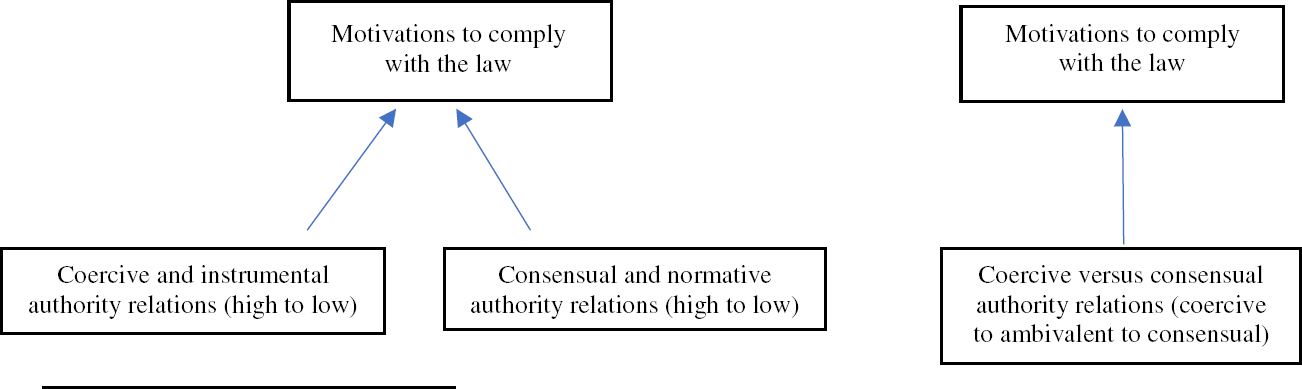
We then use latent trait analysis (LTA) to investigate the correlations between different motives to obey or disobey officers, fear of the police, and normative alignment with the police. PJT distinguishes between normative and instrumental police–citizen relations (see left-hand side of Figure 2), where value-based motivations (that imply consensual modes of policing based on fairness and legitimacy) are conceptually and empirically distinct to deterrence-based motivations to comply (that imply coercive modes of policing on effectiveness and deterrence).1 But in São Paulo, are instrumental and normative police–citizen relations so distinct in people's minds? To foreshadow the findings, we find that a sizeable minority of people (around 20%) who report a normatively grounded obligation to obey are also afraid of the police, and a sizeable minority of people (around 15%) who report feeling normatively aligned with the police are also afraid of the police. If people can hold ambivalent feelings and attitudes toward the police, could instrumental and normative factors be placed on a continuum that ranges from instrumental at one end to normative at the other end, with some mixture of the two intermingling in the middle? Perhaps police–citizen relations are better represented not as two unipolar scales (the left-hand side of Figure 2) but as one bipolar scale that moves from instrumental to normative (the right-hand side of Figure 2)?
Standard (left) and new (right) approaches to conceptualizing coercive and consensual authority relations in the context of compliance with the law

What are the predictors of legal compliance?
To foreshadow the LTA results, we find that a one latent trait model fits the data better than a two latent trait model (Appendix F in Data S1), with the single latent trait akin to the coercive versus consensual relations approach depicted in Figure 2. In the final section of analysis we use the latent trait as a predictor of self-reported offending behavior, adjusting for people's belief about the morality of the acts. This allows us to test the idea in São Paulo that the more coercive the relationship between police and citizens, the more likely they are to report having committing crime; the more consensual the relationship, the less likely they are to report committing crime, and the more ambivalent the relationship, the more likely people are to fall in the middle part of the distribution of legal compliance.
DATA AND METHODS
Appendix F in Data S1 provides details about the measures and analytical strategy. A representative sample, face-to-face survey of adults in the city of São Paulo was conducted in June and July 2015. The final sample consisted of 1804 respondents aged 16 and over living in 96 districts of the city, and was fairly representative of São Paulo as a whole in terms of key demographics. As just mentioned, we measured duty to obey using an open-ended question (“Do you think you have a duty to obey the police even when you believe they are wrong?” with binary “yes” or “no” response alternatives) and an open-ended follow-up question (“Why do you think you have/do not have a duty to obey the police even if you believe the police is wrong?”). Appendix E in Data S1 provides details about the thematic analysis on the open-ended question. After using LTA to assess the scaling properties of the different motives to obey or disobey the police, normative alignment, and fear of police, we test the extent to which measures of obligation to obey and the coercive to consensual continuum scale predict self-reported offending behavior, adjusting for geographical region, gender (self-identified male or female), age, income (with regards to the minimum wage, six categories), education (seven categories), self-reported racial identification (White, Black, Mixed White and Black, Asian-descendant, and Indigenous, see Appendix F in Data S1 for details of the classification system) and personal morality.
RESULTS
Are there different motives to feel (and not feel) obligated to obey the police? Assessing potential ambivalence in police–citizen relations
In total, 74% of respondents report feeling a duty to obey police (Table 1). Just under half (46%, or 34% of all respondents) indicate in the open-ended probe a sense of normatively-grounded obligation based on allowing the police to dictate appropriate behavior (Table 1 includes illustrative examples of the responses given to the open-ended question). This makes up what we call the “acceptance of rightful authority” group. The remainder of those who report feeling obligated to obey (54%, or 40% of all respondents) indicate that they would obey for instrumental reasons, for example, to avoid the possibility of physical force from the officer. This makes up what we label the “coercive obligation” group. Turning to the 26% of respondents who report not feeling obligated to obey, just over two thirds (69%, or 18% of all respondents) say that they thought the police lack the moral right to expect voluntary compliance, a category labeled here “rejection of rightful authority.” The remainder of those who say they did not feel a duty to obey the police (31%, or 8% of all respondents) describe how they thought that officers might act in an immoral way and/or give illegitimate orders, so that they did not feel a duty because they see not complying as the right thing to do. This makes up what we call the “disobedient protest” group.
Answers to the closed-ended duty to obey question and the four categories derived by the content analysis of the open-ended follow-up question

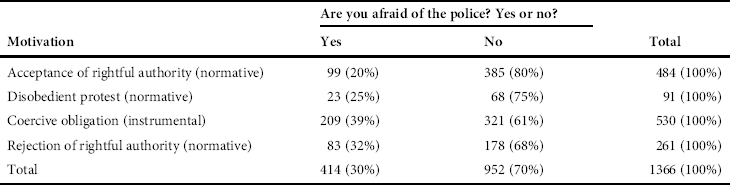
A significant minority of respondents report being afraid of the police (around 30%). Table 2 shows that levels of fear are lower among those individuals who report a normative sense of obligation to obey (20%) and a normatively-grounded duty to disobey the police (25%), and higher among those who view the police as not having the rightful authority to give orders to citizens (32%) and those who say they would comply because they fear the consequences of noncompliance (39%). However, ambivalence is evident: (a) a relatively high number of those who express normative forms of obedience or disobedience also fear the police, and (b) a relatively high number of those who express an instrumental form of obligation to obey also do not fear the police.
Fear of the police and forms of obligation to obey/not to obey the police

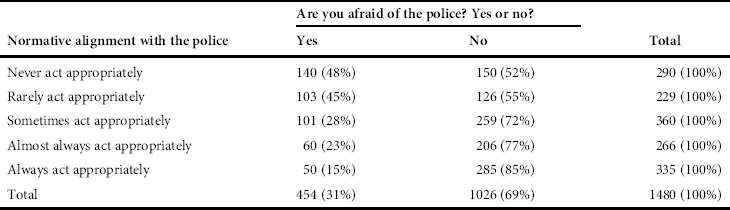
While the association between fear of the police and normative alignment with the police is a little stronger (see Table 3, e.g., of those who strongly agree with the statement “The police act according to what I believe is right,” 15% are afraid of the police, compared with 48% of those who strongly disagree), ambivalence was again present—some people who fear police also believe that officers act in normatively appropriate ways.
Fear of the police and normative alignment with the police

Are instrumental and normative police–citizen relations two ends of a single continuum?
These bivariate associations provide part of the motivation for the second step of the analysis: namely the LTA. Appendix F in Data S1 provides details, but to summarize, we find that while a two latent trait model that distinguishes between instrumental and normative factors fits the data, the one latent trait model (with instrumental factors at one end of the continuum, normative factors at the other, and ambivalence in the middle) fits the data even better. We therefore proceed with the one trait solution: parsimony has value and the data show considerable overlap in instrumental and normative sentiments, at least for some people. Appendix G in Data S1 gives a sense of what a given score on the coercive to consensual continuum corresponds to. In the middle of the coercive-consensual continuum are people who might not personally fear police, but think other people are afraid of police. They might feel a normative sense of obligation to disobey officers because they imagine that officers sometimes give immoral orders, and they might think that officers sometimes (but not always) act appropriately. At the consensual end of the continuum, people may not be particularly afraid of police (although they may tend to think other people are), they may feel a moral duty to obey officers, and they generally believe that officers always act appropriately. The coercive end of the continuum is characterized by fear of police (and think other people are too), not believing that officers act appropriately, and saying that they would disobey the order of officers because they reject their rightful authority.
Predictors of self-reported compliance with the law
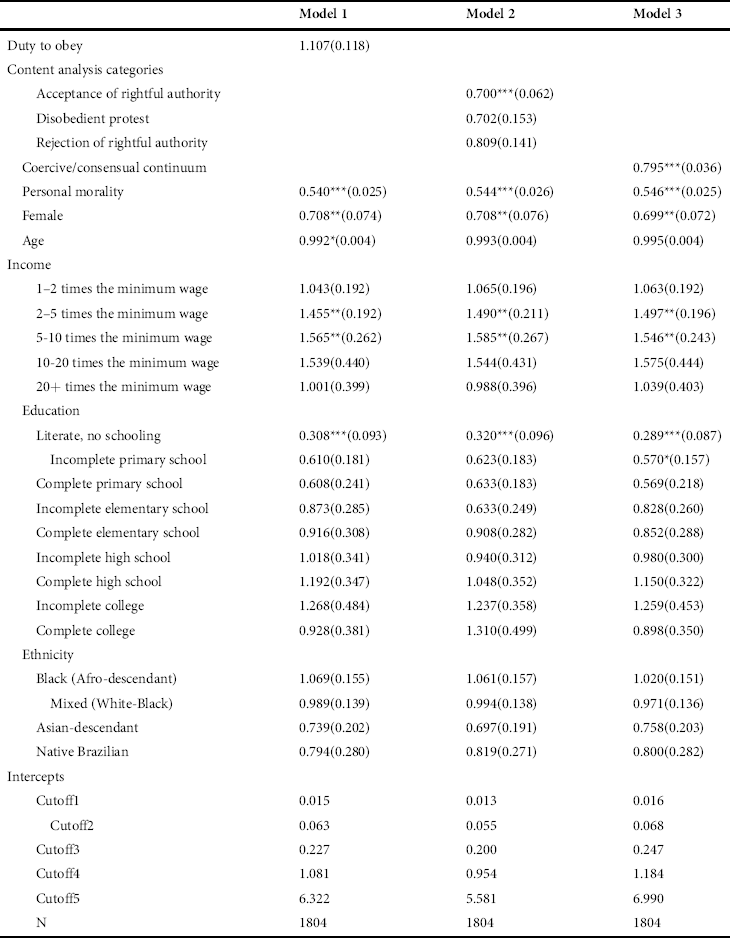
Finally, we turn to the question of whether the coercive to consensual continuum predict self-reported compliance. The results of the regression models can be found in Table 4.2 Model 1 uses the original binary duty to obey variable, Model 2 uses the four content analysis categories, and Model 3 uses the coercive to consensual continuum. In the first model, only personal morality (people's beliefs about whether the various criminal acts are right or wrong) is significant; ceteris paribus, a unit increase in the score of personal morality is associated with decreasing the fitted odds of reporting higher levels of offending behavior by 46% (in the sense of the number of different types of crimes people report having committed). By contrast, the original duty to obey variable does not predict self-reported offending behavior, controlling for everything else in the model. Model 2 finds a similar partial association for personal morality, and of the content analysis categories, the only significant predictor is acceptance of rightful authority (with coercive obligation as the reference category). All else being equal, belonging to the acceptance of rightful authority category (compared with falling in the coercive obligation category) is associated with a reduction of the fitted odds of higher levels of reported offending by 30%. Neither belonging to the disobedient protest category, nor belonging to the rejection of rightful authority category, are significant predictors of offending behavior. Finally, Model 3 finds comparable statistical effects for personal morality, and the coercive to consensual continuum scale is also a significant predictor, with a unit increase in the latent trait is associated with a reduction of the fitted odds of higher levels of offending of 21%.
Ordinal regression analysis with odds ratios, multiple imputation and clustered robust standard errors for the sampling regions in squared brackets

* p < 0.05,
** p < 0.01,
*** p < 0.001 Reference categories: minimum wage, illiterate, White, male, coercive obligation (Model 2).
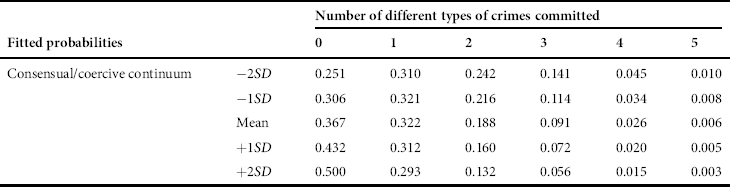
A useful way of illustrating the results of Model 3 is to derive the fitted probabilities of the outcome, conditional on the changes in the coercive to consensual latent trait, while holding all other variables constant at their mean/reference category. Results are presented in Table 5. A SD increase in the coercive to consensual latent trait corresponds, approximately, to a 5 percentage-point increase in the fitted probability of reporting having not committed any crime. In other words, the more normative respondents reported their relationship with the police was, the less likely they were to report committing crimes. Conversely, those whose relationship with police was based on fear and a lack of consent and appropriateness were more likely to report breaking the law.
Fitted probabilities of number of different types of crimes committed for Model 3

DISCUSSION
We started this paper with the idea that the social, political and legal context of São Paulo—a city with a long history of crime, police violence, relatively widespread fear of the police, and a popular sense in which force is often a central part of the exercise of power—may have implications for the sources of legitimacy (e.g. Oliveira et al., 2021), the nature of instrumental and normative police–citizen relations, and the link between legitimacy and legal compliance. Focusing on the predictors, nature and potential consequences of police legitimacy, we have addressed some of the ways in which the central tenets of PJT might need to adapt to the reality of policing in this city of the Global South. By reassessing the standard conception of legitimacy and its link to self-reported legal compliance, we also hope to contribute to ongoing debate about the meaning and measurement of legitimacy (Reference TylerTyler, 2006a, Reference Tyler2006b; Reference Bottoms and TankebeBottoms & Tankebe, 2012; Reference Tyler, Jackson, Tankebe and LieblingTyler & Jackson, 2013; Reference Hamm, Trinkner and CarrHamm et al., 2017; Reference Jackson and BradfordJackson & Bradford, 2019; Reference TrinknerTrinkner, 2019; Reference Oliveira and JacksonOliveira & Jackson, 2021).
Study one focused on the dimensions of police conduct that seem to legitimize the police in the eyes of citizens. We found that a fair amount of people in São Paulo tolerated—or at least were ambivalent toward—police use of excessive force against certain out-groups, and significant numbers believed that the police were ineffective against crime, treated different groups differently, and sometimes acted as if they were above the law. Yet, we also found even in a low trust, high fear, high police violence city like São Paulo—where certain forms of excessive use of force by the police are not firmly rejected by all, and where significant numbers believe the police to be ineffective, distributive unfair and acted as if they were above the law—a relational conception of procedural justice was key to the police being seen as legitimate by citizens.
Prior work has found that effectiveness and lawfulness judgments play a role in predicting empirical legitimacy in Pakistan, China and South Africa (Reference Bradford, Murphy and JacksonBradford, Murphy, & Jackson, 2014; Reference Jackson, Asif, Bradford and Zakria ZakarJackson et al., 2014; Reference Sun, Li, Wu and HuSun et al., 2018). This is consistent with PJT's prediction that, in contexts in which people generally have little inclination to be a member of the group that an authority represents, legitimacy may be judged more on instrumental factors like distributive justice and effectiveness than on the relational factor of procedural justice. It is also consistent with the idea that the police have to show a minimum ability to be control crime and corruption (Reference Bradford, Huq, Jackson and RobertsBradford, Huq, et al., 2014; Reference Jackson, Asif, Bradford and Zakria ZakarJackson et al., 2014) and that authoritarianism may complicate the dynamics of police–citizen relations (Reference Sun, Li, Wu and HuSun et al., 2018).
In São Paulo, by contrast, perceptions of procedural justice seem to be central to the moral recognition that legal institutions have a rightful claim of power. This suggests that the normative criteria upon which people rely to judge the appropriateness of the police exercise of legal power may mostly involve, as is the case in most Western democracies, fair process. If correct, this underlines the sense that (a) the Global South is not one big pool of “other countries” in which police–citizen relations are homogeneously different from Anglo-American contexts, and (b) in some Global South contexts, similar social values as to the ones found in most Western democracies also have currency. It is for further research to address the extent to which people from different São Paulo neighborhoods identify with the superordinate group that the police represent is for future research to address (as well as unpicking how best to define and measure superordinate group identification, for general discussion see Reference Radburn, Stott, Bradford and RobinsonRadburn et al., 2018; Reference Kyprianides, Bradford, Jackson, Stott and PóschKyprianides et al., 2021a).
Study two then found that the obligation to obey part of the legitimacy concept was more complex and more varied than has been typically found. While a fair number of respondents said that they felt a duty to obey police instructions, there were divergent reasons for this. Obedience was normative for some—it was premised in, and representative of, a relationship with police marked by rightful authority, that is, what Reference Trinkner and TylerTrinkner and Tyler (2016, p. 39) call the belief: “…that it is appropriate and right for some external authority to make decisions about law and legal policy and that they ought to voluntarily follow those decisions, without concerns about reward and punishment.” But in other cases, obedience was prudential and/or essentially coerced, representing an instrumental motivation to comply based on fear of violence and intimidation (Reference Bottoms and TankebeBottoms & Tankebe, 2012; Reference Johnson, Maguire and KuhnsJohnson et al., 2014; Reference TankebeTankebe, 2009). We also found that some people who said they did not feel a duty to obey officers went on to describe a defiance rooted in their belief that officers give immoral orders (see Reference MurphyMurphy, 2021, for a discussion of resistant defiance toward authority).
Crucially, ambivalence was a key characteristic of police–citizen relations among study two participants, with instrumental and normative factors seeming to “mix” on occasion, for example, some people both feared the police and believed that they acted in normative appropriate ways. Police–citizen authority relations in São Paulo could, we argued, be usefully conceived as existing on a coercive to consensual continuum, moving from an instrumental from one end, to ambivalence in the middle, to a normative relationship at the other. The instrumental end was based on fear of police, the belief that officers act in normatively inappropriate ways, and either an instrumental obligation to obey officers or a normative obligation to disobey based on the belief that police lack rightful authority. People who fell in the middle of the continuum exhibited an ambivalent mix of both instrumental and normative connections to the police. They might have thought that the police “sometimes” or “almost always” act appropriately while also feeling an instrumental obligation to obey the police and thinking that people often fear the police. They were also more likely to feel an obligation to disobey the police out of a sense of civic protest, thinking, for example that the police might issue an immoral order. The normative end was based on a lack of fear of police, the belief that officers act in normatively appropriate ways, and their belief that they have rightful authority.
Limitations
In the closing section of the paper, we consider the broader theoretical and policy implications of all these findings. But before we get there, we should acknowledge some limitations of our empirical work. First, the data are observational. Second, we rely on self-reports. Third, some of the measures could be improved. For example, distributive justice was measured using a single item that asks whether the police treated rich, white people better than poor, Black and/or Brown people. We recommend future studies measure the broad range of “goods” and “bads” of policing, assessing people's views on whether the police provide the same level of security, the same quality of service, enforce the law consistently, deploy their resources in an equitable manner, and ensure that everyone has equal access to the services they provide.
Fourth, respondents in study two were asked whether they felt an obligation to obey the police, and an open-ended probe was then used to try to understand what they meant when they said “yes” or “no.” People who are more articulate and/or more educated may tend to give more detailed and introspective responses to open-ended survey questions, and therefore potentially better quality data (Reference Groves, Fowler, Couper, Lepkowski, Singer and TourangeauGroves et al., 2011). In the current context, it could be that more educated people had greater insight into their nature of their sense of (or lack of) obligation and were more articulate and detailed in their answers. Normative reasons may be less intuitive than instrumental reasons (as one of the anonymous referees suggests). So more educated people may be more likely to report normative motivations, simply as a function of the methodology. It is for future work to explore this issue.
Fifth, people who are inclined to commit crime (or have recently committed a crime or two) may be more likely to think about the police in instrumental terms because they may be more attuned to police surveillance, the chance of getting arrested, being seen as someone to regulate rather than protect, and so forth. They may therefore report an instrumental motivation to obey or disobey the police. Future studies should try to unpick the temporal, causal ordering here. Sixth, we did not address the full range of instrumental and normative factors when predicting legal compliance, most notably deterrence perceptions. Future work could address likelihood, celerity, and severity. Seventh, the two surveys did not measure identification with the superordinate group that the police are assumed to represent (cf. Reference Bradford, Murphy and JacksonBradford, Murphy, & Jackson, 2014) or relational identification (Reference Kyprianides, Bradford, Jackson, Yesberg, Stott and RadburnKyprianides et al., 2021b). While it does seem that this social group was meaningful and important to the legitimation of the police given the strong role that procedural justice played, this is something that needs to be tested more directly (and for recent work into the potentially reciprocal nature of justice and inclusion, see Reference Martin and ZyphurMartin & Zyphur, 2021). Finally, there was no space in the current paper to include multi-group analysis and demographic differences in police–citizen relations.
CONCLUSION
We started this paper with the observation that Brazil's largest city represents a different context to the settings that PJT have traditionally been tested. The metropolitan region of São Paulo has 18 million residents and the city itself is considered one of the most unequal in the world (Reference Nery, Souza and AdornoNery et al., 2019). Amid a sea of skyscrapers, the landscape can swiftly change from astonishing developments for the well-off to favelas, where a large proportion of the poor population dwells. In most neighborhoods, crime rates are relatively high, and scholars have interpreted the persistence of social violence in the country as evidence of a weak rule of law (Reference AdornoAdorno, 2013). Cases of police violence perpetrated by officers of the São Paulo Military Police are common: in 2019, 13% of all 45,000 victims of murder were killed by security forces. The city is also a leading example of criminal governance, as the PCC (Primeiro Comando da Capital), a powerful prison gang, governs extensively, ruling large urban populations across enormous swaths of territory (Reference Lessing and WillisLessing & Willis, 2019).
We are not the first to say that the PJT literature could benefit from more examination of police–citizen relations in the Global South (see, for Reference Tankebeinstance, Tankebe, 2009; Reference Jackson, Huq, Bradford and TylerJackson, Huq, et al., 2013; Reference Jackson, Bradford, Stanko and HohlJackson, Bradford, et al., 2013; Reference ChengCheng, 2015; Reference AkinlabiAkinlabi, 2017; Reference Sun, Wu, Hu and FarmerSun et al., 2017). In addition to finding that procedural justice is key, we found significant ambivalence in police–citizen authority relations, and to some degree the consensual/coercive continuum that best represented people's complex attitudes maps onto some distinctive styles of policing in São Paulo. Representing heavily militarized police forces, armed officers routinely stop and question members of the public at gunpoint, especially in disadvantaged communities (Reference OliveiraOliveira, 2021). People are generally exposed to both police and neighborhood violence, and often hear stories of summary killings of gang members (Reference Lessing and WillisLessing & Willis, 2019).
While it is true that some in our study were located at the consensual end of the spectrum, while other people were located at the coercive end, there was extensive ambivalence among others—suggesting a complex scenario where the threat of violence is salient in the exercise of power by authority figures. Strikingly however, even in such a context, the continuum predicted legal compliance. We do only have correlational data, but our findings are suggestive of the idea that procedurally just policing tactics encourage legitimacy, and normative obedience and lack of fear of police encourage people to voluntarily comply with the law. It is for future studies to untangle the issue of causality here, as well as address the predictors of fear of policing, instrumental obedience, normative nonobedience, and other factors.
Overall, PJT seems to apply even in São Paulo, albeit the framework needs to somewhat adapt to match the context. Procedural justice seems key, and when complicating factors are acknowledged and incorporated into the analytical strategy, legitimacy is related to legal compliance. As in the US, UK and other similar contexts, it may be that by generating normative self-regulation using procedural-justice based approaches, legal authorities can reduce the need for more aggressive modes of social control, managing social order through nurturing and sustaining widespread feelings of obligation and responsibility toward law and legal authority (Reference TylerTyler, 2006a, Reference Tyler2006b).
It is often assumed that even if people do not comply with the law for legitimacy-based reasons, then instrumental motivations may still be in play, at least in some times and places. On this account, if all else fails, aggressive policing that demonstrates the risks of noncompliance can hold the line. But our results suggest that when people obey police through fear, this may not only fail to increase legal compliance but actually diminish it. Policing styles oriented toward attempts to increase prudential compliance, at least as far as this is generated by fear of the police, may therefore be actively counter-productive, and indeed criminogenic.
Bittner argues that police are “a mechanism for the distribution of non-negotiably coercive force” (Reference BittnerBittner, 1990, p. 131). In most countries around the world, noncompliance with police instructions may in certain circumstances risk violence. If the policed do not comply through the mechanism of legitimacy, they may be coerced, ultimately by force. Put another way, compliance with police instructions is likely to be forthcoming in the large majority of cases, whether it stems from normative or instrumental concerns, and this brute fact should be taken into account in our models of public obedience toward police. What is at stake in PJT is the reason for obedience; the claim being that normative compliance (willing consent) is both ethically more desirable and a more sustainable model for police authority and the exercise of power. In as much as they suggest that coerced compliance may be actively criminogenic, our results here are at least consistent with this latter claim.
Funding information
The studies received financial support from the São Paulo Research Foundation (FAPESP) as part of the project “Building democracy daily: human rights, violence, and institutional trust” (CEPID-FAPESP c-07923-7). This study was conducted in part by the Research Center in Political Science (UIDB/CPO/00758/2020), University of Minho, and was supported by the Portuguese Foundation for Science and Technology and the Portuguese Ministry of Education and Science through national funds.
SUPPORTING INFORMATION
Additional supporting information may be found in the online version of the article at the publisher's website.