Introduction
Subsidiary initiative reflects the proactive actions undertaken by foreign affiliates to renew and update the operational processes of a multinational enterprise (MNE) (Birkinshaw, Hood, & Jonsson, Reference Birkinshaw, Hood and Jonsson1998; Delany, Reference Delany2000; for reviews, see Schmid, Dzedek, & Lehrer, Reference Schmid, Dzedek and Lehrer2014; Strutzenberger & Ambos, Reference Strutzenberger and Ambos2014). These actions may include, but are not limited to, developing new technologies, devising novel production processes, and designing marketing channels. In those endeavors, subsidiaries move beyond existing processes by suggesting new possibilities. While MNEs may have proprietary resources and assets, subsidiaries can observe practices in foreign markets that headquarters cannot access. Hence, subsidiaries have opportunities to initiate proactive projects to strengthen an MNE's competitive advantages (Ferraris, Reference Ferraris2014; Rugman & Verbeke, Reference Rugman and Verbeke2001). Existing studies have reported that initiative behaviors can be fostered by subsidiary leadership, the local context (e.g., competition), and headquarters-subsidiary relationships (e.g., communication; see Birkinshaw et al., Reference Birkinshaw, Hood and Jonsson1998). One established finding is that subsidiary managers play a critical role in driving initiative (O'Brien, Scott, Andersson, Ambos, & Fu, Reference O'Brien, Scott, Andersson, Ambos and Fu2019).
Nonetheless, a subsidiary manager's tendency to undertake initiative can also be shaped by the MNE's exchanges with the subsidiary. Due to the wide scope and complexity of its operations, MNE headquarters may assign varying roles and tasks to subsidiaries. One critical factor is justice, or ‘the perception by a person that a decision, outcome, or procedure is both balanced and correct’ (Husted & Folger, Reference Husted and Folger2004: 720). Studies have suggested that procedural justice – or the extent to which an MNE maintains fair and transparent procedures in its interactions with subsidiaries – can influence subsidiaries' initiative-taking (Asmussen, Foss, & Nell, Reference Asmussen, Foss and Nell2019) and reduce potential bias within the MNE (Weng & Cheng, Reference Weng and Cheng2023). Nonetheless, the role of distributive justice – the degree to which a subsidiary manager regards the allocation of benefits and rewards from an MNE as just and equitable – remains unclear. This gap is important, because monetary incentives have been widely used by MNEs to engage subsidiaries (Fey & Furu, Reference Fey and Furu2008; O'Donnell, Reference O'Donnell2000). In parallel, a growing body of research suggests that economic incentives may not always be effective (Bamberger, Belogolovsky, & Chen, Reference Bamberger, Belogolovsky and Chen2017; Brockner, Wiesenfeld, & Diekmann, Reference Brockner, Wiesenfeld and Diekmann2009; Ionescu & Iliescu, Reference Ionescu and Iliescu2021) and that excessive incentives can lead to unintended consequences (Leclercq, Poncin, Hammedi, Kullak, & Hollebek, Reference Leclercq, Poncin, Hammedi, Kullak and Hollebek2020; Wang, Song, & Zhong, Reference Wang, Song and Zhong2022; Zapata, Carton, & Liu, Reference Zapata, Carton and Liu2016). The heavy use of high pay, for example, could prompt managers to engage in unethical behaviors (Wang et al., Reference Wang, Song and Zhong2022).
Thus, we ask: what is the association between subsidiary distributive justice and subsidiary initiative? Does this relationship vary across more or less internally embedded subsidiaries? We contend that when a subsidiary experiences a low to moderate level of distributive justice, an increase in justice perception can prompt the subsidiary to take on proactive projects, because sharing in gains can enhance the subsidiary manager's well-being. Nonetheless, when a subsidiary's distributive justice moves from a moderate to a high level, an increase in justice perception may diminish the subsidiary's tendency to take on proactive projects. While the rewards and benefits of doing so are attractive, subsidiaries have been assigned specific tasks, and their operating contexts are often challenging. An arduous local environment can dissuade subsidiary managers from attending to the policies and incentives promoted by an MNE. We consequently postulate that a subsidiary's distributive justice has an inverted U-shaped relationship with its tendency to take initiative. We furthermore examine whether this curvilinear relationship differs from less internally embedded subsidiaries to their more internally embedded counterparts. Amassing a sample of MNEs based in Taiwan and their primary subsidiaries, we find support for our arguments.
Our study makes two contributions. First, we advance the literature on headquarters-subsidiary relationships by theorizing both the benefits and costs of distributive justice. While the benefits have been widely noted (Kim & Mauborgne, Reference Kim and Mauborgne1998; Luo, Reference Luo2005, Reference Luo2007), the potential costs receive much less scholarly attention (for an exception, see Asmussen et al., Reference Asmussen, Foss and Nell2019). In this study, we contend that more justice is not always better in fostering subsidiary initiative. Second, our findings also enrich the research on subsidiary embeddedness by demonstrating that the extent to which subsidiaries are embedded within an MNE is a contingency that shapes subsidiary behavior. The contingent effect of internal embeddedness has crucial implications, as it suggests that relational proximity or remoteness can alter an MNE's management of its subsidiaries. Overall, by recognizing the role of distributive justice and its contingency, we hope to respond to scholars’ calls for an examination of ‘reward interdependence at the interface of headquarters and subsidiary levels of strategic leaders’ (Georgakakis, Wedell-Wedellsborg, Vallone, & Greve, Reference Georgakakis, Wedell-Wedellsborg, Vallone and Greve2023: 530).
Theoretical Background
Subsidiary Initiatives as Bottom-Up Value-Creating Behaviors
According to the Merriam-Webster Dictionary, initiative refers to the ‘energy or aptitude displayed in the initiation of action’. The management literature has suggested that employees may demonstrate such behaviors (Morrison & Phelps, Reference Morrison and Phelps1999; Parker & Collins, Reference Parker and Collins2010). Specifically, while some employees are motivated to act proactively even without being told to do so, others may lack this inclination. The heterogeneity in initiative-taking is observed in an MNE and its members as well. Within an MNE network, some subsidiaries may undertake proactive projects to improve the MNE's operations. Some ways these actions can be manifested include developing novel technologies (Phene & Almeida, Reference Phene and Almeida2008), generating new products (Beugelsdijk & Jindra, Reference Beugelsdijk and Jindra2018), and introducing new channels in foreign markets (Grewal, Kumar, Mallapragada, & Saini, Reference Grewal, Kumar, Mallapragada and Saini2013). Regardless of the form these activities take, subsidiaries that engage in initiatives have one thing in common – they actively go beyond their assigned tasks while identifying opportunities to contribute to the MNE.
Researchers have been keen to understand why some subsidiaries are more inclined to show initiative than others. One possible factor is that challenges in host country operations may dissuade the subsidiary from undertaking proactive projects. Because the holding of a foreign identity can illegitimatize a subsidiary (Hu, Li, & Yun, Reference Hu, Li and Yun2023), local stakeholders may not readily support the subsidiary. Also, foreign subunits may suffer from higher mortality (Zaheer, Reference Zaheer1995), more labor issues (Mezias, Reference Mezias2002), or greater costs in raising capital (Bell, Filatotchev, & Rasheed, Reference Bell, Filatotchev and Rasheed2012). Furthermore, foreign markets can be competitive. Local firms, for example, can be well supported by local consumers. Also, the formal and informal rules in the host country could differ considerably from those in an MNE's home country. Because addressing such institutional differences consumes substantial subsidiary resources (Marano & Kostova, Reference Marano and Kostova2016; Shirodkar & Konara, Reference Shirodkar and Konara2017), foreign subsidiaries may leave initiative as a secondary consideration – or even untouched.
Nonetheless, subsidiaries may show initiative when their lead managers have certain attributes. For example, the manager – who can mobilize resources and gather information and support from within or outside the subsidiary – can actively make contributions to an MNE (O'Brien et al., Reference O'Brien, Scott, Andersson, Ambos and Fu2019). Meanwhile, subsidiary managers who can better formulate alternatives to address business problems (Ferraris et al., Reference Ferraris, Degbey, Singh, Bresciani, Castellano, Fiano and Couturier2022) can better turn fresh ideas into concrete actions to strengthen an MNE. To the extent that managers believe they are not limited by the status quo, they can be motivated to undertake proactive projects. For example, individuals who believe that they can keep many things under control will be less deterred by negative factors (Sirén, Patel, Örtqvist, & Wincent, Reference Sirén, Patel, Örtqvist and Wincent2018).
Internally, subsidiary managers play a crucial role because they affect the formal and informal interactions with headquarters. On the one hand, given their particular jobs and responsibilities, not all employees in a subsidiary have opportunities to interact with headquarters directly. In this regard, the lead manager will be an important interface connecting the subsidiary to the corporate office (Georgakakis et al., Reference Georgakakis, Wedell-Wedellsborg, Vallone and Greve2023). On the other hand, the perceptions of the lead manager can cascade to influence the view held by the subsidiary. Due to this trickle-down effect (De Cremer, van Dijke, Schminke, De Schutter, Stouten, & Chen, Reference De Cremer, van Dijke, Schminke, De Schutter, Stouten and Chen2018), the personal view held by a lead manager has the power to permeate the whole subsidiary, thereby affecting the subsidiary's view, perspective, and actions.
Crucially, although subsidiary initiative is a bottom-up, value-creating act, headquarters also plays a role. This is because headquarters executives have the decision power to approve or reject proposals from subsidiary managers. In their study of 26 subsidiary initiative attempts, Birkinshaw and Ridderstrale (Reference Birkinshaw and Ridderstrale1999) reported that 12 failed or did not pass the threshold set by an MNE. Indeed, turning down subsidiaries’ suggestions can undermine the work relationships between headquarters and subsidiaries (Schotter & Beamish, Reference Schotter and Beamish2011). To increase their chances of success, subsidiary managers may leverage their issue-selling skills to communicate with headquarters (Ling, Floyd, & Baldridge, Reference Ling, Floyd and Baldridge2005).
Subsidiary Distributive Justice
Subsidiary distributive justice refers to the extent to which a subsidiary manager recognizes an MNE's allocation of economic rewards and benefits as fair, just, and equitable (Luo, Reference Luo2009). This construct is based on the subsidiary manager's perception. As with a typical firm, varying exchanges between headquarters and subsidiaries occur within an MNE. The headquarters can ask a subsidiary to perform certain tasks – say, procuring materials or producing products – in a host country (Tavares & Young, Reference Tavares and Young2006). After receiving the assignment, the subsidiary lead manager will perform and deliver when the work is done. Unlike arm's length transactions that grant payoffs immediately, the MNE often distributes rewards and benefits on a quarterly or yearly basis. In this process, the MNE will review the performance of subsidiary managers and determine proper benefits.
While an MNE hopes to be fair and just, subsidiary managers may think otherwise. Research has suggested that individuals of different personalities will place varying emphasis on justice issues (Colquitt, Scott, Judge, & Shaw, Reference Colquitt, Scott, Judge and Shaw2006; Schmitt, Baumert, Gollwitzer, & Maes, Reference Schmitt, Baumert, Gollwitzer and Maes2010). For some individuals, it is extremely important to receive rewards and benefits commensurate with their input. Yet for others, a little mismatch is not an issue. On the other hand, social comparison can affect the subsidiary manager's view. In this socialized world, individuals may constantly compare their benefits against those of others (Festinger, Reference Festinger1954; Suls & Wheeler, Reference Suls, Wheeler, Van Lange, Kruglanski and Higgins2012). To the extent that a subsidiary manager recognizes that other managers who perform similarly receive more benefits, the manager will conclude that the granting of benefits from the supervisor is unfair. Furthermore, the wide scope of an MNE may hinder the maintenance of fairness. The potential cultural, institutional, and geographic distance could create barriers preventing headquarters from fully attending to subsidiaries (Dellestrand & Kappen, Reference Dellestrand and Kappen2012; Zhang & Gu, Reference Zhang and Gu2021). Within an MNE, some subsidiaries have more direct and frequent work interactions with the headquarters (Ferraris, Bogers, & Bresciani, Reference Ferraris, Bogers and Bresciani2020). Due to such ties, these subsidiaries can appear more visible than others.
Hence, a subsidiary manager may recognize that an MNE maintains low, moderate, or high levels of distributive justice. The case of low distributive justice suggests a discrepancy between a subsidiary's actions and the rewards granted from the MNE headquarters. As research shows, such injustice can prompt employees to demonstrate counterproductive behaviors, including reduced efforts (Cowherd & Levine, Reference Cowherd and Levine1992), theft (Jerald, Reference Jerald1993), and absence (de Boer, Bakker, Syroit, & Schaufeli, Reference de Boer, Bakker, Syroit and Schaufeli2002; for a review, see Colquitt & Zipay, Reference Colquitt and Zipay2015). These outcomes, however, will be less likely in the case of moderate distributive justice. In this instance, an improved alignment between a subsidiary's behaviors and the reward granted by headquarters will encourage the subsidiary to demonstrate positive, desirable work behaviors. Cooper, Dyck, and Frohlich (Reference Cooper, Dyck and Frohlich1992) report that fairness can curb free-riding behavior while fostering smoother teamwork. In the case of high distributive justice, the subsidiary manager perceives the headquarters as a supervisor who gathers extensive information, offers comprehensive performance matrices, and evaluates the subsidiary with every possible effort. While the implementation of such policies is well-intended, these actions can create pressures on subsidiary managers because any underperformance will give headquarters an excuse to cut rewards. Indeed, the resources owned by the MNE are not unlimited, and the headquarters must be conscientious in allocating rewards. In this regard, Camps, Graso, and Brebels (Reference Camps, Graso and Brebels2022) assert that the implementation of justice can lead to a zero-sum game. Put differently, when a subsidiary ‘wins’ rewards, it means that headquarters ‘loses’ the game.
Hypotheses
Distributive Justice and Subsidiary Initiative
We contend that the relationship between distributive justice and subsidiary initiative will depend on the level of justice. Specifically, when distributive justice is at a low to moderate level, an increase in justice will prompt subsidiary managers to show initiative, because distributive justice helps to align subsidiary managers' goals with the MNE's goals. Abundant research has suggested that the lack of justice will separate the aims of employees from those of the firm (Kim & Mauborgne, Reference Kim and Mauborgne1996; Sumelius, Björkman, Ehrnrooth, Mäkelä, & Smale, Reference Sumelius, Björkman, Ehrnrooth, Mäkelä and Smale2014). While employees contribute time and effort to the firm, inadequate distributive justice suggests that they cannot fairly enjoy the gains. This disparity can be demotivating, discouraging employees from working to their fullest. Yet when a certain level of distributive justice is reached, employees will act differently. From their perspective, the headquarters adequately understands the contributions of each subsidiary and allocates benefits and rewards accordingly. When the MNE demonstrates a good sense of the contributions of organizational members and offers commensurate rewards, subsidiary employees will do their part and even go the extra mile. As studies document, a fair and just perception can develop mutually beneficial interorganizational relationships (Liu, Huang, Luo, & Zhao, Reference Liu, Huang, Luo and Zhao2012), thus strengthening a firm's competitive advantage. Ariño and Ring (Reference Ariño and Ring2010) observed that fairness perceptions pave the foundation for firms to continuously work with external collaborators.
In addition, a low to moderate level of distributive justice can hamper headquarters’ tendency to arbitrarily reject subsidiaries’ proposals. Although subsidiary initiative can strengthen an MNE’s operations, headquarters’ evaluation of subsidiaries’ projects may be skewed or biased (Dellestrand & Kappen, Reference Dellestrand and Kappen2012). According to Monteiro (Reference Monteiro2015), while foreign subsidiaries may suggest that headquarters adopt new technologies, headquarters could dismiss such suggestions due to ego-centric beliefs. When this happens, subsidiaries will be less likely to undertake autonomous projects. Crucially, a certain level of distributive justice can reduce headquarters’ tendency to dismiss subsidiaries’ proposals at will. When that level of distributive justice is built, headquarters must clarify its criteria and expectations in assessing subsidiaries. With such written and pre-communicated rules, headquarters cannot reject subsidiaries’ proposals erratically. The clarified rules and expectations will encourage subsidiary managers to launch projects to improve the MNE's operations. From a subsidiary manager's view, the MNE is doing a fine job in motivating employees to contribute to their employer. Prior research has documented that justice can prompt employees to demonstrate positive work behaviors beyond their basic roles of serving their employers (e.g., Cohen-Charash & Spector, Reference Cohen-Charash and Spector2001; Colquitt, Colon, Wesson, Porter, & Ng, Reference Colquitt, Colon, Wesson, Porter and Ng2001; Wong, Ngo, & Wong, Reference Wong, Ngo and Wong2006). Ultimately, the justice perception convinces employees that the exchange relationship with an employer is equitable and can be continued (Cropanzano & Mitchell, Reference Cropanzano and Mitchell2005). We thus suggest that a fair and just work environment due to distributive justice can be a precursor to subsidiary initiative.
However, when distributive justice goes beyond a certain threshold, the positive effect may decrease. First, a high level of distributive justice can prompt subsidiary managers to reason that the MNE not only establishes clear performance matrices, but also pays attention to the contributions of subsidiaries carefully and extensively. Although such measures can be well-intended, subsidiary managers may surmise that the MNE will closely observe, gauge, and monitor their behaviors. As Long, Bendersky, and Morrill (Reference Long, Bendersky and Morrill2011) document, a high level of distributive justice creates a sense of tight control. Under these circumstances, subsidiary managers may feel pressured or intimidated. To the extent that a high level of distributive justice implies a high hurdle set by headquarters’ expectations, subsidiary managers may have reduced motivation to take initiative.
Meanwhile, a high level of distributive justice also suggests that headquarters executives may assess subsidiaries more critically. In this case, organizational members will note that good performance will be always reciprocated by corresponding rewards. Anticipating such a strong demand for rewards, headquarters executives are likely to raise the bar. Indeed, if the MNE is too lenient in giving rewards, it will run out of resources too soon. In line with this view, prior research asserts that excessive justice can trigger competition between social actors (Camps et al., Reference Camps, Graso and Brebels2022). Thus, subsidiary managers who recognize a relatively high level of distributive justice from headquarters may have diminished motivation to show initiative.
Our interviews with subsidiary managers suggest that distributive justice does affect their initiative-taking. One subsidiary manager who leads a plant in Tianjin explained:
Our employer is very encouraging [of] managers to demonstrate their potential. I mean, the headquarters is always open to new ideas and suggestions. As long as you make meaningful contributions, bonuses, benefits, and rewards will follow. We like it!
Regarding the potential downside, another subsidiary manager in Malaysia told us:
While incorporating fairness to engage employees is instrumental, companies are not just about a place [for] measuring performance, maintaining justice, and feeding managers. It is crucial to develop a system to encourage people [to] do their part, and that system should not just be built upon rewards. As an employee, I don’t think that incentives and fairness will be always effective in motivating workers.
Hypothesis 1 (H1): A subsidiary’s distributive justice will have a curvilinear (i.e., inverted U-shaped) relationship with the subsidiary’s initiative.
Internal Embeddedness as a Contingency
Internal embeddedness denotes the degree to which a subsidiary interacts with the headquarters in the MNE’s main activities, including R&D, marketing, and production. Subsidiaries within an MNE can have varying levels of internal embeddedness. Some subsidiaries work with the headquarters extensively and frequently by transferring R&D knowledge and requesting marketing expertise (Schleimer, Coote, & Riege, Reference Schleimer, Coote and Riege2014). Such work interactions not only ease subsidiaries’ operations but also allow headquarters to know subsidiaries well. Due to intensive interactions, subsidiaries with a high level of internal embeddedness may appear visible to headquarters (Bouquet & Birkinshaw, Reference Bouquet and Birkinshaw2008) and perform well (Ferraris et al., Reference Ferraris, Bogers and Bresciani2020). In contrast, subsidiaries with relatively low internal embeddedness ties with headquarters may be perceived as more remote or even unfamiliar to headquarters (Monteiro, Arvidsson, & Birkinshaw, Reference Monteiro, Arvidsson and Birkinshaw2008).
We suggest that the degree of a subsidiary’s internal embeddedness will alter the curvilinear relationship between distributive justice and subsidiary initiative. Specifically, the positive effect of distributive justice would be amplified for subsidiaries that have relatively low internal embeddedness within an MNE. As noted, subsidiaries that have low internal embeddedness do not have regular, extensive work interactions with the headquarters. While the lack of such interactions puts a subsidiary into a more peripheral position in the headquarters executives’ cognitive map, distributive justice within an MNE provides opportunities for the subsidiary to earn some positive regard from headquarters. A subsidiary manager can use such opportunities to appear prominent from headquarters’ perspective. Initiatives – whether novel production methods or new market channels – help the subsidiary hold a more visible position with headquarters (Ambos, Andersson, & Birkinshaw, Reference Ambos, Andersson and Birkinshaw2010; Bouquet & Birkinshaw, Reference Bouquet and Birkinshaw2008). Indeed, when these activities are noticed, headquarters will recognize the subsidiary’s contributions. Given its distributive justice policies, the subsidiary's status will improve significantly. Such nonmonetary benefits can encourage the subsidiary manager who has a relatively low level of distributive justice to actively show more initiative.
On the other hand, the negative effect of distributive justice is likely to be dampened for subsidiaries with relatively low internal embeddedness within an MNE. Earlier, we proposed that a relatively high level of distributive justice can hinder subsidiary initiative. While this is generally the case, a subsidiary with a low level of internal embeddedness within an MNE may find a high level of distributive justice less discouraging. On the one hand, low internal embeddedness suggests that the subsidiary manager would be motivated to make contributions to the MNE via initiative. Even if the headquarters establishes high standards in assessing subsidiary proposals, the subsidiary with a low level of internal embeddedness is willing to try because the MNE's policies allow the subsidiary to prove its competence and potential. On the other hand, with low internal embeddedness, the subsidiary can have a fresh perspective from which to examine the MNE's procedures and practices. That is, due to the limited interactions, a subsidiary manager can see the MNE's operations more objectively. Thus, the subsidiary manager is better able to identify new avenues for improvement without pre-assumptions. Existing research suggests that subsidiaries that have close and cohesive relationships with headquarters could have blind faith in the MNE, thus hindering potential initiative (Weng & Cheng, Reference Weng and Cheng2019). To the extent that low internal embeddedness allows a subsidiary manager to assess the MNE's operations more impartially, the subsidiary manager may be more responsive to high distributive justice by taking more initiative.
In contrast, the relationship between distributive justice and subsidiary initiative may be different for subsidiaries with a high level of internal embeddedness within an MNE. For such subsidiaries, the positive effect of distributive justice will be dampened because internal embeddedness already induces a subsidiary manager to work toward the MNE's goals. Ultimately, internal embeddedness not only denotes work relationships, but also confers a shared identity. Research suggests that organizational members who have more embedded relationships with their supervisors demonstrate more positive work (Reiche, Kraimer, & Harzing, Reference Reiche, Kraimer and Harzing2011). Here, we suggest that for a subsidiary with high internal embeddedness, distributive justice may not have a strong simulating effect because the subsidiary manager already deems it imperative to assist the MNE. Thus, whether the headquarters shares gains fairly will be less pertinent. Indeed, too many economic incentives can impede individuals’ work motivation (Frey & Jegen, Reference Frey and Jegen2001) by ‘crowding out’ intrinsic motivation (Deci, Koestner, & Ryan, Reference Deci, Koestner and Ryan1999). Following this logic, we postulate that a high level of internal embeddedness may make a subsidiary less susceptible to the positive effect of distributive justice on undertaking initiative.
Also, for a subsidiary with a high level of internal embeddedness, the negative effect of distributive justice on subsidiary initiative will be amplified. As mentioned, such a subsidiary has extensive, regular work interactions with the MNE. Due to these interactions, the subsidiary manager has a good understanding of the headquarters’ jobs and may hold the view that any organizational members should share the burden. Although distributive justice is pertinent, the subsidiary manager may not actively respond to it because he or she has other ways to help. For example, the subsidiary manager can deal with the headquarters’ challenges with existing operations or can assist or coordinate activities with other subsidiaries. As research suggests, tensions between headquarters and subsidiaries are not rare (Ambos, Fuchs, & Zimmermann, Reference Ambos, Fuchs and Zimmermann2020). These activities allow the subsidiary manager to facilitate the MNE’s operations without resorting to initiative. In addition, when distributive justice is at a high level, a subsidiary manager who is more internally embedded within the MNE will be more concerned about high expectations from headquarters. From this manager’s perspective, while launching autonomous projects is good, submitting early-stage or less valuable proposals will backfire as doing so may damage his or her image with the MNE. As researchers maintain, embedded ties can constrain social actors, leading to suboptimal outcomes (Anderson & Jap, Reference Anderson and Jap2005; Noordhoff, Kyriakopoulos, Moorman, Pauwels, & Dellaert, Reference Noordhoff, Kyriakopoulos, Moorman, Pauwels and Dellaert2011; Villena, Revilla, & Choi, Reference Villena, Revilla and Choi2011). For example, Noordhoff et al. (Reference Noordhoff, Kyriakopoulos, Moorman, Pauwels and Dellaert2011) reported that embedded ties with customers may hinder rather than promote a focal firm’s innovation. Following this logic, we contend that the negative effect of distributive justice will be more pronounced for subsidiaries that are more embedded within an MNE.
Our conversations with managers indicate that low and high internally embedded subsidiaries react differently toward an MNE’s distributive justice. One subsidiary manager in Vietnam remarked:
My subsidiary is quite stand-alone, and I don’t have a strong attachment to headquarters. For me, it is extremely important to have policies ensuring that rewards and gains will be granted fairly. Without commensurate benefits, there is no point to make efforts.
In contrast, another manager of a subsidiary in Malaysia commented:
We have close relationships with our headquarters. While fairness matters, you need to realize that all subsidiaries are part of the MNE. As a member, one should not always ask for, and think about, rewards and benefits. This will upset people and hurt the team’s morale. It is not right.
Hypothesis 2 (H2): A subsidiary’s internal embeddedness will moderate the inverted U-shaped relationship between distributive justice and subsidiary initiative. Specifically, for subsidiaries with a low level of internal embeddedness, the positive effect of distributive fairness will be strengthened, while the negative effect will be weakened. Alternatively, for subsidiaries with a high level of internal embeddedness, the positive effect of distributive justice will be weakened, while the negative effect will be strengthened.
Methods
To test our hypotheses, we used a survey based on a sample of Taiwanese MNEs operating within the broad information technology (IT) industry. We chose this sector because firms in this industry have been quite active in serving foreign clients (Iurkov & Benito, Reference Iurkov and Benito2018; Jean, Sinkovics, & Cavusgil, Reference Jean, Sinkovics and Cavusgil2010). In June 2022, we worked with the Taiwan Electrical and Electronic Manufacturers’ Association (TEEMA), an organization that accounts for more than half of all Taiwanese manufacturing firms. We requested a list from TEEMA of all member MNEs with at least one foreign subsidiary (defined as outside the home base, i.e., Taiwan). We sent out invitations to these MNEs, and 40% agreed to participate in our study. After several rounds of phone calls and emails, 171 MNEs and their major subsidiaries had completed and returned the survey by February 2023 (https://osf.io/6n47t/). In the case of an MNE with multiple subsidiaries, we asked the selected headquarters manager to send the subsidiary section to only one strategically important subsidiary. Hence, our dataset includes only one headquarters-subsidiary paired questionnaire for each MNE. Our dyadic survey design is consistent with earlier research (Wang, Luo, Lu, Sun, & Maksimov, Reference Wang, Luo, Lu, Sun and Maksimov2014).
The response rate was approximately 11%, which is within the range (6% to 16%) suggested by Harzing (Reference Harzing2000). We assessed the nonresponse issue by comparing the characteristics of firms responding to our survey versus those that did not. The differences are statistically insignificant in terms of MNE size (p = 0.32) and MNE age (p = 0.18). Thus, nonresponse bias is not a major issue.
Common Method Variance
We took several approaches to address the potential common method variance (CMV) bias (Podsakoff, MacKenzie, & Podsakoff, Reference Podsakoff, MacKenzie and Podsakoff2012). First, in our survey, we ensured anonymity to encourage genuine responses, and we mixed the items for different constructs such that respondents would not immediately recognize our theoretical intent. Second, we collected our independent and dependent variables using different sources. Specifically, we asked each MNE to have the headquarters manager in charge of global operations answer the questions regarding subsidiary initiative (i.e., the headquarters section), while forwarding the questions on distributive justice to a subsidiary of particular strategic importance (i.e., the subsidiary section). When the survey was completed, the headquarters and subsidiary managers each mailed the questionnaire to us directly and independently. Table 1 shows the key characteristics of our sample firms. Chang, van Witteloostuijn, and Eden (Reference Chang, van Witteloostuijn and Eden2010: 179) note that gathering information from different sources is perhaps ‘the best way to avoid or minimize any potential CMV bias’. Finally, we used different measurement types to further reduce the likelihood of CMV. For example, some variables were measured using numerical values (e.g., MNE scope), while others were measured using a Likert scale (e.g., subsidiary initiative). Overall, these procedures helped to alleviate concerns regarding CMV.
Sample profile

Measurement
We designed our measurements via several steps. We obtained initial items by consulting the literature. To ensure the quality of our initial items, we conducted a pre-test using a group of 35 Executive Master of Business Administration (EMBA) students in a private university in Taiwan (average age = 41 years old; average work experience = 15 years; male = 72%). After that, we had another group of 35 EMBA students in another public university (average age = 51 years old; average work experience = 25 years; male = 84%) to answer the revised scales. Furthermore, we asked five subsidiary lead managers to comment on our scales. The Appendix lists our main variables. Unless otherwise specified, all measures follow a five-point Likert scale (1 = strongly disagree, 5 = strongly agree).
Our dependent variable is subsidiary initiative, or the extent to which a subsidiary performed value-creating activities in various business functions to strengthen an MNE's operations. This construct was measured by a five-item scale adapted from Birkinshaw et al. (Reference Birkinshaw, Hood and Jonsson1998). The reliability was satisfactory (Cronbach's α = 0.92), and the items had an average variance extracted (AVE) value of 0.76 and composite reliability (CR) of 0.94.
Our independent variable is subsidiary distributive justice, which denotes the degree to which a subsidiary lead manager perceives the overall allocation of returns, rewards, and resources from an MNE to the subsidiary to be commensurate with the subsidiary's overall performance and contributions. A four-item scale was adapted from Luo (Reference Luo2009) to measure this variable. The reliability of these items is acceptable (α = 0.94, AVE = 0.84, CR = 0.96).
We measured subsidiary internal embeddedness using a five-item scale adapted from Ciabuschi, Dellestrand, and Martin (Reference Ciabuschi, Dellestrand and Martin2011) and Oehmichen and Puck (Reference Oehmichen and Puck2016). These items include the degree of resource-sharing between the subsidiary and the MNE along several activities, including R&D, raw material, marketing efforts, personnel, as well as plant and equipment. The reliability of this scale is adequate (α = 0.84, AVE = 0.64, CR = 0.89).
Our models also included a set of control variables. At the MNE level, we controlled for MNE scope, which was measured using the number of subsidiaries of the MNE. At the subsidiary level, overseas subunits that are more critical to an MNE may feel obligated to make extra contributions. We measured subsidiary strategic importance using the headquarters managers’ evaluation of the subsidiary’s strategic importance to the MNE (1 = not important at all, 5 = very important). Also, autonomy can be relevant because without it, subsidiaries may not pursue independent projects (Birkinshaw et al., Reference Birkinshaw, Hood and Jonsson1998; Wang et al., Reference Wang, Luo, Lu, Sun and Maksimov2014). We measured subsidiary autonomy using a three-item scale, which has acceptable reliability (α = 0.89, AVE = 0.82, CR = 0.93). At the same time, the subsidiary’s top manager team (TMT) may affect subsidiary initiative, as a larger team can have more diverse perspectives and information-processing capacity (Boone, Lokshin, Guenter, & Belderbos, Reference Boone, Lokshin, Guenter and Belderbos2019). To control for this effect, we measured subsidiary TMT size as the number of individuals in the subsidiary’s TMT, excluding the lead manager. Meanwhile, subsidiaries operating in an industry more closely related to the headquarters may receive more supportive resources from the MNE and exhibit higher propensities for initiative. We measured industry relatedness by an item indicating the degree to which a subsidiary operates within the same industry as the parent firm (1 = very unrelated, 5 = very related). Meanwhile, because a joint venture subsidiary might not see itself as an integral part of an MNE, it may be less likely than a wholly owned subsidiary to show initiative. To account for this effect, we created the binary variable wholly owned subsidiary (1 if yes and 0 if no). This variable used 95% as the threshold (Chen & Hennart, Reference Chen and Hennart2002).
At the host country level, subsidiaries operating within countries that are different from the home country in terms of formal institutions may encounter substantial operational challenges (Abdi & Aulakh, Reference Abdi and Aulakh2012; Dikova, Sahib, & van Witteloostuijn, Reference Dikova, Sahib and van Witteloostuijn2010), thus being less likely to show initiative. We included the variable institutional distance, following the procedures suggested by Xu, Pan, and Beamish (Reference Xu, Pan and Beamish2004). Also, host country market size may be pertinent, because a larger market implies more opportunities for a subsidiary to uncover. We measured this effect using a host country’s total sales of personal computer products (in billions of US Dollars). Statista Report (https://www.statista.com/studies-and-reports/) provided the information.
Finally, firms represented in the study were from four segments operating within the broad IT industry: information hardware (27%); information software (25%); semiconductor electronics (26%); and other IT manufacturing sectors (22%). To control for the potential industry effect, we created three dummy variables. The omitted category is ‘other IT manufacturing’.
Findings
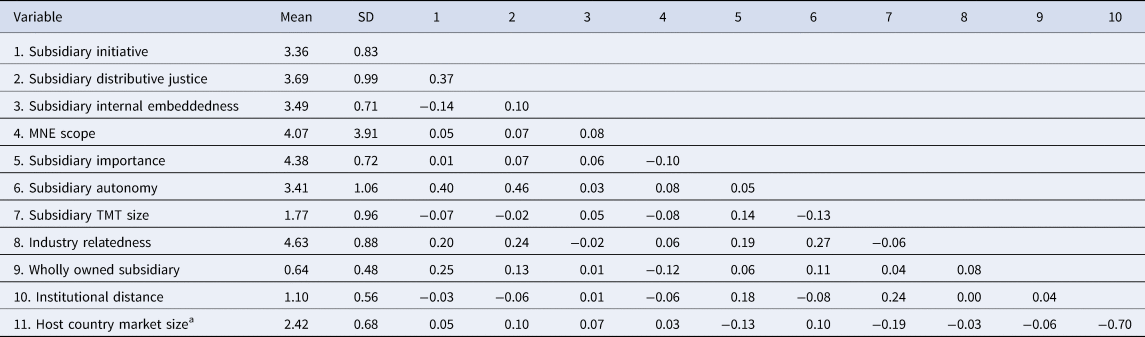
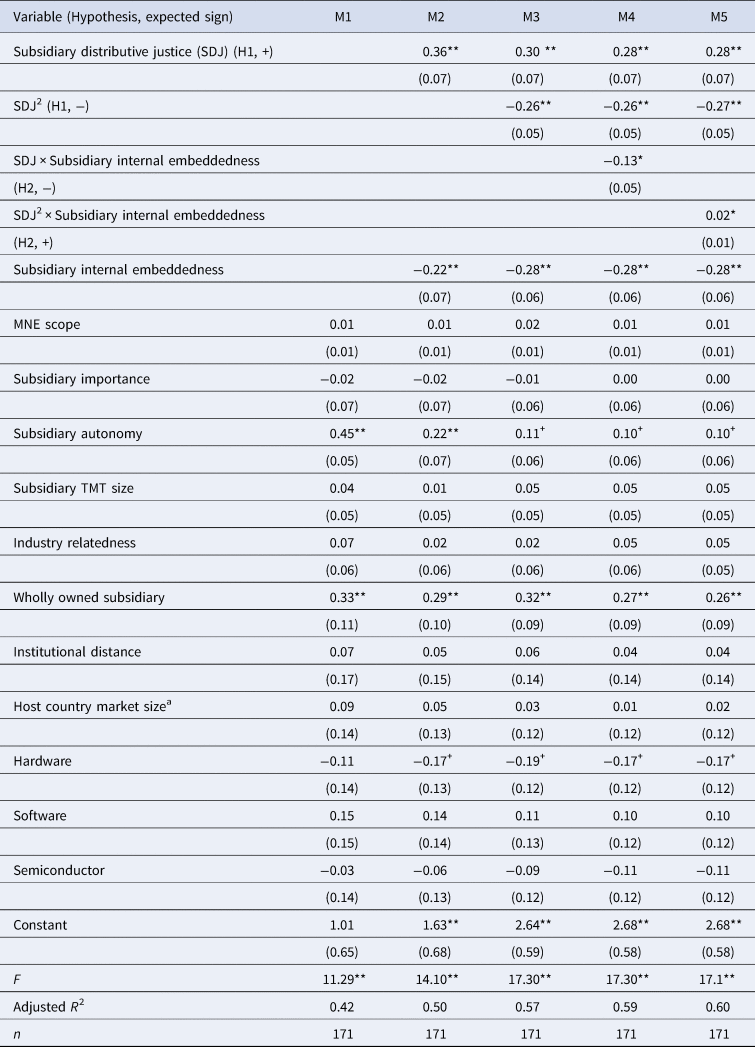
Table 2 summarizes the descriptive statistics and correlations for our variables. We used hierarchical linear regression for analysis. Table 3 shows the results. The highest variance inflation factor (VIF) value across all models was 3.4, well below the recommended threshold of 10. Hence, multi-collinearity was not a major concern. Model 1 shows the control variables, while Models 2 and 3 test the first- and second-order effects of distributive justice. Models 4 and 5 examine the interaction effects.
Means, standard deviations, and correlations

Notes: n = 171.
a In billions of USD: Correlations with absolute values greater than 0.15 are significant at p < 0.05.
Estimates of subsidiary initiative

Notes: Standard errors appear in parentheses.
a In billions of USD.
+ p < 0.1, *p < 0.05, **p < 0.01 (two-tailed tests).
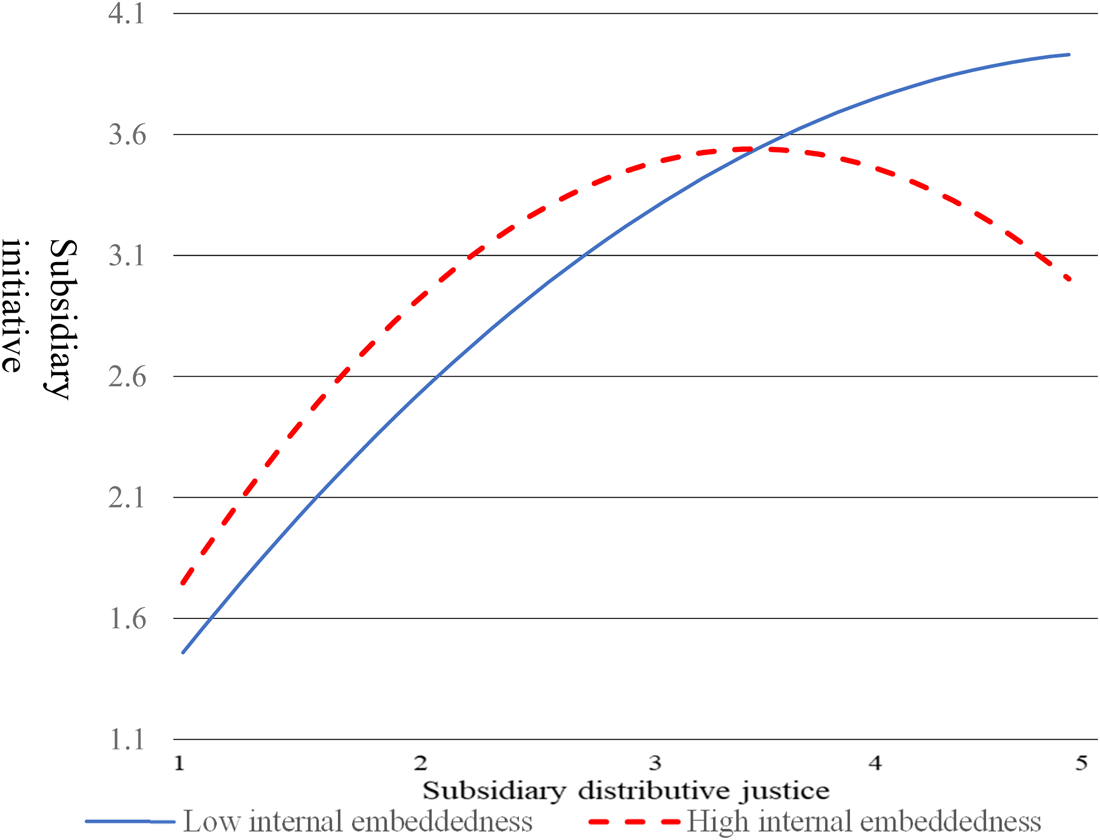
H1 argues that distributive justice has an inverse U-shaped relationship with a subsidiary's initiative. In Model 3, the first-order term for subsidiary distributive justice is positive (β = 0.30, p < 0.01), while the second-order term is negative (β = −0.26, p < 0.01). These estimates suggest that an increase in distributive justice will enhance subsidiary initiative when justice is at a low to moderate level. However, as distributive justice goes beyond a certain threshold, its marginal impact will diminish, ultimately leading to an inverse U-shaped relationship. The pattern shown in Figure 1 suggests that an inverse U-shaped relationship exists between subsidiary distributive justice and subsidiary initiative.
The curvilinear relationship between subsidiary distributive justice and subsidiary initiative

We followed the procedures suggested by Haans, Pieters, and He (Reference Haans, Pieters and He2016) in qualifying the curvilinear effect. First, we plotted the linear fitting line to see if the slope of distributive justice was sufficiently distinctive across its range. Second, we calculated the flipping point to determine if it was located well within the data range (the turning point is 3.93). Third, we added a cubic term of subsidiary distributive justice in the analysis. In results not shown here (available upon request), we found the cubic term of subsidiary distributive justice to be insignificant (β = 0.09, p > 0.1), but the first-order (β = 0.21, p < 0.01) and second-order (β = −0.90, p < 0.05) terms remain significant. Finally, we used the nonparametric estimate (Nadaraya-Watson kernel regression; see Herman, Reference Herman1994) to assess the curvilinear relationship. In results not reported here (also available on request), we again found that distributive justice has an inverse U-shaped effect associated with subsidiaries’ initiative. H1 was thus supported.
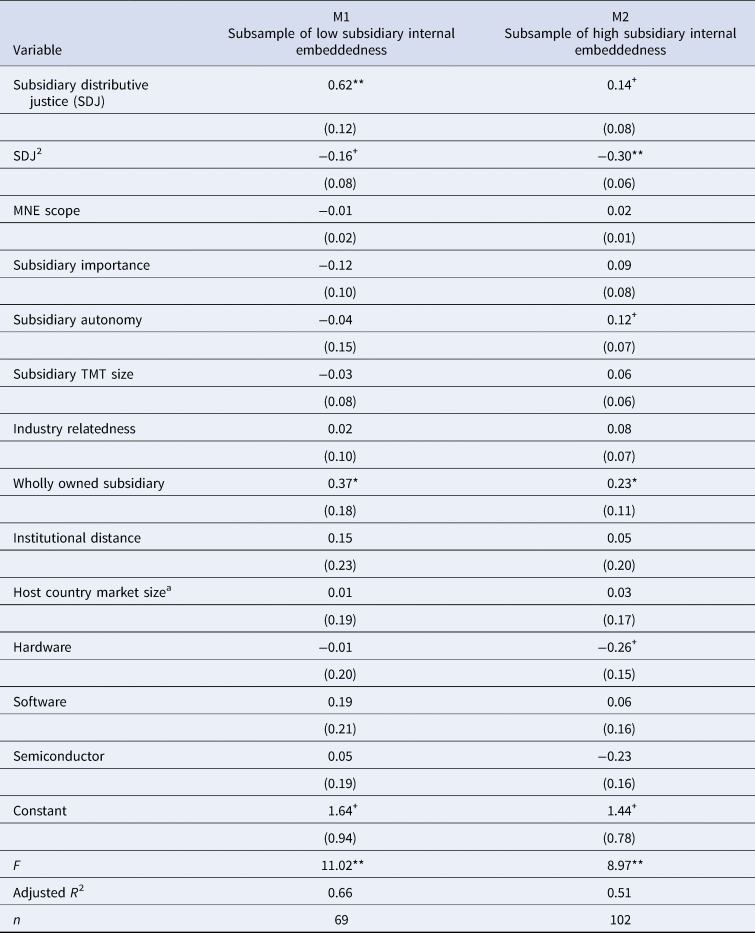
H2 argues that a subsidiary’s internal embeddedness within the MNE will moderate the curvilinear relationship between the subsidiary’s distributive justice and its initiative-taking. The interaction of the first-order term of subsidiary distributive justice and subsidiary internal embeddedness was negative and significant in Model 4 (β = −0.13, p < 0.05), while the interaction of the second-order term of subsidiary distributive justice and subsidiary internal embeddedness was positive in Model 5 (β = 0.02, p < 0.01). These estimates suggest that the positive effect of distributive justice on subsidiary initiative is dampened as subsidiary internal embeddedness increases, but the negative effect of distributive justice on subsidiary initiative is strengthened as subsidiary internal embeddedness increases. We graphed these effects in Figure 2. Specifically, we split our sample into two subgroups based on the mean of subsidiary internal embeddedness. Using the two subsamples, we re-estimated our models. As shown in Table 4, the curvilinear effects of distributive justice vary from the group of low internal embeddedness to the group of high subsidiary internal embeddedness. Specifically, in the subgroup with a high level of subsidiary internal embeddedness, the estimate of the first-order effect of subsidiary distributive justice is higher in the low internal embeddedness group than in the high internal embeddedness (β low embeddedness = 0.62, p < 0.01; β high embeddedness = 0.14, p < 0.1). This result suggests that subsidiary internal embeddedness attenuates the stimulating effect of subsidiary distributive justice. Meanwhile, in the subgroup with high subsidiary internal embeddedness, the second-order effect of subsidiary distributive justice becomes more intensified than in the subgroup with low subsidiary internal embeddedness (β low embeddedness = −0.16, p < 0.1; β high embeddedness = −0.30, p < 0.01). Thus, subsidiary internal embeddedness is found to amplify the negative effects of subsidiary distributive justice. We graphed these effects in Figure 2. As can be seen, while distributive justice is instrumental in prompting subsidiaries to show initiative, the group with high internal embeddedness reaches the reflection point quickly, after which it diminishes. The group with low internal embeddedness reaches the turning point at a later stage. These findings support H2 that internal embeddedness is a crucial contingency.
Subsidiary distributive justice, internal embeddedness, and subsidiary initiative

Subgroup estimates of subsidiary initiative

Notes: Standard errors appear in parentheses.
a In billions of USD.
+ p < 0.1, *p < 0.05, **p < 0.01 (two-tailed tests).
Post-Hoc Analyses
To ensure the robustness of our findings, we performed several post-hoc analyses, including endogeneity and subsample estimations.
Endogeneity
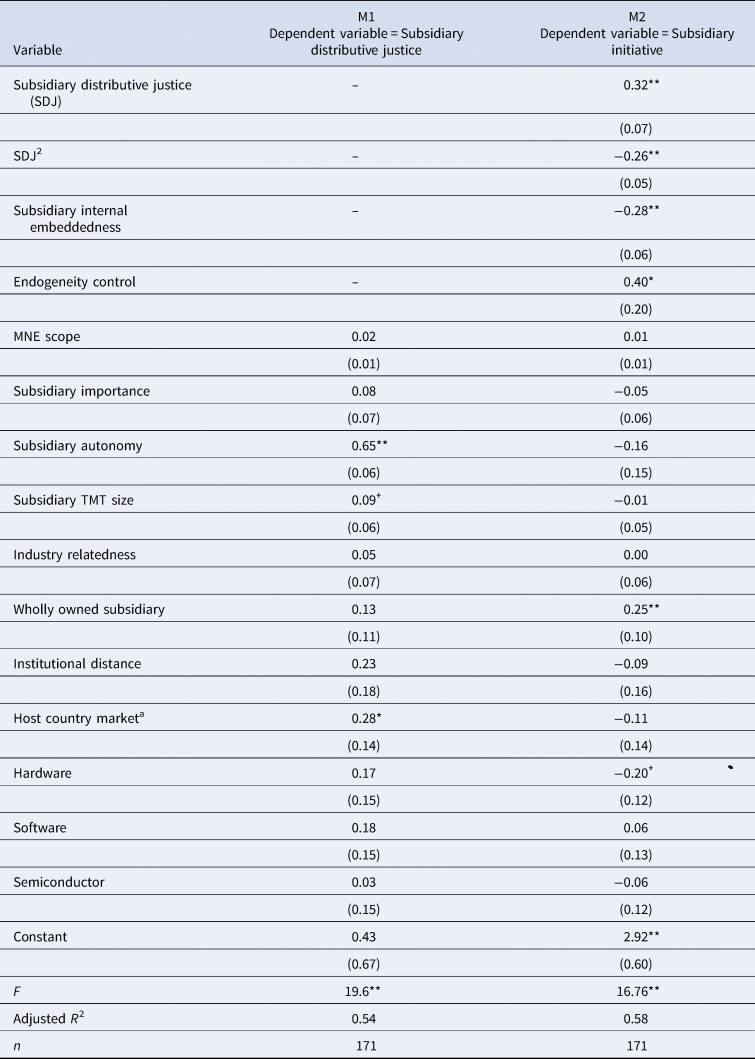
Theorists have maintained that endogeneity is a critical issue for many strategic decisions. If potential endogeneity is not adequately addressed, then researchers’ conclusions may be biased. In our study, one likely endogenous variable is subsidiary distributive justice. To tackle this issue, we followed Chatterjee and Hambrick's (Reference Chatterjee and Hambrick2007) two-step suggestion. The first step calculated the predicted independent variable by regressing the observed independent variable on the control variables described above. The second step included this predicted variable as an additional control in estimations of the outcome variable. As Table 5 shows, the first-order term for subsidiary distributive justice is positive (β = 0.32, p < 0.01), while the second-order term is negative (β = −0.26, p < 0.01) in predicting subsidiary initiative. Hence, endogeneity seems not to be a major issue.
Estimates with endogeneity control

Notes: Standard errors appear in parentheses.
a In billions of USD.
+ p < 0.1, *p < 0.05, **p < 0.01 (two-tailed tests).
Subsample analyses
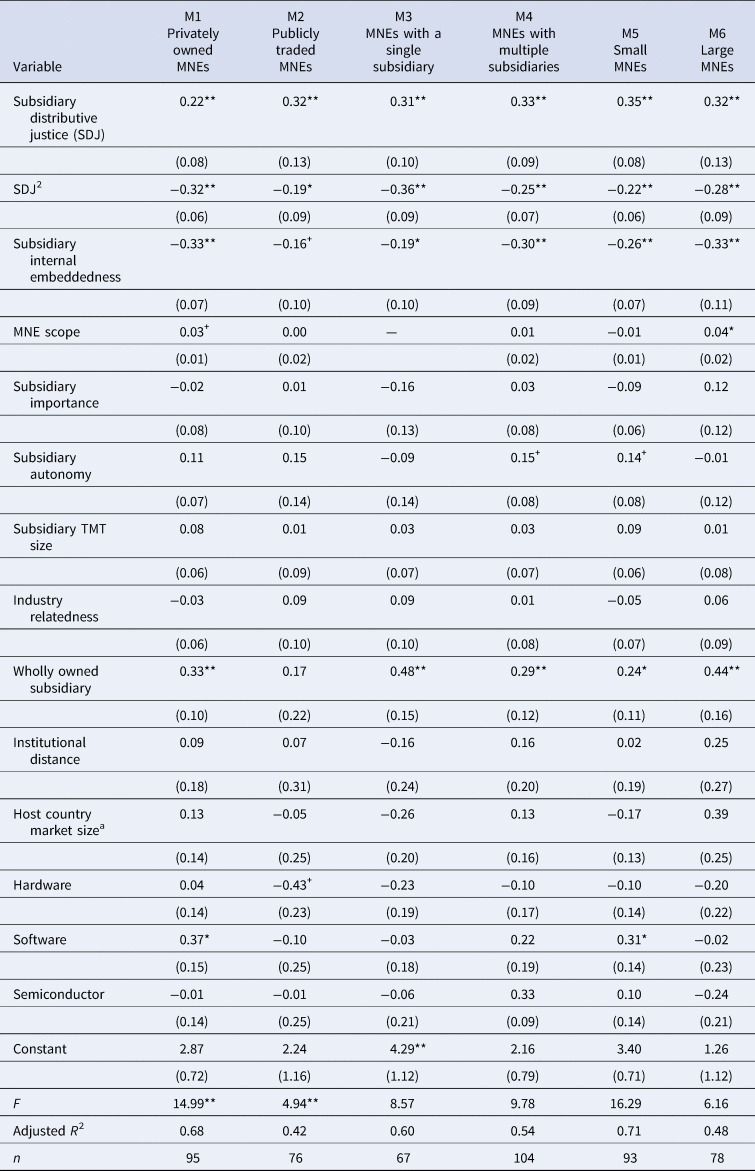
To ensure the robustness of our findings, we constructed three sets of subsamples based on three criteria: (1) whether an MNE is publicly or privately traded, (2) whether an MNE has one or multiple subsidiaries, and (3) whether an MNE's size is relatively small or large (operationalized by the threshold of 300 employees). Our rationale is as follows. First, with their visible images, publicly traded MNEs may have additional resources to motivate subsidiaries to show initiative. Second, whether an MNE has one or multiple subsidiaries could matter because social comparisons (Festinger, Reference Festinger1954; Suls & Wheeler, Reference Suls, Wheeler, Van Lange, Kruglanski and Higgins2012) can be more salient in a larger MNE group than in a smaller counterpart. Third, relative to a smaller MNE, a larger MNE can have more resources to encourage subsidiaries to launch autonomous projects. As can be seen from Table 6, our conclusions are consistent across these subsamples.
Subsample analysis of subsidiary initiative

Notes: Standard errors appear in parentheses.
a In billions of USD.
+ p < 0.1, *p < 0.05, **p < 0.01.
Discussion
The purpose of our study is to understand the relationship between distributive justice and subsidiary initiative. While MNEs have used rewards to engage subsidiaries, the effectiveness of this approach is not well understood. We postulate that when distributive justice is at a low level, an increase of distributive justice can induce subsidiaries to undertake autonomous projects to strengthen an MNE's operations. Yet when distributive justice goes beyond a threshold, subsidiaries may have reduced motivation to show initiative, because a high level of justice suggests that the MNE has high expectations for subsidiaries’ projects. Results based on a sample of subsidiaries owned by MNEs and their major subsidiaries support our arguments. The findings also suggest that this curvilinear relationship will vary depending on a subsidiary’s internal embeddedness within an MNE.
Theoretical Implications
Our findings have several theoretical implications. First, the degree to which an MNE shares gains fairly and equitably within its network is one issue that needs more scholarly attention. Verbeke, Bachor, and Nguyen (Reference Verbeke, Bachor and Nguyen2013) reported that procedural justice can ease the process for an MNE to engage in knowledge transfer. Asmussen et al. (Reference Asmussen, Foss and Nell2019) mathematically demonstrated that procedural justice has the potential to foster subsidiary initiative, despite a potential cost. Also, Weng and Cheng (Reference Weng and Cheng2023) showed that procedural justice helps MNEs more equally allocate attention toward subsidiaries. Although these studies recognize the bright side of justice, the potential dark side remains insufficiently understood.
Our results suggest that while granting rewards and benefits commensurate with subsidiaries’ actions is helpful, a high level of justice is not a blessing. This finding opens up several avenues for further research. One area is to investigate which characteristics of subsidiary managers will accelerate or delay the emergence of the reflection point associated with justice. For example, to the extent that short-tenured managers act more aggressively than their long-tenured counterparts, the former set of managers may be more responsive to distributive justice, thus delaying the threshold's appearance. Alternatively, if more seasoned managers tend to behave conservatively than their less seasoned counterparts, then the threshold may appear earlier for older managers. Meanwhile, the origin of the subsidiary manager can make a difference. Relative to a local hire, a subsidiary manager hired from a home country may have a stronger bond with the MNE. For this manager, distributive justice can be more effective in boosting subsidiary initiative, thus advancing the arrival of the threshold. Researchers can explore these factors.
Second, we find that the non-monotonic relationship between distributive justice and subsidiary initiative varies across low versus high internally embedded subsidiaries. While it has been noted that subsidiaries can have multiple types of embeddedness (Cheng & Huang, Reference Cheng and Huang2021; Ferraris, Reference Ferraris2014; Meyer, Mudambi, & Narula, Reference Meyer, Mudambi and Narula2011), scholars largely focus on external embeddedness. For example, research has documented that external embeddedness can be instrumental in engendering subsidiary innovation (Isaac, Borini, Razig, & Benito, Reference Isaac, Borini, Razig and Benito2019), managing knowledge (Javernick-Will, Reference Javernick-Will2013), and affecting eventual performance (Halaszovich & Lundan, Reference Halaszovich and Lundan2016). Here, our results suggest that internal embeddedness is a crucial contingency. While external embeddedness may be central to an MNE's attention, the degree to which subsidiaries are close to headquarters is equally important. Our findings are in line with research that suggests both external and internal embeddedness are critical to determining subsidiary behaviors and performance (Cheng & Huang, Reference Cheng and Huang2021; Ferraris et al., Reference Ferraris, Bogers and Bresciani2020).
The role of internal embeddedness creates several avenues for further exploration. For example, do levels of internal embeddedness shape subsidiaries’ search scope and intensity? Studies have suggested that subsidiaries can help the MNE explore unknown areas, thus facilitating the firm’s external search (Cyert & March, Reference Cyert and March1963). While performance has been noted as a pivotal factor (Hu, Gu, & Xia, Reference Hu, Gu and Xia2022), the degree of internal embeddedness can be pertinent because it shapes a subsidiary's orientation. Also, our finding suggests that internal embeddedness can serve as a quasi-governance mechanism to alter the effects of other control methods employed by an MNE. Specifically, subsidiaries with a low level of internal embeddedness may be inclined to win an MNE's attention, as they hope to improve their images within the MNE. Hence, internal embeddedness may moderate the effect of the MNE's positive notice on subsidiaries. Meanwhile, managers in relatively less embedded subsidiaries may hope to receive clearer, more transparent policies regarding promotion, because such policies provide guidelines for advancing their careers within the MNE. Scholars can pursue these inquiries in the future.
Practical Implications
Given our findings, we offer two implications for practitioners. First, headquarters executives are advised to have a realistic view of using distributive justice to manage subsidiaries. Although allocating rewards and benefits fairly can motivate subsidiary managers, it is not always effective. As demonstrated, too much emphasis on justice could prompt subsidiary managers to shy away from taking initiative. Hence, a naïve belief in using economic gains and fairness to engage subsidiaries is not realistic. To avoid going beyond the threshold, headquarters executives may seek feedback from subsidiaries regularly. Incorporating the comments from subsidiaries will help the headquarters make better use of its policies and resources.
Separately, headquarters executives can consider each subsidiary's internal embeddedness in planning and executing distributive fairness policies. For example, in creating rules and expectations governing initiative on the part of subsidiaries, headquarters may list areas to which more highly embedded subsidiaries can better contribute. Doing so can increase motivation in these subsidiaries to show initiative. Alternatively, headquarters may persuade subsidiaries with a high level of internal embeddedness to launch proactive projects, without relying on economic incentives or justice policies. Sophisticated headquarters executives will effectively use this factor in building a cohesive, productive MNE team.
Limitations and Future Research Directions
As with other research, our study has several limitations. Most obviously, to understand justice perception within subsidiaries, we used responses from subsidiary lead managers. Although this approach allowed us to know the orientation of the subsidiary due to the subsidiary managers’ leadership role, it is helpful to collect multiple responses from a subunit.Footnote 1 Relatedly, we asked the headquarters executive in charge of global operations to give his or her assessment of subsidiary initiative. While our method follows prior research (Birkinshaw et al., Reference Birkinshaw, Hood and Jonsson1998; O'Brien et al., Reference O'Brien, Scott, Andersson, Ambos and Fu2019), we cannot ascertain that subsidiaries’ bottom-up value-creating behavior is entirely driven by subsidiaries’ lead managers’ motivation rather than headquarters’ influence. Future research can devise more sophisticated methods to gauge subsidiary initiative.Footnote 2 Second, we used questionnaires to collect our data. Although informative, surveys may not fully demonstrate causal effects. To better understand the causal effect, future research may employ experiments (Hill, Matta, & Mitchell, Reference Hill, Matta and Mitchell2021; Zapata et al., Reference Zapata, Carton and Liu2016). Third, our findings are based on a sample of MNEs in the IT industry based in Taiwan. It is helpful to draw on firms in other industries and countries to know whether our findings are held in other contexts. Ultimately, industry conditions and home country contexts (Hobdari, Gammeltoft, Li, & Meyer, Reference Hobdari, Gammeltoft, Li and Meyer2017) are not the same, and such heterogeneity may alter the effectiveness of distributive justice in fostering subsidiary initiative.
Despite these limitations, our findings demonstrate that distributive justice is not always helpful to MNE headquarters in eliciting initiative from subsidiaries. Our findings alert researchers and practitioners to use justice thoughtfully, especially when dealing with managers who are working overseas and have varying levels of internal embeddedness with the corporate office.
Data availability statement
The data and codes that support the findings of this article are openly available in the Open Science Framework at https://osf.io/6n47t/
Acknowledgments
We thank the Senior Editor Professor Qian (Cecilia) Gu and two reviewers for their development feedback.
Funding statement
This study was supported by the Taiwan National Science and Technology Council (112-2410-H-194-040-SS3) and the Ministry of Science and Technology (108-2628-H-194-001-SS2).
Appendix
Main Variables and Measurements

David H. Weng (hcweng@fullerton.edu) is an assistant professor in the Department of Management, California State University Fullerton. He was born and grew up in Taiwan, but currently works in the United States. His research interests include upper echelons, corporate strategy, and international management.
Hsiang-Lin Cheng (hlcheng@ccu.edu.tw) is a full professor of strategy at National Chung Cheng University, Taiwan. His research focuses on international management, small and medium-size enterprise (SME) management, and B2B marketing.