I. NON-PRECLUDED MEASURES: AN OVERVIEW
Non-Precluded Measures (NPM) provisions in Bilateral Investment Treaties (BITs) have acquired a great deal of importance in international investment law. Despite that importance, there is still a dearth of academic literature in this area. While some work has been done in general,Footnote 1 country- or region-specific studies are still rare. Except for India,Footnote 2 no study has been done on the NPM provisions in BITs signed by all South Asian countries, or signed by an individual South Asian country. In this regard, this paper aims to make a contribution by studying NPM clauses in BITs signed by South Asian countries. For this purpose, the paper studies 147 stand-alone BITs of South Asian countries which are in force; these comprise seventy-two BITs of India,Footnote 3 twenty-five BITs of Pakistan,Footnote 4 twenty-three BITs of Sri Lanka,Footnote 5 twenty-one BITs of Bangladesh,Footnote 6 four BITs of Nepal,Footnote 7 and two BITs of Afghanistan.Footnote 8 In undertaking this study, both doctrinal and empirical research methodologies are followed. Therefore, in an attempt to shed some light on NPM provisions in the BITs of South Asia, the paper has focused mainly on the following areas: the importance of studying NPM provisions in context of South Asian countries (Part I); the mapping of NPM clauses in the BITs of South Asian countries (Part II); permissible objectives provided in the BITs of South Asian countries (Part III); and nexus requirement links in the BITs of South Asian countries (Part IV). However, before we address these issues as such, we first need to clarify the concept of NPM provisions.
A. NPM Provisions: An Analysis
NPM clauses are basically exceptions to the scope of the application of BITs. As the text suggests, these provisions allow states to take actions which are otherwise inconsistent with their treaty obligations.Footnote 9 These actions, when taken by states, are usually considered to be consistent with a BIT if they fall under the permissible objectives specified in the NPM clauses. In other words, NPM clauses transfer the cost of harm done to investment from host states to investors in exceptional circumstances.Footnote 10 It can also be said that NPM provisions allow the host states to impair the investments covered under BITs by being an instrument of regulation in the hands of host states.Footnote 11 Therefore, NPM provisions are important and probably the most effective device to ensure sufficient regulatory space for host states to pursue their non-investment policy objectives.Footnote 12 Examples of their importance are the cases filed by investors against Argentina during the Argentine crisis, where NPM clauses were invoked by Argentina for the default of investments made in its territory before different investment arbitral tribunals.Footnote 13 The decisions of these tribunals were not consistent, and they had given quite divergent rulings.Footnote 14 Nonetheless, these cases not only generated a debate on the interpretative methodology followed by these tribunals but also emphasized the significance of NPM provisions in the BITs for protecting a state’s regulatory space.Footnote 15 In recent years there has been a plethora of examples where disputes have emerged between foreign investors and host states over regulatory measures taken by the state, such as measures relating to environmental policy,Footnote 16 sovereign decisions regarding privatization,Footnote 17 urban policy,Footnote 18 monetary policy,Footnote 19 taxation,Footnote 20 and many others.Footnote 21 It is clear that these disputes arose when host states tried to broaden the sphere of their regulatory space.
Thus, the question arises: How can states create such regulatory space within the contours of the BIT? States can devise such a mechanism by creating specific exceptions in the treaty to assure that host states have sufficient regulatory latitude.Footnote 22 Nearly all investment treaties cover one or two exceptions in order to protect the essential interests of the Contracting Parties from the coverage of the treaty obligations.Footnote 23 Some of these exceptions are narrowly draftedFootnote 24 and some are broad in scope.Footnote 25 However, there are also exceptions which apply to all or many BIT obligations.Footnote 26 For example, Article 15 of India-Australia BIT provides for:
Prohibitions and Restrictions:
Nothing in this Agreement precludes the host Contracting Party from taking, in accordance with its laws applied reasonably and on a non-discriminatory basis, measures necessary for the protection of its own essential security interests or for the prevention of diseases or pests.Footnote 27
The above provision allows Contracting Parties to take measures for the protection of their essential security interests and for the prevention of diseases. Even if these measures harm the foreign investments, they shall not be construed as violating any treaty provision. These exceptions are, in general, called non-precluded measures clauses.Footnote 28 The importance of studying NPM provisions in the context of South Asia will be discussed below.
B. Why Study NPM Provisions in the Context of South Asian Countries?
Given the fact that all South Asian countries are either developing countries or least developed countries and tend to invite more and more investments in order to generate capital in their countries, the examination of this important provision in the BITs of these countries becomes necessary.
Thus it is pertinent to go through a brief study of each South Asian country in respect of the following three aspects—which can be the common factors to all the South Asian countries—in order to understand the importance of studying NPM provisions in the context of South Asia:
-
1. The number of BITs signed by South Asian countries;
-
2. Foreign Direct Investment (FDI) inflows in South Asian countries; and
-
3. The rise in investment cases globally and against South Asian countries.
For the purposes of a comparative study, the year 1990 is taken as a base year in this section, because most of the South Asian countries started moving towards liberalization after 1990.
1. Number of BITs signed by South Asian countries
The number of BITs signed by South Asian countries shows the acceptance of these countries to be held accountable under international law for their regulatory conduct that impacts foreign investment. Hence, if we analyze BITs signed by these countries, Pakistan has signed forty-six BITs to date.Footnote 29 While it signed its first BIT with Germany in 1959,Footnote 30 by 1990 it had signed seven BITs with China,Footnote 31 France,Footnote 32 Germany,Footnote 33 Korea,Footnote 34 Kuwait,Footnote 35 the Netherlands,Footnote 36 and Sweden.Footnote 37 However, between 1990 and 2014 it had signed thirty-nine BITs.Footnote 38 Sri Lanka has signed in total twenty-nine BITs;Footnote 39 it had signed seventeen BITsFootnote 40 by 1990, and from 1990 to 2014 it had signed a further twelve BITs.Footnote 41 Bangladesh has signed thirty BITsFootnote 42 in total; nine BITs by 1990,Footnote 43 the other twenty-one BITs between 1990 and 2015.Footnote 44 Nepal has signed six BITsFootnote 45 in total to date; two BITs were signed before 1990Footnote 46 and four after 1990.Footnote 47 Bhutan and the Maldives have not signed any BITs with any country to date.Footnote 48 Afghanistan signed all of its three BITs between 1990 and 2015.Footnote 49 India has signed eighty-four BITs to date, all after 1990.Footnote 50 In India, after economic reforms in 1991, foreign investment policy was liberalized and Bilateral Investment and Protection Agreements (BIPAs) were entered into with other countries to protect and promote investments on a reciprocal basis to ensure more FDI inflow in the country.Footnote 51 While, in the absence of any literature, it is difficult to say with certainty about other countries in South Asia, there is hardly any doubt that the Indian BITs were signed to attract more FDI inflows.Footnote 52
It is clear that South Asian countries started entering into BITs with other countries at a faster rate after 1990. It can also be said, though there is little evidence available, that BITs were signed to ensure more FDI inflows in these countries. Therefore, this rapid increase in the number of BITs shows the willingness of these countries to be subjected to treaty obligations in order to attract foreign investments into their territories.
2. FDI inflows in South Asian countries
Although increased FDI inflow is considered good for the economy in any country, at the same time it also increases the vulnerability of that country to BIT claims. This is because any policy decision that impacts the investment can bring the state before an international tribunal. Therefore it is pertinent to assess the FDI inflow situation in South Asian countries. FDI inflow in Pakistan was US$278 millionFootnote 53 to 1990; however, it soared up to US$1,747 million by 2014.Footnote 54 FDI inflow in Sri Lanka was US$43 millionFootnote 55 to 1990, then increased to US$944 million to 2014.Footnote 56 FDI inflow in Bangladesh was just US$3 millionFootnote 57 to 1990; however, by 2014 this figure had risen to US$1,527 million.Footnote 58 FDI inflow in Nepal was US$6 million to 1990,Footnote 59 but by 2014 it had grown to US$30 million.Footnote 60 FDI inflow in Afghanistan was zero (in US million dollars)Footnote 61 to 1990; however, by 2014 it had risen to around US$54 million. FDI inflow in India grew at an exceptional rate after 1990. While it could manage to attract only US$237 million as FDIFootnote 62 to 1990, this figure soared to US$ 34,417 million by 2014.Footnote 63
There is no doubt that the “economic reforms” that took place after 1990 in most of these countries were crucial to the increased FDI inflow into their territories.Footnote 64 But at the same time, with increased FDI inflow came higher responsibility for the protection of these investments. This, though indirectly, made South Asia more vulnerable to BIT claims.
3. Rise of investor-state arbitration against states globally and against South Asian countries
The BIT regime has seen tremendous growth from 1990; this can be determined by the fact that whereas there were only around 300 BITs signed before 1990,Footnote 65 nearly 2,935 BITs existed as of October 2015.Footnote 66 This shows how fast this regime has grown.
However, the downside of this tremendous growth can be seen in the rise of the number of investor-state arbitrations. With the growth in number of BITs, there is also growth in the number of investment disputes. The total number of known treaty-based Investor State Dispute Settlement (ISDS) cases by the end of 2012 was 514.Footnote 67 However, by the end of 2013, the number of known treaty-based cases increased to 568.Footnote 68 And, by the end of 2014, investors initiated forty-two new ISDS cases, thereby taking overall number of known ISDS cases to around 610.Footnote 69 Of all the forty-two cases which were brought against states in 2014,Footnote 70 sixty percent of them were filed against developing countries and forty percent were filed against developed countries.Footnote 71 It is also worth mentioning that the share of cases against developed countries was forty-seven percent in 2013, and thirty-four percent in 2012, while the historical average is twenty-eight percent.Footnote 72 These data show that developing countries are subjected to BIT claims on more accounts than the developed countries globally.
In the case of South Asia, a large number of investor-state cases have already been filed against these countries. Pakistan has been subjected to these cases on eight accounts,Footnote 73 Sri Lanka on three accounts,Footnote 74 Bangladesh on one account,Footnote 75 and India on sixteen accounts.Footnote 76 In most of the decided cases, decisions have gone in favour of the investors.Footnote 77
Thus, a combination of three factors—a rise in number of BITs signed, increasing FDI inflows, and rising investor-state cases against South Asian countries—clearly shows that all South Asian countries are more vulnerable to BIT claims than ever before. The possibility of the regulatory measures of these countries being challenged by BIT claims is, thus, quite high. Therefore, in order to see whether these countries will have sufficient regulatory latitude to pursue their non-investment policy objectives, a study of NPM provisions is important in the context of South Asia.
Against this background, this paper intends to analyze and assess the NPM clauses in the BITs of the South Asian countries. Within this approach, Section II will delve into the detailed study of NPM clauses in the BITs of South Asian countries. In doing such research activity, it will deal in detail with the placement, form, and structure of NPM clauses in these countries. Section III provides a detailed analysis of the different provisions relating to permissible objectives provided in the BITs of these countries. Section IV will then delve into the nexus requirement links provided by these NPM clauses, with some reference to the interpretative methodologies followed by arbitral tribunals during the Argentine crisis. In conclusion, an assessment shall be made in Section V of the BITs signed by these countries with respect to NPM provisions. It will also suggest necessary changes with regard to NPM clauses in these BITs.
II. MAPPING THE NPM PROVISIONS
Whether NPM provisions are a common element in BITs globally is a difficult question to answer. It is more difficult given the fact that hardly any research has been done in respect of NPM provisions in BITs globally. However, there are academic papers available which suggest that NPM provisions are a relatively more common element in BITs than in other international treaties, and that they play an important role in the legal regime of foreign investment;Footnote 78 this seems to be true, bearing in mind that the high frequency of NPM provisions is limited only to the BITs of a certain number of countries.Footnote 79 But at the same time, it would not be right to say that NPM provisions are common elements in all BITs globally. This also tells us that other countries do not very frequently and consistently incorporate NPM provisions into their BITs. The reason for this inconsistency is unknown; according to Salacuse, “NPM clauses are subject to the negotiation dynamics of the states negotiating an investment treaty”.Footnote 80 One can relate this reasoning to the status and negotiation capability of a country to agree or not agree the terms of the BIT. As BITs were signed by developing countries to attract FDI flows into their territories,Footnote 81 it is possible that developing countries might have made some compromises on their regulatory powers while negotiating BITs by not including NPM provisions or any other exceptions in their BITs.
If we analyze the frequency of NPM clauses in the BITs of South Asian countries, the outcome is quite surprising. In South Asia, the number of BITs signed by these countries is 198;Footnote 82 out of these 198, 152 are in force.Footnote 83 The surprise comes when one examines the NPM clauses in these BITs.Footnote 84 , Footnote 85 , Footnote 86 , Footnote 87 , Footnote 88
Table 1 shows that India is the only country in this region which has NPM provisions in almost all of its BITs.Footnote 89 It is difficult to ascertain why other countries have not included NPM provisions more frequently in their BITs. Out of these 147 BITs studied, only eighty contain NPM provisions.Footnote 90 These numbers become more surprising when India is excluded from the list. South Asian countries, excluding India, have eighty BITs in force altogether, out of which only ten contain NPM provisions.Footnote 91 This number is not even close to ten percent of the total number of BITs signed by these countries. This certainly cannot be said to be an encouraging outcome for countries looking for more and more regulatory latitude. This section will now delve into the specific traits of the NPM provisions found in these BITs.
NPM provisions in BITs of South Asian countries

A. Placement of NPM Clauses in BITs
Generally, any BIT consists of three documents; the main body, the protocol, and the exchange of notes between the parties. NPM provisions in the BITs of South Asian countries are usually found in the main body.Footnote 92 However, “NPM-like provisions” have also been found in the protocolsFootnote 93 and in the notes of exchangeFootnote 94 between the Contracting Parties. The next subsection will examine the form and structure of NPM provisions in these BITs.
B. Form and Structure of NPM Clauses in BITs
Study relating to the formulation of NPM provisions can be made on the basis of the following two grounds:
-
1. Based on textual grounds;Footnote 95 and
-
2. Based on structural elements.Footnote 96
1. Textual grounds
NPM provisions can be studied on the basis of the following textual traits:
-
(a) Model NPM provision;
-
(b) Modified Model NPM provision; and
-
(c) GATT Article XX type.
A model BIT is not a legally binding document.Footnote 97 It is a document drafted to provide a balance between investment and non-investment policies based on a country’s own domestic policies by keeping in view the requirements and needs of that country for entering into future BITs. Thus, it provides a guideline to the state as to how the state will advance in future negotiations while concluding a BIT with another state.Footnote 98
(a) Model NPM provision and (b) Modified Model NPM provision. These approaches basically shed light on the dynamics of NPM provision on the basis of the language of the NPM provision used in the model BIT of a country. Hence, these approaches are best suited for studying a country that has a model BIT. IndiaFootnote 99 and Sri LankaFootnote 100 are the only countries that have model BITs in the South Asian region. The other countries in South Asia either do not have any model BIT, or are in the process of preparing one.Footnote 101 Hence, studying NPM provisions using this approach would not be the best way to proceed with the present study. However, a pertinent study relating to GATT Article XX-type provisions can be made through this approach.
(c) GATT Article XX type. Those NPM provisions which bear a resemblance to or which are close to the language of GATT Article XXFootnote 102 are called Article XX-type NPM provisions. Article XIV of the General Agreement on Trade in Services (GATS) has a similar form to Article XX of GATT.Footnote 103 To date, only around twenty-five to thirty BITs contain GATT- or GATS-like NPM provisions (XX-NPM) out of more than 2,900 BITs signed.Footnote 104
In South Asia, XX-NPM provisions are rare. The only BIT which has a XX-NPM provision is the India-Colombia BIT.Footnote 105 Article 13 of this BIT contains a broad range of exceptions; however, only Article 13(5) of the BIT can be said to be a XX-NPM provision.Footnote 106 Although Article 13(5) resembles GATT Article XX, it varies from Article XX’s original form. Still, it can be said that XX-NPM provisions provide enough space for regulatory discretion to host states. With this, I will now move on to the second approach, a study based on structural elements.
2. Structural elements
This approach is best suited for the purposes of the present study. It has the following five components:
-
(a) Scope;
-
(b) Permissible objectives;
-
(c) Nexus requirement;
-
(d) Self-judging and non-self-judging NPM clauses; and
-
(e) Limitations on NPM Provisions.
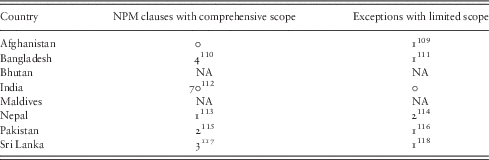
(a) Scope. NPM provisions have a comprehensive scope. This means it precludes the regulatory measures taken by host states from incurring any obligations arising out of any provision of the treaty. However, there are also “limited scope exceptions” which apply only to one or some provisions of the treaty. It is argued here that these limited scope exceptions, which are narrow in scope, should not be conflated with NPM provisions. In this sense, this approach is different from that taken by William Burke-White and Andreas Von Staden, where they say that there can be two types of NPM provisions: first, NPM provisions with comprehensive scope, and second, NPM provisions with limited scope.Footnote 107 There is hardly any doubt that the NPM provisions are also called “general exceptions”. Black’s Law Dictionary defines the word “general” as “universal, not particularized”.Footnote 108 It means that the term “general exception” would act as an exception having universal application. This, in the context of BITs, would mean that it would cover all the BIT provisions. So here the question arises: Can a general exception have limited scope? The answer to this, after making the analysis above, would be “no”. Therefore, it is argued here that NPM provisions have only comprehensive scope. Thus, allowing the proposition that there can be two types of NPM provisions would not be correct; limited scope exceptions are specific treaty exceptions restricted to just one or two treaty provisions, and are different from NPM provisions. However, for the purposes of this section, a study shall be made as follows:
-
(i) NPM provisions with comprehensive scope; and
-
(ii) Exceptions with limited scope.
-
Most of the countries in the South Asian region contain both comprehensive scope and limited scope exceptions. Table 2 explains this dynamic. It is worth noting that all of the limited scope exceptions are found either in protocols or in notes of exchange in the BITs of the South Asian countries. Table 2 shows that even limited scope exceptions are not common in these BITs. They are in low numbers in the BITs of these countries.
NPM provisions with comprehensive and limited scope

(b) Permissible objectives. These basically specify, within the NPM provision, areas in which the state can exercise its regulatory authority to achieve its non-investment policy objectives without attracting anyFootnote 109 , Footnote 110 , Footnote 111 , Footnote 112 , Footnote 113 , Footnote 114 , Footnote 115 , Footnote 116 , Footnote 117 , Footnote 118 obligation created by the BIT. In other words, permissible objectives mean those non-investment policy objectives that are listed in NPM provisions and for which the host country can deviate from its BIT obligations.Footnote 119 An attempt has been made to identify these permissible objectives in the BITs of South Asian countries in Table 3. Table 3 shows more emphasis has been placed on either essential security interests or circumstances of extreme emergency. Important permissible objectives like health, public order, environment, and morality have not been able to attract much attention from these countries.Footnote 120 , Footnote 121 , Footnote 122
Permissible objectives in NPM provisions in BITs of South Asian countries120

(c) Nexus requirement links. Nexus requirement in an NPM clause is the link between adopted measures and the objective sought through those measures.Footnote 123 As the language of NPM provisions varies from one BIT to another, the wording in a nexus requirement link also varies from one NPM clause to another. For example, the NPM provision in the Armenia-India BITFootnote 124 has “for” as its nexus requirement link,Footnote 125 whereas the Denmark-India BITFootnote 126 has “necessary” as its nexus requirement link.Footnote 127 Therefore, the nexus requirement links can be worded differently; some examples are: “for”,Footnote 128 “directed to”,Footnote 129 “necessary”,Footnote 130 and “relating to”.Footnote 131 The significance of the nexus requirement link lies in the fact that it determines the degree of connection between the measures taken and the objective sought.Footnote 132 Table 4 identifies the various nexus requirement links used in NPM provisions in the BITs of South Asian countries.Footnote 133 , Footnote 134 , Footnote 135 , Footnote 136 , Footnote 137 , Footnote 138 , Footnote 139 , Footnote 140 , Footnote 141 , Footnote 142 , Footnote 143 , Footnote 144 , Footnote 145 , Footnote 146
Nexus requirement links in NPM provisions in BITs of South Asian countries

Table 4 shows various nexus requirement links as applied in the NPM provisions. Sometimes one NPM clause uses more nexus links through various subclauses in the provision. This can be shown in the case of India, where the total number of nexus requirement links that are shown in Table 4 is seventy-five, while the number of BITs with NPM provisions counts only seventy, which technically means there should have been only seventy nexus requirement links. However, a study of the NPM provision of the India-Colombia BIT reveals that the NPM provision uses four nexus requirement links through several of its sub-provisions.Footnote 147
(d) Self-judging and non-self-judging NPM clauses. Self-judging clauses appear in a number of treaties (mutual assistance, extradition, trade, investment, private international law).Footnote 148 Any provision having self-judging characteristics will have three basic traits or elements: first, the state will have enough space for unilateral considerations, i.e. the state will have the right to ascertain the legality of extraordinary measures; second, the provision allows for independent assessment by the state claiming derogation and thus grants the state discretion to do so; and third, the threshold for the standard of review by the tribunal or court will get diluted to the examination of just good faith by the tribunal.Footnote 149
What makes these provisions special is the manner in which they are drafted; therefore, it is the construction of the language of a particular provision rather than its content that is important. The phrase “if the requested state considers” grants the state enough discretion to take any measure to protect its essential interests without being subjected to the external evaluation of measures taken by it. Different drafting techniques are used to grant such kinds of discretion in different international treaties, which is expressed in phrases such as “if the state considers”, “in the state’s opinion”, or “if the state determines”, etc.Footnote 150 Also, the presence of self-judging clauses in treaty provision cannot be presumed; it has to be expressly incorporated in the treaty.Footnote 151
It is pertinent here to also discuss non-self-judging clauses (NSJCs). NSJCs come into play when treaty provisions explicitly or implicitly do not specify the degree of deference to be accorded to the invocation of NPM provisions by one of the parties.Footnote 152 In other words, it becomes the job of the tribunal to determine the deference to be given to the state’s determination. Thus it does not grant the parties the discretion to evaluate their own situation. Rather, it posits an objective test of whether the exception is applicable in any given circumstances.Footnote 153 To put it simply, it does not leave any discretion with the parties.
AgainstFootnote 154 this background, where SJCs can provide much discretion to a state to justify its actions without incurring any international obligation, a study of the BITs of South Asian countries is much needed. Table 5 lists the number of BITs that have SJCs or NSJCs. Thus it can be seen here that, except on one occasion, in all NPM provisions the language is of NSJCs only. It means less discretionFootnote 155 , Footnote 156 , Footnote 157 , Footnote 158 , Footnote 159 , Footnote 160 , Footnote 161 , Footnote 162 , Footnote 163 , Footnote 164 , Footnote 165 , Footnote 166 , Footnote 167 , Footnote 168 , Footnote 169 while justifying the measure taken by the party for breach of treaty provisions.
Self-judging and non-self-judging clauses

(e) Limitations on NPM provisions. Almost all NPM provisions contain some restrictions or limitations on their applicability. Common conditions/limitations to which NPM provisions are subjected are “non-discriminatory”, “reasonable”, “good faith”, etc. Table 6 lists this dynamic in more detail. Thus it can be seen here that there is no dearth of limitations which restrict the invocation of NPM provisions. This certainly creates balance between the regulatory space of the host state and the protection of investments.
Limitations on NPM provisions

This ends the analysis of the anatomy of NPM provisions. The next section will explain the permissible objectives in the NPM provisions of South Asian countries.
III. PERMISSIBLE OBJECTIVES IN NPM PROVISIONS
This section undertakes the study of each permissible objective found in the BITs of South Asian countries.
A. Essential Security Interest
Out of the eighty BITs having NPM provisions in this region,Footnote 170 seventy-three have an essential security interest (ESI) as one of the permissible objectives.Footnote 171 Given the fact that these BITs use few permissible objectives in the NPM provisions, ESI assumes importance as it can be used for both security and non-security issues.Footnote 172 However, before an ESI can be used to exonerate the state from defaulting on its international law obligation, the state will have to prove that the measures taken were “essential” for its security interest. Now the question arises: What is the meaning of “essential” here? Some scholars have argued that the ordinary meaning of essential is “vitally important”.Footnote 173 Black’s Law Dictionary provides for the meaning of essential as “indispensably necessary” or “important in the highest degree” or “requisite”.Footnote 174 This means that the word “essential” before “security interest” sets a high threshold for a state to prove that the security interests taken are indispensably necessary. Once it is settled that security interests can be applied only in situations of the highest degree of importance, we should turn our attention to the meaning and scope of the term “security interest”. For this purpose, an enquiry should be made into understanding the word “security”. To start with the investment law regime, NAFTA, Chapter XXI, in its Article 2102, contains ESI as an exception and provides an exhaustive list of exceptions under ESI; however, it is mainly concerned with war, traffic in arms, etc.Footnote 175 The Energy Charter Treaty, Article 24, on exceptions, provides for the protection of the essential security interests of its signatories. However, it also stipulates ESI in terms of military necessity, war, and armed conflict.Footnote 176 In FTAs, Article 10(18)(2)(b) of the India-Korea IIAFootnote 177 and Article 6(12)(1)(b) of the India-Singapore IIAFootnote 178 also provides for ESI, but again in the context of the military and war, etc. Thus most of these instruments provide for the meaning of ESI in the provision itself. However, what happens if the provision is silent on the scope or meaning of ESI? It has been argued by many scholars that a plain reading should be taken while interpreting ESI;Footnote 179 however, there are also many investment law scholars who have argued for a broad meaning of ESI.Footnote 180 Also, the broad meaning given to ESI by various investment arbitration tribunals while interpreting Article 11 of the US-Argentina BIT provides an alternate interpretation for ESI.Footnote 181 These tribunals held that the inclusion of economic emergency within the meaning of ESI was justified;Footnote 182 thus they gave a broad meaning to the term ESI.
In the WTO regime, two important exceptions pertinent to the present study are the general exceptionsFootnote 183 and security exceptionFootnote 184 of GATT. However, in BITs such types of demarcation have not been observed, which means ESI deals with both security and non-security issues.Footnote 185 Thus, ESI in BITs is different from in Article XXI of GATT, which only provides for security exceptions. ESI in BITs is used in a general sense, as it covers more issues than just conventional security related issues.
With the evolution of international law, the meaning of security has also changed from its conventional meaning of state security in war or armed conflict to various other issues.Footnote 186 It now encompasses diverse issues such as economic security,Footnote 187 environmental security,Footnote 188 energy and resource security,Footnote 189 food security,Footnote 190 bio-security,Footnote 191 and health security,Footnote 192 etc. This reasoning bolsters the proposition that the scope of ESI has been broadened to encompass even the conventionally non-security-related issues.
To analyze this aspect in the context of South Asia, almost all ESI provisions in South Asian BITs are silent on their content.Footnote 193 Also, some of the NPM provisions in these BITs use different words, like “vital interests and security”,Footnote 194 “war, armed conflict, national emergency or civil disturbances”,Footnote 195 and “national interest”.Footnote 196 To deal with these terms separately, “vital interest” basically grants the state the freedom from international obligations when circumstances adversely affect its prestige or potentially threaten its existence.Footnote 197 “National emergency” is a broad term; it includes more than just security interest. The LG&E Tribunal accepted that economic crisis can be subsumed either under “essential security interest” or under “national emergency”.Footnote 198 It again should be left to a margin of appreciation decided on by the state, as different states have a different understanding of the matter.Footnote 199 “National interest” brings down the threshold of proving an emergency situation, as the more strict term “emergency” is absent; it provides that states will only have to show that the measures taken were in the interest of the country. What is “interest” will again have to be left to the host state. The Nepal-Finland BIT is the only BIT having an NPM clause that provides for the protection of ESI in time of war or armed conflict, or other emergency in international relations.Footnote 200 Thus it imposes upon the state a condition that security interests should be used only in a time of war or armed conflict, or other emergency in international relations. The phrase “other emergency in international relations” can also be found in Article XXI(b)(iii) of GATT, and in Article 2102(1)(b)(ii) of NAFTA.Footnote 201 This term is certainly broader than “war” or “armed conflict”; despite its vague structure, the expression is independent of any other term used here. The term “emergency” is more serious in nature, different from routine tensions or disagreements. The phrase could apply to those international situations which involve the future threat of war or armed conflict. Also, “emergency” can refer to an economic, social, or political situation as well. The best reading of this phrase would thus allow it to be used in almost all situations of a serious nature.Footnote 202
As has already been discussed in Section II, self-judging clauses can play a vital role in providing states with a large regulatory space. Therefore, if ESI does not provide for its content, it means that a state through its SJC can determine the meaning of ESI. Among the BITs in South Asian countries, only one BIT has a SJC in its NPM provision;Footnote 203 the other BITs having NPM provision are non-self-judging.
Given the fact that all South Asian countries are grappling with various regional problems, for example terrorism, financial problems, or issues relating to natural calamities,Footnote 204 ESI can play a vital role by providing justification for regulatory measures taken in cases of the above-mentioned regional problems. Since regional problems can best be understood by the countries in that particular region, it is argued here that the margin of appreciation should always be given to the host states.
B. Public Order
Public order as a permissible objective has not been used very frequently in the BITs of South Asian countries. It appears in only eight of these BITs.Footnote 205 In the context of India, public order appears in four BITs: Colombia-India, Portugal-India, Morocco-India, and Qatar-India. Article 13(5) of the India-Colombia BIT poses a high threshold for the use of this exception as it is qualified by the word “necessary”, which means that only in situations of extreme urgency can the public order exception be invoked. The chapeau of this provision also puts some limitations on the use of exceptions given under it.Footnote 206 The Portugal-India and Qatar-India BITs do not put any limitation on the invocation of this exception except that the measure should be used in a non-discriminatory manner. However, the Qatar-India BIT, apart from having a permissible objective of “public order”, provides for “morality affecting public order” as a separate permissible objective. It means that this permissible objective can be invoked only in those situations where public order is affected by issues of morality. The Morocco-India BIT sets a higher threshold as it provides for “strictly necessary” as a qualification for public order to be used as an exception. This “strictly necessary” requirement is more stringent than the “necessary” requirement. It means a state seeking to justify its actions under an NPM provision will have to show that it fulfils the requirements of the “strictly necessary” test. Pakistan does not have public order as a permissible objective in its BITs. This is surprising given that the public order situation in Pakistan has faced many problems in the past, and indeed in the present;Footnote 207 in this situation it is suggested that Pakistan should include public order as a permissible objective in its BITs. Bangladesh has two BITs containing public order as a permissible objective: the US-Bangladesh and Turkey-Bangladesh BITs. Both of these BITs require a high-threshold necessity test to be passed in order to justify state action to invoke public order exception. In Sri Lanka, the public order exception appears only in the US-Sri Lanka BIT. It again sets a high-threshold requirement: “necessary”. Nepal, in its Finland-Nepal BIT, contains a public order exception. It also sets a high threshold for exceptions to be invoked by states as it provides for “necessary” as a requirement to be satisfied.
The meaning of “public order” differs from one jurisdiction to another.Footnote 208 For example, in France, Italy, and Switzerland, it plays a fundamental and even constitutional role; whereas in the US and Germany, it is used to describe a class of offences and sum of behavioural norms, respectively.Footnote 209 Also, in the US Gambling case in the WTO, the panel acknowledged that the meaning of “public order” can vary in time and space and it depends on various factors such as social, cultural, ethical, and religious values.Footnote 210 Thus, an attempt to ascertain the meaning in international law using Article 31 of Vienna Convention on the Law of Treaties (VCLT) shall be made.
1. Ordinary meaning
In the absence of any clear text available in these BITs, the dictionary meaning shall be taken to define the term. The fourth edition of Black’s Law Dictionary, though, does not provide for the definition of “public order”; however, it does provide for the definition of “disorder”. It defines “disorder” as “turbulent or riotous behaviour; immoral or indecent conduct; the breach of public decorum and morality”.Footnote 211 However, the ninth edition of Black’s Law Dictionary defines disorder as “A public disturbance; a riot <civil disorder>”.Footnote 212 Thus, the meaning of “public order” can be ascertained as the absence of disorder.
2. Object and purpose
The preamble of any BIT can be relied upon to determine the object and purpose of the treaty. However, different BITs have different preambles. Thus, ascertaining one uniform meaning of “public order” is not possible. Therefore, imposing on a country an internationally uniform definition of “public order”, which may not correspond to the country’s own values and might prevent the country from justifying a measure based on its domestic order, would go against the object and purpose of that BIT.Footnote 213
It is possible that the scope and meaning of “public order” was purposely not included in the BITs. Thus, it is suggested that the arbitral tribunals should give due deference to the country concerned while interpreting “public order”.
C. Public Health
Human health has been recognized by the WTO as being “important in the highest degree”.Footnote 214 The safety of public health is no doubt a matter of the utmost importance for any state. However, bound by the obligations of BITs, states sometimes give up on welfare measures that might go against its BIT obligations.Footnote 215 Therefore, it would be wise to include issues like public health exceptions in BITs. To look at the situation in South Asia, public health appears in nineteen BITs of South Asian countries.Footnote 216 This Article includes formulations such as “for the prevention of diseases or pests”,Footnote 217 “the prevention of diseases and pests in animals or plants”,Footnote 218 or “to protect human, animal, plant life or health”,Footnote 219 etc., within the ambit of public health. This paper shall refer to them as “public health-related provisions”. These formulations are broad in scope, as compared to “public health exceptions”, as they also include life and health issues for animals and plants.Footnote 220 It means that the host state can also take measures in cases of the failure of crops or spread of diseases in animals. Also, it becomes relatively easy to prove the condition of public health emergencies as the host state only needs scientific evidence to prove its existence or continuance, as compared to security-related issues.Footnote 221 The WTO regime, through the jurisprudence of the cases decided by panels and appellate bodies, also provides guiding principles in understanding public health exceptions and their applicability.Footnote 222
In terms of South Asia, India has fifteen BITs having public health or public health-related provisions: Australia-India,Footnote 223 BLEU-India,Footnote 224 Bosnia and Herzegovina-India,Footnote 225 Colombia-India,Footnote 226 Czech-India,Footnote 227 Denmark-India,Footnote 228 France-India,Footnote 229 Germany-India,Footnote 230 Korea-India,Footnote 231 Kuwait-India,Footnote 232 Malaysia-India,Footnote 233 Mauritius-India,Footnote 234 Netherlands-India,Footnote 235 Italy-India,Footnote 236 and Spain-India.Footnote 237 Pakistan has public health exceptions in two of its BITs: Mauritius-PakistanFootnote 238 and Singapore-Pakistan.Footnote 239 Sri Lanka has a public health-related exception in only its China-Sri Lanka BIT.Footnote 240 Bangladesh and Nepal have no public health exceptions in their BITs.Footnote 241 For the purposes of simplicity, an analysis will be made of different “public health-related provisions” separately; the approach for such a study will be as follows:
-
1. Prevention of disease and pests;
-
2. Prevention of disease and pests in animals and plants;
-
3. Public health; and
-
4. Other formulations.
1. Prevention of disease and pests
This kind of formulation appears in five BITs of South Asian countries.Footnote 242 All of these BITs, except in one case,Footnote 243 use “necessary” as a nexus requirement link. The Kuwait-India BIT sets a higher threshold as it provides for the prevention of disease and pests as a specific measure in circumstances of extreme emergency, apart from using “necessary” as a nexus requirement link. It is also pertinent to note here that this formulation does not provide for the bearer of the disease—human or animal. Thereby, it sets the threshold lower than any other provision that makes any such distinction. Therefore, a broad meaning can be given to this formulation so as to include both humans and animals in cases of disease.
2. Prevention of disease and pests in animals and plants
This kind of formulation appears in eleven South Asian BITs.Footnote 244 Six of these BITs use “necessary” as a nexus requirement link;Footnote 245 four of them use “directed to”;Footnote 246 and one of them uses “to” as a nexus requirement link.Footnote 247 It is obvious that “necessary” is more stringent, as it sets a higher threshold than “directed to” or “to” as a nexus requirement link. In terms of which is more stringent, a “necessary” > “directed to” > “to” kind of formulation can be made. It is also pertinent to mention here that the word “disease” in this formulation is used only for animals. Thus it leaves human health issues unaddressed.
3. Public health
This formulation can be found in four BITs of South Asian countries.Footnote 248 All of these four BITs use “directed to” as a nexus requirement link; which means states will not have to prove that measures taken by them were necessary. It means that states will have more regulatory latitude in cases of public health.
4. Other formulations
The India-Colombia BIT uses the language “to protect human, animal, plant life or health”, and the India-Spain BIT uses “in circumstances of extreme emergency posing a threat to the life or health of human beings, animals or plants”. The India-Colombia BIT uses the language of GATT Article XX(b).Footnote 249 It covers a wide range of items. It takes into consideration the life and health issues of humans, animals, and plants. Here, life and health terms need some discussion. Protection of life means protection of both life and limb from any possible threat. Health may or may not fall under this category. Also, the phrase “life or health” means that proving either a life threat or a health threat will justify the action taken by the state. Thus, this type of formulation covers in itself a broad range of life- and health-related aspects. The same interpretation can be made for the public health exception in the Spain-India BIT, wich uses the phrase “life or health”; but the Spain-India BIT also sets a higher threshold for the measures, as it says that measures should be taken only in circumstances of extreme emergency.
There are 400 million poor people in South Asia,Footnote 250 and it is a well-established notion that poverty creates ill-health because it forces people to live in environments that make them sick, without decent shelter, clean water, or adequate sanitation.Footnote 251 Sometimes, due to external or internal factors, endemic diseases like Ebola, swine flu, bird flu, and so on spread in public, creating panic among people. And the section of society which gets most affected by these endemic diseases are the poor. Therefore, it is suggested that the host state should maintain maximum regulatory latitude in the area of public health in the BIT itself.
D. Circumstances of Extreme Emergency
Ranjan argues that circumstances of extreme emergency (CEE), in stricto sensu, is not a permissible objective,Footnote 252 as CEE refers only to the circumstances and not the objective sought. However, this paper defers from the analysis made by Ranjan on this because the word “circumstances” itself leaves space for any permissible objective term to fall under its purview. For example, the absence of a public health exception or any other permissible objective in an NPM provision can be covered by a CEE permissible objective, subject to the fulfilment of the conditions of “extreme” and “emergency”. Therefore, this paper would label CEE as the “jack of all permissible objectives”, as it may perform the function of all other permissible objectives absent in BITs, thus providing the host state with the maximum discretion and regulatory latitude. Limitations on CEE, i.e. the burden on the host state to prove the existence of circumstances of “extreme emergency”, will have to be examined on a case-by-case basis. Also, the deference of standard of review to a host state may make the task of proving the existence of “extreme emergency” easier for the host state.
In the context of South Asia, in India CEE are found in sixty-two of its BITs.Footnote 253 However, the India-UzbekistanFootnote 254 and India-Italy BITsFootnote 255 use a lower level of threshold, as they provide for “national emergency” and “emergency”, respectively, i.e. without the prefix “extreme” in it.Footnote 256 Bangladesh in two of its BITs use CEE as a permissible objective: India-BangladeshFootnote 257 and Uzbekistan-Bangladesh.Footnote 258 However, the Uzbekistan-Bangladesh BIT uses only the word “emergency” and not CEE.Footnote 259 Thus, it provides a lower degree of threshold to the host state. Nepal, in its Finland-Nepal BIT,Footnote 260 uses the phrase “other emergency in international relations”. This can be interpreted to include a wide range of scenarios; however, it will depend mainly on the nature of the standard of review. Sri Lanka in its India-Sri Lanka BITFootnote 261 uses CEE as a permissible objective.
E. Morality
Two South Asian BITs contain morality as a permissible objective: Turkey-BangladeshFootnote 262 and Qatar-India.Footnote 263 The phrasing in the Turkey-Bangladesh BITFootnote 264 bears some resemblance with GATS Article XIV(a)Footnote 265 and GATT Article XX(a)Footnote 266 . However, what is interesting here is the text of the Qatar-India BIT, which provides for “morality affecting public order”.Footnote 267 It means morality as an exception can only be invoked when it affects the public order of that country. As it is very hard to prove that there is a violation of the morality norms of a country, the provision is very stringent. This provision requires not only evidence of morality violation but also proof of the breach of public order, and furthermore requires evidence that this breach of public order has taken place solely because of morality issue(s) in a country. This is definitely very stringent and it makes invoking the morality defence almost impossible.
In the US-Gambling case,Footnote 268 the WTO panel analyzed the definition of “public morality” as “standards of right and wrong conduct maintained by or on behalf of a community or nation”,Footnote 269 and “the content of these concepts for members can vary in time and space, depending upon a range of factors, including prevailing social, cultural, ethical and religious values”.Footnote 270 In the China Audio-visual case,Footnote 271 the appellate tribunal accepted that even restrictions on the trading rights of China in violation of China’s accession protocol can be considered as a violation of “public morality”; thus, the tribunal gave a very broad meaning to public morality.Footnote 272 In the EU-Seal Ban case,Footnote 273 the appellate body even went to the extent of accepting arguments put forward by the EU that the ban on seal imports to the EU was justified under Article XX(a) of GATT as it clearly addresses the morality of persons in EU territory consuming seal products from inhumane commercial hunts.Footnote 274
To ascertain the meaning of “public morality” from commonly accepted objective evidence is not only difficult but also seemingly impossible because of social, cultural, political, and economic differences between different jurisdictions and regions.Footnote 275 Therefore, it is submitted that every country should have some leeway to decide what is moral according to its own domestic values.
F. International Peace and Security (IPS)
In South Asia, IPS appears in four BITs: India-Colombia, US-Bangladesh, Turkey-Bangladesh, and US-Sri Lanka. The India-Colombia BIT clearly states that obligations are in the context of the UN Charter.Footnote 276 The rest of the BITs do not refer to the UN Charter as such, but states “maintenance or restoration of international peace or security”.
It is generally understood that this exception refers to obligations under the UN Charter.Footnote 277 Basically, it saves states from the paradoxical situation that is created by the complex dynamics of interstate relationships; e.g. if a state undertakes a measure owing to a Security Council resolution and thereby affects the investor, it would simply mean a contradiction between the obligations of a state to the UN and the obligations of that state in its BITs. Although, according to Article 103 of the UN Charter,Footnote 278 obligations to the UN have supremacy over any other obligation in international law, it would still leave the question of the obligations of a state to an investor unanswered. This exception attempts to create a balance between the obligations of a state to the UN, on the one hand, and the obligations in its BITs, on the other hand. It basically says states will not be held responsible for a breach of their obligations under their BITs if they were working under obligations created by the UN. Thus, South Asian countries should incorporate provisions like this so as to avoid any chance of being caught up in a conflict of different norms.
G. Miscellaneous
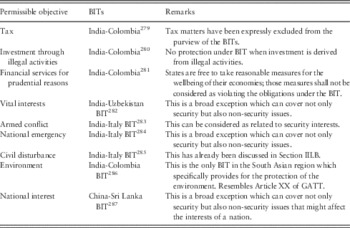
Miscellaneous exceptions have been found in the BITs of South Asian countries. These are listed in Table 7.
Other miscellaneous permissible objectives

With Footnote 279 , Footnote 280 , Footnote 281 , Footnote 282 , Footnote 283 , Footnote 284 , Footnote 285 , Footnote 286 , Footnote 287 this, a detailed enquiry into the permissible objectives used in the BITs of the South Asian countries has been completed. The next section will examine the nexus requirement links.
IV. NEXUS REQUIREMENT LINKS (NRLs)
As has already been discussed in Section II, the “nexus requirement link” assumes importance in determining the degree of connection between the measures taken and the objective sought by the host state. Different South Asian BITs use different NRLs, and these different phrases have different meanings. Therefore, studying these NRLs is important in helping us to understand their impact and effects on these BITs. These NRLs shall be studied under two broad headings:
-
A. “Necessary” as NRL; and
-
B. Non-“Necessary” as NRL.
A. “Necessary” as NRL
Twenty-two South Asian BITs use “necessary” as a NRL;Footnote 288 out of these, India has “necessary” NRLs in eighteen BITs,Footnote 289 Bangladesh has them in two BITs,Footnote 290 and Sri Lanka and Nepal both have “necessary” in one BIT.Footnote 291 Necessity serves two purposes. First, it creates a fine balance between an investor’s interests and the state’s interest. Second, it distinguishes between legitimate state actions and illegitimate state actions that are taken as an instrument of protectionism.Footnote 292 This NRL has acquired significance against the background of interpretations taken by different tribunals while deciding the ISDS cases against Argentina for the measures taken by it during its economic crisis.Footnote 293 Tribunals in CMS v. Argentina,Footnote 294 Sempra v. Argentina,Footnote 295 and Enron v. Argentina Footnote 296 conflated the meaning of “necessity” under customary international law (CIL) with the meaning of “necessary” under Article XI of the US-Argentina BIT. Also, those tribunals did not provide any legal justification for such interpretative methodologies. The annulment committees of those tribunals criticized the approaches taken by the tribunals. The CMS annulment committeeFootnote 297 in fact went to the extent of saying that the tribunal made a manifest error of law by conflating two concepts.Footnote 298
However, these cases are just one set of class of cases which adopted different methodologies for interpreting the term “necessary”. The tribunal in LG&E v. Argentina Footnote 299 first justified Argentina’s measures under Article 11 of the US-Argentina BIT, and then again tried to support it under Article 25 of Draft Articles on State Responsibility, as in CIL. Though it tried to maintain the distinction between customary claim and treaty claim, it failed to clarify the precise content of Article 11 of the US-Argentina BIT, and thereby fell short of giving reasons for supporting a specific treaty norm with a more general customary norm. The tribunal in Continental Casualty v. Argentina Footnote 300 rejected the suggested equivalence between Article 11 of the US-Argentina BIT and the CIL defence of necessity.Footnote 301 It held that the term “necessary” should be interpreted in line with GATT and WTO case-law.Footnote 302 In this way, the tribunal in this case moved away from the “no other means available” test to the WTO’s “least restrictive alternative” test.Footnote 303
This shows that there is great degree of divergence amongst the tribunals on the meaning of “necessary”. With respect to South Asia, in all twenty-two BITs where a “necessary” NRL has been found, there is no definition of the term “necessary”. The absence of any concrete definition of “necessary” in the treaty exception would anyway force the tribunals to look for the meaning of “necessary” elsewhere. Thus, it is suggested here that arbitral tribunals, while interpreting “necessary”, instead of engaging in finding the balance between the benefits of regulatory measures and the impact on investment by these measures, should try to look into the aspect of whether or not any less restrictive measure is available (the least-restrictive-alternative test).Footnote 304 When such a less restrictive measure is available, measures taken by host states shall be said to be not “necessary”. Therefore, in the context of South Asian BITs, “necessary” can be interpreted by relying on the WTO jurisprudence that was used in the Continental Casualty case. This approach is suitable for the South Asian region; not only will it prevent any excessive restriction on foreign investments from host states, it will also serve the regulatory power of these countries better. This is because arbitral tribunals would focus more on finding whether or not a less restrictive measure is available than on questioning the regulatory objective.Footnote 305 This can help South Asian countries significantly, as the question of harm done to investments will shift from the intent of the government or state to the availability of any less restrictive measure. With this, a study of Non-“Necessary” NRLs will be made in the following section.
B. Non-“Necessary” NRLs
Non-“necessary” NRLs include every other NRL except “necessary” NRLs. In this section a study will be made in respect of only those NRLs which are found in the BITs of South Asian countries. These are as follows:
1. For
“For” is found in fifty-one BITs of South Asian countries.Footnote 306 ItFootnote is one of the most lenient nexus standards found in the BITs of South Asian countries. Such a formulation, at least in its ordinary meaning, suggests a relatively thin nexus, under which measures would appear to be permissible as long as they merely further a permissible objective.Footnote 307
2. Directed to
This type of formulation is found in four BITs of South Asia.Footnote 308 This suggests that actions are permissible as long as they are intended by the government to further a legitimate end.
3. Relating to
This is found in just one BIT of South Asia.Footnote 309 It simply involves an examination of whether the “means” and “ends” of the measure are reasonably related.Footnote 310 In other words, there must be “a close and genuine relationship of ends and means”.Footnote 311 That is, based on an analysis of the text of the measure itself, it must be determined whether the design and structure of the measure are closely related to the goal of the measure.Footnote 312
4. To
“To” is found in three BITs of South Asia.Footnote 313 It provides a comparatively thin nexus between the measures taken and the objective sought. It provides much deference to the host state in this regard, as states only have to show that the measures taken were under the scope of one of the permissible objectives; no further justification of measures would be necessary.
5. In pursuance of
There is only one BIT in South Asia which provides for this type of formulation.Footnote 314 The ordinary meaning of pursuance is “engagement in an activity or course of action”; it basically assumes that the state already has some existing obligation in international law in general, apart from treaty obligations. Therefore, it lays down such a formulation which can harmoniously resolve the conflict between two different obligations of a state under international law.
Thus, it can be seen that there are in total six NRLs that are used in the BITs of South Asian countries.Footnote 315 Most prevalent among them is the “for” NRL, and then comes the “necessary” NRL. Having “for” as a NRL gives states some leeway to take regulatory measures without much difficulty in justifying their action, which seems to be a reasonable choice for these countries.
V. CONCLUSION
The importance of NPM provisions lies in the fact that they grant host states sufficient regulatory latitude in cases of extreme circumstances to pursue their non-investment policy objectives. In fact, NPM provisions are not only important but also the most effective device to ensure adequate regulatory space for host states.
However, the study done in this paper shows that NPM provisions are not adequately present in the BITs of these countries. Except for India, other countries have incorporated this provision in only a few of their BITs. This approach is confusing in the sense that these countries have included this provision in some of their BITs; therefore not including NPM provisions in their other BITs is difficult to understand. Therefore, it is suggested that these countries should include NPM provisions in their BITs more frequently in order to ensure sufficient regulatory latitude while pursuing non-investment policy objectives.
The in-depth analysis of NPM provisions made in Section II also gives surprising results; regarding permissible objectives, important public policy objectives like public health, environment, public order, and so on have been found in only very few instances. This region, as argued in Section III, is already surrounded by many regional problems. Against this background, it is argued here that countries in this region must specify terrorism, financial crises, or even situations of natural calamities as part of ESI in their NPM provisions. It is also submitted that all South Asian countries should include public health exceptions in all of their BITs. South Asian countries should also include CEE as a permissible objective in their BITs, as it may include in its scope any type of permissible objective that the states might not have been able to include in the NPM provisions while negotiating or drafting. This situation of having few or no permissible objectives dealing with issues like public health, environment, public order, and so on pushes states to the edge of facing BIT claims in cases of default. Thus, it is submitted that these countries should include at least those permissible objectives which are important from a South Asian perspective.
Self-judging clauses are important as they provide the host state with the discretion to assess cases of emergency. In this respect, South Asian BITs seem to have completely ignored the importance of these clauses. Of all the BITs signed by these countries, as studied in this paper, only one contains a self-judging clause. The other BITs contain only non-self-judging clauses. This cannot be considered an acceptable situation as it deprives the state of the ability to assess emergency situations. As the meaning of emergency situations may vary from country to country, it is considered best for the country to assess the situation on its own. Thus, it is submitted that South Asian countries must incorporate self-judging clauses in their BITs.
On the issue of nexus requirement links, not many South Asian countries have “necessary” as a nexus requirement link. This nexus requirement link imposes a very high threshold on the host state to justify its measures taken in the pursuit of non-investment policy objectives. In this sense, it is good that it is not found in many BITs of South Asian countries, as these countries will not have to satisfy its high threshold requirement. A lesson must be learnt from the events which took place in the Argentine crisis and its aftermath. Thus, it is submitted that South Asian countries may avoid or ignore phrases like “necessary”—which impose a high threshold of proving the necessity of state actions—while engaging in BIT negotiations.
As all the countries in this region are developing countries, it would be better for South Asian countries to learn from the Argentine crisis and prepare beforehand for any future problem, rather than waiting for problems to arise and then reacting to those situations.
With this, it is suggested here that South Asian countries must renegotiate their existing BITs so as to incorporate NPM provisions, and these countries must also strive to incorporate NPM provisions in their future BITs.