INTRODUCTION
Changes in ocean circulation cause variations in chemical characteristics of seawater, which influences regional environmental conditions including ecosystems (Larsen et al. Reference Larsen, Yokoyama and Fernandes2017). The Tohoku area in northeastern Japan is situated in a region where the cold Oyashio Current and warm Kuroshio Current converge (Oguma et al. Reference Oguma, Suzuki and Nagata2002). This oceanic front provides high productivity and high biodiversity in the region (Tanaka et al. Reference Tanaka, Komatsu, Itoh, Yanagimoto, Ishizu, Hasumi, Sakamoto, Urakawa and Michida2017). It is thought that the intensity of the Oyashio Current varies with decadal oceanographic changes in the Pacific Ocean (e.g., Tanaka et al. Reference Tanaka, Komatsu, Itoh, Yanagimoto, Ishizu, Hasumi, Sakamoto, Urakawa and Michida2017). Due to high nutrients of the Oyashio Current documenting the history of ocean circulation in coastal areas is key to better understand the relationships between physical oceanography and coastal ecosystems.
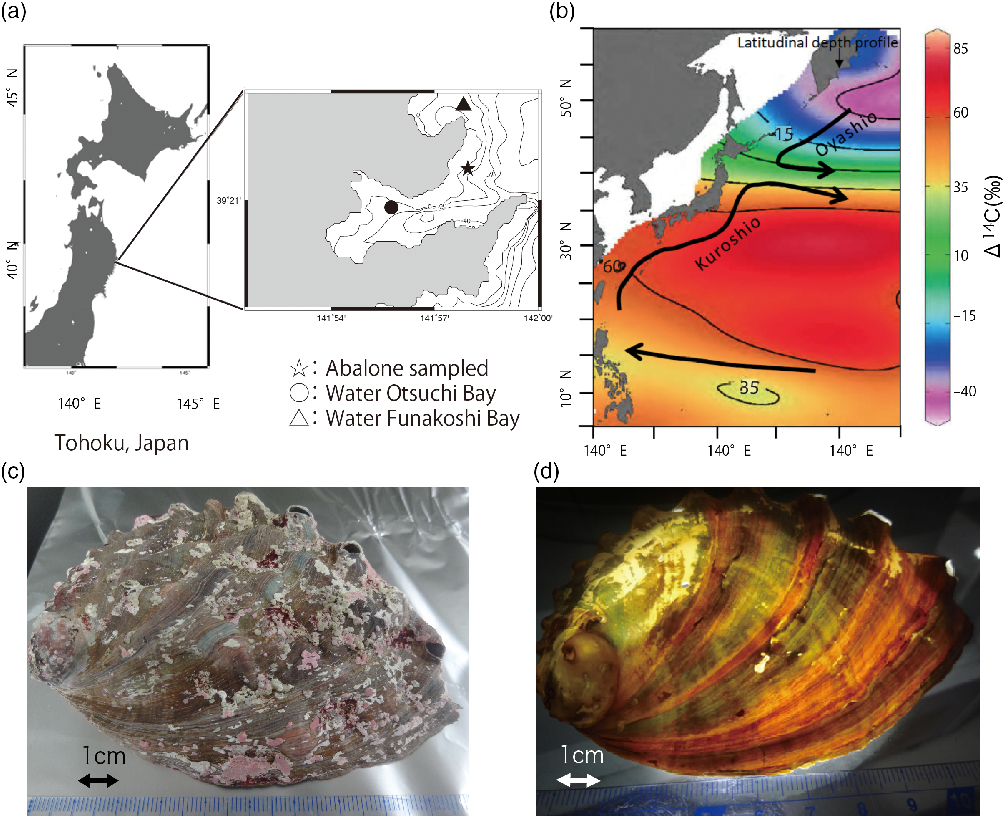
Otsuchi Bay is in the Tohoku region on the Pacific coast of Northern Japan (Figure 1a). In winter, the ocean is characterized by the cold Oyashio Current from the subarctic North Pacific, and the Kuroshio Current from the subtropical North Pacific (Oguma et al. Reference Oguma, Suzuki and Nagata2002; Ishizu et al. Reference Ishizu, Itoh, Tanaka and Komatsu2017; Tanaka et al. Reference Tanaka, Komatsu, Itoh, Yanagimoto, Ishizu, Hasumi, Sakamoto, Urakawa and Michida2017). Seawater radiocarbon could potentially identify the water masses that converge at Otsuchi Bay (Figure 1b), since significant depletion of radiocarbon content within the Oyashio Current could occur due to intensive upwelling that mixes the surface North Pacific water with deep water (Hirabayashi et al. Reference Hirabayashi, Yokoyama, Suzuki, Miyairi and Aze2017a; Larsen et al. Reference Larsen, Yokoyama and Fernandes2017; Yokoyama and Ohkouchi Reference Yokoyama and Ohkouchi2017). The Oyashio Current is thus characterized as a high nutrient cold-water mass with depleted radiocarbon typically around Δ14C ≈ –20 (Satoh et al. Reference Satoh, Fukuda, Miyairil, Yokoyama and Nagata2019).
(a) Map of study area, with circle showing location of sampling localities in Otsuchi Bay, Japan. (b) Distribution of Δ14C around the Northern Pacific coastal area, Japan (Yokoyama and Ohkouchi Reference Yokoyama and Ohkouchi2017). (c) Collected Ezo abalone (Haliotis discus hannai) shells from Otsuchi Bay, Japan, before acid treatment (Shell growth check is unclear). (d) Ezo abalone shells after acid treatment under the powerful light (number of shell growth check is shown).

Variations in Δ14C have occurred with basin-scale decadal climate variabilities such as El Niño Southern Oscillations (ENSO; Horel and Wallace Reference Horel and Wallace1981; Schwing et al. Reference Schwing, Murphree and Green2002), Pacific Decadal Oscillations (PDO; Mantua et al. Reference Mantua, Hare, Zhang, Wallase and Francis1997; Minobe Reference Minobe1997) and North Pacific Gyre Oscillation (NPGO; Di Lorenzo et al. Reference Di Lorenzo, Schneider, Cobb, Franks, Chhak, Miller, McWilliams, Bograd, Arango, Curchitser, Powell and Riviere2008; Sakashita et al. Reference Sakashita, Miyahara, Yusuke, Aze, Obrochta and Nakatsuka2017). ENSO corresponds to the Southern Oscillation Index (SOI; Ropelewski and Jones Reference Ropelewski and Jones1987). Changes in Kuroshio transport, due to different climate modes of ENSO and PDO during the last century, have been reported from coral samples (Yamazaki et al. Reference Yamazaki, Watanabe, Tsunogai, Iwase and Yamano2016; Hirabayashi et al. Reference Hirabayashi, Yokoyama, Suzuki, Miyairi and Aze2017a, Reference Hirabayashi, Yokoyama, Suzuki, Miyairi, Aze, Siringan and Maeda2017b). However, additional marine records of Δ14C in relationship to climate variability such as SOI, PDO and NPGO are needed.
The Tohoku region experienced a large tsunami caused by the Great Tohoku Earthquake in 2011 CE. The earthquake and tsunami significantly altered local marine and ecological environments (Fukuda and Nagata Reference Fukuda and Nagata2017; Ishizawa et al. Reference Ishizawa, Goto, Yokoyama and Miyairi2019a, Reference Ishizawa, Goto and Yokoyama2019b). However, the relationship between oceanographic changes and coastal ecosystems before and after the Tsunami are not well understood. Thus, ecological studies using geochemical methods are required for a better understanding of the resilience of local ecosystem against geohazards.
In this study, we report on radiocarbon measurements in abalone shells from the region to reconstruct the history of ocean current variations along the Tohoku coast. Radiocarbon analyses of ocean waters are used to compare with results from abalone shells to see if it can be a good proxy to track high latitude water masses in the past as it has been successfully employed at low latitude regions using reef building coral skeletons (e.g., Druffel et al. Reference Druffel, Robinson, Griffin, Halley, Southon and Adkins2008; Yokoyama et al. Reference Yokoyama, Suzuki, Siringan, Maeda, Abe-Ouchi, Ohgaito, Kawahata and Matsuzaki2011; Hirabayashi et al. Reference Hirabayashi, Yokoyama, Suzuki, Miyairi and Aze2017a). Historically, people in Japan were eating abalone on a daily basis. The evidence of this can be found in archeological shell midden sites around this region. Thus, we are also aiming to investigate the potential of reconstructing long-term Holocene North Pacific local reservoir age.
METHODS
Ezo abalone (Haliotis discus hannai) is a type of gastropod. Their shells consist approximately of 90% aragonite and 10% calcite (Nakahara Reference Nakahara1994). Abalone shell structure is resistant to diagenesis due to its stiff and dense structure, and hence they are suitable for radiocarbon analyses. Checks in shell growth occur due to lowering of seawater temperatures (Ohmura et al. Reference Ohmura, Takami, Horii, Noro, Horikoshi and Kuji2014) and shell ages can be estimated by counting the checks (Inoue and Oba 1967). In average, abalone shells grow up to 100 mm and it takes between about 4 to 10 years (Hirose Reference Hirose1974).
Three abalone samples, each longer than 100 mm in length, were used in this study. The sample H66 (112.9 mm, male) was collected on February 15, 2017; H104 (111.2 mm, male) and H105 (113.0 mm, female) were both collected on June 29, 2017. H66 was sampled from about 5 m water depth; H104 and H105 were collected from 6 to 8 m in water depth. The 2–6-m depth area is a kelp forest, mainly constructed of an alga S. japonica var. religiosa. The 6–8-m depth area consists of algal turf.
Otsuchi Bay is in the Tohoku region on the Pacific coast of Northern Japan (Figure 1a). Ocean conditions are characterized by converging of two major currents in the North Pacific, the cold Oyashio Current from the subarctic North Pacific and the Kuroshio Current from the subtropical North Pacific (Oguma et al. Reference Oguma, Suzuki and Nagata2002; Ishizu et al. Reference Ishizu, Itoh, Tanaka and Komatsu2017; Tanaka et al. Reference Tanaka, Komatsu, Itoh, Yanagimoto, Ishizu, Hasumi, Sakamoto, Urakawa and Michida2017). These currents are clearly distinguished by the Δ14C of seawater where the Oyashio Current is from cold and depleted Δ14C waters of the Bering sea, whereas the Kuroshio Current is warm with relatively enriched Δ14C waters (Larsen et al. Reference Larsen, Yokoyama and Fernandes2017; Yokoyama and Ohkouchi Reference Yokoyama and Ohkouchi2017; Figure 1b). A notable influence of the Oyashio Current flow is that the seasonal seawater temperature minimum (5–7ºC) occurs in March to April and maximum (19–21ºC) in August to September (Abo et al. Reference Abo, Nagashima and Otobe2001).
Abalone shells covered by moss were placed in a container with 500 mL 20% acetic acid for 3 hr to remove surface moss then rinsed using Milli-Q water 3 times (Figure 1c). Investigation of shell growth checks was made with a high-power electric light (Figure 1d) and then they were cut every 2 to 5 mm (about 4 cuttings per a shell growth check). The shells were then dissolved by adding 10 mL of phosphoric acid and heated to 80ºC for 4 hr to produce CO2 gas. Carbon dioxide gas was then converted into graphite (Yokoyama et al. Reference Yokoyama, Miyairi, Matsuzaki and Tsunomori2007). Analysis with an accelerator mass spectrometer was then conducted at the Atmosphere and Ocean Research Institute, the University of Tokyo (Yokoyama et al. Reference Yokoyama, Koizumi, Matsuzaki, Miyairi and Ohkouchi2010; Hirabayashi et al. Reference Hirabayashi, Yokoyama, Suzuki, Miyairi, Aze, Siringan and Maeda2017b; Yokoyama et al. Reference Yokoyama, Miyairi, Aze, Yamane, Sawada, Ando, de Natris, Hirabayashi, Ishiwa, Sato and Fukuyo2019). Radiocarbon values are reported as Δ14C (Stuiver and Polach Reference Stuiver and Polach1977).
RESULTS
Our data shows that Δ14C values measured from abalone shells have clearly indicated seasonal variabilities:
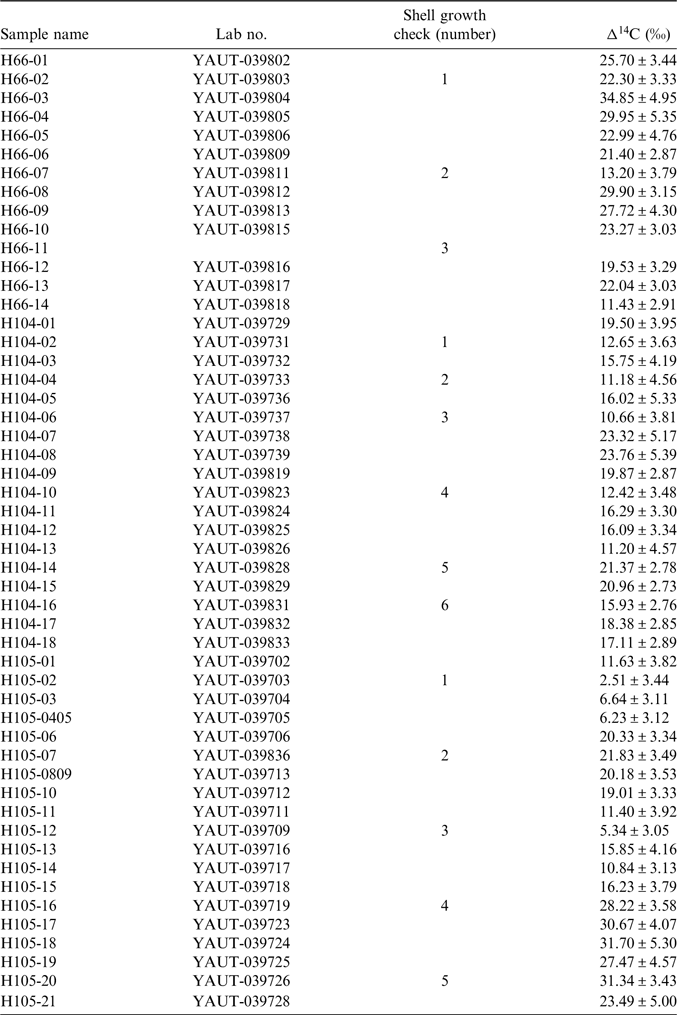
H66 has three shell growth checks correlated with winter periods and the Δ14C value was always are greater than 11‰. The smallest value was 11.43 ± 2.9‰ (Table 1, Figure 2a). Between the first shell growth check (H66-02) and the next sample (H66-03), Δ14C values increase from 22.3 ± 3.3‰ to the highest value of 34.9 ± 4.9‰. At the second shell growth check (H66-07), the Δ14C value is low 13.2 ± 3.8‰. At H66-08, Δ14C value again increases 29.90 ± 3.15‰. The third shell growth check period could not be measured because of insufficient amount of CO2 gas collected.
Δ14C values of Ezo abalone (Haliotis discus hannai) from Otsuchi bay, Japan.

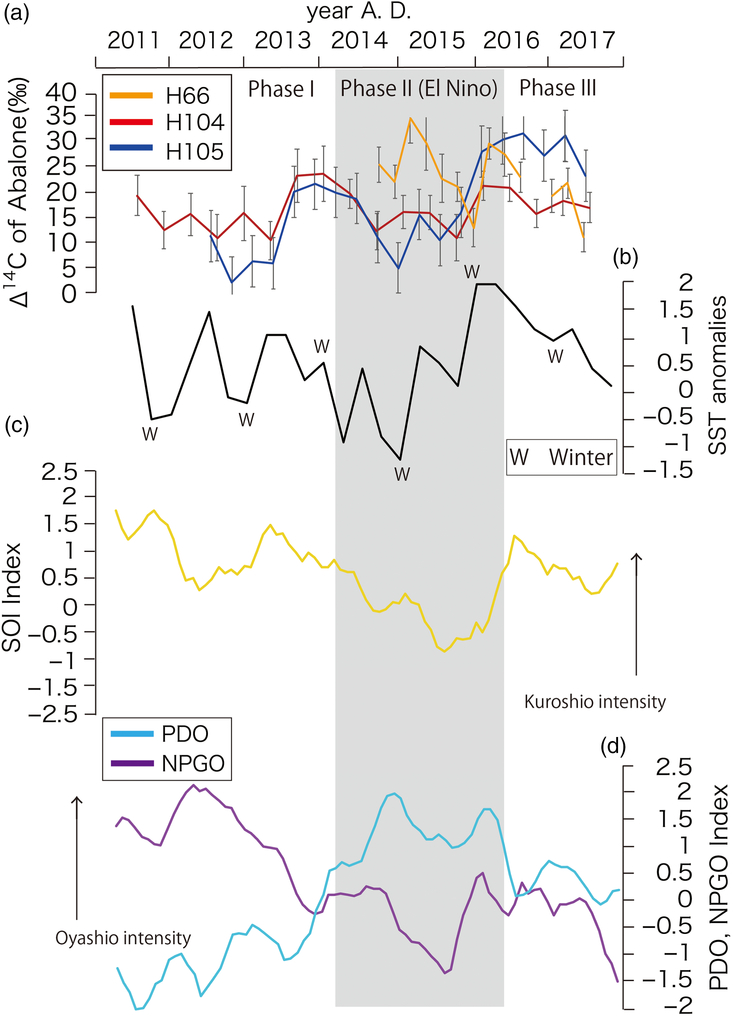
Three phases based on SOI index (El Niño) are shown in panels (a) to (d): Phase I (~ 2013 winter, ~2014 spring); Phase II (2014 summer, ~2016 spring), and Phase III (~2016 summer). Checks in growth can be identified during winters marked as (W) in panel (b). Δ14C values of checks in H66, H104 and H105, match with winter periods in (b) determined from sea surface temperature anomalies (SST) at Sanriku Ria area, Japan (Data taken by the Japan meteorological agency address: https://www.data.jma.go.jp/kaiyou/data/shindan/a_1/japan_warm/japan_warm_data.html). The SOI Index shown in panel (c) follows a similar trend to Δ14C variations in H104 and H105. (d) When both the PDO Index and NPGO Index are close to zero Δ14C values of H104 and H105 are high because of the minimal intrusion by the Oyashio Current from the North. However, H66, collected from shallow waters, is directly influenced by high Δ14C from the Kuroshio Current.

H104 has six shell growth checks (Table 1) and Δ14C values show seasonal variations ranging from 10.66 ± 3.81‰ to 23.76 ± 5.39‰ (Figure 2a). The Δ14C decreases at the first, second, third and fourth shell growth checks where it goes below 13‰. After the third shell growth check at H104-07 there is a significant increase in Δ14C to 23.8 ± 5.4‰. Between the fourth and fifth shell growth check, Δ14C shows smaller values of 11.2 ± 4.6‰. The fifth shell growth check did not decrease and showed a Δ14C value of 21.37 ± 2.78‰. The sixth shell growth check decreased to 15.93 ± 2.76‰, this value is slightly higher than the fourth shell growth check in H104.
H105 has 5 shell growth checks (Table 1). Δ14C value records significant variations between 2.51 ± 3.44‰ and 31.70 ± 4.07‰. At the first shell growth check indicated the smallest value of Δ14C is 2.51 ± 3.44‰. Around the second shell growth check Δ14C did not decrease and remained around 20‰. Between the third and fourth shell growth check, Δ14C records two significant increases. The first increase is from 5.34 ± 3.0‰ to 15.9 ± 4.2‰ (H105-12 to H105-13) and then it drops at the third shell growth check to 10.8 ± 3.1‰. The second increase was the largest Δ14C increase for the sample, moving from 16.2 ± 3.8‰ to 28.2 ± 3.6‰. After the fourth shell growth check, Δ14C value remains over 27‰.
When the Δ14C values are compared to climate variabilities such as SOI, PDO and NPGO, they can be separated into three phases (Figure 2). In Phase I (before boreal spring in 2014), Δ14C value ranged from about 5‰ to 35‰, coinciding with the time for SOI, PDO and NPGO respectively as positive (0 to 2), negative (–1 to 0), and positive (0.5 to 2). In Phase II (from 2014 summer to 2016 spring), Δ14C value ranged between 5‰ and 15‰. This period corresponds to negative SOI phase (–1 to 0), positive PDO phase (0.5 to 2) and smaller NPGO phase (0.5 to –0.5). This also coincides with ENSO. In Phase III (summer 2014 onwards), it can be noted that SOI has returned to a positive phase (0 to 1), PDO remains positive (0 to 1.5) and NPGO becomes positive (0.5) also.
DISCUSSION
Abalone and Oyashio Current Inflow in Otsuchi Bay
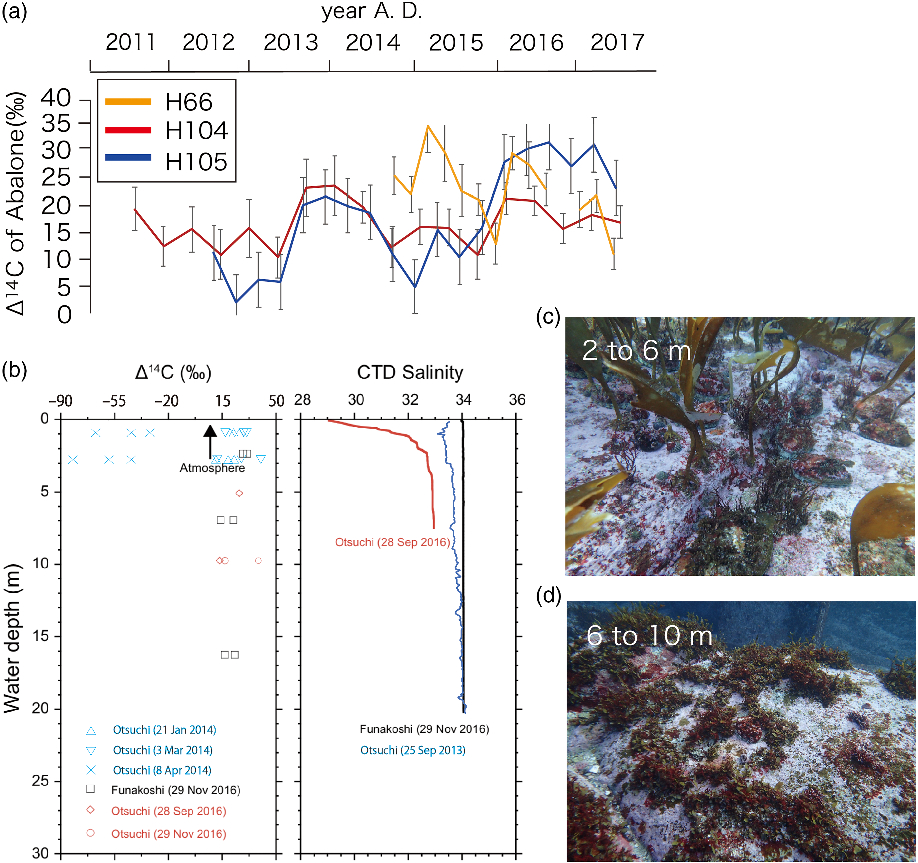
The timing of the decreases in the values of Δ14C, in H104 and H105, can be compared with seasonal seawater temperature anomalies at Sanriku Ria area (Figure 2b). Otsuchi Bay is located near the oceanic front between the Kuroshio and Oyashio Currents (Oguma et al. Reference Oguma, Suzuki and Nagata2002; Ishizu et al. Reference Ishizu, Itoh, Tanaka and Komatsu2017; Tanaka et al. Reference Tanaka, Komatsu, Itoh, Yanagimoto, Ishizu, Hasumi, Sakamoto, Urakawa and Michida2017) where significant convergence of water masses occurs in winter where the drop in Δ14C values of seawater leaves a trace of Oyashio Current intrusion in the spring. Measurements of dissolved inorganic carbon in seawater show significant decreases when the Oyashio Current inflows into the Otsuchi Bay. It shifts from ca. 20‰ (under the influence of Kuroshio Current) to –60‰ (under the influence of Oyashio Current) on average at depths of 1–3 m (Figure 3b). The current study shows that the Δ14C value of the abalone shells decreases near the shell growth check boundary which forms because low temperatures inhibit growth (Ohmura et al. Reference Ohmura, Takami, Horii, Noro, Horikoshi and Kuji2014). Assuming that the latest shell growth check was formed during the period of low seawater temperature, which occurred during the winter of 2017, when the shell was retrieved, low temperature waters flowing into the Bay can be attributed to the greater influence of Oyashio Current.
(a) Δ14C value of three abalones, H66, H104 and H105 (b) Depth profiles of the Δ14C values of DIC in seawater and CTD salinity in Funakoshi Bay (black), Otuchi Bay in 2016 (red) (Kubota et al. Reference Kubota, Shirai, Murakami-Sugihara, Saike, Minami, Nakamura and Tanabe2018) and Otuchi Bay in 2017 (blue; Satoh et al. Reference Satoh, Fukuda, Miyairil, Yokoyama and Nagata2019). (c) Habitant of adult abalone at 2–6 m, H66 located. (d) Habitant of adult abalone at 6–10 m, H104 and H105 located.

H104 and H105 shows a clear Δ14C decrease that is well correlated with sea surface temperature (SST) drops in three consecutive years namely winter 2017, autumn 2016 and winter 2015 (Figure 3). Similar trends can also be seen in the Δ14C values in abalone shells. These Δ14C values clearly record the timing of the Oyashio Current inflow. However, during the spring of 2015, Δ14C values of abalone shell did not decrease, despite the onset of winter. Intense exchange of water between the inner and outer part of the bay is observed, induced by prolonged seasonal westerly winds occurring at the Otsuchi Bay region, which brings cold and nutrient rich water into the bay (Furuya et al. Reference Furuya, Takahashi and Ishizu1993). Similar phenomena could be thought to have occurred in 2015. The deep water from the outer area of Otsuchi Bay may have been affected by the high Δ14C values. Between 2012 and 2013, the Δ14C value of H104 varied by about 5‰, where SST variations are more significant. The minimum and maximum seasonal values we see in the records might be underestimated. This is thought to be because of low resolution sampling of conducted throughout this study to see the annual pattern of changes in relation to temperature variations. However, our results from H104 and H105 nicely capture the timing of the Oyashio Current inflow in 2012 and 2013. In contrast, Δ14C of abalone shells do not drop below ca. 15‰ in 2016 and 2017 (Figure 2) suggesting that there was little influence from the water originating from the Oyashio Current. Our results demonstrated that the Δ14C values in abalone shells can be used to investigate the timing of the Oyashio Current intrusion into the Otsuchi Bay and therefore can be used to reconstruct local paleoceanographic conditions in the past.
The abalone shells’ Δ14C variations seems to be well-correlated with basin scale climate variabilities, such as the SOI, PDO and NPGO (Figure 2). The Δ14C records can be separated into three phases as described above. In Phase I, the abalone Δ14C data show that the comparable contributions from waters originated from the Oyashio and the Kuroshio Currents. Higher Kuroshio Current water dominates in the bay during the summer, whereas colder and lower Δ14C water occupied during the winter. At the end of the phase I, SOI significantly depleted from 1 to 0. This made the Kuroshio Current stronger in winter and hence Δ14C values increased. During the Phase II, as is coincided with El Niño conditions, higher Δ14C suggest greater influence from the water associated with Oyashio Current water. These changes occurred concurrently with the time when the NPGO index value were the lowest during the period of interest in this paper. During Phase III, all three indices (SOI, PDO and NPGO) converged to zero. During this phase, there were fewer influences from Oyashio originated water. The physical oceanographic conditions seem to be controling the strength or extension of Oyashio Current that the water mass signatures are clearly recorded as Δ14C in abalone shells.
Past Oyashio Current Influences in the Otsuchi Bay Recorded in Abalone Shells
Significant Δ14C fluctuations are found in three shells that were examined in this study, namely H66, H104 and H105 (Figure 3a). From the latest shell growth check at winter 2017, H104 and H105 has a similar trend of Δ14C values whereas slightly different signatures are recorded in H66. This is either due to an inaccurate age model of the H66 abalone shell or the influence of different water masses because of very small difference in habitat depth.
Increases in the influence of the Oyashio Current in the Sanriku Ria region is recorded in H66 as a drop in Δ14C values of 22.30 ± 3.33‰ at first shell growth check to 13.20 ± 3.79‰ for second shell growth check (Table 1). Physical oceanographic records also show that the areas influenced from Oyashio Current as the result of its southward expansions were larger in 2015 compared to the one observed in winter 2014. This is consistent with the record of Δ14C in abalone shells in depleted values (Figure 3). Though, one potential issue would be regarding its age model that an abalone over 100 mm in shell length is often estimated as 4–10 yr old (Hirose Reference Hirose1974). Yet, we could only observe three lines of shell growth checks in H66. Shell growth checks observed using strong desk light may not be able to detect all the growth checks recorded in the shell of H66, therefore age calculation of this shell would be underestimated. It is known that shell growth checks become fainter under different environmental factors including warm water conditions during winter and the turbid benthic condition (Ohmura et al. Reference Ohmura, Takami, Horii, Noro, Horikoshi and Kuji2014). Further study is needed to confirm the mechanism of producing shell growth checks by employing soft x-ray and other geochemical methods such as oxygen isotopes.
The different habitat of H66 abalone shell potentially recorded small spatial differences in water masses in the bay. Radiocarbon values in H66 are higher than ca.13‰, including times of shell growth check formation. Comparing three abalones examined in this study, H66 is found in shallow 2–6 m water depth (Table 1, Figure 3), whereas H104 and H105 where retrieved from 6 to 10 m water depth at Otsuchi Bay. The CTD (Conductivity Temperature Depth profiler) data collected just outside of the Otsuchi Bay indicates a significant salinity gradient between the surface and 5 m of water depth (Figure 3). Considering that adult abalone only moves less than 500 m in 3 years (Akimoto et al. Reference Akimoto, Owada and Tenji1976), the Δ14C value can be considered an average of the warm Kuroshio Current between 2 m to 6 m depths. Thus, abalones living in deeper water could be good recorders of the coastal properties in the Otsuchi Bay.
The range in Δ14C was lower between 2012–2015 compared to the periods coinciding with the time after the Great East Japan Earthquake and tsunami which occurred in March 2011. The tsunami altered the local coastal environments significantly (cf. Kawamura et al. Reference Kawamura, Takami, Hayakawa, Muraoka and Tamaki2017) influencing the nutrient conditions for biota in the bay. A clear reduction in abalone populations was observed for a period after the tsunami in 2011 until 2015 (Hayakawa et al. Reference Hayakawa, Kawamura, Fukuda, Fukuda and Sasaki2017). However, recovery of the populations after 2015 coincided with changes in Δ14C. This suggest that the duration for recovery of coastal ecology took more than 3 years. Hence ecological resilience against large scale natural hazards can be deduced using shell chemistry of abalone.
CONCLUSIONS
The Δ14C values in H104 and H105 abalone shells clearly shows cold Oyashio Current influence in 2012, 2013, and 2017 at Otsuchi Bay. Such data can be used to reconstruct fluctuations in past water masses. CTD data and radiocarbon data derived from abalone shells can be used to investigate vertical mixing in the water masses in the bay. Small differences in the depth habitat could be discerned in the measured Δ14C variations.
The abalone population decline which occurred just after the Great East Japan Earthquake is recorded in the shell chemistry. Δ14C measurements on abalone shells can therefore be used to estimate the recovery duration after geohazards affecting coastal ecological environments.
ACKNOWLEDGMENTS
A part of this research was supported by Grants-in-Aid for Scientific Research, MEXT (No. KAKENHI JP15KK0151, JP17H01168) and JST CREST Grant Number JPMJCR13A4, Japan.