Introduction
The Republic of Serbia has quite favourable conditions for poultry production. There are almost 0.7 ha of agricultural land per capita (Rodić et al., Reference RODIĆ, BOŠNJAK and VUKELIĆ2007). The country is a net-exporter of maize (one of the world top 10 exporters) and soybean (Mihailović et al., Reference MIHAILOVIĆ, SUBIĆ and SIMONOVIĆ2009). Besides, the skilled personnel and scientific potential that in the past had provided development of specialised, intensive poultry production are the resource that can still be counted on. Poultry has a long tradition in Serbia and has always been an important livestock sector (Peharda, Reference PEHARDA1990; Supić et al., Reference SUPIĆ, MILOŠEVIĆ and ČOBIĆ2000; Bošnjak and Rodić, Reference BOŠNJAK and RODIĆ2008).
Since poultry provides abundant, relatively cheap food of high quality (Mack et al., Reference MACK, HOFFMANN and OTTE2005; Alders and Pym, Reference ALDERS and PYM2009; Hodges, Reference HODGES2009), its importance in Serbia nowadays is emphasised, as the country is faced with a severe economic crisis and a lower living standard, as a direct consequence of the two decades long transition process with numerous accompanying problems.
With its value of production of 217 million US dollars, poultry production in Serbia accounts for about 12% of the total value of Serbia's livestock production (Munćan et al., Reference MUNĆAN, ŠEVARLIĆ, VASILJEVIĆ and ZARIĆ2007). However, regardless of the sector's importance, poultry production has significantly decreased over the last two decades.
Several factors have contributed to this decline, including:
• A significant shrinkage of the national market, which began with the disintegration of the Federal Republic of Yugoslavia in the early 1990s
• Decreased demand for animal products, due to lowering of the living standard
• Certification non-harmonized with the EU standards, which has limiting effects on export to EU markets
• The inefficient privatisation process that has led to bankruptcy and collapse of many state/socially/owned farms that used to be the biggest and the most developed ones in the whole sector until the privatisation process began
• Being uncompetitive in the international markets, due to high production costs, technical obsolescence of processing capacities, and rather limited range of final poultry products
• Undeveloped vertical integration and poor relationships between producers and processors in general; and last but not the least
• The absence of institutional support to poultry production.
Types of poultry producers in Serbia
The poultry sector in Serbia consists of three different types of producers:
1. Large poultry companies with modern, intensive, commercial farms,
2. Small-scale specialised, intensive or semi-intensive farms, and
3. Backyard, extensive producers.
It is estimated that small-scale farms and backyard poultry production account for more than half of poultry meat production and two thirds of egg production (Škorić, 2009).
The majority of large poultry companies possess big, intensive commercial farms, with the most recent production technology, modern slaughterhouses and often associated co-operating small-scale farms. Unfortunately, there are very few companies of this type in Serbia today. The two biggest farms produce one third of the country's total meat production. In egg production, the company that for many years used to be the largest producer (700,000 laying hens) with its share of 15% of total egg production in the country was seven times bigger than the second one. Today it is closed, as well as many other unsuccessfully privatised farms and enterprises (Tica et al., Reference TICA, PEJANOVIĆ, ZEKIĆ and MILIĆ2006). Most of these farms were state/socially/owned and those that survived the privatization process have all been privatised (there are no more social/public poultry farms in Serbia). Foreign investors (mainly from Croatia and Slovenia, the ex-Yugoslav republics) have recently bought some of them, but it is still too early to estimate the impact of new ownership. As a rule, these farms’ production levels are the same as those in the developed countries, but despite that, they often have economic problems caused by unfair seasonal competition of small-scale and backyard producers that, outside legal channels, offer their products at extremely low prices.
There are also numerous small-scale, specialised, intensive or semi-intensive farms. Their exact numbers are unknown since some of them are not officially recognised. Some of these producers are linked to large companies that provide market access, but are, in many cases, uncontrolled, producing mostly for local markets. The small-scale farms contain on average 10-15,000 broilers and 1-5,000 layers, and their production and economic results varies greatly, depending on many factors, including scope of production, relationships with large companies, intensity level, and chosen market channel.
Besides these producers, there are thousands of backyard poultry farmers, having small numbers of laying hens (usually pure breeds), extensive, mostly free-range production systems and/or small-scale broiler meat production (up to a few hundred birds). They usually produce meat and eggs for their own consumption and market their surplus products outside legal market channels, utilising a kind of competitive advantage on the domestic market, i.e. the consumers’ preferences of the (perceived) freshness and taste of the backyard products (Pavlovski et al., Reference PAVLOVSKI, CMILJANIĆ, LUKIĆ and ŠKRBIĆ2002; Rodić et al., 2006; Rodić, Reference RODIĆ2009). These backyard producers and some of the small-scale ones lack consistency in quality and supply. However, due to low input/low output strategy they manage to maintain lower prices than intensive commercial farms and to significantly influence the market in seasons, making commercial production (especially small and medium-scale) unstable, vulnerable and uncertain.
Poultry population
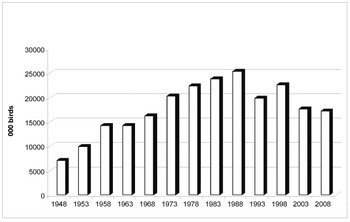
The poultry population in Serbia has decreased significantly since the beginning of the 1990s. According to the official statistical data, the total poultry population declined from 25 million birds in early 1990s, to 16 million birds in 2008 (Figure 1). According to the data from the Poultry producers association (Škorić, 2009), number of broilers in Serbia is 55-60 millions (800,000-1,000,000 parents) and laying hens 4-5 millions (60,000 – 70,000 parents). The exact number of backyard hens is unknown.
Accounting for 96% of total poultry production, chicken production is the main sub-sector, therefore the only one analysed in this paper. Duck, goose and turkey production represent only 4% of total poultry production in Serbia, dominated by extensive, small-scale production systems used mostly for self-consumption or sold in local markets. The potentials in this area have not been exploited.
Number of poultry in Serbia. Source: Statistical yearbooks of Serbia.

Poultry meat production, consumption and export
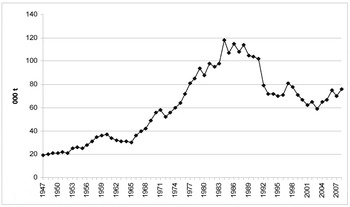
According to the official data, Serbia produced 76,000 tons of poultry meat in 2008 (Figure 2) which is 40% less than in the late 1980s.
Poultry meat production in Serbia. Source: Statistical yearbooks of Serbia.

There are differences in broiler meat production among different producers, in terms of breeds, housing systems, management practices and achieved production results. Generally, all the three types of producers have intensive production, based on broiler hybrids. The duration of production is 42-45 days, density averages 17 birds per m2, feed conversion ratio is less than 2.0, and the average gross weight of slaughtered chicken is now above 2 kg due to changed consumer preferences (1.6 kg only few years ago). Whole fresh carcasses still dominate the market, although consumer preferences are slowly changing towards cuts and processed poultry products, which is in line with the European trend in poultry meat consumption (Magdalaine et al.; 2008, Magdalaine, Reference MAGDALAINE2009; Vukasović, 2009).
In Serbia, both exported and imported quantities of poultry meat are rather modest. Over the last five years, exports averaged 1,550 t/year (less than 2% of total production), and the import only 150 t/year. Hence, nearly all poultry meat is consumed domestically (currently 10 kg of poultry meat per capita) accounting for about one fifth of total meat consumption in the country (Vlahović and Štrbac, Reference VLAHOVIĆ and ŠTRBAC2006). Poultry, as well as other meat, consumption fell dramatically in the early 1990s, but poultry meat consumption has increased over the last few years, possibly due to its lower price as compared to other meat types. So the fear of avian influenza has not had any significant influence on consumption in Serbia, as opposed to some more developed countries, where a significant decrease in poultry products consumption has been reported (Windhorst, Reference WINDHORST2006; Sariozkan et al., Reference SARIOZKAN, YALCIN, CEVGER, ARAL and SIPAH2009).
Serbia has the potential to produce much more than it actually does. The opportunities are, unfortunately, unexploited due to low domestic demand, banned export to the EU (even transit via the EU countries is banned), prices that are not competitive in the international markets and a rather limited range of meat products.
The Serbian slaughtering industry is characterised by over-capacity in relation to the number of animals slaughtered and current market demand, which leads to inefficient use of its capacities. The slaughtering capability of big, industrial slaughterhouses exceeds more than twice the total yearly production. Additionally, since the 2005 ban on home-slaughtered birds in local markets, several new, private small-scale slaughterhouses have been offering slaughtering services to small-scale and backyard producers. Another challenge is the obsolete equipment and technology in slaughtering industry; some capacities need urgent investments. There is also a serious lack of harmonised certification, which limits the export to the EU countries.
The prospects of poultry exports are difficult to estimate, since they are to some extent dependent on political issues; however, poultry imports are expected to rise, primarily due to strong marketing campaigns and competitive prices offered recently by companies from Hungary and Slovenia.
Table egg production, consumption and export
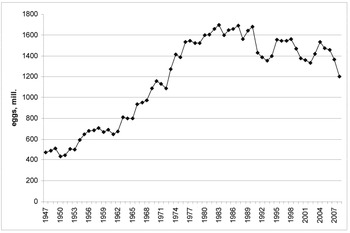
In 2008 Serbia produced 1.2 billion table eggs (Figure 3), which is 30% less than twenty years ago. Both export and import are very limited (in the last five years the export averaged 30t/year and the import 156 t/year). Thus all the eggs produced (160 eggs per capita) are consumed domestically (compared to more than 200 eggs in late 1980s). Egg-processing capacities are insufficient: there is only one egg-processing unit in the country, which produces liquid and powder eggs. Its total technical capacity is 100 millions eggs, but the capacity use is about 60%.
Table egg production in Serbia. Source: Statistical yearbooks of Serbia.

In table egg production, there are significant differences between production on commercial farms (large industrial and small-scale) and backyard producers. While commercial farms use battery cages providing 450 cm2 of floor space per hen with a yearly production of 280-300 eggs, backyard producers have very small flock (usually up to a hundred) of pure bred hens kept under a free-range system. They produce a small number of eggs per hen per year, and only during spring and summer. Their contribution reduces the official national average egg production in 2003-2007 as low as 132 eggs/hen/year, although the production on commercial farms was even above 300 eggs/hen/year. However, these producers are very numerous, so the fact that they market the eggs at extremely low prices has considerable effects on domestic egg market during certain parts of the year.
The economics of poultry production
Poultry production in the former Yugoslavia was generally well positioned in the overall national economy (which benefited from a consistent price policy and led to a relatively high accumulative production) until the early 1990s (Tadić et al., Reference TADIĆ, WITTMMER and PARAŠILOVAC1990; Peharda, Reference PEHARDA1990). Afterwards, the economics of poultry production in Serbia, as well as in some other ex-YU republics (Raguž-Đurić et al., 2006) deteriorated, which was a part of devastation of the agriculture and economy as a whole (Novković and Rodić, Reference NOVKOVIĆ and RODIĆ1999; Pejanović et al., Reference PEJANOVIĆ, TICA and RODIĆ2003).
As mentioned above, Serbia's potentials for poultry production exceed current domestic demand. Export is therefore a condition sine qua non for further development of the Serbian poultry sector. Unfortunately, the sector is not ready to make any significant exports.
Among the main constrains there are unsatisfactory concentration, specialisation and vertical integration in the sector, limiting large export shipments that require constant deliveries and quality. That is why urgent action is needed and should be aimed at chain management development, through contract farming (which is still underdeveloped in Serbia) or development of other models of long-term business relationships (Viaene and Verheecke, Reference VIAENE and VERHEECKE2009).
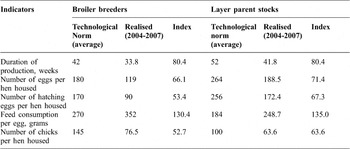
The economy of the poultry sector depends upon many factors. Besides, the economics of poultry meat and table egg production are different for different types of producers. Due to their various intensity and productivity levels, it is difficult to give any general assessment. However, it is broadly agreed among poultry specialists and agrarian economists in the country, that one of the biggest issues concerning the poultry sector in Serbia (affecting both large scale and small-scale producers) is the low utilisation of genetic potential of parent stocks. Since the country has neither domestic poultry hybrids nor grandparent stocks, the sector is fully dependent on the import (5.5 mill €/year). Due to mismanagement in the field and frequent misbalance between supply and demand, producers often keep parent stock for a much shorter duration compared to standard production periods, or they destroy the day-old chicks. Sometimes that leads to highly insufficient utilisation of parent stock, sometimes less than 50% of possible capacity, which directly affects the price of day old chick (0.45 - 0.55 €) and pullet (4.5 - 5.0 €), production costs at farm level, profitability of the sector as a whole, and consequently its competitiveness. The figures in Table 1 indicate the utilisation of genetic potentials of parent stocks. All the parameters are clearly far from desirable. Without significant improvements in this field, it will be impossible to achieve any higher degree of production efficiency in the whole chain.
An additional concern of Serbian poultry producers are high costs of production. On the farm level they are higher than in the EU and the third countries (Rodić et al., Reference RODIĆ, PERIĆ and DJUKIĆ-STOJČIĆ2009; Rodić, Reference RODIĆ2009) that Serbian producers have to compete with in the EU market (first of all with the US and Brazil producers).
Production results of parental stocks in Serbia.

(Source: Milošević and Perić,Reference MILOŠEVIĆ and PERIĆ2008)
Almost all the major inputs for both broiler meat and table egg production are more expensive in Serbia than in other countries (Hunton, Reference HUNTON2002; Van Horne and Achterbosch, Reference VAN HORNE and ACHTERBOSCH2008). This is a direct consequence of low productivity and inefficiency of the Serbian economy on the whole, since the small-scale, inefficient production is not only a characteristic of poultry production, but of other systems as well. Agricultural holdings in Serbia have only 2.49 ha of arable land on average (only 2% of holdings use over 15 ha). Crop yields are significantly lower than those in the developed countries. The five year average yield (2003-2007) was 4.56 t/ha for maize and 2.4 t/ha for soybean, significantly increasing feed prices. Other related sectors (energy sector, veterinary service, etc.) are characterised by low productivity and high inefficiency, influencing costs of production.
Labour costs seem to be Serbian advantage, since the average net monthly salary is 350 €; in reality however they are not. Productivity in the sector is very low because of numerous small-scale producers and insufficiently utilised capacities. For the minority of producers whose productivity is high, the major concern is that social outlays are very high due to extensive employment in Serbia. That additionally burdens both salaries and income, making labour costs of those producers almost equal to those in the developed countries (since these producers, contrary to small scale ones stay away from the grey economy).
There is actually no institutional support to poultry production, so the whole sector is rather neglected, which is not the case with other sectors. Consequently, the prices in the poultry sector are very unstable and fluctuate considerably, not only in terms of the prices of final poultry products, but including all the products in the chain. For example, the price of poultry for slaughter (live weight) is very often on the level of its production costs (0.90 €/kg in 2005); however in certain, very short periods of year it is even three times higher (3.00 €/kg in 2000). The same happens with eggs (from 0.05 €/egg in 2003 up to 0.18 €/egg in 2000). Presently in Serbia, prices depend on season, location, trade channel and egg size, but not on housing system. Not surprisingly, in Serbia there is no registered commercial production of table eggs in housing systems approved by the EC Directive 1999/74. The increased production costs of non-caged eggs, recorded in the EU countries (Van Horne and Bondt, Reference VAN HORNE and BONDT2003; European Commission, Reference EUROPEAN COMMISSION2004; Polet, Reference POLET2005; Van Horne, Reference VAN HORNE2007) and obtained in experiments conducted in Serbia (Perić et al., Reference PERIĆ, MILOŠEVIĆ, TOLIMIR and ŽIKIĆ2007, Perić et al., Reference PERIĆ, MILOŠEVIĆ and TOLIMIR2008, Rodić et al., Reference RODIĆ, PERIĆ, ĐUKIĆ-STOJČIĆ and MILOŠEVIĆ2008) are hardly manageable without price differences for eggs produced in different housing systems.
Conclusions
Poultry production in Serbia was devastated in the early 1990s, as was the whole economy, and it has not recovered yet. The sector as a whole is characterised by insufficient concentration, specialisation, vertical integration and efficiency, affecting profitability and competitiveness, and consequently limiting export as the key factor of the sector's development.
There are many open questions, making any predictions for the Serbian poultry sector development uncertain, especially in the long term. The standard of living, pricing policy, international relations, supply of raw materials and breeding stock all determine such trends. If trade liberalisation continues, the Serbian poultry industry will face increasing competition from overseas producers.
Serbia's under-utilised potential for poultry production exceeds current domestic demand. Export is therefore very important for the future development of Serbian poultry sector. To be able to compete on the world market, however, the commercial sector must further upgrade technology, reduce production costs, and improve marketing efficiency.
Small-scale and backyard producers are increasingly facing serious constraints, due to their relative inefficiency, lack of technical expertise and market information, especially where there are underdeveloped extension services. The bio-security concerns may further impose constraints on those producers.
Establishment of long-term links within the frame of vertical chains of production could be recommended as a surviving strategy for the small-scale producers, enabling them to manage price and production risks and to improve quality and uniformity of their products.
Acknowledgements
This paper is a part of the Technological development project No 2021/2008, funded by the Serbian Ministry of Science. The authors are grateful to Mr Rade Škorić, President of the Serbian poultry association, for providing the unpublished data and useful comments.