The momentous decision to abolish a national currency has been placed directly in the hands of the voters only twice, when European Union (EU) members Denmark and Sweden held referendums (in 2000 and 2003, respectively) on adoption of the euro.1
See also Jonung 2004; Jonung and Vlachos 2007; and Hobolt and Leblond 2007. Frieden 1997 focuses on legislators' choices over an exchange rate regime.
In the next section we review the relevant political economy and political behavior literatures on exchange rate politics and public opinion toward the EU. The second section provides a brief background to the Danish and Swedish euro referendum campaigns. The third section, the empirical core of our article, presents the data, variables, and empirical models for both the Danish and Swedish referendums. We find that calculation and community operate in predictable ways across the two cases. The final section concludes and offers suggestions for future research.
Calculation, Community, and Currency
Two main classes of explanation attempt to account for the exchange rate policy and EU attitudes and behavior. A first emphasizes various political economy variables and focuses, in Hooghe and Marks's terms, on rational “calculation.” A second, more specific to the EU, focuses on “community,” that is, on attitudes toward Europe's system of “multilevel governance,” national sovereignty, democracy, and the like. A third class of explanations, focusing on domestic and partisan-political “cues,” does not cut decisively across our cases, and we consider it only alongside standard demographic controls.2
We borrow this typology from Hooghe and Marks 2005.
“Calculation” and Political Economy
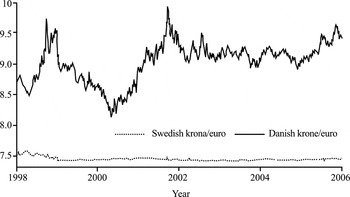
We begin with existing political-economic accounts. The outcomes of the referendums in Denmark and Sweden would have very different effects on monetary policy in these two countries. Denmark would keep a fixed exchange rate regime regardless of the outcome of the referendum, since it pegged the krone to the euro.3
Countries in the Exchange Rate Mechanism (ERM) II are allowed to let their currencies float within a band around a central parity. Although the allowable band is ± 15 percent, Denmark chooses to keep the krone within a narrower ± 2.25 percent range. That said, we must note that even if the purchasing power of the Danish currency does not change as a consequence of accession to the euro, control over who has monetary authority does. Whether this distinction captured the imagination of Danish voters is difficult to ascertain based on the survey data we have at our disposal.

Krone and krona: Exchange rate relative to euro
The choice between a floating and a fixed exchange rate regime has real consequences for both policymakers and their constituents. For Swedish policymakers, a floating exchange rate regime provides a degree of monetary policy autonomy—in that the interest rate is set by the Riksbank and not by the European Central Bank (ECB)—in an environment where capital markets are well integrated with the rest of Europe.4
It is important to note that we are talking about a limited amount of monetary discretion as the Riksbank has targeted a 2 percent rate of inflation, ± 1 percent, since 1995. The Riksbank, however, can change its inflation target; if authority is transferred to the ECB then that opportunity is lost.
The idea that voters would be influenced by their position within the international economy is hardly a new one. The literature on trade policy and rent seeking, for example, demonstrates that firms and interest groups will lobby and voters will vote in accordance with whether they are export-oriented or import-competing.5
Krueger 1974.
See Frieden 1991 and 1994. Optimal currency area (OCA) theory (for example, Mundell 1961) can be used to derive similar predictions. See Jonung 2004, for an application of OCA theory to the Swedish euro referendum.
Frieden's work (1991 and 1994) derives political implications not just based on the stability of the exchange rate regime but based on its level as well. As adopting the euro would not have dramatically changed the domestic value of the Swedish currency, we do not pursue that distinction here.
Scholars studying individual- and national-level attitudes toward the EU and the euro have examined the impact of these distributional concerns. Many find that individuals with high involvement in (or exposure to) international markets favor adoption of the euro when compared to those employed in the nontradable sector.8
See Scheve 1999; Gabel 2000; Kaltenthaler and Anderson 2001; Banducci, Karp, and Loedel 2003; and Gabel and Hix 2005.
This is not to say that an individual's exposure to international factors within the domestic economy solely determines his or her preferences regarding exchange rate policy. A number of scholars examining preferences over both the EU and the euro argue that public opinion reflects an underlying cost-benefit calculation that is based on broad notions of economic self-interest.9
See Eichenberg and Dalton 1993; Gärtner 1997; Gabel 1998; and Kaltenthaler and Anderson 2001. Gabel 2000 summarizes this literature.
Scheve 1999.
Gabel and Hix 2005.
In a recent survey of attitudes toward globalization, Hainmueller and Hiscox 2006 suggest that the effects of education do not reflect such utilitarian concerns, but rather exposure to ideas and information.
Banducci, Karp, and Loedel 2003.
“Community” and Multilevel Governance
A contrasting set of hypotheses argues that economic interests—whether conceived of in terms of international exposure or levels of human/financial capital—do not matter as much as attitudes toward the transfer of policymaking authority from the national to the supranational level—that is, questions of “community.” Studies in the vein of “multilevel governance” examine the extent to which issues of national identity impact attitudes toward the EU in general.14
See, generally, Hooghe and Marks 2000.
McLaren 2002.
Müller-Peters 1998.
Voters in Denmark and Sweden may also view their vote for or against the euro as a continuation of their support, or lack thereof, for the entire EU project. Space does not permit a review of the literature exploring attitudes toward the European integration in general and the EU in particular.18
See Hooghe and Marks 2005, for an excellent recent review.
Summary and Hypotheses
In view of this discussion, our primary challenge involves extending existing insights to the question of “voting for change,” that is, to our empirical terrain of referendum votes on the single European currency. This involves two key steps. First, it involves exploiting the unique opportunity posed by the Danish and Swedish referendums by applying insights from the political economy of trade and globalization to the question of exchange rate regimes and national currencies. Second, because we are working in the context of the EU, it involves disentangling attitudes toward the EU as a whole from attitudes regarding exchange rate regimes and/or the adoption of the euro as a currency. This has not yet been undertaken: studies of support for the euro—whether based on aggregate-level public opinion or on individual-level attitudes—often use feelings about the EU as a control variable, or ignore them entirely.20
Aggregate level studies of euro attitudes (for example, Kaltenthaler and Anderson 2001; and Anderson 2006) do not control for attitudes toward the EU. Individual level studies are mixed: Gabel 2000 does not control for attitudes toward the EU while Gabel and Hix 2005; and Banducci, Karp, and Loedel 2003 do.
The euro referendums in Denmark in 2000 and in Sweden in 2003 provide an unprecedented natural experiment within which to examine the politics of money. These referendums represent the only occasions known to us when questions of exchange rate policy and national currency were put to a direct democratic vote. In addition, the pair of cases offers a fruitful inferential profile. While the two countries are broadly similar in a number of political and economic respects, they vary in terms of the choice confronting their electorates. In Denmark, this was a choice not solely about exchange rate policy, at least de facto in the short run, but about national currency. We thus expect “community” attitudes to have played a larger role than political-economic calculation. In Sweden, both issues were at stake, and we anticipate that both calculation and community came into play. Before turning to our core analysis, we briefly summarize the background to and conduct of the euro referendum campaigns in Denmark (2000) and Sweden (2003).
Background to the Referendums
Denmark and Sweden have approached the EU in broadly similar ways.21
For a detailed analysis of “Nordic” approaches to the EU, see Ingebritsen 1998; and Hansen and Wæver 2001.
Hooghe and Marks 2005, 430.
Kaltenthaler and Anderson 2001, 161.
Neither country participated in the EU's Economic and Monetary Union (EMU) at its inception. Denmark obtained an open-ended “opt-out” from the single currency in the 1993 Maastricht Treaty, though it has continuously participated in the ERM of the European Monetary System (EMS), maintaining parity with the German Deutschmark since 1982 and then from, 1999, with the euro inside the narrow (±2.25 percent) band of the modified ERM II.24
For a general account of Denmark's approach to monetary union, see Iversen and Thygesen 1998; and Marcussen 2005.
For a general account of Sweden's approach to monetary union, see Moses 1998; and Miles 2005, chap. 6.
This mix of relations to EMU produced different political and economic stakes in the two countries. In Denmark, adoption of the euro would constitute a de jure change in Danish monetary governance (with nominal control transferred from the Nationalbank to the ECB) with little de facto consequence for monetary policy. Consequently, the question of adopting the euro in Denmark most clearly represented a choice about the name of the currency—whether to replace a stable currency called the krone with another currency named the euro—and about where and how it would be governed, but not about exchange rate policy per se. For Sweden, on the other hand, any ultimate decision about participation in the euro would represent a choice over both exchange rate policy and the name (and symbolism) of the currency.
By virtue of their absence from the initial euro-group, domestic political forces would come to play an increasingly important role in subsequent discussions regarding Danish and Swedish participation in the EMS. As circumstances changed, first the Danish government (in 2000) and then the Swedish government (in 2003) eventually sought to end their relative monetary isolation from the rest of the EU. Both directly consulted the electorate through a referendum on adoption of the single currency. Both referendum campaigns involved questions of political-economic calculation as well as political-symbolic community. Yet, because the mix of issues at stake varies across the pair of countries—only the currency question in Denmark, both exchange rate regime and currency in Sweden—we expect to see discernibly different patterns of determinants across the two referendums, with political economy factors, in particular, playing a larger role in Sweden than in Denmark. Our core analysis of these historic “votes for change” follows.
Empirical Analysis
Methodology
We confront two issues in our analysis of the votes in Denmark and Sweden. First, we evaluate whether issues related to calculation and community influenced individuals voting in these referendums. A simple and straightforward approach would be to estimate a logit26
For the sake of exposition we ignore the detail surrounding the development of the logit model. See Greene 2003, for a discussion.

where (and ignoring subscripts denoting individuals) Y reflects whether an individual voted “yes” or “no” on the euro referendums, C and I refer to sets of variables measuring calculation and community attributes respectively, and X is a set of control variables. We use e to denote an error term that follows the logistic distribution and, most importantly, is uncorrelated with the factors contained in C, I, and X.
Many studies of individual attitudes toward the euro include a variable that captures an individual's attitude toward the EU as a whole.27
This variable is either included as a control for general—and otherwise unmeasured—attitudes toward the EU or is a variable of theoretical interest. This approach, while not generally problematic, is inappropriate for our purposes. To be concrete we rewrite equation (1) and add a variable denoting preferences toward the EU:
In both referendums individuals were asked whether they supported the adoption of the euro. A vote in favor of the referendum in Sweden would result in a new exchange rate regime while in Denmark it would not. Since we are interested in whether individual votes reflected concerns over exchange rate policy (for example, calculation concerns) or over national sovereignty and identity (for example, community concerns), the inclusion of the EU term on the right-hand side of equation (2) raises issues. In our view, attitudes toward the EU are at best a function of the variables included in C, I, and X, and at worst are endogenous with respect to the attitudes that are correlated with votes on the referendums yet are not included as independent variables.
Excluding the EU term from equation (2) is not an option as that would lead to problems of omitted variables which, in turn, would cause the estimated parameters to be biased. Estimating equation (2) via instrumental variables is feasible in principle but not in practice, because the paucity of questions in both the Danish and Swedish surveys makes it difficult to find appropriate instruments. All of the variables we consider below are plausible in principle but do not satisfy the exclusion restriction; that is, they belong in the set of C, I, and X variables.
Our solution, and one that satisfies our general theoretical interest in separating attitudes toward the euro from attitudes regarding the EU, is to create a dependent variable that captures four possible preferences, as indicated in Table 1.
Scheme of attitudes toward the EU and the euro

Consider first the cell labeled “unilateralist sentiment.” Individuals falling into this cell both express a desire for their country to resign from the EU and vote against adoption of the euro. By contrast, individuals who want their countries to remain in the EU and also vote “yes” on the referendums we categorize as having “integrationist sentiment” to capture the idea that they want to further embed their country within the EU.
The cases on the other diagonal are perhaps the most interesting. The “status quo” cell reflects the situation before—and, as it happened, after—the referendums in Denmark and Sweden. In this situation individuals prefer that their country remain a member of the EU yet maintain an independent currency. We refer to the set of preferences in the last cell as “unilateral euroization” to capture the idea that individuals here prefer that their country leave the EU yet replace their national currency with the euro.
Because we are interested in the effect of different independent variables on the probability that an individual will fall into the different cells in Table 1 we use a multinomial logit statistical model. Multinomial logit allows for the analysis of unordered choices (in our case four mutually exclusive and exhaustive choices) and provides a framework within which an independent variable can have a different impact (different parameter estimate and associated standard error) across the choices. Since we have four possible choices we report the results from our multinomial logit model for the outcomes unilateralist sentiment, unilateral euroization, and integrationist sentiment. This means that the coefficients for each of these categories are interpreted with reference to the omitted or baseline category, in this case, the status quo outcome. One further note: to facilitate comparison of coefficients across outcomes we report 95 percent confidence intervals (based on robust standard errors) for each parameter estimate rather than traditional standard errors.28
We do not report marginal effects because we do not have specific hypotheses or expectations with regard to the magnitude of the effects we would observe. We did, however, calculate them to see if the confidence intervals for the marginal effects resulted in substantively different conclusions from those that we report. They did not.
In the next section we discuss the data, variables, and results from our statistical analysis of the Danish and Swedish referendums. Our general expectation is that variables related to calculation and community concerns will both loom large in the Swedish referendum, as that was a choice over both the name and the value/variability of the currency. In the Danish case we only expect community related values to have a statistically significant effect. We now turn to the analysis of these two referendums.
The Danish Referendum (2000)
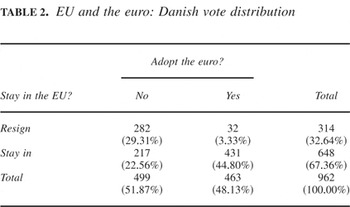
For the Danish referendum, we use interview-based survey data of 1,000 individuals conducted after the vote by the Danish Data Archive (DDA) in October 2000. The DDA survey asked with regard to the euro-referendum, “How did you vote in the referendum?” Of the 1,000 individuals interviewed, 463 (46.3 percent) answered “yes,” 499 (49.9 percent) answered “no,” and the remaining 38 (3.8 percent) responded either “didn't vote,” “didn't have the right to vote,” or “don't want to answer.” The DDA survey also asked “If you should vote today if Denmark should leave the EU would you vote for or against [that proposition]?” To this question 208 (20.8 percent) answered “for,” 668 (66.8 percent) answered “against,” and 124 (12.4 percent) had no opinion.29
Putting the “no opinion” respondents with the “resign” respondents provides a more conservative statistical test than omitting them from the sample altogether. If we drop these respondents the empirical results we report below do not change in terms of sign and significance; the magnitudes change only slightly.
EU and the euro: Danish vote distribution

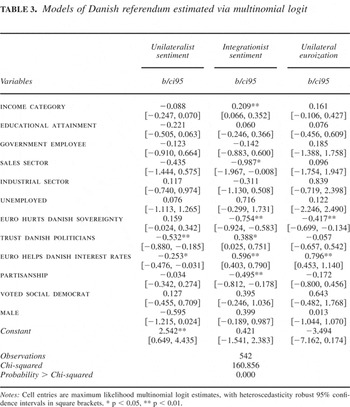
Multinomial logit results for the Danish referendum are reported for three models in Table 3. Our fundamental interest is in the column headed “integrationist sentiment,” as this corresponds to voting yes on the referendum and expressing a preference for remaining in the EU. The status quo situation—remaining in the EU without the euro—is the omitted category.
Models of Danish referendum estimated via multinomial logit

Beginning with calculation concerns, recall that voters in Denmark were not casting ballots based primarily on preferences over the flexibility of the exchange rate regime but rather were deciding whether to abandon a key symbol of national sovereignty and identity, the krone. Consequently we anticipate that political economy factors should not have loomed large in the minds of Danish voters. Unfortunately, the DDA survey did not ask specific questions regarding whether individuals are employed in export- or in import-competing industries. It did, however, ask about the individual's sector of employment and it did record information that can be used to indicate human capital.
We use two measures of an individual's human capital: one measuring income (the question asks for gross household income in eight ascending categories) and one measuring education (the question asks about years of education, again in ascending order). Prior research has found that individuals with higher levels of human capital will be more likely to support the EU and will likely express a preference for European monetary integration.30
See Scheve 1999; and Gabel and Hix 2005. Recent work on the determinants of attitudes toward international trade also finds that individuals with higher levels of income and education tend to be more inclined to support open markets. See Hainmueller and Hiscox 2006, for a review and discussion.
Our second measure of human capital, educational attainment, does not achieve statistical significance in the model. One possibility, of course, is that because education is correlated with income we might not be able to accurately estimate parameters for both variables. To investigate this possibility we estimated alternative models, one with just education and one with just income. In neither case did we obtain results substantively—or significantly—different from those reported in Table 3.
Danish voters were also asked about the nature of their employment. As mentioned above, the DDA survey did not ask specific questions that can be used to ascertain whether individuals are directly involved in international production and investment. It did, however, record information about one's sector of employment. We include dummy variables indicating whether someone is employed in the government, sales, or industrial sector or whether they are unemployed. Retired individuals (though the survey did not ask what sector they had been employed in) serve as the reference category.
The use of mutually exclusive and exhaustive categories is useful for allowing us to test a variety of hypotheses regarding occupational sector and EU/euro attitudes. Consider first the outcome unilateralist sentiment. There is no statistically significant difference across occupations when it comes to preferences toward the EU: none of the occupation variables in this column are statistically different from the omitted category (retired individual) or from each other (based on the reported confidence intervals). The same can be said of the column for unilateral euroization. The only variable that is statistically significant is the dummy coded 1 for individuals employed in the sales sector: as compared to retirees, these individuals prefer to remain in the EU with the krone (the omitted category) rather than remaining in the EU with the euro. Individuals in the sales sector, however, are no different in their attitudes toward the euro than individuals employed in other sectors. The confidence interval on the parameter estimate for sales is large enough to include the parameter estimates for the other occupational categories.
The DDA survey also asked a few questions to get at feelings of community.
- Membership in the euro will substantially threaten Danish sovereignty? (higher values = agreement).
- Adoption of the euro will help Danish interest rates? (higher values = agreement).
- How much do you trust Danish politicians? (higher values = more trust).
Consider first the issue of Danish sovereignty. Individuals who intensely agree with the question that adoption of the euro will threaten Danish sovereignty are more likely to vote “no” on the euro (the confidence intervals for each category allow us to reject the null that the parameter estimates are identical). They are also likely to express a preference against continued membership in the EU (again, we note that the confidence interval for the estimate in the unilateral euroization category allows us to reject the null hypothesis that attitudes regarding unilateral euroization and integrationist sentiment are identical). This finding is not that surprising: if an individual feels that the euro threatens sovereignty they will be opposed to its adoption. What is the most interesting is that opposition to the euro is not the same as opposition to the EU. The parameter estimates in these columns are statistically different from one another suggesting that just because one is opposed to the euro for nationalistic/identity reasons, it does not mean that he or she is opposed to EU membership altogether.
We also include a question that points to a critical difference between the ERM II and adoption of the euro: the issue of interest rates. While the consideration of interest rates is nominally a calculation/political economy concern we treat it as an issue related to national sovereignty and the strength of the national economy. We do so because the question is vague in the sense that we do not know if individuals are thinking about the level or the volatility of interest rates when they were asked whether they thought that adoption of the euro would help Danish interest rates. Given that membership in the ERM II and adoption of the euro are not markedly different in terms of exchange rate behavior, this question gets at an individual's views of the monetary policy carried out by the Danish monetary authority. We find individuals who believe that adopting the euro would help interest rates to be inclined to vote “yes” on the referendum. There is also clear separation of attitudes toward the euro and the EU; while concerns over interest rates have a positive impact on both variables there is a clear and statistically significant difference across these equations.
Finally, we include a measure that examines the extent to which Danish voters trust politicians because one can interpret the referendum on the euro as an explicit vote of confidence in the party (the Social Democrats) in power at the time of the referendum. Individuals with a high degree of trust in politicians support membership in the EU and voted “yes,” while those that do not trust politicians voted “no” and desire that Denmark would resign from the EU.
Taken as a whole, the Danish referendum provides general support for the argument that voters cast their ballots in line with their attitudes toward “community” issues such as national sovereignty and identity. Economic calculus considerations—with the exception of income level—did not condition these votes for (or against) change. Individuals who believed that the euro impinges on Danish sovereignty and who did not trust politicians were inclined to vote “no.” Interestingly, at least from the point of view of exchange rate politics, those who believed that the euro would “strengthen interest rates” voted “yes” on the euro in spite of the fact it would likely not have an impact on foreign exchange behavior, yet would transfer monetary authority from Copenhagen to Frankfurt.
The Swedish Referendum (2003)
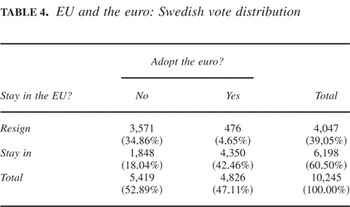
In analyzing the Swedish referendum we draw on an exit poll carried out by Sveriges Television (SVT) in collaboration with the University of Gothenburg and the Royal Institute of Technology, Stockholm. This exit poll, called Valu, polled 10,731 individuals outside of eighty polling places across Sweden. While not a perfect instrument with which to distinguish attitudes regarding the EU and the euro, the Valu poll did ask two key questions relevant to our dependent variables. First, they asked “How did you vote in the Euro referendum today?” Forty-six percent of those polled answered “yes” and 52 percent answered “no,” numbers in line with the aggregate national outcome. The poll also asked “Do you think that Sweden should resign from the EU or stay in the Union?” To this question 60 percent answered “stay in,” 24 percent answered “resign,” and the remaining 16 percent had no opinion. We summarize these outcomes in Table 4.
EU and the euro: Swedish vote distribution

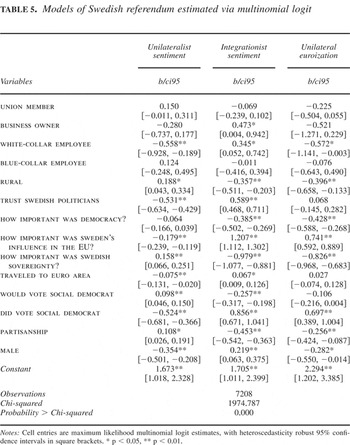
Table 5 contains the results of our three multinomial models based on the Valu exit polls. As with the Danish case we separate the variables into those that reflect calculation and those that capture community. Unfortunately the SVT survey did not ask questions about income and education; rather, the poll recorded characteristics related to union membership, employment class (owner or employee), and rural hometown.
Models of Swedish referendum estimated via multinomial logit

Economic calculus considerations derived from employment status are captured in several variables. A dummy variable indicating union membership is not statistically significant either in terms of separation across the columns or when we examine the individual cell entries.31
This is reflected in the fact that the unions were not of a single mind when it came to the referendum. When we separated out each individual union (LO, TCO, and SACO), we still did not find a statistically significant impact.
Additional support for the argument that individuals involved in export oriented or financial sectors would support a fixed exchange rate regime, and hence would vote for the euro, comes from a dummy capturing the urban-rural divide. Individuals living in rural (and likely nonexport-oriented) areas are more likely to vote “no” on the referendum and, overall, are opposed to Swedish membership in the EU.
Like the DDA survey, the Valu exit poll contains questions probing an individual's attitudes toward “community” (multilevel governance) and national issues. We tap three questions to get at these factors:
- How important was democracy in influencing your vote? (higher = more important)
- How important was it that Sweden be influential in the EU? (higher = more important)
- How important was Swedish sovereignty? (higher = more important).
With the exception of the impact of democracy on the probability that an individual votes “no” on the euro and answers that Sweden should resign from the EU, all of the marginal effects for these three questions are statistically significant at the 95 percent level.
As a control variable we include a question that captures the extent to which individuals generally trust Swedish politicians. With regard to trust in politicians we find, as we did in the Danish case, that individuals with high levels of trust are most likely both to support Swedish membership in the EU and vote in favor of euro adoption. Similarly, individuals that believe that the EU undermines Swedish democracy were more likely to vote “no” on the referendum though we cannot distinguish between those “no” voters who want to resign from and those who want to remain in the EU. A similar pattern arises with regard to the question of the importance of Swedish sovereignty. In this case, however, individuals who believe that Swedish sovereignty is very important are most likely to argue for a Swedish resignation from the EU and to vote “no” on the euro. This impact, unlike the previous one, is different from both other possibilities and demonstrates that “community” concerns play critical roles in votes on the euro.
While this does suggest that sovereignty issues are important, nationalist considerations also played an important role in voting decisions in the Swedish euro referendum. The Valu exit poll asked “how important was it that Sweden be influential in the EU?” Individuals who place a high value on Swedish influence were most likely to support Swedish membership in the EU and to vote “yes” on the referendum and were least likely to support a policy where Sweden would leave the EU.
The Swedish referendum, then, shows that voters cast their ballots based on both “calculation” of political economic benefits and losses and on “community” considerations. Individuals whose employment profile places them in internationally oriented sectors are more likely to favor Sweden's adoption of the euro as it decreases transactions costs and increases exchange rate stability, characteristics that would result in higher returns for these individuals. Nationalistic/ideational considerations are also important: individuals concerned with Swedish sovereignty and democracy are less likely to vote for the euro even though they might still support Swedish membership in the EU.
Conclusions
The literature on the political economy of exchange rate arrangements has developed tremendously during the past decade. We contribute to this growing literature by analyzing the determinants of individual-level preferences in the euro referendums in Denmark (2000) and Sweden (2003). The comparison of these two cases is informative: in Denmark adoption of the euro would substitute one fixed exchange rate arrangement—the krone—for another—the euro. The Swedish referendum, on the other hand, was not just a vote about substituting the euro for the krona; it was also a vote to switch from a floating to a fixed exchange rate. In either case voting “yes” would further integrate these two countries into the political, social, and economic nexus of the EU.
We find support for the idea that the outcomes of these referendums hinged on different considerations of calculation and community and we offer a modest critique of existing scholarship on attitudes toward the euro. Individuals in both countries like that their countries are members of the EU yet do not want to take the step of adopting the single currency. Separating these attitudes, and identifying their behavioral determinants, represents an especially pressing problem in view of an eventual euro referendum in Poland and, possibly, in other aspiring member states.32
Mark Beunderman. Poland to hold euro referendum. euobserver.com, 25 October 2005. Available at 〈http://euobserver.com/?aid=2017>2〉, accessed 19 June 2007.
In addition, this study raises a number of issues surrounding the behavioral and democratic contours of the politics of money that should inform future research. A first involves the question of democratic involvement in monetary politics. While alleged trade-offs of expertise and control have been widely debated in the literature on central bank independence, we know much less about the democratic contours and implications of exchange rate regimes and currency choices themselves. A second issue involves the nature of money. Our results support the view that, far from a “mere” pocketbook issue, money centrally involves questions of meaning and identity. Widely asserted in the constructivist literature, this observation should lead to further work assessing the relative importance of calculation and community in monetary politics, to say nothing of broader types of “change” at stake in the international political economy.